Published: November 2025 | Last updated: May 2026 | Editorial review and quality control: Martina N.
The hours and days right after a herpes diagnosis can feel surreal. Shame, anger, fear of what comes next, fear of telling anyone, fear that intimacy is somehow over. None of those feelings are unreasonable, and none of them are permanent. Herpes is one of the most common viral infections on the planet, and the gap between how stigmatized it feels and how clinically routine it actually is may be the most important thing to understand in the first few weeks.
This article covers what to expect emotionally in the early weeks after diagnosis, what current public-health data say about transmission and treatment, how to talk to partners with confidence, and the daily habits that quiet anxiety over time. It is written for people who just got news they are still processing, and for partners and friends who want to support them well.
Key Takeaways
- Roughly one in six U.S. adults aged 14 to 49 carries HSV-2, per CDC NHANES surveillance, and about two thirds of adults under 50 globally carry HSV-1, per WHO data. You are very far from alone.
- Daily suppressive antiviral therapy reduces herpes recurrences by 70 to 80 percent in people with frequent outbreaks and lowers transmission risk to partners by roughly half when paired with condom use.
What the first weeks after a herpes diagnosis really feel like
The emotional arc after a positive herpes test follows a familiar shape, even though specifics differ from person to person. Most people move through three or four phases that loosely map onto how psychologists describe adjustment to any chronic but manageable health diagnosis. Knowing the shape of the arc helps when you are inside it.
The first phase is disbelief and re-checking. You re-read the result, call the clinic, look up the test method, and wonder whether the lab made a mistake. This is normal and usually brief.
The second phase is grief, in the same shape grief takes in any other context. You are mourning a version of your sexual and romantic life that you imagined was a certain way. The mourning is real even when the reality you are now in is not nearly as different as it feels in week one.
The third phase is disclosure fear: how do you tell a current partner, how do you handle the conversation with future partners, what happens the first time you say it out loud. These fears are intensified by a stigma that has very little to do with the actual medical picture and a lot to do with cultural messaging about sexual health.
The fourth phase is a slower stabilization. You start to live with the diagnosis as a fact about your body rather than a verdict about your worth. The American Sexual Health Association notes that emotional adjustment typically takes weeks to a few months and follows the same arc as adjusting to any chronic but manageable condition (ASHA herpes resources).
What helps during this window:
- Limit your research time to a defined window each day. The herpes corner of the internet has many high-quality resources and a long tail of worst-case stories. Pick reliable sources (CDC, WHO, NHS, ASHA) and step away when your time is up.
- Tell one person you trust. Not a partner conversation yet; just one friend, family member, or therapist. Saying it out loud once usually moves something internally.
- Avoid making large life decisions about relationships, dating, or career in the first two to three weeks. Your nervous system is in shock; the diagnosis itself is not asking you to change much.

How common herpes actually is, in numbers
The single most useful reframing in the first weeks after diagnosis is a clear sense of how prevalent herpes really is. Stigma thrives in the absence of numbers.
CDC analyses of National Health and Nutrition Examination Survey (NHANES) data estimate HSV-2 seroprevalence at roughly 11 to 12 percent of U.S. adults aged 14 to 49, often summarized as about one in six in that age band. The figure varies substantially by age, sex, and region. The CDC also reports several hundred thousand new genital herpes infections each year in U.S. surveillance data.
The global picture is similar in scale. The World Health Organization estimates that roughly 3.8 billion people under age 50 (about 64 percent of that group) carry HSV-1, and that around 520 million people aged 15 to 49 carry HSV-2 (WHO herpes simplex virus fact sheet). HSV-1 most commonly causes oral cold sores but increasingly causes a meaningful share of new genital herpes cases through oral-genital contact.
A few things follow from these numbers. You are statistically very far from alone: in any room of twenty adults under 50, an average of two or three carry HSV-2 and roughly thirteen carry HSV-1, with most unaware of their status. Most carriers are asymptomatic; the CDC and WHO both note that the majority of people with HSV either have no symptoms or have symptoms so mild they are mistaken for something else, such as a small abrasion, an ingrown hair, or a minor yeast infection. And herpes is not a serious health threat for most adults outside of specific contexts (immunocompromise, neonatal exposure, very rare central nervous system involvement); HSV causes localized outbreaks that may be uncomfortable but do not damage internal organs, do not affect fertility, and do not shorten life expectancy. The biggest impact for most people is psychological, which is what this article is built around.
Most people with HSV infection are unaware that they are infected.
How to tell a partner you have herpes
The herpes disclosure conversation is one of the most feared moments of the diagnosis and one of the most consistently overrated in how badly it goes. Multiple peer-reviewed studies on STI disclosure show that supportive responses from partners are the norm when the conversation is handled calmly, and that disclosure is associated with stronger trust in the relationship over time.
A few practical points hold up across the research:
Pick the moment carefully. Disclosure works best before sexual intimacy, in a low-stress setting, with enough time for the partner to ask questions. Do not disclose in the middle of an intimate moment, do not disclose by text in a first conversation, and do not wait so long that disclosure feels like a betrayal.
Lead with calm facts, not apologies. A useful template: "There is something I want to share before we get more physically intimate. I have herpes. About one in six adults in our age range does. It is manageable, I am (or am not) on suppressive medication, transmission risk is reduced by these specific steps, and I am happy to answer any questions you have." That tone signals you have the information you need and that the diagnosis is not an emergency.
Anticipate the most common reactions. Many partners need a moment to process, ask a few questions, and then respond. Some need to look things up before answering. A small percentage respond negatively. That last category is a filtering signal rather than a reflection of your worth: partners who cannot calmly process common health information are unlikely to be reliable on harder topics.
Know the transmission numbers before the conversation. With no precautions, the annualized rate of HSV-2 transmission in heterosexual couples (positive partner to negative partner) is roughly 10 percent per year, dropping substantially with daily suppressive antiviral therapy, consistent condom use, and avoiding sex during prodrome or active outbreak (CDC STI Treatment Guidelines: genital herpes). With all three precautions combined, transmission rates drop to a few percent per year.
What you are asking your partner to engage with is the same level of risk management already implicit in any sexually active life.
"Before we get more physically intimate, I want to share something. I have HSV (oral / genital). It is the same virus that causes cold sores, and about one in six adults our age has it. I am on (daily / episodic) antivirals, I avoid sex during outbreaks, and I am happy to talk through what this means for us. Take whatever time you need."
Calm, factual, brief. Most partners respond well to that exact shape.
Building a support system that actually helps
The strongest predictor of how well someone adjusts emotionally to a herpes diagnosis is not the severity of symptoms or even the type of HSV involved. It is the quality of the support system they have in place. People with at least one trusted confidant and access to a vetted information source typically stabilize within a few months. People in social isolation often take longer.
A few categories of support, ordered by typical impact:
Peer support communities. Moderated online communities for people with HSV (the ASHA forum, long-running Reddit communities, and dedicated apps) are the single most-cited resource by people who have been through this process. The value is not advice on medical questions, which should come from a clinician. The value is hearing from people who carry the same diagnosis and are doing well. That experience is what stigma quietly hides from view.
A therapist or counselor. Cognitive behavioral therapy (CBT) has the strongest evidence base for anxiety, intrusive thoughts, and self-image distortions following a sexual-health diagnosis. A therapist does not have to be an STI specialist, though some are. What matters is having a regular space to process the diagnosis without performing okayness for friends.
A trusted person in your real life. One person, not your entire social circle. The point is not to broadcast; it is to have a person who knows the situation and can sit with you when a recurrence or a difficult conversation lands.
A clinician you trust. The clinician who delivered the diagnosis is sometimes not the right long-term partner for managing it. Look for a primary care doctor, sexual-health clinic, or infectious-disease specialist who treats herpes patients regularly and is comfortable discussing suppressive therapy, partner notification, and pregnancy considerations without judgment.
What rarely helps in the first three months: telling acquaintances you do not trust, posting publicly about the diagnosis before you have processed it, and reading high-volume social platforms that mix supportive content with worst-case stories. The signal-to-noise ratio in those spaces is too low when you are still raw.

Daily coping, antivirals, and what moves the needle
After the first month or two, most of the day-to-day work of living with herpes is unspectacular: small habits and clinical choices that quietly reduce outbreak frequency and the mental load around the diagnosis.
Antiviral medication makes the biggest measurable difference. Three antiviral drugs are FDA-approved for genital herpes management: acyclovir, valacyclovir, and famciclovir. They come in two modes. Episodic therapy is taken at the first sign of an outbreak and shortens the duration and severity of the episode. Suppressive therapy is taken daily and reduces the frequency of recurrences by 70 to 80 percent in people with six or more outbreaks per year, per CDC treatment guidelines (CDC STI Treatment Guidelines). Daily suppressive therapy also reduces the rate of asymptomatic viral shedding, which is what cuts transmission risk to partners by roughly half in clinical trials.
Sleep, stress, and immune health. Stress and physical illness are recognized triggers for herpes recurrences per the NHS genital herpes overview (NHS genital herpes). Sleep deprivation and sustained physical or emotional load are also commonly reported triggers in clinical practice, since each suppresses immune function. Eight hours of sleep, regular moderate exercise, and a meditation or breathing practice during high-stress periods have measurable downstream effects on outbreak frequency.
Sun and friction triggers (for HSV-1). For people whose primary outbreaks are oral cold sores, ultraviolet exposure and physical friction (lip injury, dental work) are the strongest reported triggers. SPF lip balm and conservative oral care during high-risk periods make a measurable difference.
Knowing your prodrome. Most people with recurring outbreaks experience a prodrome warning phase 12 to 24 hours before a visible lesion appears: localized tingling, itching, or aching. Catching the prodrome and starting episodic antivirals at that moment shortens many outbreaks to a single day or prevents the visible lesion entirely.
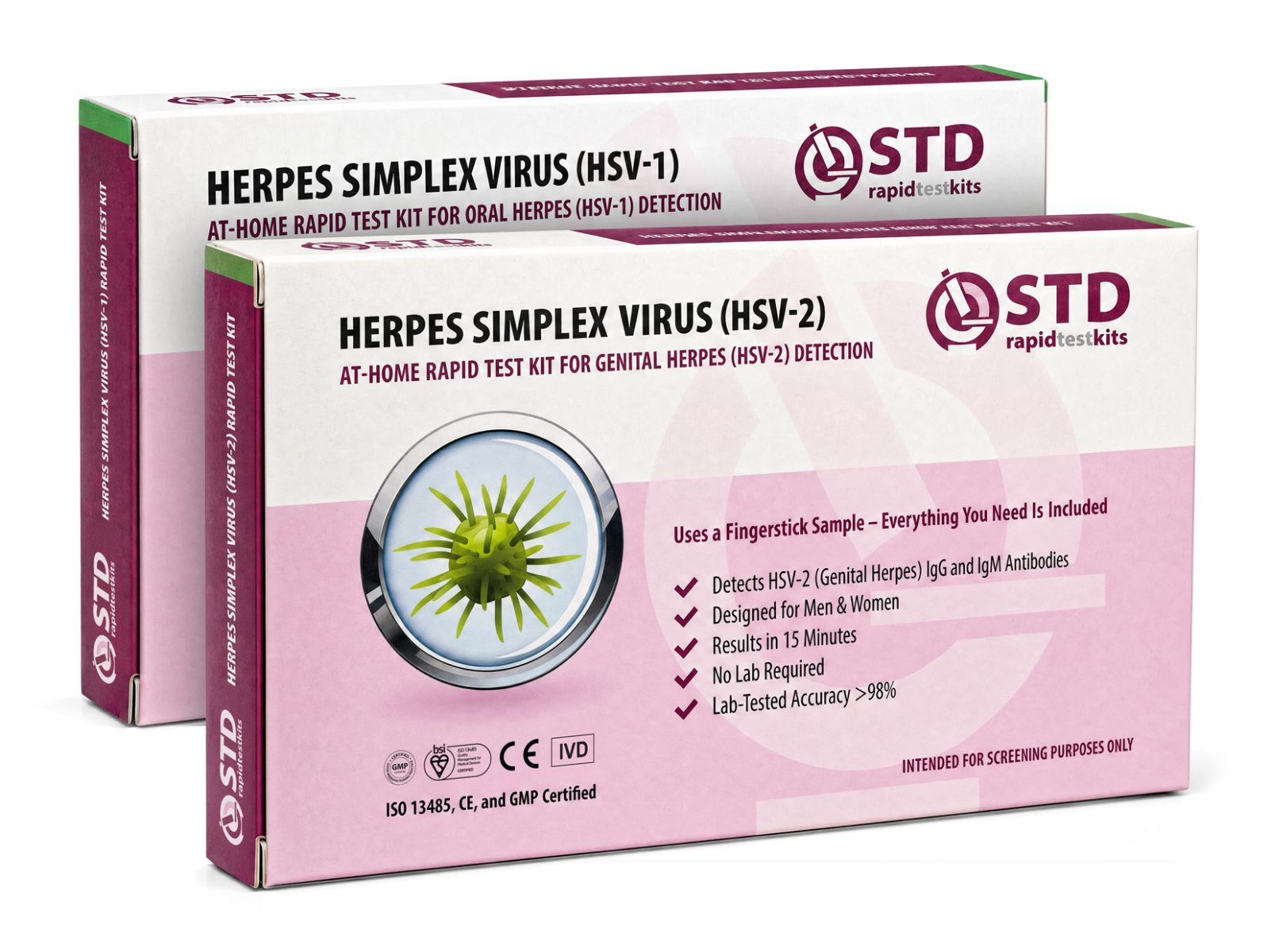
A reliable testing routine for general STI health. A herpes diagnosis is not a reason to over-test. It is a reason to have an established, calm pattern for general sexual-health checkups. For partners who want to know their own herpes status without going to a clinic, at-home rapid antibody tests offer a private first step.
This article is published by stdrapidtestkits.com, which sells at-home STI testing kits. We recommend products based on fit for the reader's situation, not commercial benefit. The clinical guidance above draws from CDC, WHO, NHS, and ASHA materials and is not a substitute for evaluation by a licensed clinician.
Recognizing and managing outbreaks
Knowing what a herpes outbreak actually looks like, and how it differs from look-alikes, removes a layer of low-grade anxiety from daily life.
A typical recurrent outbreak follows a four-phase pattern:
- Prodrome (12 to 24 hours): localized tingling, itching, or burning at the site where lesions tend to appear.
- Blister phase (1 to 2 days): small clear or cloudy fluid-filled blisters, usually clustered, often painful or tender.
- Ulcer phase (2 to 4 days): the blisters break open into shallow ulcers, which is the most contagious phase.
- Crust and healing phase (4 to 10 days): the ulcers crust over and heal without scarring in most cases.
A first ("primary") outbreak is often more severe and longer: lesions may be widespread, accompanied by flu-like symptoms, swollen lymph nodes, and significant pain. By the second or third outbreak the body has built specific immunity and recurrences are typically milder, shorter, and less frequent. Most people see outbreak frequency decrease over time, often substantially by the second or third year after diagnosis (NHS genital herpes).
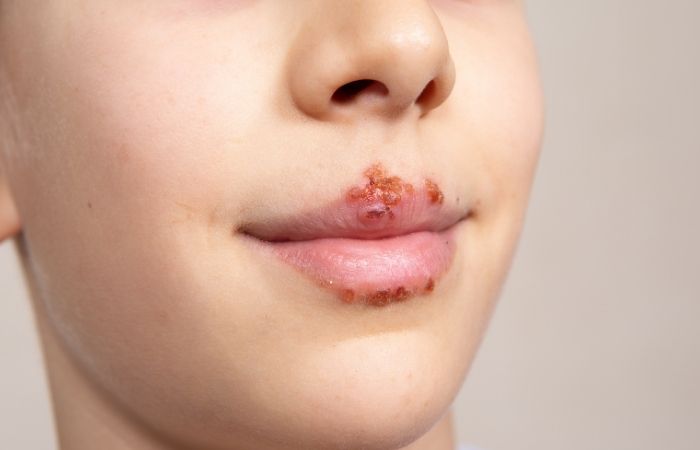
For oral herpes (HSV-1 or HSV-2), lesions appear on or near the lips, in or around the mouth, or on the chin. They are commonly mistaken for canker sores, fever blisters from another cause, dry chapped lips, or contact dermatitis. The classic clustered-blister-then-crust pattern is the most reliable visual signature.
Look-alikes worth knowing:
- Canker sores (aphthous ulcers) appear inside the mouth on soft tissue, are not preceded by blisters, and are not caused by HSV.
- Angular cheilitis (cracks at the corners of the mouth) is usually fungal or bacterial.
- Folliculitis on the genital area can present as small clustered bumps but lacks the prodrome and ulcer phase.
If a lesion does not look or behave like a typical herpes outbreak, see a clinician. Direct PCR or culture of a swabbed lesion is the most reliable way to confirm an active outbreak; blood antibody tests answer a different question (past exposure rather than the cause of a present lesion).
The long view: relationships, mental health, identity
A useful rule of thumb from the herpes adjustment literature: the impact of a herpes diagnosis on quality of life is highest in the first six months and declines steadily after that. By two years post-diagnosis, most people report that herpes has minimal effect on their daily life, sexual satisfaction, or relationship quality. The diagnosis becomes a fact about the body, in the same category as any other manageable health condition.
A few things tend to be true at the long-term horizon.
Most people with HSV form satisfying long-term relationships, including with HSV-negative partners. Disclosure becomes a routine conversation rather than a crisis.
The mental-health effect of the diagnosis is concentrated early. Studies of HSV-positive adults consistently show no long-term elevation in depression or anxiety once the adjustment period passes, especially with adequate support.
Self-image recovery is largely a function of exposure to other people living well with HSV. The single most reliable intervention is access to a community of people who have been through this and are doing fine.
For some, the experience becomes a meaningful piece of their broader story: a reason to learn more about sexual health, to advocate for destigmatization, or to become a resource for friends in the same position. None of that is required.
By two years post-diagnosis, most people with HSV report minimal impact on daily life, sexual satisfaction, or relationship quality. The steepest rate of psychological adjustment happens in the first six months, which is the window when access to peer support and accurate information matters most.
Frequently asked questions
- Will I be able to have a romantic and sexual life after a herpes diagnosis?
- Yes. Decades of research and clinical experience show that most people with herpes form satisfying relationships, including with partners who do not have HSV. Disclosure, daily suppressive antivirals when needed, consistent condom use, and avoiding sex during outbreaks reduce transmission risk substantially. Many couples are HSV-discordant for years without transmission.
- How do I tell a new partner that I have herpes?
- Pick a private, low-pressure setting before sexual intimacy. Lead with calm facts: how common HSV is, how transmission risk is managed, and that you are happy to answer questions. Avoid disclosing during an intimate moment or by text in a first conversation. Most partners respond supportively; the few who do not are filtering themselves out.
- How likely am I to transmit herpes to a partner?
- With daily suppressive antivirals, consistent condom use, and avoiding sex during prodrome or active outbreak, the annual transmission rate for HSV-2 in heterosexual couples typically drops to low single digits per year. Your clinician can estimate your specific risk based on HSV type, which partner is positive, sex of each partner, and how often outbreaks occur.
- Does daily antiviral medication actually work?
- Most people on daily suppressive therapy have significantly fewer outbreaks and a meaningfully reduced risk of passing the virus to partners. Your clinician can help you decide between daily suppressive therapy and episodic (as-needed) therapy based on how often your outbreaks occur and how disruptive they are.
- Will herpes affect my fertility or a future pregnancy?
- Herpes does not impair fertility in men or women. During pregnancy, the main concern is neonatal HSV, a rare but serious infection that can occur if a baby is exposed to active genital lesions during delivery. Obstetric management (suppressive antivirals in late pregnancy, cesarean delivery if active lesions are present at labor) reduces this risk to very low levels. Tell your obstetric provider early in pregnancy.
- Can stress trigger an outbreak?
- Yes. Physical and psychological stress, sleep deprivation, illness, ultraviolet exposure, and physical friction at the lesion site are commonly reported triggers. Identifying your personal triggers and managing them is a meaningful piece of long-term outbreak control.
- How long does an outbreak typically last?
- A first ("primary") outbreak can last 2 to 4 weeks if untreated. Recurrences are usually shorter, often 5 to 10 days, and become less frequent over time. Starting antivirals at the first sign of prodrome can shorten an episode by several days or prevent visible lesions entirely.
- Are at-home rapid herpes tests reliable?
- At-home rapid blood antibody tests detect HSV-1 or HSV-2 antibodies, which indicate past exposure to the virus. They are useful for confirming HSV status when a clinic visit is inconvenient. Antibody tests do not identify the cause of a specific active lesion; for that, a clinician's swab with lab PCR is more direct. Antibody seroconversion takes about 12 weeks after exposure, so testing too soon after a possible exposure may miss a recent infection.
Where to start this week
If you received a diagnosis in the last few days, the most useful work is small and concrete. Tell one person you trust. It does not have to be a partner; a friend, a family member, or a therapist all work. Saying it out loud once usually moves something internally that scrolling alone will not.
Then book one appointment with a clinician who treats herpes regularly. Bring written questions about suppressive therapy, transmission risk in your specific situation, and how outbreaks tend to evolve over the first year. A clinician familiar with HSV will treat this as routine, which is often the single most reassuring part of the early weeks.
Keep your research anchored to a small set of authoritative sources (CDC, WHO, NHS, ASHA) for the first few weeks. Open-ended doomscrolling mixes high-quality material with worst-case stories at a signal-to-noise ratio that does not serve you while you are still raw.
The diagnosis you received this week is not the diagnosis you will be living with in six months. Adjustment takes weeks to a few months for most people, and by the second year, most report that herpes has minimal effect on daily life.
- Tell one trusted person you do not have to perform okayness for.
- Book one appointment with a clinician familiar with HSV.
- Keep research anchored to CDC, WHO, NHS, and ASHA for the first few weeks.
- U.S. Centers for Disease Control and Prevention. STI Treatment Guidelines, genital herpes section. Daily suppressive antiviral therapy reduces recurrence frequency by 70 to 80 percent in patients with frequent recurrences and reduces transmission risk to partners.
- World Health Organization. Herpes simplex virus fact sheet. Global prevalence estimates for HSV-1 (about 3.8 billion people under 50) and HSV-2 (about 520 million people aged 15 to 49), plus management overview.
- National Health Service (UK). Genital herpes overview: symptoms, common triggers for recurrence (including stress and illness), antiviral treatment, and pregnancy considerations.
- American Sexual Health Association. Herpes resources: emotional adjustment after diagnosis, disclosure guidance, and peer support information.
