
Published: September 2025 | Last updated: May 2026 | Editorial review and quality control: Martina N.
A positive test for herpes or chlamydia can feel like an ending. The reality is far less dramatic. Chlamydia is a bacterial infection that antibiotics clear in days. Herpes stays in the body, but daily antivirals plus a small amount of planning bring transmission risk down sharply. Either way, sex is still on the table. What changes is the conversation you have before it.
This guide walks through the medical timelines, the science behind protection, and the disclosure scripts people actually use. It is written for the majority of readers who mostly need reassurance, and the smaller share who need a concrete plan for the next few weeks.
Key Takeaways
- Chlamydia is curable with antibiotics; the CDC recommends waiting seven full days after the start of treatment before resuming sex.
- Herpes stays in the body, but daily antiviral therapy plus condoms substantially reduce HSV-2 transmission to an uninfected partner.
Where the Story Usually Begins
It can start as an itch that will not settle, a burn while peeing, or a bump you noticed in the shower and spent the next four days searching online about. For a lot of people there is no symptom at all, only a text from a former partner saying you should probably get tested.
Chlamydia often arrives quietly. Subtle discharge, a pelvic ache, a stinging sensation when urinating. Many cases never produce a symptom strong enough to send anyone to a clinic, which is part of why the CDC chlamydia guidance recommends annual screening for sexually active women under 25 regardless of how anyone feels.
Herpes is even more elusive. According to the CDC genital herpes fact sheet, most people with HSV-2 either have no symptoms, have symptoms so mild they go unnoticed, or have symptoms that get mistaken for razor burn, an ingrown hair, or a yeast infection. By the time someone is sitting across from a clinician asking what comes next, they have usually already started the harder process of asking what this means for their life.
If you arrived here from a Google search after spotting one symptom, the most likely scenarios are still benign: razor irritation, a heat rash, a yeast imbalance, or a single bump that resolves on its own. A same-week rapid test replaces the spiral of guesses with a real answer, which is often all the situation requires.
Why a Diagnosis Hurts More Than It Should
If you tested positive for strep throat, no one in your life would suggest you were dirty. Swap strep for STI and the descriptors arrive on cue: dirty, reckless, damaged, promiscuous. These words trace back to a century of public-health messaging that conflated infection with moral failing, and the cultural cleanup is still in progress.
People who feel shame after a diagnosis are measurably less likely to tell partners, less likely to return for follow-up testing, and more likely to pass an infection along without intending to. The WHO STI overview identifies stigma as one of the largest barriers to STI control worldwide. The shame is doing the pathogen's work for it.
Catching an infection that more than a billion people have lived through at some point makes you ordinary. The body did what bodies do, and what comes next is mostly practical.
The <a href="https://www.who.int/news-room/fact-sheets/detail/sexually-transmitted-infections-(stis)" target="_blank" rel="noopener">WHO STI fact sheet</a> identifies stigma as a leading global barrier to testing, disclosure, and treatment. Reducing shame is one of the measurable interventions that lowers transmission across populations.
Sex After Chlamydia: The Real Timeline
Chlamydia is a bacterial infection treated with antibiotics, usually a single dose of azithromycin or a week-long course of doxycycline. The CDC chlamydia guidance is direct: wait seven full days after a single-dose treatment, or seven days after finishing a multi-day course, before resuming any sexual activity. That window protects both you and your partner from passing the bacterium back and forth.
Readers also worry about long-term fertility. Untreated chlamydia can cause pelvic inflammatory disease (PID) and tubal scarring in people with female reproductive anatomy, and untreated infection in any anatomy can spread to surrounding tissue. A single infection that is caught and treated promptly rarely causes lasting damage. The CDC recommends prompt treatment and three-month follow-up testing precisely because early clearance protects fertility outcomes.
Re-treating partners matters just as much. If your partner was exposed and is not treated, the infection will simply ping-pong between you. CDC's expedited partner therapy guidance allows clinicians in many states to write a prescription for a partner without seeing them, which removes one of the most common excuses for skipping that step.
Physical clearance and emotional clearance run on different clocks. After the seven-day mark, many people still describe a low background anxiety: what if it did not work, what if I pass it on, what if my partner walks. Treatment failure with first-line antibiotics is uncommon, and most reinfections trace back to an untreated partner rather than a failed prescription.
If you want certainty, the CDC recommends a follow-up test three months after treatment, particularly if you have a new partner. A private swab at home is a much lower bar than a second clinic visit, which is part of why home retesting compliance tends to be higher than clinic-retest compliance.

Sex After Herpes: Permanent Does Not Mean Forever Contagious
Herpes is the harder conversation because it does not go away. Once HSV-1 or HSV-2 is in the body it stays in the nerve roots indefinitely. Antiviral medication suppresses the virus's ability to surface as outbreaks and reduces the amount of virus shed between outbreaks. Both effects matter for sex.
The most studied antiviral for daily suppression is valacyclovir. The CDC's herpes guidance notes that daily suppressive therapy substantially reduces HSV-2 transmission risk to an uninfected partner, and consistent condom use adds further protection on top of that. The exact reduction varies with the source partner's sex, how recent the infection is, and how strictly the regimen is followed. The direction is clear: a person on suppressive therapy who uses condoms during higher-risk windows and avoids sex when prodromal symptoms (the tingling or burning that often signals an outbreak is coming) appear is a low-transmission partner.
The two timing rules are straightforward: avoid sex during a visible outbreak or when prodromal tingling appears, and wait until any active lesions are fully crusted over and healed before resuming.
That leaves the in-between time, which is most of the time, and which is the part most people are anxious about. The CDC fact sheet notes that HSV-2 can transmit from skin even when no sore is visible, a phenomenon called asymptomatic shedding. Daily antivirals exist specifically to address that risk.
Most people who have genital herpes have no symptoms, have very mild symptoms that go unnoticed, or have symptoms but do not recognize them as a sign of infection.
Side by Side: What Changes With Each Diagnosis
The two infections at the center of this article behave differently in almost every dimension that matters for sex. Treatment, testing, disclosure norms, and follow-up are not interchangeable. The table below pulls apart the most common confusion points.
| Aspect | Herpes (HSV-1 / HSV-2) | Chlamydia |
|---|---|---|
| Curable? | No, but manageable with daily antivirals | Yes, with antibiotics |
| When is sex safe again? | After lesions fully heal; daily antivirals reduce between-outbreak risk | Seven days after the start of treatment (CDC) |
| Do you need to tell partners? | Yes, before any sexual contact, even when asymptomatic | Yes if exposure was before treatment; not required once cleared and a new partnership begins |
| Testing approach | Swab of an active lesion is preferred; clinical guidelines generally discourage IgM blood testing | NAAT urine or swab is the lab gold standard; at-home swab is a useful screen |
| Re-testing? | No retest clears it; periodic check-ins with a clinician help | Yes, three months after treatment, especially with a new partner |
Three Myths That Hold People Back
Most of what stops people from dating after a positive test is not the test itself. It is the bad information they absorbed in the years before they ever heard the result.
Myth one: any sex risks passing it on. For chlamydia, this is straightforwardly wrong once the seven-day post-treatment window has passed and a follow-up test is clear. For herpes, the risk is real but small with the right tools. Suppressive therapy, condoms, and timing around symptoms turn a high-anxiety situation into a manageable one. The WHO STI fact sheet notes that most STIs are preventable or curable with appropriate care, and the rest are manageable.
Myth two: no one wants to date someone with herpes. Genital HSV-2 prevalence in U.S. adults is well into the double digits, and HSV-1 (which causes most oral cold sores and an increasing share of new genital cases) is even more common. A great deal of dating is already happening between people who carry one or both. Disclosure changes how the conversation goes, not whether the conversation can happen.
Myth three: a positive result ends casual sex. Casual sex becomes harder, not impossible. Some people put their status on a dating-app profile to filter early. Some wait until things feel real and then have the conversation in person. Both are defensible. What is harder to defend is having the conversation only after sex, or skipping it altogether.
Per the <a href="https://www.ashasexualhealth.org/stdsstis/herpes/" target="_blank" rel="noopener">American Sexual Health Association</a>, about 12% of Americans aged 14 to 49 have genital HSV-2. HSV-1, which causes most oral cold sores and an increasing share of new genital infections, is even more common across age groups. A large share of dating already happens between people who carry one or both.
What Disclosure Actually Sounds Like
The fantasy version of disclosure is a long emotional confession. The reality is much shorter. A version a lot of people have used:
"Before things go any further, there is something you should know. I have genital herpes. I take antivirals every day, and I have not had an outbreak in months. There is still a small transmission risk even with condoms, so I wanted to tell you up front. Happy to answer questions."
This is short on purpose. It names the fact, sets a calm tone, gives the listener a realistic sense of risk, and hands them the floor. You do not have to explain how you contracted the virus. You do not have to make a joke to defuse the moment. You do not have to apologize.
For chlamydia, the equivalent is simpler once treatment is complete and the waiting window is over: "I tested positive for chlamydia a few weeks back. I finished treatment, waited the full seven days the CDC recommends, and I have a clear follow-up." That is it.
Some people will thank you. Some will ghost. The reaction tells you something about how this person handles hard conversations in general.
After a calm disclosure, most partners react with practical questions rather than rejection. The most common are about transmission risk, what protection looks like in practice, and how long since the last outbreak. Having clear answers ready reduces the silence that often makes the moment feel heavier than it actually is.
Your Desire Did Not Die With Your Diagnosis
After a positive test, many people describe a strange split inside their own body. Part of them wants intimacy and pleasure as much as before. Part of them flinches at the thought, as if the body itself is now suspect. Both responses are normal, and both deserve patience rather than judgment.
Reclaiming your sex life is partly a logistics question (medication, condoms, timing, disclosure) and partly a question of attention. What turns you on did not vanish because of a swab result. What changed is that the path to acting on it now has a couple of extra steps. Those steps are care, applied to yourself and the person you are with.
Some people find their first post-diagnosis encounter awkward in ways they did not expect. They notice their attention drifting to whether they took the morning antiviral, or whether the condom went on right. That noise quiets with practice.
There is no rule about when readiness arrives. Some people find their stride within weeks. Others want months. The honest signal is whether you can talk about your status calmly and ask for what you want without the conversation collapsing inside you.
Tools That Help: Protection and Peace
The point of the items in the table below is not just risk reduction. It is anxiety reduction. The two are linked: a low-risk encounter that you cannot stop worrying about during is not actually serving you. Each tool carries some of the cognitive load so you can be present.
| Tool | What it does | Best used when |
|---|---|---|
| External condoms / dental dams | Reduce fluid contact and a meaningful share of skin-to-skin contact | Every encounter with a new partner; ongoing for herpes-positive partners |
| Daily antiviral suppression (e.g. valacyclovir) | Lowers HSV-2 shedding and outbreak frequency; reduces transmission to an uninfected partner | Ongoing for anyone living with genital herpes, especially the first year |
| At-home STI rapid tests | Private screening with results in minutes; flag when clinic confirmation is needed | After a new partner; before resuming sex; when symptoms appear |
| Disclosure conversation | Builds informed consent, lowers fear, removes the worst-case surprise | Before any sexual contact, casual or committed |
Where Testing Fits In
Testing has a different role for each infection. For chlamydia, the relevant tests are the initial diagnostic, an optional test of cure after treatment, and any future-exposure test the next time you have a new partner. The CDC chlamydia screening guidance recommends a re-test three months after treatment for anyone with a recent infection, because reinfection rates are high.
For herpes there is no test that clears you. Antibody blood tests can confirm exposure, and a swab of an active lesion is the diagnostic gold standard during an outbreak. Clinical guidelines generally discourage IgM blood testing for HSV because of high false-positive rates and the inability to distinguish recent from past infection. If your original herpes diagnosis came from an IgM blood test and you have never had symptoms, a swab-based confirmation during any future outbreak is worth pursuing.
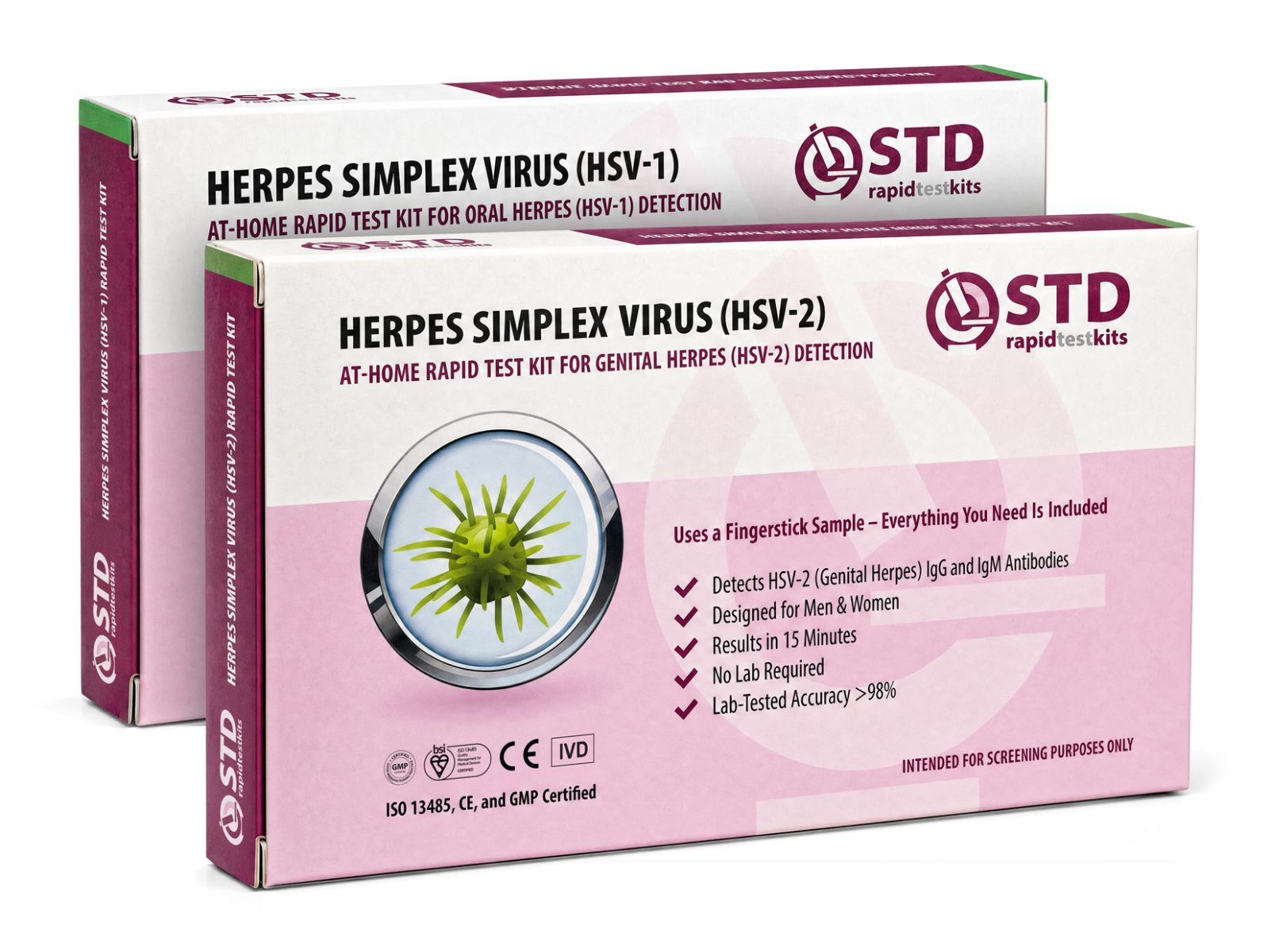
At-home rapid tests have a specific role here. They are lateral-flow immunoassays, not laboratory NAAT, so they are best understood as a screening tool that delivers a private answer fast and points you toward clinic confirmation when needed. For someone watching for chlamydia symptoms two weeks after a hookup, or someone who wants to verify herpes antibody status before a new relationship, that speed and privacy can be the difference between testing and procrastinating.
This article is published by stdrapidtestkits.com, which sells at-home rapid STI test kits. Product recommendations below are based on fit for a reader's specific concern, not commercial benefit.
When the Body Is Ready and the Mind Is Still Catching Up
Your outbreak has healed. Your follow-up test is clear. You have disclosed, used protection, done every step on the list. Sex still feels strange. That is the second half of recovery, and it takes longer than the antibiotics or the antivirals do.
Sex is one of the most cognitively loaded things humans do. Identity, worth, control, and trust all show up in the same body. After a positive test, those threads get tangled. Some people respond by rushing into sex to prove they are still wanted. Others avoid it entirely, afraid of being exposed again either to a virus or to rejection. Both reactions are common, and both deserve a second look.
If the fear is still louder than the desire, talking helps. A therapist trained in sexual health can move things faster than a friend, though a friend who listens without flinching also helps. Online communities for people living with HSV-2 are particularly useful here, because they normalize the part of the experience that doctors rarely address: that you are still allowed to be a sexual person, with or without a diagnosis.

You Deserve Answers, Not Assumptions
If you read this far, you wanted real information rather than rumor or judgment. That instinct is worth honoring. Chlamydia and herpes can shift how you date and how you trust for a while, but they do not take your sex life away from you. With treatment, honesty, and a small amount of planning, you keep what mattered to you before the test result arrived.
The fastest way to stop spiraling is to replace uncertainty with data. Whether you need a confirmatory test for yourself, a clean baseline before a new relationship, or just an answer about whether that bump is a pimple or something more, at-home testing turns a multi-week worry into a fifteen-minute one.
If you are mid-treatment: follow the seven-day window and put the three-month re-test on your calendar. If you are post-treatment and considering a new partner: a clean re-test before you resume sex covers the practical bases. If a partner has just disclosed to you: a baseline rapid test today plus a clinic test on the right window date is a reasonable plan.
FAQs
- When can I have sex again after chlamydia treatment?
- The CDC recommends waiting seven full days after the start of a single-dose antibiotic treatment, or seven days after completing a multi-day course. If your partner was also exposed, both of you need to finish treatment before resuming sex, otherwise the infection will pass back and forth. A follow-up test three months after treatment is recommended, particularly with a new partner.
- When can I have sex again after a herpes diagnosis?
- Avoid sexual contact during an active outbreak and until lesions are fully healed. Between outbreaks, daily antiviral medication (commonly valacyclovir) plus consistent condom use bring HSV-2 transmission risk to an uninfected partner down substantially. The first year after infection has higher viral shedding, so the early stretch deserves the most caution.
- Do I have to disclose every time?
- Herpes: yes. It is a lifelong virus, and informed consent matters even when transmission risk is low. Chlamydia: it depends on timing. If you had sex with someone before you knew you were positive, they need to know so they can get tested and treated. If it has been months, you have completed treatment, and your follow-up is clear, you do not need to volunteer your medical history to every future partner.
- How soon should I disclose herpes to someone I am dating?
- Before any genital, oral, or skin-to-skin sexual contact. You do not have to disclose on a first date or to people who are clearly not heading toward physical intimacy. The benchmark is simple: your partner has the information before they make a decision that depends on it.
- What if my partner blames me?
- Blame is usually fear wearing a different outfit. Their first reaction is rarely their final one, so try not to internalize whatever lands in the first ten minutes. Many partners come back later with calmer questions. If they do not, that tells you something useful about how they would have handled other hard conversations later.
- Is oral sex still safe?
- Mostly, with caveats. HSV-1 can pass from an active cold sore to a partner's genitals during oral sex; HSV-2 less commonly does the reverse. Chlamydia can occasionally infect the throat. If either partner has visible lesions or symptoms, hold off. Otherwise, barrier protection for higher-risk encounters and treating active outbreaks promptly handle most of the risk.
- How accurate are at-home STI tests?
- Rapid lateral-flow tests are screening tools that give a private result in about 15 minutes; they are most useful after the correct window period for each infection. A positive result should prompt a lab NAAT confirmation, and a negative result outside the recommended window calls for a repeat test at the correct time.
- How do I know I am emotionally ready to have sex again?
- When the fear has stopped running the show. A small amount of nervousness is fine. The signal to look for is whether you can have the disclosure conversation calmly, ask for what you want, and notice your partner's reaction without spiraling. That readiness builds with practice; waiting longer in silence rarely speeds it up.
How We Sourced This Article: We combined CDC and WHO guidance with peer-reviewed clinical-trial findings on suppressive antiviral therapy, then translated the medical guidance into plain English. Every external link was verified to lead to an authoritative public-health source and opens in a new tab so you keep your place in the article.
- U.S. Centers for Disease Control and Prevention. Chlamydia: detailed fact sheet, screening, treatment timing, and three-month retest guidance.
- U.S. Centers for Disease Control and Prevention. Genital herpes: symptoms, transmission, and suppressive antiviral therapy.
- U.S. Centers for Disease Control and Prevention. STI Treatment Guidelines: clinician reference for treatment regimens and partner management.
- World Health Organization. Sexually transmitted infections (STIs) fact sheet: global prevalence, prevention, and stigma as a barrier to care.
- American Sexual Health Association. Herpes: prevalence (about 12% of Americans aged 14-49 have genital HSV-2), symptoms, transmission, testing, and prevention overview.
- NHS. Genital herpes: symptoms, treatment, and prevention overview.
