Why Some STDs Don't Show Up on Standard Tests (And What to Do About It)
A clean STD panel can hide a real infection. Standard screens cover four illnesses; the most common viral and parasitic STIs are routinely left off unless you specifically ask. This guide explains what is included, what is not, why timing and sample site matter, and how to put together a screen that fits your risk.



- A typical “full panel” STD screen covers four infections only (chlamydia, gonorrhea, syphilis, HIV). Herpes, HPV, and trichomoniasis are routinely left off unless you specifically ask.
- Timing and sample site matter as much as the test itself. A urine-only test cannot detect a throat or rectal infection, and most tests read negative if taken before the window period closes.
Published: October 2025 | Last updated: April 2026 | Editorial review and quality control: Martina N.
A negative STD test feels like good news. Often it is. But the phrase “full panel” is doing a lot of quiet work, and most clinic screens cover fewer infections than people assume. Herpes is usually left off. So is HPV. Trichomoniasis, which the World Health Organization describes as the most common curable non-viral STI globally, is rarely included unless symptoms point that way. And even infections that are on the panel can read negative if you test inside the window period or if the swab missed the actual exposure site.
This article walks through what a standard panel really tests for, which infections it routinely skips, why timing and sample site quietly produce false negatives, and how to assemble a screen that matches your risk, whether through a clinic, an at-home rapid test, or both. If you have ever walked out of a checkup with a “clean” result and lingering doubt, this is the explanation that should have come with it.
What does a standard STD panel actually test for, and what does it miss?
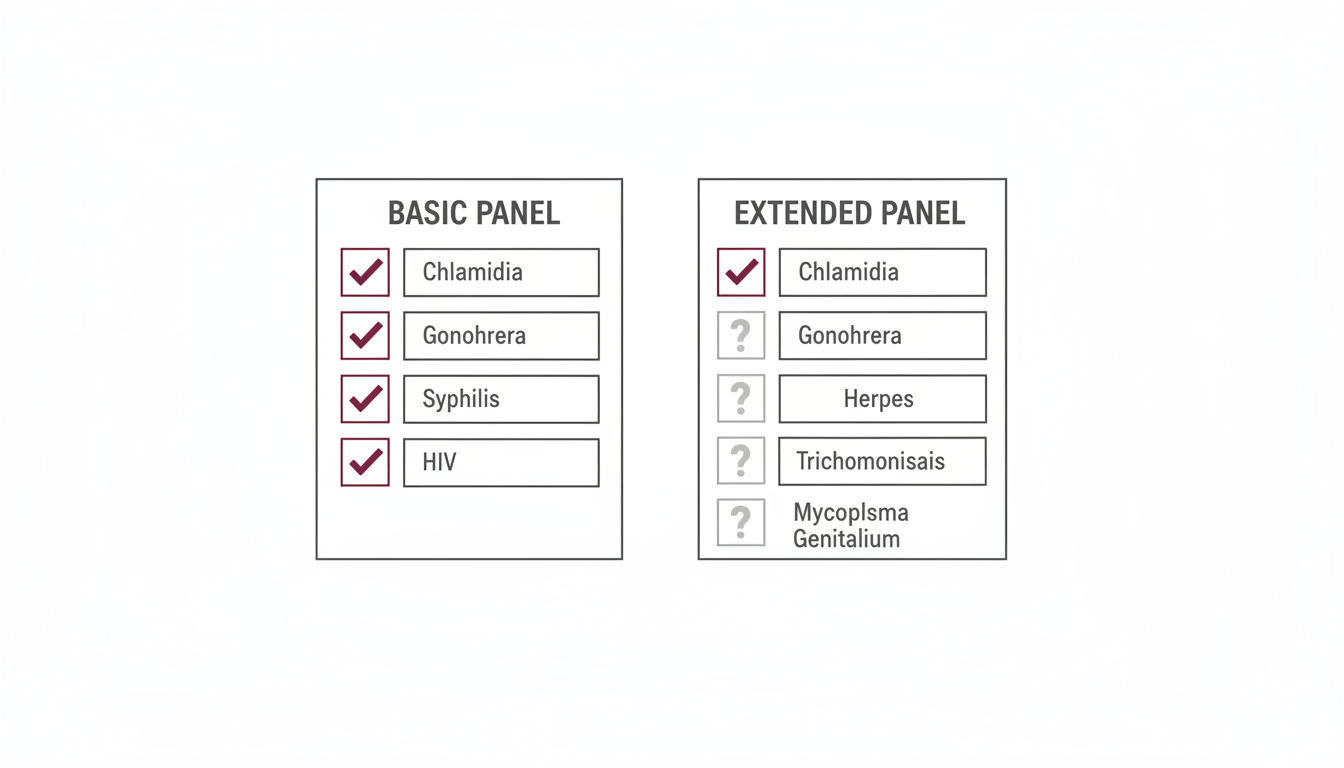
Most routine STD screens cover four infections only: chlamydia, gonorrhea, syphilis, and HIV. Herpes (HSV-1 and HSV-2), HPV, and trichomoniasis are not included unless you specifically request them or have symptoms that point that way. Mycoplasma genitalium is rarely tested anywhere outside a specialty clinic. Even on the four covered infections, a urine sample cannot detect a throat or rectal infection, and any test will read negative if taken before the window period closes. If symptoms persist after a negative result, the right move is a targeted retest, not reassurance.
What a “Standard” STD Panel Actually Covers
The U.S. Centers for Disease Control and Prevention publishes routine screening recommendations that focus on four infections for sexually active adults: chlamydia, gonorrhea, syphilis, and HIV. Most clinic screens, urgent-care panels, and “full STD test” packages map directly to that list. These four account for most diagnosable bacterial and bloodborne STIs in the U.S., they have well-validated screening assays, and treatment is straightforward when caught early.
Several common infections fall outside that list. Herpes (HSV-1 and HSV-2) is not included unless you ask. HPV is not screened on most adult panels at all. Trichomoniasis, despite being one of the most prevalent curable STIs in the U.S. per CDC surveillance, is rarely added by default. Mycoplasma genitalium, which clinicians have started recognizing as a meaningful cause of urethritis and pelvic discomfort, is almost never on a routine clinic panel.
So when a provider says, “your STD test was negative,” what they typically mean is, “the four infections we tested for came back negative.”
In most U.S. clinics and at most urgent-care centers, a “full panel” or “complete STD test” includes chlamydia, gonorrhea, syphilis, and HIV. Some clinics add hepatitis B and C for higher-risk patients. Herpes, HPV, and trichomoniasis are add-ons you typically have to request by name.
The Infections Most Often Missed
Four infections account for the bulk of the “my test was negative but I still got an STI” pattern. Each is missed for a different reason.
Genital herpes (HSV-1 and HSV-2). Per the CDC herpes overview, most people with genital herpes do not know they have it. Routine screening is not recommended for asymptomatic adults because the available antibody blood tests can miss recent infections (antibodies take weeks to develop) and can produce false positives in low-prevalence groups. Unless you have visible sores or specifically request type-specific antibody testing, your panel does not include herpes.
HPV. There is no FDA-approved HPV blood test for general use. HPV screening for cervical cancer prevention happens through Pap and HPV co-testing during gynecologic visits, not through STD panels. Men have no routine HPV test at all. So a “clean” STD panel says nothing about HPV status either way.
Trichomoniasis. The CDC trichomoniasis overview notes that about 70 percent of infected people have no symptoms, and most clinics do not test for trich unless symptoms point to it. Men in particular often carry trich silently and pass it on, then test “negative” because nobody looked for it.
Mycoplasma genitalium. A bacterial STI that causes urethritis, cervicitis, and pelvic inflammatory disease in some carriers. Per WHO guidance on STIs, M. genitalium has been recognized as a clinical issue more recently, and most non-specialty clinics still lack the molecular assay needed to detect it. We do not sell a home test for it; if symptoms suggest M. genitalium, this is one to bring to a clinician.
Why Timing Quietly Sabotages Results
Even on the four infections that are on a standard panel, timing changes the answer. Every STI has a window period: the gap between exposure and when a test can reliably detect the infection. Testing inside that window returns a genuine negative for the assay's capability, not for the infection itself, because the pathogen is present but below the assay's detection threshold.
The window varies by infection and by test technology. Antibody tests take longer than antigen or nucleic-acid tests because they wait for your immune system to build a detectable response. Per CDC HIV testing guidance, modern fourth-generation lab tests detect HIV within roughly 18 to 45 days of exposure; antibody-only rapid tests can take 23 days to 3 months for some users.
If you tested two days after a Friday hookup, the result is meaningless for almost every infection on the panel.
| Infection (test type) | Approximate window before reliable detection |
|---|---|
| Chlamydia and gonorrhea (NAAT swab/urine) | 1 to 2 weeks |
| Syphilis (blood) | 3 to 6 weeks; up to 12 in some cases |
| HIV (4th-generation lab test) | 18 to 45 days |
| HIV (antibody-only rapid) | 23 days to 3 months |
| Hepatitis B and C | 3 weeks to 6 months depending on assay |
| HSV-2 antibodies (blood) | 6 to 12 weeks, occasionally longer |
| Trichomoniasis (NAAT swab) | 1 to 4 weeks |
False Negatives and the Sample-Site Problem
Even outside the window period, a test can read negative when the infection is real. Sample-site mismatch is the most common reason. A urine NAAT for chlamydia and gonorrhea is excellent at detecting urethral or cervical infection. It cannot detect a pharyngeal (throat) or rectal infection at all, because the bacteria are not in the urine. So if your last exposure was oral or anal, and your provider only collected urine, the relevant infection was never sampled.
What works instead is anatomic sampling: a throat swab for pharyngeal exposure, a rectal swab for receptive anal exposure, a urine or genital swab for vaginal or insertive exposure. The CDC screening recommendations explicitly call for site-specific sampling in patients with corresponding exposure. Many busy urgent-care visits skip the conversation and default to urine.
Other false-negative drivers are smaller in scale but real:
- Herpes antibody blood tests can produce inconclusive results, especially in people with low antibody titers, and can take months to seroconvert after a first infection.
- Lab errors and improper collection happen, particularly with self-collected swabs handled inconsistently.
- Some lateral-flow rapid tests (the kind used in at-home kits and many clinic point-of-care setups) trade a few percentage points of sensitivity for the ability to give a result in 15 to 20 minutes. A positive result on a lateral-flow test is meaningful; a negative result inside a window period is less so.
Taken together, a negative result only speaks to the infections tested, the samples collected, and the timing of the draw. We sell at-home rapid tests for herpes and other common STIs; the kit below targets the herpes gap most clinic panels leave open.
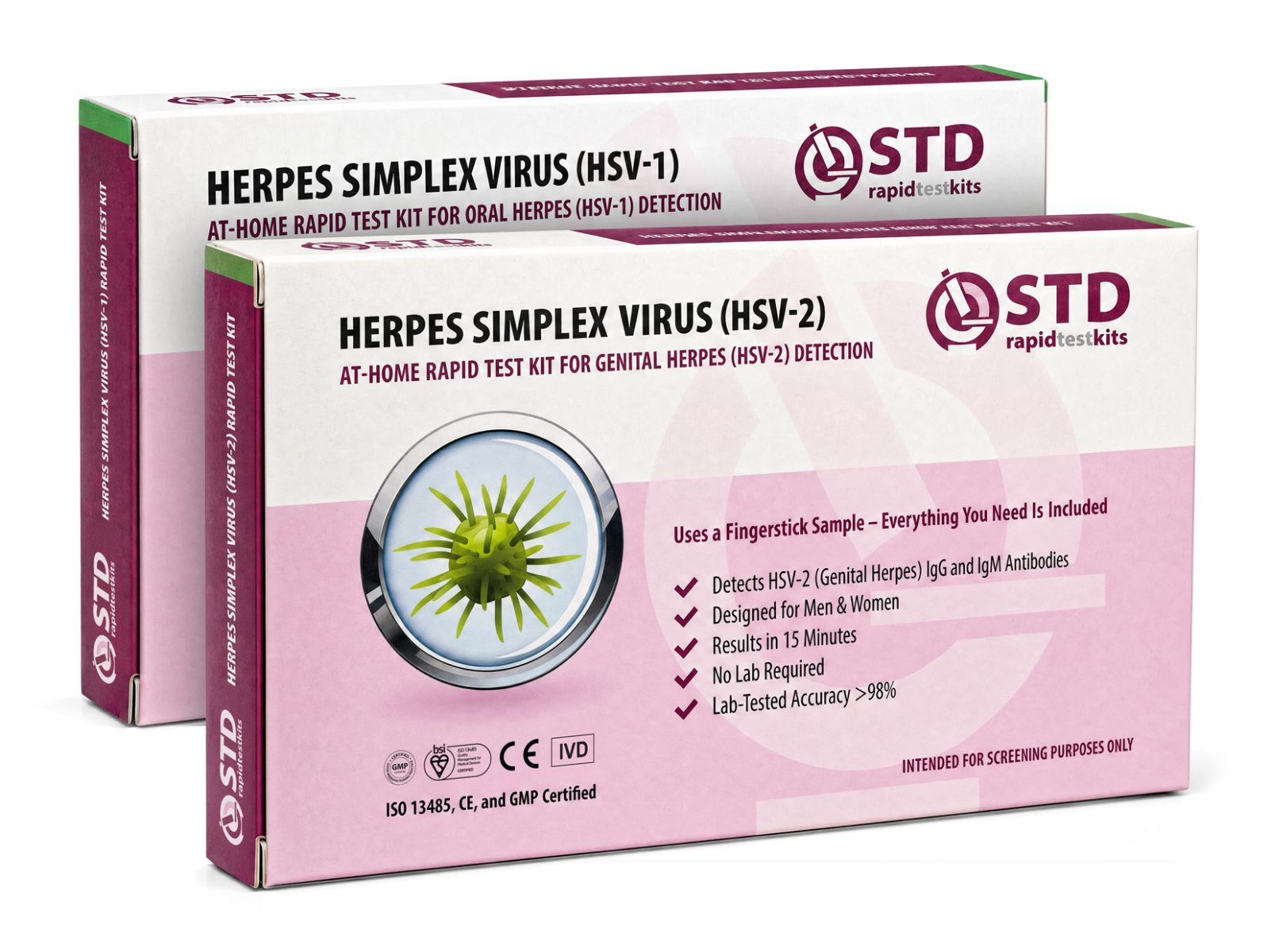
Most people with genital herpes have no symptoms or have very mild symptoms. Most people do not know they have a herpes infection.
When Symptoms Persist After a “Negative” Result
Few experiences are more disorienting than symptoms that say one thing while a test says another. Discharge, irritation, recurring sores, burning urination, pelvic pain: none of these go away because a panel came back clean. They mean something specific was missed, or the infection is one the panel does not cover.
Persistent symptoms after a negative test deserve a closer look. The most useful next step is to write down what was tested (request the lab order if you are unsure), what sample type was used, and how long after exposure you tested. With that information, a second provider or an at-home retest can fill in the gaps without starting from scratch.
Specific patterns worth flagging:
- Unusual discharge with color, odor, or texture changes that lasts more than a week.
- Genital or oral sores or blisters that recur on a similar timeline (often herpes, regardless of what the antibody panel said).
- Burning during urination, pelvic discomfort, or rectal symptoms after relevant exposure.
- Symptoms a partner is also experiencing.
If a provider dismisses lingering symptoms as anxiety or stress without ordering a targeted retest, ask for the lab order from your last visit and bring it to a second provider.
Symptoms persisting more than two weeks after a negative test, recurring sores or blisters, rectal symptoms after anal exposure, or a partner's diagnosis are all reasonable triggers for a follow-up. Bring a list of what was actually tested last time and what sample type was used. That alone often changes the conversation.
How to Get a More Complete Screen
The mechanics of a complete screen are not complicated, but they require a specific conversation. Here is what to ask for, and how to ask:
- Name the infections you want covered. “I want a panel that includes chlamydia, gonorrhea, syphilis, HIV, hepatitis B and C, herpes type-specific antibodies, and trichomoniasis.” That sentence covers more ground than 90 percent of default panels.
- Specify sample sites based on actual exposure. If you have had oral sex, ask for a throat swab. If receptive anal, a rectal swab. If genital, a urine NAAT or genital swab. The CDC screening guidance supports site-specific sampling; your job is to bring it up.
- Mind the timing. If exposure was within the last week, ask which infections you can test reliably now and which need a retest later. Note the dates so the follow-up actually happens.
- Use at-home kits to fill the gaps. If your local clinic does not offer herpes antibody testing, or if trichomoniasis is left off the requisition, an at-home rapid test can cover those gaps without an extra appointment.
- Loop in partners. An asymptomatic carrier on either side can quietly cycle an infection back and forth between you. Joint testing breaks that loop.
What Our Home Kits Cover, and What They Don't
Here is exactly what our at-home kits can and cannot do, so you can pick the right tool.
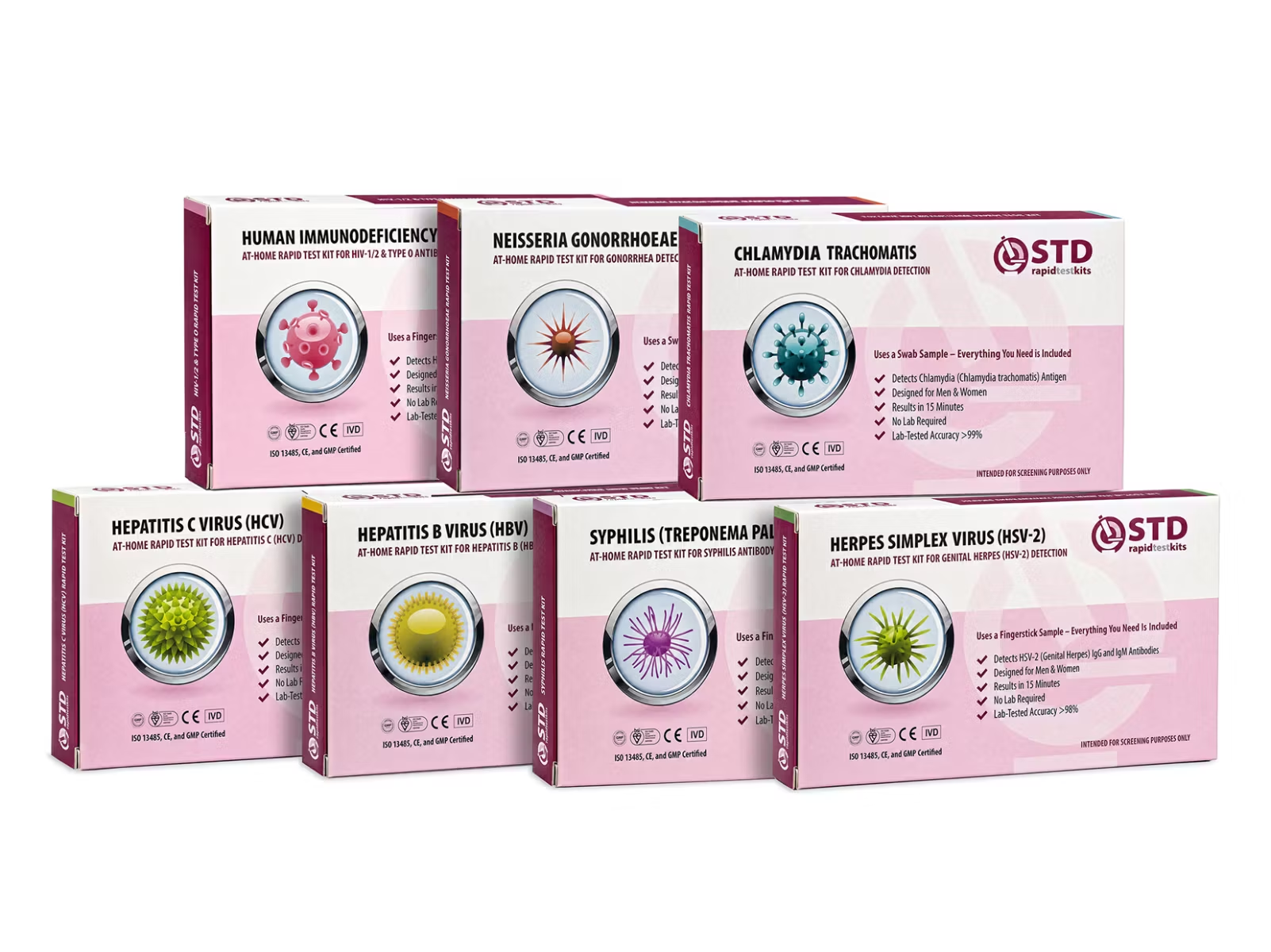
What we sell: rapid lateral-flow tests for HIV, syphilis, hepatitis B, hepatitis C, chlamydia, gonorrhea, herpes (HSV-1 and HSV-2 antibody, fingerstick blood), trichomoniasis (vaginal swab, women only), and HPV (vaginal swab, women only). Combination kits stack these in 2-, 3-, 6-, 7-, 8-, and 10-test bundles.
What we do not sell: mycoplasma genitalium tests, urine-sample tests, throat or pharyngeal swab kits, rectal swab kits, and lab-processed mail-in NAAT panels. If your concern is throat gonorrhea after oral exposure, or a rectal infection after anal exposure, the right test is a clinic-collected swab from that site. We do not have a home equivalent and we will not pretend otherwise.
Sample-type and gender notes: our trichomoniasis and HPV kits are validated for vaginal self-swab only. We do not offer a male-compatible at-home version of either. Male readers concerned about trich should ask a provider for the urine or urethral NAAT. The 10-in-1 combo is a women-only kit; the 8-in-1 covers men and women; smaller combos are any-gender unless marked otherwise.
Test technology, plainly: our home kits are rapid lateral-flow immunoassays. They use the same swab or blood sample type as the lab gold standard for many infections, but they are not NAAT or PCR. Lab NAAT is more sensitive than rapid lateral-flow, especially in asymptomatic infections. Use a home rapid test for screening, privacy, and speed. Confirm a positive result with a clinician.
Our trichomoniasis and HPV at-home tests are validated for vaginal self-swab only; we do not offer a male-compatible home version of either. Male readers needing a test for trich should ask a clinic for a urine or urethral NAAT. For HPV-related concerns, male readers should request a clinical evaluation since there is no routine HPV test for men.
Frequently asked questions
- Which STIs are usually left off a standard panel?
- Herpes (HSV-1 and HSV-2), HPV, and trichomoniasis are the three most commonly excluded. Mycoplasma genitalium is almost never on a non-specialty panel. Most standard screens cover only chlamydia, gonorrhea, syphilis, and HIV unless you specifically request more.
- Can I test negative and still have an STI?
- Yes. The three most common reasons are: testing inside the window period, testing the wrong sample site (urine when the infection is in throat or rectum), and testing for the wrong infections (the panel did not include the one you have). A negative result on a covered infection is meaningful only if timing and sample type match the exposure.
- Why is herpes not on routine STD panels?
- Two reasons. First, antibody tests cannot reliably detect a brand-new infection because seroconversion takes 6 to 12 weeks. Second, in populations where herpes prevalence is lower, false positives become common enough that the CDC concluded routine asymptomatic screening creates more confusion than benefit. If you want a reliable result, request a type-specific antibody test and wait at least 12 weeks after possible exposure.
- How accurate are at-home STD tests?
- Quality varies by manufacturer. Reputable at-home rapid lateral-flow kits report sensitivity in the mid-to-high 90 percent range and specificity above 99 percent for most infections, when used correctly and after the relevant window period. They are screening tools, not diagnostic confirmation. A positive result should be followed by clinical confirmation; a negative result inside a window period should be repeated.
- How soon after exposure should I test?
- If you can only test once, prioritize the infection you are most concerned about. For a recent unprotected encounter, chlamydia and gonorrhea NAATs are the fastest to confirm at 1 to 2 weeks. HIV with a 4th-generation lab test needs 18 to 45 days; antibody-only HIV tests can take 23 days to 3 months. Syphilis blood testing closes at 3 to 6 weeks, occasionally up to 12. Herpes antibody seroconversion is typically 6 to 12 weeks. If you test early and the result is negative, plan a follow-up at the longest relevant window.
- Can throat or rectal STIs be missed on a urine test?
- Yes, completely. A urine NAAT detects urethral or cervical infection only. Throat (pharyngeal) gonorrhea or chlamydia requires a throat swab; rectal infection requires a rectal swab. If you had oral or anal exposure and the provider only collected urine, that exposure site was never tested. Ask for site-specific sampling.
- Do at-home kits cover everything a clinic does?
- No, and any kit that says otherwise is overpromising. At-home rapid kits work best for the well-studied bloodborne infections (HIV, syphilis, hepatitis) and for self-collected vaginal or penile swabs. Throat and rectal swabs, mycoplasma genitalium, and lab-confirmation NAAT are clinic territory. The honest pattern is to use home kits to fill gaps in clinic panels, and clinic visits to confirm or extend home results.
- What should I do if my symptoms persist after a negative test?
- Start by requesting a copy of your actual lab order rather than only the result sheet. The order shows you exactly which infections were tested and what sample type was collected. If herpes, trich, or a site-specific swab is missing, those are the first gaps to fill. Do not let a provider dismiss persistent symptoms without a plan for what to test next.
- U.S. Centers for Disease Control and Prevention. STI screening recommendations covering which infections are screened routinely and which require a clinical reason to add.
- U.S. Centers for Disease Control and Prevention. Genital herpes overview discussing why most people with the infection do not know they have it and the limits of antibody testing.
- U.S. Centers for Disease Control and Prevention. Trichomoniasis overview noting that about 70 percent of infections are asymptomatic and that screening is not routine.
- U.S. Centers for Disease Control and Prevention. HIV testing landing page covering window periods for 4th-generation lab tests, antibody-only rapid tests, and NAAT.
- World Health Organization. Sexually transmitted infections fact sheet covering global prevalence of curable STIs including trichomoniasis and emerging concerns around mycoplasma genitalium.
- U.K. National Health Service. Genital herpes overview, symptoms, and what testing is appropriate.
- Mayo Clinic. Sexually transmitted infections (STIs) symptoms and causes, including which infections often go undiagnosed.