Published: June 2025 | Last updated: May 2026 | Editorial review and quality control: Martina N.
How fast can an STD cause symptoms?
Gonorrhea and herpes are the fastest, with first signs typically within 1 to 14 days for gonorrhea (most in the first week) and 2 to 12 days for herpes. Chlamydia, syphilis, and trichomoniasis usually take 1 to 4 weeks. HIV's first flu-like phase shows up at 2 to 4 weeks. Many infections cause no symptoms at all, so the absence of any sensation does not rule out exposure. Match testing to an infection's window period, not how you feel.
Key takeaways
- Gonorrhea can produce symptoms within the first week after exposure; chlamydia, HIV, and syphilis typically take 2 weeks or longer.
- Up to 70% of chlamydia infections in women cause no symptoms at all, so feeling fine after exposure is not the same as being uninfected.
A sudden burn while urinating the morning after sex feels like proof. So does a tingle, a blister, or a strange new discharge. Sometimes that reading is accurate; more often it isn't. The relationship between when you were exposed to a sexually transmitted infection and when your body lets you know is messier than most one-line answers admit. Some infections start sending signals within 24 hours, some wait two months, and some never bother. This guide walks through the realistic timeline for each of the seven most common infections, the symptoms worth taking seriously, and when an at-home test can actually answer the question you're asking.
This article is published by stdrapidtestkits.com, which sells at-home STI testing kits. We recommend products based on fit-for-purpose for the reader's concern, not commercial benefit. Our rapid kits use lateral-flow chemistry, which is excellent for screening but not equivalent to laboratory NAAT/PCR testing; we flag the difference where it matters.
Incubation period vs window period: two clocks running
When people ask how fast an STD can show up, they are usually asking one of two different questions. Each has its own clock.
The incubation period is the time between exposure and the first symptoms. It is the body's biological response time. Some pathogens replicate quickly, irritate tissue almost immediately, and produce visible or felt signs within a day or two. Others stay quiet for weeks while they multiply at a slower pace.
The window period is the time between exposure and when a test can reliably detect the infection. A test looks for the pathogen itself or for the antibodies the immune system makes against it. Both take time to reach detectable levels. A test taken on day three after exposure may miss an infection that will be obvious by day fourteen.
These two clocks rarely line up. Symptoms can appear before a test turns positive (common with herpes), or a test can detect an infection while the body still feels normal (common with chlamydia). That mismatch is the source of most testing confusion. Knowing which question you are asking, ‘am I feeling something real?' versus ‘is the test going to find anything yet?', is the first step.
Incubation is when you might feel it. Window period is when a test can find it. They rarely line up, and that mismatch explains most of the testing confusion you'll find online. The right move depends on which clock you're trying to read.
Gonorrhea: often the first to speak up
Gonorrhea is the fastest-acting common STI in people with penises. Published clinical guidance describes typical onset of urethral symptoms within the first one to two weeks after exposure (a 1 to 14 day window), with most cases producing signs in the first seven days. Some men describe a sharp, scraping burn during urination starting just two or three days after exposure. The bacterium colonizes the urethra fast, and inflamed tissue does not stay quiet for long. The CDC's gonorrhea overview notes that gonorrhea often has no symptoms at all, particularly in women.
Early gonorrhea signs in men include:
- Burning or sharp pain during urination
- Thick yellow, white, or greenish discharge from the penis
- Painful or swollen testicles (less common)
For people with vaginas the picture is different. Most cases produce mild symptoms or none at all. When signs do appear, they tend to start a week or two after exposure and may include increased vaginal discharge, bleeding between periods, or burning during urination. The discharge is often subtle enough to be mistaken for a yeast infection or normal cyclical change.
Pharyngeal gonorrhea (in the throat) and rectal gonorrhea cause symptoms even less often. A persistent sore throat or rectal irritation after oral or anal sex is worth a clinic visit, since at-home rapid kits screen genital sites only; we do not sell a pharyngeal or rectal swab.
About half of men and most women with gonorrhea never develop symptoms at all. The absence of a burn or discharge is not evidence the infection is not there. The <a href="https://www.cdc.gov/gonorrhea/about/index.html" target="_blank" rel="noopener">CDC's gonorrhea overview</a> recommends annual screening for sexually active women under 25 and for anyone with a new partner, regardless of how they feel.
Herpes (HSV-1 and HSV-2): tingling within 2 to 12 days
Herpes simplex virus produces its first outbreak (the primary infection) faster than most STIs. Clinical references describe typical onset between 2 and 12 days after exposure, with the average around 4 days. Some people report tingling, burning, or itching at the site within 24 to 48 hours, especially during a stressful period or while their immune system is busy with another illness. The CDC's genital herpes overview describes the typical primary outbreak and notes that many people with HSV have no symptoms or only very mild ones.
The classic primary outbreak progresses in stages:
- Prodromal phase (first 24 to 72 hours): tingling, burning, or itching at the contact site, sometimes with shooting pains in the legs, hips, or buttocks
- Vesicles: clusters of small fluid-filled blisters appear on red, irritated skin
- Ulcers: blisters break open into shallow, painful sores
- Crusting: sores scab over and heal, usually within 2 to 4 weeks of the first symptom
A primary outbreak often comes with flu-like symptoms (fever, body aches, swollen lymph nodes in the groin) that do not appear with later recurrences. People sometimes mistake the early tingling for a pinched nerve and the early bumps for ingrown hairs or razor burn. The pattern that distinguishes herpes is the cluster of vesicles on a reddened base in roughly the same place each time it returns.
For HSV antibody blood tests, manufacturer labelling and clinical guidance generally describe the test becoming reliable about 6 to 12 weeks after exposure (timing varies by assay), since the body needs that long to produce detectable IgG antibodies. A swab or PCR test taken from an active sore is faster and more accurate during a visible outbreak. Our HSV-1 and HSV-2 home tests are fingerstick blood antibody tests, useful for confirming seroconversion 12+ weeks after a possible exposure rather than identifying an active lesion.
For an active genital sore, a clinic-administered swab or PCR is faster and more accurate than any blood antibody test. Home HSV blood antibody tests answer a different question: have you seroconverted from a possible exposure 12+ weeks ago. The two tests are complementary; neither replaces the other.
Chlamydia: quiet for 1 to 3 weeks, often longer
Chlamydia is the most-reported STI in the United States, and one of the quietest. The CDC's chlamydia overview notes that chlamydia often has no symptoms; published epidemiological data put the asymptomatic share at roughly 70% in women and around 50% in men. When symptoms do appear, they typically start 1 to 3 weeks after exposure, sometimes later.
Possible early signs include:
- Mild burning during urination
- Thin, watery, or milky discharge
- Pelvic discomfort or spotting between periods (in women)
- Testicular tenderness or aching (in men, less common)
Because chlamydia is so often silent, the danger is not the symptom but the delay. Untreated chlamydia in women can cause pelvic inflammatory disease, which scars the fallopian tubes and raises the risk of ectopic pregnancy and infertility. The CDC's chlamydia overview recommends annual screening for all sexually active women under 25 because of this exact problem: a quiet infection that does long-term damage.
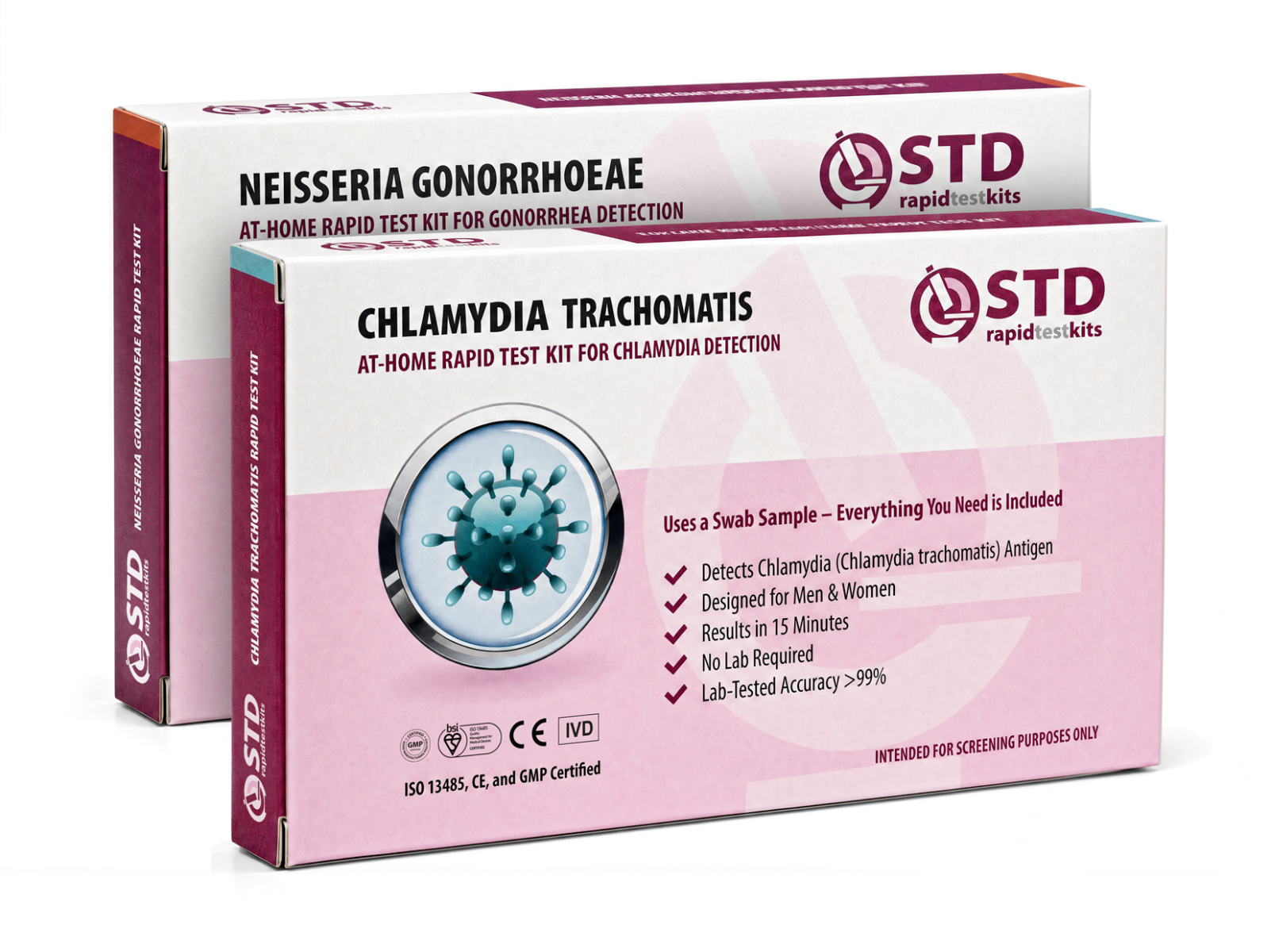
Chlamydia rapid swab tests become reliable about 1 to 2 weeks after exposure. Self-collected vaginal or penile swabs work well at home; the test detects bacterial protein on the swab via lateral-flow chemistry. A negative result earlier than two weeks does not rule out infection, especially if a partner has tested positive. Lab NAAT is the gold-standard for confirmation.
HIV: flu-like signs at 2 to 4 weeks
HIV does not produce symptoms within 24 hours, despite stories that suggest otherwise. Clinical guidance describes the first phase of HIV infection (acute retroviral syndrome) as appearing 2 to 4 weeks after exposure in many newly infected people, with a substantial subset never developing acute symptoms at all and only learning of the infection through a routine test or a later illness. The CDC's HIV testing overview details when various test types become reliable.
Acute HIV symptoms commonly include:
- Fever (often the first sign)
- Sore throat that lingers
- Body aches and fatigue
- Swollen lymph nodes in the neck or groin
- A flat, pinkish rash on the chest or back, lasting a few days
- Mouth ulcers
- Night sweats
People often mistake this constellation for the flu or mononucleosis. The clue that distinguishes acute HIV from a viral illness is the timing relative to a recent exposure plus the swollen lymph nodes and the fact that it does not improve on a normal flu schedule.
Two important details about timing. First, the acute phase is when a person carries the highest viral load and is most contagious, often before their own test would turn positive. Second, the test you use changes the window period dramatically. Antigen-antibody (fourth-generation) lab tests detect HIV reliably from about 18 to 45 days after exposure. Antibody-only rapid tests, including most home kits, become reliable from around 23 to 90 days. An HIV RNA test can detect the virus from about 10 to 33 days but is generally only ordered after a documented high-risk exposure.
If you've had a possible high-risk HIV exposure (condomless sex with a partner of unknown or positive status, condom failure, or a needle-stick injury), post-exposure prophylaxis (PEP) must start within 72 hours of exposure to be effective, and works best when started within 24. PEP is a 28-day course of antiretroviral medication available from sexual health clinics, urgent care, and many emergency rooms. Testing alone in the first 72 hours is not the priority; getting on PEP is.
Syphilis: a painless sore at 10 to 90 days
Syphilis has the longest and most variable incubation period of the common STIs. Clinical references describe an average of around 21 days from exposure to the first sign, with the range stretching from 10 to 90 days. The CDC's syphilis overview describes the primary sore (which lasts 3 to 6 weeks before healing on its own), the secondary stage rash, and the long-term consequences of untreated infection.
That first sign, called a chancre, is the symptom worth knowing on sight:
- A single, round sore
- Firm to the touch, with a clean, smooth base
- Painless (this is the giveaway)
- Located wherever the bacterium entered the body: genitals, mouth, anus, or rarely the lips or fingers
The chancre heals on its own within 3 to 6 weeks even without treatment. People often mistake it for an ingrown hair, a small cut, or a harmless bump and assume the problem went away with the sore. The bacterium has not gone anywhere; it has moved into the bloodstream. Untreated syphilis progresses to a secondary stage with a rash (often on the palms and soles), patchy hair loss, and flu-like symptoms 6 weeks to 6 months after the chancre disappears, then to a latent stage with no symptoms, and potentially to severe organ damage years later.
Blood tests for syphilis (RPR, treponemal antibody) become reliable about 3 to 6 weeks after exposure. A test taken in the first two weeks may miss the infection because antibody levels have not yet risen.
The painless syphilis chancre heals on its own within 3 to 6 weeks even without treatment. Many people assume the problem went away with the sore. The bacterium has not gone anywhere; it has moved into the bloodstream and continues to do damage. A blood test from week 3 to 6 onward can catch this stage before it progresses to the secondary rash or to long-term organ damage.
Trichomoniasis: 5 to 28 days
Trichomoniasis is caused by a microscopic parasite (Trichomonas vaginalis) and is the most common curable non-viral STI worldwide. Symptoms typically begin 5 to 28 days after exposure, with most people who develop signs noticing them in the second week.
In women, common signs include:
- Frothy yellow-green vaginal discharge with a strong odor
- Genital itching, burning, or soreness
- Discomfort during urination or sex
In men, trichomoniasis is asymptomatic about 70% of the time. When signs do appear, they tend to be mild urethral irritation or burning during urination.
An important caveat for at-home testing: our rapid trichomoniasis kit is validated for vaginal self-swab only. Male readers needing a test should see a clinic, where a urethral swab or urine PCR is the standard of care.
Other infections in this same speed bracket include Mycoplasma genitalium (1 to 3 weeks, often silent in both sexes) and hepatitis B, which usually takes 1 to 4 months for the first liver-related signs but can occasionally cause flu-like symptoms within a few weeks. These are harder to identify without a lab test.
How they compare at a glance
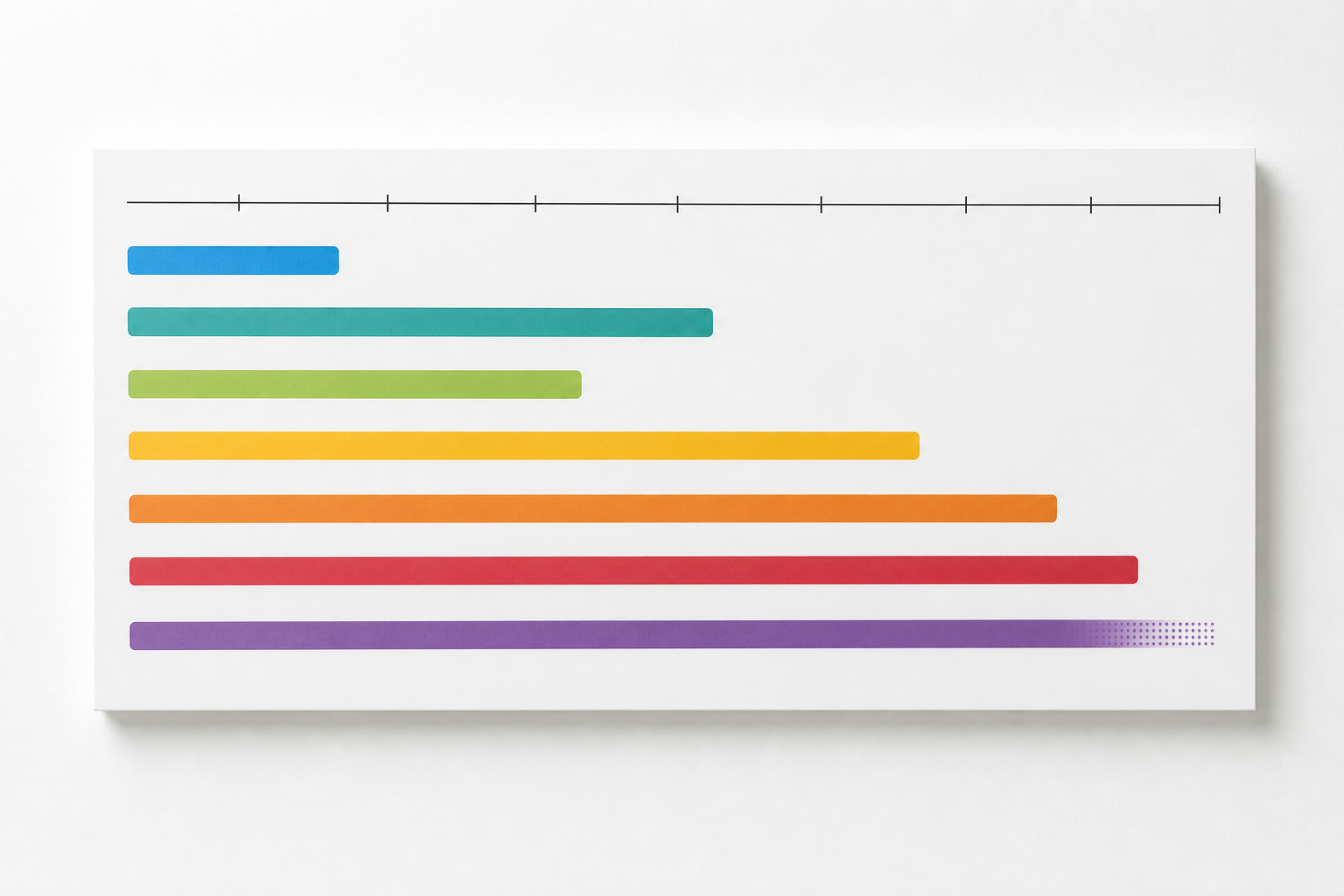
The table below summarizes the realistic ranges for symptom onset and reliable testing windows for the seven infections covered above. The middle column reflects what most people who develop symptoms experience; the range column covers the published outliers.
| Infection | Typical first symptoms | Range | Test reliable from |
|---|---|---|---|
| Gonorrhea (men) | 2 to 7 days | 1 to 14 days | 5 to 7 days (swab) |
| Gonorrhea (women) | Often none | 1 to 14 days when present | 5 to 7 days (swab) |
| Chlamydia | 1 to 3 weeks | Often silent | 7 to 14 days (swab) |
| Herpes (HSV-1 / HSV-2) | 2 to 12 days | Within 24 hours possible | Antibody blood: 6 to 12 weeks |
| HIV (acute phase) | 2 to 4 weeks | Up to a third have none | Ag/Ab lab: 18 to 45 days |
| Syphilis | About 21 days | 10 to 90 days | Blood: 3 to 6 weeks |
| Trichomoniasis | 5 to 28 days | Often silent in men | Within 1 week (swab) |
Why a test the morning after won't give a real answer
The instinct after a worrying exposure is to test as soon as possible. The biology disagrees. Every STI test, whether at-home or in a clinic, is looking for one of three things: the pathogen's genetic material (PCR or NAAT), an antigen the pathogen produces, or antibodies the immune system has made in response. All three need a minimum amount of biological signal to register.
Take chlamydia and gonorrhea. The bacteria need a few days of replication on the swabbed tissue before there is enough antigen on a self-collected sample for the test strip to react. A swab taken 24 hours after exposure is mostly testing the swab; the bacteria are still establishing themselves on the mucosal surface.
HIV is a more dramatic example. The virus enters cells, replicates inside them, and only releases enough viral load (and triggers enough antibody production) to be detectable after weeks. A negative HIV test on day three after a high-risk exposure is essentially meaningless. The CDC's HIV testing overview recommends specific retest schedules depending on the test type because of this exact problem.
Syphilis blood tests rely on antibodies, which the immune system needs around three weeks to produce in detectable amounts. A blood test taken at one week is testing whether the antibodies have arrived, not whether the bacteria are present.
A symptom-driven test makes sense any time a symptom is present. A screening test taken in the first 24 to 72 hours produces a false sense of safety: chlamydia and gonorrhea swabs need 7 days or more, HIV antigen-antibody tests need 18, and syphilis blood tests need around 21. A negative on day one is not a clean bill of health.
What to do if symptoms show up within 24 hours
Quick-onset symptoms after sex can mean an STI, but they often mean something else. Friction, latex allergy, urinary tract infection, yeast infection, and contact dermatitis from a new soap, lubricant, or condom all produce overlapping signs. The job is to triage, not panic.
If the exposure was high-risk (no condom with a new or unknown partner, condom failure, or a needle-stick injury), the most useful early intervention is not testing. It is post-exposure prophylaxis. PEP for HIV must begin within 72 hours of exposure, ideally within 24, to be effective. Local sexual health clinics and many emergency rooms can prescribe it.
Triage in the first 48 hours
- Test or see a clinician for: a new painful sore or blister at the contact site; discharge that is unusual in color, smell, or amount; burning urination that does not improve with water and rest within 24 to 48 hours; a painless ulcer of any kind on the genitals, mouth, or anus (always worth a syphilis check); fever paired with a recent exposure history.
- Likely benign and often resolves on its own: mild burning that fades within 24 hours and is not paired with discharge; a small red bump that flattens within a day; slight irritation after a long session, especially with a new lubricant or condom material.
Common misconceptions about symptom timing
The internet is full of confident-sounding takes on what STI symptoms mean and when to expect them. Several are worth correcting.
‘If I feel fine the next morning, I'm in the clear.' Most STIs need days or weeks to produce symptoms, and a substantial share never do. Feeling fine on day one tells you almost nothing about your status.
‘Symptoms within 24 hours mean it is from my last partner.' Possible, but the timing alone does not prove it. Herpes can be present for years and reactivate during stress, illness, or sex with anyone. A first outbreak can also occur weeks or months after the actual primary infection if the immune system suppressed it initially.
‘Burning when I pee is always an STI.' Urinary tract infections, dehydration, and friction also produce burning. The texture of the symptom matters: STI-related burning is often paired with discharge, while UTI burning comes with urgency, frequency, and cloudy urine.
‘If a partner tested negative, I am fine.' Only if the partner tested at the right time. A test taken inside the window period can miss an active infection. Couples sometimes ping-pong infections this way for months.
‘At-home rapid tests are NAAT-equivalent.' They are not. At-home rapid lateral-flow kits use a different chemistry from laboratory NAAT/PCR tests. They are good for screening, especially when paired with the right timing, but a positive home result is worth confirming with a clinic test, and a negative does not have the same analytical sensitivity as a clinic NAAT.
An estimated one in five people in the U.S. has a sexually transmitted infection on any given day, and most of those infections are silent until tested for.
When should you test?
Match the test to the infection. The schedule below is a practical compromise between window-period biology and real-life patience.
Within 72 hours of high-risk exposure: If you had unprotected sex with a partner of unknown HIV status, a condom failure with a known-positive partner, or a needle-related exposure, the priority is HIV PEP at a clinic or ER. Testing comes later.
Day 7 to 14: Useful for chlamydia and gonorrhea swab tests if symptoms have started or if you want an initial screen. A negative at this point is reassuring but not final, especially if symptoms are present.
Day 14 to 21: Reasonable to retest chlamydia and gonorrhea, and to begin syphilis blood testing.
Week 4 to 6: Antigen-antibody HIV testing becomes reliable. Most syphilis tests are also reliable at this point. A combination home kit covering several infections at once is a sensible move here.
Week 12: The conservative window for HIV antibody-only tests and HSV antibody tests. A negative result here is a strong signal of an uninfected status, assuming no further exposure in the interim.
Three other practical rules. First, retest if symptoms appear at any point regardless of an earlier negative. Second, test more often if you have new partners more than once or twice a year. Third, if a current partner is positive for any infection, test immediately and again at the partner's relevant window period; do not wait for symptoms.
FAQs
- Can STD symptoms really appear in 24 hours?
- For gonorrhea (in men) and herpes, yes. Some men report a urethral burn 24 to 48 hours after exposure, and herpes can produce tingling or itching at the contact site within a day. Most other infections take longer, and many cause no symptoms at all.
- Which STD shows up the fastest?
- Gonorrhea in people with penises is typically the fastest, with symptoms commonly starting between days 2 and 5. Herpes runs a close second, with first signs in 2 to 12 days.
- Can I test the day after sex?
- You can take the test, but the result will not be reliable for most infections. Chlamydia and gonorrhea tests need about 7 to 14 days to produce a stable result. HIV antigen-antibody tests need 18 to 45 days. Syphilis blood tests need about 3 to 6 weeks.
- What if I have a rash or sore that came on within hours?
- A bump or rash within hours is more often friction, latex allergy, contact dermatitis, or razor irritation than an STI. A painless sore that lasts more than a few days warrants a syphilis check. A painful blister cluster suggests herpes. Either way, see a clinician or use an at-home test at the right window.
- How do I tell an STI from a UTI?
- UTIs typically cause urgency, frequency, cloudy urine, and lower-belly cramping with no discharge. STIs are more often paired with discharge, sores, or unusual genital sensation. Symptoms can overlap, so the only reliable way to tell is a urine culture for the UTI plus an STI swab or blood test.
- Can anxiety cause symptoms that feel like an STI?
- Yes. Heightened attention to genital sensation can amplify normal stimuli into something that feels like a symptom. Phantom itching, mild burning, and a sense of irritation are all reported by people who later test fully negative. A test cuts through this loop in a way that reassurance does not.
- What is the earliest a combination home kit can give me a meaningful answer?
- A combination kit run at week 2 to 3 will give early but not definitive readings on chlamydia, gonorrhea, syphilis, and trichomoniasis. Repeat the HIV portion at week 6 (antigen-antibody) and again at week 12 for the most conservative result.
- Can I get an STI from a single encounter?
- Yes, including from oral and anal sex. Per-act transmission probability varies by infection and exposure type, but for many STIs a single unprotected encounter is enough to transmit.
The summary, plainly
Some STIs are loud within a day or two, others are silent for weeks. Testing too early gives a misleading negative; ignoring symptoms because the timing seems off can let an infection spread. The fastest-acting infections (gonorrhea, herpes) are also the most likely to be felt. The slowest (chlamydia, HIV, syphilis) are the most likely to be missed. Match the test to the infection's window period and retest if anything changes. Knowing the timeline removes most of the guesswork.
- U.S. Centers for Disease Control and Prevention. Sexually transmitted infections (STIs): overview, screening recommendations, and broad notes on the often-asymptomatic course of common STIs.
- U.S. Centers for Disease Control and Prevention. HIV testing overview, including window periods for antigen-antibody, antibody-only, and RNA tests, and acute-phase context.
- U.S. Centers for Disease Control and Prevention. About genital herpes, including primary outbreak progression and the role of swab versus blood antibody testing.
- U.S. Centers for Disease Control and Prevention. About chlamydia, including the often-asymptomatic course and screening recommendations for women under 25.
- U.S. Centers for Disease Control and Prevention. HIV post-exposure prophylaxis (PEP) overview, stating verbatim that 'PEP must be started within 72 hours (3 days) after a recent possible exposure to HIV' and that the sooner PEP starts, the better.
- NHS. Sexually transmitted infections (STIs), patient-facing overview of common symptoms and testing pathways.
