
Published: October 2025 | Last updated: May 2026 | Editorial review and quality control: Martina N.
Do condoms fully prevent STDs?
No. Condoms sharply reduce risk for fluid-borne STIs when used correctly and consistently. They offer partial protection against skin-spread infections (genital herpes, HPV, primary syphilis) because the latex doesn't cover every contact zone. After exposure, test on the right window-period date for the specific infection rather than relying on the condom alone.
You used a condom. Everything went the way it was supposed to. And now, hours or days later, your brain is replaying the moment and asking the question every sexually active person has thought at least once: was that actually enough?
This article answers that without the panic and without the salesy oversimplification. Condoms are one of the strongest single tools you have for cutting STD risk, and they work for very real biological reasons. But "strong protection" and "complete protection" are different things, and the difference matters when you're deciding whether to test, when to test, or whether something you're feeling is worth attention. The short version: condoms catch most STIs that travel in body fluids and only some of the ones that travel on skin. Knowing which group your exposure falls into is the difference between testing on the right schedule and being caught off guard months later by an infection that built up silently in the bloodstream while everything felt normal.
Key Takeaways
- Condoms are highly protective against STIs that travel in body fluids (chlamydia, gonorrhea, HIV, hepatitis B, trichomoniasis) and only partially protective against skin-spread infections (genital herpes, HPV, primary syphilis) because the barrier doesn't cover every inch of contact.
- If you want certainty after a recent encounter, testing on the right window-period date is the only honest answer. Most STIs are asymptomatic at any given moment, so 'I feel fine' is not a substitute for a test.
How Condoms Actually Work Against STDs
STIs don't all travel the same way. Some live inside body fluids, some live on the skin itself, and a small number live in both places. A condom is a physical barrier, which means it works very well against the first group and only partially against the second.
Fluid-based infections live inside semen, vaginal secretions, pre-ejaculate, or blood. Chlamydia, gonorrhea, HIV, hepatitis B, and trichomoniasis all spread this way. When a latex or polyurethane condom is on the whole time and stays intact, it physically blocks fluid exchange at the covered area. Per the CDC's condom effectiveness summary, consistent and correct use of latex condoms is highly effective at preventing sexual transmission of HIV, with meaningful but variable risk reduction for other fluid-borne STIs.
Skin-to-skin infections work differently. Herpes (HSV-1 and HSV-2), human papillomavirus (HPV), and primary syphilis can spread from any infected skin area to any uninfected skin area that touches it. The condom does its job on the covered shaft. The base of the penis, the scrotum, the labia, the upper thigh, the pubic mound, the perineum, and the perianal skin are all in contact during most sex. None of those areas are covered. For an infection that lives in semen, the uncovered skin barely matters. For an infection that lives on skin, that uncovered zone is where transmission can occur.
There's a third complication worth naming: viral shedding. Herpes can be infectious even with no visible sores at all. Per the NHS genital herpes overview, the virus can be passed on even without symptoms, with higher risk in the first six months after a person is infected, which is why visual inspection cannot substitute for a test or a partner's testing history.
What STDs Can You Still Get With a Condom?
The list is shorter than people imagine, but the items on it are important. Three infections sit firmly in the "skin contact, not just fluids" category, and they are the ones most often missed by people who assume condom use covers everything. A second, smaller group spreads through routes the latex barrier was never designed to address at all.
Herpes. Lesions can appear on the shaft of the penis, but they also commonly appear on the scrotum, the pubic area, the inner thigh, the buttocks, or the perianal skin. Any of those zones can touch a partner during sex. Transmission can also happen without visible sores during asymptomatic viral shedding, which is why a partner's history of herpes (even when they currently look "clear") is medically relevant.
HPV. The virus spreads through direct skin-to-skin contact at the genital area. A condom reduces the contact surface but doesn't eliminate it, per the CDC condom effectiveness overview. Most sexually active adults will acquire at least one HPV strain at some point, even with consistent condom use, which is one reason vaccination is so important. Per CDC HPV vaccination guidance, HPV vaccination is recommended routinely through age 26; adults aged 27 through 45 who were not previously vaccinated may choose to get the vaccine after discussing their individual risk with their doctor.
Syphilis. The first stage is a painless ulcer called a chancre. If the chancre is on the shaft, a condom may cover it. If it's at the base, on the scrotum, on the labia, in the perianal area, or inside the mouth, condom coverage doesn't reach it. Per CDC syphilis information, chancres are infectious and often go unnoticed because they don't hurt and may sit somewhere the infected person can't easily see.
A smaller group of skin-spread conditions sits in the same coverage-mismatch pattern, though they're less commonly discussed: pubic lice live on coarse hair the condom doesn't cover, molluscum contagiosum spreads through direct contact with visible bumps on uncovered skin, and scabies mites burrow into skin during prolonged contact. None of these routes involves the fluids a condom is designed to block.
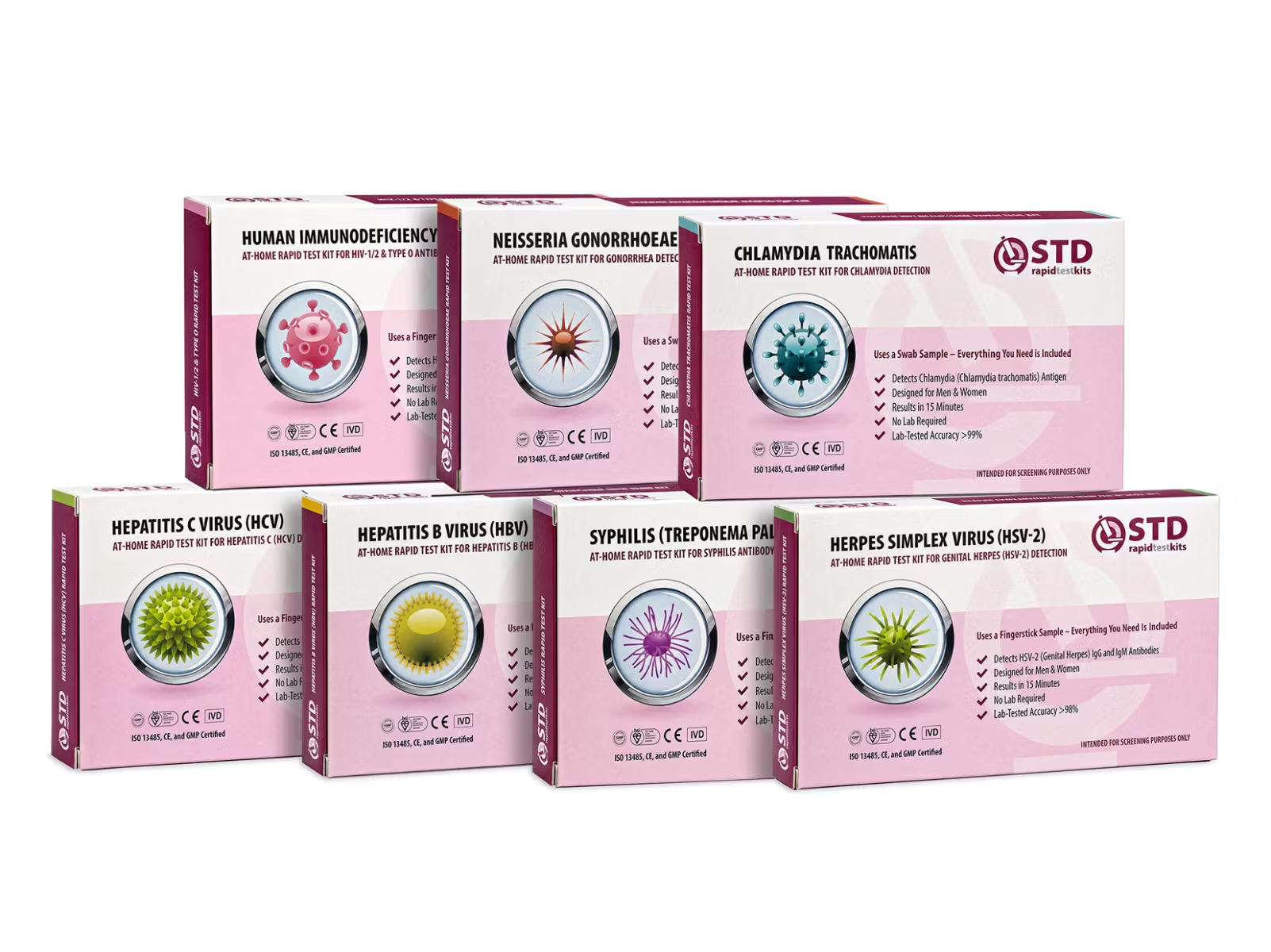
A note before the recommendations that follow: this site sells the rapid at-home STI test kits referenced in this article. Product picks below are matched to the article topic, not chosen on commercial grounds alone, and we direct readers to clinic-based testing in situations where a lateral-flow rapid test is not the right tool.
| STD | Condom protection level | Why |
|---|---|---|
| Chlamydia | High | Fluid-borne, blocked at the barrier |
| Gonorrhea | High | Fluid-borne, blocked at the barrier (genital site) |
| HIV | High | Fluid-borne, blocked at the barrier |
| Hepatitis B | High | Fluid-borne, blocked at the barrier |
| Trichomoniasis | High | Fluid-borne, blocked at the barrier |
| Herpes (HSV-1, HSV-2) | Partial | Skin-to-skin spread outside covered area, including during asymptomatic shedding |
| HPV | Partial | Skin-to-skin spread outside covered area; usually asymptomatic |
| Syphilis (primary) | Partial | Chancre may sit on scrotum, vulva, perianal skin, or mouth, outside the latex |
| Pubic lice | Low | Lice live on coarse pubic hair, which a condom does not cover |
| Molluscum contagiosum | Low | Spreads via touch on visible bumps, not via fluid |
| Scabies | Low | Mite burrows into skin during prolonged contact; no fluid involved |
Oral Sex Is Sex, and Oral STIs Do Exist
Oral sex carries lower per-act risk than penetrative sex for most STIs, but it is not risk-free. Several pathogens routinely transmit between mouth and genitals, and the breakdown surprises a lot of readers:
- Genital herpes (often HSV-1). Oral herpes caused by HSV-1 can spread from the mouth to the genitals through oral sex, which is why some cases of genital herpes are due to HSV-1, per the CDC genital herpes overview.
- Gonorrhea. Pharyngeal infection is well documented and frequently asymptomatic, which is why CDC screening guidance recommends throat swabs for some patient groups.
- Syphilis. Chancres can appear on the lips, tongue, or inside the mouth as easily as on genital skin, and they are typically painless.
- HPV. Oral HPV is contributing to a rising share of oropharyngeal cancers, particularly in men.
Dental dams and condoms used during oral sex reduce risk for the relevant transmission routes, but they are rarely used in real-world encounters. That doesn't make anyone reckless. It just means "we only did oral" is not a safe assumption when an exposure was symptomatic or when a partner's testing status is unknown. The tricky part: the symptomatic site can be in the throat, where the person carrying the infection often feels nothing at all. For pharyngeal gonorrhea or oral syphilis specifically, a clinic-administered throat swab or oral examination is the right test. We do not sell pharyngeal swabs at home; for that situation a clinic visit is the correct path. Our rapid panels do cover the adjacent genital and bloodwork risk from the same exposure event.
Per-act risk is lower than penetrative sex for most STIs, but it is not zero. Gonorrhea, herpes, syphilis, and HPV all move between mouth and genitals. Pharyngeal infections are usually silent, so symptoms in the carrier are not a reliable filter. If an oral exposure is on your mind, plan a clinic throat swab plus the appropriate blood tests on their respective windows.
Testing After Protected Sex: The Window Periods That Matter
Most testing anxiety isn't about whether to test, it's about timing. People test the morning after, get a negative, and feel falsely safe. Then they wonder six weeks later if something was missed.
Every infection has a window period: the time between exposure and the moment your body or the infection itself reaches detectable levels. Test inside the window and a negative doesn't mean what you think it means. Test after it closes and a negative is genuinely useful.
Two test technologies do most of the work. Nucleic Acid Amplification Tests (NAAT) look directly for the genetic material of the infection in a sample, usually a swab or urine, and are the laboratory gold standard for chlamydia and gonorrhea. Lateral-flow rapid tests, including the kind that come in at-home kits, screen using antibodies or antigens on a strip. The two technologies are complementary, not equivalent: laboratory NAAT has higher analytical sensitivity in early infection, while rapid tests are faster, cheaper, and private. Per Mayo Clinic's overview of STI diagnosis, lab-based and home-based approaches play complementary roles in screening, and a positive on a rapid test is generally worth confirming with a clinic-administered NAAT or follow-up serology.
Window periods aren't arbitrary cutoffs. They reflect how long the infection or your immune response takes to produce something a test can measure.
| STI | Earliest reliable test | Confirmation |
|---|---|---|
| Chlamydia | About 2 weeks | Not usually needed |
| Gonorrhea | About 2 to 3 weeks | Not usually needed |
| Syphilis | About 6 weeks | 12 weeks if early result is negative and symptoms persist |
| HIV (4th-gen / rapid) | About 6 weeks | 12 weeks |
| Herpes (HSV-2 antibody) | About 6 weeks | 12 to 16 weeks if needed |
| Hepatitis B | About 6 weeks | Repeat at 6 months in some clinical contexts |
| Hepatitis C | About 8 to 11 weeks | Repeat at 6 months if exposure risk was high |
The Asymptomatic Blind Spot
The reason "I feel fine" is not a useful diagnostic in sexual health is that asymptomatic infection is the rule rather than the exception for several common STIs. Per the WHO fact sheet on sexually transmitted infections, the majority of curable STIs are asymptomatic at any given time. A few specific examples make the point concrete:
- Genital herpes: most people with genital herpes have no symptoms or only very mild symptoms, and most don't know they're infected.
- HPV: most genital HPV infections cause no symptoms and clear on their own within two years; clinically silent infection is the default state.
- Chlamydia: often has no symptoms, with the asymptomatic share particularly high in women, per the CDC chlamydia fact sheet.
- Gonorrhea: pharyngeal and rectal infections in particular are typically silent.
This explains the gap that catches a lot of people off guard. A partner who tells you they've never had anything can be honest about their symptom history while still carrying an active infection that has never made itself known. They aren't lying. The information they have is genuinely incomplete.
Most people infected with HSV-2 have not had the condition diagnosed. Many such people have mild or unrecognized infections but shed virus intermittently in the genital tract.
Why "Clean" Is a Social Term, Not a Medical One
"I'm clean" is one of the most common phrases in casual sexual conversations and one of the least precise. In practice it usually means one of three things, none of which are equivalent to "I currently have no STI":
- "I've never been diagnosed with an STI." True, but compatible with carrying an asymptomatic infection that has never been tested for.
- "I was tested recently and it was negative." True, but the test panel may not have included herpes, HPV, or extragenital sites.
- "I don't have symptoms." True, but most STIs are asymptomatic at any given moment.
The other gap is what actually gets tested. A standard STI panel at most clinics covers chlamydia, gonorrhea, syphilis, HIV, and sometimes hepatitis B and C. Herpes is generally not included unless you specifically ask, because population-level routine HSV screening is not currently recommended. HPV is screened in cervical-cancer screening (Pap or HPV co-test) for people with a cervix, and not routinely tested for at all in people without one.
Add this together and "I was tested" can mean a panel that completely missed two of the three skin-spread STIs that condoms only partially block. None of this is anyone's fault. It's a feature of how default panels are structured.
- Never diagnosed. Compatible with carrying an asymptomatic infection that has never been tested for.
- Recently tested negative. Often on a panel that excludes herpes and HPV.
- No current symptoms. The default state for most STIs.
Why You Still Feel Worried After Doing Everything Right
You can use a condom correctly, the math says your risk is low, and your brain still circles back to the same question. The worry is predictable: most people are taught to think about protection as safe-or-unsafe rather than as a matter of degree, so the residual probability registers as alarm even when it's small.
The worry sticks around because the body gives you nothing reliable to act on. Most STIs produce no obvious symptoms in the first days, and many stay silent for months, so feeling fine is not a useful signal. Compounding that, there is a real gap between exposure and the point where any test can return a meaningful result, which means even a correct negative has an expiry date. You can be technically uninfected, technically infected-but-not-detectable, or technically clear-on-a-test-that-isn't-yet-meaningful, and from your body's perspective those three states feel identical in the first few days.
A scheduled test on the correct date replaces the symptom-checking loop with a concrete answer. Pick the window, mark the date, test then, and don't re-evaluate before then.
- No early-warning symptoms. Most STIs are silent in the first days, and many stay silent for months.
- The window gap. Between exposure and detectability, no test (positive or negative) is meaningful yet.
What Actually Makes Sex Safer, Beyond Condoms
The strongest predictors of low STI risk over a lifetime aren't condoms alone. They're condoms plus a small set of habits that compound. None of them are heroic, and none require overhauling your sex life.
Routine testing on a real schedule. Per the CDC's 2021 STI Treatment Guidelines, hosted on the agency's STI clinical guidance index for healthcare providers, sexually active women under 25 should be screened annually for chlamydia and gonorrhea, with older women screened annually if they have new or multiple partners. The same guidelines recommend HIV testing at least once for everyone aged 13 to 64, with more frequent testing for higher-risk groups, and at least annual STI screening for men who have sex with men, with 3 to 6 month intervals for higher-risk activity.
Vaccination where it exists. The HPV vaccine is one of the most effective primary prevention tools in sexual health, blocking the strains responsible for the vast majority of cervical and a substantial share of head-and-neck cancers. Hepatitis B vaccination provides durable immunity for life in most people. Both vaccines close transmission paths that no condom can fully cover.
Conversation with partners about testing status and recent activity. This is the habit most people skip, and is also the highest-leverage one. A thirty-second "when was your last test?" conversation changes your effective risk profile far more than worrying after the fact, because it lets you make a decision in advance rather than spending two weeks reverse-engineering one.
Treatment of any current infection. Most STIs are curable with a short course of antibiotics or highly manageable on antiviral therapy. Early treatment also reduces transmission to partners, which is its own form of protection.
The shift to make here is moving from "I used a condom, I'm covered" to "I used a condom, I get tested on a schedule, and I talk to partners."
- Routine testing on a schedule that matches your sexual activity, not just when something feels off.
- Vaccination where it exists, especially HPV and Hepatitis B.
- Partner conversation about testing status before sex with a new partner, not after.
- Treatment of any positive result, which protects your future partners as well as you.
When You Should Definitely Get Tested, Even If You Used Protection
Testing is most useful in five specific scenarios. If any of them apply, don't wait for symptoms to make the decision for you.
1. The condom slipped, broke, or came off late. Fluid exposure is the main pathway condoms protect against, and a barrier failure removes that protection at the moment it mattered most. Test on the window-period schedule above.
2. You had a new partner whose testing history you don't know. Even with consistent condom use, the skin-to-skin infections retain a non-zero transmission probability per encounter, and that adds up across multiple new partners.
3. You notice a new symptom. Burning during urination, unusual discharge, a sore or bump you haven't had before, an unexplained rash, or a persistent sore throat after oral sex are all reasons to test. Most turn out to be non-STI causes (friction, ingrown hairs, yeast, common viral pharyngitis), but a few don't, and guessing isn't a good substitute for an objective test.
4. A partner tells you they tested positive. This is the highest-yield reason to test. Partner-notification testing has a much higher positivity rate than routine screening, and the right move is to test on the correct window for the specific infection they were diagnosed with.
5. You're due for routine screening based on your age, gender, and sexual activity. This is the baseline most people skip because they don't have a specific reason in any given month. Routine screening exists precisely because most STIs are silent.
One more thing on retesting. If you tested early in the window after an exposure and the result was negative, that isn't always the end of the conversation. Retest if your first test landed inside the window for that infection, if new symptoms appeared after the negative result, if you've had a new partner since the first test, or if a partner from the relevant window subsequently tests positive. Any one of those scenarios is enough on its own.
If multiple infections are in play, or you simply don't want three separate clinic visits, a multi-infection at-home kit can cover most of the common screening targets in one sitting. Use the combination kits the way they're designed to be used: as a fast, private screen that catches anything elevated, with positive results confirmed by clinic NAAT or serology before treatment.
Bottom Line: Condoms Help, but Not on Their Own
Do condoms fully prevent STDs? No. They cut risk sharply for the infections that travel in body fluids, and they cut risk partially for the ones that travel on skin. A physical barrier cannot cover every square inch of skin-to-skin contact, which is where the gap comes from, not from any defect in the condom itself.
Treat condoms as one of three layered tools. The other two are testing on a real schedule that matches your sexual activity, and honest conversation with partners about when each of you was last tested. Together, condoms, on-schedule testing, and partner conversation get you closer to a reliable risk picture than any single tool can on its own.
If you've made it to the end of this piece, the most useful thing you can do today is decide whether you're inside or outside the testing window for your last encounter. If you're outside the window and haven't tested, that's the move. If you're inside the window, mark the date on a calendar and stop checking symptoms in the mirror until then.
Today's three concrete moves
Did you have an encounter and you're now past the relevant window without having tested?
Yes: Schedule the test today. An on-window negative result is more reliable than weeks of worry.
No: Continue to the next step.
Are you up to date on HPV and Hepatitis B vaccination?
Yes: Good. You've closed two transmission paths no condom can fully cover.
No: Ask a provider about catching up. HPV is routinely recommended through age 26, and through age 45 with shared clinical decision-making.
Is there a new partner on the horizon?
Yes: Have the testing-status conversation before sex with them, not after.
Three quick decisions based on where you are right now.
Frequently Asked Questions
- I used a condom the whole time. Does that protect against herpes and HPV too?
- For fluid-based infections like chlamydia, gonorrhea, and HIV, yes. Correct, consistent condom use cuts that risk sharply. For herpes and HPV the protection is only partial. Both viruses spread by skin-to-skin contact, and a condom covers the shaft but not the surrounding skin in contact during sex. HSV in particular sheds from sites a condom doesn't cover, including the scrotum, vulva, inner thighs, perianal skin, and lips. This is the limit of what a barrier can physically cover, not a sign that the condom failed.
- How risky is unprotected oral sex for STIs?
- Lower than penetrative sex for most pathogens, but not risk-free. Gonorrhea, herpes, syphilis, and HPV all transmit between mouth and genitals or mouth and anus. Pharyngeal gonorrhea in particular is often asymptomatic. If you had a recent oral exposure and want to test, focus on chlamydia and gonorrhea (throat swab at a clinic), syphilis (rapid blood test), and HIV (rapid blood test).
- How soon after sex can I take an at-home STI test?
- The most common mistake is testing the morning after. An early negative doesn't close the question, it just means your body hasn't reached the level the test needs yet. If you've already tested early and got a negative, schedule a second test at the window-period date that matches the infection you're worried about. A negative result at the correct date is the one worth trusting.
- What if I have no symptoms at all?
- Asymptomatic means undetectable to you, not inactive. Pick a testing cadence that matches your sexual activity level (yearly is the baseline for most adults, every 3 to 6 months for higher-risk activity), and don't lean on the absence of symptoms as evidence of anything. The test gives an objective answer that your body cannot.
- Should I get tested even if I trust my partner?
- Trust and testing answer different questions. Many infected people don't know they are, because the infection produces no symptoms, and standard panels often skip herpes and HPV. A recent negative test on both sides is the only way to move from assumption to verified status; routine testing is the practical way to get there without it being a question of trust in any specific partner.
- What does "clean" actually mean when a partner says it?
- The practical gap is what standard panels leave out. Most clinic panels skip herpes and HPV entirely, so a recent negative result can miss two of the three skin-spread infections that condoms only partially block. If those are your concern, ask specifically for HSV-2 serology and check whether your partner has been vaccinated for HPV. Symptom history alone isn't informative for either infection.
- Do internal (female) condoms protect the same way?
- Yes, broadly. Internal condoms are a physical barrier and follow the same logic: high protection against fluid-based STIs at the covered area, partial protection against skin-to-skin infections because the barrier doesn't cover every contact zone. They are a valid alternative when an external condom isn't an option.
- Is a positive at-home test a final diagnosis?
- A positive on a rapid at-home test is a strong screening signal, not a final diagnosis. Confirm with a clinic-administered NAAT (for chlamydia, gonorrhea, trichomoniasis) or appropriate serology (for HIV, syphilis, herpes, hepatitis) before starting treatment. Confirmation matters because some treatments depend on the specific infection and strain.
- U.S. Centers for Disease Control and Prevention. Condom effectiveness summary, including the description of latex condom use as highly effective at preventing sexual transmission of HIV and the partial-protection language for skin-spread STIs.
- U.S. Centers for Disease Control and Prevention. Genital herpes overview, including the statement that most people do not know they have a herpes infection and that HSV-1 can spread from the mouth to the genitals through oral sex, accounting for some cases of genital herpes.
- U.S. Centers for Disease Control and Prevention. Syphilis about page, including chancre presentation and the transmissibility of primary lesions outside covered areas.
- U.S. Centers for Disease Control and Prevention. Chlamydia fact sheet, including the language that chlamydia often has no symptoms.
- World Health Organization. Sexually transmitted infections fact sheet, including data on the asymptomatic prevalence of curable STIs.
- U.K. National Health Service. Genital herpes overview, including the higher asymptomatic shedding risk in the first six months after infection.
- U.S. Centers for Disease Control and Prevention. STI clinical guidance for healthcare providers, hosting the 2021 STI Treatment Guidelines that include the screening-frequency recommendations by age, sex, and risk profile cited in this article.
- U.S. Centers for Disease Control and Prevention. HPV vaccination guidance, including routine recommendation through age 26 and the discuss-with-your-doctor framing for adults aged 27 through 45.
- Mayo Clinic. Sexually transmitted diseases (STDs): diagnosis and treatment overview, used to ground the lab-versus-home-testing complementary-role framing in this article.
