
Published: October 2025 | Last updated: May 2026 | Editorial review and quality control: Martina N.
Foreplay is a wide category. It can be as no-contact as a flirty text exchange or as direct as oral sex on a partner whose status you don't know. The STD risk profile varies enormously across that range, and a lot of activities people lump together as “fooling around” carry no realistic infection risk at all. This guide separates the activities that can transmit a sexually transmitted infection from the ones that can't, names which infections are involved, and gives you a practical playbook for reducing risk where it does exist.
If you're scrolling because something happened and you're worried, the short answer up front: most concerns from foreplay alone resolve fine, and the at-home tests linked later in this article cover the meaningful exposures. The longer answer, which most readers benefit from, is a calm walk through the actual transmission routes so you can match your worry to the activity.
Key Takeaways
- Most foreplay activities (kissing, hand contact through clothing, verbal arousal) carry no realistic STD risk; the activities that do are the ones involving direct mucous-membrane or genital-skin contact.
- Oral sex can transmit chlamydia, gonorrhea, syphilis, herpes (HSV-1 and HSV-2), and HPV, with HIV risk being extremely low; barriers and routine multi-STI testing manage this risk well.
How STDs actually move during foreplay
To know which foreplay activities carry STD risk and which don't, it helps to understand how these infections move between people in the first place. STDs don't transmit through air, eye contact, or proximity. They need a route. The four routes that matter for foreplay are:
- Skin-to-skin contact, where one partner has an active lesion or an area of viral shedding (relevant for herpes simplex and HPV).
- Mucous membrane contact, where infectious fluids or shedding cells from one partner reach the mouth, vaginal, anal, or urethral tissue of another.
- Fluid exchange, where blood, semen, vaginal fluid, or pre-seminal fluid carrying an infection reaches a route of entry.
- Indirect transfer through shared objects, like sex toys passed between partners or used in different orifices without cleaning.
Foreplay activities that don't trigger any of these routes don't carry STD risk. That covers most of what people think of as foreplay: talking, watching, undressing, restraining, and most hand-on-clothing touch. Foreplay activities that do trigger one or more routes are where the risk hierarchy lives, and oral sex sits near the top of that hierarchy because it pairs mucous membrane contact with the possibility of fluid exchange. The CDC's STI Treatment Guidelines describe these routes in detail and lay out which infections move through which mode.
Both HSV and HPV shed without visible symptoms, which means visual inspection is not a reliable screen for either infection. A partner who feels fine and has no sores can still pass the virus. Routine testing, vaccination where available, and barriers close this gap.
The STDs most likely to spread through foreplay
Not every STD has the same transmission profile during foreplay. Some are skin-shedding viruses that don't need penetration. Some are bacterial infections that need genital or mucous-membrane contact. A few need direct fluid exchange to move at all. Here is how the main ones break down for activities that fall under the foreplay umbrella.
Herpes simplex (HSV-1 and HSV-2) transmits via skin-to-skin contact with an infected area, including during asymptomatic shedding. HSV-1 historically caused oral cold sores; HSV-2 historically caused genital sores; today either virus can occupy either site, often through oral sex. The CDC's herpes overview notes that asymptomatic transmission accounts for a substantial share of new cases, which is why a partner saying “I'm clean, I have no symptoms” doesn't tell you the risk.
Human papillomavirus (HPV) also transmits skin-to-skin and is the most common sexually transmitted infection in the United States. Genital-to-genital contact without intercourse can transmit it. Most infections clear within one to two years without symptoms. Persistent infection with high-risk HPV strains can cause cervical, oropharyngeal, anal, vulvar, vaginal, and penile cancers over the course of years or decades. The HPV vaccine targets the strains responsible for most of these cancers and works best when given before any exposure, which is why it is recommended in adolescence and through young adulthood. The CDC's HPV page covers transmission and the cancer-prevention pathway in more detail.
Chlamydia and gonorrhea are bacterial. Both can infect the genital tract, the throat (pharyngeal), and the rectum. They can pass during oral sex when the giving partner has a pharyngeal infection (often asymptomatic) and the receiving partner's genital tissue is exposed, and the reverse direction works too. Pharyngeal cases frequently produce no sore throat, no swelling, no signal at all, which is why screening matters even when nobody feels sick.
Syphilis transmits through contact with primary-stage chancres, which can appear on the genitals, anus, lips, or inside the mouth. A chancre on the lip during oral sex can transmit syphilis to a partner's genital area. Stage matters: early (primary and secondary) syphilis is the most infectious phase.
Trichomoniasis is a parasite passed mainly through genital-to-genital contact and shared damp objects. It is not commonly associated with oral transmission.
HIV is the rarest of the foreplay-relevant infections to transmit through non-penetrative contact. The CDC's STI Treatment Guidelines describe oral sex transmission risk as extremely low, though not zero, with the highest theoretical risk being a receptive partner taking ejaculate from a partner with detectable viral load. Risk drops further when the partner with HIV has an undetectable viral load on suppressive treatment, an effect known as Undetectable equals Untransmittable (U=U), as covered in the same CDC guidance.
| Foreplay activity | STD risk level | Main infections of concern |
|---|---|---|
| Sexting, role-play, watching content | None | None |
| Restraint, blindfolding, fetish play (clothed) | None | None |
| Mouth-to-mouth kissing | Very low | HSV-1 (oral herpes) |
| Manual touch over clothing | None | None |
| Manual touch on bare genitals | Low | HSV, rare bacterial transfer |
| Frottage (genital skin-to-skin, no penetration) | Moderate | HSV, HPV |
| Oral sex without a barrier | Moderate to high | Gonorrhea, chlamydia, syphilis, HSV, HPV; HIV very low |
| Sex toys shared without cleaning or condom change | Moderate to high | Trichomoniasis, HSV, HPV, bacterial vaginosis, hepatitis |
Which foreplay activities carry the most risk
The activities at the top of the risk table above deserve more detail, because they are also the ones most people lump in with general foreplay and underestimate.
Oral sex
Oral sex tops the foreplay risk hierarchy because it pairs mucous-membrane contact with possible fluid exchange. Either direction (giving or receiving) can transmit infection. The giving partner risks acquiring throat infections and any oral-mucosa-contact infection (HSV, syphilis, HPV). The receiving partner risks acquiring genital infections from the giving partner's mouth, throat, or lips. Pharyngeal gonorrhea is particularly easy to miss because the throat infection is usually silent. The WHO sexually transmitted infections fact sheet explicitly lists oral exposure as a transmission route across multiple bacterial STIs.
Barriers are effective. A condom on a penis or a dental dam (a thin square of latex or polyurethane) over a vulva or anus blocks fluid and most skin contact. Many couples skip barriers for oral sex because it feels overcautious, and that is the single most common path to a positive screening result later.
Frottage and direct genital skin-to-skin contact
Rubbing genitals together with no penetration still transmits the skin-shedding viruses, mainly HPV and HSV. Asymptomatic shedding from a partner with HSV can transmit the virus even when there is no visible sore, and HPV is so common across sexually active adults that any genital skin-to-skin contact carries some baseline risk. Vaccination against HPV (recommended through age 26 routinely and through age 45 with shared decision-making, per ACIP guidance summarized by the CDC) is the most effective single protection against HPV-related cancers.
Fingering and hand-to-genital contact
The risk here is real but low. Bacterial STIs and HSV could theoretically transmit if there is broken skin on the hand and infectious fluid contact, or if the hand moves between partners' genitals without washing. Trichomoniasis can survive briefly on damp surfaces. The practical answer: trim and wash before, wash between partners, and don't move from anus to vagina without cleaning between.
Most morning-after sore throats are viral pharyngitis from a regular cold or flu virus, not pharyngeal gonorrhea or chlamydia. But pharyngeal STIs are also frequently silent, so a sore throat is a poor signal either way. If you had unprotected oral sex with a new or untested partner, the right move is to test by 2 weeks post-exposure regardless of whether your throat hurts. A clinic does pharyngeal swabs; at-home rapid kits cover the genital and bloodwork side of the same exposure event.
Which foreplay activities carry essentially no STD risk
This is the part of the article that serves the majority of readers who came in worried after something they probably didn't need to worry about. The activities below are not on any credible transmission-route list because they don't trigger skin-to-skin, mucous-membrane, or fluid-exchange contact in any meaningful way.
Sexting and verbal foreplay
No physical contact, no transmission, full stop. The risk profile of sexting is privacy and consent, not infection. If you and a partner are exchanging messages or audio, you are not at STD risk from the conversation itself.
Watching adult content together
Same logic. Visual stimulation, even with a partner present, doesn't move infection between bodies.
Undressing and striptease
The act of removing clothing, performing a striptease, or watching a partner do so is no-contact foreplay. It can transition into contact-based activity, and that's where the risk question would re-enter, but the undressing itself is not a transmission route.
Restraint, blindfolding, and consensual bondage
Tying a partner up, blindfolding them, or other consensual restraint scenarios are about sensory restriction, not infection routes. As long as the activity stays at the no-contact or clothed-contact level, there is no STD risk. The risk question reappears the moment activity moves to oral, genital, or shared-toy contact, but the restraint mechanic itself adds nothing.
Sploshing and food play
Substances like food, paint, or other messy materials used in wet-and-messy fetish play don't transmit STDs unless they are paired with another route (oral contact with a partner's genitals, for example). Cleanliness of the substance itself matters for skin irritation and yeast risk, not STDs.
Most fetish and role-play scenarios
If the role-play involves clothing, props, or scenarios but not direct skin-to-skin contact between mucous membranes or genitals, it is on the no-risk side of the line. Once the activity transitions into oral, genital, or shared-fluid contact, the relevant transmission routes apply.
Sex toys: a separate transmission story
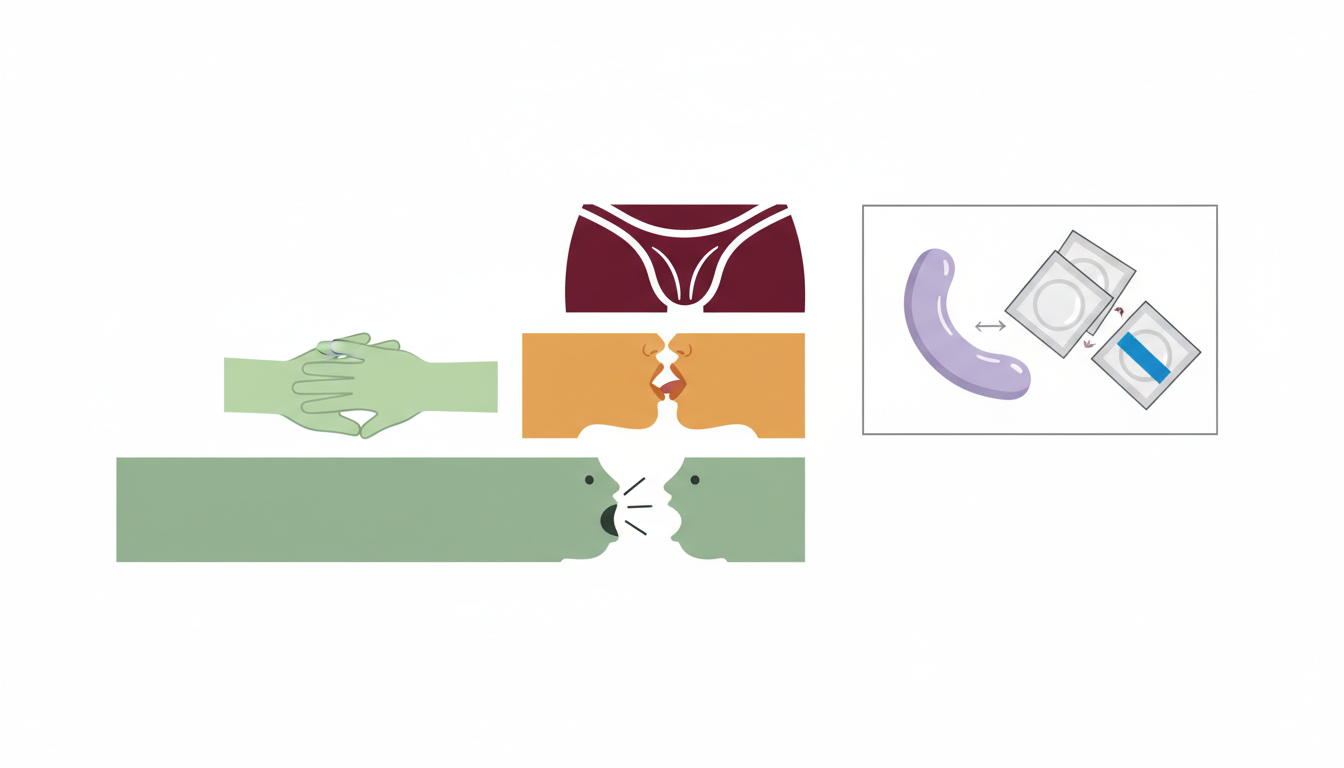
Sex toys are the underappreciated transmission route in foreplay because they sit in two risk categories at once. Used solo, they are nearly zero risk if cleaned reasonably. Shared between partners, or moved between body sites on the same person, they can transmit several infections including HSV, HPV, trichomoniasis, hepatitis B, and bacterial vaginosis-associated organisms.
The Mayo Clinic's STD overview hub covers the major sexually transmitted infections and the practical controls (cleaning, barrier use, avoiding cross-contamination) that apply to shared objects in intimate contact.
How to share sex toys safely
- Cover non-porous toys with a fresh condom for each partner. When you switch partners, switch the condom.
- Wash with mild soap and warm water between uses. For non-electric toys, follow the manufacturer's cleaning guidance, which usually includes a full water rinse and air drying. For electric toys, use a damp cloth on the body and avoid submerging unless explicitly waterproof.
- Don't move a toy from anus to vagina or anus to mouth without cleaning between. This is the same logic as not using the same gloves for raw chicken and salad. The microbiome of the anus is different from genital and oral environments, and transferring it causes both bacterial vaginosis flares and infection transmission.
- Toys made from porous materials (jelly, some TPE rubbers) cannot be fully sterilized. Always cover them with a condom when sharing, and consider replacing them periodically. Silicone, glass, and stainless steel are non-porous and easier to clean fully.
- Store toys clean and dry. Damp storage encourages mold and bacteria; that is a non-STD problem worth flagging.
If a partner has a known STI and you share toys without barriers, test on the standard windows for that infection (covered in the testing section below).
If you only adopt one habit from this section, make it this one: when sharing a toy between partners, swap the condom on the toy each time the toy changes user, the same way you would change a barrier when switching activities. That single action neutralizes most of the transmission risk that shared toys add, and it is far easier in the moment than scrubbing a toy mid-session.
Practical ways to reduce risk without killing the mood
The point of this section isn't to turn intimacy into a clinical procedure. It is to name the small set of habits that actually shift outcomes, so you can stop worrying about the long list of things that don't matter and pay attention to the few that do.
Have the status conversation early
Asking a new partner when they last tested, what they tested for, and what their pattern is sounds clinical until you've had it once. Then it becomes brief and matter-of-fact. The conversation also flushes out partners who haven't tested in years, partners who didn't realize their last screening didn't include the throat or rectum, and partners who simply assumed.
Use barriers for the activities that need them
Condoms for penetrative contact, condoms for sharing sex toys, dental dams or condoms cut open and laid flat for oral on a vulva or anus. Latex and polyurethane block fluid and most skin shedding. They don't perfectly block HSV or HPV, since those can shed from skin areas a barrier doesn't cover, but they substantially reduce risk.
Get the HPV vaccine if you're eligible
Per ACIP guidance summarized on the CDC's HPV page, routine vaccination runs through age 26, and shared clinical decision-making applies through age 45. The vaccine is most effective before any HPV exposure but provides benefit even after some exposure has occurred.
Test on a regular cadence, not just after a scare
The most common testing pattern (test only after something specifically worrying happens) misses the silent infections that happen between scares. Annual or six-monthly testing for sexually active adults with new partners, and quarterly testing for people with multiple new partners, catches the asymptomatic cases that scare-driven testing misses.
Treat treatment as a normal part of sexual health
Bacterial STIs (chlamydia, gonorrhea, syphilis, trichomoniasis) are curable with antibiotics. Viral STIs (HSV, HPV, HIV, hepatitis B and C) are managed with medications and have substantially better outcomes when caught early. A positive result is not a verdict; it is information that lets you take a specific action.
Disclosure: this article is published by stdrapidtestkits.com, which sells at-home STI testing kits. Recommendations are based on clinical fit for the reader's concern, not commercial benefit.
The two highest-leverage actions
- Use a barrier (condom or dental dam) for oral sex with a new or untested partner. This single change addresses the activity that drives most foreplay-related transmission.
- Get the HPV vaccine if you are eligible (routine through age 26, shared clinical decision-making through age 45). It is the only protection against HPV-related cancers that does not depend on per-encounter barrier compliance.
When to test, and what to test for
Different infections have different window periods, which is the gap between exposure and when a test can reliably detect the infection. Testing too early gives a false sense of security; testing on the right window catches the infection while it is still in the system. The window-period figures below reflect the CDC's STI Treatment Guidelines for current FDA-cleared assays; specific kits and laboratory assays may have slightly different validated windows on their package inserts.
Bacterial STIs (chlamydia, gonorrhea, syphilis)
Test from approximately 2 weeks post-exposure. Earlier than that, the bacterial load may be below the test's detection threshold. The CDC's screening guidance recommends annual testing for sexually active women under 25 and for older women with risk factors, plus annual screening for men who have sex with men.
HIV
Fourth-generation antigen-antibody tests detect HIV from approximately 2 to 6 weeks post-exposure for most people; a small subset takes longer. A retest at 12 weeks confirms a clear result. Earlier testing can miss recent infections, so factor in the window.
Herpes (HSV-1 and HSV-2)
Antibody tests detect seroconversion, which can take 6 to 12 weeks (occasionally longer for some assays). Testing during the window after a recent exposure can return a false negative. If you have visible symptoms (a sore or vesicle), a swab of the lesion at that moment is more direct than antibody testing.
Hepatitis B and C
Hepatitis B antibodies and antigens become detectable around 4 to 12 weeks post-exposure depending on the marker. Hepatitis C antibodies typically take 8 to 11 weeks. Both are blood tests.
HPV
There is no widely available routine antibody test for HPV in men. For women, cervical cancer screening (Pap and HPV co-test) is the established detection pathway, run on a multi-year cadence per cervical screening guidelines, not a per-encounter test. Genital warts, when present, are diagnosed visually.
What if I'm not sure which exposure I'm worried about?
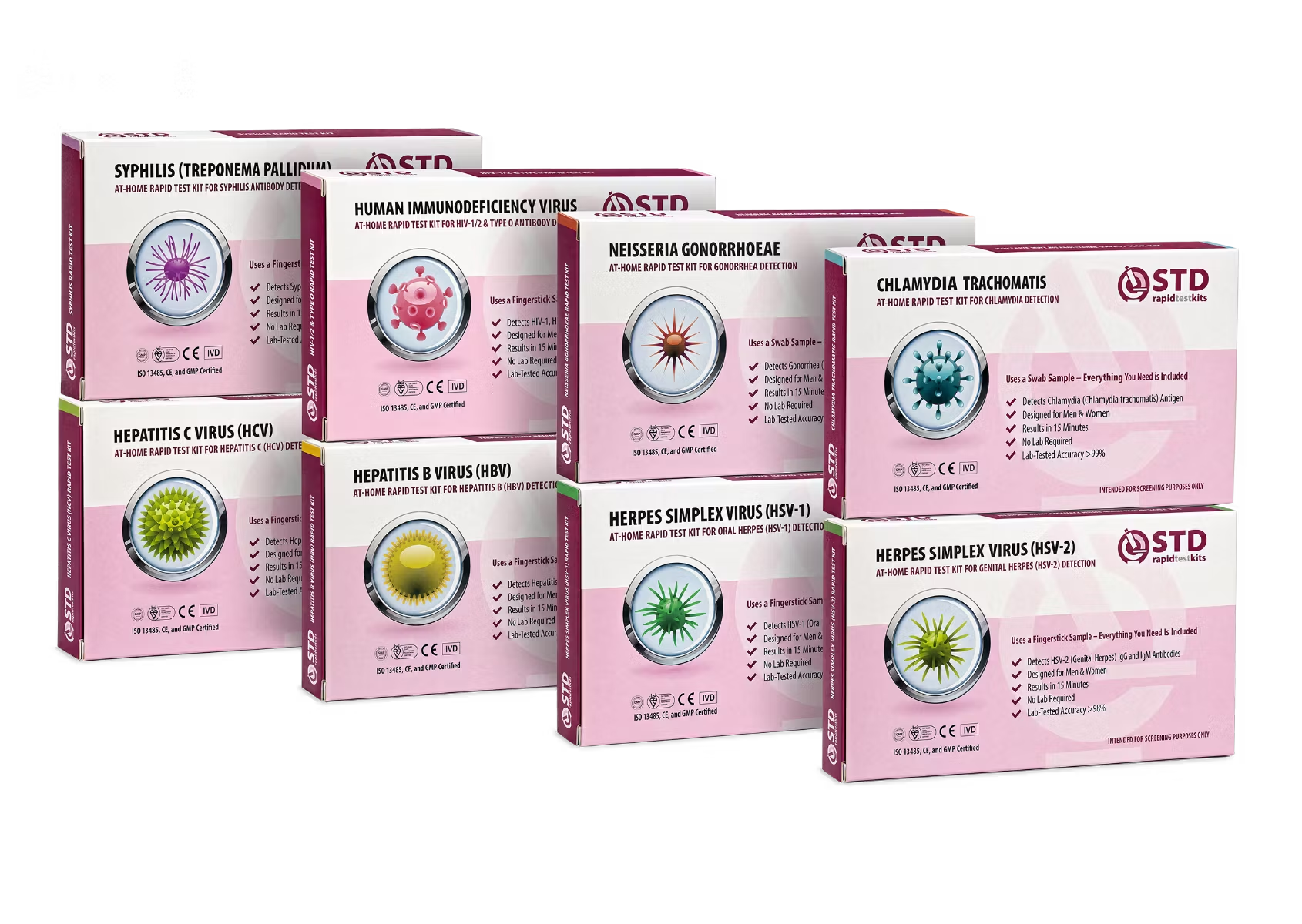
For a single concerning encounter where you don't know the partner's full status, the practical sequence is: test for bacterial STIs at 2 weeks, test for HIV at 6 weeks (or sooner with a fourth-generation test), and consider a herpes antibody test at 12 weeks if symptoms appear. A multi-infection home panel covers most of these in one kit and removes the guesswork about which single test to order.
Many STDs can be spread through oral sex. Using a condom, dental dam or other barrier method each and every time you have oral sex can reduce the risk of giving or getting an STD.
Frequently asked questions
- Can you get an STD from kissing?
- HSV-1 (oral herpes) is the main infection that transmits via mouth-to-mouth kissing, especially when one partner has an active cold sore or is shedding the virus asymptomatically. Other STIs like HIV, chlamydia, and gonorrhea are extremely rare from kissing alone, since they require genital tissue contact or fluid exchange that kissing typically doesn't provide. Syphilis can theoretically transmit from a chancre on the lip, but this is uncommon.
- Is oral sex really risky for STDs?
- Yes, and the throat-based route is the easiest to miss: pharyngeal gonorrhea and chlamydia produce no symptoms in most people, so a partner can pass them without knowing they have an infection. Barriers (condoms for oral on a penis, dental dams for oral on a vulva or anus) substantially reduce risk for chlamydia, gonorrhea, syphilis, herpes, and HPV. HIV transmission via oral sex is rare but not zero.
- Can sex toys transmit STDs?
- Yes, when shared between partners or moved between body sites without cleaning or a barrier change. HSV, HPV, trichomoniasis, hepatitis B, and bacterial vaginosis-related organisms can all transfer through shared toys. Wash with soap and warm water between uses, use condoms when sharing (and switch the condom between partners), and don't move a toy from anus to vagina or mouth without cleaning between.
- Does fingering carry STD risk?
- Hand-to-genital contact carries low but non-zero risk. The main scenarios are broken skin on the hand in contact with infectious fluid, or hands moving between partners without washing. Trichomoniasis can survive briefly on damp surfaces. Washing before and between partners brings the risk close to zero.
- What about HPV from skin-to-skin contact during foreplay?
- HPV transmits skin-to-skin and doesn't require penetration. Genital-to-genital rubbing is a recognized transmission route. Most HPV infections clear on their own within 1 to 2 years, but a subset cause warts or, over years, HPV-related cancers including cervical, oropharyngeal, and anal cancer. HPV vaccination (routine through age 26, with shared clinical decision-making through age 45 per ACIP) is the most effective single protection.
- If we both tested negative, can we skip barriers during oral sex?
- Some couples in mutually monogamous relationships choose this once they share recent comprehensive negative results. Be aware of test windows: a chlamydia or gonorrhea result reflects status from the time of testing, not from any exposure in the days afterward. HSV antibody tests reflect older infections and may not catch recent seroconversion. Comprehensive testing, mutual monogamy, and re-testing periodically are the conditions that make the choice reasonable.
- How soon after a worrying foreplay encounter should I test?
- The window depends on the infection: chlamydia and gonorrhea are testable around 2 weeks out; HIV with a fourth-generation test from 2 to 6 weeks (retest at 12 weeks to confirm); HSV antibodies from 6 to 12 weeks. Any symptoms warrant evaluation immediately regardless of timing.
- Is there a way to test for everything from one kit?
- Yes. Multi-test home panels cover the most common STIs in a single kit (typically 6 to 10 infections), which is more efficient than buying multiple single-infection tests separately. The 6-in-1 and 8-in-1 panels listed in this article cover the main infections from foreplay and intercourse exposure events. For pharyngeal or rectal swabs specifically, an in-clinic visit is the more reliable route, since at-home kits don't currently offer those swab types.
- U.S. Centers for Disease Control and Prevention. STI Treatment Guidelines, including transmission routes for chlamydia, gonorrhea, syphilis, herpes, and HPV; HIV oral-sex risk characterization; U=U guidance on suppressive treatment; and recommended testing windows for FDA-cleared assays.
- U.S. Centers for Disease Control and Prevention. Genital Herpes overview, including asymptomatic shedding and transmission via skin-to-skin contact.
- U.S. Centers for Disease Control and Prevention. About HPV, including transmission routes, HPV-related cancer pathway, and ACIP vaccination guidance.
- World Health Organization. Sexually transmitted infections (STIs) fact sheet, with global epidemiology and oral transmission routes for bacterial STIs.
- Mayo Clinic. Sexually transmitted diseases (STDs) overview hub, covering the major STIs and the practical controls (cleaning, barrier use, avoiding cross-contamination) that apply to shared objects in intimate contact.
