Why Sex Educators Say You Should Be Wrapping Your Toys
When to wrap a sex toy, when to skip, and how to clean up
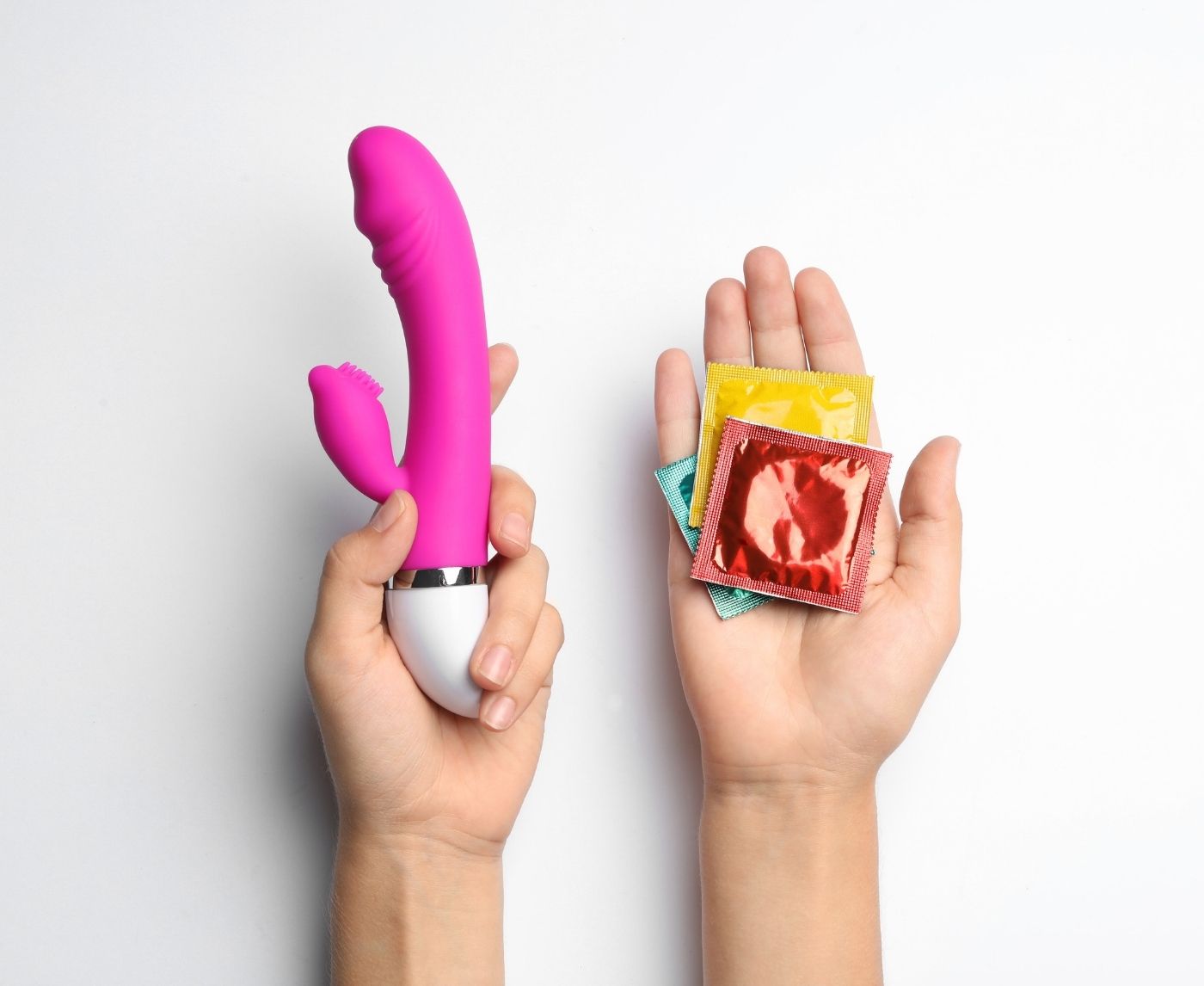



- Use a fresh condom on a toy whenever it crosses a border: between people, between body openings, or between sessions where cleaning was incomplete.
- Porous toy materials (jelly rubber, TPR, soft thermoplastics) cannot be fully sanitized at home. A condom is the practical workaround when replacing the toy is not an option.
Published: July 2025 | Last updated: May 2026 | Editorial review and quality control: Martina N.
The phrase “safer sex” usually conjures penises and condoms. It rarely conjures vibrators, dildos, or the silicone plug sitting in a bedside drawer. Yet sex toys can carry the same bacteria and viruses that move between bodies during partnered sex, and they pass between hands, partners, and orifices more easily than most people realize.
Wrapping a toy in a condom is the lowest-effort hygiene upgrade in sexual health. It costs about thirty cents, takes a few seconds, and prevents a long list of headaches: cross-contamination between people, accidental bacterial transfer between anal and vaginal play, ruined textured silicone, and lubricant residue that never quite scrubs out of grooves. This guide walks through when a condom on a toy is genuinely worth it, when you can skip it, and how to think about toy hygiene as a complete system rather than a single product.
Key Takeaways
- Use a fresh condom on a toy whenever it crosses a border: between people, between body openings, or between sessions where cleaning was incomplete.
- Porous toy materials (jelly rubber, TPR, soft thermoplastics) cannot be fully sanitized at home. A condom is the practical workaround when replacing the toy is not an option.
What the Actual Transmission Risk Looks Like
Sex toys can carry the same organisms that pass between bodies during unprotected sex. Chlamydia, gonorrhea, trichomoniasis, HPV, HSV, and HIV have all been recovered from inanimate surfaces in laboratory and clinical studies. Survival times range from minutes for HIV on dry surfaces to hours for chlamydia and gonorrhea on damp ones. The risk profile is different from skin-to-skin contact, but it is not zero, especially for toys used internally and not cleaned between uses (NHS STI overview).
Research that sampled vibrators after vaginal use has found HPV DNA on the toy surface, sometimes still detectable after one round of manufacturer-recommended cleaning. This is part of why mainstream sex educators now address toy hygiene as its own topic rather than folding it into general STI guidance.
Bacterial transfer is just as real. Studies of women who have sex with women have linked shared toy use to higher rates of bacterial vaginosis. The vaginal and anal microbiomes also do not get along: moving a toy from anus to vagina without a fresh barrier can introduce E. coli and other enteric bacteria where they cause urinary tract or vaginal infections.
Toy Materials Matter More Than You Think
The material your toy is made of determines how completely you can sanitize it. Bodies do not interact with all silicone, glass, or rubber the same way, and the difference is not cosmetic.
Body-safe, non-porous materials include 100% medical-grade silicone, borosilicate glass, stainless steel, and high-grade ABS plastic. These can be cleaned with soap and warm water, and if the toy contains no electronics, sanitized in boiling water or the dishwasher’s top rack with no detergent. Bacteria and viruses do not have anywhere to hide.
Porous materials include jelly rubber, thermoplastic rubber (TPR), thermoplastic elastomer (TPE), latex, and most “soft skin” novelty toys. Under a microscope, these materials have tiny pits and channels that trap fluid, lubricant, and microorganisms. No amount of scrubbing reliably removes everything.
One complication: many toys sold as “silicone” are in fact silicone blends, and some are mislabeled outright. Without lab testing you cannot always tell. If a toy feels squishier than firm silicone, smells faintly of plastic, or is being sold for under twenty dollars at a novelty store, treat it as porous regardless of what the label says. A condom turns the surface of a porous toy into latex (or polyisoprene, or polyurethane), which is non-porous and disposable.
| Material | Porous? | Cleaning method | Condom recommended? |
|---|---|---|---|
| 100% medical-grade silicone | No | Soap and warm water; boil 3 to 5 minutes if no electronics | Optional for solo use; yes when sharing |
| Borosilicate glass | No | Soap and warm water; boil or dishwasher top rack | Optional for solo use; yes when sharing |
| Stainless steel | No | Soap and warm water; boil or dishwasher top rack | Optional for solo use; yes when sharing |
| High-grade ABS plastic | No (surface) | Soap and warm water; do not submerge electronics | Optional for solo use; yes when sharing |
| Jelly rubber / TPR / TPE | Yes | Soap and water only; cannot be fully sanitized | Yes, every session |
| Latex novelty toys | Yes | Soap and water only | Yes, every session |
| Silicone blends (mislabeled) | Often yes | Soap and water; treat as porous | Yes, every session |
Sharing Toys, Between People and Between Body Openings
Sharing covers two situations, and both create transmission risk.
The first is between people. Whether you are passing a toy between partners in the same session, lending one to a friend, or playing in a group setting, the toy carries fluid from each previous user to the next. Public-health guidance is consistent here: do not share sex toys, and if you do, cover them with a new condom for each partner (NHS condoms guidance). “New condom” is the operative phrase. Reusing a condom across partners cancels the benefit.
The second is within one body. Anus to vagina is the highest-risk swap, because the rectal microbiome routinely contains bacteria that cause infections elsewhere. Mouth to vagina is also worth a barrier swap if you have any active oral concern, including cold sores, since HSV can transmit from oral surfaces.
The practical workflow educators teach in workshops:
- One condom per orifice, per person.
- Swap the condom whenever the toy crosses a “border” between people or between body openings.
- Tie off the used condom before setting the toy down, so it cannot accidentally be re-used.
The workflow exists for a reason: it removes the in-the-moment decision-making about whether the previous condom was “clean enough” or whether you can get away with skipping the swap.
Do you really need a condom on a sex toy?
Yes when you are sharing the toy between people, between body openings (vaginal, anal, oral), or when the toy is made of a porous material that cannot be fully sanitized. Probably not when you are the only user, the toy is 100% medical-grade silicone, glass, or stainless steel, and you use it in one body opening per session with a soap-and-water clean afterward.
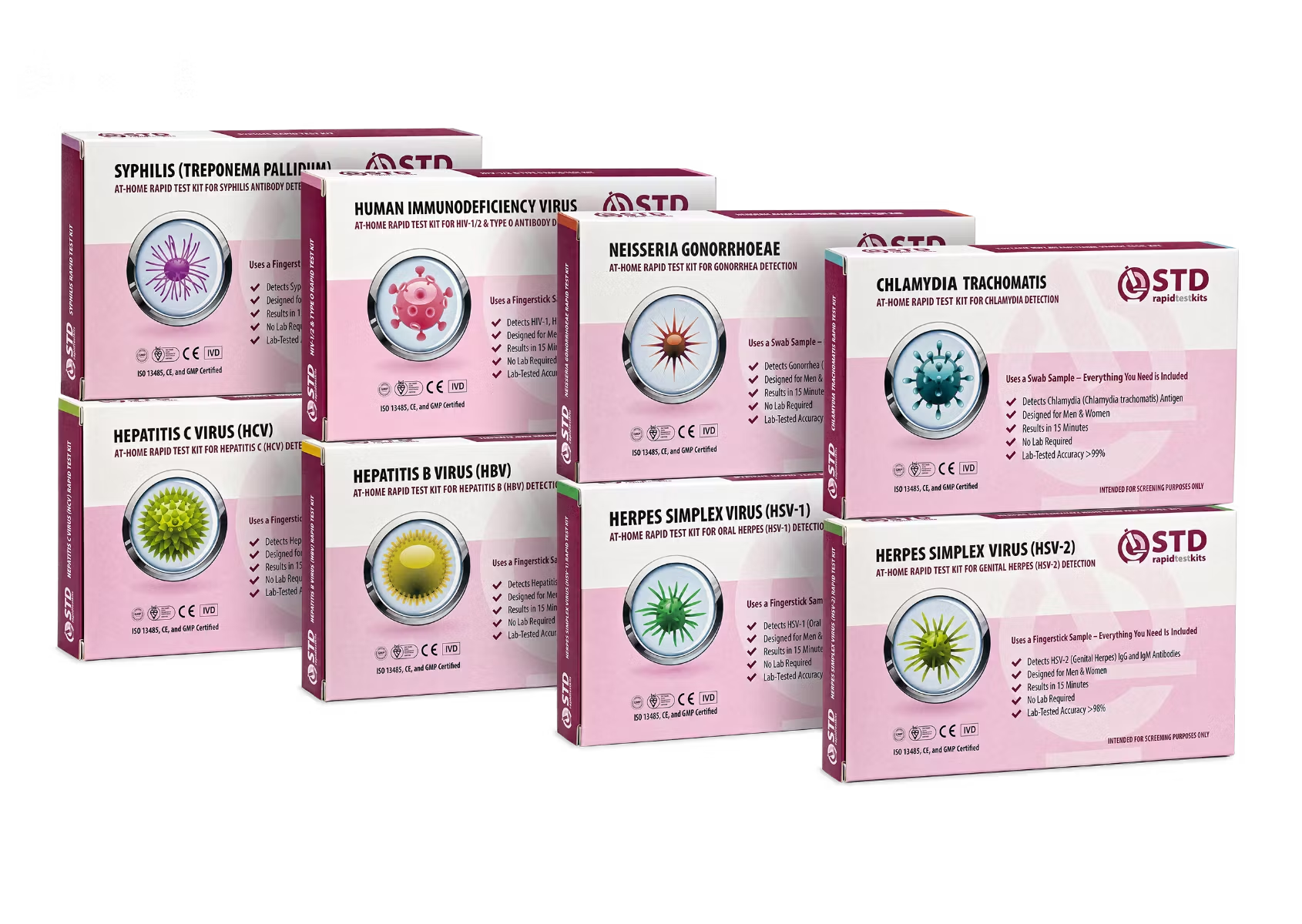
We sell at-home rapid STI test kits. The products mentioned below are recommended only where they fit a reader's concern (for example, after a shared-toy exposure), not as a general add-on to every situation.
Cleanup, Travel, and Extending the Life of Your Toy
Most people who use condoms on toys say the main day-to-day reason is not infection avoidance, it is cleanup. Anyone who has tried to dig dried lubricant out of the seam of a textured rabbit vibrator understands. The condom catches the lubricant, the fluid, and the cleanup time.
Situations where the cleanup factor matters most:
- Travel. Hotels and short-term rentals rarely offer ideal toy-cleaning conditions. A condom keeps the toy surface clean between rinses.
- Toys that are not waterproof or fully submersible. Many vibrating toys have battery compartments or motors that should not be soaked. A condom protects the toy body from fluids.
- Hard-to-clean lubricants. Silicone-based and oil-based lubricants are harder to wash off than water-based ones, and silicone lubricants can bond with cheaper silicone toys over time, leaving a sticky residue that does not come off.
Condoms also extend the lifespan of high-quality toys. Lubricant exposure can break down some surface coatings, and repeated deep-cleaning wears the texture down. Wrapping a toy you care about means you can skip the deep-scrub cycle after most sessions. One thing to avoid: double-bagging. Stacking two condoms on a toy increases friction between the layers and makes either layer more likely to tear.
If the condom is going on a silicone toy, choose a water-based lubricant for inside and outside the condom. Silicone lube can degrade cheaper silicone surfaces over time, leaving them tacky. Water-based lubes wash off easily with soap and warm water.
When You Probably Do Not Need a Condom
Most people, most of the time, with most toys, do not strictly need to use a condom every session. The defaults that make a condom optional:
- A toy made from 100% medical-grade silicone, borosilicate glass, or stainless steel with no porous components.
- Solo use only.
- Used in one body opening per session, with a normal soap-and-water clean afterward.
- Stored clean and dry between uses, in its own case or a clean drawer.
If all four of those are true, the chance of a toy causing an infection is low enough that adding a barrier is more about preference than risk reduction. Some people still prefer the wrap because it speeds cleanup or feels mentally cleaner. Both reasons are valid.
The defaults flip the moment any of those conditions break. Porous material, more than one user, more than one body opening, intermittent cleaning, or storage in a shared drawer with other toys: any of those reintroduces enough risk that a condom becomes the easier path.
Eco-Conscious Alternatives to Single-Use Condoms
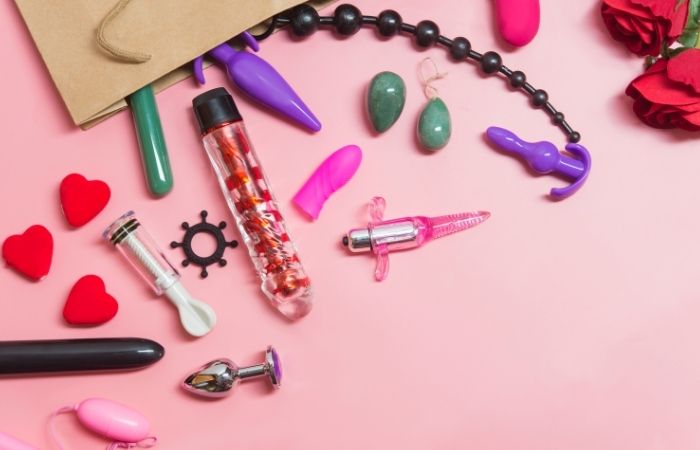
Single-use condoms are a real source of household waste, and not everyone wants to add a sleeve of latex to every session. There are reasonable lower-waste alternatives, with the caveat that all of them require more upkeep than a disposable condom.
- Reusable silicone toy sleeves. A few manufacturers sell soft silicone covers that fit over a vibrator or dildo and can be boiled or run through the dishwasher. They work well for solo use and for situations where you swap the sleeve rather than the toy. Sleeve sanitation is only as good as the boiling time and storage hygiene, and a torn or aging sleeve loses its barrier function.
- Investing in fully non-porous toys. Buying one good 100% medical-grade silicone toy that you can boil between deep-cleans replaces several condom-wrapped porous toys over time. Higher upfront cost, lower waste over its life.
- Biodegradable condoms. Brands like Sustain Natural and GLYDE sell natural-rubber latex condoms with reduced packaging and no animal-derived ingredients. They are not compost-safe in most municipal systems, but they break down faster than synthetic latex.
What does not count as a barrier: cling film, food wrap, balloons, latex gloves cut up into makeshift covers. These either do not seal, contain pinhole defects, or are not rated for body contact. They are not safer-sex devices in any clinical guidance.
Queer, Kink, and Group Play: Barrier Etiquette
Sex toys are central to a lot of queer and kink play, and the etiquette around barriers reflects that. In many lesbian and queer-women community settings, condom-on-toy is standard for any toy that crosses bodies. Strap-on dildos used in pegging or queer-women sex pass between bodies as easily as a penis does, and they deserve the same hygiene attention.
In kink-positive event spaces, condoms on toys are often a posted rule, especially for shared furniture or equipment (a Sybian, for example, or a fucking machine with interchangeable attachments). This is not because organizers think attendees are unclean. The logic is the same as wiping down a bench at a gym: a small, public act of care for the next person who uses the equipment.
For double-ended toys, designs meant to be used by two people simultaneously, the condom-per-end approach is the safe one. Each end gets its own condom, swapped if either user wants to change ends. Some manufacturers now sell double-ended toys with a textured neutral middle precisely so users can grip without confusing which end belongs to whom.
For sex toys used in non-monogamous relationships, the barrier rule scales with the number of partners. A toy used regularly with one consistent partner is hygienically very different from a toy used in a play-party context with several. At a play party, bringing your own condoms is expected for the same reason you would wipe down shared equipment at a gym.
Group-play barrier rules at a glance
- One condom per orifice, per person. Swap when the toy crosses a border.
- Double-ended toys: one condom per end, both ends fresh each time the toy changes hands.
- Shared equipment (machines, harnesses, Sybians): cover the attachment with a fresh condom for each user, the same way you would wipe down a gym bench.
Trauma-Informed Toy Play
For some people, sex with toys is a deliberately chosen route back into intimacy after sexual trauma, medical trauma, or both. Therapists who work in sex-positive trauma care often suggest that having control over hygiene rituals helps with grounding. The act of unwrapping a condom and rolling it onto a toy is small, deliberate, and reversible, and that combination is what makes it useful as a ritual: a clear signal that play is starting, a boundary the person decides on their own terms, and a way to neutralize a worry about cleanliness that might otherwise pull them out of their body.
This is not a treatment plan, and it does not replace working with a sex therapist if trauma is affecting your sexual function. For many people, though, the framing of “this is how I take care of my body and my pleasure” makes barrier use feel supportive rather than restrictive.
“They Used It With Someone Else”: What To Do
Finding out a toy was used with someone other than the people you assumed is uncomfortable, regardless of relationship structure. Wanting clarity about what happened and what your exposure was is not an overreaction. The questions worth working through:
- What kind of toy was it? Porous toys used with another person carry meaningfully more residual risk than non-porous toys that were cleaned between uses. A porous toy used without a condom is best retired and replaced.
- What body openings were involved, and was the toy cleaned between users? Anal-to-vaginal cross-use without a barrier or cleaning is the highest risk for both bacterial and STI transmission.
- When did the use happen relative to now? Most STIs have detectable windows of one to twelve weeks depending on the infection. Timing tells you when a test result will be most reliable (NHS STI overview).
- What is the relationship agreement going forward? Whether this is a trust conversation or a logistics conversation depends on the relationship. Either way, set explicit norms for toy hygiene going forward: condoms on shared toys, a written list of which toys are for whom, or a “shared” versus “private” toy split.
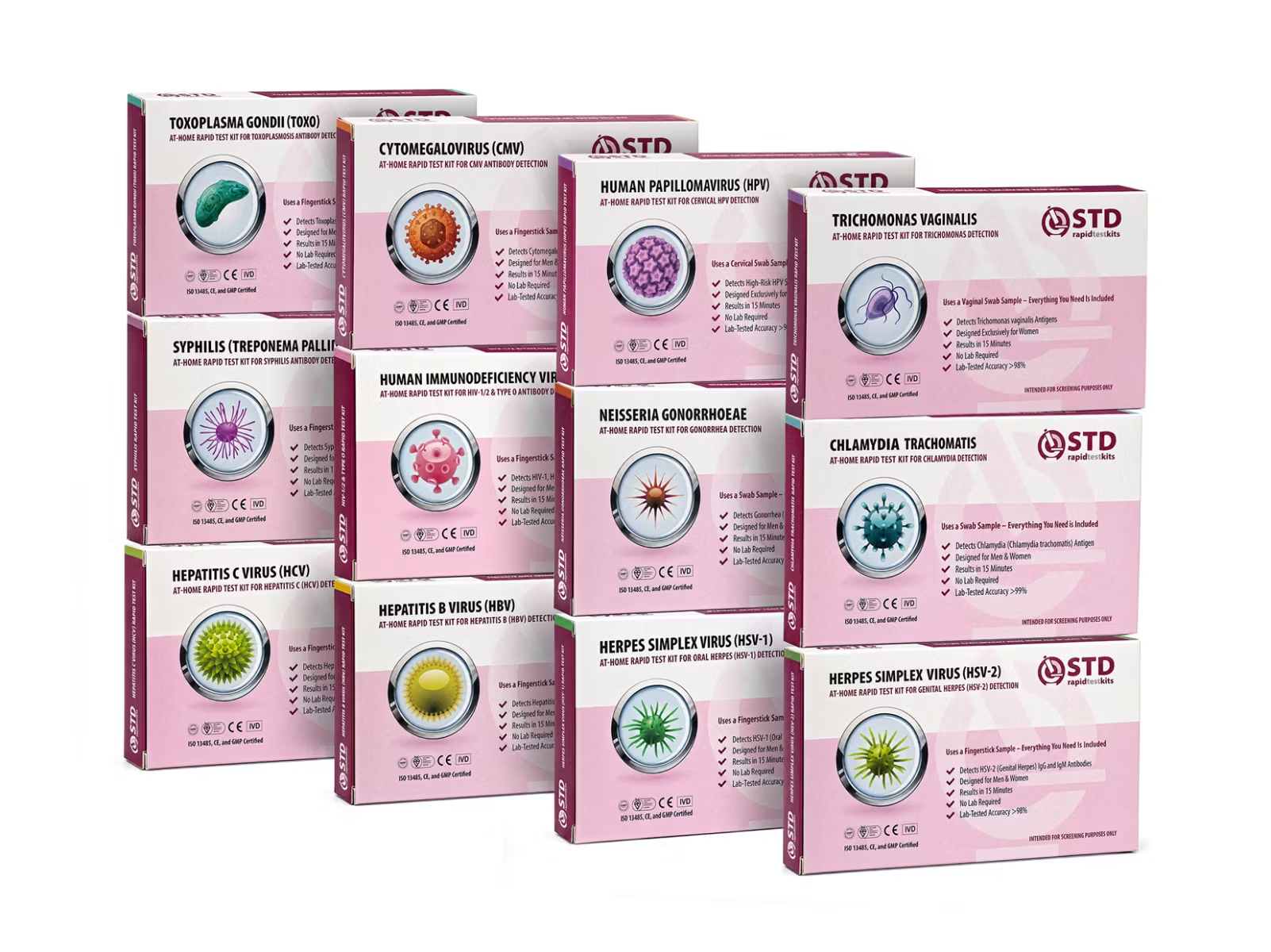
Testing is the cleanest answer to the medical question. An at-home rapid panel can screen for several common STIs without a clinic visit, and a clinic visit is still the right move for anyone with active symptoms or a known exposure to something like HIV.
Monogamy Is Not Microbe-Proof
There is a persistent idea that condom use, on toys or in general, stops being necessary once two people are in a closed relationship. Emotionally that tracks. Biologically it is partly right and partly wrong.
What it gets right: if both partners tested negative for STIs after their respective window periods, and have had no other partners since, the STI transmission risk between them through shared toys drops close to zero, assuming both partners are being accurate about exposures.
What it gets wrong:
- Asymptomatic carriers. HPV, HSV, and trichomoniasis can sit in a body for months without symptoms. A negative test on the first day of a relationship is not always the final answer for these specifically.
- Bacterial imbalance. The vaginal and anal microbiomes shift with hormones, antibiotics, diet, and toy use itself. BV and yeast overgrowth can occur in long-term monogamous relationships, and a shared toy can amplify a flare.
- Dormant exposure from before. A porous toy used before the current relationship and stored without thorough cleaning may still hold residue. If the cleaning history is unclear, the safer move is to retire it.
Condom use in a monogamous relationship is not an accusation. It is an option people can take or not take based on what they want from the session, what materials their toys are made of, and how much cleanup they want afterward (NHS condoms guidance).
Wrap the Toy, Protect the Pleasure
Condoms on sex toys are an underused, low-cost hygiene upgrade. Whether you use them every session or only when sharing, the decision should come from accurate information about the toy in your hand and the bodies in the room, not from shame, marketing, or assumptions. The reliable rule: when a toy crosses a border between people, between body openings, or between sessions of vastly different cleaning standards, put a fresh condom on it. Beyond that, condom use is preference, and either choice is defensible.
If anything in this guide raised an exposure concern worth clearing up, the next step is testing. Window periods matter, and an at-home rapid panel is the lowest-friction way to get an answer without scheduling a clinic visit.
Frequently Asked Questions
- Can I reuse the same condom on my toy?
- No. Always use a fresh condom when sharing toys, switching between partners, or switching between body openings. A reused condom carries fluids from the previous use and is mechanically weaker.
- What kind of condom works best on a sex toy?
- A standard non-lubricated external condom (latex or polyisoprene) is the workhorse. If you are using silicone toys, avoid silicone-based lubricant inside the condom, since silicone lubes can bond with cheaper silicone surfaces. Polyisoprene is the standard non-latex option for users with latex sensitivities.
- Is boiling my toy a substitute for using a condom?
- For solid, fully waterproof, 100% silicone or borosilicate glass or stainless steel toys with no electronics, yes. Boiling for three to five minutes is an effective sanitization step. For battery-powered, porous, or motor-containing toys, boiling is not safe, and a condom is the practical alternative.
- If I am the only one using my toys, do I still need condoms?
- In most solo cases with a body-safe toy and good cleaning habits, no. The exceptions are porous toys (where deep cleaning is not reliable), switching the same toy between vaginal and anal use within one session, and travel where cleaning conditions are limited.
- Are flavored condoms safe for internal toy use?
- Flavored condoms are intended for oral use. The flavorings can irritate vaginal and anal tissues, so for toys used internally, use an unflavored external condom.
- Do condoms reduce how good a vibrator feels?
- For most users, no. Vibrations transmit through latex and polyisoprene without meaningful loss, and some users prefer the slight reduction in friction. If sensation is a concern, an ultra-thin condom or a custom silicone sleeve are both options.
- What if my toy is an unusual shape or has a flared base?
- Most external condoms stretch to fit common toy shapes, including some with a flared base. For larger or wide-bulb shapes, a “large” or “XL” condom or a purpose-made toy sleeve fits better than forcing a standard size.
- Are there condoms made specifically for sex toys?
- A small number of manufacturers sell reusable silicone toy sleeves marketed for vibrators. Standard external condoms work in almost all cases and are widely available, which is why most sex educators default to them.
- NHS. Sexually transmitted infections overview, including symptoms, testing, and prevention.
- NHS. Condoms: how they work, how to use them, and guidance on shared sex toys.
- U.S. Centers for Disease Control and Prevention. Sexually transmitted infections (STI) main topic page.
- U.S. Centers for Disease Control and Prevention. Bacterial vaginosis basics, including risk factors.
- World Health Organization. Fact sheet on sexually transmitted infections, including transmission and prevention.
- MedlinePlus (U.S. National Library of Medicine). Sexually transmitted infections topic page.