
Published: September 2025 | Last updated: May 2026 | Editorial review and quality control: Martina N.
Not everyone walks out of a play party worried about STIs. Plenty of kink scenes feel safer on paper than mainstream sex: no penetration, no ejaculation, often no naked genital contact at all. That assumption is wrong in a specific, fixable way. Sexually transmitted infections do not need penetrative sex to pass between bodies. They need contact, and kink scenes routinely create the kind of contact that lets bacteria, viruses, and fluids move from one person to another.
This guide covers the exposures that get skipped in standard sex-ed: shared toys, impact play that breaks skin, gear that moves between partners, and the small fluid exchanges that feel like nothing in the moment. It also covers what to test for, when to test, and how to fold testing into your aftercare instead of treating it as a confession.
Key Takeaways
- Skin-to-skin contact, shared insertable toys, and reused gloves transmit STIs even when no penetrative sex happens. The reverse claim, that kink is automatically safer, is the single most common reason people skip testing after a scene.
- Testing windows differ by infection: 7 to 14 days for chlamydia and gonorrhea, 3 to 6 weeks for syphilis and hepatitis B, and 12 weeks for a reliable HSV-2 antibody test. Plan testing around the exposure that worries you most, not a single date.
How Kink Scenes Actually Spread STIs
Penis-in-vagina or penis-in-anus is one transmission route; it is not the only one. Sexually transmitted infections move through whatever route lets the pathogen reach a mucous membrane or a small break in skin. Kink scenes create those routes constantly, often without anyone noticing.
Shared insertable toys carry both bacteria and viruses. Cleaning a silicone dildo with soap and water reduces visible residue, but it does not reliably inactivate HPV or HSV. Published work in Sexually Transmitted Infections (Anderson et al., 2014) documented HPV DNA persisting on toys after standard cleaning, including on non-porous silicone. The fix is either a fresh barrier (a new condom on the toy for each partner) or a full disinfection step between uses: medical-grade isopropyl alcohol wipe-down, a 10% bleach solution rinsed thoroughly with water, or boiling for non-porous toys that tolerate heat.
Impact play that breaks skin is a second route. Caning, heavy paddling, single-tail whips, and needle play can produce small breaks even when no blood is visible. Hepatitis B is roughly 50 to 100 times more infectious than HIV per blood exposure (CDC Hepatitis B Information) and can survive on surfaces at room temperature for at least seven days. Sharing a flogger or cane that previously contacted a positive partner's blood is a real, if low-frequency, exposure route. HIV transmission through the same blood-contact route is real but substantially less probable than hepatitis B per exposure event, and requires a partner with detectable viral load plus an open entry point on your side. The risk is not zero in a bloody impact scene with shared implements, but documented seroconversion (the point when your immune system produces detectable antibodies) from this exact route is uncommon compared to hepatitis B; modern antiretroviral therapy further reduces it when the source partner is on suppressive treatment per CDC HIV transmission guidance.
Latex and leather gear creates a third route through cross-contamination. A glove used to penetrate one partner, then reused on another without changing it, is functionally the same exposure as bareback finger penetration. Bondage rope tightened around genitals can produce micro-abrasions that turn into entry points for HSV or syphilis the next time the rope is reused.
Fluid exchange that feels minor adds a fourth route. Saliva on a gag or flogger handle. Anal mucus carried on a butt plug. Pre-ejaculate or vaginal fluid wiped onto a leather harness that is then borrowed. The conventional script for sex does not cover any of these, even though the underlying transmission biology is the same as during intercourse.
| Exposure scenario | Likely STIs to consider | Suggested test point |
|---|---|---|
| Shared insertable toy used on multiple people without a fresh barrier | HPV, HSV, chlamydia, gonorrhea, trichomoniasis | Test 7 to 14 days; retest at 4 to 6 weeks |
| Impact play with broken skin (caning, paddling, needle play) | Hepatitis B, syphilis, HSV, HIV (lower probability) | Baseline now if blood was visible; retest at 6 to 12 weeks |
| Latex glove reused between partners | Chlamydia, gonorrhea, trichomoniasis | Test 7 to 14 days |
| Rope or harness in genital contact, then reused | HSV, HPV, syphilis | Watch for symptoms; test if anything develops |
| Saliva transfer (gag, flogger handle, mouth-to-toy) | Oral HSV, oropharyngeal gonorrhea | Clinic swab if symptoms or known exposure |
Window Periods: How Long to Wait Before Testing
Testing too early misses real infections. Testing too late lets them spread to the next partner. The window period (the gap between exposure and when a test can reliably detect the infection) varies more than most people expect, and rapid lateral-flow chemistry has different timing than a lab NAAT (nucleic acid amplification test, the standard high-sensitivity lab method).
Chlamydia and gonorrhea are detectable on lab NAAT testing as early as 7 days after exposure. At-home rapid lateral-flow swab tests typically peak in sensitivity by day 14, especially once any symptoms appear. If your exposure was a shared toy or a reused glove, day 14 is a reasonable test point.
Trichomoniasis follows a similar curve, with reliable detection by 7 to 14 days. Note that our home test for trich is validated only for vaginal self-swab in female anatomy; male readers needing a trich test should see a clinic.
Syphilis takes longer. The bacteria need 3 to 6 weeks to produce detectable antibodies after exposure. A test at 6 weeks catches the majority of infections; CDC guidance suggests a confirmatory test at 12 weeks if any chance of exposure remains.
Hepatitis B antibody and surface antigen tests become reliable at 6 to 12 weeks. If the exposure involved blood and broken skin, an early baseline test helps document your status, but a follow-up at the 8 to 12 week mark is what actually clears you.
HIV via the standard 4th-generation lab test (antigen-antibody) is detectable as early as 18 days after exposure for most people, with full coverage by 6 weeks per CDC HIV testing guidance. Rapid blood-based tests using antibody-only chemistry generally need 6 to 12 weeks for reliable results.
HSV antibody testing is the slowest. Most people develop detectable antibodies in 4 to 12 weeks, with a small fraction needing up to 16 weeks. A negative HSV-2 antibody result at 4 weeks does not rule out a recent exposure; a negative at 12 weeks is much closer to a real all-clear.
| Infection | Common kink exposure route | Earliest reliable test | Recommended confirmation |
|---|---|---|---|
| Chlamydia | Shared toys, glove reuse | 7 days | 14 days |
| Gonorrhea (genital) | Shared toys, glove reuse | 7 days | 14 days |
| Trichomoniasis (women) | Shared toys, vaginal contact | 7 days | 4 weeks |
| Syphilis | Skin-to-skin, blood contact | 3 weeks | 6 weeks |
| Hepatitis B | Open skin plus blood/fluid contact | 3 to 6 weeks | 8 to 12 weeks |
| HIV (4th-gen lab) | Blood contact, open skin | 18 to 45 days | 6 weeks |
| HSV-2 (blood antibody) | Genital skin contact | 4 to 6 weeks | 12 weeks |
| HPV (women) | Skin-to-skin, shared toys | No specific test point | Routine cervical screening |
Can you really get an STD without traditional sex?
Yes. Skin-to-skin contact, shared toys, gloves reused between partners, and small fluid exchanges in kink scenes can all transmit infections including herpes, HPV, chlamydia, gonorrhea, syphilis, and hepatitis B. Test at the right window for the infection you might have been exposed to: 7 to 14 days for chlamydia and gonorrhea, 3 to 6 weeks for syphilis and hepatitis B, roughly 18 days to 6 weeks for HIV on a 4th-generation lab test, and 12 weeks for an HSV-2 antibody test.
At-Home Rapid Tests vs Clinic Testing After a Scene
Both pathways work. The question is which one fits the exposure and your tolerance for friction.
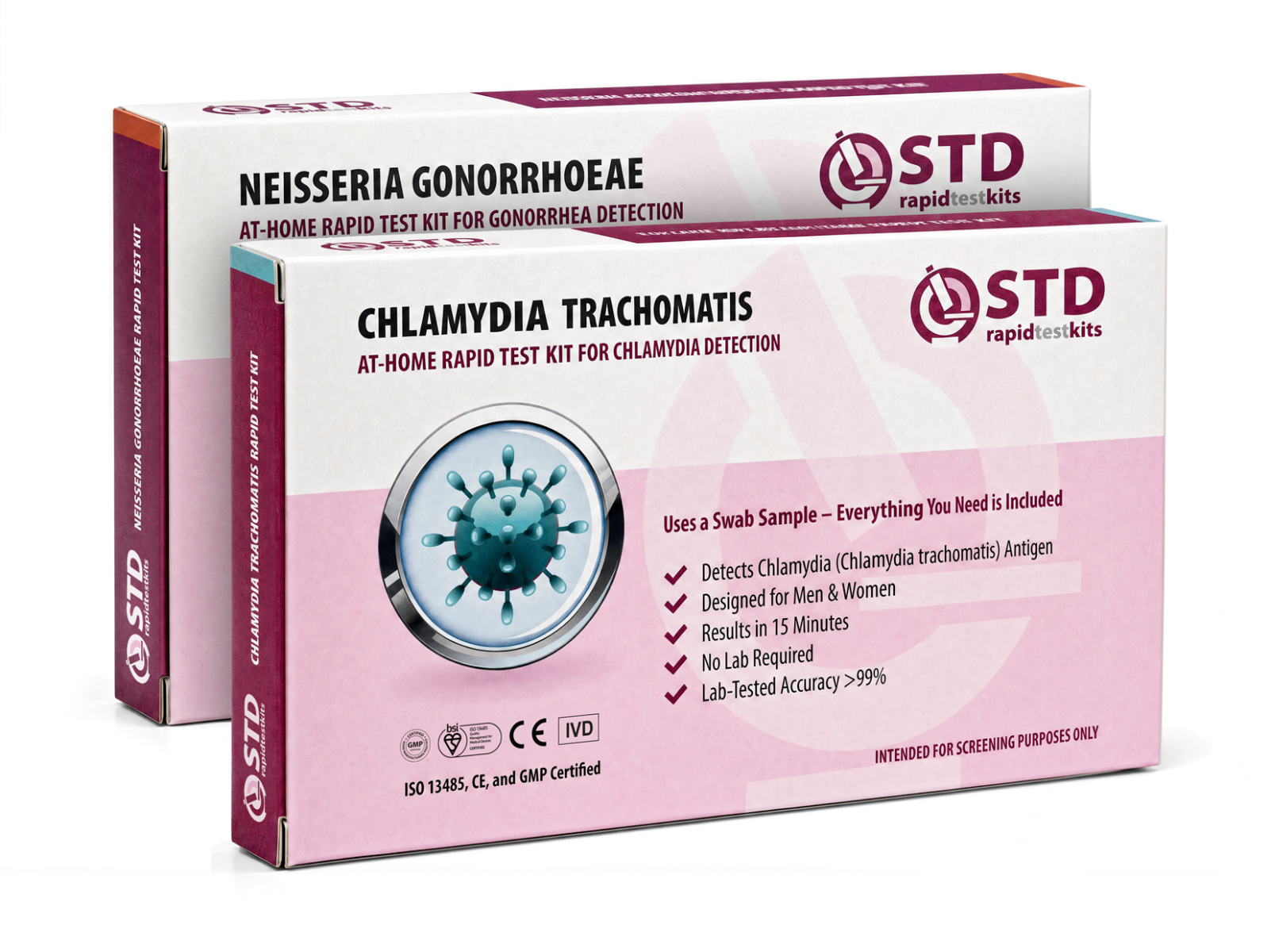
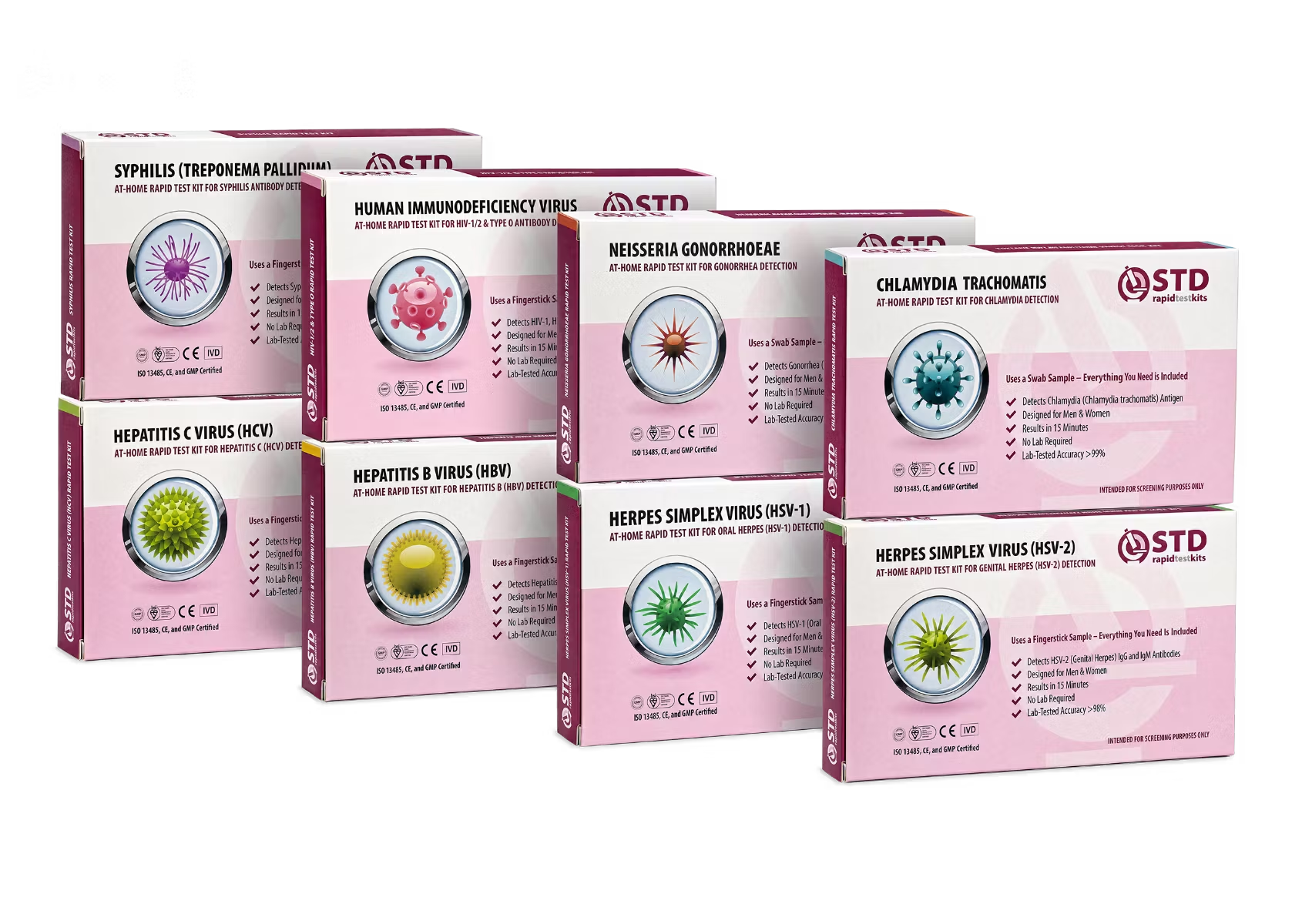
Rapid lateral-flow at-home tests give you a result in 10 to 20 minutes. They use either a fingerstick blood sample (HIV, syphilis, hepatitis B and C, HSV antibody) or a self-collected swab (chlamydia, gonorrhea, plus trichomoniasis and HPV for women). For most people in a kink scene, this is the right first move: privacy is high, results stay with you, and you can test at 14 days, 6 weeks, and 12 weeks as the windows for different infections close.
Lab-processed mail-in tests use the same sample types but send them to a lab for NAAT (chlamydia, gonorrhea) or confirmatory antibody work. Sensitivity is higher than rapid lateral-flow, especially for asymptomatic infections, and they can sometimes test sample sites a home kit cannot (rectal or oropharyngeal swabs, depending on the provider). Turnaround is 2 to 5 business days. If a rapid test came back negative but you want a higher-sensitivity confirmation, this is the next step.
Clinic testing is the right move when you have visible symptoms (a sore, an ulcer, unexplained discharge), when you need a pharyngeal or rectal swab, or when you want clinician-driven follow-up like partner notification and prescription treatment in one visit. Clinics can also do same-day blood draws for syphilis and HIV with faster turnaround on confirmatory results.
stdrapidtestkits.com sells the rapid lateral-flow at-home options. We don't sell mail-in NAAT panels, and we don't sell pharyngeal or rectal swabs. If your concern is throat exposure from oral contact in a scene, a clinic visit is the right call for that specific question; our home tests cover the genital and bloodborne side of the same exposure event.
A negative result inside a window period is not a clean bill of health. If your exposure happened in the last week, repeat the test at the 4 to 6 week mark. If you have ongoing partners from the same scene, retest after they have completed any treatment too.

When the Math Says You Should Test Anyway
The single most common reason people skip testing after a kink scene is some version of "but we didn't actually have sex." The exposure analysis above is what should override that reflex.
If a toy moved between bodies without a fresh barrier, the math says test, even if no genital contact happened in the conventional sense. A dildo that was vaginally inserted in one partner and then anally inserted in another (or the same partner, switching orifices) is functionally bareback contact between those two body areas; the toy is the route.
If an impact scene drew even small amounts of blood (and skin breaks too small to notice in the moment count here), the math says test for hepatitis B at the 6 to 12 week mark, especially if you don't have documented HBV vaccination on file.
If a glove was reused between partners, the math says test for chlamydia, gonorrhea, and trichomoniasis at the 7 to 14 day mark. Latex gloves are not a barrier when the same glove touches two people in succession.
The shorthand: if you are asking the question, the answer is usually yes. A rapid home test takes 15 minutes and gives you a real answer at day 14; follow up at 6 weeks for syphilis, hepatitis B, and HIV if the exposure was a bloody one.
Lowering Risk Without Killing the Scene
Risk reduction in kink does not require treating every scene like a sterile field. A few low-friction practices shift the risk profile substantially.
Barrier rotation on toys. A fresh condom on every insertable toy, swapped between partners and between body areas (vaginal to anal, anal to vaginal). Cheap, fast, and addresses the highest-frequency exposure route in the article above.
A fresh glove per partner and per body area. Latex or nitrile gloves are inexpensive and cut the pathogen load on hands or toys to functionally zero between uses, as long as you actually change them.
Disinfect toys properly between sessions, not just between partners. Soap and water removes visible residue but does not inactivate HPV or HSV reliably. Use one of: 70% isopropyl alcohol wipe-down for non-porous toys; a 10% bleach solution rinsed thoroughly with water; or boiling for silicone, glass, or stainless steel that tolerates it. Porous toys (jelly rubber, some TPE) cannot be fully disinfected; treat them as single-partner items or replace them.
Take blood and impact play seriously. Single-use needles, sharps disposed in a proper container, and individual canes or floggers per person when blood may be drawn. Hepatitis B vaccination, if you don't already have it, is the single highest-impact preventive step for impact scenes; it is a routine adult vaccine, available at most pharmacies, and provides lifetime protection in over 90% of recipients per CDC.
Build testing into negotiation. A standard ask before a scene with a new partner: when did you last test, for what, and what was the result? Offering your own results first removes the social cost of asking. Communities that have made this routine report fewer outbreaks and easier disclosure conversations overall.
More than 1 million sexually transmitted infections are acquired every day worldwide, the majority of which are asymptomatic.
What Happens If You Test Positive
A positive result after a scene is not a moral failing. It is biology doing what biology does in the presence of an exposure. The work after a positive splits into three: treatment, disclosure, and follow-up testing.
Treatment for the bacterial infections (chlamydia, gonorrhea, syphilis, trichomoniasis) is short courses of antibiotics, available through any clinic, urgent care, or telehealth provider that handles sexual health. Most regimens are single-dose or one-week. Hepatitis B in adults often clears on its own; chronic infection is uncommon (around 5% of adult-onset cases per CDC) and is monitored long-term. HSV is managed, not cured, with antiviral suppression that reduces both symptoms and onward transmission risk.
Disclosure is the part most people freeze on. A short, direct script works in kink communities: "I tested positive for X after our scene last weekend. Wanted to let you know so you can get tested too. Here is my treatment plan if you want it for reference." Not an apology, not an accusation, just the information the partner needs.
Follow-up testing closes the loop. After treatment for a bacterial STI, retest at the interval your provider recommends (typically 3 months for chlamydia and gonorrhea per CDC) to confirm clearance. For HSV and HBV, ongoing monitoring is part of the management plan rather than a one-off check.
Post-positive 3-step protocol
- Treat: antibiotics for bacterial STIs are single-dose or one-week courses, available through urgent care or telehealth; HSV antivirals reduce both symptoms and onward transmission.
- Disclose: short factual message to recent partners, including treatment status. People in kink communities respond better to direct disclosure than to elaborate explanations.
- Retest: 3 months post-treatment for chlamydia and gonorrhea to confirm clearance; ongoing monitoring for HSV and HBV per provider guidance.
Folding Testing Into Aftercare
The frame that works for ongoing kink involvement is testing as ritual, not testing as crisis. Picking a regular cadence and sticking to it removes both the anxiety and the social weirdness of testing only after something feels wrong.
A workable default for sexually active people in active scenes: a full panel every 3 months, plus targeted retesting after any specific exposure that warranted a one-off test. Many community-organized play parties now include testing reminders in the same calendar where they post event dates.
The targeted retesting protocol after a high-fluid or high-skin-contact scene: test the appropriate infections at the 14-day mark for the bacterials, again at 6 weeks for syphilis and hepatitis B, and at 12 weeks for HSV antibody if that was a concerning exposure. The math sounds heavier than it is in practice; once the cadence is in place, the actual time spent on testing is minutes per quarter.
A Realistic Testing Cadence for Active Kinksters
For people who play regularly, the testing cadence that produces both peace of mind and reasonable cost: a full panel every 3 months, with the option to swap in single-infection rapid tests between cycles for specific exposures. Combination kits cover the bacterial and bloodborne infections in one shipment, which works well for the quarterly cycle.
If your situation involves regular play with new partners or in group settings, the 3-month interval matches what CDC recommends for sexually active populations at higher exposure risk. For lower-frequency play, a 6-month or annual cycle is reasonable, plus testing on demand for specific concerns.
FAQs
- Can you really get an STD if there was no penetrative sex?
- Yes. Herpes, HPV, syphilis, and hepatitis B can all transmit through skin-to-skin contact, shared toys, or reused gloves. Chlamydia, gonorrhea, and trichomoniasis can transmit through any contact that gets one partner's secretions onto another partner's mucous membranes. None of those require penis-in-vagina or penis-in-anus contact to move between bodies.
- How risky are shared toys, really?
- Higher than most people assume. HPV and HSV can persist on toy surfaces after standard soap-and-water cleaning. Bacterial infections like chlamydia and gonorrhea transmit easily on a toy that moves between bodies inside a single session. Use a fresh condom on the toy for each partner, or fully disinfect (alcohol wipe, dilute bleach rinsed, or boiling for non-porous toys) between uses.
- I had heavy impact play that left bruises but no visible blood. Is testing worth it?
- If gear was shared and you have any reason to think a previous user could have had a bloodborne infection, test for hepatitis B at 6 to 12 weeks. Microscopic skin breaks from impact are real entry points even when nothing visibly bled. If the gear was your own and nobody else used it that night, the risk is low.
- Rope play is mostly safe, right?
- Mostly, with one caveat. Rope tightened around genital skin or other thin-skinned areas can cause micro-abrasions that become entry points for HSV or syphilis the next time the same rope is reused with someone carrying either infection. Personal rope (not shared between partners) and rope that does not contact genitals is genuinely low-risk.
- I didn't notice any fluids during the scene. Am I fine?
- Not necessarily. Pre-ejaculate, vaginal secretions, and anal mucus are not always visible. Skin breaks from impact play are often invisible in the moment. If anything in the scene involved genital contact, toy sharing, or sustained skin contact in sensitive areas, a test gives you a real answer instead of guessing.
- How long should I wait before testing after a scene?
- For chlamydia and gonorrhea, 7 to 14 days. For syphilis and hepatitis B, 3 to 6 weeks. For HIV on a 4th-generation lab test, about 18 days to 6 weeks. For HSV antibody testing, 12 weeks. If you have visible symptoms at any point, test immediately and then again at the appropriate window.
- Are at-home rapid kits actually accurate enough for kinky exposures?
- For testing inside the right window, yes. Rapid lateral-flow kits are well-validated for HIV, syphilis, hepatitis B and C, HSV antibody, and the major bacterial infections via swab. They are slightly less sensitive than lab NAAT for asymptomatic infections, so the protocol is: rapid test at the early window for fast peace of mind, plus retest at the longer window if anything came back negative but exposure was real.
- How do I tell a play partner I tested positive?
- Keep it short and factual: "I tested positive for X after our scene last weekend. Wanted to let you know so you can get tested too." Not an apology and not an accusation. People in kink communities respond better to direct disclosure than to elaborate explanations; the information is what they actually need.
Our article was constructed based on current advice from the most prominent public health and medical organizations, and then molded into simple language based on the situations that people actually experience. We pulled testing-window timing and screening cadence from CDC and WHO guidance, cross-referenced disinfection chemistry against published work in sexual-health journals, and reviewed every external link to confirm it leads to a primary source. Citations open in a new tab so you can verify any specific claim against the original guidance.
- U.S. Centers for Disease Control and Prevention. Sexually Transmitted Infections (STI) hub, including treatment guidelines and screening recommendations.
- U.S. Centers for Disease Control and Prevention. Genital Herpes hub, transmission and testing guidance.
- U.S. Centers for Disease Control and Prevention. Hepatitis B Information, transmission, infectivity, and adult vaccination guidance.
- U.S. Centers for Disease Control and Prevention. HPV (Human Papillomavirus), transmission and screening.
- World Health Organization. Sexually transmitted infections (STIs), global incidence and asymptomatic-infection statistics.
- U.S. Centers for Disease Control and Prevention. HIV testing, transmission risk, and barrier-method effectiveness.
