

Published: August 2025 | Last updated: April 2026 | Editorial review and quality control: Martina N.
Most men can carry chlamydia or gonorrhea for weeks or months without ever feeling sick. That isn't a niche statistic. The CDC's screening guidance specifically calls it out: a large share of male infections produce no noticeable symptoms, and the only reliable way to know your status is a test, not a 2 a.m. self-check in the mirror. This article is for any man who has ever Googled symptoms instead of booking a swab, who feels weird about clinics, or who has been told that 'real men' just push through. The piece covers the actual risk picture, what testing involves in 2026, and where at-home options fit in, with no lecture for anyone who has been putting it off.
Why don't men test for STDs as often as they should?
Most STIs in men produce no symptoms, and the cultural pressure around 'real men don't ask for help' tends to delay testing past the point where treatment would have been simplest. Public-health bodies including the CDC and WHO recommend that sexually active adults test at least once a year, with more frequent testing every 3 to 6 months for men with multiple partners or any condomless encounter with a new partner. At-home rapid tests, telehealth lab orders, and free public-health clinics now close the convenience gap, so 'I never had a chance to test' is no longer accurate for almost anyone.
Key Takeaways
- Most STIs in men produce no symptoms, so 'I feel fine' isn't a reliable substitute for testing on a schedule that matches your sex life.
- Public-health bodies recommend at least once a year for sexually active men, every 3 to 6 months for men with multiple partners or recent condomless exposure.
The Silent Side of Most STIs in Men
Marcus, 27, noticed a faint burn when he peed after a weekend trip with friends. He chalked it up to chlorinated pool water and beer. Two months later the burning was still there and discharge had started. By that point his girlfriend was infected too, and both of them needed antibiotics. 'I felt like a ghost,' he said later. 'Like I'd been carrying something I didn't even know about.'
His story is common, and it usually goes one of two ways: either symptoms are absent entirely, or they're so mild that men explain them away. The CDC notes that chlamydia often has no symptoms. Men may experience discharge or burning, but many don't notice anything at all. The same pattern shows up with gonorrhea, trichomoniasis, and HPV. Even genital herpes can shed virus during periods with no visible sores, which is how transmission keeps happening between partners who both 'felt fine.'
The 'I'd know if I had something' instinct is one of the most common reasons men skip testing. It feels like a reasonable belief because the symptoms we picture from sex-ed posters (a clear lesion, a dripping discharge, an obvious rash) only match a fraction of real cases. The biology doesn't care about how you feel. Bacteria can multiply in the urethra or rectum without triggering an immune response that you'd notice. Untreated, they can move upward and damage the epididymis, the same way untreated chlamydia in women can scar the fallopian tubes. Most of the time the symptoms aren't there to catch, so vigilance gets you nothing. Testing on a schedule that matches your sex life is what closes the gap.
Machismo: The Invisible Barrier
In communities where 'tough it out' is a default value, asking for a swab can feel less like routine healthcare and more like admitting weakness. That cultural pressure is well documented. Peer-reviewed research has linked masculine norms (specifically self-reliance, restricted emotionality, and risk-taking) to lower rates of HIV and STI testing across multiple countries. Men in those studies cite fear of looking weak, fear of being labeled promiscuous, and fear of moral judgment from clinicians.
The pattern shows up especially in Latino, Black, and rural communities, where ideas about masculinity often shape how men interact with the healthcare system. None of this is unique to one ethnicity or income bracket. White-collar professionals do the same thing. They Google symptoms at 1 a.m., post anonymously to subreddits, ask friends in vague terms ('hypothetically, if a guy had X...'), and then avoid the actual appointment. Online symptom checks aren't a substitute for a clinical exam or a lab test, which is the whole reason this article exists.
Talking to a clinician about your sex life feels uncomfortable for almost everyone the first time. It gets routine fast. Most providers are not surprised, judgmental, or interested in your history beyond what's clinically relevant. They are paid to do a job. If clinic visits genuinely aren't an option (work hours, insurance, geographic distance, or just dread), at-home testing has filled in a lot of those gaps. Where you test matters less than whether you test at all.
Across multiple peer-reviewed studies, men who score higher on traditional masculinity measures (self-reliance, restricted emotional expression, risk-taking) are consistently less likely to have been tested for STIs in the prior year, less likely to know their status, and more likely to delay seeking care after a possible exposure. The pattern is a population trend, not a personal failing.
The “No Symptoms Means No Problem” Myth
This myth is dangerous because it sounds like common sense. You feel fine, so why test? The problem is that your immune system can host an active infection without producing the kind of symptoms you'd notice in a mirror or feel during urination. Research on male carriers has consistently shown that a substantial portion of new diagnoses come from men with no warning signs at all. The same biology applies to viral infections.
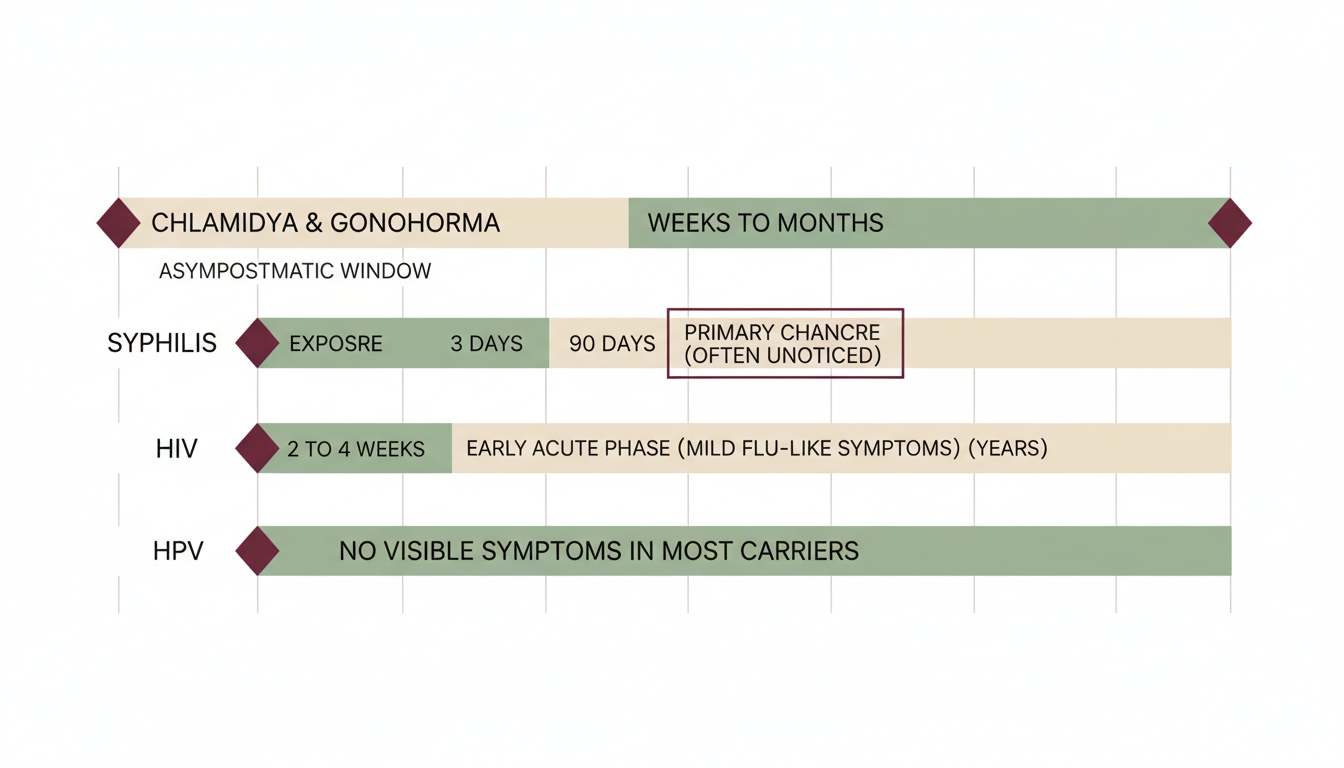
HIV during early acute infection can feel like a flu (fever, fatigue, sore throat) and pass without prompting a test. Syphilis can produce a single painless chancre that heals on its own, leaving the infection to progress to a secondary stage with rashes, swollen lymph nodes, and potential damage to the brain, nerves, and heart. HPV usually produces no symptoms at all, which is why partners can pass it back and forth for years before it ever causes a problem.
The 'I feel fine' response is also a permission slip to skip the awkward conversation with a partner. It feels like protection (no symptoms, no liability). What it actually does is delay the moment someone has to deal with it. By the time symptoms force the issue, treatment is more involved, and there's usually a partner-notification call that should have happened a long time ago. The CDC, WHO, and Cleveland Clinic all give the same recommendation: sexually active adults should get tested on a schedule that matches their risk profile, not their symptom profile. Testing screens for what you can't see, full stop.
Chlamydia: often produces no noticeable discharge, burning, or pain. Many male carriers feel completely normal.
Gonorrhea: can be silent in the urethra and is frequently silent in pharyngeal or rectal infection.
HPV: almost always produces no symptoms. High-risk strains can persist for years before any visible change.
Trichomoniasis: often produces no urethral symptoms in men, even when transmission to partners is active.
Herpes (HSV-1 and HSV-2): can shed virus during periods with no visible sores, sometimes called asymptomatic shedding.
HIV: the early acute phase may pass as a brief flu, then settle into years without symptoms.
When Waiting Has a Cost
Jorge, 35, works construction and prides himself on never missing a shift. A small sore on his shaft showed up after a new partner. He told himself it was friction from a tight harness belt. He didn't tell anyone. Three months later it still hadn't healed, his lymph nodes were swollen, and sitting hurt. The clinic confirmed secondary-stage syphilis. He needed a course of penicillin, partner notification, and a follow-up plan. 'I felt stupid,' he said. 'It wasn't that I didn't care. I didn't want anyone to think I was dirty.'
Jorge's delay was three months. CDC guidance confirms syphilis is curable with the right antibiotics when treated early. The primary stage requires the least clinical attention and the narrowest partner-notification net. The longer it sits untreated, the more complicated treatment becomes, and the wider that net gets. The same arithmetic applies to most other STIs. Untreated chlamydia in men can lead to epididymitis, a painful inflammation of the tube that carries sperm, and in a small subset of cases it contributes to fertility problems. Untreated gonorrhea can spread to joints and produce a reactive arthritis that lingers after the bacteria are gone.
Untreated HIV moves through stages over years and eventually damages the immune system enough to cause AIDS-defining infections. Modern antiretroviral treatment, started early, prevents nearly all of that and reduces the viral load to undetectable in most patients (which also makes onward transmission essentially zero). None of these outcomes are inevitable. They are downstream of delay. Machismo doesn't mention this part: ignoring an infection only buys it time to spread.
This article is published by stdrapidtestkits.com, which sells at-home STI testing kits. We recommend products based on fit-for-purpose for the reader's concern, not commercial benefit. Where a clinic visit is genuinely the better option, we say so.
What Testing Looks Like in 2026
Testing is no longer a single dreaded clinic visit. The options have multiplied. In-clinic testing remains the most thorough route, especially for newly active patients or anyone with active symptoms. Public-health clinics offer low-cost or free testing in most U.S. counties, often without requiring insurance. Telehealth visits can prescribe lab work that you complete at a Quest or LabCorp draw site, which keeps your interaction with a clinician on the phone instead of in a waiting room.
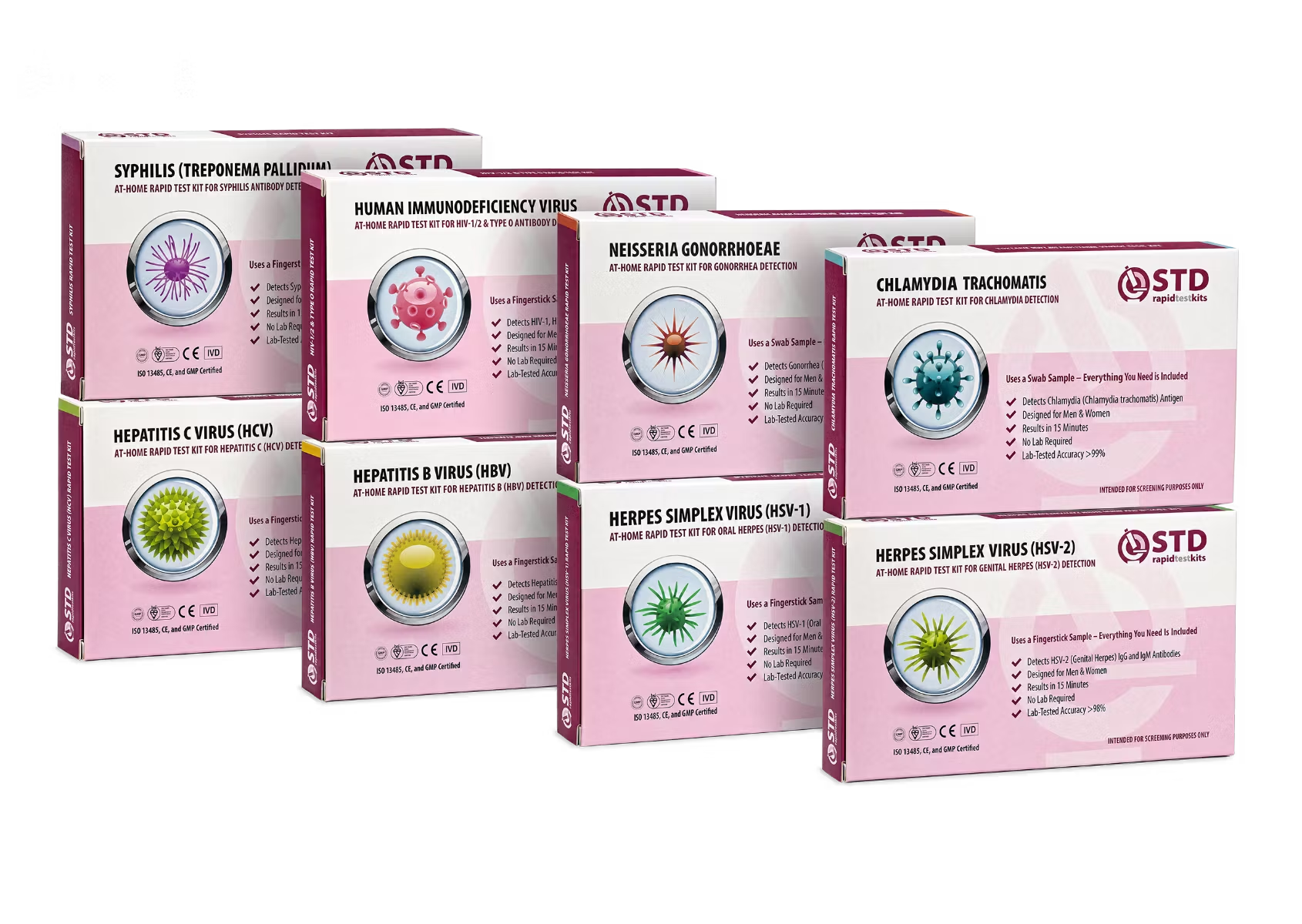
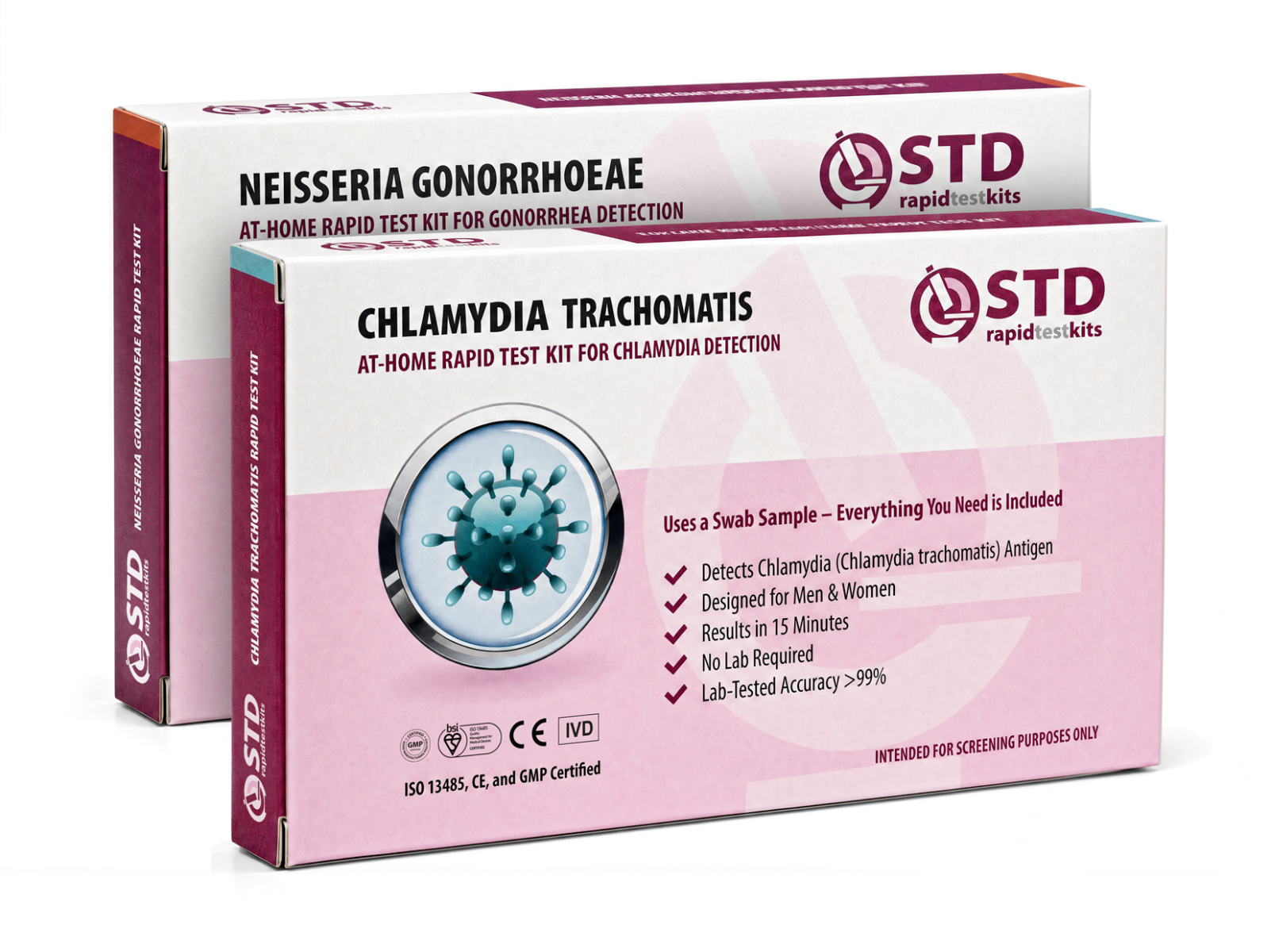
At-home rapid test kits cover the gap for men who genuinely won't book a clinic visit. They use a fingerstick blood sample (for HIV, syphilis, HSV, and hepatitis screening) or a self-collected swab (for chlamydia and gonorrhea), with a result you read on the cassette in about 15 minutes. Lateral-flow rapid tests are not the same technology as a laboratory NAAT (nucleic acid amplification test), which remains the gold standard for chlamydia and gonorrhea per CDC guidance. Rapid tests are screening tools. A positive result is worth confirming with a clinician. A negative result, taken inside the proper window after exposure, is reassuring on a population basis.
None of this replaces medical advice. It does mean that 'I never got a chance to test' is no longer accurate for almost anyone. The fingerstick blood draw is mildly uncomfortable for about five seconds. The swab takes a few seconds. The hardest part is the decision to do it. Once you've tested once, the second time is a non-event.
How to Bring It Up With a Partner
There is a version of this conversation where you tell your partner you want to get tested before changing how you use protection, and she thinks you're accusing her of something. There is another version where she says 'good idea, let's go together.' The difference is almost always tone, timing, and framing.
Most public-health communicators recommend framing testing as a shared step rather than a personal suspicion. 'I want both of us to feel relaxed before we change anything' lands differently than 'I think you might have something.' One reads as care. The other reads as accusation. Timing matters too. Bringing this up at the start of a relationship, or before a first sexual encounter, is a normal adult conversation. Bringing it up in the middle of an argument or right after sex is harder for everyone. The same tone-first principle applies whether your partner is a woman or a man. The accusation framing lands badly in either direction.
Jared, 29, learned that the hard way. His girlfriend sat on the edge of his bed with test results in her hand. She wasn't angry, he recalls. She was hurt. 'She said, I thought we were being safe.' That moment changed what testing meant for him. A routine chore became a way of protecting the trust between them. If you're already in a relationship and you've never tested together, you can introduce it as part of a yearly health routine. ('I'm overdue for blood work and a sexual-health screen, want to do yours at the same time?') When men model these conversations, the cultural script that says testing is suspicious starts to weaken. The hardest moments are the first three. After that, the conversations get easier with practice.
- Shared step: 'I want both of us to feel relaxed before we change anything about how we use protection.'
- Annual routine: 'I'm overdue for blood work and a sexual-health screen. Want to book yours at the same time?'
- Mutual care: 'I'd rather we both go in clean before this gets serious.'
What to avoid: any sentence that starts with 'I think you...' Even when the intent is care, the grammar lands as accusation.
The Data Behind the Silence
The WHO estimates more than a million new curable sexually transmitted infections worldwide every day in people aged 15 to 49, with viral infections like HIV and herpes adding to that total. The CDC's most recent surveillance summary shows that reported cases of chlamydia, gonorrhea, and syphilis in the United States remain at near-historic highs after a decade of steady increases. Men are tested less frequently than women on a per-population basis, even when reported behaviors (number of partners, condom use, recent symptoms) suggest similar risk.
Peer-reviewed research has found a consistent pattern: men who score higher on traditional masculinity scales are less likely to have been tested in the prior year, less likely to have known their status, and more likely to delay seeking care after a possible exposure. That's a population pattern, not a personal failing. It results from cultural messaging about what counts as a 'real' health concern, plus the very normal human instinct to avoid uncomfortable information.
The flip side: when testing becomes routine in a peer group, the rate goes up across that group. Norms move together. If your friends mention their last test the way they mention dental cleanings, you eventually mention yours. Public-health researchers describe this as denormalizing stigma, which is a fancy way of saying that talking about testing in regular conversation makes the whole thing easier for the next guy who needs to do it. None of this is theoretical. The infections are spreading in the gaps between sexually active adults who aren't being screened. Closing those gaps is the single highest-leverage public-health intervention for STIs at the population level.
More than 1 million curable sexually transmitted infections (STIs) are acquired every day worldwide in people 15-49 years old, the majority of which are asymptomatic.
The Group Pact: How Adrian and His Friends Made Testing Routine
Adrian, 29, and his friends started a routine after one of them tested positive for gonorrhea: twice a year, no excuses, the whole group goes. They built it into a Saturday: brunch, then the clinic, then the gym. Three years later they are still doing it. The conversation has shifted from awkward jokes to actual updates. Someone got a new partner, so he tested earlier than scheduled. Someone else had a result come back positive for HSV-1, learned the implications, and adjusted.
'It's just what we do now,' Adrian says. 'Like getting your car serviced. If you don't, it's gonna break down.' Group accountability is one of the fastest documented ways to break the silence around testing. When one person in a peer group models testing as routine, the rest tend to follow within months. This is true for healthy eating, gym attendance, financial planning, and (per public-health research) preventive screening.
Men who don't have a friend group like Adrian's can replicate the structure with one buddy. The protocol is simple. Pick a date, both book a test (clinic, lab, or at-home kit), share the result-back date, hold each other to it. Scheduling something with another person roughly doubles your odds of actually following through. That accountability is for your own benefit, even when it feels like you're doing it for the friend. Eric, 24, walked past his city's clinic three times before going in. 'I kept thinking someone would see me and assume the worst. In my head, I was already guilty of something.' One conversation with a friend who'd already tested was what got him through the door.
The buddy-system protocol, in four steps
- Pick a date together (clinic visit, telehealth lab order, or at-home kit, whichever both of you will actually do).
- Both book or order on the same day so the deadline is shared.
- Tell each other the expected result-back date so it stays on a calendar instead of in someone's head.
- Hold each other accountable until both results are in, then schedule the next round.
What Untreated STIs Actually Do
Most STIs are highly treatable when caught early. Bacterial infections (chlamydia, gonorrhea, syphilis) clear with a course of antibiotics in nearly all cases, though gonorrhea resistance to first-line antibiotics has been rising for over a decade, making it harder to treat without clinical guidance on the current regimen. Trichomoniasis clears with a single oral antibiotic. HSV (both HSV-1 and HSV-2) is not curable, though daily suppressive therapy reduces both outbreak frequency and transmission risk. HIV is now a managed chronic condition for people on antiretroviral therapy, with a normal life expectancy and no detectable virus in most adherent patients. HPV usually clears on its own; the small subset of high-risk strains that don't can be tracked and treated before they progress to cancer.
The story changes when treatment is delayed. Late-stage syphilis can produce neurological damage, cardiovascular damage, and visible skin lesions that complicate treatment. Untreated chlamydia in men can damage the epididymis. Untreated gonorrhea can disseminate, spreading through the bloodstream to skin, joints, and rarely heart valves. Untreated HIV progresses to AIDS over a span of years and dramatically reduces life expectancy. Untreated HPV can develop into anogenital cancers including anal, penile, and oropharyngeal cancers.
Chris, 35, only learned this lesson after a breakup. His ex told him she had tested positive for gonorrhea. He had no symptoms, no discomfort, nothing. He went straight to the clinic and tested positive too. 'I realized I could have been spreading this for months without knowing.' None of these outcomes are typical. They become more likely the longer you wait. The structural fix is the same in every case: screen on a schedule, treat what's positive, retest after treatment to confirm clearance for bacterial infections.
Real Strength Is Knowing, Not Guessing
Resilience usually gets framed as the ability to push through. The other half of resilience is knowing when to act before something gets worse. A man who notices a leaking pipe and ignores it isn't tougher than one who calls a plumber. He's just one floor away from a bigger bill.
Testing carries no moral weight. It's the same kind of routine maintenance most adults already do for their teeth, blood pressure, and cholesterol. The reason testing feels different is that we never modeled it as routine. The fix is straightforward: do it once, recommend it once, and stop apologizing. The cultural script around men's sexual health has been wrong for a long time, and the men who decided to test anyway, regardless of what their friends said, are the reason public-health data on testing rates is moving in the right direction at all.
If the last sexual-health conversation you had was in a high-school health class, you have a lot of company. The next one doesn't have to be in a doctor's office. It can be a five-minute phone reminder, a swab in your own bathroom, and a result you read on a Tuesday. Combo at-home test kits cover most of the common infections in a single panel, which keeps the friction low. Whatever route you pick, the goal is the same: stop guessing.
FAQs
- Can I have an STD without any symptoms?
- Yes, and it's common enough that waiting for symptoms before testing means waiting too long for most infections. Chlamydia, gonorrhea, HPV, and trichomoniasis are all typically silent in men. Herpes can shed virus without a visible sore. The only reliable way to know is a regular screening schedule, not a self-check in the mirror.
- How soon after sex should I get tested?
- It depends on the test type and the infection. Chlamydia and gonorrhea can typically be detected one to two weeks after exposure with a NAAT lab test, and rapid screening kits are most reliable around two weeks post-exposure. For HIV, lab-based fourth-generation antigen/antibody tests (drawn from a vein) usually detect infection 18 to 45 days after exposure. Rapid fingerstick fourth-generation tests, the kind used in at-home kits, can take 18 to 90 days to reach reliable accuracy. Full HIV confirmation is generally established at 90 days. Syphilis IgG seroconversion takes 3 to 6 weeks. If you test negative before the longer window, retest at the longer mark for definitive reassurance.
- Are at-home STD tests accurate?
- Lateral-flow rapid tests, used correctly inside the proper window after exposure, are reliable as a screen. They are not the same technology as a laboratory NAAT (nucleic acid amplification test), which remains the gold standard for chlamydia and gonorrhea per CDC guidance. Lab tests use molecular amplification and have higher analytical sensitivity, especially in early or asymptomatic infections. A positive at-home result is worth confirming with a clinician. A negative result, taken inside the right window, is reassuring on a population basis.
- How often should men get tested?
- Most public-health bodies (CDC, WHO) recommend at least once a year for sexually active adults, with more frequent testing every 3 to 6 months for men with multiple partners or any condomless encounter with a new partner. Anyone starting a new exclusive relationship should test before stopping barrier protection. Higher-risk groups (men who have sex with men, sex workers, anyone using injection drugs) typically need more frequent screening per CDC guidance.
- Can you get an STD from oral sex?
- Yes. Gonorrhea, syphilis, herpes (both HSV-1 and HSV-2), HPV, and chlamydia all have documented oral or pharyngeal transmission, and oral gonorrhea is often asymptomatic. HIV transmission via oral sex is possible but lower probability than other routes, especially when there are no oral lesions or bleeding gums. If you're concerned about a throat-specific infection, a clinic-administered pharyngeal swab is the right tool; we don't sell that test.
- Will testing show up on my medical record?
- Clinic-based testing typically goes into your chart and may be shared with your primary care provider depending on the system. Public-health departments report some positive results to state surveillance for disease tracking, but the data is anonymized for population research. At-home tests don't enter any medical record at all unless you choose to bring the result to a clinician. If a positive result is confirmed at a clinic, that visit becomes part of the standard record.
- What happens if I test positive?
- Most STIs are treatable. Bacterial infections (chlamydia, gonorrhea, syphilis, trichomoniasis) clear with antibiotics. HSV is managed with daily suppressive therapy. HIV is managed with antiretroviral therapy and is now compatible with normal life expectancy and zero onward transmission when the viral load is undetectable. The next step after a positive screening result is a clinical confirmation, treatment if applicable, and a partner-notification conversation. Public-health departments can help with anonymous partner notification if you'd rather not do it directly.
- How do I bring up testing with a partner?
- Ask as logistics, not confession. 'I'm overdue for blood work and a sexual-health screen, want to book yours at the same time?' is a low-stakes entry. If you're earlier in a relationship, framing it as mutual care rather than individual suspicion ('I'd rather we both go in clean before this gets serious') lands better than any version that starts with 'I think you...'. Suggesting you both do it at the same time keeps the energy collaborative rather than accusatory.
- U.S. Centers for Disease Control and Prevention. About Sexually Transmitted Infections, including general screening guidance and high asymptomatic-infection prevalence in men.
- U.S. Centers for Disease Control and Prevention. About Chlamydia, including the frequent absence of symptoms and recommended screening cadence.
- U.S. Centers for Disease Control and Prevention. About Gonorrhea, including rising drug-resistance trends and the need for clinical guidance on current treatment.
- U.S. Centers for Disease Control and Prevention. About Syphilis, including the silent primary-stage chancre and progression to secondary disease when untreated.
- U.S. Centers for Disease Control and Prevention. HIV testing recommendations, including window-period timing for laboratory-based and rapid fingerstick fourth-generation tests.
- World Health Organization. Sexually Transmitted Infections (STIs) fact sheet, source of the global daily new-infection estimate for curable STIs in people aged 15 to 49.
- UK National Health Service. Sexually transmitted infections (STIs) overview, including when symptoms typically appear and when to seek testing after a possible exposure.
- Cleveland Clinic. STD Testing overview, including testing types, sample collection, and follow-up care.
