
Published: December 2025 | Last updated: May 2026 | Editorial review and quality control: Martina N.
Most men in the United States have been exposed to HPV by middle age, yet the standard checkup almost never screens them for it. The U.S. Centers for Disease Control and Prevention notes that nearly everyone who is sexually active will get HPV at some point in their lives unless they have been vaccinated (CDC, About HPV). The catch for men is structural: there is no FDA-approved general HPV screening test in routine clinical practice, so a man can carry the virus, clear it, transmit it, or eventually develop a cancer from it without anyone offering him a test along the way.
The reassuring part of that picture, before any of the rest of this article: for most men with a healthy immune system, an HPV infection clears on its own within about two years without causing any lasting problem (CDC, About Genital HPV Infection). The screening gap is real, and it matters for the minority of cases that do not clear. But the default story is not catastrophe.
This guide walks through why the gap exists, what tests do exist for higher-risk situations, what to do when an at-home or in-clinic HPV test is not an option, and how to think about exposure without panic or denial. It is written for any man trying to figure out whether to push his provider for more, whether to vaccinate or revaccinate, and what to say to a partner when neither side has clear answers.
Key Takeaways
- HPV testing is not part of standard care for men in the United States, even when they ask, so a man can carry and transmit the virus for years without ever being tested or diagnosed.
- The tools men actually have today are vaccination through age 26 (with shared clinical decisions through age 45), consistent condom use, and routine testing for the other STIs that travel alongside HPV.
This Is Not Just a Women's Virus, And It Never Was
HPV, the human papillomavirus, gets framed as a women's health issue almost everywhere it appears. The clinical scaffolding around it (Pap smears, cervical cancer screening, vaccination campaigns aimed at teenage girls) was designed in that direction for solid medical reasons. Cervical cancer was the most lethal HPV-linked disease for decades, and women had the only validated routine screening test for the precancerous cell changes the virus causes.
That history created a structural gap with real consequences. HPV does not care about gender or orientation. It infects skin and mucous membranes wherever genital, oral, or anal contact happens, which means cis men, gay men, bi men, trans folks, and nonbinary people all sit inside the same risk pool. The U.S. National Cancer Institute notes that nearly all sexually active people are infected with HPV within months to a few years of becoming sexually active (National Cancer Institute, HPV and Cancer). Validated screening, however, exists for cervical cancer and not for the high-risk strains men also carry. Women get screened, treated, and counted; men sit outside that infrastructure.
HPV-associated cancers in men (throat, anal, penile) account for a meaningful share of all HPV-attributable cancer cases in the United States today. Treating HPV as a women's-clinic problem leaves the male side of that chart with almost no preventive infrastructure beyond vaccination, which is exactly why the screening gap persists.
Why HPV Testing Is Not Routine for Men
The absence of routine male HPV screening is not because the virus behaves differently below the belt. It is a layered policy decision built on cost-effectiveness models, the limits of validated test technology, and old assumptions about who carries clinical risk.
| Reason | What It Means |
|---|---|
| No FDA-approved test for penile HPV | There is no validated screening sample type for the penis or scrotum comparable to a cervical Pap smear, which limits what primary-care providers can order. |
| Most HPV clears on its own | Roughly nine in ten HPV infections clear within two years per CDC data, especially in men, so the assumption embedded in current guidelines is that mass screening would not change clinical action often enough to justify itself. |
| Focus on cancer prevention in women | Cervical cancer's tight link to HPV made female screening the priority in every guideline that followed, and male screening has lagged behind. |
| No symptoms equals no urgency | Most men with HPV have no symptoms, so neither they nor their doctors think to bring it up during routine checkups. |
What Testing Does Exist for Men Today
There is no FDA-approved general HPV screening test for men. The tests that do exist sit in narrow clinical contexts or in research settings, and most primary-care providers will not bring them up unless a patient pushes.
| Test Type | Who It Is For | Limitations |
|---|---|---|
| Anal Pap or anal HPV swab | Often used for men who have sex with men, especially if HIV-positive or immunocompromised | Not standard primary-care testing; often requires a specialist (proctologist or specific anal-dysplasia clinic) |
| Visual diagnosis | Used when visible genital warts are present | Identifies only low-risk strains that produce warts; does not detect high-risk types linked to cancer or any internal infection |
| Penile or oral swab testing | Largely research-only at this time | Not validated for general clinical use; not available through routine ordering |
This site does sell a rapid at-home HPV test, but its validation is currently limited to self-collected vaginal samples, which makes it appropriate for women only at this time. There is no validated at-home HPV test for male anatomy on the U.S. market that we know of. Men whose partners have a high-risk HPV result, or who have other reasons to want HPV screening, should see a primary-care provider, urologist, proctologist, or ENT specialist depending on the area of concern.
Why Feeling Fine Does Not Mean You Are Safe
Most STIs make their presence felt somewhere along the way. Burning, itching, discharge, a fever, a sore that sticks around longer than it should, all of these can prompt a visit. HPV does not work like that. In men it is overwhelmingly asymptomatic. There is no fever, no discharge, no sting during urination, no rash on the timeline you would expect from a textbook STI. Even the visible form (genital warts caused by low-risk HPV types) is regularly mistaken for ingrown hairs, skin tags, friction bumps, or condom irritation.
The strains that matter most clinically (HPV 16, HPV 18, and a handful of other high-risk types) almost never cause warts at all. They cause silent cell changes deep in the cervix, the back of the throat, the anal canal, or the penis itself. Those changes take years to develop into something detectable. A man can host a high-risk strain for a decade, pass it to multiple partners along the way, and never get a single cue from his own body that anything is happening.

What Carrying HPV Without Knowing Looks Like in Practice
Public-health educators and sexual-health clinicians describe a recurring pattern. A man gets what he considers a thorough STI workup before a new relationship. The panel checks chlamydia, gonorrhea, syphilis, HIV, and sometimes herpes. Every result comes back negative. He shares the clean panel with his new partner, and they both make decisions based on it.
Months or years later, the partner returns from a routine Pap smear with abnormal results and a high-risk HPV finding. The man, blindsided, defaults to the only mental model he has: I tested negative, so it cannot be me. The truth he has not been told is that HPV was never on his panel in the first place. Standard STI testing does not include HPV for men in almost any context, so a clean STI bill of health and an HPV diagnosis on his partner's chart are entirely compatible.
This is not anyone's fault on the individual level. It is the predictable consequence of a screening system that was built to protect one outcome (cervical cancer in women) and stopped there. The emotional fallout (blame, confusion, mistrust between partners) is real, and it lands disproportionately on the partner who got tested, not the partner who could not be.
A standard male STI panel does not include HPV. A clean panel result and a high-risk HPV diagnosis on a partner's chart are entirely compatible. When a partner gets a Pap-smear flag, the honest answer is not "I tested negative for that" but "the U.S. system does not routinely test me for that."
The Cancers HPV Causes in Men, and Why That Matters Now
For most of the last forty years, HPV-associated cancer was synonymous with cervical cancer. That picture has shifted. According to the U.S. National Cancer Institute, HPV-associated oropharyngeal cancer rates in men have been rising for two decades, and oropharyngeal cancer is now among the most prevalent HPV-associated cancers in American men (National Cancer Institute, HPV and Cancer). The trend is driven by oral and pharyngeal infections from sexual contact, an entirely preventable shift if vaccination rates were higher.
The other cancers in the male HPV chart matter too:
- Penile cancer is rare in absolute terms but disproportionately driven by chronic high-risk HPV infection.
- Anal cancer rates have risen for two decades, particularly in men who have sex with men and in immunocompromised men.
- Oropharyngeal cancer (throat, tonsil, base of tongue) in men is rising fastest, and is almost always HPV-driven when it appears.
None of these cancers comes with an early warning. They develop slowly, over years, from a virus the man almost never knew he had. By the time symptoms appear (a persistent sore throat, trouble swallowing, a lump in the neck, blood in the stool), the cancer is already established. That is the gap early prevention is designed to close.
Nearly everyone who is sexually active will get HPV at some point in their lives if they don't get the HPV vaccine.

Why the Medical System Has Not Caught Up Yet
Screening recommendations in the United States are written by panels (the U.S. Preventive Services Task Force, the American Cancer Society, specialty societies) that weigh whether testing changes outcomes at a population level. For HPV in men, the math has been frustrating for advocates.
About nine out of ten HPV infections clear on their own within two years without any intervention (CDC, About Genital HPV Infection), so a positive test in most men would not change clinical action. There is no proven treatment for the HPV virus itself, only for the diseases it eventually causes (warts and precancers). And there is no validated screening test for penile or oral HPV that produces actionable results most of the time.
Stacked, those facts make it hard for a guideline body to recommend mass male screening. They do not, however, account for the secondary harms that flow from the gap: silent transmission to partners, missed counseling opportunities for vaccination, and emotional fallout when one partner tests positive and the other has no way to know their status. Those harms are real, but they have historically not been the metric guideline writers use.
The shift is starting. As HPV-related cancers in men climb past historical baselines, some specialty groups now recommend anal Pap testing for men who have sex with men, and ENT societies are looking harder at oropharyngeal screening for high-risk patients. None of this has reached routine primary care for the average man yet.
The three structural barriers in plain language
- Most HPV infections in men clear on their own within two years, which makes mass screening hard to justify on traditional cost-effectiveness grounds.
- There is no treatment for the HPV virus itself, only for the warts and precancers it can later cause, so a positive test in an asymptomatic man does not usually change clinical action.
- No validated, FDA-approved screening test exists for penile or oral HPV in routine clinical use, so even providers who want to test cannot order a standardized one.
What Men Can Actually Do Now
You cannot wait for a guideline change. Until screening for men becomes standard, the playbook is built on prevention and on testing for the infections that travel alongside HPV, not on direct HPV detection. The most useful steps a man can take today look like this.
- Get vaccinated if you are under 27, and talk with your provider about catch-up vaccination through age 45 under the CDC's shared clinical decision-making guidance. The current vaccine covers nine of the highest-risk HPV strains, and protection holds even after some prior exposure.
- Use condoms consistently. They do not eliminate HPV transmission (the virus is shed from skin not always covered by the condom) but they measurably reduce it, and they reduce the other STIs in the same chain.
- Screen for the STIs that travel alongside HPV. Chlamydia, gonorrhea, syphilis, HIV, and herpes are all testable and (in the bacterial cases) curable in ways HPV is not, and they share transmission routes.
- Watch the visible signal. Any new growth, bump, or lesion in the genital or anal area gets a look from a clinician, even when it seems trivial.
- Talk to partners with the right vocabulary. "I have a clean STI panel" is true; "I am HPV-negative" is almost never something a man can honestly claim.
Why At-Home STD Testing Still Helps Men Even Without HPV
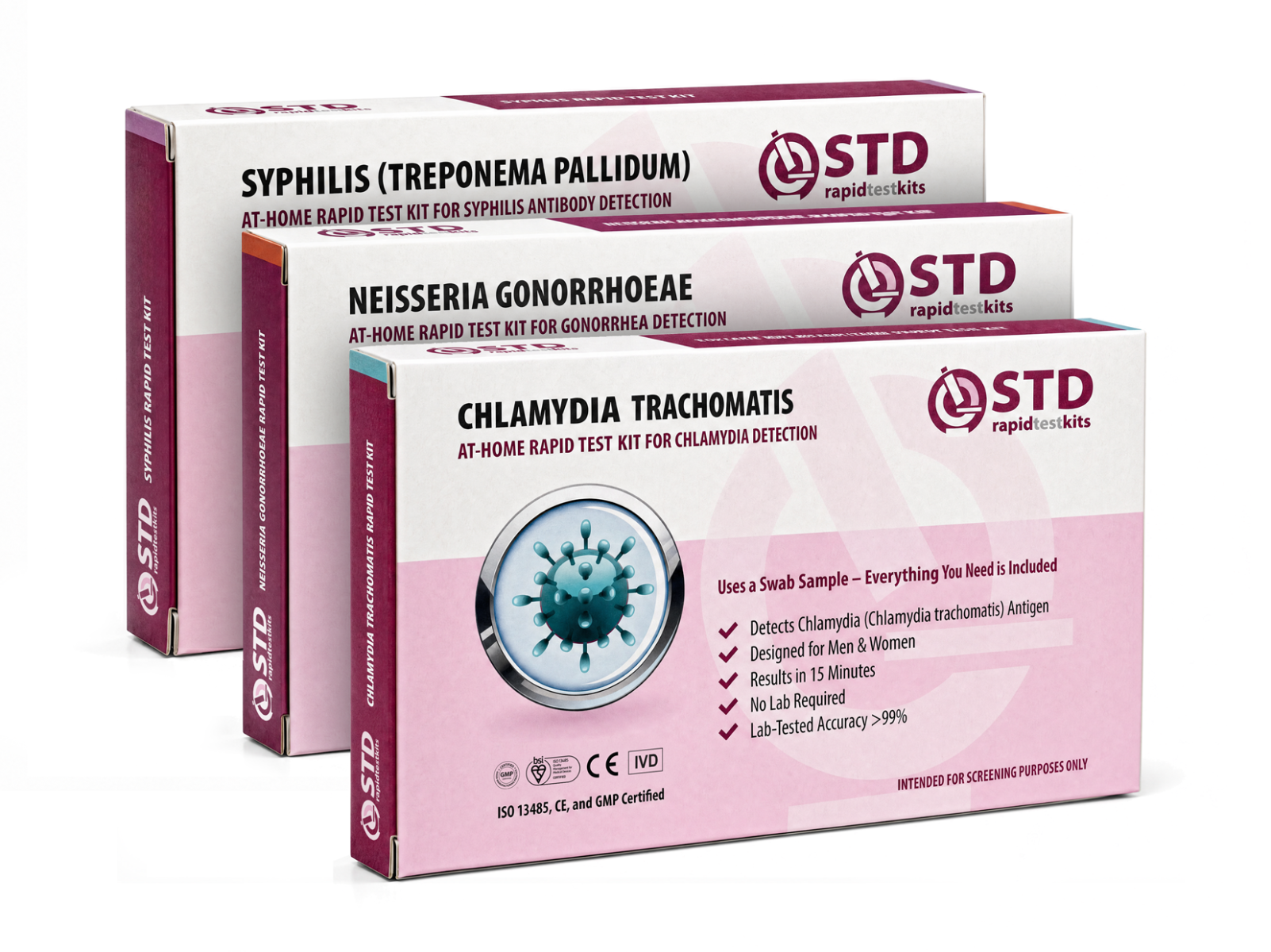
If at-home HPV testing for men is not currently a real option, what is the point of an at-home STI kit at all for male readers? The point is that HPV almost never travels alone. The behaviors and exposure patterns that put someone in HPV's path also put them in the path of chlamydia, gonorrhea, syphilis, HIV, herpes, and (depending on context) hepatitis B or hepatitis C. Those infections are all testable. Several of them are silent in men too: chlamydia in particular is asymptomatic in the majority of male infections.
Screening yourself for the infections you can detect does three useful things at once. It catches an asymptomatic case early enough for treatment. It reduces the chain of transmission to partners. And it signals to a partner that you take shared sexual health seriously, even when the system has not handed you a tool for every infection in the chain.
| Action | Why It Matters |
|---|---|
| Get the HPV vaccine if you are under 27 (or through 45 with shared clinical decision-making) | Covers nine of the highest-risk strains and provides meaningful protection even after some prior exposure |
| Ask about anal Pap testing if you are MSM or HIV-positive | The only routine HPV-related screening currently available to men, and the highest-yield one if you qualify |
| Use protection consistently | Reduces but does not eliminate HPV transmission risk, and meaningfully lowers risk for the other STIs in the same chain |
| Be honest with partners about what your panel actually covers | Avoids the 'clean panel equals HPV-free' misunderstanding that fractures trust later |
| Run a yearly at-home or in-clinic STI panel for the testable infections | Catches asymptomatic chlamydia, gonorrhea, syphilis, HIV, and herpes early enough for treatment |

Breaking the Cycle for Men and Boys
Routine male HPV screening is unlikely to arrive in the United States within the next several years. What can arrive faster is a cultural shift in how HPV is discussed: as a virus that affects every sexually active person, not as a women's-clinic problem. That shift starts in three places.
In schools, comprehensive sex education needs to teach HPV alongside the other STIs rather than as a footnote attached to cervical cancer. In clinics, primary-care providers and pediatricians need to bring up the HPV vaccine for boys with the same matter-of-fact certainty they use for girls. At home, parents with sons need to model the kind of openness about sexual health that breaks the silence the previous generation grew up inside.
None of that is a substitute for the screening test that does not yet exist. It is the long game that makes the eventual arrival of one matter. In the meantime, the steps above (vaccinate, screen what you can, communicate honestly, see a provider for anything visible) are the responsible default. They will not make any man HPV-proof. They will materially reduce the chance that a man transmits a strain that ends up hurting someone he loves.

Frequently Asked Questions
- Can men actually get HPV?
- The simpler question for men is not whether they can get HPV but whether the system will tell them they have it. The answer to the first is yes, with prevalence in adult men close to the rates seen in women. The answer to the second is almost always no, because routine primary-care testing does not include HPV for men. Most male carriers are never diagnosed.
- Why is HPV not included on a regular STI panel for men?
- A regular male STI panel focuses on infections detectable through urine, blood, or simple swab samples (chlamydia, gonorrhea, syphilis, HIV, sometimes herpes). HPV in men does not have a validated screening sample type comparable to a cervical Pap smear in women. Until that gap is closed, mainstream panels skip it.
- If I have no symptoms, can I assume I do not have HPV?
- No. HPV in men is overwhelmingly asymptomatic, and the high-risk strains that matter most clinically almost never cause visible symptoms at all. Feeling fine is fully consistent with carrying the virus, which is a large part of why mass male screening was never built into the U.S. system.
- How do most men find out they have HPV?
- Most men never find out. A smaller share are diagnosed when visible warts appear, others learn about it indirectly because a partner's Pap smear flags a high-risk strain, and a small fraction find out only when an HPV-related cancer is detected years later. Silent lifelong carriage without a diagnosis is the default outcome for men in the United States.
- Can HPV cause cancer in men?
- It can, and the most prevalent HPV-linked cancer in American men today is oropharyngeal cancer, which affects the throat, tonsils, and base of the tongue. Anal and penile cancers also feature in the HPV chart, particularly in men who have sex with men and in immunocompromised men. For the full cancer breakdown, see the cancer section above.
- Is there any HPV test available for men?
- In specific situations, yes. Anal Pap or anal HPV testing is offered to men who have sex with men and to HIV-positive men in many specialty clinics. Visible warts can be diagnosed by a clinician on sight. Penile and oral HPV swab testing exists mainly in research settings and is not available as a routine clinical test.
- Do condoms prevent HPV?
- Condoms reduce HPV transmission but do not eliminate it, because the virus is shed from skin not always covered by the condom (the base of the penis, scrotum, inner thighs). Consistent condom use lowers risk meaningfully without making transmission impossible, and it still helps for the other STIs that travel alongside HPV.
- Should adult men still get the HPV vaccine?
- If you are under 27, the vaccine is routinely recommended. Through age 45, the CDC supports shared clinical decision-making between you and your provider. The vaccine still provides meaningful protection against strains you have not been exposed to, even if you have been exposed to others.
- I tested negative for everything on my STI panel. Am I HPV-free?
- Not necessarily, because standard STI panels for men do not include HPV. A clean panel rules out chlamydia, gonorrhea, syphilis, HIV, and sometimes herpes. It does not rule out HPV in any meaningful way, which is exactly the gap this article is about.
- My partner tested positive for high-risk HPV. What should I say?
- An honest opening is: 'I have not been tested for HPV because the U.S. system does not routinely test men for it.' That is true, and it shifts the conversation from blame to shared understanding. From there, both of you can look at vaccination, ongoing monitoring, and continued screening for related cancers.
How We Sourced This Article: The clinical claims in this guide are drawn from current guidance issued by the U.S. Centers for Disease Control and Prevention, the World Health Organization, the National Cancer Institute, and the U.K. National Health Service, with additional context from the American Cancer Society. Where guideline bodies have updated their advice on vaccination or screening, we have used the most current published version. We deliberately favor root-level institutional pages over secondary-coverage sites so the citations remain stable as guidelines evolve.
- U.S. Centers for Disease Control and Prevention. About Genital HPV Infection. Source for the '9 out of 10 HPV infections clear within two years' figure used in this article.
- U.S. Centers for Disease Control and Prevention. About HPV. Source for the 'nearly everyone who is sexually active will get HPV' wording used in the opening paragraph and pull-quote.
- National Cancer Institute. HPV and Cancer. Used here for the broader 'nearly all sexually active people are infected with HPV' framing and for the rising trend of HPV-associated oropharyngeal cancer in men.
- American Cancer Society. HPV and HPV Testing. Background overview on which HPV tests exist, who they are validated for, and the limits of HPV testing in men specifically.
- World Health Organization. Cervical cancer fact sheet. Used for global background on HPV's role in HPV-associated cancers.
- U.K. National Health Service. Genital warts overview. Clinical overview of low-risk HPV-associated genital warts and how they are recognized.
