Published: October 2025 | Last updated: May 2026 | Editorial review and quality control: Martina N.
A negative STD test feels like a verdict, but it is closer to a snapshot. The result tells you what your body looked like to one specific test at one specific moment, using the specific sample you collected. That is genuinely useful information. It is also incomplete. Many people walk out of a clinic, or open the result window on a home cassette, with the relief of "clean" and the false certainty that comes with it.
The honest version of the story is more nuanced. STD tests have a built-in blind spot called the window period, the stretch of days or weeks between exposure and the moment a test can reliably detect the infection. Test inside that window and an active, contagious infection can still come back as negative. Many infections are also silent in their early stages, so feeling fine afterward is not proof you are uninfected. None of this means home testing is unreliable. It means timing, test selection, and a willingness to retest are part of the result, not afterthoughts.
Key Takeaways
- Every STD test has a window period when an active infection can read as negative. Testing too soon after exposure is the most common reason for a falsely reassuring result, even with a high-quality test.
- Many STDs, including chlamydia, gonorrhea, herpes, and HPV, cause no symptoms in their early stages. Feeling fine after a negative test is not the same as being uninfected; retesting after the window has closed is what turns a snapshot into a real answer.
When "Negative" Doesn't Mean Nothing's There
The trap of early reassurance is one of the most common ways people misread their test results. After a risky encounter, the panic builds, and the impulse is to test fast. A clear line feels like resolution. The conversation closes. But a test taken three or four days after exposure is checking your body before there is anything yet to find. The infection can already be replicating in the cells where you were exposed; the test simply cannot see it.
STD tests are tools, not verdicts. Like any tool, their accuracy depends on how and when they are used. The CDC's STI testing guidance is explicit about this: a result reflects what is detectable at the moment of testing, not what is happening biologically. Test too early, and your body has not yet produced enough antibodies, the pathogen has not yet replicated to a detectable level, or the sample collected was not from the infected site.
There is also the silence of the infection itself. Chlamydia, gonorrhea, trichomoniasis, herpes, and HPV can all live in the body without producing a single noticeable symptom. You feel fine, the test comes back clean, and yet the infection persists and is potentially transmissible. That gap between how you feel and what is actually happening is exactly where the false sense of security forms.
Testing three to four days after exposure is checking your body before there is anything to find. Even with a perfectly functional kit and a correctly collected sample, that early result is not informative about the current encounter; it is a placeholder until the window period for the relevant infection has closed.
What Tests Can Actually Tell You
Before deciding what a negative result means, you need to know what your test was designed to detect. Not all STD tests look for the same thing, and the differences matter. Some look for genetic material from the pathogen itself, others look for proteins on the pathogen's surface, and a third group looks for antibodies your body produces in response to infection. Each approach has its strengths, and each has a window period of its own.
The table below breaks down the most common test categories, what they detect, and where each one can let you down. A rapid antigen test taken five days after a high-risk exposure, an antibody test taken before seroconversion, or a swab collected from the wrong anatomic site can all produce a negative result that looks definitive but is not. That is before you factor in human error: expired kits, incomplete sample collection, reading results outside the manufacturer's time window, or simply testing for the wrong infection given the exposure type.
| Test Type | What It Detects | Typical Use | Where It Can Miss |
|---|---|---|---|
| NAAT / PCR (lab-processed) | Genetic material (DNA or RNA) | Chlamydia, gonorrhea, trichomoniasis | Requires the right sample type from the right anatomic site; can miss infections sampled outside the infected location |
| Rapid lateral-flow (antigen) | Pathogen proteins | Trichomoniasis, some HIV kits, HPV | Lower sensitivity than NAAT; false negatives more likely in low-level or very early infections |
| Antibody (IgG / IgM) | Body's immune response to infection | HIV, syphilis, HSV-2 | Cannot detect an infection until the body has mounted a measurable antibody response, often weeks after exposure |
| Combined antigen / antibody | Both viral proteins and antibodies | Fourth-generation HIV tests | Still has a window period of roughly 18 to 45 days for laboratory versions and longer for rapid versions |
The Window Period: When a Test Cannot See an Infection Yet
The window period is not a guess or a marketing caveat. It is a measurable biological gap. When you are exposed to an infection, the pathogen needs time to replicate and your immune system needs time to react. A test cannot detect what has not yet reached its threshold of detection. Each STD has its own window because each pathogen replicates at a different speed and each test technology has a different sensitivity floor.
You are exposed on a Friday. By Monday, the bacteria or virus may have made its way to the tissues where it will establish, but the pathogen load is still low. Your body has not yet produced antibodies in measurable amounts. The pathogen has not yet shed enough material into the sample (urine, swab, blood) for a test to pick up. So a test on Monday morning, taken correctly, with a perfectly functional kit, can come back negative. That result is technically accurate; it just is not the whole picture.
The window period is also why the CDC's HIV testing recommendations include explicit retesting timelines. For HIV, a fourth-generation antigen-antibody laboratory test typically detects infections 18 to 45 days after exposure. A rapid antibody-only test may need up to 90 days. The retesting table in the next section is built around those windows.
Can you have an STD and still test negative?
Yes, especially if you tested inside the window period for the infection in question. Common detection points: 7 to 14 days for chlamydia, gonorrhea, and trichomoniasis on NAAT; 3 to 6 weeks for syphilis antibody tests; 18 to 45 days for a fourth-generation HIV laboratory test; up to 90 days for a rapid HIV antibody test; and up to 12 to 16 weeks for HSV-2 IgG antibody seroconversion. For a single potential exposure, the common pattern is a first test at 2 to 3 weeks, then a confirmatory retest at the standard endpoint for each infection. A single early negative is a starting point, not a final answer.
Window Periods by STD
Each infection has its own detection timeline. The numbers below reflect the most sensitive testing options for each pathogen; lower-sensitivity tests will have longer effective windows. These are population-level averages drawn from current CDC and WHO guidance, not personal guarantees. Individual immune responses and pathogen loads vary, and the safest reading is to treat the lower end of each range as "may detect" and the upper end as "reliable result."
The asymmetry matters. Bacterial STDs like chlamydia and gonorrhea reach detectable levels in roughly a week, so a NAAT at two weeks post-exposure is generally reliable. Viral infections that depend on antibody response (HIV, syphilis, hepatitis B and C, HSV-2) often need a month or longer. Mixing up those two timelines is where most "clean result that wasn't" stories begin.
| STD | Test Method | Earliest Reliable Detection | Confirmatory Retest |
|---|---|---|---|
| Chlamydia | NAAT (urine or swab) | 7 to 14 days | 14 to 21 days |
| Gonorrhea | NAAT (urine or swab) | 7 to 14 days | 14 to 21 days |
| Trichomoniasis | NAAT or rapid antigen swab | 7 to 14 days | 21 days |
| Syphilis | Treponemal antibody (blood) | 3 to 6 weeks | 6 to 12 weeks |
| HIV | Fourth-generation Ag/Ab (lab) | 18 to 45 days | 45 days |
| HIV | Rapid antibody (blood, oral) | 23 to 90 days | 90 days |
| HSV-2 (herpes) | IgG antibody (blood) | 6 to 8 weeks | 12 to 16 weeks |
| Hepatitis B | HBsAg plus antibody (blood) | 4 to 9 weeks | 12 weeks |
| Hepatitis C | HCV antibody (blood) | 8 to 11 weeks | 12 weeks |
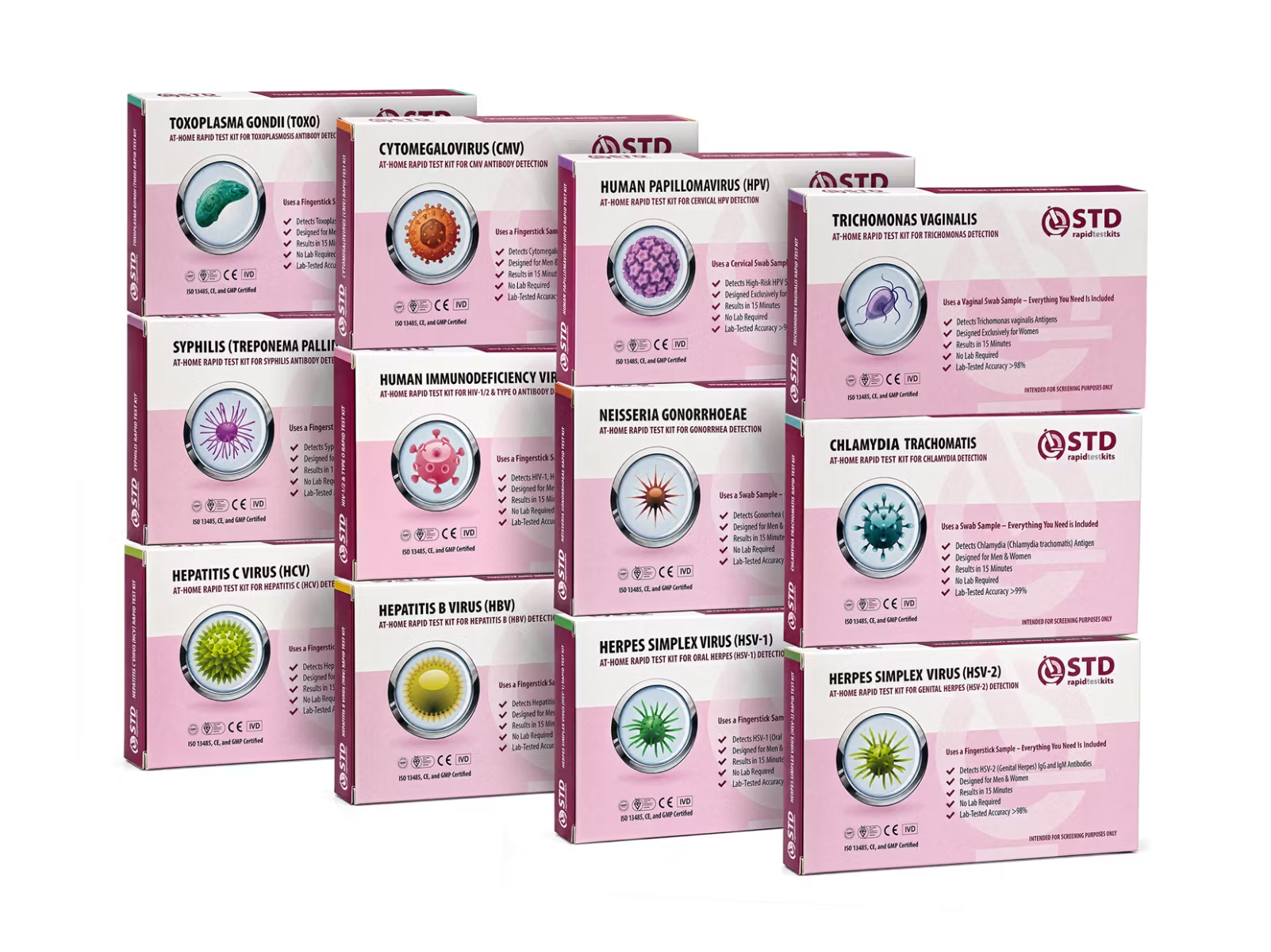
The kit below is sold by this site. It covers seven of the infections in the table above through rapid at-home lateral-flow chemistry, not laboratory NAAT, and is intended for screening once each infection's window period has closed.

The Common Pattern Behind a "Clean Result That Wasn't"
Clinicians who staff sexual health clinics describe the same pattern again and again. A person has a higher-risk exposure, panics within the first week, tests immediately with whatever is on hand or at the closest urgent care, and gets a negative result. Reassured, they stop thinking about it. Two to four weeks later, symptoms appear, or a partner discloses an infection. They retest, and this time the result is positive.
What happened was not a defective test. The first test correctly reported what it could see at the time. The second test, run after the pathogen had reached detectable levels, correctly reported the now-established infection. The error was timing, compounded by the assumption that one negative result was the end of the conversation.
This pattern shows up in published surveillance data too. CDC STI surveillance and screening-accuracy reviews have repeatedly flagged that a meaningful fraction of negative tests in symptomatic patients get reclassified as false negatives once retesting occurs after the window closes. The takeaway is consistent across infections: when in doubt about timing, retest.
The three-step pattern most missed infections follow
- Step 1: A higher-risk exposure prompts an immediate test, often within the first three to seven days.
- Step 2: The early test comes back negative because the pathogen has not yet reached detectable levels. The reader feels reassured and stops thinking about it.
- Step 3: Symptoms appear two to four weeks later, or a partner discloses a positive result. A retest at that point comes back positive for what the first test could not yet see.
When to Retest After a Negative Result
If you tested inside the window period for your specific infection, retesting is not optional. It is the only way to convert a partial answer into a real one. The retesting schedule depends on what you were exposed to and which test you used; the timeline below covers the most common patterns.
Days 1 to 6 after exposure: almost no STD will show up on any test. Testing in this window can be useful for baseline reasons (knowing your status before a new partner) but is not informative about the current encounter.
Days 7 to 14: chlamydia, gonorrhea, and trichomoniasis can begin to appear on NAAT-based tests. Antibody-based tests for viral infections will still be negative even if infection occurred. Treat any negative in this window as preliminary.
Weeks 2 to 4: NAAT results for the bacterial STDs are now reliable. Fourth-generation HIV tests begin to detect early infections. Syphilis antibody tests start to become useful around the three-week mark.
Weeks 6 to 12: the standard confirmatory window for HIV, syphilis, hepatitis B, and hepatitis C. A negative across this whole panel at 12 weeks post-exposure, with no further high-risk contact in the interim, is the clearest "all-clear" most testing protocols can give.
Weeks 12 to 16: the conservative window for HSV-2 antibody seroconversion. Some immune systems take longer to produce detectable IgG, which is why the herpes window is the longest on the routine panel.

Feeling Fine Isn't the Same as Being Clear
Most people associate STDs with symptoms: discharge, sores, burning, pain. So when a test comes back negative and there are no symptoms, the brain stitches the two together into a confirmation. The trouble is that for most STDs, the absence of symptoms is not informative. It is the default state.
The pattern is striking. According to the CDC's chlamydia overview, chlamydia often causes no symptoms, which is why routine screening is recommended for sexually active women under 25 even in the absence of any complaint. Herpes infections, particularly HSV-2, go undiagnosed in a large fraction of carriers because the initial outbreak is mild or absent. HPV typically clears on its own without ever announcing itself. Trichomoniasis is asymptomatic in the majority of cases per the WHO STI fact sheet.
| STD | How Often Symptoms Are Absent | Symptoms When They Appear |
|---|---|---|
| Chlamydia | Often asymptomatic in both women and men; a majority of infections cause no noticeable symptoms | Burning urination, abnormal discharge, pelvic or testicular pain |
| Gonorrhea | Frequently asymptomatic in women; a substantial share of men remain symptom-free | Painful urination, thick discharge, anal or pharyngeal symptoms |
| Herpes (HSV-2) | Majority of infections remain undiagnosed | Tingling, blisters, ulcers on genital or anal skin |
| HPV | Majority of infections clear without symptoms | Genital warts (low-risk types), abnormal pap result (high-risk types) |
| Trichomoniasis | Majority of infections are asymptomatic per WHO | Foul-smelling discharge, itching, irritation |
Why "Clean" Is the Wrong Word for a Test Result
The language used around STD testing has consequences. Calling a negative result "clean" implies that anyone who tests positive is somehow "dirty," which is medically inaccurate and socially destructive. STDs are infections caused by bacteria, viruses, or parasites. They are not character markers. Most are treatable, all are common, and many are invisible.
The word also overstates the test's reach. A negative is a result; it is not a state. It tells you what one test, at one timepoint, with one sample type, could detect. It does not certify your body as infection-free for the future, and depending on timing, it does not even certify you as infection-free for the past. "Clean" frames the result as permanent and total when it is, by design, partial and provisional.
The stigma carried by the word also discourages disclosure. Partners who suspect they may have been exposed are less likely to share that fear with someone who has already declared themselves "clean." The conversation stalls before it begins. A more honest vocabulary is simply: "I tested negative on this date, for these specific infections, using this test type, before my last potential exposure." Partners can act on a dated, specific status disclosure; they cannot act on a vague claim of cleanliness.
No HIV test can detect HIV infection immediately after exposure. The time between when a person may have been exposed to HIV and when a test can accurately detect HIV is called the window period.
Treat Testing Like an Ongoing Health Routine
The shift that actually changes outcomes is treating STD testing the way you would treat any other routine health check: as a periodic reading of your current state, not a permanent badge. Blood pressure is not measured once and forgotten. Cholesterol is not assumed stable forever. A negative STD test in 2024 says something useful about 2024; it says nothing about a partner you met in 2025.
This does not mean testing every week or living in fear. It means knowing the situations that warrant retesting: a new sexual partner, a non-monogamous arrangement, a barrier failure, a partner's disclosure of their own positive result, or new symptoms appearing weeks after a previous negative test. CDC screening recommendations for sexually active adults vary by age and risk profile, but the underlying principle is consistent: regular, planned testing protects you and your partners more than reactive panic testing after each scare.
For people in higher-risk categories, the recommended cadence is more frequent. Annual full-panel testing is the floor for sexually active adults under 25, men who have sex with men, and people with multiple recent partners. Every three to six months is closer to the floor in those groups. For most everyone else, testing at the start of a new relationship, after any potential exposure, and once a year as a baseline is a reasonable rhythm.
Frequently Asked Questions
- Can I still have an STD if my test came back negative?
- Yes. A negative test means the infection was not detectable at the moment of testing with the specific test you used; it does not mean no infection is present. If you tested inside the window period, before symptoms could develop, or with a test that does not cover the pathogen relevant to your exposure, a true infection can still be there. Plan a retest at the standard confirmatory point for that infection.
- What exactly is the window period?
- The window period is the gap between exposure to an infection and the point at which a test can reliably detect it. Each STD has its own window: roughly 7 to 14 days for chlamydia and gonorrhea via NAAT, 3 to 6 weeks for syphilis antibody tests, 18 to 45 days for fourth-generation HIV laboratory tests, and up to 12 to 16 weeks for HSV-2 antibody seroconversion. Testing before that window closes increases the chance of a false negative.
- I feel completely fine. Why would I need to test again?
- Most STDs are asymptomatic in their early stages. Chlamydia often causes no symptoms in either sex, herpes goes undiagnosed in a majority of carriers, and HPV usually has no visible symptoms. Feeling fine after a potential exposure is consistent with both no infection and early, silent infection. A timed retest is the only way to tell the two apart.
- How many times should I test after a single high-risk exposure?
- A common pattern is to test once at 2 to 3 weeks post-exposure for the bacterial STDs (chlamydia, gonorrhea, trichomoniasis), then a second time at 6 to 12 weeks for HIV, syphilis, and hepatitis, with a final retest at 12 to 16 weeks if there is reason to suspect HSV-2 exposure. Two well-timed tests usually beat five poorly timed ones.
- What if my first test was within days of exposure?
- Treat that result as preliminary at best. A test taken three to five days after exposure is checking your body before there is anything to find. Plan a retest at two weeks for the bacterial STDs and a second retest at 6 to 12 weeks for the antibody-based viral tests. The first test is not wrong, it is just early.
- What does a faint line on a home test mean?
- A faint line on a lateral-flow test is usually treated as a weak positive, not a negative. Lateral-flow chemistry produces visible lines when antigen or antibody is detected, even at low concentrations. A faint line warrants a confirmatory test, ideally a laboratory NAAT for bacterial STDs or a confirmatory antibody assay for HIV, syphilis, or herpes. It is not an inconclusive result; it is a result that deserves follow-up.
- Can I stop using protection after a negative test?
- Only in a specific context: both partners have tested negative outside of their respective window periods, no new sexual contact has occurred between testing and now, and both partners are in a mutually monogamous arrangement. Outside those conditions, protection remains useful, and not only for fluid-borne infections. Herpes and HPV can transmit through skin-to-skin contact regardless of barrier method.
- Are at-home STD tests accurate?
- When used after the relevant window period and according to instructions, at-home rapid tests are useful screening tools. Lateral-flow chemistry has lower analytical sensitivity than laboratory NAAT, so a positive at-home result should be confirmed with a lab test, and a negative result close to the edge of the window period should be retested at the standard confirmatory point. Treat the at-home result as a strong screening signal, not a final lab diagnosis.
Don't Let One Test Decide Your Truth
The clean result that wasn't is a familiar story in sexual health clinics, and the cause is almost always the same: a test taken too early, interpreted too definitively, and never followed up with the retest that would have given a real answer. The way through that pattern is to know your window period, plan the confirmatory retest, treat each result as a snapshot of one moment rather than a permanent verdict, and keep using protection until both partners are outside the window and aligned on status.
A negative taken at the right time and confirmed where needed is the result worth acting on. One taken five days post-exposure is a prompt to schedule the next test.
1. Record the date you tested, the test type used, and the infections it covered. A dated note is the basis of any honest future status disclosure.
2. Schedule the confirmatory retest at the window-period endpoint for each relevant infection: 14 to 21 days for the bacterial STDs, 6 to 12 weeks for HIV, syphilis, and hepatitis, and 12 to 16 weeks for HSV-2.
3. Continue using protection until both you and your partner are outside the window period and have shared dated test results, not just verbal reassurance.
- U.S. Centers for Disease Control and Prevention. STI testing recommendations, screening guidance, and detection windows for common sexually transmitted infections.
- U.S. Centers for Disease Control and Prevention. HIV testing options, window periods for fourth-generation and rapid antibody tests, and confirmatory testing protocols.
- U.S. Centers for Disease Control and Prevention. Chlamydia overview, asymptomatic-carriage description, and screening recommendations.
- U.S. Centers for Disease Control and Prevention. STI surveillance and data resources, including national trends and screening-accuracy reviews.
- World Health Organization. Sexually transmitted infections fact sheet covering global prevalence, asymptomatic-carriage estimates, and testing principles.
- National Health Service (UK). Sexually transmitted infections overview, including initial testing timing guidance, symptoms, and treatment information.
- Mayo Clinic. Sexually transmitted diseases (STDs) symptoms and causes overview, covering signs of common STIs and when to seek diagnostic testing.
