
Published: August 2025 | Last updated: May 2026 | Editorial review and quality control: Martina N.
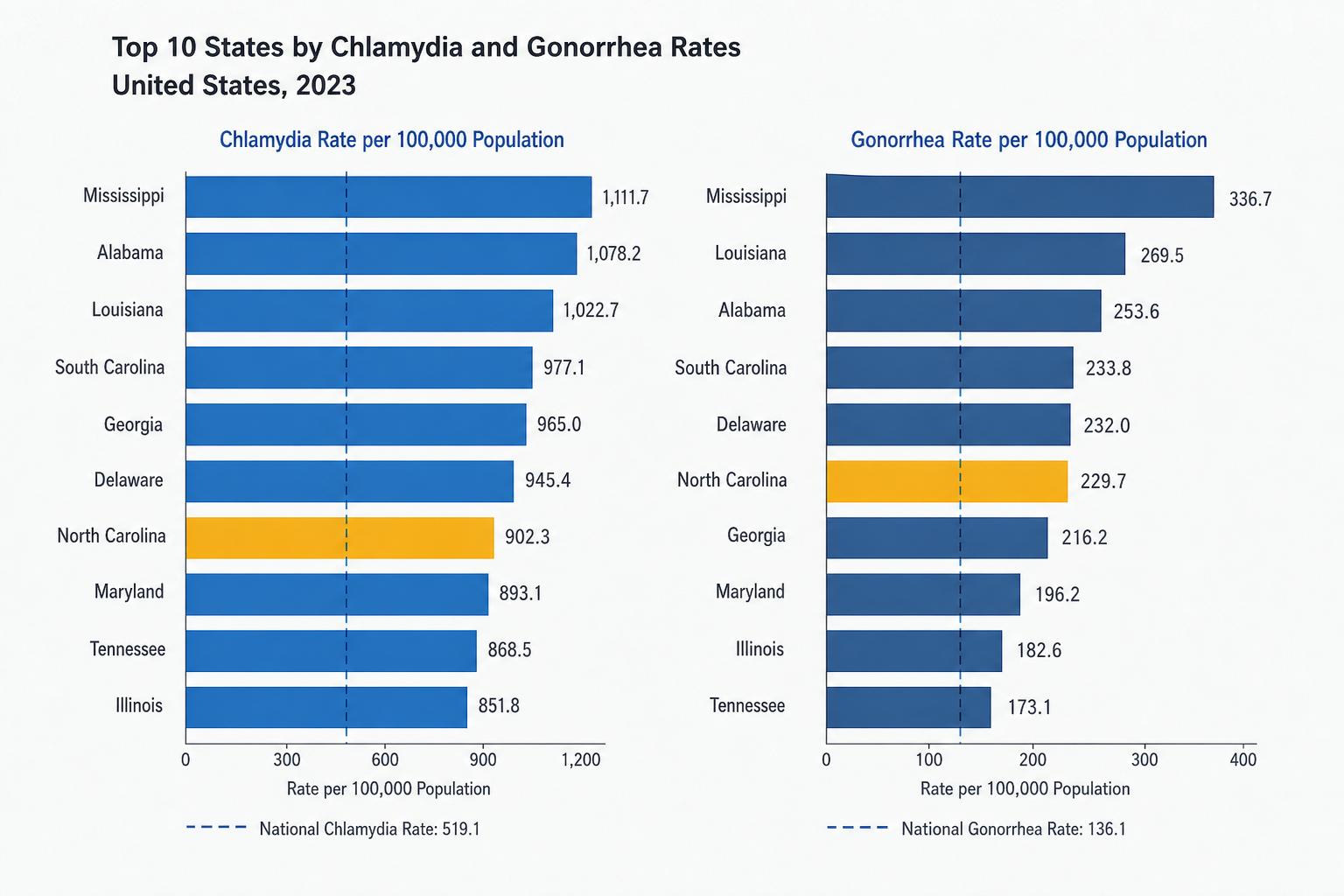
North Carolina has spent years near the top of every chlamydia and gonorrhea ranking that nobody wants to lead. According to the CDC's 2023 STI Surveillance report, the state ranked 7th nationally for chlamydia and 6th for gonorrhea, with the heaviest burden falling on adults between 15 and 29 years old (see the CDC's STI Surveillance hub for the full data tables). The state recorded tens of thousands of new diagnoses that year, plus a much larger pool of cases that were never reported because they were never tested for.
Most chlamydia and gonorrhea infections cause no symptoms at all, especially in the first weeks after exposure, which explains why North Carolina's numbers stay elevated regardless of how any one community behaves. People who feel fine assume they are fine, skip testing, and pass the infection on without knowing. This piece breaks down what the rankings actually mean, where the disparities show up, what untreated infections do over time, and what testing looks like in 2026.
Key Takeaways
- North Carolina ranked 7th nationally for chlamydia and 6th for gonorrhea in the CDC's 2023 STI Surveillance report, with adults aged 15 to 29 carrying most of the diagnosed cases.
- The majority of chlamydia and gonorrhea infections cause no symptoms in the first weeks, so untreated cases keep transmitting. Annual testing is the practical fix.
Where North Carolina Ranks in the 2023 Numbers
The CDC's annual STI Surveillance report is the canonical source for state-level rankings. Its 2023 edition placed North Carolina 7th in the country for chlamydia and 6th for gonorrhea, with rates per 100,000 residents above the national average for both infections (see the CDC STI Surveillance hub for the underlying tables and methodology).
Two patterns matter more than the rankings themselves. First, the burden is sharply concentrated by age: adults aged 15 to 29 account for the majority of new chlamydia and gonorrhea diagnoses statewide, the same demographic juggling first apartments, first real jobs, and the early years of dating life when routine sexual-health visits often slip off the radar. Second, the burden is sharply concentrated by geography. Mecklenburg County, home to Charlotte, has reported gonorrhea rates several times higher than the statewide rural average. Durham, Cumberland, and Guilford counties consistently report rates well above the state median.
The headline numbers also obscure how many infections never make it into surveillance data at all. Lab-confirmed cases only count people who walked into a clinic, completed a test, and had the result reported back to the state health department. CDC modeling suggests that for every diagnosed chlamydia case, additional cases go undetected in the same year. North Carolina's reported numbers represent the floor, not the ceiling, of the real burden.
From the CDC's 2023 STI Surveillance report:
- 7th nationally for reported chlamydia cases.
- 6th nationally for reported gonorrhea cases.
- Adults aged 15 to 29 carry the majority of diagnosed cases.
- Mecklenburg, Durham, Cumberland, and Guilford counties consistently rank above the state median.
Where exactly does North Carolina rank for STDs?
North Carolina ranked 7th nationally for chlamydia and 6th nationally for gonorrhea in the CDC's 2023 STI Surveillance report, with rates above the national average for adults aged 15 to 29. Most of the burden is driven by asymptomatic infections that go untested, not by changes in sexual behavior.
Why "No Symptoms" Is the Most Dangerous Symptom
Chlamydia often causes no symptoms, especially in women, and gonorrhea is similarly silent at many sites of infection (CDC About Chlamydia; CDC About Gonorrhea). People who feel fine, who do not have discharge or pain on urination or any of the textbook warnings, are routinely walking around with active, transmissible infections.
That gap between feeling healthy and being infected is the single biggest driver of community spread. Public health workers in North Carolina describe a recurring pattern: a person tests positive after a partner-notification call, then realizes they had been exposed weeks or months earlier and were never going to seek a test on their own because nothing felt wrong. Each undetected case is a potential transmission vector for as long as it stays untreated.
The pattern is sharper in two situations. The first is throat or rectal infection from oral or anal sex. Pharyngeal (throat) gonorrhea typically produces no symptoms, sometimes a mild sore throat that gets dismissed as a cold. Rectal infections produce no recognizable signs in most cases, and people who do not suspect infection there do not ask for site-specific testing. The second is in long-term partnerships where one partner picked up an infection before the relationship and never had a window of obvious symptoms to flag it. Routine annual screening would catch both. Symptom-driven testing won't.
Treat "no symptoms" the way you would treat a blood-pressure reading you have never checked. Absence of evidence is not evidence of absence. The CDC's screening guidance recommends annual chlamydia and gonorrhea testing for all sexually active women under 25, all sexually active gay and bisexual men, and anyone with a new partner or multiple partners regardless of gender.
Annual chlamydia and gonorrhea screening is recommended for:
- All sexually active women under 25.
- Sexually active gay and bisexual men.
- Anyone with a new partner or multiple partners, regardless of gender.
- Pregnant patients, at the first prenatal visit and again in the third trimester for higher-risk patients.
People with ongoing risk factors should test every three to six months.
Who Carries the Heaviest Burden
The state-level ranking averages out a lot of variation that matters. Inside North Carolina, the rate of reported gonorrhea in some urban counties is several times higher than in surrounding rural counties, and reported chlamydia rates among Black residents are substantially higher than among white residents in counties that publish race-stratified data, documented in county-level health briefs from Durham, Mecklenburg, and Guilford. Looking at disparities clarifies where the ranking actually comes from: specific neighborhoods where testing access has been chronically underfunded.
The disparity tracks closely with structural factors public-health researchers have catalogued for decades: housing instability, gaps in insurance coverage, the patchwork of available clinics, the legacy of school sex-education curricula that taught abstinence rather than sexual health, and the long-running underfunding of state and county STI programs. When a clinic closes, the rate in the surrounding ZIP code rises within a year. When a Title X family-planning provider loses funding, screening drops in the same population. The bacteria do not track demographic categories. The infrastructure for finding and treating them does.
Income and transportation matter for the same reason. A clinic three miles away on a bus line that runs every 90 minutes is functionally inaccessible for someone working hourly shifts. A clinic that bills insurance is functionally inaccessible for the share of working-age North Carolinians without coverage. Each of those small frictions adds days or weeks to the time between exposure and diagnosis, which is exactly the window in which the infection moves to a new partner.
North Carolina's high overall numbers are largely the sum of specific neighborhoods where testing access has been chronically underfunded. Where rates fall fastest, free testing programs, partner-services contacts, and at-home test options have expanded together.

The Hotspots: Mecklenburg, Cumberland, Durham
Three counties account for a disproportionate share of statewide cases year after year. Mecklenburg, with a population of roughly 1.1 million centered on Charlotte, consistently reports the highest gonorrhea rate in the state and one of the highest among large U.S. metros. Durham, much smaller in population but home to Duke University and a dense student-and-young-professional core, posts rates that move with the academic calendar. Cumberland County, anchored by Fayetteville and Fort Liberty, shows a different pattern shaped by a large active-duty military population with frequent rotations and deployments.
Each county explains a different part of the state ranking. In Mecklenburg, density and partner mixing matter: large young-adult populations, a dense dating-app market, and a transient renter base together produce more sexual-network connections per capita than rural counties. In Durham, the academic-year cycle drives spikes around the start of fall and spring semesters, when student populations turn over and testing-clinic capacity at student health services often runs months behind demand. In Cumberland, deployment cycles and the long separations of military life create high-risk windows that the local health department has been working to address with on-base testing partnerships.
Rural counties tell their own story. Lower population density typically means lower raw counts but not necessarily lower rates per capita. The bigger problem in rural areas is testing access: a county with two clinics and one part-time STI nurse can leave residents driving 60 miles or more for a confirmatory test. That distance is the silent multiplier on every other risk factor.
Across all three urban counties, the common thread is testing access, specifically how easy or hard it is to get a test in the same week as a possible exposure. The counties with the lowest rates in the state share a few things: at least one walk-in STI clinic with same-day testing, a strong partner-services follow-up program at the local health department, and good public awareness of free or sliding-scale options.
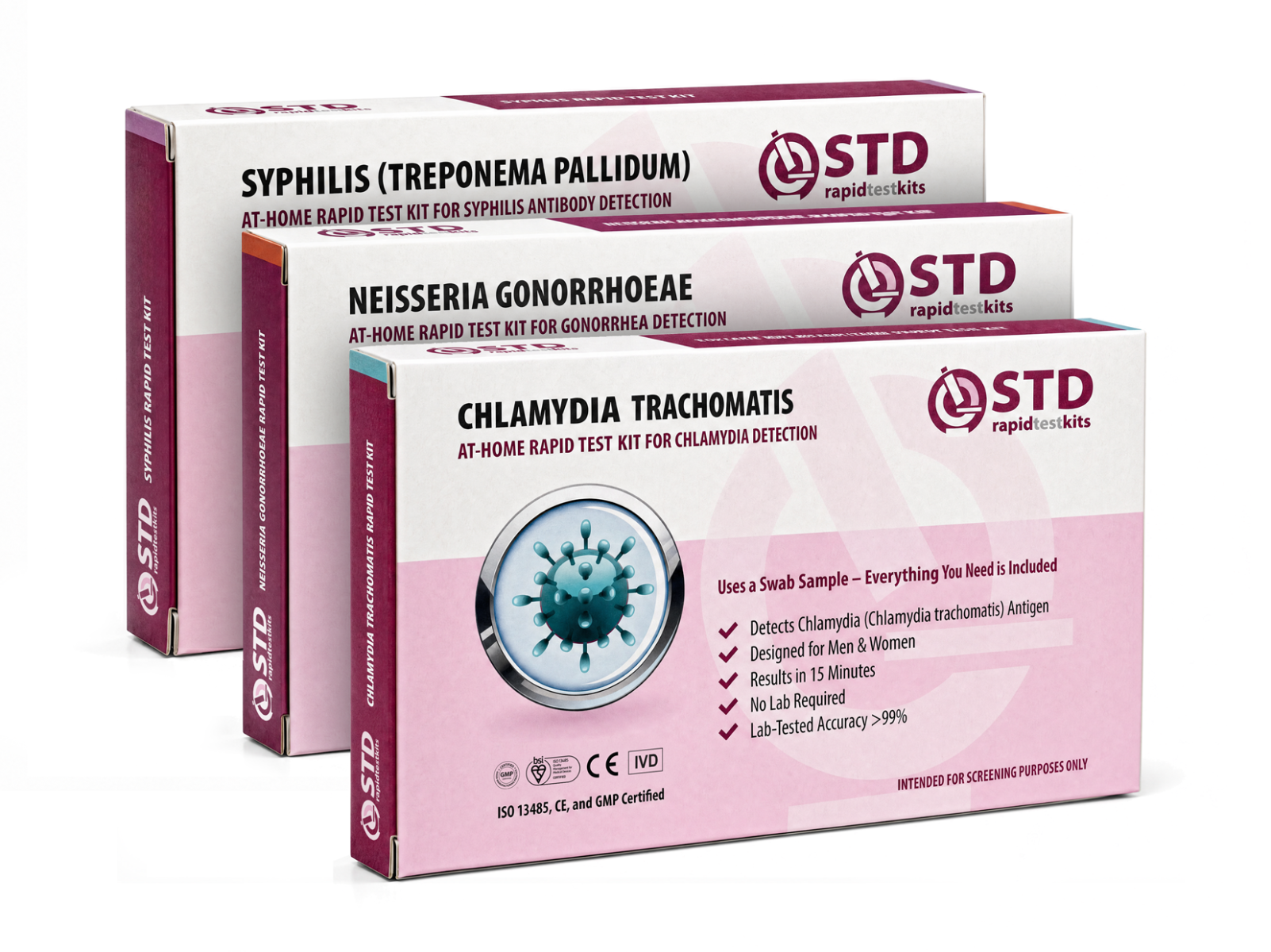
This site sells at-home rapid STI test kits; the option below is one of our own products.
What Untreated Chlamydia and Gonorrhea Do Over Time
The reason "no symptoms" matters is not just the chance of passing infection on. Both chlamydia and gonorrhea cause real, sometimes permanent damage when they go untreated long enough.
For people with a uterus, untreated chlamydia or gonorrhea is the most common cause of pelvic inflammatory disease (PID), an upper-genital-tract infection that scars the fallopian tubes and raises the risk of ectopic pregnancy and tubal-factor infertility. The CDC's PID fact sheet notes that about 1 in 8 women with a history of PID experiences difficulty getting pregnant (CDC PID). The damage often happens silently, with cramping or low-grade pain that gets attributed to a menstrual cycle or stress, until someone tries to get pregnant years later and discovers the consequence on an ultrasound.
For people with a penis, untreated infection more commonly causes epididymitis, a painful inflammation of the tube behind the testicles, which in rare cases progresses to chronic pelvic pain or reduced fertility. Untreated gonorrhea can also disseminate beyond the genital tract entirely, producing joint infections, skin lesions, and in rare cases bacteremia and endocarditis.
Pregnancy is the other context where delay becomes urgent. Chlamydia and gonorrhea acquired during pregnancy can transmit to a newborn during vaginal delivery, causing neonatal conjunctivitis (a leading historical cause of childhood blindness, now largely prevented by routine prophylaxis) and, in the case of chlamydia, neonatal pneumonia. Universal prenatal testing is the standard of care, and most North Carolina obstetricians screen at the first prenatal visit and again in the third trimester for higher-risk patients.
Antimicrobial resistance is the slow-motion threat in the background. Gonorrhea has progressively developed resistance to nearly every antibiotic class it has been exposed to, and the CDC's current recommended regimen, a single intramuscular dose of ceftriaxone, is the last fully reliable first-line option (CDC STI Treatment Guidelines).
Long-term complications to know about
- Pelvic inflammatory disease (PID): scarring of the fallopian tubes; the CDC reports about 1 in 8 women with a history of PID experiences difficulty getting pregnant.
- Epididymitis in people with a penis: painful inflammation behind the testicles; rarely progresses to chronic pelvic pain or reduced fertility.
- Neonatal transmission: chlamydia or gonorrhea acquired during pregnancy can transmit at delivery, causing newborn conjunctivitis or pneumonia.
- Antimicrobial resistance: gonorrhea has progressively developed resistance, leaving ceftriaxone as the last fully reliable first-line treatment.
How Stigma Keeps Infections Moving
The biggest barrier to testing in North Carolina, after access, is stigma. Public-health workers and clinic staff describe the same pattern across cities and small towns: people delay getting tested because they are worried about being seen at the clinic, about having the conversation with a parent's friend who works at the front desk, about a clinician's tone, about an insurance Explanation of Benefits arriving at home with the words "sexually transmitted" on it. None of those concerns are irrational. Most have a real, fixable cause underneath.
Some of the fixes are individual. Public health departments offer free testing without an Explanation of Benefits because the visit is not billed to insurance. Many county clinics offer evening hours specifically to reduce the chance of a workplace conflict. Telehealth and at-home rapid kits remove the waiting-room visibility problem entirely. Partner-services teams at the state DHHS will, if a patient prefers, notify a sex partner anonymously rather than asking the patient to handle it. The infrastructure to test privately exists; most people just have not been told about all of it.
Some of the fixes are cultural. Treating an STI test the same way you would treat an annual cholesterol panel is the most useful mental shift available. The CDC, the American College of Obstetricians and Gynecologists, and the U.S. Preventive Services Task Force all recommend annual chlamydia screening for sexually active women under 25, framed as a routine wellness measure rather than a response to suspected infection.


What Testing Looks Like in 2026
Getting tested in North Carolina has changed substantially over the past few years, and the practical question for most readers is which route fits their life and budget.
County health departments are the most accessible starting point for residents without insurance or who want to keep the visit off an insurance Explanation of Benefits. Every county in the state runs a public-health department that offers low- or no-cost STI testing, partner-notification services, and treatment when needed. Sliding-scale fees apply for residents without coverage, and the visit is generally not billed to insurance even when the patient is insured. Most departments offer chlamydia and gonorrhea NAAT testing, syphilis and HIV blood testing, and counseling on prevention. Walk-in availability varies by county; the state DHHS Communicable Disease Branch maintains a county-by-county directory.
Primary-care and OB-GYN offices work equally well for patients with existing coverage and fold naturally into a yearly physical or routine gynecologic visit. Most insurance plans cover STI screening as preventive care without a copay, with the advantage of integration with the rest of someone's medical care, including pregnancy planning, contraception, and follow-up if results require treatment.
At-home rapid testing fits a different need, best suited to people who would otherwise skip testing because of access or stigma constraints. Lateral-flow rapid kits let someone take a sample at home, run the result in roughly 15 minutes, and act on the answer the same day. The trade-off is that lateral-flow chemistry has lower analytical sensitivity than the lab-based NAAT used at clinics, especially in asymptomatic infections, so a positive at-home result is worth confirming at a clinic, and a recent exposure can produce a false-negative if the test is run inside the window period. At-home testing is most useful as a screening tool between clinical visits, or as a first step for someone who would not test at all otherwise.
According to the CDC's 2021 STI Treatment Guidelines, annual screening for chlamydia and gonorrhea is recommended for all sexually active women under 25, and for older women with new or multiple sex partners.
The Bottom Line for North Carolinians
North Carolina's position near the top of the national STI charts reflects a small set of structural factors: a young population, uneven access to clinics, asymptomatic infections that drive transmission, and decades of public-health programs chronically underfunded relative to the size of the problem. None of that is fixable in a single article. The piece any individual reader can move this week is whether they have had an STI test in the last 12 months.
If the answer is yes, and you have had a new partner or any concern since then, the right move is a repeat screen. If the answer is no, the right move is to pick the option you will actually use, whether that is a county health department visit, a stop at your primary care provider, or an at-home rapid kit ordered on a Friday night and run on Saturday morning. The strongest predictor of whether someone gets tested is whether testing has been made easy enough to follow through. The strongest predictor of community spread is the gap between exposure and diagnosis. Closing your own gap, with whatever option fits your life, is the single most useful thing you can do about North Carolina's ranking.
Testing is healthcare. The result, whatever it is, gives you information you didn't have, options you didn't have, and protection for the people you care about.
Three concrete next steps
- Pick a testing route this week: county health department visit, primary-care or OB-GYN visit, or an at-home rapid kit.
- If a result comes back positive, confirm at a clinic when possible and follow CDC-recommended antibiotic regimens.
- Notify and test sexual partners from the past 60 days, and avoid sex for seven days after treatment to prevent reinfection.

FAQs
- Where does North Carolina rank for STDs?
- In the CDC's 2023 STI Surveillance report, North Carolina ranked 7th nationally for chlamydia and 6th for gonorrhea, with rates above the national average for adults aged 15 to 29.
- Can you have chlamydia or gonorrhea without symptoms?
- Testing is the only reliable way to know. The CDC notes that chlamydia often causes no obvious symptoms, especially in women, and pharyngeal (throat) and rectal infections are typically asymptomatic regardless of the underlying infection. Symptom-driven testing misses most cases, which is why annual screening is recommended for sexually active adults under 25.
- Can untreated chlamydia cause infertility?
- Yes, and it often happens without warning. Chlamydia can reach the fallopian tubes before any symptoms appear, leaving scar tissue that shows up years later as fertility problems or an ectopic pregnancy. The CDC's PID data puts the difficulty-conceiving figure at about 1 in 8 women with a PID history. Because the damage is gradual and typically painless, most women discover it when they try to get pregnant rather than during the infection itself.
- Which counties in North Carolina have the highest rates?
- Mecklenburg, Durham, Cumberland, and Guilford counties consistently report rates above the state median, driven by a mix of population density, age structure, and access-to-care factors.
- How often should I get tested?
- The CDC recommends annual chlamydia and gonorrhea testing for sexually active women under 25, all sexually active gay and bisexual men, and anyone with a new partner or multiple partners. People with ongoing risk should test every three to six months.
- Can you get gonorrhea in the throat?
- Yes. Pharyngeal (throat) gonorrhea is acquired through oral sex and is usually asymptomatic. Site-specific throat-swab testing is needed because a urine or blood test will not detect it. Most home rapid kits do not test pharyngeal samples, so clinic testing is the right tool for a suspected throat infection.
- I tested positive, what happens now?
- Both chlamydia and gonorrhea are treated with antibiotics. Take the result to a primary-care provider, your county health department, or any sexual-health clinic for a prescription, and avoid sex for seven days after treatment. Sexual partners from the past 60 days should also be notified and treated.
- Are at-home rapid tests as accurate as clinic tests?
- Lab-based NAAT testing performed at a clinic is the analytical gold standard, with higher sensitivity than at-home lateral-flow kits, especially for asymptomatic infections. At-home rapid kits are most useful for routine screening between clinical visits, and a positive at-home result should be confirmed at a clinic before treatment decisions.
- U.S. Centers for Disease Control and Prevention. STI Surveillance hub, 2023 reporting year. Used as the source for the state-level rankings (NC 7th for chlamydia, 6th for gonorrhea) and the demographic concentration in adults aged 15 to 29.
- U.S. Centers for Disease Control and Prevention. About Chlamydia. Source for the asymptomatic-presentation pattern in women and for general transmission and screening context.
- U.S. Centers for Disease Control and Prevention. About Gonorrhea. Source for asymptomatic infection patterns at pharyngeal and rectal sites.
- U.S. Centers for Disease Control and Prevention. Pelvic Inflammatory Disease. Source for the about-1-in-8 figure on fertility difficulty after a history of PID.
- U.S. Centers for Disease Control and Prevention. 2021 Sexually Transmitted Infections Treatment Guidelines. Source for the current ceftriaxone-based gonorrhea regimen and screening recommendations.
- U.S. Centers for Disease Control and Prevention. Sexually Transmitted Diseases, prevention and clinical screening recommendations.
