
Published: August 2025 | Last updated: May 2026 | Editorial review and quality control: Martina N.
Can men have chlamydia without symptoms?
Yes, and it is the usual pattern. Most men with chlamydia feel nothing, so the infection can sit on the urethral lining for weeks or months. When signs do appear they are mild: faint burning when you urinate, a little morning discharge, or a one-sided testicular ache; only a test gives a reliable answer.
For decades, chlamydia has been called the silent infection. The label gets repeated casually, but most people miss what makes it dangerous: chlamydia is even quieter in men than in women. Per the CDC's chlamydia overview, it is one of the most common sexually transmitted infections in the United States, and most men who carry it never feel a thing. The infection can stay silent for months while it keeps transmitting.
That silence explains a lot. It explains why a man who feels fine can carry chlamydia for months. It explains why a steady partner can develop pelvic inflammatory disease before either person knows anything is wrong. It explains why surveillance keeps showing male-to-female transmission even when both partners say they were careful. This guide walks through what "silent" really means inside the male body, which subtle signs are worth paying attention to, when a test gives you a real answer, and what current CDC and WHO guidance recommends if the result comes back positive.
Key Takeaways
- Most men with chlamydia notice nothing. The infection can sit on the urethral lining for weeks or months before any signal arrives, if one ever does.
- Testing is the only reliable way to know your status, especially after a new partner, condom failure, or a partner's positive diagnosis. Caught early, a 7-day course of doxycycline clears it before any complication.
Why chlamydia hides in male anatomy
Chlamydia trachomatis is a slow, low-grade infection by design. The bacterium replicates inside cells lining the urogenital tract, and in men it tends to settle in the urethra without producing the kind of dramatic inflammatory response that forces a person to notice. The CDC's basic chlamydia overview reports that the infection often has no symptoms, with men frequently noticing nothing for weeks or months after exposure.
Compare that to the female reproductive tract. The cervix has more receptive cell types and a more reactive immune response, which means a woman with chlamydia is more likely to develop noticeable discharge, post-coital bleeding, or pelvic discomfort. The cervix sounds an alarm. The male urethra often does not.
Biology is only part of it. Healthcare habits do the rest. Routine STI screening is built into adult women's healthcare through cervical cancer screening visits and pregnancy care; nothing comparable is built into routine men's healthcare. The World Health Organization notes that many people with chlamydia have no symptoms, which makes routine testing rather than symptom-response the only reliable detection path.
The female cervix has columnar epithelial cells that mount a strong inflammatory response to chlamydial infection, producing visible discharge and discomfort. The male urethra is lined with a different cell type that mounts a quieter response. Same infection, very different signal strength. That is the core reason men miss it.
The subtle signs men brush off
"No symptoms" is not always literally true. Many men with chlamydia have signs that are real but quiet, easy to attribute to anything else. When the infection does declare itself, the WHO notes that symptoms may take up to three weeks to appear after exposure. The infection often whispers when it should shout.
The checklist below covers the presentations men report most often. None of them are dramatic, and none feel like a clear medical event, which is exactly why they get waved away as dehydration, a workout strain, or the start of a cold. If any of these follow a new or unprotected exposure, an at-home chlamydia test answers the question that guessing cannot.
The NHS notes that most people with chlamydia have no symptoms at all, a pattern that leaves male infections especially undetected. Men typically notice something faintly off, decide it is nothing, and the infection continues. By the time the sign returns or a partner reports a positive diagnosis, weeks or months have usually passed.
Subtle chlamydia signs men tend to dismiss
Most men have none of these at all. Having one or more does not confirm infection, and not having them does not rule it out. Only a test confirms chlamydia.
- Faint burning or stinging during urination, sometimes only at the start of the stream, that fades after a day or two Common
- Cloudy, whitish, or yellow discharge at the urethral opening, often most noticeable first thing in the morning Common
- An itching or tingling along the urethra, present even when not urinating, that feels like a crawl rather than a sharp burn Less common
- Mild ache, discomfort, or heaviness in one testicle, easily mistaken for a strain Less common
- An increased urge to urinate without the classic burning of a urinary tract infection Less common
- Rectal soreness, mild discharge, or bleeding after receptive anal sex Less common
- A scratchy, low-grade sore throat after receptive oral sex that resolves on its own Rare
What the color of a morning drip can mean
The morning drip earns its own search traffic because it is the one chlamydia sign men can actually see. Overnight, urethral inflammation produces a small volume of fluid that pools at the opening because urination is not flushing it away. By morning there is a visible droplet or a small stain on underwear. Color and consistency are imperfect signals on their own, but they offer a rough first read on what might be going on.
Whatever the shade, discharge that follows a new or unprotected exposure is a reason to test rather than wait. Read the table below as orientation, not as a diagnosis.
| Discharge appearance | Common interpretation | What to do |
|---|---|---|
| Watery, clear | Early urethral inflammation, or simply high hydration | Test if it follows a recent unprotected exposure |
| Milky white | Mucus mixed with discharge from urethritis | Test; chlamydia and non-gonococcal urethritis are both candidates |
| Thick yellow or yellow-green | Heavier bacterial load; gonorrhea or co-infection more likely | Test for both chlamydia and gonorrhea, and do not delay |
| Bloody or pink-tinged | Significant urethral irritation or another cause | See a clinician, not a home test, for evaluation |
What "silent" actually costs
An infection that hides still damages tissue. In men, untreated chlamydia can extend from the urethra into the epididymis, the coiled tube behind each testicle that stores and matures sperm. The result is epididymitis: swelling, tenderness, sometimes a low-grade fever, usually on one side rather than both. Chlamydia and gonorrhea together are the leading documented causes of epididymitis in sexually active men under 35.
Most cases of epididymitis resolve fully with prompt antibiotics. Delayed treatment is what shifts the balance toward permanent damage. Severe or prolonged cases can leave residual scarring in the affected tubule, and that scarring is the documented mechanism behind the fertility effects in the literature: sperm count, motility, and morphology measurements all skew worse after long-untreated infections. The NHS chlamydia information lists infection in the testicles among the recognized complications of untreated male infection.
There is also evidence linking persistent or recurrent chlamydial infection to chronic prostatitis-style symptoms, including pelvic pain and discomfort during ejaculation, although the causal picture is less clean than for epididymitis. Reactive arthritis is a separate, less common post-infectious complication that produces joint inflammation (often knees, ankles, and feet), eye inflammation, and sometimes urethral symptoms together; it tends to appear in young men weeks after the original infection and usually resolves over months.
Epididymitis from untreated chlamydia presents as one-sided testicular pain, swelling, and sometimes fever. It is treatable with antibiotics, but a delay of weeks to months raises the chance of obstructive scarring that can affect fertility. One-sided testicular pain that lasts more than a day or two warrants prompt clinical attention. Acute, severe scrotal pain with a hard testicle is different, and is a same-day emergency department issue, because testicular torsion shares some of these features and is time-critical.
How men's symptoms differ from women's
The differences trace back to the tissues the bacterium prefers to colonize. In people with penises, chlamydia mainly infects the urethra, the throat after oral sex, and the rectum after receptive anal sex. In people with vaginas, it primarily infects the cervix, with the same throat and rectal sites available depending on the kind of sex.
The cervix has columnar epithelial cells that are particularly susceptible to chlamydial infection and that produce visible discharge changes when inflamed. The male urethra is lined with cells that mount a smaller response. That single biological difference drives most of the symptom asymmetry between men and women, and it is why male infections rarely produce a clear prompt to act on.
Chlamydia in men vs women, at a glance
| Presentation | Men | Women |
|---|---|---|
| Likelihood of noticing anything | Mostly silent; faint, intermittent signs at best | Often silent, but more likely than men to develop visible signs |
| Typical genital symptom | Mild urethral burning, morning drip, sometimes a one-sided testicular ache | Abnormal vaginal discharge, bleeding between periods or after sex, pelvic discomfort |
| Throat infection after oral sex | Usually no symptoms | Usually no symptoms |
| Rectal infection after receptive anal sex | Often silent; soreness or mild discharge when present | Often silent; soreness or mild discharge when present |
| Most serious untreated complication | Epididymitis with potential fertility effects | Pelvic inflammatory disease, ectopic pregnancy risk, tubal-factor infertility |
The same infection produces a louder signal in the cervix than in the male urethra.
When the alarm rings on the wrong body
Clinicians who work in sexual health describe a recurring pattern: a man and a woman in a relationship, the woman develops what looks like recurring urinary tract infections or pelvic discomfort, and rounds of antibiotics for the wrong condition do not resolve it. Eventually a clinician orders an STI panel and chlamydia comes back positive on her swab. The man is tested, also positive, and reports no symptoms at any point.
This is a typical presentation of chlamydia in mixed-sex couples. The female partner's body responds with a noticeable inflammatory signal because the cervix and upper reproductive tract are more reactive to the infection. The male partner's urethra usually does not. The infection is the same; the alarm rings only on one side.
The interpersonal fallout is often harder than the medical treatment, which is a single course of antibiotics for both partners. There are conversations about how long the infection has been there, who introduced it, and whether monogamy has been broken. None of those conversations have a clean answer when chlamydia can hide for months and the partner who carried it had no way to know.
The lesson here is not about blame. The practical takeaway is that a partner's diagnosis is a clinical reason to test, regardless of how a man feels. A test gives an answer; symptom status alone does not.
For sexually active men outside a tested-monogamous relationship, a useful rule of thumb is annual screening at minimum, with an additional test after each new partner or after any condom failure. Men with multiple partners or who have receptive oral or anal sex should add throat and rectal site testing, since urine-only screening misses those infections.
Disclosure: stdrapidtestkits.com sells the rapid at-home test kits linked below. Our editorial guidance follows CDC, WHO, and NHS standards regardless of that commercial relationship.
When to test, and how home tests compare to lab NAAT
Two questions decide whether a test gives you a real answer: when is it reliable, and which format fits your situation.
Window period. Chlamydia testing becomes reliable about 1 to 2 weeks after exposure, and most clinical guidance recommends waiting 14 days before trusting a negative result. A test taken in the first few days after sex can return a false negative because the bacterial load is still building toward a detectable level. If you test that early and the result is negative, retest at the two-week mark.
The test types you will encounter:
- Lab nucleic acid amplification test (NAAT) on urine or swab. The laboratory standard. The CDC STI Treatment Guidelines call NAAT the recommended test for chlamydia because of its high analytical sensitivity on urethral, urine, and rectal samples. Turnaround is typically one to three days. Available through clinics, primary care, and lab-mailed kits.
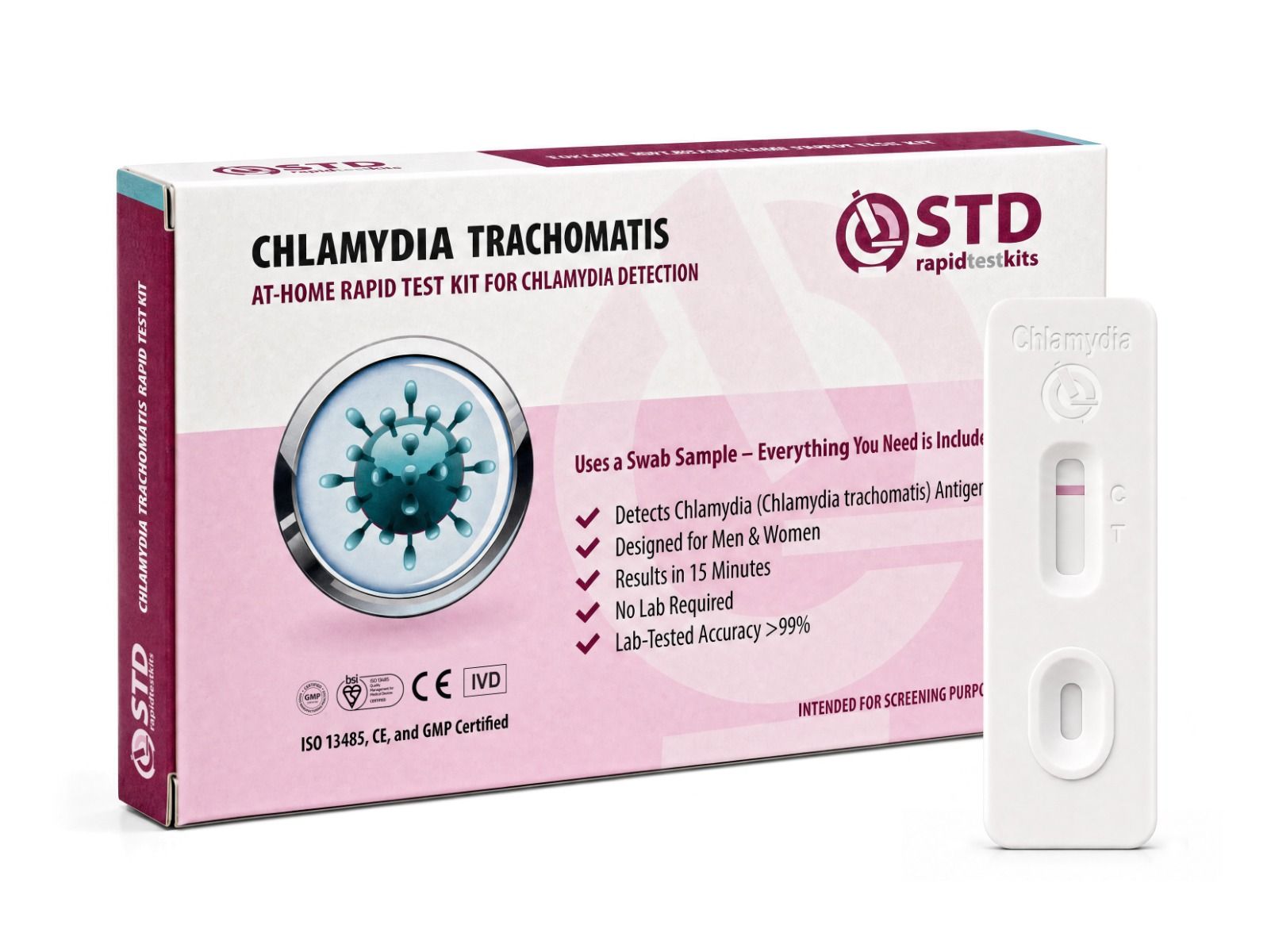
- Rapid lateral-flow swab, at home. A self-collected genital swab tested on a lateral-flow cassette at home, with a result in about fifteen minutes. Lateral-flow chemistry is meaningfully less sensitive than lab NAAT, especially at the lower bacterial loads of an asymptomatic infection. A positive result is highly informative; a negative result close to a recent exposure is a good reason to retest, ideally with a lab NAAT for confirmation.
- Clinic-collected swab plus lab processing. Same NAAT chemistry as the urine option, with a clinician collecting the sample. A reasonable choice if you also want a physical exam.
An at-home rapid test is most useful as a screening tool for the privacy and speed it offers. Most clinicians will want a lab NAAT confirmation before prescribing antibiotics, so the at-home test typically slots in as the first step rather than the only step. The friction it removes (booking, time off work, sitting in a waiting room, explaining the situation to a stranger) is exactly the friction the stigma layer feeds on. Removing it changes who actually tests, which is why at-home STI test kits exist in the first place: a man who would not make the appointment will still read a cassette in his own bathroom.
Treatment: the current playbook
The CDC's STI Treatment Guidelines list doxycycline 100 mg orally twice daily for 7 days as the first-line regimen for uncomplicated urogenital chlamydia. Single-dose azithromycin 1 g remains an alternative when sticking to a seven-day course is genuinely unrealistic, but the doxycycline regimen is favored because it has higher cure rates for urogenital and especially rectal infection.
A few practical points to know going in:
- Treat every sexual partner from the past 60 days. Expedited partner therapy is an option in many U.S. states, which lets a clinician prescribe medication for partners without an in-person visit.
- Avoid all sexual contact (including oral) for 7 days after starting doxycycline, or for 7 days after taking single-dose azithromycin. The bacterium can still be present and transmissible during the early days of treatment.
- Retest at roughly 3 months. Reinfection is common enough that the CDC recommends retesting at three months regardless of whether partners were treated, because an untreated partner, a new partner who carried it asymptomatically, or the same sexual network can reintroduce it.
- Doxycycline 100 mg twice daily for 7 days (first-line CDC regimen).
- No sexual contact (including oral) for 7 days after starting treatment.
- Notify every partner from the past 60 days, or use expedited partner therapy if available in your state.
- Retest at roughly 3 months even with no symptoms.
Transmission truths beyond penetration
"I always use condoms" is a sentence chlamydia hears all the time. Condoms are highly effective when used correctly and consistently for vaginal and anal intercourse, but a few realities limit their reach.
Condoms cover the penile shaft, but chlamydia can also be exchanged through contact with infected fluids on areas not covered, including the base of the penis, the scrotum, and the perineum. Pre-ejaculate carries the same bacterial load as ejaculate. Oral sex without a barrier transmits chlamydia in either direction, with throat infection being a known route. Sex toys shared without cleaning or a fresh barrier can carry the infection from one person to another.
Condom failure is also more common than people admit. Slippage, breakage, partial-use inconsistency ("just for a minute"), and microscopic damage from oil-based lubricants all reduce the protective effect. Condoms remain a primary risk-reduction tool in public-health guidance, but they work best paired with periodic testing rather than treated as a substitute for it.
Pre-ejaculate transmits chlamydia. Oral sex without a barrier transmits it in either direction. Sex toys passed between partners without cleaning or a fresh condom carry it. None of these routes require penetrative intercourse, and none are fully covered by the standard "used a condom" mental model.
Men who have sex with men face a hidden risk
Among men who have sex with men, chlamydia rates remain disproportionately high. Most of this gap traces to clinical screening practice, not personal behavior. Many primary care clinics still default to a urine sample for chlamydia testing, which only catches urethral infection. Rectal and pharyngeal infections, which are common in this population, are missed unless the patient specifically asks for swab-based site-specific testing or the clinic offers it as routine.
The CDC's guidance documents asymptomatic rectal and pharyngeal chlamydia as a recognized pattern, with screening recommendations covering all exposed anatomical sites rather than urine alone. A man can carry rectal chlamydia, feel completely well, and pass it during sex with another partner. He can carry pharyngeal chlamydia and pass it during oral sex. Neither site requires the urethra to be involved at all.
This is one of the strongest cases for asking explicitly for three-site swabs (urethral, rectal, pharyngeal) at a clinic. A urine-only test is incomplete for anyone who has had receptive anal or oral sex. Inclusive sexual healthcare here is straightforward in principle: test the sites where the bacteria can live, on a schedule that makes sense for the number of partners involved.
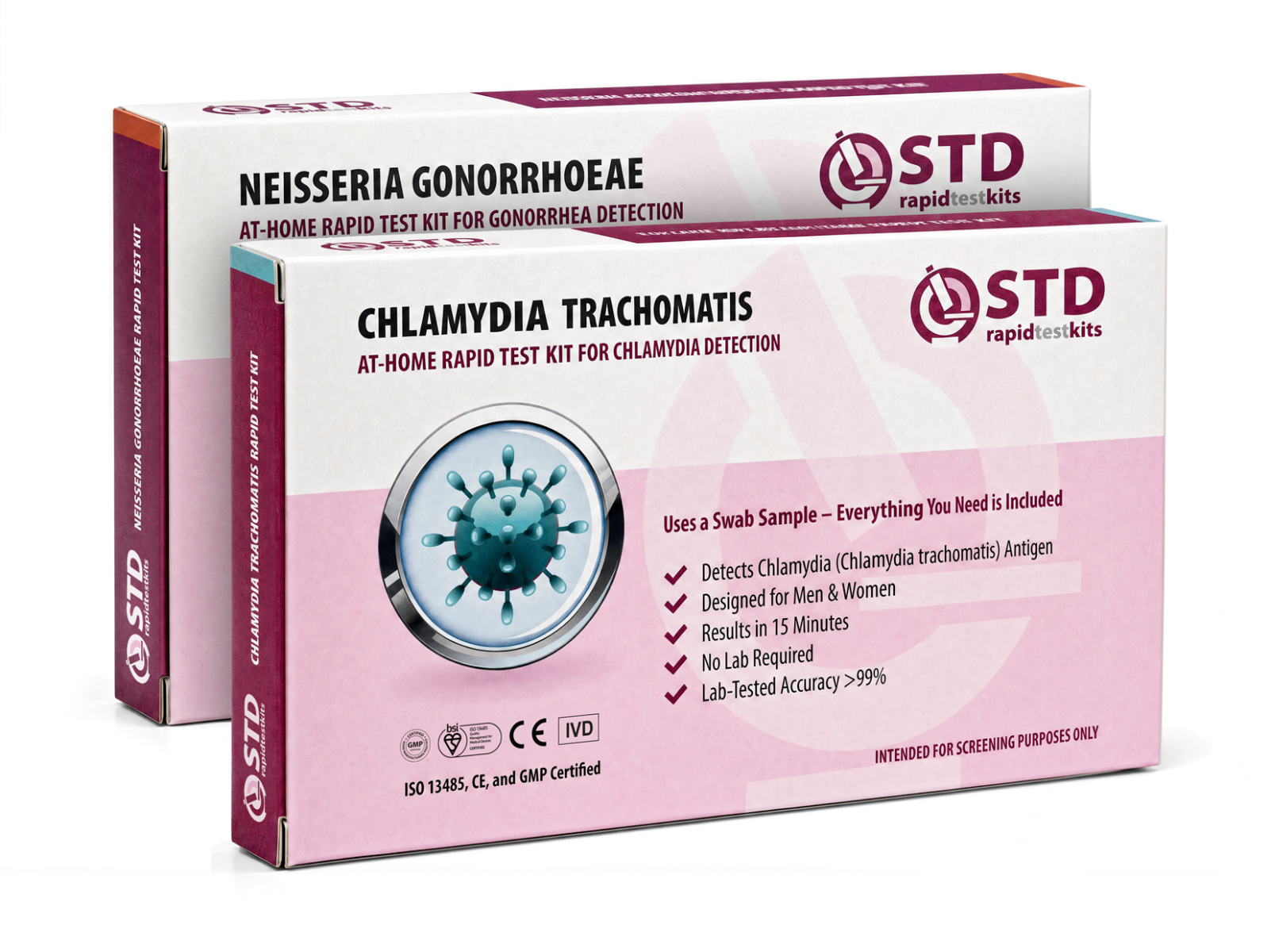
Our at-home swab kits cover urethral and vaginal sample collection. They do not cover rectal or pharyngeal sample collection, which need to be performed and processed by a clinic with a certified laboratory. If your concern is specifically a throat or rectal exposure, see a sexual health clinic or your primary care office for site-specific NAAT swabs; our genital chlamydia kit is the right tool for the urethral exposure that drives most male symptoms.
Why the cost rarely stays with one body
An asymptomatic infection still ripples outward, to partners, to pregnancies, and to HIV risk, in ways the infected man never sees.
What happens to partners. A man who does not know he is infected does not know to use barriers more carefully or to inform partners. The CDC treatment guidelines note that asymptomatic infection is common in both men and women. An untreated male partner is a frequent source of an undiagnosed infection in a female partner, and the consequences for her include pelvic inflammatory disease, ectopic pregnancy risk, and tubal-factor infertility. Many men only learn the cost of their silent infection through a partner's diagnosis or through fertility difficulties that show up later.
Pregnancy implications. Chlamydia in pregnancy is associated with preterm rupture of membranes, low birth weight, and newborn conjunctivitis or pneumonia from exposure during delivery. If you and a partner are trying to conceive, both of you should screen at the start. A 7-day doxycycline course resolves the carrier status before it can affect the pregnancy.
HIV acquisition and transmission. Mucosal inflammation from any untreated STI raises both susceptibility to HIV acquisition during exposure and, if HIV is already present, the likelihood of onward transmission. This effect applies in the affected tissue specifically, which is why HIV co-testing is worthwhile alongside any chlamydia screen and why prompt treatment reduces a downstream risk that is otherwise easy to overlook.
Three ways the cost ripples outward
- Female partners face pelvic inflammatory disease, ectopic pregnancy risk, and tubal-factor infertility.
- Untreated chlamydia in pregnancy is associated with preterm rupture of membranes, low birth weight, and newborn eye or lung infection.
- Mucosal inflammation from untreated chlamydia raises HIV acquisition risk during exposure in the affected tissue.
Telling recent partners
Most men describe partner notification as the worst part of a positive test. The good news is that scripts exist, they are short, and they do not need to be perfect.
- Recent hookup: "Quick health heads-up. I tested positive for chlamydia recently. It's common and curable, but you should get tested too."
- Long-term partner: "My test came back positive for chlamydia. We will both need a course of antibiotics and a retest at three months. Want me to set up a kit for you?"
- Ex-partner from the last 60 days: "My recent test came back positive for chlamydia. No blame either way. Please get checked so you can treat it if needed."
The pattern that works is short, factual, no finger-pointing, then a concrete next step. Anonymous partner-notification services exist in many state health departments if direct contact feels impossible. Chlamydia is curable in a single course of antibiotics for both partners; the conversation is uncomfortable for an evening, but the consequences of skipping it can run for years.
The takeaway: test on a schedule, not in a panic
A burning urethra, a yellow morning drip, or a one-sided testicular ache will not make great small talk. Pretending the signs aren't happening is the path that costs fertility, partner health, and any reasonable peace of mind. Chlamydia is common, curable, and beatable in a single seven-day antibiotic course if you catch it.
Testing as a routine, rather than a response to a problem, removes most of the stigma calculation. A man who tests every six to twelve months between new partners is not flagging a suspicion; he is doing maintenance.
Chlamydia often has no symptoms, but it can cause serious health problems, even without symptoms. If symptoms occur, they may not appear until several weeks after having sex with a partner who has chlamydia.
Your next steps
If you are weighing whether to test now and what to do with the result, the short flow below maps the common situations to a clear action.
Should I test for chlamydia now?
Have you had a new partner, a condom failure, or a partner's positive diagnosis recently?
Yes: Plan to test about 14 days after that exposure, which is when a negative result becomes reliable. Testing sooner is reasonable if you have symptoms, but retest at the two-week mark to be sure.
Did an at-home rapid test come back positive, or do you have ongoing symptoms?
Yes: Confirm with a clinician and start the first-line course: doxycycline 100 mg twice daily for 7 days. Notify every partner from the past 60 days and skip all sex, including oral, for 7 days after starting treatment.
No: If your negative test fell within two weeks of a possible exposure, retest at the two-week mark. Otherwise screen again at your next routine interval, roughly every 6 to 12 months or with each new partner, and retest at about 3 months after any treated infection.
Guidance only. A healthcare provider can advise based on your specific situation.
FAQs
- Can I have chlamydia and feel completely fine?
- Yes, and it is the most common pattern in men. Test after a new partner, after condom failure, or after a partner discloses a positive diagnosis, regardless of how you feel. Many men carry chlamydia for weeks or months with no signs at all, or with signs subtle enough to attribute to dehydration, a strain, or a minor cold.
- How soon after exposure does a test become reliable?
- Wait about 14 days after a possible exposure before trusting a negative result. A test taken in the first few days after sex can return a false negative because the bacterial load is still building. Lab NAATs reach reliable detection slightly sooner than rapid lateral-flow strips, but the practical 2-week wait covers both formats.
- What does treatment look like?
- Doxycycline 100 mg twice daily for 7 days. No sex for those 7 days. Notify every partner from the past 60 days. Retest at 3 months even with no symptoms. Azithromycin 1 g as a single dose is an option if completing 7 days isn't realistic, but cure rates are lower, especially for rectal infection.
- What does the color of penile discharge tell me?
- Color is a rough hint, not a diagnosis. Watery or milky discharge often points to early urethral inflammation; thick yellow or yellow-green discharge suggests a heavier bacterial load and raises the odds of gonorrhea or co-infection, so test for both. Bloody or pink-tinged discharge needs a clinician's evaluation rather than a home test. Any discharge after a new or unprotected exposure is a reason to test.
- Can chlamydia cause permanent infertility in men?
- Untreated, long-running infections can scar the epididymis and degrade sperm parameters, and chronic chlamydial epididymitis is associated with measurable fertility effects. Most men treated promptly recover normal parameters within months. The longer an infection runs unrecognized, the higher the chance of residual scarring.
- Is the at-home rapid test as accurate as a lab NAAT?
- No. The CDC names lab NAAT as the recommended chlamydia test because of its high analytical sensitivity on urethral, urine, and rectal samples. At-home rapid tests use lateral-flow chemistry, which is faster and more private but less analytically sensitive, especially at the lower bacterial loads of an asymptomatic infection. A positive at-home result is highly informative; a negative result close to a recent exposure is worth confirming with a lab NAAT.
- Can chlamydia spread through oral sex?
- Yes. Pharyngeal chlamydia is well documented. The throat infection itself usually causes no symptoms or only a mild, transient sore throat, and it can be transmitted to a partner during subsequent oral sex. A urine-only test does not detect a throat infection; a pharyngeal swab does, and that swab needs to be collected and processed by a clinic.
- How long after treatment can I have sex again?
- Avoid all sexual contact (including oral) for 7 days after starting doxycycline, or for 7 days after taking single-dose azithromycin. The bacterium can still be present and transmissible during the early days of treatment.
- U.S. Centers for Disease Control and Prevention. About Chlamydia: chlamydia as a common STI, asymptomatic presentation, and the several-week symptom-onset window.
- U.S. Centers for Disease Control and Prevention. STI Treatment Guidelines (Chlamydial Infections): first-line doxycycline 100 mg twice daily for 7 days, single-dose azithromycin alternative, NAAT as the recommended test, 60-day partner-notification window, 3-month retesting recommendation, and extragenital screening guidance.
- World Health Organization. Chlamydia fact sheet: global epidemiology, asymptomatic infection patterns, the up-to-three-week symptom-onset window, and the role of screening in detection.
- UK National Health Service. Chlamydia: most people have no symptoms, complications including infection in the testicles, testing options, and treatment.
- MedlinePlus (U.S. National Library of Medicine). Chlamydia Infections: plain-English summary of symptoms, complications including epididymitis and reactive arthritis, and treatment.
