
Published: August 2025 | Last updated: May 2026 | Editorial review and quality control: Martina N.
Two of the most commonly reported bacterial sexually transmitted infections in the United States travel together far more often than most people realize. When a clinician finds chlamydia, gonorrhea is on the differential. When gonorrhea turns up, chlamydia is treated alongside it at the same visit. The reasons sit at the intersection of biology, behavior, and how quietly both infections can move through the body.
For most readers landing here, the question is some version of this. I tested positive for both, or my partner did, or my clinician said to expect them as a pair, so what does that mean? The short version: you are not unusual, the treatments are well-established, and the next steps are concrete. The longer version is below.
Key Takeaways
- Chlamydia and gonorrhea share transmission routes and infect the same mucosal tissues, so a single sexual exposure can transmit both at once.
- Concurrent infection is common enough that CDC guidance recommends presumptive chlamydia treatment whenever gonorrhea is diagnosed, unless chlamydia has been ruled out by laboratory testing.
Why these two infections travel together biologically
Chlamydia is caused by Chlamydia trachomatis, a bacterium that can only replicate inside human host cells. Gonorrhea is caused by Neisseria gonorrhoeae, a paired bacterium that lives on mucosal surfaces. Two different organisms with two different replication strategies, but the same target tissue. Both infect the columnar epithelial cells lining the urethra, cervix, rectum, and pharynx. Their habitats overlap almost completely, which means an exposure that delivers one organism to a vulnerable mucosal surface is positioned to deliver the other.
Both spread through unprotected vaginal, anal, and oral sex. Both can colonize the throat and rectum, often without producing noticeable symptoms in those sites. Laboratory studies have also documented that gonococcal infection can alter the host cell environment in ways that may support chlamydial replication, with proposed mechanisms involving changes to iron availability and inflammatory signaling. The research is suggestive rather than definitive on the precise mechanism, but the clinical observation is consistent. Where one of these organisms shows up, the other often follows.
Both organisms target the same mucosal tissue at the same anatomical sites (urethra, cervix, rectum, pharynx), which is why a single sexual exposure can transmit both at once.
How common is the overlap?
Chlamydia and gonorrhea remain the two most commonly reported notifiable infections in the United States. The CDC's annual STI surveillance reported approximately 1.5 million chlamydia cases and approximately 540,000 gonorrhea cases nationally in 2024 (1,515,985 and 543,409 respectively, both representing year-over-year declines from 2023). Both figures are widely understood to undercount the true number of infections because asymptomatic cases often go unreported.
Among people diagnosed with gonorrhea, concurrent chlamydial infection is common enough that the CDC's Sexually Transmitted Infections Treatment Guidelines recommend treating chlamydia presumptively at the time of gonorrhea diagnosis, unless chlamydial infection has been ruled out by laboratory testing. Co-infection rates vary by population, anatomic site, and screening setting, with published figures often in the 20% to 40% range and higher in adolescent and young adult populations.

Why the symptoms hide so well
Both infections are commonly asymptomatic, particularly in cervical, pharyngeal, and rectal sites. When chlamydia does produce symptoms, they tend to be vague. Mild discomfort during urination, light discharge, sometimes spotting between periods. Gonorrhea is somewhat more likely to produce noticeable symptoms in urethral infection, with a thicker discharge and a more acute burning sensation, but it commonly stays silent in the throat or rectum.
The result is a long window of unknowing transmission. Someone can carry either or both organisms for weeks to months without feeling differently, and during that time pass the infection along to new partners who in turn may pass it further. The CDC's chlamydia screening recommendations exist for exactly this reason.
CDC screening intervals at a glance
- Sexually active women under 25: annual chlamydia and gonorrhea screening, regardless of symptoms.
- Women 25 and older with risk factors (new partner, multiple partners, partner with an STI): annual screening.
- Men who have sex with men: multisite screening at the urethra, rectum, and pharynx, often every 3 to 6 months for higher-risk patterns.
- Pregnant people: screening at the first prenatal visit, with repeat screening in the third trimester for those at continued risk.
When you test for one, screen for both
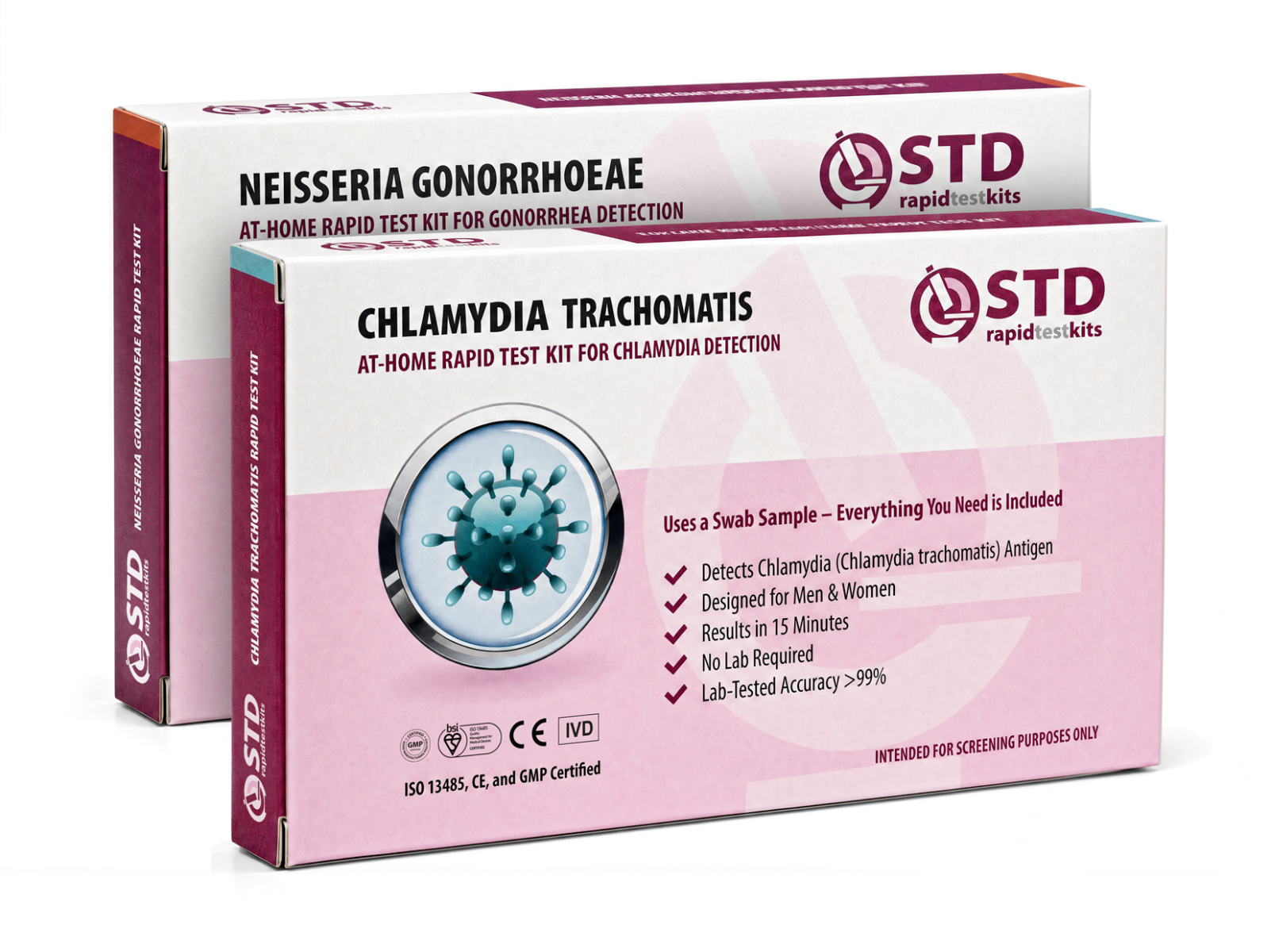
Because the two infections travel together, every modern combination kit and clinical screening protocol covers them together. At-home rapid kits use a self-collected vaginal or penile swab to detect both organisms from a single sample. Broader at-home combination panels add fingerstick blood testing for the blood-borne infections (HIV, syphilis, hepatitis B, hepatitis C) so that a single exposure event can be screened across the relevant pathogens in one sitting.
The at-home rapid kits use lateral-flow immunoassay chemistry on a self-collected sample. Laboratory NAAT (nucleic acid amplification testing), the analytical reference standard the CDC cites for chlamydia and gonorrhea screening, has higher sensitivity for low-burden and asymptomatic infections. The two formats are complementary rather than interchangeable. At-home screening is fast, private, and accessible, and works well as a first answer. Laboratory NAAT is the appropriate confirmation step for a positive at-home result, and the appropriate escalation if symptoms persist after a negative at-home result.
This site sells at-home rapid STI kits, including the 2-in-1 chlamydia and gonorrhea swab kit linked below. Product recommendations are based on fit for the reader's concern, not commercial preference.
A diagnosis is not a moral verdict
The cultural framing around sexually transmitted infections often trails the medical reality. Chlamydia and gonorrhea spread through ordinary human contact, the same route that transmits many other infections passed from person to person. Most people who test positive for either acquired the organism from a partner who did not know they were infected. That is the asymptomatic part of the math. Most ongoing transmission, statistically, comes from people who have no idea anything is wrong.
The medical response is straightforward. The emotional response is often harder, especially when results arrive alone in a notification on a phone. Clinicians who handle these diagnoses every week typically tell patients some version of the same thing: this is common, this is fixable, and the next steps are concrete.
Treatment, in plain terms
The CDC's 2021 STI Treatment Guidelines (the current published edition, with an update in development) describe the standard regimens:
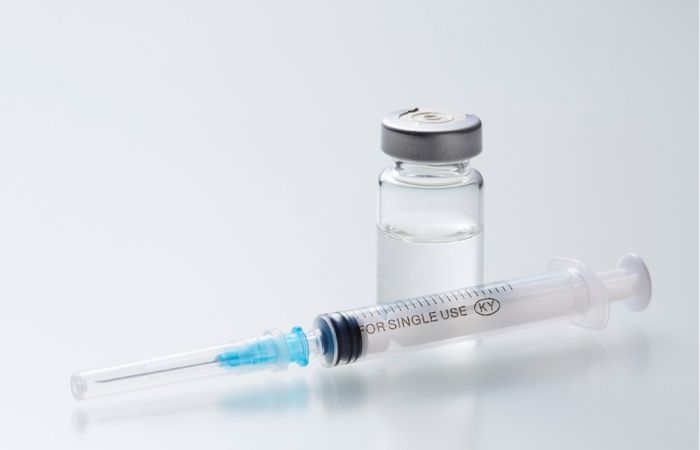
- For gonorrhea: a single 500 mg intramuscular injection of ceftriaxone for adults and adolescents weighing under 150 kg, and 1 g for those at or above 150 kg. The previous dual-therapy approach that combined ceftriaxone with azithromycin was replaced with ceftriaxone monotherapy in 2020, with separate chlamydia treatment when co-infection cannot be excluded.
- For chlamydia: doxycycline 100 mg orally twice a day for 7 days as the preferred regimen. Azithromycin 1 g orally as a single dose remains an alternative, particularly when medication adherence is a concern.
For both infections, the CDC recommends abstaining from sex for 7 days after completing therapy, and until partners have also completed treatment, to avoid reinfection. A test of cure is generally not recommended for uncomplicated genital chlamydia or gonorrhea in adults treated with the recommended regimens. A 3-month follow-up retest is recommended, however, as a screen for reinfection.
Reinfection is often the bigger problem
Reinfection rates within 3 to 6 months of treatment are notably high. Published studies and CDC guidance describe reinfection figures often in the 10% to 20% range, frequently driven by untreated partners rather than by failure of the original course. The bacteria themselves remain susceptible to first-line antibiotics in the vast majority of cases, particularly for chlamydia. The reinfection pattern is mostly about the partner network, not the medication.
Reinfection matters for more than continued transmission. Untreated or repeatedly reinfected chlamydia and gonorrhea can cause pelvic inflammatory disease (PID) in women, where the infection ascends from the cervix into the upper reproductive tract. The CDC describes the resulting damage as scar tissue that can block the fallopian tubes, raising the long-term risk of infertility, chronic pelvic pain, and ectopic pregnancy (a pregnancy implanted outside the uterus, which is a medical emergency). Prompt treatment of each episode dramatically reduces these risks, which is the deeper reason the 3-month retest and partner treatment matter beyond clearing any single infection.
This is why expedited partner therapy has become a CDC-endorsed prevention strategy where state law permits it. Under expedited partner therapy, the person who has been diagnosed receives antibiotics or a prescription to deliver to their partner without that partner having to attend a separate clinic visit. The approach reduces reinfection rates substantially in randomized trials, particularly for heterosexual partnerships where the index patient is comfortable having the conversation. Local availability varies by state, so it is worth asking your clinician what is permitted in your area.
Condoms reduce risk but do not eliminate it
Condoms used correctly and consistently substantially reduce the per-act transmission probability for both chlamydia and gonorrhea. Reduction, however, is not elimination. Several factors limit protection.
First, oral sex is often performed without barrier protection. Pharyngeal gonorrhea and pharyngeal chlamydia transmission both occur through oral-genital contact, and pharyngeal gonorrhea in particular is overwhelmingly asymptomatic. Second, condoms cover the penile shaft but do not cover every area of skin-to-skin or genital-secretion contact during sex. Third, inconsistent or partial use, such as a condom applied partway through an encounter or used in some encounters but not others, carries substantially higher transmission risk than consistent use throughout.
None of that is an argument against condoms. They remain one of the most effective single tools available, and they help substantially. It is an argument for combining barrier methods with regular screening and direct partner communication. The combination produces lower overall risk than any single intervention by itself.
Consistent, correct condom use lowers per-act transmission for both infections, but consistent means every encounter, start to finish. Pharyngeal and rectal sites are less reliably covered, and oral sex frequently happens without barrier protection. Regular screening closes the residual gap.
Partner notification and the 3-month retest
Once you have a diagnosis, two practical steps reduce both your reinfection risk and the chance of onward community transmission.
- Tell recent sexual partners, typically anyone within the last 60 days or the most recent partner if longer ago, that they should be tested and treated. Many state and local health departments offer anonymous partner-notification services for people who cannot or do not want to have the conversation directly.
- Retest in approximately 3 months. This is screening for reinfection, not test of cure. Reinfection is common enough that the 3-month retest is part of routine CDC-recommended follow-up regardless of how the original conversation with partners went.
These steps work better when the diagnosis is treated as logistics rather than as a verdict. A short, clear message to a recent partner is the most effective form of partner notification, and the cleanest exit from the cycle for both people involved.
Persons treated for gonorrhea should also be treated routinely with a regimen effective against uncomplicated genital Chlamydia trachomatis infection, unless chlamydial infection has been excluded by a nucleic acid amplification test.
Putting it together
For most readers, the practical reality looks like this. A diagnosis of one of these infections strongly raises the probability of the other, which is why combination testing is standard. Treatment is short, well-defined, and effective. The most important follow-through after treatment is partner treatment and a 3-month retest. Regular screening between exposures, annually for sexually active people under 25 and more often for higher-risk patterns, catches infections that are silent more often than not.
If you are deciding whether to test now, the at-home rapid kits provide a screening answer at home in about 15 minutes from a self-collected swab. A positive result is worth confirming with a laboratory NAAT through a clinic, and worth starting treatment for promptly. A negative result, when symptoms or recent exposure concerns persist, is worth following up with clinic testing as well. No single test rules out infection definitively in every scenario, which is why the screening pattern matters as much as any one result.
The shame around these diagnoses is the part that should fade fastest. The treatments are old, well-studied, and effective. The conversations with partners are awkward and matter more than the awkwardness. The pattern of testing and retesting is the part that becomes routine if you let it.
Concrete action sequence
- Test now. Use an at-home swab kit, or visit a clinic for a NAAT, depending on access and turnaround needs.
- Confirm any positive at-home result with a laboratory NAAT through a clinic, and start treatment promptly.
- Complete the full antibiotic course as prescribed, and tell recent partners (typically the last 60 days) so they can be tested and treated.
- Abstain from sex for 7 days after finishing therapy, and until partners have completed treatment.
- Retest at approximately 3 months as a reinfection screen, even if you have no symptoms.
FAQs
- Can a single sexual encounter transmit both chlamydia and gonorrhea?
- Yes. Both bacteria can be transmitted through one episode of unprotected vaginal, anal, or oral sex with an infected partner. Co-infection is common enough that clinical guidelines often recommend treating for both whenever one is diagnosed.
- How common is co-infection in clinical practice?
- Roughly 1 in 4 to 1 in 3 people diagnosed with gonorrhea test positive for chlamydia at the same visit, with even higher rates in adolescent and young adult populations. The overlap is consistent enough that the CDC's default is to treat both at once rather than wait for a second confirmatory result.
- Are symptoms different when both infections are present?
- Not reliably. Both infections are commonly asymptomatic, especially in pharyngeal and rectal sites. When symptoms occur, they are not specific enough to distinguish one infection from the other, or to confirm co-infection, without laboratory testing.
- Can one round of antibiotics treat both?
- Yes, in practical terms. Current CDC guidance is a single 500 mg intramuscular ceftriaxone injection for gonorrhea plus a 7-day course of oral doxycycline 100 mg twice a day for chlamydia. Both regimens are typically initiated at the same visit.
- When can I have sex again after treatment?
- The CDC recommends abstaining from sex for at least 7 days after completing therapy, and until any partners have also completed treatment, to avoid reinfection.
- Do I need a follow-up test after treatment?
- You do not need a second test to confirm the antibiotics worked. The standard regimens are reliable for uncomplicated infection. The 3-month follow-up is specifically to catch reinfection from an untreated partner, not to double-check the treatment. If symptoms persist beyond 7 days after finishing therapy, see a clinic rather than self-retesting at home.
- Can untreated chlamydia or gonorrhea cause infertility?
- In women, untreated or repeatedly reinfected chlamydia and gonorrhea can ascend into the upper reproductive tract and cause pelvic inflammatory disease (PID), which can scar the fallopian tubes and increase the risk of infertility, chronic pelvic pain, and ectopic pregnancy. Prompt antibiotic treatment of each episode reduces that risk substantially, which is why early testing and the 3-month retest matter.
- Is oral sex a real transmission route for these infections?
- Yes. Both organisms can colonize the pharynx, and pharyngeal gonorrhea is overwhelmingly asymptomatic. Multi-site screening (genital, rectal, and pharyngeal) is part of standard CDC recommendations for people whose risk patterns include receptive oral sex.
- U.S. Centers for Disease Control and Prevention. Sexually Transmitted Infections Treatment Guidelines, 2021. Source for current recommended regimens (ceftriaxone for gonorrhea, doxycycline for chlamydia), the abstain-7-days post-treatment recommendation, the presumptive dual treatment guidance, and the 3-month retest recommendation.
- U.S. Centers for Disease Control and Prevention. Annual STI Surveillance. Source for U.S. annual reported case counts of chlamydia (1,515,985 in 2024) and gonorrhea (543,409 in 2024).
- U.S. Centers for Disease Control and Prevention. About Chlamydia. Source for asymptomatic infection prevalence, screening recommendations, and complications of untreated infection including PID, tubal scarring, infertility, and ectopic pregnancy.
- U.S. Centers for Disease Control and Prevention. Gonorrhea. Source for multisite screening recommendations, pharyngeal infection asymptomatic patterns, and symptom prevalence by anatomic site.
- World Health Organization. Sexually transmitted infections (STIs) fact sheet. Source for global burden context and consistency with U.S. clinical guidelines.
- U.K. National Health Service. Chlamydia. Source for cross-system consistency on screening recommendations, test technology, and treatment regimens.
