Why Are STDs Spiking in 2026? What the Data Really Shows
Some STIs are climbing fast, some have plateaued, and a few are easing from pandemic-era peaks. This guide walks through what the latest CDC and WHO data actually show, who is most affected, and how at-home rapid testing fits into a 2026 prevention plan.




- Reported syphilis in the U.S. has climbed every year for over a decade, and congenital syphilis has more than doubled since 2018, per CDC surveillance.
- Most chlamydia and trichomoniasis infections in women cause no symptoms (WHO), which is why scheduled testing matters even when nothing feels wrong.
Published: September 2025 | Last updated: May 2026 | Editorial review and quality control: Martina N.
After four years of disrupted clinic visits, falling condom use, and a generation that meets new partners through phones first, the United States is reporting some of the highest sexually transmitted infection numbers in decades. The headline figures are real, but the story underneath them is more useful than the headlines suggest.
The picture is also more nuanced than a single word like "spike" implies. Some infections are climbing fast, some have plateaued, and a few are easing from pandemic-era peaks. What hasn't changed is the central problem: many infections cause no symptoms at all, so testing has become the only reliable way to know your status. This article walks through what the most recent CDC and WHO data actually show, who is most affected, and what at-home testing can and cannot tell you in 2026.
This article is published by stdrapidtestkits.com, which sells at-home STI testing kits. Recommendations here are based on fit-for-purpose for the reader's concern, not on commercial benefit.
What the Latest STI Numbers Actually Say
Recent CDC STI surveillance reports tell a mixed story, not a uniformly catastrophic one. Reported chlamydia case counts have hovered around 1.6 million per year for the past several years, neither spiking nor falling sharply. Reported gonorrhea cases dipped from their 2020 peak but remain well above pre-2014 levels. Syphilis has truly accelerated, with primary and secondary cases climbing year over year and congenital syphilis cases reaching levels not seen in decades.
Reported numbers also undercount real infection rates. Many cases are never tested, and many positive results from non-reportable settings never reach surveillance. CDC estimates the actual prevalence of common STIs is well above the reported figure, particularly for HPV and herpes, which are not routinely reportable in most jurisdictions.
The geographic story is uneven. Several southern and southwestern states report sustained high rates, but rural counties in the Midwest and Mountain West have seen some of the steepest year-over-year increases since 2022. That pattern tracks closely with closures of public-health clinics and gaps in Medicaid expansion, not with anything specific about the people living in those areas.
For readers, the practical takeaway is simpler than the surveillance complexity. If you have had a new partner in the last six months, if condoms have been inconsistent, or if your last test was over a year ago, current case rates are not the deciding factor. Your individual exposure is. National headlines can sound alarming or reassuring depending on which year and which infection you read about; what matters for you is whether you have been tested recently.
| Infection | Reported U.S. Cases (CDC, recent year) | Direction Since 2018 |
|---|---|---|
| Chlamydia | About 1.6 million per year | Roughly stable |
| Gonorrhea | Around 600,000 per year | Slight decline from 2020 peak |
| Syphilis (primary and secondary) | Tens of thousands per year | Substantial increase |
| Congenital syphilis | 3,882 cases reported in 2022 (CDC) | More than doubled since 2018 (CDC 2022 surveillance) |
Why Now: The Real Drivers Behind the Trend
A single cause does not explain rising STI numbers. Several trends collided around the pandemic and the aftermath has not settled.
Start with delayed care. From 2020 through 2022, many sexual-health clinics shut down or sharply cut testing capacity. Routine checkups were missed, treatments were delayed, and exposure windows widened. Even after services resumed, public-health staffing remained below pre-pandemic levels in many states, with budget cuts further reducing capacity through 2024 and 2025.
Then came shifts in behavior. Sexual activity rebounded after pandemic isolation, often with new partners and increasingly through dating apps that compress the time between match and meeting. The increase in activity was not matched with prevention habits. Condom use has continued a long decline, especially among teenagers and young adults. Some users rely on hormonal contraception or pre-exposure prophylaxis (PrEP) for HIV and assume those tools cover other STIs, which they do not.
A third factor sits in plain view: most STIs cause no symptoms in most people. According to the World Health Organization, the majority of common STIs produce no symptoms in those infected, and a large share of gonorrhea infections in both sexes are also silent, particularly at non-genital sites. People who feel fine often skip testing, infections persist, and they pass quietly to new partners.
Add the steady decline of HPV vaccination coverage in some regions, the rise of antibiotic-resistant gonorrhea strains tracked by CDC laboratory networks, and reductions in school-based sex education in many states.
The trend is layered: delayed care (clinic closures and staffing cuts since 2020), shifted behavior (more partners, fewer condoms, app-mediated meetings), and silent infections (most cases never produce symptoms). Each is small on its own. Stacked, they explain why surveillance numbers have not returned to pre-pandemic baselines.
Who Is Most Affected (And It Is Not Just Big Cities)
Several long-running myths about who gets STIs do not match the data. The first myth is that infection is mostly an urban problem. Recent CDC reports show some of the sharpest year-over-year increases in rural counties, particularly in southern and midwestern states where local clinics have closed or merged and where stigma around sexual-health care remains high. Where public-health infrastructure thins out, infections grow.
The second myth is that STIs mainly affect young adults. People aged 15 to 24 still account for almost half of new chlamydia and gonorrhea diagnoses, but the fastest-growing age band for several infections is 45 and older. People returning to dating after divorce or after a partner's death often have not been tested in years and may not realize that monogamy assumptions from a previous relationship no longer apply. Public-health workers describe seeing first-time positive results in patients who have been sexually active for decades but have never had an STI test.
The third pattern is harder to talk about. Black, Latino, and Indigenous communities in the U.S. report STI rates well above national averages. The cause is not behavioral. It tracks closely with healthcare access, insurance coverage, and the historical placement of public clinics. When public-health funding is cut, the people first served by underfunded clinics are the ones whose case rates climb first.
Men who have sex with men remain disproportionately affected by syphilis and HIV, but heterosexual transmission has driven much of the recent increase in congenital syphilis. Pregnancy-related transmission to newborns is the most preventable category of severe outcome, and the one where the public-health system has lost the most ground.

How Symptoms Hide, and Why That Matters Now
The classic signs that older sexual-health education focused on (burning urination, genital sores, visible discharge) still happen. They simply happen less often than the curriculum implied. More commonly, the early signs of common STIs are subtle, delayed, or look like something else entirely.
Mild irritation gets blamed on laundry detergent, friction, or stress. A small sore on the lip is treated as a cold sore and forgotten. A bit of unusual discharge is mistaken for a yeast infection. None of these are misreadings caused by carelessness. They reflect the actual experience of infection: most STIs do not announce themselves with textbook symptoms.
This matters more in 2026 than it did a decade ago for two reasons. First, the asymptomatic share of common infections is now well documented. WHO reports that the majority of chlamydia and trichomoniasis infections in women produce no symptoms, and CDC data on gonorrhea show that a substantial share of pharyngeal and rectal infections produce no symptoms either. Second, the consequences of late diagnosis have not changed. Untreated chlamydia can cause pelvic inflammatory disease and tubal infertility. Untreated syphilis progresses through stages and can damage the heart and nervous system if it reaches late stages. Untreated HIV continues to cause immune-system damage even when the person feels fine.
Waiting for symptoms is not a reliable strategy in 2026. People who are sexually active with new or multiple partners benefit from testing on a schedule, not from testing only when something feels off. Screening intervals depend on individual risk, but the CDC's general recommendation is at least annual STI testing for sexually active adults under 25 and for higher-risk adults of any age.
More than 1 million curable sexually transmitted infections are acquired every day worldwide in people aged 15 to 49 years.
Testing Has Become the Most Useful Tool
In an era when STI rates are uneven and symptoms are unreliable, testing is the most direct way to know your status. That is true regardless of what you assume about your relationship, your partner, or your own behavior.
For decades the practical barrier to testing was access. Getting tested meant taking time off work, sitting in a clinic waiting room, and answering a series of awkward questions before any sample was collected. For some people that experience was tolerable. For many, especially those in rural areas or those who feared judgment, it was enough of a barrier to skip testing entirely. The result was the asymptomatic-spread problem described above.
At-home rapid testing has shifted the cost-benefit math. The technology behind a rapid lateral-flow test is not new, but the willingness of regulators to authorize self-collected sample testing for several common STIs is recent. Testing can now happen at the kitchen table on a Saturday morning without an appointment, without insurance paperwork, and without explaining anything to anyone.
A few caveats matter. Rapid lateral-flow tests are screening tools, not lab-grade NAAT testing. A positive result is meaningful and warrants confirmation with a clinic or telehealth provider before treatment. A negative result is also meaningful, but only if you have waited long enough after exposure for the infection to be detectable. Window periods vary by infection: roughly 14 days for chlamydia and gonorrhea, 3 to 6 weeks for syphilis, and 18 to 45 days for most 4th-generation HIV antigen-antibody tests with 90 days considered conclusive. Test too early and a real infection can return a false negative.
Think of home testing as an entry point rather than a final answer. It removes the friction of clinic-based testing, surfaces likely positive cases, and routes them toward confirmatory testing and treatment.
Testing window periods at a glance
- Chlamydia and gonorrhea: detectable about 14 days after exposure.
- Syphilis: typically detectable 3 to 6 weeks after exposure.
- HIV (4th-generation antigen-antibody): most infections detectable within 18 to 45 days; 90 days considered conclusive.
- Test before the window closes and you may get a false negative; plan a follow-up at the right interval if your first test was early.
Condom Use, Birth Control, and the Risk Gap
One of the quieter drivers of rising STI numbers is the steady decline of condom use, especially among younger people. According to the CDC's Youth Risk Behavior Survey, condom use among sexually active high school students has been falling for years and is now well below levels reported a decade ago.
Several factors drive the decline. Hormonal contraception has expanded, including long-acting reversible options like the IUD and implant, which protect against pregnancy without requiring use at the moment of sex. PrEP has expanded HIV prevention. These tools are excellent at what they do, but they do not protect against any STI other than HIV in the case of PrEP, and condoms remain the only routinely accessible barrier method. When people transition from condoms to pill-and-PrEP, exposure to other STIs goes up.
Other factors are social. Conversations about safer sex have not kept up with how relationships actually start in 2026. People meet through apps, escalate through messaging, and often skip explicit conversations about prior partners or testing status before sex happens. Some assume monogamy without confirming it. Others rely on the visual impression that a partner "looks clean," which is meaningless for asymptomatic infections.
The takeaway is not that everyone should use condoms in every encounter. The takeaway is that risk reduction is layered. Condoms reduce exposure to fluid-borne infections substantially. Vaccination prevents HPV and hepatitis B. Testing catches what slips through. Communication closes the assumption gap. No single tool covers everything; using two or three together covers most realistic risk.
Even when condom use is consistent, the asymptomatic share of common STIs means infections can still pass during the gap between exposure and symptom recognition. Routine testing closes that gap better than any single behavioral change. CDC recommends at least annual screening for sexually active adults under 25 and for higher-risk adults of any age.
Trust, Assumptions, and Quiet Transmission
The most commonly missed scenario in STI testing is also the most uncomfortable to talk about. People in long-term, apparently exclusive relationships often assume they do not need to test. That assumption can be wrong for at least three reasons.
The first is timing of prior testing. If neither partner was tested before the relationship started, an infection acquired earlier may still be present and may have been transmitted between partners without anyone noticing. Latent infections like HPV and herpes can persist for years before producing any sign.
The second is honesty. Many people in committed relationships are honest about exclusivity. Some are not. Long-running surveys of American adults consistently find non-trivial rates of outside contact during marriages and committed partnerships. Most relationships are honest. Some are not, and the testing implication is the same either way: shared status confirmation is more reliable than assumed exclusivity.
The third is the staleness of past results. A partner who tested negative two years ago but has not tested since is not currently confirmed negative. STI status is a snapshot, not a permanent property. Testing on a roughly annual cadence keeps that snapshot current.
None of this is about distrust. Reframing testing as care rather than accusation is the cultural shift that public-health communicators have been pushing for years, and it is finally landing. Couples who test together, share results, and update them periodically are doing what public-health programs have recommended for decades. The infections that have driven the recent increase mostly transmit during the symptom-free phase, which is exactly the phase where assumed-clear status is most likely to be wrong.

What Is Changing in the Medical Landscape
Beyond personal choices, the systems around STI care are shifting. Several changes are worth knowing about for anyone planning to test in 2026.
Pharmacies in many states now offer expedited STI panels through partnerships with reference labs. Telehealth providers can prescribe treatment within hours of a confirmed positive result, which collapses the gap between diagnosis and care. Several state Medicaid programs have added coverage for self-collection and at-home testing as a way to reach populations that under-use clinic-based services.
Access remains uneven. Rural counties continue to lose public clinics. Public-health funding cuts in 2024 and 2025 reduced staffing at many federally funded testing sites. The result is a two-track system: residents of well-funded urban areas have more options than ever, while residents of underfunded counties have fewer than they did a decade ago.
At-home rapid kits help bridge that gap, with caveats. They are not equivalent to lab NAAT testing in analytical sensitivity, especially for low-bacterial-load asymptomatic infections. A negative rapid result is not as definitive as a negative NAAT result, particularly when tested early in the window period. Use a home kit for routine screening, with a clear plan to confirm any positive through a clinic or telehealth provider before treatment.
Antibiotic resistance is the other shift worth tracking. Gonorrhea has developed resistance to most of the antibiotics historically used to treat it, and the CDC's antimicrobial resistance surveillance network now monitors for emerging resistance to ceftriaxone, the current first-line drug.
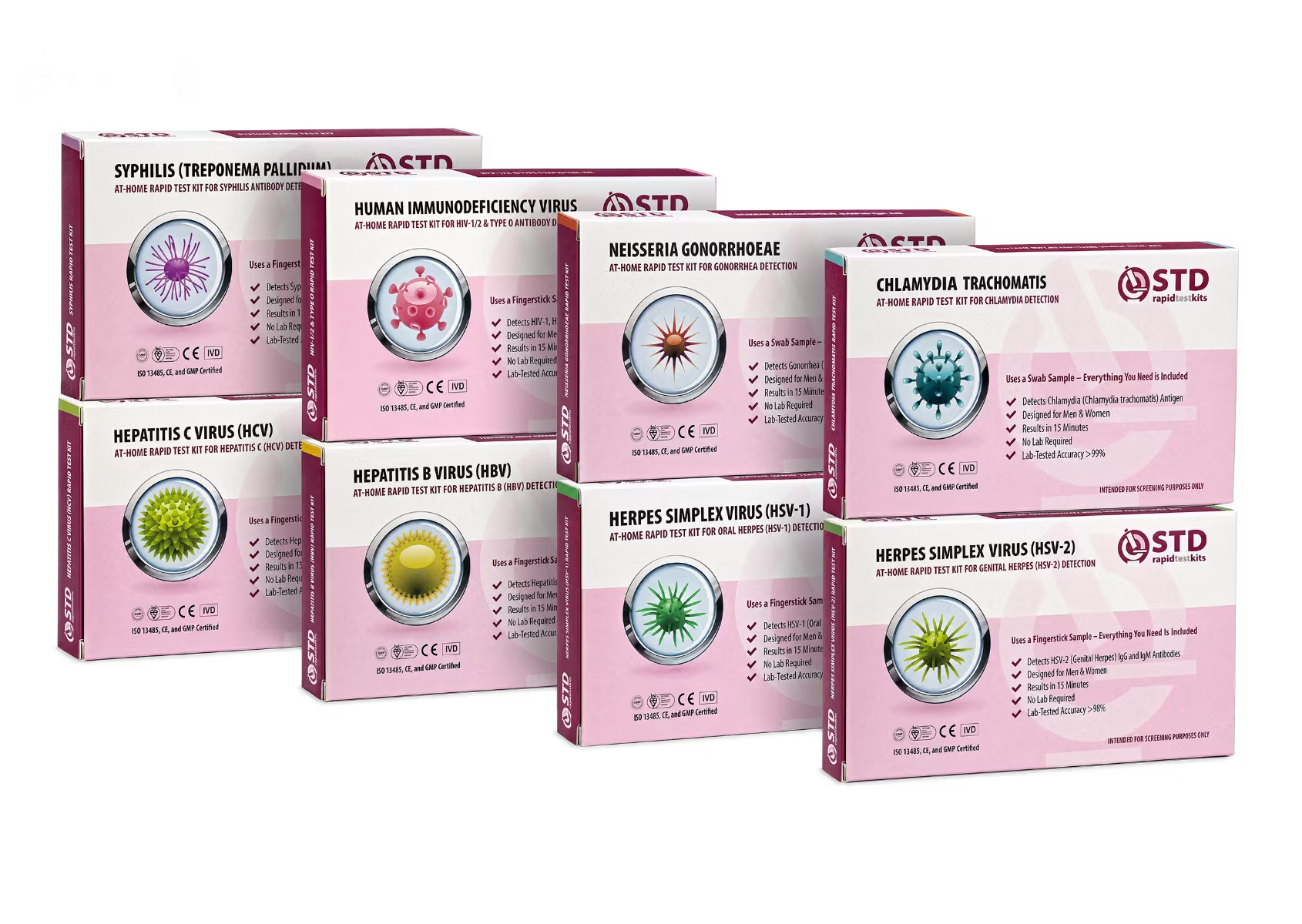
Prevention in 2026: Layered, Not Single-Step
A decade ago, prevention conversations often centered on a single tool: condoms, abstinence, or vaccination depending on the speaker. Public-health practice has moved toward layered prevention, recognizing that no single tool covers all STIs and that combining tools reduces risk substantially more than any one of them on its own.
The layers in 2026 look like this:
- Vaccination. Routine HPV vaccination is recommended through age 26, with shared clinical decision-making for adults through age 45 per ACIP guidance. Hepatitis B vaccination is recommended for all adults under 60 who have not been vaccinated. Both vaccines provide durable protection against infections that are otherwise common in sexually active adults.
- Barrier methods. Consistent and correct condom use substantially reduces transmission of fluid-borne infections including HIV, gonorrhea, chlamydia, and trichomoniasis. They reduce but do not eliminate skin-contact transmission of HPV and herpes.
- Pre-exposure prophylaxis. PrEP is highly effective at preventing HIV when taken as prescribed. It does not protect against other STIs, and CDC recommends quarterly STI testing for people on PrEP precisely because increased exposure to non-HIV infections is observed in some PrEP populations.
- Routine testing. Scheduled testing closes the loop on the asymptomatic-transmission problem. CDC recommends at least annual testing for sexually active adults under 25 and for higher-risk adults of any age. Healthy People 2030 sets explicit national targets for increasing testing coverage.
- Communication. Talking about prior partners and recent test results with new partners is the unglamorous prevention tool that closes the assumption gap. It is also the tool with the steepest culture shift required, especially in casual contexts.
Layered prevention is not perfect. It does shift the risk profile substantially, and it gives people who do encounter an infection a much higher chance of catching it early and treating it before complications develop. In a year of mixed national headlines, that personal-level math is the part you control.
If your last test was over a year ago, or if you have changed partners since your last result, this week is a reasonable time to test. Not because something is wrong. Because routine testing is what current public-health guidance recommends regardless of how the national numbers look.
Frequently asked questions
- How bad is the STI situation in 2026, really?
- It depends on the infection. Syphilis (including congenital syphilis) is genuinely climbing and is at levels not seen in decades, per CDC surveillance. Chlamydia is roughly stable at around 1.6 million reported cases per year. Gonorrhea has eased slightly from its 2020 peak but is still well above pre-2014 levels. The headline word "spike" applies most accurately to syphilis.
- Can you have an STI and feel completely fine?
- Yes, and it is more common than not. WHO notes that most chlamydia and trichomoniasis infections in women produce no symptoms, and a substantial share of gonorrhea infections in both sexes are also silent. Feeling fine is not a reliable signal of being clear.
- How soon after sex can I test?
- Window periods vary by infection. Chlamydia and gonorrhea are typically detectable about 14 days after exposure. Syphilis usually shows up at 3 to 6 weeks. 4th-generation HIV antigen-antibody tests can detect most infections within 18 to 45 days, with 90 days considered conclusive. Testing earlier than the window can produce a false negative; if you test early, plan a follow-up test at the right interval.
- Are at-home rapid STI tests accurate?
- Used at the right window after exposure and following the kit's instructions, rapid lateral-flow tests are useful for screening. They are not equivalent to lab NAAT testing in analytical sensitivity, especially for low-bacterial-load asymptomatic infections. A positive home test is meaningful and should be confirmed by a clinic or telehealth provider before treatment.
- Do condoms prevent all STIs?
- Condoms substantially reduce transmission of fluid-borne infections such as HIV, gonorrhea, chlamydia, and trichomoniasis when used consistently and correctly. They reduce but do not eliminate skin-contact transmission of HPV and herpes, since those infections can be present on areas of skin not covered by the condom.
- Is oral sex risky for STIs?
- Lower risk than vaginal or anal sex for several infections, but not zero. Gonorrhea, syphilis, herpes, chlamydia, and HPV can all transmit through oral contact. CDC recommends pharyngeal screening for people whose sexual practices include oral sex, particularly for those at higher risk.
- If I am in a long-term relationship, do I still need to test?
- If both partners were tested before the relationship and have remained exclusive, baseline risk is low. Many couples never establish that baseline. Latent infections from before the relationship can also persist. A shared, current test result is more reliable than an assumption of exclusivity, and most public-health guidance recommends periodic testing throughout adulthood.
- What should I do if a test comes back positive?
- Most STIs are treatable, and even lifelong infections like herpes and HIV are well managed with current medications. Confirm the result through a clinic or telehealth provider, start treatment as advised, and notify recent partners so they can test. Anonymous notification services exist if direct conversation is not safe or feasible. A positive result is the start of treatment, not the end of normal life.
How we sourced this article. We summarized current guidance from the U.S. Centers for Disease Control and Prevention and the World Health Organization, supplemented with U.S. federal data on adolescent risk behavior and HHS Healthy People 2030 STI objectives. Where surveillance numbers are reported in ranges, we used the figures most consistent with the most recent published surveillance reports rather than projections. This article is a summary of public-health guidance, not clinical advice.
- U.S. Centers for Disease Control and Prevention. STI surveillance data and trend reports for chlamydia, gonorrhea, and syphilis in the United States.
- World Health Organization. Sexually transmitted infections fact sheet, including global incidence estimates and the asymptomatic nature of common STIs.
- U.S. Centers for Disease Control and Prevention. Youth Risk Behavior Survey (YRBS) data, including condom-use trends among sexually active high school students.
- U.S. Centers for Disease Control and Prevention. About sexually transmitted infections (background, transmission, and prevention overview).
- U.S. Department of Health and Human Services. Healthy People 2030: Sexually Transmitted Infections objectives and progress.
- Pan American Health Organization / World Health Organization regional office. Sexually transmitted infections topic page.