Published: September 2025 | Last updated: May 2026 | Editorial review and quality control: Martina N.
Maybe it is your first time testing after a hookup that left you with questions. Maybe an ex just texted you about a positive result, and your stomach flipped. Or maybe you have had a strange itch with no discharge, and an hour of late-night searching gave you a list of possible infections that range from mild to terrifying. Whatever brought you here, you want a calm walkthrough of how at-home STI test kits work and which one fits the situation you are in right now.
This guide explains the two sample types you will encounter in a home rapid kit (a self-collected swab or a fingerstick blood drop), what each one can and cannot detect, when in your timeline a test will reliably catch an infection, and what to do if a result looks weird. Reading this should leave you with a real plan and a much shorter list of fears.
Key Takeaways
- Home rapid STI kits use either a self-collected swab (for chlamydia, gonorrhea, trichomoniasis, HPV) or a fingerstick blood drop (for HIV, syphilis, hepatitis B, hepatitis C, HSV antibodies). Urine STI testing is a clinic lab service that home rapid cassettes do not replicate.
- The sample type, the infection, and how recently you were exposed all determine when a test can detect an infection. Testing too early can produce a negative that simply reflects the window period.
What is in the box (and why pee is rarely part of it)
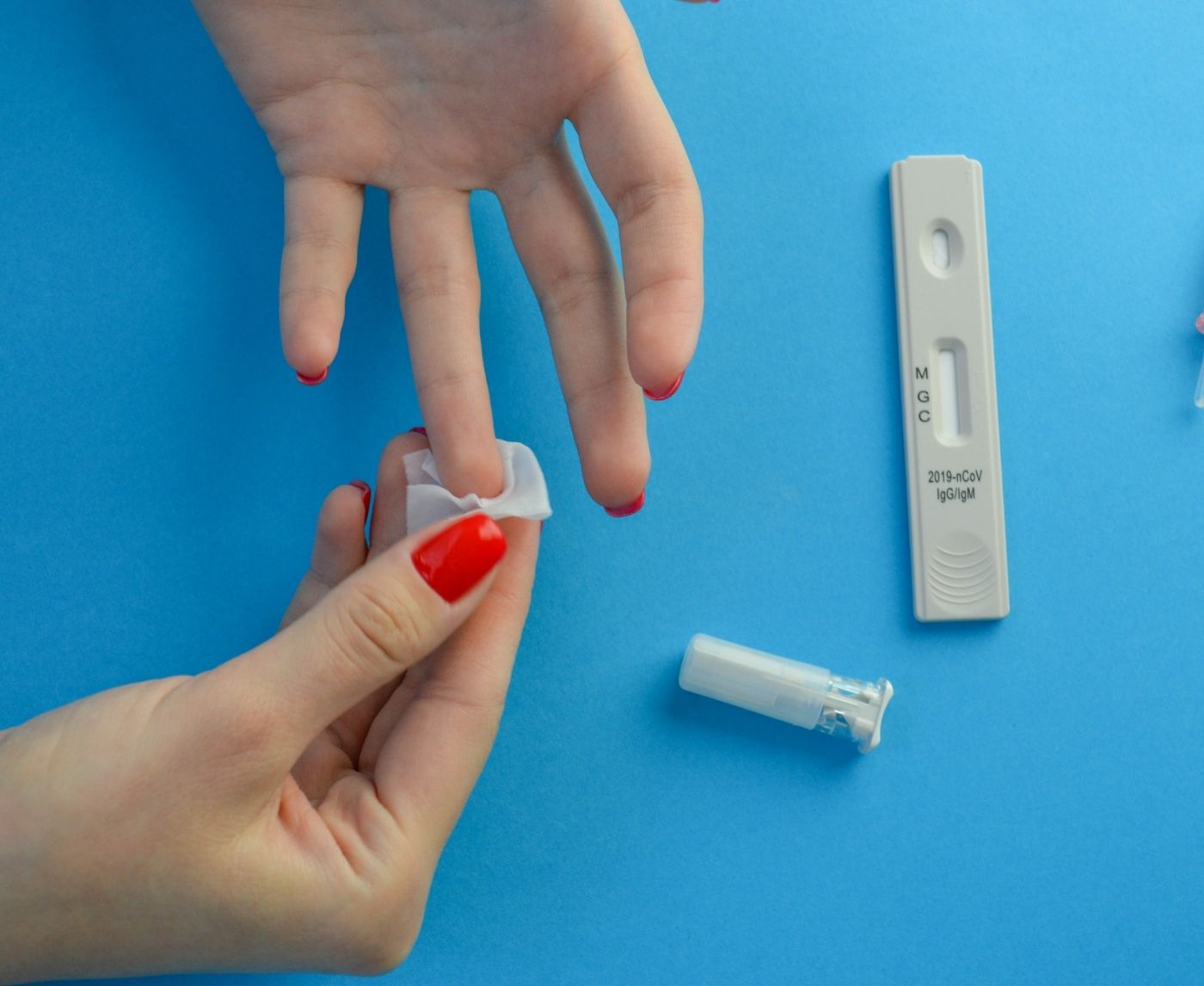
Open an at-home STI kit and you will find smaller, more familiar items than most people picture. Depending on which kit you ordered, you may see one or both of two collection setups. The first is a swab, a long cotton-tipped stick paired with a small cassette that looks a lot like a pregnancy test. The second is a fingerstick lancet (a small spring-loaded device that pricks your fingertip) along with a buffer bottle and another cassette.
Both setups belong to a family of tests called rapid lateral-flow immunoassays. They give a result in roughly 15 minutes by detecting either antigens shed by the pathogen itself (on a swab) or antibodies your body produces against an infection (in blood). They are screening tools designed for at-home use, and they share the general accuracy chemistry that pharmacy COVID-19 antigen tests use.
Here is the part that surprises a lot of first-time buyers: most at-home rapid kits do not use urine. Lab-based clinic testing for chlamydia and gonorrhea often uses a urine sample run through a NAAT (nucleic acid amplification test) instrument, which is the most sensitive method available. That instrument cannot be replicated in a home cassette. At-home rapid kits for chlamydia and gonorrhea use a self-collected vaginal or penile swab instead. If a kit promises a urine-based home test, it is almost always a mail-in lab kit rather than a 15-minute rapid result.
Each kit also includes a printed instruction sheet, sometimes a control card, and a result-reading window. The most common cause of a wasted test is not the chemistry; it is rushing the collection step or reading the window outside the instructed timeframe.
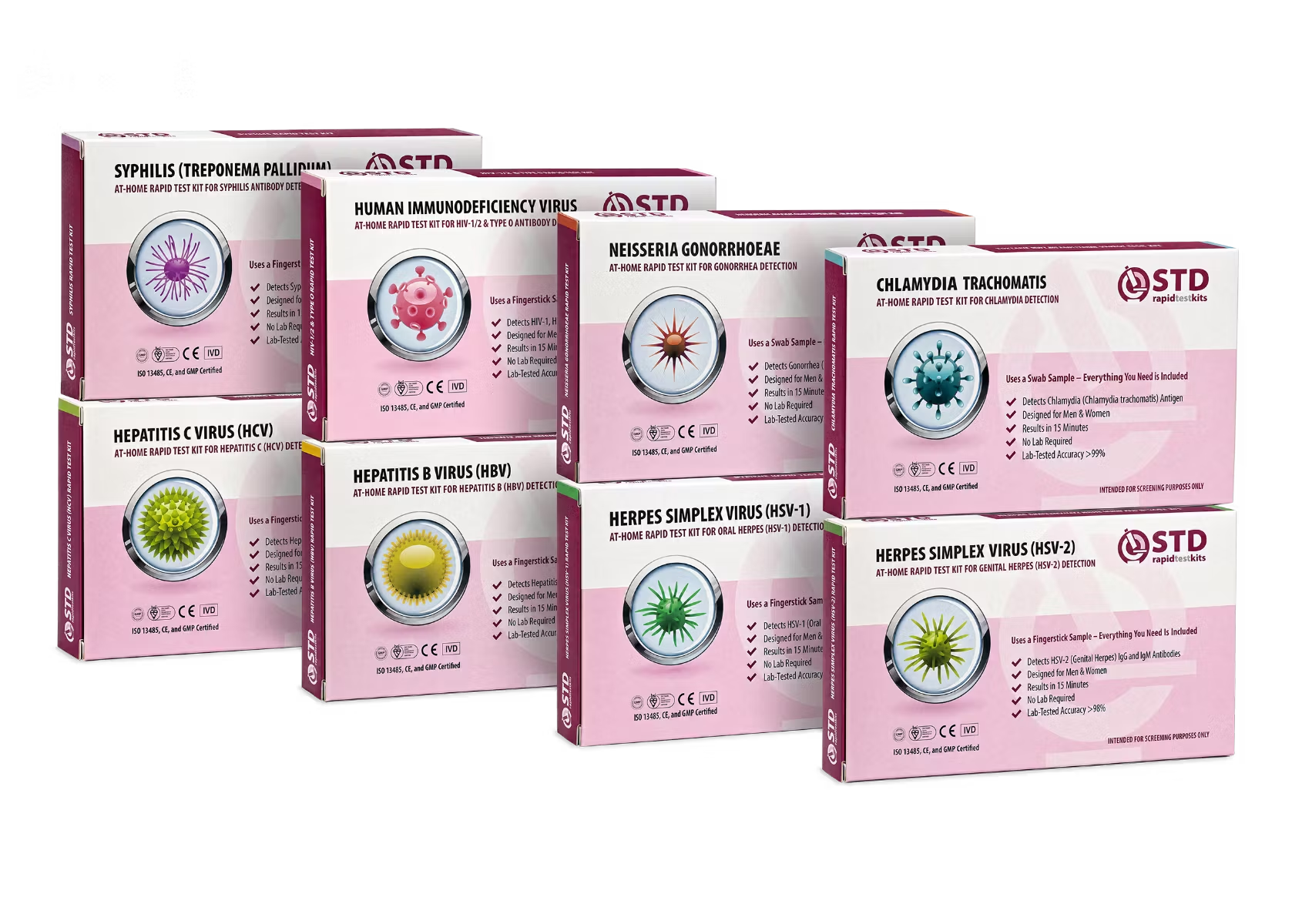
This site sells rapid lateral-flow tests only: swab-based kits for chlamydia, gonorrhea, trichomoniasis, and HPV, and fingerstick blood kits for HIV, syphilis, hepatitis B, hepatitis C, and herpes (HSV-1 and HSV-2 antibodies). We do not sell urine-sample tests, throat swabs, or rectal swabs. If your symptoms or exposure point toward a throat, rectal, or urine-based test, a clinic visit is the right next step, and we say so plainly throughout this guide.
Our trichomoniasis and HPV kits are validated for vaginal self-swab and are women-only. Our HSV blood tests detect antibodies, not active lesions; if you have a visible sore right now, a clinic-administered swab of the lesion is more accurate than any antibody test.
Two sample types: swab and fingerstick blood
You will see two collection methods across our catalog. Each one is built around the biology of the infection it screens for, which is why one kit cannot cover everything.
A self-collected swab is used when the infection lives on a mucosal surface. Chlamydia, gonorrhea, trichomoniasis, and HPV all live in the cells lining the vagina, urethra, and (in clinical settings) the throat or rectum. A swab pulls up enough of those cells to give the test something to read. Home swab tests on this site are validated for self-collected vaginal or penile sampling; they are not validated for throat or rectal use.
A fingerstick blood sample is used when the infection is in your bloodstream or when the test is hunting for antibodies your immune system made in response to past exposure. HIV, syphilis, hepatitis B, hepatitis C, and herpes (HSV-1 and HSV-2) all fit this pattern. A spring-loaded lancet pricks the side of your fingertip, you transfer one or two drops to the included cassette, and the result reads in about 15 minutes.
The table below maps each method to what it covers in our catalog.
| Sample Type | Infections Detected (our kits) | How You Collect | Best Used When |
|---|---|---|---|
| Self-collected swab | Chlamydia, Gonorrhea, Trichomoniasis (women), HPV (women) | Sterile swab inserted vaginally or applied to penile area, then placed in buffer | You want to screen genital infections after a possible exposure or in routine check-ups |
| Fingerstick blood | HIV, Syphilis, Hepatitis B, Hepatitis C, HSV-1 and HSV-2 antibodies | Lancet pierces fingertip; transfer 1 to 2 drops to test cassette | You want to screen for blood-borne infections or check past HSV exposure |
| Lab-processed urine (clinic only) | Chlamydia, Gonorrhea (NAAT) | First-catch urine in a sterile cup at the clinic | A clinic visit is on the table; NAAT is the most sensitive method |
Window periods: when each test can catch an infection
The hardest part of any STI test is timing. Your body needs time after exposure to either grow enough of a pathogen to be detected on a swab or to produce enough antibodies to be detected in blood. If you test too early, a negative result may simply mean the test cannot see what is there yet.
These windows vary by infection and by the assay technology. Lab NAATs are the most sensitive, so they shorten the window. Rapid lateral-flow kits are slightly less sensitive than NAATs, which means a wider safety margin is wise. The table below uses conservative ranges drawn from CDC clinical guidance and the WHO STI fact sheet. If your kit's instruction insert lists different numbers, follow those.
| Infection | Sample Type | Earliest Reliable Detection (rapid test) | Best Accuracy Window |
|---|---|---|---|
| Chlamydia | Swab | About 14 days post-exposure | 14 to 21 days |
| Gonorrhea | Swab | About 14 days post-exposure | 14 to 21 days |
| Trichomoniasis (women) | Swab | About 5 to 28 days | 1 to 4 weeks |
| HIV (antibody-only rapid) | Blood | About 23 days | Retest after 90 days if exposure is recent |
| Syphilis | Blood | About 21 days | 6 to 12 weeks |
| Hepatitis B (HBsAg rapid) | Blood | About 4 weeks | 6 to 12 weeks |
| Hepatitis C | Blood | About 8 weeks | 11 to 24 weeks |
| HSV-1 / HSV-2 antibodies | Blood | About 6 weeks | Retesting at around 16 weeks gives high confidence in seroconversion |
Match the test to what you are worried about right now
Symptoms and exposure history both shape the right test choice. Here is how to think it through.
If you have genital symptoms (burning during urination, abnormal discharge, pelvic discomfort) and recent vaginal or penile sex, a self-collected swab for chlamydia and gonorrhea is the highest-yield first move. Both infections are common, both are bacterial, and both are treatable. Catching them quickly matters because untreated infections can travel to the upper reproductive tract.
If you had unprotected oral sex and now have a sore throat or visible spots in your mouth, an at-home swab kit will not help. Throat infections need a pharyngeal swab, which is collected by a clinician and processed by NAAT. The same is true for rectal symptoms after receptive anal sex. We sell neither of these. See a clinic for those concerns.
If you have a visible blister or sore that you suspect is herpes, the most accurate test right now is a swab of the lesion itself, processed by PCR at a lab. A clinician can collect this in minutes. Our home HSV-1 and HSV-2 kits test antibodies in blood, so they answer a different question (whether you have ever been exposed at some point) rather than whether this specific sore is active HSV. Most people develop detectable HSV antibodies within 12 weeks of exposure, and retesting at around 16 weeks gives high confidence in seroconversion. See CDC STI clinical guidance for full context.
If you had a higher-risk exposure (a partner with a known infection, a condom break, a partner whose status you do not know) and you have no symptoms yet, the smartest move is a combination kit that covers the major systemic infections (HIV, syphilis, hepatitis) plus the common bacterial ones (chlamydia, gonorrhea). A 6-in-1 or 8-in-1 lets you cover most of the risk surface from one exposure event in a single box.
If you have ongoing exposure (multiple partners, condomless sex with someone whose status you do not know), screening every three to six months is the CDC's general recommendation for sexually active adults at higher risk. Annual screening is the floor for everyone sexually active, since most chlamydia and gonorrhea infections produce no symptoms.
How rapid lateral-flow chemistry works (and where collection goes wrong)
Rapid lateral-flow tests look simple, but the chemistry is well-validated. A sample is added to a buffer that releases the target molecule (an antigen for swab tests, an antibody for blood tests). The mixture wicks up the test strip by capillary action and crosses two zones. The first zone holds antibody-coated particles that bind to your target. The bound complex continues up the strip to the test line, where a second antibody traps it and forms a visible colored band. A separate control line confirms the test ran correctly.
What this means in practice: you need enough sample volume, you need the buffer to mix correctly, and you need to read the result inside the time window printed on the instructions (usually 15 minutes). Reading too early can miss a faint positive. Reading too late can show drying-pattern artifacts that look like lines.
The two most common collection mistakes are predictable and fixable.
First, swab collection that does not go deep enough. A vaginal swab needs about 5 cm of insertion (per kit instruction sheet) and a few rotations to collect the right cell layer. A penile swab needs to enter the urethra by about 2 to 4 cm (per kit instruction sheet) and rotate. The instruction sheet illustrates this; follow it even if it feels awkward, because a shallow swab samples skin cells instead of infected mucosa.
Second, fingerstick collection that does not yield enough blood. The fix is mechanical. Warm your hands first (run them under warm water for 30 seconds). Hang your hand below your heart for a minute before lancing. Lance the side of the fingertip pad rather than the dead-center pulp. Once the drop forms, gently milk the finger from the base toward the tip, releasing and re-pressing rather than squeezing constantly.
If you bungle a collection, do not use the result. Most kits include a single test. If you are out of supplies, order another kit and try again rather than guessing from a partial sample.
Faint lines, invalid results, and what each pattern means
Open a tested cassette and you will see one of four patterns. Knowing what each one means saves a panic spiral.
A clear test line and a clear control line mean a positive result. The test detected the target. Even if the test line is faint, in lateral-flow chemistry a line is a line. A faint test line generally indicates a real but lower-concentration positive (early infection, low-titer antibodies). The next step is a confirmatory test through a clinic.
A clear control line and no test line mean a negative result, with a critical caveat: the result is only reliable if you tested inside the right window for that infection. A negative test five days after exposure carries far less weight than a negative test six weeks after exposure.
No control line at all means the test is invalid. Discard it and re-test. Common causes are too little sample, too much sample (which floods the strip and washes out the line), or buffer that was not mixed properly. This is a damaged test, so do not interpret the test line either way.
A test line with no control line is also invalid for the same reason. The control line is the test's self-check, and without it the chemistry has not been validated for this run.
Reading the result outside the timeframe (often a 15-minute window) introduces another problem. Some negative tests develop a faint shadow in the test position over hours as the strip dries. That shadow is the chemistry winding down, so it should not be interpreted as a positive. If you set a kit aside for an hour and then check it, throw it out and run a new one rather than try to interpret the remnant.
Any positive result on a home rapid test, faint or bold, deserves a confirmatory test through a healthcare provider. Confirmatory testing usually involves a more sensitive technique like NAAT (for chlamydia and gonorrhea) or a Western blot or RNA test (for HIV).
When to retest (and when you do not need to)
Retesting matters in two situations: you tested too early in the window, and you have had new or ongoing exposure since your last test.
If you tested for chlamydia or gonorrhea less than 14 days after exposure and got a negative result, retest at 2 to 3 weeks for higher confidence. If you tested for HIV with a rapid antibody-only kit before the 90-day window closes, the CDC HIV testing guidance recommends a follow-up test after that window (roughly 12 to 13 weeks post-exposure). The same logic applies to syphilis (retest around 6 weeks) and HSV antibodies (retest at around 16 weeks).
Retesting after treatment is a separate conversation. The CDC recommends a test of cure three weeks after treatment for chlamydia and gonorrhea in pregnant patients, and a re-screen at three months for everyone treated for either infection (because reinfection from an untreated partner is common). Test of cure is not the place for a rapid antigen kit, because it can detect non-viable bacterial fragments for several weeks after treatment ends and produce a false positive. Wait the recommended interval and use a NAAT through your provider.
If you have multiple sex partners or ongoing condomless sex, the CDC recommends screening every three to six months for HIV, syphilis, chlamydia, and gonorrhea. For everyone else who is sexually active, an annual baseline screen catches asymptomatic infections that would otherwise go undiagnosed; the CDC notes that most chlamydia and gonorrhea cases produce no symptoms at all.
If your exposure was a single contained event and you tested at the right window, you do not need to keep retesting.
Many people who have an STI experience no symptoms. The only way to know if you have an STI is to get tested.
Privacy, plain packaging, and why people choose home testing
For a lot of readers, the appeal of an at-home kit comes down to one thing: avoiding the waiting-room conversation. Kits ship in plain packaging without obvious labeling. The exterior carries the courier's tracking sticker and nothing else identifying the contents. A roommate or partner who happens to bring in the box has no way of knowing what is inside.
The collection happens on your timeline, in your space. A swab takes about a minute. A fingerstick takes about three. Reading the result is a 15-minute wait you can spend doing anything else. There is no front-desk paperwork, no insurance copay, and no provider asking sex-history questions in a slightly-too-loud voice.
That said, a home kit is a screening tool that gives you a strong signal. It is not a final diagnosis. Any positive result deserves a follow-up with a healthcare provider, both for confirmatory testing and for treatment. Treatment for chlamydia, gonorrhea, syphilis, hepatitis B, and HIV requires a prescription. Provider follow-up also opens the door to partner notification, which is an important part of stopping transmission and protecting people who may not yet know they were exposed.
Home testing fills the gap between the first worry and the clinic visit. What it does is give you a starting point so the clinic visit (when needed) is more focused and less anxious. You arrive with a clearer question and a useful preliminary result.

You deserve answers, not assumptions
Choosing the right at-home test is mostly about three questions. Which infection are you actually worried about? How long has it been since the exposure that triggered the worry? And where do your symptoms (if any) point? The answers narrow the kit choice almost immediately. A swab covers the bacterial genital infections; a blood test covers the systemic ones; a combination covers most of the risk surface from a single exposure event.
The hardest part of testing is deciding to find out. The lancet and the swab are easy by comparison. Order the kit, follow the timing, read the result inside its window, and confirm anything positive with a provider. A known result is always easier to act on than weeks of guessing.
Three questions to narrow your kit choice
- Which infection are you actually worried about? Bacterial genital infections (chlamydia, gonorrhea) point to a swab kit. Bloodborne infections (HIV, syphilis, hepatitis) point to a fingerstick blood kit.
- How long has it been since the exposure? Match the kit to the right window: about 14 days for bacterial swabs, retest at 90 days for HIV antibody, around 6 weeks for syphilis, and around 16 weeks for HSV antibodies.
- Where do your symptoms point? Genital symptoms fit a self-collected swab. Throat or rectal symptoms need a clinic. A visible sore needs a clinician-collected PCR swab, not a home antibody test.
FAQs
- Can I use a urine sample with any of your at-home kits?
- No. The kits on this site use either a self-collected swab or a fingerstick blood drop. Urine NAAT testing is a clinic and lab service. If you specifically want a urine-based home option, you are looking at a mail-in lab kit rather than a 15-minute rapid kit.
- How soon after sex can I test reliably?
- It depends on the infection. Bacterial infections (chlamydia, gonorrhea) detect reliably about 14 days after exposure on a rapid swab. HIV antibody-only rapid kits should be repeated after the 90-day window, syphilis around 6 weeks, and HSV antibodies up to around 16 weeks for full seroconversion. If your exposure is recent and your initial result is negative, plan a retest at the upper end of the window.
- Is a faint test line still a positive result?
- Yes. In lateral-flow chemistry a line is a line, even a faint one. A faint test line usually means a real but lower-concentration positive, often early in the infection. Confirm any positive (faint or bold) with a healthcare provider; do not dismiss it.
- What if there is no control line?
- The test is invalid. Throw it out and run a fresh one. The control line is the test's internal self-check, so without it neither a positive nor a negative result is reliable.
- I had oral sex and my throat hurts. Will a home test help?
- No. Throat infections (pharyngeal chlamydia or gonorrhea) need a swab of the throat itself, collected by a clinician and processed by NAAT. We do not sell pharyngeal swabs. See a clinic for that one.
- I have a visible blister and I am worried it is herpes. Should I order an HSV kit?
- For an active lesion, the most accurate test is a swab of the sore itself, processed by PCR at a lab. A clinician can do this in minutes. Our home HSV kits are blood antibody tests; they tell you whether you have been exposed at some point, rather than whether this specific sore is active HSV. Antibody tests are most useful around 12 to 16 weeks after a suspected exposure.
- My swab kit says women only but I am a man. Can I use it?
- Our trichomoniasis and HPV kits are validated for vaginal self-swab only. There is no validated male home version of either. If you are male and need testing for trichomoniasis or HPV, see a clinic.
- What do I do if the test comes back positive?
- Take the result seriously and book a follow-up with a healthcare provider for confirmatory testing and treatment. Treatment for chlamydia, gonorrhea, syphilis, hepatitis B, and HIV requires a prescription. A positive at-home result is a strong indicator. It is preliminary until confirmed by a provider, and a provider can also help with partner notification.
How we sourced this article: Our editorial team built this guide from current public-health guidance (CDC, WHO, NHS) and from the manufacturer instructions for the rapid lateral-flow kits we carry. We synthesize this information into plain-English explanations rather than personal clinical advice. The cited sources below cover the specific recommendations and window-period figures referenced in the article body. The article was reviewed for clinical accuracy by our medical reviewer.
- U.S. Centers for Disease Control and Prevention. STI clinical guidance and screening recommendations, including HSV serology context and screening intervals.
- U.S. Centers for Disease Control and Prevention. HIV testing overview, including rapid antibody window periods and post-window retest guidance.
- U.S. Centers for Disease Control and Prevention. Genital herpes (HSV-1 and HSV-2) reader-facing overview and home-testing context.
- U.S. Centers for Disease Control and Prevention. Chlamydia detailed fact sheet, including asymptomatic-infection prevalence and screening intervals.
- World Health Organization. Sexually transmitted infections (STIs) fact sheet, global burden and screening principles.
- UK National Health Service. Sexually transmitted infections (STIs) overview, including testing approach and confirmatory care.
