
Published: August 2025 | Last updated: May 2026 | Editorial review and quality control: Martina N.
Small towns have a way of making personal matters feel public. People notice who drives past the clinic at 10 a.m. on a Tuesday, and the receptionist might be your aunt's best friend. None of this is bad on its own, the closeness is what people love about rural life, but it becomes a real obstacle when a sexual-health concern sends someone looking for a test. That hesitation has a measurable cost: the CDC's STI surveillance program reports that chlamydia, gonorrhea, and syphilis rates have been rising in many rural counties, sometimes at year-over-year rates that match or outpace nearby urban areas.
This guide is for the reader who has already weighed the awkwardness of being recognized at the local clinic against the cost of not testing at all. It walks through three private routes that actually work in rural America: at-home rapid test kits delivered in unmarked packaging, planned visits to an out-of-county clinic, and confidential telehealth consults. Each route has tradeoffs, and the right choice depends on which infection is on your mind, how soon you need an answer, and whether you have symptoms.
Key Takeaways
- CDC surveillance shows rural chlamydia and gonorrhea rates have grown at rates that often match or outpace urban counties, even as rural testing access lags.
- At-home rapid kits, out-of-county clinic visits, and telehealth consults are the three confidential routes that sidestep small-town visibility without compromising on test accuracy.
Why Privacy Hits Different in Rural America
In a city, anonymity is the default. A clinic on a busy block sees hundreds of patients a week, and nobody notices who walks in. In a town of three thousand, that math reverses. The clinic might see twenty patients a day, the staff is small, and most of them grew up in the same neighborhood as their patients. That structural difference is what makes rural sexual-health care feel exposed even when the law guarantees confidentiality.
HIPAA, the federal health-privacy law, applies the same way in every zip code. A nurse who shares your test result with anyone outside your clinical care team is breaking the law and risking their license. The HHS Office for Civil Rights enforces those rules, and small clinics get audited too. But the worry that keeps rural readers home isn't usually about a direct leak from inside the clinic. It's about being seen in the parking lot, about a chance encounter in the waiting room, about a friend of a friend who works the front desk and now knows you were there.
Consider what this looks like in practice. A young farmhand notices a burning sensation two days after a weekend trip. In a city he would walk into urgent care, get a swab, and pick up antibiotics by dinner. In his rural county the only option is a health center attached to the high school, where the receptionist sings in the same church choir as his mother. He tells himself the symptoms will pass. Two months later the gonorrhea has spread to his testicles, and he's driving ninety minutes to the next county for emergency care he could have gotten on day three.
Stories like that are common enough that public-health researchers have studied the effect. Confidentiality concerns are a well-documented barrier to STI care, and the pattern is sharper in low-density populations where social and clinical networks overlap. Every week of delay raises the odds that an infection moves further into the body and further into the community, and the cost lands on the patient first before spreading outward to partners, ex-partners, and the broader network.

The Hidden Math Behind Rural STI Spread
There's a comfortable story about rural life that says small towns are insulated from problems we associate with cities. Fewer strangers, smaller dating pools, more conservative social norms. The numbers do not support that story. CDC surveillance data over the past decade has shown that some of the fastest year-over-year increases in chlamydia, gonorrhea, and syphilis have come from non-metropolitan counties (see the CDC STI statistics dashboard). The difference is not that rural areas have more infections per capita on day one. It's that infections inside small networks stay hidden longer and recur more often.
Public-health researchers call the second part of that dynamic network saturation. In a dense urban dating network, a single untreated infection has many possible paths it can take, and most of those paths eventually reach people who get tested regularly. In a small rural network, the paths are fewer but more recurrent. The same handful of people keep encountering each other across months and years. One untreated case can cycle through a community repeatedly, infecting and reinfecting the same partners, before it ever shows up in surveillance data.
The other piece is education. School-based sex education in rural districts tends to lean harder on abstinence and lighter on the practical mechanics of testing and prevention. Research using CDC Youth Risk Behavior Survey data has found adolescents in non-metropolitan counties are less likely to report receiving instruction on how to get tested, where to access free or low-cost testing, and what to do after a positive result. Less information up front means slower recognition of symptoms later.
All of this compounds into a feedback loop. Lower testing rates feed a perception that rural areas are low-risk, which lowers testing rates further, which keeps cases out of surveillance, which reinforces the perception. Breaking that loop starts with one decision at a time: someone in the community deciding to test, get treated, and notify partners. That shift tends to accelerate once testing becomes the norm rather than the exception in a network.

According to the WHO global health sector strategy on STIs, stigma is among the primary obstacles to timely diagnosis and treatment, particularly in communities where confidential care is scarce.
Three Private Testing Options That Actually Work
Privacy comes in several shapes, each a tradeoff between speed, cost, accuracy, and how exposed the testing process feels to the person doing it. The three routes below cover the most common rural-friendly options. The right choice depends on the specific infection you're worried about and how much logistical effort you can put behind staying confidential.
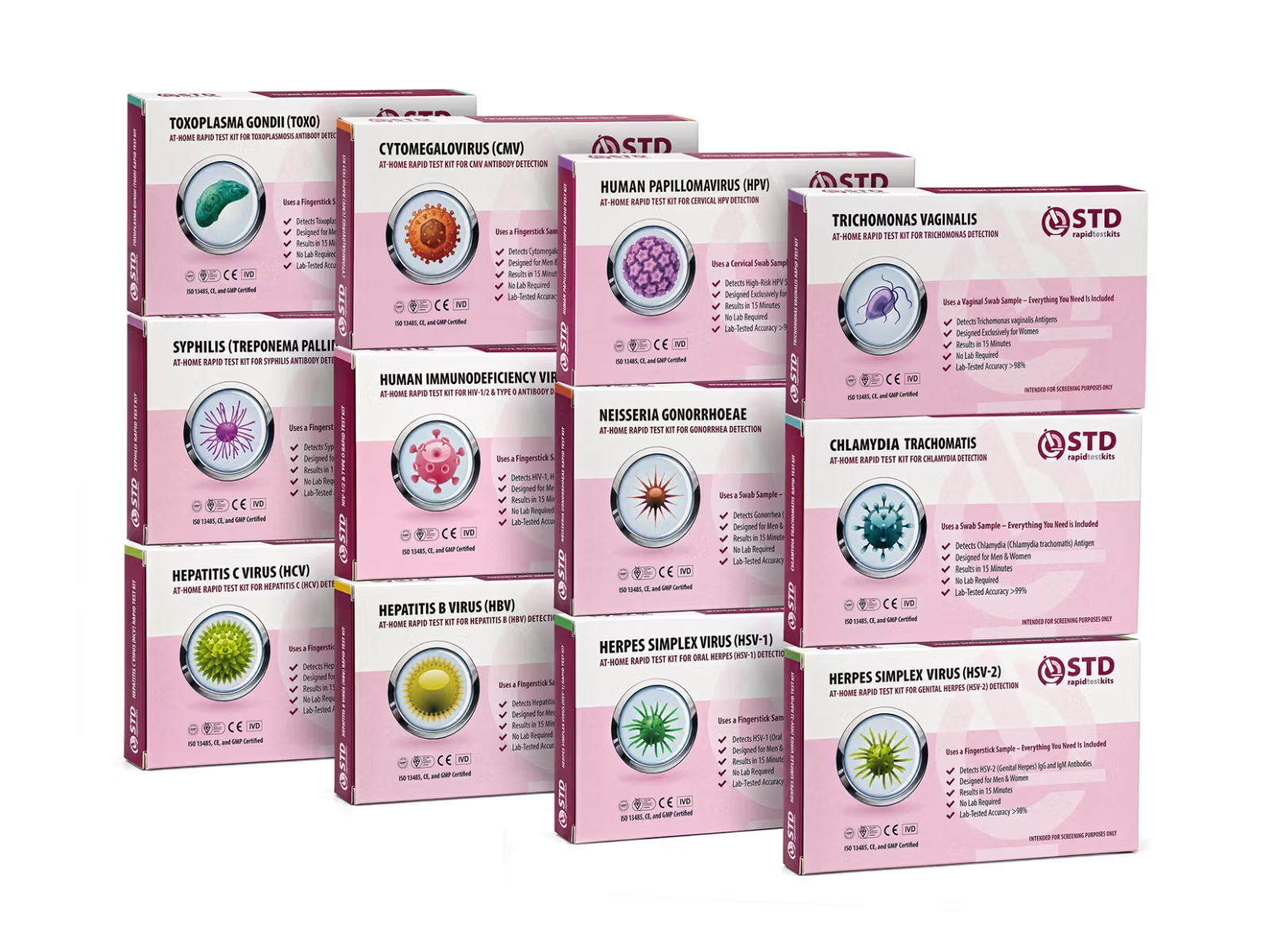
Route 1: At-home rapid test kits. These are lateral-flow tests you take in your own kitchen and read in fifteen to twenty minutes, the same chemistry used in many clinic rapid tests. Kits ship in plain unmarked outer packaging, often through standard postal mail. The user collects either a self-swab (for chlamydia, gonorrhea, trichomoniasis in women, HPV in women) or a fingerstick blood drop (for HIV, syphilis, hepatitis, HSV-1, HSV-2). Results are read directly on the cassette, with no lab involvement and no third-party paperwork inside your local health system. Well-validated rapid kits report sensitivity in the mid-to-high 90s and specificity above 99%, comparable to the rapid screening used in clinics for the same conditions.
The catch with at-home rapid tests is timing. Every infection has a window period during which the test cannot reliably detect it yet. For HIV, rapid antigen/antibody fingerstick tests (the type used in at-home kits) have a detection window of 18 to 90 days per CDC HIV testing guidance; the narrower 18-to-45-day window applies only to lab-based vein-draw antigen/antibody tests. For syphilis, the antibody window is typically 3 to 6 weeks. For chlamydia and gonorrhea swab tests, accuracy is good from about 1 to 2 weeks post-exposure. Read the kit's instructions carefully before testing, and retest at the end of the window if your first result is negative but the exposure was recent.
Route 2: Planned visits to an out-of-county clinic. If you'd rather see a provider in person but don't want to be seen at your hometown clinic, the workaround is to drive. Many rural readers pair a testing visit with errands they would have done anyway: groceries at a bigger supermarket, a routine specialist appointment, a weekend trip. Planned Parenthood publishes a clinic locator that lets you sort by distance and call ahead to confirm same-day testing availability. County health departments outside your home county will also test, often on a sliding-scale or free basis under Title X family planning funding from the HHS Office of Population Affairs, which is designed specifically to keep adolescent and adult sexual-health care confidential.
Route 3: Confidential telehealth. A video consult with a sexual-health provider can route lab orders to a pharmacy or lab of your choosing, and prescriptions for treatable infections (chlamydia, gonorrhea, syphilis, trichomoniasis, the antivirals used to manage HSV outbreaks) can be sent to a mail-order or out-of-area pharmacy. Telehealth doesn't cover every situation; you still need a physical sample for confirmatory testing in most cases. But it works well as a follow-up to an at-home positive result, or as a way to discuss symptoms with a provider you'll never run into in person.
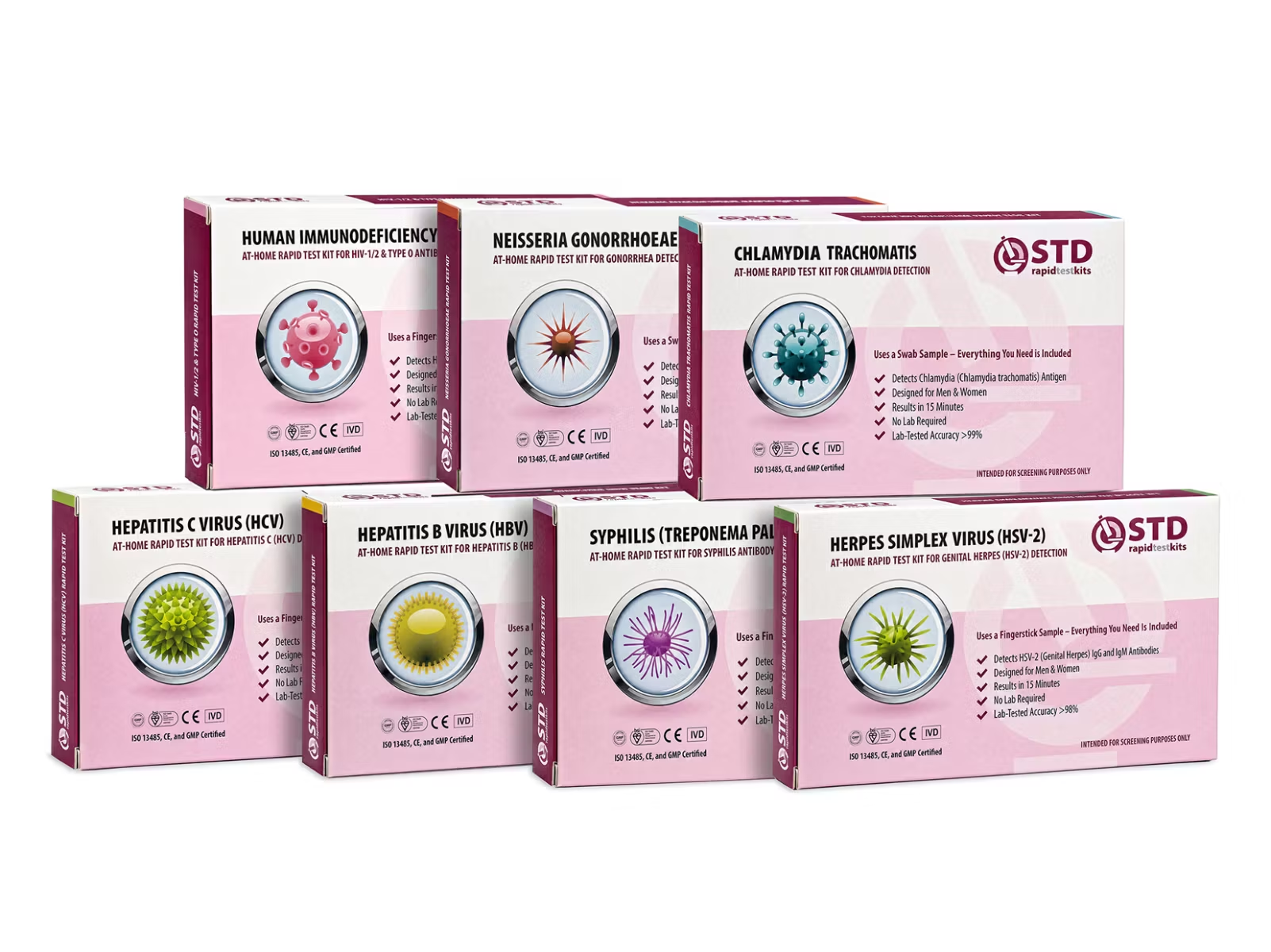
This site sells rapid at-home test kits for most conditions discussed in this guide; the 7-in-1 kit below covers seven of them.
What Happens After a Positive Home-Test Result
A positive at-home rapid test functions as a screening signal rather than a final diagnosis. The standard next step is confirmatory testing followed by treatment, and for most rural readers the worst-case scenario isn't a positive result. It's not knowing what to do next when one comes up.
The first step is confirmatory testing. Lateral-flow rapid tests are designed for high sensitivity, which means a small fraction of positives will turn out to be false alarms on follow-up. A confirmatory lab test (typically a NAAT, or nucleic acid amplification test, for bacterial STIs, or a Western blot or RNA-PCR for HIV, or treponemal antibody plus RPR for syphilis) is the standard. Telehealth makes this step easy: you book a consult, the provider orders the lab work, and you submit a sample at any participating LabCorp or Quest location. Draw stations exist in most rural counties, often inside larger pharmacies, and the visit itself looks identical to any routine blood draw.
The second step is treatment. Almost every bacterial STI is curable with a short course of antibiotics, and the regimens are well-established. The CDC STI Treatment Guidelines list the recommended drugs and durations for each infection. Telehealth providers can prescribe these directly, and for mail-order pharmacy delivery most of these medications are stable and ship in unmarked packaging.
The third step is partner notification, which is the part many rural readers dread the most. In a small social network, telling a partner about a positive test is essentially impossible to keep private long-term. There are workarounds. Many state health departments offer anonymous partner-services programs: you give them a partner's contact information, and a health-department staffer reaches out without revealing your name, recommending the partner get tested. For some infections, expedited partner therapy (EPT), available in most but not all U.S. states, lets a provider prescribe treatment to your partner without seeing them in person.
Making Testing a Routine Instead of an Emergency
The strongest defense against the rural-privacy bind is to test before there's a reason to worry. Routine testing means a negative result is the default expectation, not a frightening hope. It also means that when a positive result does come up, you catch it early, when treatment is simplest and the social cost is lowest.
The CDC's standing recommendation for sexually active adults under 25 is annual chlamydia and gonorrhea screening, with HIV screening at least once per lifetime and more often if any risk factors are present. People with multiple partners, new partners, or partners with positive results should test more frequently; every three to six months is a reasonable cadence for a sexually active adult who wants to stay ahead of any infection. Annual syphilis screening is recommended for adults in communities with rising case rates, which now includes many rural counties.
The practical version of this advice for a rural reader is to set a calendar reminder. Order a multi-infection rapid kit (or schedule a telehealth screening) at a fixed time each year, the same way you'd schedule a dental cleaning. Routine becomes its own privacy mechanism. Testing happens because it's June and June is when you test, rather than because something has gone wrong.
One last note. The conversation in rural communities about sexual health is shifting. Local health departments in many counties have started offering free or sliding-scale testing under Title X. Some pharmacies now dispense self-collection kits over the counter. Telehealth is more accepted by insurers than it was three years ago, and today's reader has access to options that did not exist a decade ago.
The Bottom Line for Rural Readers
Living in a small town shouldn't decide whether you find out about an STI in time to treat it. The three routes covered here (at-home rapid kits, out-of-county clinic visits, and telehealth consults) exist precisely so a rural reader can test on their own terms. None of them require explaining yourself to anyone in your hometown. All of them produce results that hold up clinically, especially when paired with confirmatory lab testing after a positive screen.
- Order an at-home rapid kit (plain packaging, 15-minute result) or book a confidential telehealth screening.
- If your screen is positive, drive to an out-of-county clinic or use a telehealth-ordered lab draw at LabCorp or Quest for confirmation.
- Use your state health department's anonymous partner-services program (or expedited partner therapy where available) for notification.
Getting Started Without Overthinking It
Getting started is the hardest part: ordering the kit, scheduling the telehealth call, deciding which weekend you'll drive to the next county. Once that step is taken, the rest of the process is short. A rapid test takes fifteen minutes, a telehealth call takes about thirty, and a regional clinic drive costs you a day. Compared to the alternative (waiting, hoping, and giving an untreated infection more time to spread), the math is straightforward.
FAQs
- Is rural STD testing harder because there are fewer clinics, or because of privacy worries?
- Both, but privacy is usually the deeper barrier. Many rural counties have at least one clinic, and Title X funding has expanded testing access in non-metro areas. The harder problem is being seen at that clinic by people you know. That's why at-home kits and telehealth consults solve the rural testing problem in a way that simply adding more clinics doesn't.
- Is my local clinic actually allowed to tell anyone I was tested?
- No. HIPAA prohibits any healthcare provider from sharing your protected health information outside your direct care team without your written authorization. That includes the receptionist, the nurse, and the lab tech. Violations are enforced by the HHS Office for Civil Rights and can lead to fines and loss of license. The fear of being recognized in the parking lot is much more common than an actual privacy breach inside the clinic itself.
- How accurate are at-home rapid STD tests compared to clinic tests?
- For most common infections, well-validated lateral-flow rapid tests report sensitivity in the 95 to 99 percent range and specificity above 99 percent, comparable to the rapid tests used in clinics. Laboratory NAAT (nucleic acid amplification testing, used in many in-clinic settings) is more sensitive in some scenarios, particularly for early or asymptomatic infections. A negative rapid test taken inside an infection's window period should be repeated at the end of the window.
- What's the window period for each STI?
- Roughly: chlamydia and gonorrhea swab tests, 1 to 2 weeks post-exposure. HIV, 18 to 90 days for rapid antigen/antibody fingerstick tests (the at-home kit format); lab-based vein-draw antigen/antibody tests detect infection in 18 to 45 days. Syphilis antibody tests, 3 to 6 weeks. Hepatitis B and C antibody tests, 2 to 6 months. HSV antibody tests, 6 to 12 weeks, with some people seroconverting later. Always check the specific kit's instructions for the exact window it requires.
- If my home test is positive, can I get treated without going to the local clinic?
- Usually yes. A telehealth provider can order confirmatory lab work at any LabCorp or Quest location and, once results are confirmed, can prescribe treatment to a mail-order or out-of-area pharmacy. For most bacterial STIs the antibiotic course is short and arrives in plain packaging. You may still need to come in for an in-person visit for certain conditions, but the routine treatment path can stay outside your hometown.
- How do I notify partners without my whole town finding out?
- Most state health departments offer anonymous partner-notification services. You provide a partner's contact information, and a health-department staffer reaches out without naming you, recommending the partner get tested. Expedited partner therapy (EPT) is another option for some infections in states where it is legal; a provider can prescribe treatment directly to a named partner without an in-person visit. The CDC website lists per-state partner-services programs.
- Will my insurance show STI testing on a family policy?
- Sometimes. If you're on a parent's or spouse's plan, an Explanation of Benefits can disclose what services were billed. Workarounds: pay out of pocket for at-home kits (which don't generate insurance billing), use Title X clinics that bill on a sliding scale, or use telehealth services that offer a private-pay path. Title X is specifically designed to keep sexual-health care confidential from a policyholder.
- How often should a rural reader test if they're sexually active?
- At minimum, once a year for chlamydia and gonorrhea if you're under 25 or have new partners, and at least once in your lifetime for HIV (with more frequent testing if you have ongoing risk factors). Adults with multiple partners or partners of unknown status should test every 3 to 6 months. Annual syphilis screening is recommended in communities with rising case rates, which includes many rural counties per recent CDC reports.
- U.S. Centers for Disease Control and Prevention. Sexually Transmitted Infections surveillance, statistics, and screening recommendations.
- U.S. Centers for Disease Control and Prevention. HIV testing, window periods, and laboratory testing guidance.
- U.S. Centers for Disease Control and Prevention. STI Treatment Guidelines, with recommended antibiotic regimens for chlamydia, gonorrhea, syphilis, and trichomoniasis.
- World Health Organization. Fact sheet on sexually transmitted infections, including global burden and barriers to care.
- U.S. Department of Health and Human Services. HIPAA privacy rule and enforcement by the Office for Civil Rights.
- U.S. Department of Health and Human Services Office of Population Affairs. Title X family planning program, confidentiality provisions, and sliding-scale access.
