When a "Good Kid" Gets Chlamydia: A Reality Check for Parents
Calm-action guide for parents after a teen's positive chlamydia test




- Chlamydia is among the most commonly reported bacterial STIs in the U.S., and the CDC recommends annual screening for everyone under 25 who is sexually active because the case burden is highest in this age group. Most cases have no symptoms at all.
- Treatment is a short course of antibiotics, sex is paused for 7 days after, and the CDC recommends retesting roughly 3 months later because reinfection is common.
Published: September 2025 | Last updated: May 2026 | Editorial review and quality control: Martina N.
The call from the school nurse, or a text from your teen, or a quietly placed test result on the kitchen table. Whatever brought you here, take a breath. A positive chlamydia result in your teenager is not a moral failure, not the end of their future, and not evidence you raised them wrong. It is a treatable bacterial infection that more than a million Americans test positive for each year, with adolescents and young adults making up a disproportionate share.
What happens in the next 48 hours matters more than the diagnosis itself. The way you respond shapes whether your teen tells you about the next thing, follows through on treatment, and shows up for retesting in 90 days. This guide walks you through what chlamydia is, what the treatment looks like, what to say (and what to skip), and how to use at-home testing as a calm tool rather than an emergency response.
Key Takeaways
- Chlamydia is among the most commonly reported bacterial STIs in the U.S., and the CDC recommends annual screening for everyone under 25 who is sexually active because the case burden is highest in this age group. Most cases have no symptoms at all.
- Treatment is a short course of antibiotics, sex is paused for 7 days after, and the CDC recommends retesting roughly 3 months later because reinfection is common.
Chlamydia doesn't care about the GPA
Parents often walk into this expecting one kind of shock and get hit with another. Most describe the diagnosis itself as smaller than the deeper jolt: the gap between who they thought their kid was and the fact that a sexually transmitted infection now sits in the family medical chart. That gap rests on a myth, that "good kids" don't get STIs.
Chlamydia is caused by the bacterium Chlamydia trachomatis. It spreads through unprotected oral, vaginal, or anal contact with an infected partner. Condoms reduce risk substantially but do not eliminate it. The CDC's chlamydia hub describes it as a common STI and recommends annual screening for sexually active people under 25, a recommendation that reflects the high case burden in this age group.
The reason rates run so high in this age group has very little to do with character. Adolescent biology, cervical-tissue susceptibility in young women, peer-driven decision-making, gaps in school-based sex education, and inconsistent testing all stack up. One careful encounter is enough exposure. Condoms lower the risk substantially without eliminating it, and birth control covers a completely different problem, which is pregnancy. None of these tools makes chlamydia transmission impossible.
One unprotected encounter with a partner who does not know they are infected is enough exposure. Academic standing, faith community, or social reputation has no bearing on whether the bacteria transmitted.
What chlamydia looks like (and why it usually looks like nothing)
Chlamydia has a cruel design feature: it often produces no symptoms. The CDC estimates that the majority of infections, in both men and women, are asymptomatic. When symptoms do appear, they tend to show up one to three weeks after exposure and can be easy to dismiss.
In people with vaginas, possible signs include unusual discharge, bleeding between periods or after sex, pelvic or lower abdominal pain, and burning during urination. In people with penises, the more common pattern is a clear or cloudy discharge from the urethra, a burning sensation when peeing, and occasionally testicular tenderness. Chlamydia of the throat, contracted through oral sex, almost never causes symptoms. Rectal infection can cause pain, discharge, or bleeding but is also frequently silent.
Because most cases are quiet, routine screening matters more than waiting for symptoms. The CDC recommends annual chlamydia screening for all sexually active women under 25, and for older women with new or multiple partners. For men, screening recommendations are more situational, but men who have sex with men should be screened at least annually at all exposure sites.
Most chlamydia infections cause no symptoms at all. When signs do show up, they appear 1 to 3 weeks after exposure and can include burning during urination, unusual discharge, pelvic or lower abdominal pain, bleeding between periods, or testicular tenderness. Throat and rectal infections are usually silent.
The numbers your teen's pediatrician already knew
Roughly half of all reported chlamydia infections in the U.S. occur in 15 to 24 year olds, even though that age group makes up about 14 percent of the population. CDC surveillance data consistently shows that undertesting leaves a substantial share of infections undetected among adolescents and young adults. Teen behavior has not changed dramatically; consistent screening is what has not kept up.
A teen does not need to be promiscuous to get chlamydia. Exposure once, with a partner who has it, is enough. Many of those partners do not know they have it, since most infections are silent. The diagnosis your teen now has in their chart is, statistically, the most ordinary "abnormal" result a pediatrician sees in this age group.
Reframing the diagnosis this way matters because shame slows down everything that follows. Teens who feel broken delay partner notification, skip the retest, and stay silent when something else comes up next year.

Treatment is short, simple, and not the part that fails
For uncomplicated genital chlamydia in adolescents and adults, the CDC's 2021 STI Treatment Guidelines recommend doxycycline 100 mg taken twice daily for 7 days as first-line therapy. Azithromycin as a single 1-gram dose is the alternative regimen when adherence is a concern. Both work. Doxycycline is preferred because it reaches higher cure rates for rectal and pharyngeal infections.
Pills are the easy part. Three quiet rules come with them, and those rules are where treatment most often goes wrong.
Most pediatricians, college health centers, and urgent care clinics can prescribe treatment same-day. Many states allow expedited partner therapy, which means your teen can be given a second prescription to pass to a partner without that partner having to come in. Ask the prescribing clinician whether your state allows it.
The three rules after the prescription
- Wait 7 full days after the last dose of antibiotics before any sexual contact, including oral.
- Notify every sexual partner from the past 60 days so they can be tested and treated at the same time.
- Retest about 3 months after treatment, regardless of how your teen feels, because reinfection from an untreated partner is common.
Confidentiality: what the law says
This is the section parents get caught up on. In every U.S. state, minors have some legal right to consent to STI testing and treatment without parental involvement. The exact age and scope vary by state, and the Guttmacher Institute's Minors' Access to STI Services page is the standard reference parents and clinicians use to look up state-by-state rules.
That right exists for a reason. Research consistently shows that when teens believe their parents will be notified, a meaningful subset will not seek testing or treatment at all. Confidentiality protections work as a public-health tool, designed to keep teens in care, not to cut parents out.
If your teen is already telling you, you are past the hardest part. Honor it. You do not have to tell the school, the grandparents, the youth pastor, or the other parent unless your teen wants you to. Ask: "Is there anyone you want me to tell, or anyone you'd rather I didn't?" Then follow that answer exactly. Surprising your teen by telling someone they did not name will close that line of communication fast.
Unless your teen specifically asks you to, you don't need to tell the school, grandparents, the youth pastor, the other parent, or the partner's family. STI test results are protected health information. The smallest possible circle keeps trust intact.
What to say in the first 24 hours
The first reaction lands hardest. A parent who reacts with calm interest gets follow-up information. A parent who reacts with panic or anger gets silence the next time something happens.
Useful opening lines: "Thanks for telling me." "Okay, chlamydia is the most common one and it's the most treatable one. What did the clinic say next?" "Do you want me in the room when you make the prescription call, or do you want privacy?" "Is there anything you're scared about that you want to talk through?"
Lines to skip, even if they are true: "Who was it?" "I thought you knew better." "Did you use protection?" "I'm not mad, I'm disappointed." Anything that puts your teen in the position of defending their character distracts from the actual task, which is finishing antibiotics and getting through partner notification.
If you find yourself needing to vent, do it sideways. Another parent, a therapist, a friend who is not connected to your kid's social circle.
Most people who have chlamydia do not have any symptoms.
Why retesting in 3 months is non-negotiable
This is the rule parents most often miss because the teen feels better and the antibiotics are done. The CDC recommends retesting anyone treated for chlamydia roughly 3 months later. The treatment did not fail. Reinfection just happens often in this age group, usually from a partner who was not treated at the same time.
Two main reinfection paths show up. A partner who slipped through the first round of treatment is one. A new partner who was already infected is the other. Both are extremely common in the 90-day window after a positive diagnosis. Retesting at 3 months catches a re-acquired infection before it can quietly cause damage, particularly pelvic inflammatory disease in young women, which is the main long-term complication of untreated chlamydia.
Put the retest on a calendar now. Make it boring. "Hey, we put your retest on the family calendar for August. Want me to order a home kit, or do you want to handle it through the clinic?" We sell a rapid chlamydia swab test that can be used for the 3-month retest at home without a clinic visit, which removes the friction for teens who would otherwise skip the follow-up entirely. Boring is the goal.
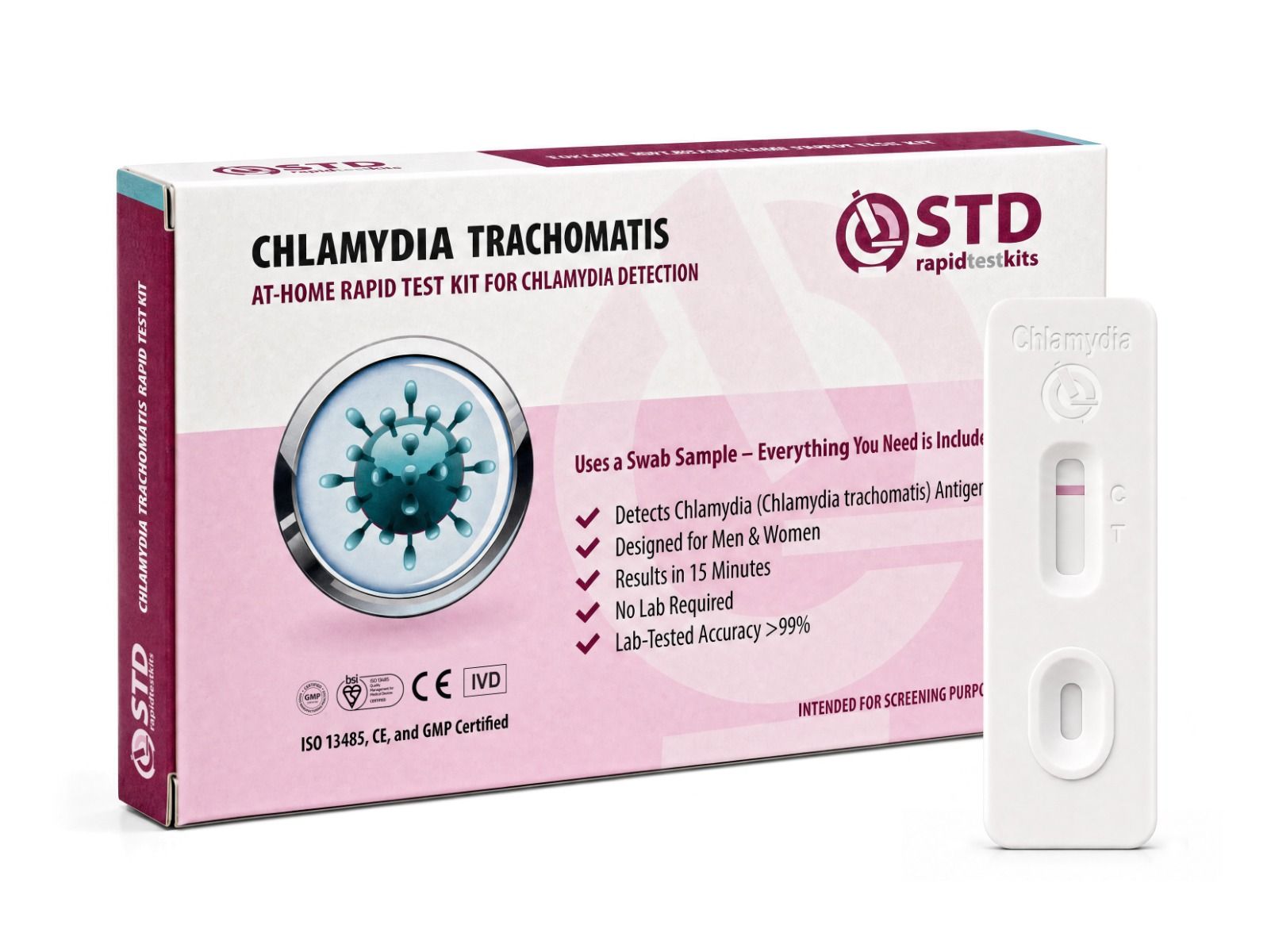
Home test, mail-in lab, or clinic? Pick by friction
Three roads lead to the same answer, but the path matters when a teen is the patient. Testing happens when the path is easy, so the option your teen will actually use is the option that works.
A clinic test, typically a urine sample or a swab, is the most thorough option because a clinician can run a nucleic acid amplification test (NAAT), which is the laboratory gold standard for sensitivity, and screen for other STIs at the same time. A mail-in lab kit collects a sample at home, mails it to a lab, and returns results in a few days. An at-home rapid test, like the lateral-flow swab kits we sell, produces a result in about 15 minutes with no shipping wait.
Rapid lateral-flow tests are not the same as lab NAATs. They use a different chemistry and have lower analytical sensitivity. They work best as a screening tool: very useful for catching infections that would otherwise go untested, and worth confirming with a clinic NAAT if the home result is positive or if symptoms persist after a negative.
Be honest about which path your teen will use. If they will not walk into a clinic, a rapid home test is dramatically better than no test. If they will go to the clinic, the NAAT is the more sensitive option.
| Test type | Time to result | Sensitivity profile | Best when |
|---|---|---|---|
| Clinic NAAT | 1 to 3 days | Laboratory gold standard | Severe symptoms, multi-STI screening, or first-time diagnosis confirmation |
| Mail-in lab kit | 3 to 7 days after mailing | Lab-grade NAAT chemistry | Teen wants no clinic visit and can wait several days |
| Rapid home test | About 15 minutes | Lateral-flow screening; lower than NAAT | Friction is the barrier, especially for the 3-month retest |

The myths that keep teens infected
Five misunderstandings drive most teen exposures. Knowing them lets you correct quietly without lecturing.
"Oral sex doesn't count." Chlamydia can infect the throat, and an infected throat can transmit to a partner's genitals during the next encounter. Throat infections almost never cause symptoms.
"They looked clean." Most infected people look exactly like uninfected people, because most chlamydia infections are silent. Visual screening is not a thing.
"We used a condom every time." Condoms reduce chlamydia risk significantly but not to zero. They slip, break, get applied late, and do not cover every exposure surface.
"Birth control covers it." No method of pregnancy prevention prevents STI transmission. Only barrier methods reduce STI risk.
"It was only once." Single-exposure transmission happens, and it happens more often than teens expect.
You do not need to deliver these five points as a speech. They land better as casual corrections spread over weeks. "Oh, by the way, oral can transmit chlamydia too. I just learned that. Wild."

Partner notification, the part that feels worst
This is the conversation teens dread, and it is also non-optional from a public-health standpoint. The CDC recommends notifying any sexual partner from the past 60 days, or the most recent partner if longer ago than that, so they can be tested and treated.
The mechanics matter. Your teen does not need to confess in person. A direct text is fine. They do not have to apologize, justify, or open a relationship conversation. The clinical job is information transfer, nothing more.
Many state health departments offer anonymous partner notification services, where a public-health worker contacts the partner without using your teen's name. Ask the clinic that diagnosed your teen whether this option is available locally.
If your teen is in a current relationship, the conversation is harder and more loaded. Your job is to be useful, not to script the relationship. Offer to be in the room when they make the call if they want backup. Offer to step out if they want privacy.
"I just tested positive for chlamydia. You should get tested and treated. It's usually treatable in one visit."
Three sentences. No apology, no justification, no relationship conversation. Many teens screenshot this exact wording, change one word, and send it.
The emotional piece is real and usually short
Teens process this in waves. The first wave is often relief that the symptom finally has a name. The second wave is shame, sometimes anger at the partner, sometimes anger at themselves. The third wave, usually within a week, is exasperated boredom with the whole topic. Boredom is what you want.
Useful supports in the meantime: keep the household tone calm and ordinary, do not introduce new restrictions that read as punishment, watch for signs of deeper distress like sleep disruption or social withdrawal, and offer a therapist conversation if any of those persist past two weeks.
If you find yourself spiraling, that is a separate problem worth its own care. Your teen does not need to manage your reaction. A friend, a partner, a therapist, or a peer support line can hold that for you.
What to do this week
If you are reading this within 24 hours of finding out, work the checklist below in order. If you are reading this further out and want to retroactively reset the household tone, the simplest move is to acknowledge directly: "I think I reacted bigger than I needed to last month. I'm sorry. I'm here if you want to talk about anything, including the retest in a few weeks."
This-week checklist
- Confirm the prescription is filled and your teen has started it.
- Mark the calendar for 7 days after the last dose, the date sex can resume.
- Talk through partner notification logistics together: a direct text, an app, or an anonymous state-health-department notification service.
- Put the 3-month retest on a calendar and decide together whether it happens at the clinic or with a home kit.
- Stop there. No new restrictions, no relationship conversations, no sex-ed lectures this week. Those can come up naturally next month if they need to.
You did not fail. They did not fail.
The diagnosis is information, not a verdict on your parenting, your teen's character, or the future of either of you. Hundreds of thousands of teens go through this every year and come out the other side with a treated infection, a more honest relationship with their own body, and a parent who proved to be useful in a hard moment.
What carries forward is the pattern you set this week. A teen whose parent stayed calm becomes a young adult who tells their next doctor everything. A teen whose parent reacted with shame becomes a young adult who hides things. The retest in 90 days closes out the medical side. The way you handled this week shapes the next conversation, and the one after that.
FAQs parents actually ask
- How did my teen get chlamydia if they used a condom?
- Condoms cut chlamydia risk substantially, but not to zero. They can slip, get applied after contact has already happened, or miss exposure routes during oral sex. None of that means your teen was careless. It means condoms are good protection, not perfect protection. If your teen is going to keep being sexually active, regular screening every 3 to 12 months matters more than relying on any single barrier.
- Can I get the antibiotics on their behalf?
- In most states, no. Minors typically consent to their own STI treatment, which means your teen has to make the call, the visit, or the telehealth appointment. You can absolutely help: drive them, sit with them, hand them the phone. What you can't do is be the patient. The good news is the prescription itself is a 7-day course of doxycycline or a single dose of azithromycin. It's not a complicated visit.
- Do I need to tell their other parent?
- Legally and medically, usually no. The decision belongs to your teen. Ask them: do you want me to tell them, do you want to tell them, or do you want to keep this private for now? Then do what they say. The exception is if there is an immediate medical concern that needs both households on the same page, like coordinating treatment for a partner who lives elsewhere. Otherwise, your teen's medical privacy holds.
- Will this show up on a college application or background check?
- No. STI test results are protected health information under HIPAA. They sit in a medical chart that nobody other than treating clinicians can see. Insurance companies do see claim codes, which is why some teens pay cash at a Planned Parenthood instead of running it through a parent's insurance. If keeping this off the insurance Explanation of Benefits matters, ask the clinic about cash pricing or sliding-scale options.
- Can chlamydia really come from oral sex?
- Yes, and pop culture has trained two generations of teens to assume otherwise. One practical wrinkle: most home rapid tests, including ours, sample the genital tract, not the throat. If oral exposure is the specific concern, the right tool is a clinic visit that includes a pharyngeal swab. The at-home swab covers the genital infection that most often co-occurs with that exposure.
- What if my teen refuses to talk to me about any of this?
- Step back. Their unwillingness to talk to you about this specific thing does not mean they won't take care of it. Make the resources available: a kit on the shelf, a printout of a local teen-friendly clinic, a sentence like "I'm not going to bring this up again, but if you ever need help making a call I'm in." Then let it sit. A lot of teens come back to the conversation two or three weeks later when the shame has cooled off.
- Is the retest in 3 months really necessary if everything went fine?
- Yes, and the easiest way to make sure it happens is to put a specific date on your phone calendar right now: 90 days from the last antibiotic dose. Treat it as a maintenance appointment, not a referendum on the original diagnosis. If your teen would rather skip the clinic re-visit, a rapid chlamydia home kit makes the follow-through about 15 minutes of friction instead of a half-day clinic logistics problem.
- Can my teen still have kids someday after this?
- Almost certainly yes. The fertility risk people worry about comes from chlamydia infections that go untreated for months or years, not from one treated case caught and resolved quickly. Your teen got tested, got treated, and is going to retest. That sequence is exactly what protects long-term reproductive health. The thing that hurts fertility is undiagnosed silent infection, which is why screening is the point.
- U.S. Centers for Disease Control and Prevention. Chlamydia hub page describing chlamydia as a common STI and listing the annual screening recommendation for sexually active people under 25.
- U.S. Centers for Disease Control and Prevention. 2021 Sexually Transmitted Infections Treatment Guidelines, chlamydia section. Source for the doxycycline first-line regimen, azithromycin alternative, partner notification window, and 3-month retest recommendation.
- U.S. Centers for Disease Control and Prevention. Chlamydia basic information page covering transmission, asymptomatic infection, and screening guidance.
- Guttmacher Institute. Minors' Access to STI Services policy resource, used for the confidentiality and minor-consent discussion in this article.
- National Health Service (UK). Chlamydia patient overview covering symptoms, transmission, complications, and treatment, used for the asymptomatic-infection pull quote and for comparison with U.S. guidance.
- World Health Organization. Sexually transmitted infections fact sheet covering global STI burden, transmission, and treatment principles.