What to Expect at Your First STD Test: Clinic vs At-Home Edition
Clinic vs home STI test: what happens at each step, from booking to result.
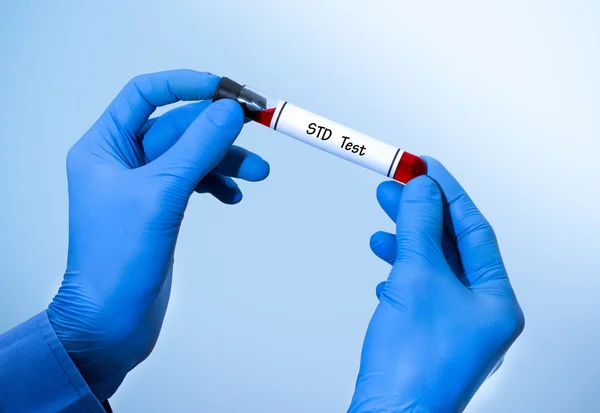



- Clinic visits and at-home rapid kits are both valid entry points. The choice usually comes down to whether you need professional sample collection and same-day treatment access (clinic) or maximum privacy and convenience (home).
- Most STIs need a waiting window after exposure before any test is reliable: roughly 1 to 2 weeks for chlamydia and gonorrhea, and up to 3 months for an HIV antibody test to turn positive, per CDC HIV testing guidance.
Published: July 2025 | Last updated: May 2026 | Editorial review and quality control: Martina N.
Booking your first STI test puts you in a small but growing club: people who would rather know than guess. Whether you are heading to a clinic next Tuesday or unboxing a self-collection kit on your bathroom counter, this guide walks through what happens at each step.
The short version is that both options work, both are valid, and the right pick depends on what is getting in your way. If cost or in-person discomfort is the obstacle, an at-home rapid kit can be the lower-friction entry point. If you want professional sample collection, on-the-spot counseling, and the option to start treatment the same day, a clinic visit is hard to beat. Most readers do not pick one and stick with it forever; they use whichever option fits the moment.
One scope note before we start: this article comes from stdrapidtestkits.com, which sells rapid lateral-flow home tests using self-collected vaginal or penile swabs and fingerstick blood. We do not sell urine-sample kits, throat (pharyngeal) swabs, rectal swabs, or lab-processed mail-in panels. If your specific exposure was oral or anal, a clinic visit is the right move because that is where those sample types are collected. We will flag this again in the sections where it matters.
Key Takeaways
- Clinic visits and at-home rapid kits are both valid entry points. The choice usually comes down to whether you need professional sample collection and same-day treatment access (clinic) or maximum privacy and convenience (home).
- Most STIs need a waiting window after exposure before any test is reliable: roughly 1 to 2 weeks for chlamydia and gonorrhea, and up to 3 months for an HIV antibody test to turn positive, per CDC HIV testing guidance.
Scheduling a clinic visit or ordering a home kit
For a clinic visit, several free or low-cost paths exist. Public health clinics, Planned Parenthood centers, university student health services, federally qualified health centers (FQHCs), and LGBTQ+ health centers all offer STI testing, often on a sliding scale or at no cost depending on income and insurance status. Title X family planning clinics are required by federal rule to keep services confidential, including for many minors. To find a testing site near you, the CDC maintains a free testing-site locator at gettested.cdc.gov.
You may be asked for ID or insurance at intake, but you can specifically ask for confidential billing if you live on a family policy and do not want a claim to surface on a parent's statement. Walk-ins are common; appointments shorten waits. The intake form typically asks about your sexual history, partners in the last 3 to 12 months, and any symptoms.
For an at-home kit, you order online and the kit arrives in plain packaging with no return-address branding. Our rapid kits include the cassette, a sample collector (sterile swab or fingerstick lancet), buffer solution, and a step-by-step instruction sheet. Read the full instructions before you open anything sealed. The most common reason for an unclear result is rushing the collection or reading the cassette outside the time window printed on it. Kits typically range from about 40 USD for a single-infection test up to a few hundred for combination panels, and most are eligible for HSA or FSA payment.
If cost is the blocker, these four routes regularly offer free or sliding-scale STI testing in the U.S.:
- Public health and Title X clinics: confidential by federal rule, low or no cost based on income.
- Planned Parenthood health centers: full STI panels, sliding scale, walk-ins common.
- Federally qualified health centers (FQHCs): community-based clinics with income-based fees.
- LGBTQ+ health centers and university student health: queer-affirming care plus on-campus options for students.
What happens during a clinic visit
The visit usually starts with paperwork and a short intake conversation. A clinician or nurse will ask which kinds of sex you have had (vaginal, oral, anal), how many partners you have had in the last 3 to 12 months, whether you use barriers, whether you have any symptoms, and whether anything specific brought you in today. This is not a judgment exercise; the answers determine which tests you need. If you are nervous, telling them is fine. Many providers are trained in trauma-informed care and will go slower if you ask.
Sample collection depends on the panel. For chlamydia and gonorrhea, most U.S. clinics now use a first-catch urine sample for the penile route and either a clinician-collected or self-collected vaginal swab for the vaginal route, run through lab-based nucleic acid amplification testing (NAAT). NAAT is widely treated by CDC clinical guidance and the major U.S. labs as the analytical gold standard for these two infections. For HIV, syphilis, and viral hepatitis, the clinic draws blood, either by fingerstick for rapid tests or by venipuncture for laboratory antibody and antigen testing.
If you have had oral or anal sex, ask whether throat (pharyngeal) and rectal swabs are part of the panel. They are not included by default in many primary-care offices, but CDC guidance specifically recommends extragenital testing for people with corresponding exposures. You can request a chaperone, a provider of a specific gender, or simply ask the clinician to talk you through each step. Rapid HIV and syphilis results may come back the same visit; NAAT lab results typically take 2 to 5 days.
Sample types a clinic can collect
- First-catch urine sample for chlamydia and gonorrhea (penile route).
- Vaginal swab, clinician-collected or self-collected, for chlamydia, gonorrhea, trichomoniasis.
- Pharyngeal (throat) swab on request, for people with oral exposure.
- Rectal swab on request, for people with receptive anal exposure.
- Fingerstick or venous blood draw for HIV, syphilis, hepatitis B, and hepatitis C.
What happens during an at-home rapid test
The first move is to read the instructions all the way through before opening any sealed components. Set up on a clean flat surface, wash your hands, and have a timer ready (your phone is fine). Different infections use different collection methods, so the steps below describe the general pattern.
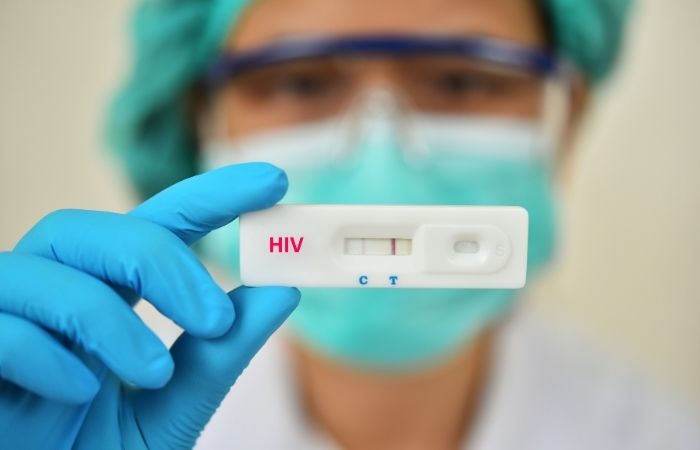
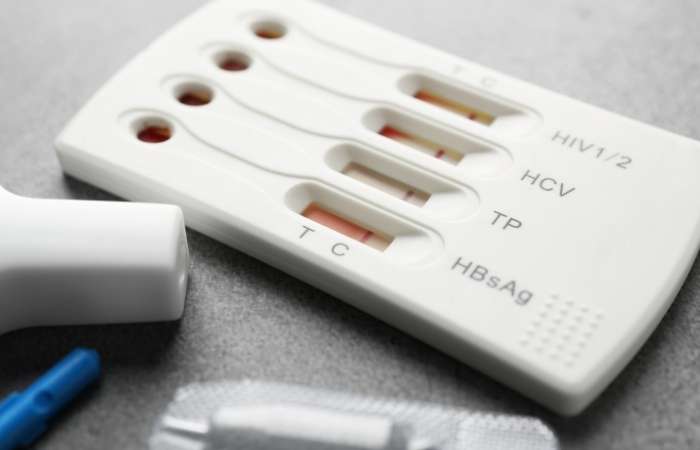
For a fingerstick blood test (HIV, syphilis, hepatitis B, hepatitis C, HSV-1 antibody, HSV-2 antibody): you will use the included lancet to prick the side of a fingertip, collect a small drop of blood with the pipette or directly into the cassette well, and add the buffer solution. Results typically appear in the cassette window in roughly 15 minutes. The control line confirms the test ran correctly; the test line indicates a reactive (presumptive positive) result.
For a self-collected swab (chlamydia, gonorrhea, plus trichomoniasis and HPV for vaginal anatomy): you will insert the sterile swab as the instructions direct (for vaginal swabs, about 1 to 2 inches, rotating for the listed number of seconds), then transfer the swab into the buffer tube. After mixing, you transfer a small volume to the cassette and read the result at the printed time mark.
Two practical tips. First, do not read a cassette early or late; lines that appear outside the read window are not interpretable. Second, store the kit at the temperature listed on the box. Heat and humidity can degrade the reagents. If anything goes wrong (the control line does not appear, or the result is genuinely ambiguous), the test is invalid and you should run a fresh kit or go to a clinic.
Accuracy: how the two options compare
Laboratory testing on a clinician-collected sample is the analytical gold standard for most STIs. Lab NAAT directly detects the genetic material of the pathogen and is widely reported in clinical literature to reach sensitivity above 95 percent for chlamydia and gonorrhea when run on the right sample type. Lab serology for HIV, syphilis, and hepatitis combines antigen and antibody detection and tightens the window period for early infection compared to antibody-only tests.
Rapid lateral-flow tests, which is what every at-home kit on our site uses, work on a different principle. The cassette contains immobilized antibodies that bind to a target on the strip and produce a colored line. Lateral-flow chemistry is not NAAT; it is a separate technology with a different sensitivity profile. Independent reviews of home rapid STI kits report sensitivity in the mid-to-high 90 percent range when the user follows the instructions exactly, with specificity typically above 99 percent. That is excellent for screening at home and worth confirming with lab testing on any positive result.
A lateral-flow test result that looks positive should be confirmed at a clinic before treatment, especially for HIV and syphilis. A lateral-flow result that looks negative is also useful as long as you were past the window period for the specific infection at the time you tested. If you tested very soon after a known exposure, retesting after the window period is more reliable than treating one early negative as final.
| Factor | Clinic visit | At-home rapid kit |
|---|---|---|
| Sample types available | Urine, swab (vaginal, throat, rectal), blood (fingerstick or venous) | Self-collected vaginal or penile swab, fingerstick blood |
| Test technology | Lab NAAT (gold standard) plus antigen/antibody serology | Rapid lateral-flow immunoassay |
| Turnaround | Rapid HIV/syphilis same visit; NAAT 2 to 5 days | Read in about 15 minutes at home |
| Counseling on result | On-site, usually immediate for positives | DIY, optional telehealth follow-up |
| Same-day treatment | Yes for many bacterial STIs | No, requires clinic confirmation |
| Cost (typical) | Free to sliding-scale at public clinics; insurance dependent | About 40 to 250 USD per kit, often HSA/FSA eligible |
| Best when | You want professional collection and immediate care | Privacy, convenience, or geography is the main obstacle |
Is at-home testing as accurate as a clinic visit?
For screening purposes, well-used home rapid lateral-flow tests reach sensitivity in the mid-to-high 90 percent range and specificity above 99 percent. Clinic lab NAAT and antigen/antibody serology are analytically more sensitive, especially for early infection. Use home tests to screen privately and confirm any positive at a clinic before starting treatment.
Waiting for results and what the timeline really looks like
Clinic timelines depend on what was tested. Rapid HIV antibody tests done in-clinic return a result while you wait, usually within 20 to 40 minutes. Rapid syphilis screening is similar. NAAT for chlamydia and gonorrhea is processed in a laboratory and most clinics deliver those results within 2 to 5 business days via secure patient portal, phone call, or letter. If you tested for hepatitis B or C, expect a few days for confirmatory serology.
At-home rapid lateral-flow results appear in the cassette window in about 15 minutes. You read the result yourself, which means the emotional landing is private but unsupported. If the result is positive, plan ahead before you test: have a clinic, telehealth provider, or trusted friend lined up in case you need to make a call right after. If the result is unclear or invalid (no control line), the test is not interpretable and you should run a fresh kit or visit a clinic.
One important framing: a negative result is reliable only if you tested after the right window period for that infection. Chlamydia and gonorrhea typically need about 1 to 2 weeks. HIV antibody-based tests, including most rapid HIV screens, can take up to 3 months to turn positive after exposure, per CDC HIV testing guidance. Hepatitis C antibody tests usually become positive within 8 to 11 weeks. If you tested very early after a known exposure, the right move is to retest at the end of the window even when the first result is negative.
CDC recommends that everyone aged 13 to 64 be tested for HIV at least once as part of routine health care, and more often if they have ongoing risk factors.
Privacy, confidentiality, and comfort
In the U.S., clinic visits are protected by HIPAA, and many public-health and Title X clinics have additional confidentiality rules that apply to STI testing specifically. You can ask for confidential billing, paper or no-cost services, or in some clinics an anonymous identifier instead of your legal name. If you are a minor, most U.S. states allow you to consent to your own STI testing without parental involvement; the rules vary by state and the clinic intake staff can tell you what applies locally.
At-home testing maximizes a different kind of privacy: physical and social. Nobody sees you walk in, the kit ships in plain packaging, and no clinical record is created unless you choose to share your result with a provider later. The trade-off is that there is no built-in support in the moment. If a result is unexpected, you are reading it alone. People for whom in-person visits feel unsafe (because of stigma, abusive partners, or fear of being recognized) often find home testing the only viable first step, and that is a legitimate use case.
A practical tip for either path: write down what you plan to do if the result is positive before you test. Two or three steps is enough. Knowing the next move makes the wait less heavy.

If your result comes back positive
A positive result is the start of a treatment plan, not the end of any chapter that matters. Many STIs are bacterial and curable with antibiotics: chlamydia, gonorrhea, and syphilis fall in this category and respond to short antibiotic regimens per CDC treatment guidelines. Viral infections (HIV, HSV-1, HSV-2, hepatitis B, hepatitis C) are managed differently. Modern antiretroviral therapy for HIV is highly effective; people on suppressive therapy with an undetectable viral load do not transmit HIV sexually (the U=U principle). Hepatitis C is curable with direct-acting antiviral courses lasting 8 to 12 weeks.
Two long-term worries deserve a direct answer because they drive a lot of first-test anxiety. Untreated chlamydia and gonorrhea can progress to pelvic inflammatory disease and cause long-term fertility complications in women, which is the main reason routine screening exists; catching the infection early prevents that outcome in nearly all cases. HPV clears spontaneously in most people, but persistent high-risk strains drive the majority of cervical cancer cases, which is why regular HPV testing and cervical screening remain part of the same prevention picture.
If your positive came from a clinic test, the provider will usually discuss next steps in the same visit. For bacterial STIs, antibiotics often start that day. For viral infections, you will be referred to a confirmatory test (if not already done) and then to a specialist or primary-care provider for ongoing care.
If your positive came from an at-home rapid test, bring the cassette or a photo of it to a clinic or telehealth appointment for confirmatory testing. Home lateral-flow results are screening signals; lab confirmation is the standard next step before treatment. Many people are not aware they can be re-treated and re-infected with the same bacterial STI through a partner who has not been treated, so partner notification and partner treatment are part of the plan. Most state and local health departments offer anonymous partner notification tools if telling someone directly is not safe.
Testing for women, men who have sex with men, trans, and nonbinary readers
The right test panel depends on your anatomy and the kinds of sex you have had, not on the gender on your ID. CDC screening recommendations are routinely updated and cover anatomy-specific panels.
For sexually active women under 25, annual screening for chlamydia and gonorrhea is recommended, with additional screening based on partners and pregnancy status. For men who have sex with men, the CDC recommends at least annual screening for chlamydia, gonorrhea, syphilis, and HIV, with site-specific testing (urethral, pharyngeal, rectal) based on exposure and every 3 to 6 months for higher-risk patterns. For trans and nonbinary people, screening should follow the anatomy that is present and the sex that has happened; a trans woman with a neovagina, a trans man with a cervix, a nonbinary person with any anatomy, every combination has its own answer and a queer-affirming clinician can map yours out.
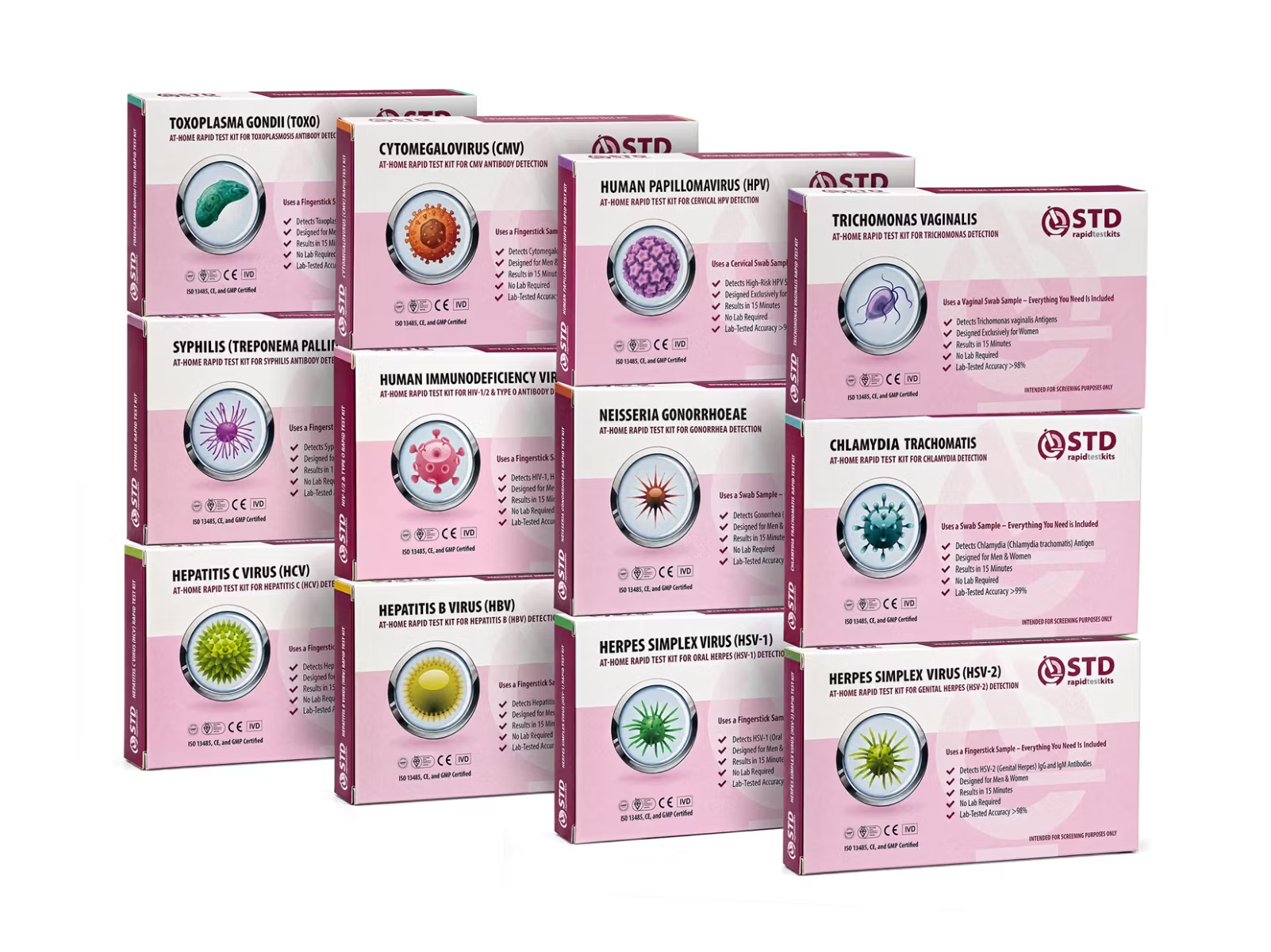
One catalog limit worth knowing: our HPV and trichomoniasis rapid kits are validated for vaginal self-swab only, and we do not currently offer a male-compatible HPV or trichomoniasis home test. Male readers needing either should test at a clinic. If your exposure was oral or anal, the throat and rectal swabs that catch those routes are clinic-only and we do not sell them. Our HIV, syphilis, hepatitis B, hepatitis C, chlamydia, gonorrhea, HSV-1, and HSV-2 kits are any-gender and ship in plain packaging with no return-address branding.
Managing the anxiety before and after
The hardest part of a first test is usually the waiting. A few practical moves reduce the load. Pick the test date in advance so it is not floating as something you keep meaning to do. Stop searching symptom photos online once you have booked or ordered; the search results are an anxiety amplifier, not a diagnostic tool. Tell at least one trusted person that you are in the testing window, even vaguely, so the emotional load is shared.
Plan a small landing for after the test. A walk, a movie, a low-key meal, an episode of something undemanding. The point is to have a soft transition out of the high-anxiety moment, not to celebrate or compensate.
If the result is negative and you are still anxious, that is normal. Anxiety does not always switch off with reassurance. If the result is positive, the anxiety has somewhere to go: into the next concrete step (confirmation, treatment, partner notification). The wait was the worst part; the path forward is the work, and the work is doable.
Anxiety reset, four moves that help
- Pick a specific date and time for the test, not a vague “soon”, so it stops floating in your head.
- Stop scrolling symptom photos once you have booked or ordered; image search feeds anxiety, not diagnosis.
- Tell one trusted person you are in a testing window. Even a vague heads-up shares the emotional load.
- Plan a quiet activity for after the test: a walk, a low-key meal, an undemanding show. Soft landings matter.
Common myths that hold first-timers back
First-time testers often arrive with misinformation absorbed from school health class, social media, or half-remembered stories. The biggest myths are worth naming directly because they actively stop people from testing.
No symptoms means no infection. Many STIs, especially chlamydia and HPV, are silent in the early phase. Routine screening catches them.
Only people with many partners get STIs. Transmission can happen on a single exposure with a single partner. STIs do not score sexual history.
Home tests are not real tests. Rapid lateral-flow kits are a different technology from lab NAAT, but they are real, regulated, and useful for screening when used correctly.
A positive result will be reported with my name. In the U.S., some infections (HIV, syphilis) are reportable to public health for surveillance, but identifying information is protected and the data is used to track trends, not to prosecute anyone.
FAQs
- How often should I get tested for STIs?
- If you are sexually active, the CDC recommends at least annual screening for the infections that match your anatomy and exposures. Every 3 to 6 months is the right cadence for people with new or multiple partners or higher-risk patterns. Use the screening table on cdc.gov/sti to match your situation to a panel.
- Is at-home testing accurate enough to trust?
- For most people's screening needs, yes, with one condition attached. Use the home result as a signal, not a final word; any positive needs lab confirmation before treatment. The lateral-flow chemistry in home kits is genuinely useful for private, timely screening; it just is not as analytically sensitive as lab NAAT on a clinician-collected sample.
- Will I be judged at a clinic?
- Most clinic and public-health staff are trained to be matter-of-fact about STI testing. If a specific provider makes you uncomfortable, you can ask for a different one or move to a sexual-health clinic, Planned Parenthood, or an LGBTQ+ health center, all of which work with STI testing every day.
- Can I get tested if I do not have insurance?
- Yes. Public health clinics, Title X family planning clinics, FQHCs, and Planned Parenthood offer testing on a sliding scale or free of charge. The CDC Get Tested locator at gettested.cdc.gov flags free testing sites.
- How long should I wait after a possible exposure before testing?
- Roughly 1 to 2 weeks for chlamydia and gonorrhea, 3 to 6 weeks for syphilis (with up to 3 months for full reliability), and up to 3 months for an HIV antibody test to be conclusive. If you have an urgent concern, test now and retest at the end of the window.
- What is the difference between an STD and an STI?
- The two are used interchangeably in everyday language. The clinical preference is STI (sexually transmitted infection), because many infections never produce a recognizable disease state. The CDC and WHO now use STI in most current materials.
- Will anyone find out if I get tested?
- Your medical information is protected. In the U.S., HIPAA covers most STI testing visits. Some specific infections (HIV, syphilis) are reported to public-health surveillance without your identifying information being disclosed publicly. If you want maximum privacy, ask the clinic about confidential billing or use an at-home kit.
- What if I am too anxious to go through with the test?
- That is a common starting place. Picking a low-pressure option helps: an at-home kit, a friend who comes with you, a telehealth pre-visit to know what to expect, or a clinic specifically listed as LGBTQ+ affirming. Choosing the easier path first is not weakness; it is what gets the test done.
- U.S. Centers for Disease Control and Prevention. STI screening recommendations by population, including age-banded chlamydia and gonorrhea screening and extragenital testing guidance for MSM populations.
- U.S. Centers for Disease Control and Prevention. HIV testing guidance, window-period detail for antibody-based and combined antigen/antibody assays.
- U.S. Centers for Disease Control and Prevention. Get Tested locator for free and confidential STI and HIV testing sites in the United States.
- Planned Parenthood. National sexual and reproductive health organization providing in-clinic STI testing, sliding-scale fees, and confidential services.
- World Health Organization. Sexually transmitted infections topic page, including global prevalence and screening framework.
- National Health Service (UK). Sexually transmitted infections overview, how testing works at sexual health clinics, and what kinds of samples are collected.