
Published: November 2025 | Last updated: May 2026 | Editorial review and quality control: Martina N.
When a partner tells you they have an STD, the next thirty seconds matter more than the next thirty minutes. Your first sentence shapes whether they keep talking or shut down. It shapes whether you walk away with the full story or only the surface version. It also shapes how you feel about yourself a week from now.
This guide is for that moment after disclosure. It covers the reactions that quietly break trust, the scripts that hold it together, and the medical reality that makes a calm response possible. Most sexually transmitted infections are common, manageable, and far less dangerous than the shame attached to them. Knowing that in advance makes the right words easier to find when you need them.
Key Takeaways
- Lead your first response with “thanks for telling me” before asking anything else. Disclosure takes courage, and your opening sentence sets the tone for the rest of the conversation.
- Most STIs are either curable with antibiotics or controllable with medication. Knowing the medical reality in advance keeps fear from driving your words.
Why your first reaction matters more than your final answer
The brain treats unexpected emotional news a lot like a physical threat. Your heart rate climbs, your jaw tightens, your inner voice scrambles to protect you. None of that is wrong. The trouble is that whatever you say in the next ten seconds tends to come from that protection mode, not from the calmer part of you that knows this person and what they mean to you.
That is why preparation helps. People who have thought about this scenario in advance tend to say better things in the moment. They have rehearsed something close to “thanks for trusting me, can you tell me more?” Their first sentence buys time, signals respect, and keeps the conversation alive while the nervous system settles.
If you have never thought about it before today, that is fine. The single most useful instinct is to pause before speaking. A breath, a nod, a hand resting on theirs. That tiny gap stops the wrong words from leaving your mouth. It also tells your partner that you are present, not panicked.
What you say next can be honest about your own feelings. “I want to hear this, give me a second to take it in” is fine. “Ew” or “are you serious” is not. The difference is whether your reaction is centered on your partner or on you.
“I want to hear this, give me a second to take it in.” That single sentence is enough. It buys the few seconds your nervous system needs to stop running the panic script. It signals you are present without committing you to a response you have not thought through.
Words that wound, even when you do not mean them to
The most damaging reactions are often the most automatic. “How did you get it?” sounds like curiosity but lands like an interrogation. “Are you sure you did not give it to me?” treats the disclosure as an accusation rather than a gift. “That is gross” closes the door for good.
Each of these phrases comes from a real feeling: fear, suspicion, surprise. The feelings are valid. The phrasing is not. Stigma around STIs runs so deep that people repeat it without realizing they are doing it. Even raised eyebrows or a long silence can read as judgment to someone who already expected rejection.
The CDC's guidance on partner conversations notes that disclosure is one of the highest-stress situations in dating, particularly for stigmatized infections like herpes and HIV. People often rehearse their disclosure for weeks. By the time they say the words out loud, they are watching your face for every micro-expression. If they see disgust or blame, even briefly, the conversation rarely recovers.
People do not hide STDs because they are bad people. They hide them because they have learned, from culture or experience, that honesty gets punished. Your face in the first second is what tells them whether this conversation was a mistake.
| What you might say | Why it hurts | Better option |
|---|---|---|
| “Wait, are you clean now?” | Implies they were “dirty” before. Reinforces shame and frames the infection as a moral failing. | “Thanks for telling me. Can you walk me through what this means for us?” |
| “Who gave it to you?” | Feels accusatory and irrelevant in the moment. Shifts the focus to a forensic investigation. | “I appreciate you trusting me with this.” |
| “Ew. Really?” | Triggers an immediate shame spiral and shuts down future communication. | Silence is okay. Breathe. Then: “I'm listening.” |
| “You should have told me before we even kissed.” | Sounds like blame. Ignores how hard disclosure actually is. | “Thanks for being upfront. I know that isn't easy.” |
What to say instead: scripts that hold trust together
You do not need to have the perfect sentence ready. You need three building blocks: acknowledgment, gratitude, and a question that gives them control.
Acknowledgment. “I hear you.” Or simply nodding while keeping eye contact. A short response is enough.
Gratitude. “Thank you for telling me. I know that took something.” This is the load-bearing sentence. It tells your partner that the risk they took was worth taking.
An opening question. “Can you walk me through what this means for us, when you are ready?” That last piece matters. Letting them lead the rest of the conversation respects their pace and their expertise about their own diagnosis. People living with STIs typically know more about transmission, treatment, and prevention than the average person. Asking them to teach you is a quiet way of saying “I trust you.”
If you are not ready to keep talking yet, you can say so. “I want to be present for this, and I need a few minutes to settle. Can we keep going in a bit?” That sentence is not avoidance. It is the opposite.

The medical reality that makes a calm response possible
A lot of fear around STD disclosure comes from outdated assumptions. Most sexually transmitted infections fall into one of three categories: curable with antibiotics (chlamydia, gonorrhea, syphilis, trichomoniasis), suppressible with antiviral medication (herpes, HIV, hepatitis B in many cases), or cleared by the immune system over time (most HPV infections). Almost none of them are the life sentences popular culture suggests.
A few specifics worth knowing before you respond:
- Chlamydia and gonorrhea are typically cured with a short course of antibiotics. After treatment and a follow-up test of cure, transmission risk drops to near zero according to CDC clinical guidance.
- A person living with HIV who is on effective treatment and has an undetectable viral load cannot transmit the virus through sex. This is summarized as Undetectable = Untransmittable, supported by multiple large studies and adopted as official CDC guidance.
- Genital herpes is common and manageable. Antiviral suppression plus barrier protection substantially reduces transmission risk per the CDC's herpes fact sheet, and many people with herpes go long stretches between outbreaks.
- HPV affects most sexually active adults at some point and is usually cleared by the immune system within two years. Persistent high-risk strains require monitoring, which is what routine cervical screening catches.
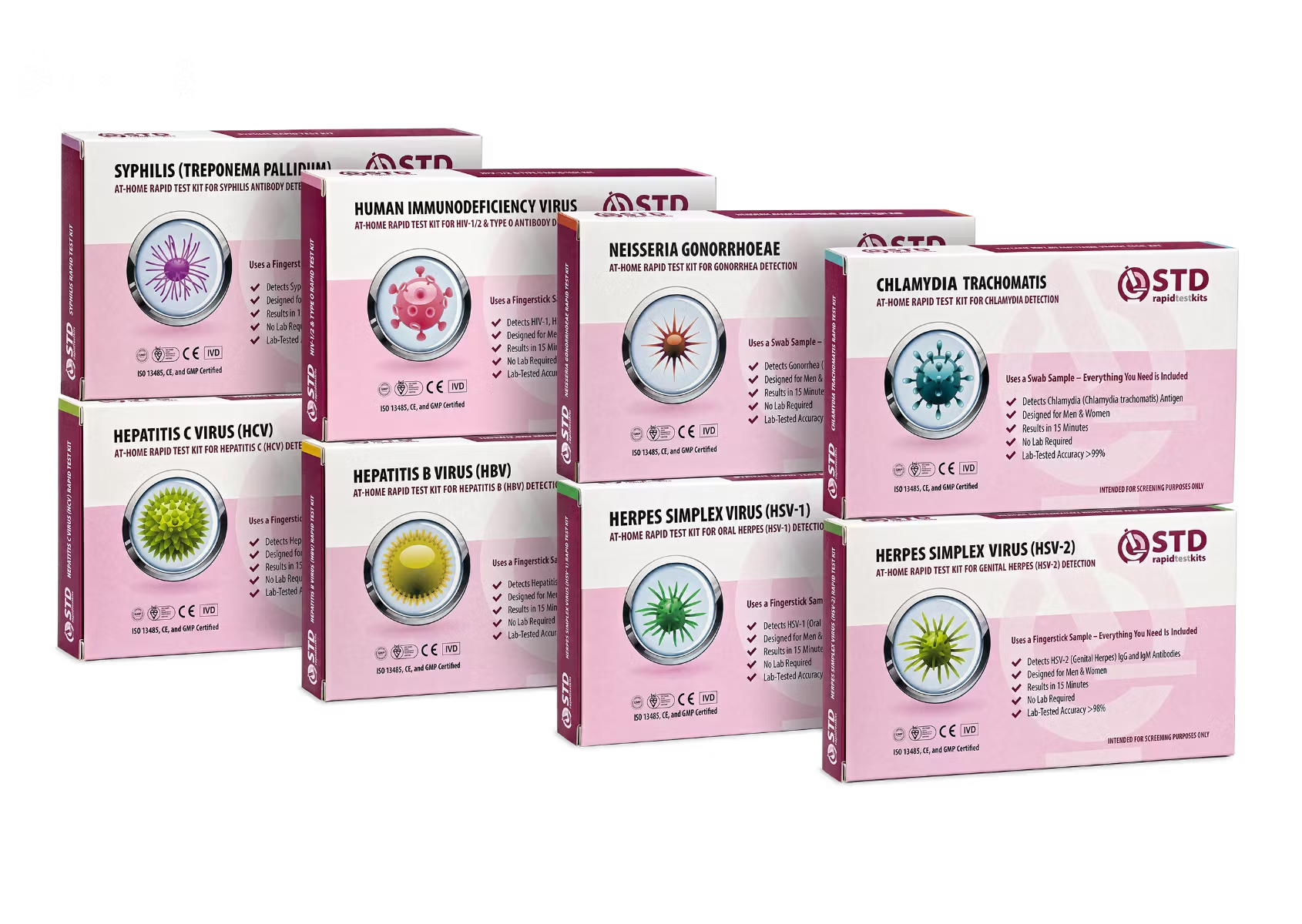
If you want clarity on your own status before continuing the conversation, an at-home rapid panel can help. The kit below screens for seven of the most common infections without a clinic visit.

Why they did not tell you sooner
One of the most common follow-up questions after disclosure is “why did you not tell me before now?” It feels like a fair question. From the discloser's side, it almost always sounds like an accusation.
There is rarely a single reason for delayed disclosure. Some people wait until they feel emotionally safe. Others worry about being ghosted, mocked, or screenshot. Many have been punished in the past for honesty and have learned to lead with caution. Some wait until things are physical enough to matter. Disclosure timing is personal and depends on the relationship, the infection, and the person's own readiness.
This is not the same as deceit. Withholding information for safety is different from withholding it for manipulation. The question to ask yourself, calmly, is whether the person is being honest with you now. Are they offering specifics? Are they answering follow-up questions without dodging? Are they giving you what you need to make informed decisions about your own health going forward?
If the answer is yes, the timing matters less than the integrity. If the answer is no, your reservations are valid and worth following.
Legal requirements around STI disclosure differ by U.S. state and by the specific infection. Several states have HIV-specific disclosure laws; rules for other infections vary. For the current law that applies to a specific situation, a local public-health clinic or legal-aid resource is the right place to ask.
When you feel angry or betrayed
Some people respond to disclosure with anger rather than shock. The anger may be aimed at the partner (“why am I only finding this out now?”), at the situation (“what does this mean for my health?”), or at something more diffuse (“why is sex never simple?”).
Anger is data. It points at something real, but it is rarely a useful first response. If you feel rage in the moment, the kindest move is to name it without acting on it. “I notice I am feeling angry. I want to be fair to both of us, so I need a few hours before I keep talking.” That sentence holds the door open. It also gives you time to figure out whether the anger is about your partner, your fears, or something else entirely.
After a pause, ask yourself two questions. First, what specifically are you afraid of? Health risk, loss of trust, or embarrassment? Second, is this person actively trying to protect you or actively hiding something? The answers usually clarify whether the relationship is salvageable or whether you need to step back. Either decision is allowed.
A good debriefing partner does three things: lets you vent without immediately taking sides, asks questions rather than handing down verdicts, and protects your partner's privacy as a default. If you would not want your own medical history broadcast to someone else's friends, your partner deserves the same protection. Frame the conversation as “I want to talk through how I feel,” not “help me decide whether to dump them.”
From disclosure to decision: practical next steps
After the initial conversation comes the practical layer. Three steps cover most situations.
1. Get specifics. Which infection? How long ago diagnosed? Currently on treatment? Most recent test results? These questions are not interrogation when asked respectfully and after acknowledgment. They are how informed consent works.
2. Talk about protection. Condoms, internal condoms, dental dams, antiviral suppression, PrEP for HIV-negative partners of someone living with HIV, vaccination against HPV and hepatitis B. The right combination depends on the specific infection, and your partner usually knows which options apply.
3. Test yourself. If there is any chance of past exposure, knowing your own status removes a layer of uncertainty. Discreet at-home rapid kits make this easier than clinic appointments for many people. The kit below screens for eight of the most common infections using swab and fingerstick blood samples, with results in about fifteen minutes. At-home rapid lateral-flow tests are screening tools, so a positive result is worth confirming with a clinical NAAT lab test where available.
This is the part where the relationship usually stabilizes. The medical questions have answers. The protection options have evidence behind them. The shame, which was the loudest voice in the first hour, becomes the quietest one.
Boundaries without blame, and rebuilding intimacy
Sometimes, after all the right conversations, you decide the relationship is not for you. That is a valid choice. The question is whether you can exit it cleanly.
A clean exit sounds like: “I appreciate you trusting me with this. I have thought about it, and I do not think I am the right person to navigate this with you. That is about my own capacity, not about your worth.” It does not sound like: “I cannot believe you have that, I am out.” Same outcome, very different exit. The first leaves the discloser with their dignity intact. The second confirms every fear they had about telling anyone in the first place.
If you stay, similar care applies. Decide together what you are comfortable with, what you want to learn more about, and what protection strategies you will use. Revisit the conversation as needed. Mayo Clinic's guidance on partner conversations recommends treating STI disclosure as an ongoing conversation rather than a single one-time event.
Physical closeness after disclosure rarely picks up exactly where it left off. There is often a short pause, a renegotiation, a deliberate effort to re-establish trust on the new terms. That pause is healthy. What helps: asking your partner what they are comfortable with, sharing what you are comfortable with, and treating the conversation as ongoing. What hurts: pretending nothing changed, or pretending everything changed forever. The truth is usually in the middle.
If you have an undetectable viral load, you will not transmit HIV through sex.
FAQs
- Should I get tested if my partner tells me they have an STD?
- Usually yes. Even if you feel fine and used protection every time, some STIs spread without symptoms. Testing is not a vote of no-confidence in your partner; it is basic stewardship of your own health. A clinic visit or an at-home rapid panel both work. Time it correctly: most infections have a window period before they show up on a test, so ask a clinician or read the kit's instructions about when to test based on the date of possible exposure.
- Is it okay to end a relationship after someone discloses an STD?
- Yes. Ending a relationship because you do not feel equipped to navigate the risk is a valid choice. Ending it as a punishment for the disclosure is not. The difference shows up in how you exit. A respectful exit names your own capacity (“this is not something I am ready for”) without framing your partner as damaged or dirty.
- What if I said something hurtful in the moment?
- Say: “I reacted from fear, not from how I actually feel about you. I am sorry. I want to have this conversation again, the right way.” Most people who disclose have braced for a worse reaction than they got, and a genuine repair attempt often lands harder than if you had said the right thing the first time. Do not double down on the original reaction; just come back and try again.
- Do I have to tell future partners if I was exposed but tested negative?
- If you tested outside the relevant window period and the result is negative, you are not actively carrying an infection and disclosure rules do not apply the same way. If you are still in the window period (for example, within the first few weeks after possible HIV or syphilis exposure), it is honest to mention that you are mid-retest. The standard most people respect: be open about anything that could affect a partner's informed consent.
- How do I know if my partner is still contagious?
- Ask. The answer depends on the infection, whether they are on treatment, and how recently they were tested. Someone with chlamydia who finished antibiotics and passed a test of cure is not transmitting. Someone with HIV who is undetectable on treatment is not sexually transmissible. Someone with herpes on suppressive antivirals plus barrier protection has substantially lower transmission risk than untreated herpes. Specifics matter, so ask for them.
- Can you get STIs from oral sex?
- Yes. Herpes, gonorrhea, chlamydia, syphilis, and HPV can all transmit through oral contact. The risk is lower than vaginal or anal sex for several infections but is not zero. Barrier protection (condoms, dental dams) reduces transmission for the partner giving oral sex. Pharyngeal infections often have no symptoms, which is one reason routine throat swab screening exists for people at higher risk.
- Why didn't they tell me sooner?
- Usually fear of rejection, or a learned wariness from a past disclosure that went badly. The more useful question is whether they are being honest with you now and giving you what you need to make decisions. People wait until they trust the listener, until the relationship feels serious enough, until they have rehearsed how to say it. Late disclosure is not automatic deceit.
- Is it safe to keep dating someone with an STI?
- For the vast majority of STIs, yes. People with chronic STIs date, marry, raise children, and live long sexually healthy lives. What makes it work is information, mutual respect, and a real protection plan: treatment adherence, barrier protection where useful, vaccination where applicable, and regular conversation. The <a href="https://www.who.int/news-room/fact-sheets/detail/sexually-transmitted-infections-(stis)" target="_blank" rel="noopener">WHO STIs fact sheet</a> is a solid starting point for understanding what management looks like infection by infection.
- U.S. Centers for Disease Control and Prevention. Sexually transmitted infections (STI) overview, prevention, and partner notification guidance.
- U.S. Centers for Disease Control and Prevention. HIV treatment and viral suppression, including the Undetectable = Untransmittable evidence base.
- U.S. Centers for Disease Control and Prevention. Genital herpes basics, transmission, and management.
- World Health Organization. Sexually transmitted infections (STIs) fact sheet, covering global burden, treatment, and prevention.
- Mayo Clinic. Sexually transmitted diseases: how to talk to your partner.
