
Published: August 2025 | Last updated: May 2026 | Editorial review and quality control: Martina N.
Sexual contact between siblings is rare. The questions that follow it, however, are not unusual: which infections might have transmitted, how long someone has to wait before a test can reliably detect them, and where to turn for support if the situation involved coercion, a minor, or simply does not feel okay in retrospect.
This article addresses those three questions directly, in plain language, and without moralizing. We will also correct a piece of misinformation that surfaces in older online content: the claim that genetic similarity between partners somehow speeds up STI transmission. It does not. The biology of sexually transmitted infection is the same regardless of who the two people are.
Key Takeaways
- Genetic relatedness between partners has no effect on STI transmission. Risk depends on the type of contact, the infection status of either partner, and whether barriers were used correctly.
- STIs have window periods. Tests run too early can return false negatives. Windows range from about 14 days for chlamydia and gonorrhea swab tests to 6 to 12 weeks for HSV antibody seroconversion, with CDC-recommended retesting at 12 weeks for confirmation.
How STIs actually spread
Sexually transmitted infections move between bodies through three well-characterized routes. Bacterial infections like chlamydia, gonorrhea, and syphilis transmit through direct contact with infected mucous membranes (genital, oral, or rectal tissue) and through exchange of bodily fluids during sexual activity. Viral infections vary: HIV and the hepatitis viruses move primarily through blood and certain other fluids, while herpes simplex (HSV-1 and HSV-2) and human papillomavirus (HPV) transmit through skin-to-skin contact with infected areas, including during periods when no visible lesions are present.
Biologically, a pathogen is responding to its own environment: the specific tissue it can colonize. A bacterium does not check the genetic relationship between two partners. Older online articles sometimes assert that consanguinity raises STI risk through a biological mechanism, but there is no microbiology that supports this claim. The major public health bodies, including the U.S. Centers for Disease Control and Prevention, the World Health Organization, and the UK NHS, do not list relatedness anywhere in their transmission-factor lists.
Five factors drive transmission risk, each applying identically regardless of who the partners are:
- Type of contact (oral, vaginal, anal, or skin-to-skin without penetration).
- Whether barriers (condoms, internal condoms, dental dams) were used, and used correctly.
- Infection status of either partner at the time of contact.
- Tissue integrity. Abrasions, open sores, and inflammation raise transmission probability for most STIs.
- Number of contact events. One exposure carries some risk; repeated exposure raises cumulative risk.
When weighing post-contact risk, focus on the contact details, not the relationship between the two people.
Genetic relatedness, emotional context, and how the contact was framed at the time do not change the biology of transmission. A specific bacterium or virus responds to whether it reached suitable tissue, not to who the two people involved were. This matters because guidance built on a false premise (such as the idea that consanguinity speeds infection) leads to the wrong testing decisions. Use the five risk factors above to weigh exposure, and treat the relationship itself as a separate issue requiring its own (often non-medical) support.
When contact involved coercion, a minor, or did not feel okay
A substantial share of reported sibling sexual contact involves coercion, an age difference, intoxication beyond consent, or another form of power imbalance. By definition, sexual contact involving a minor is sexual abuse, regardless of who initiated it or how it was framed at the time. The same applies to any contact that involved force, threats, or coercion at any age.
If any of that describes the situation you are reading this for, the most important resource is not a test kit. It is professional support. The medical question matters too, and the rest of this article covers it, but safety, immediate support, and (when a child was involved) appropriate reporting come first.
RAINN National Sexual Assault Hotline (United States): 800-656-HOPE (4673), 24/7, confidential. Counselors can help with reporting decisions, immediate support, and finding trauma-informed care in your area. You do not have to decide about reporting in order to talk to someone. Online chat is available at <a href="https://www.rainn.org/">rainn.org</a>.
Childhelp National Child Abuse Hotline: 800-422-4453, staffed 24/7 by professional crisis counselors. For situations involving someone who was a minor at the time, no matter how long ago.
SAMHSA National Helpline: 800-662-4357. Free, confidential, 24/7 referral service for local mental health and substance use support. More information at <a href="https://www.samhsa.gov/find-help/national-helpline">samhsa.gov</a>.
Which infections to consider testing for
For any specific exposure of concern, testing the full standard panel is more informative than guessing which infection might have transmitted. The standard list covers the eight to ten infections that, between them, account for the vast majority of new STI diagnoses each year per CDC surveillance data.
The bacterial group:
- Chlamydia. The most commonly reported notifiable infection in the United States. Often asymptomatic. Treatable with antibiotics.
- Gonorrhea. Frequently co-tested with chlamydia. Antibiotic-treatable but increasingly resistant; current CDC guidance is dual therapy.
- Syphilis. Antibody-detectable; a staged disease with distinct primary, secondary, and tertiary phases. Penicillin-treatable at any stage.
The viral group:
- HIV. Per-act transmission probability varies substantially by exposure type. Per the CDC's HIV transmission overview, receptive anal intercourse with an untreated partner carries the highest per-act risk, followed by receptive vaginal intercourse, with insertive intercourse at progressively lower rates. Risk rises further when the source partner has a detectable viral load, when either partner has abrasions or an active STI co-infection, or when no barrier was used. Testing windows for HIV are technology-specific (see the next section): laboratory fourth-generation antigen-antibody tests can detect infection from about 18 to 45 days, while home rapid antibody tests may need up to 90 days for full sensitivity. People on suppressive antiretroviral therapy with sustained undetectable viral loads do not sexually transmit the virus (the U=U principle).
- Hepatitis B. Vaccine-preventable. Treatment depends on whether the infection is acute or chronic.
- Hepatitis C. Curable in most cases with direct-acting antiviral therapy.
- Herpes simplex virus (HSV-1 and HSV-2). Detected by blood antibody testing. Antivirals manage outbreaks and reduce transmission risk.
- Human papillomavirus (HPV). Vaccine-preventable. Persistent high-risk strains cause cervical and other cancers. Screening is typically by Pap and HPV cotest in clinical care; a home swab is available for women on a screening basis.
Parasitic (most relevant for women):
- Trichomoniasis. Treatable with a single dose of metronidazole or tinidazole. Often asymptomatic in men but symptomatic and persistent in women.
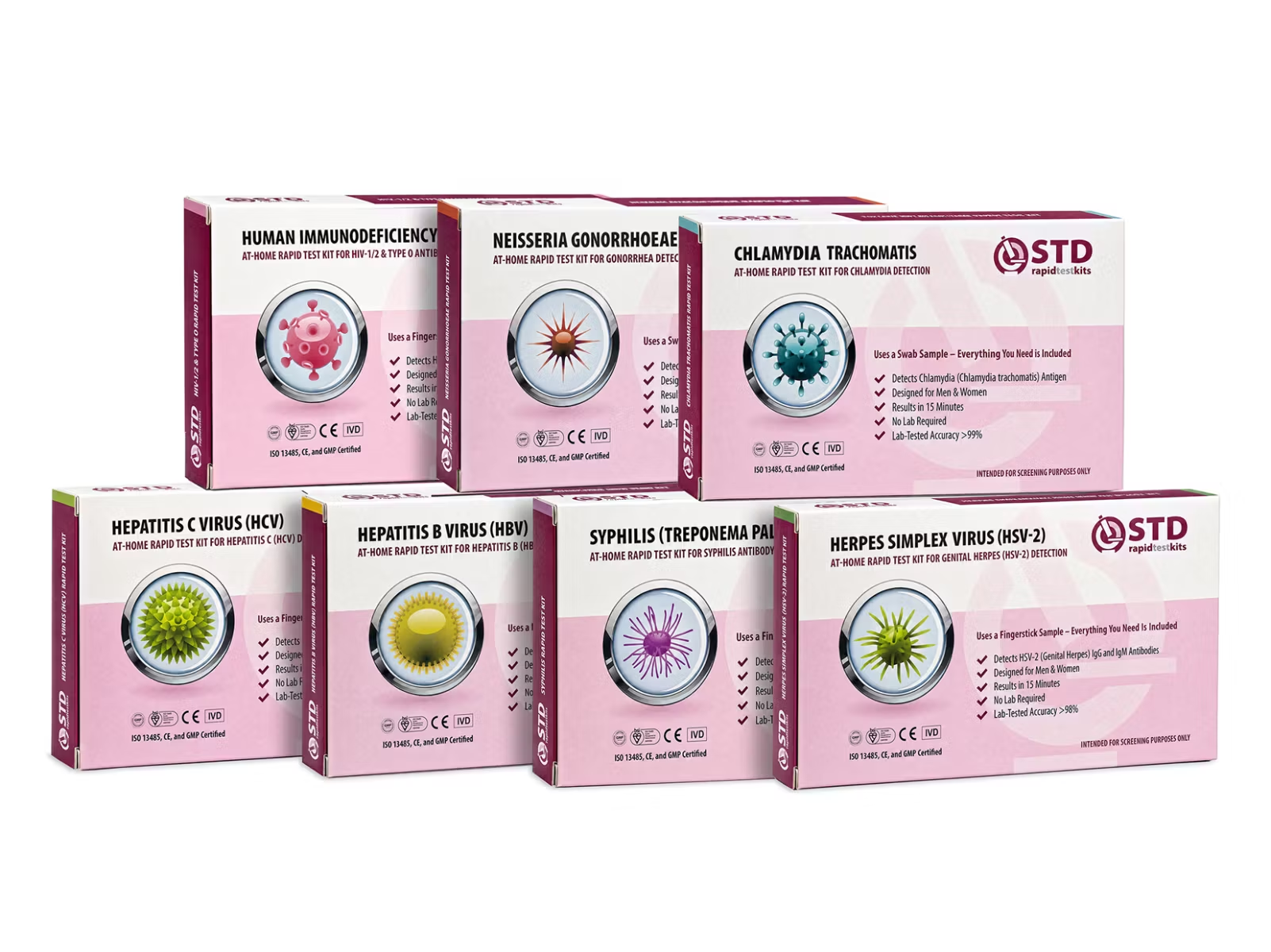
Our at-home rapid kits are available for chlamydia, gonorrhea, syphilis, HIV, hepatitis B, hepatitis C, HSV-1, HSV-2, and (validated for vaginal self-swab only) trichomoniasis and HPV. Combination panels bundle several of these for screening after a single exposure of concern.
After a single exposure of concern, testing the standard multi-infection panel is consistently more informative than picking one or two infections to test based on what feels most likely. STIs frequently co-occur, many are asymptomatic, and the marginal cost of running a combination panel is small compared with the cost of missing an infection that goes untreated for months. The right reason to skip part of the panel is that the exposure type genuinely could not have transmitted that infection (for example, a contact with no fluid exchange).
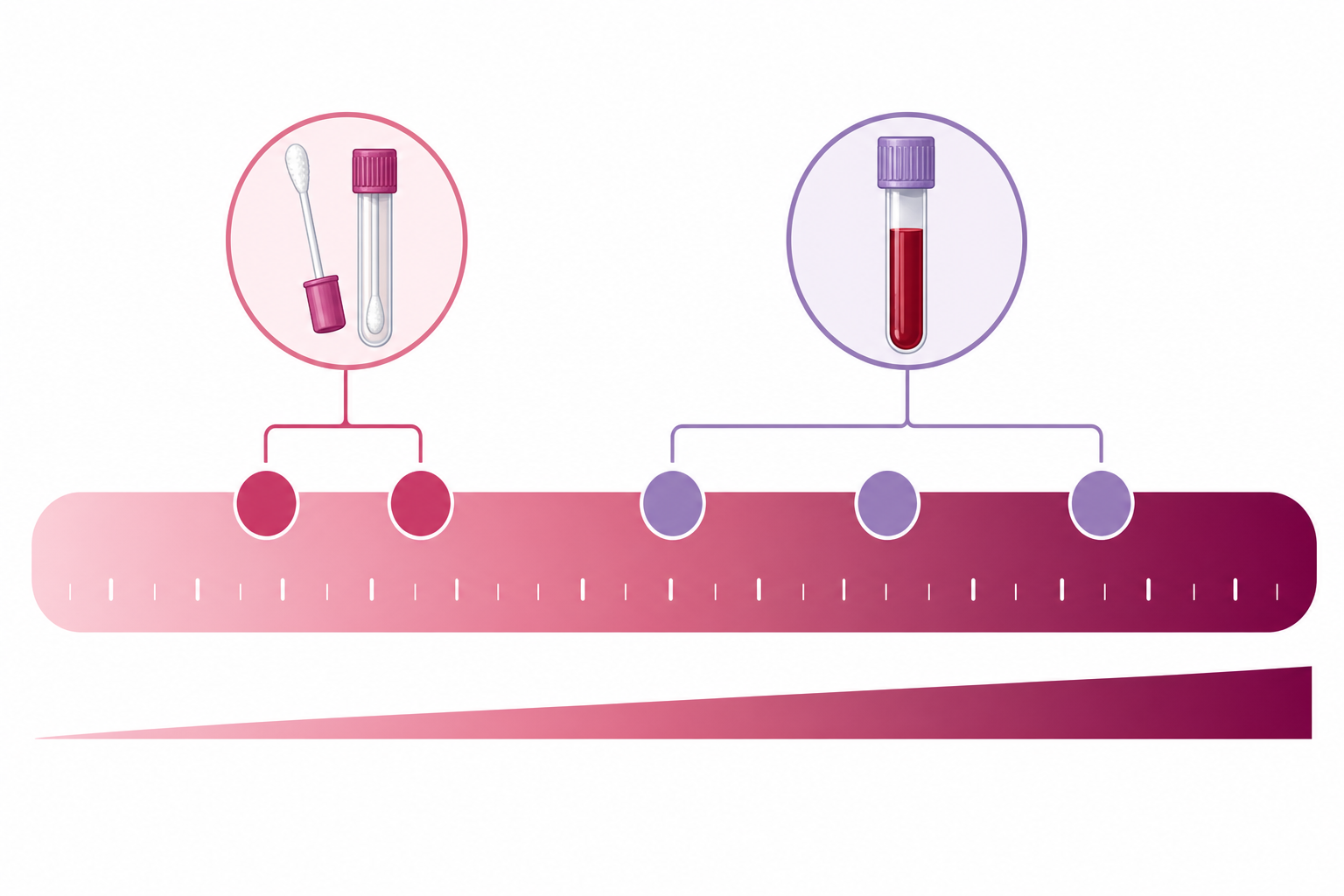
Testing window periods by infection
Each infection has a window period: the time from exposure to when a test can reliably detect it. Testing too early can return a false negative result. Per CDC STI testing guidance, these ranges are the single most useful number to know for each infection. The table below summarizes the windows that apply to at-home lateral-flow rapid tests; laboratory NAAT and fourth-generation HIV testing can detect infection slightly earlier in some cases. The HSV window and 12-week retesting recommendation reflect the CDC STI Treatment Guidelines, which note that type-specific HSV antibody tests can be falsely negative early in infection and recommend repeat testing 12 weeks after the presumed time of acquisition.
| Infection | Sample type | Reliable detection window after exposure |
|---|---|---|
| Chlamydia | Self-collected swab | From day 14 |
| Gonorrhea | Self-collected swab | From day 14 |
| Trichomoniasis (women) | Self-collected swab | From day 7 to 14 |
| Syphilis | Fingerstick blood (antibody) | 6 to 12 weeks |
| HIV (home rapid antibody) | Fingerstick blood | Up to 90 days for full sensitivity |
| Hepatitis B | Fingerstick blood | 6 to 9 weeks |
| Hepatitis C | Fingerstick blood | 8 to 11 weeks |
| HSV-1 and HSV-2 | Fingerstick blood (antibody) | 6 to 12 weeks; per CDC STI Treatment Guidelines, repeat testing at 12 weeks is recommended if initial result is negative |
At-home rapid tests vs laboratory testing
At-home rapid STI kits use lateral-flow immunoassay chemistry, the same general technology behind home pregnancy tests and COVID antigen tests. A sample (self-collected swab or fingerstick blood) reacts with antibodies on a test strip, and a control line plus a result line indicate whether the target marker is present. The advantages are speed and privacy: a typical kit returns a result in about 15 minutes at home, with no clinic visit, no insurance claim, and no public record outside the buyer's own household.
Laboratory testing uses different chemistry. For bacterial infections, the laboratory gold standard is NAAT (nucleic acid amplification testing), which detects the pathogen's genetic material directly and is generally more sensitive than lateral flow, especially during early infection or low-level asymptomatic carriage. For HIV, hospital labs typically use fourth-generation antigen-antibody combination assays, which can detect infection slightly earlier than home antibody-only tests.
In practice, home rapid tests work well for screening. A negative result inside the appropriate window is informative, and a positive result is a screening signal that warrants confirmation by NAAT or a clinic-grade follow-up.
Using a home test kit responsibly
Three practical points apply to any at-home STI test, regardless of brand or panel size:
- Time it correctly. Run the test inside the appropriate window for the infection, not immediately after exposure. A chlamydia test run on day 3 carries a high false-negative rate; the same test on day 21 carries a much lower one.
- Follow the swab or fingerstick instructions exactly. Self-collected vaginal or penile swabs require specific rotation and depth. Fingerstick blood collection requires the correct lancet pressure and a full drop. Skipping these reduces sensitivity.
- Treat any positive as preliminary. A positive lateral-flow result is a strong screening signal. The next step is a confirmatory laboratory test (NAAT for bacterial infections, or a fourth-generation HIV lab assay) through a primary care clinician, a sexual health clinic, or a Planned Parenthood location. Treatment follows confirmation.
If multiple infections might be in scope, which is typical after a single exposure of concern, a combination panel is more cost-effective than buying single-infection kits one at a time. The kit referenced below is sold by this site; the guidance in this section applies to any lateral-flow home STI test regardless of brand.
After a positive or equivocal result
A positive at-home result is the start of a clinical pathway, not the end of one. For an equivocal or unclear result (a very faint line, an ambiguous control), repeat the test after a brief interval or schedule a clinic visit. Faint lateral-flow lines can indicate genuinely positive low-titer samples or can be artifacts of timing; a clinician's read on a confirmatory test settles the question.
1. Confirmatory testing. A primary care clinician, a sexual health clinic, or a Planned Parenthood location can order the appropriate confirmatory lab test (NAAT for bacterial infections; a fourth-generation antigen-antibody assay or RNA PCR for HIV; quantitative PCR for hepatitis viruses).
2. Treatment. Chlamydia, gonorrhea, syphilis, and trichomoniasis are antibiotic-treatable. Hepatitis C is curable in most cases with direct-acting antivirals. HIV is managed with daily antiretroviral therapy that, when adherent, suppresses the virus to undetectable levels; per CDC guidance, undetectable equals untransmittable in sexual contact. HSV-1, HSV-2, and high-risk HPV are managed rather than cured, but management is effective.
3. Partner notification. State and local health departments offer confidential partner-notification services for situations where direct conversation feels impossible or unsafe.
4. Retesting on schedule. The CDC recommends retesting for chlamydia and gonorrhea three months after treatment, because reinfection is common.
Mental health and long-term support
The medical question, including any positive test result, sits inside a larger emotional context for most people in this situation. Common reactions include guilt, shame, confusion about consent in retrospect, and (for cases involving abuse, coercion, or a minor at the time) post-traumatic responses that can surface years after the contact itself.
Professional mental health support helps. Trauma-informed therapists, in particular, are trained to work with sexual abuse and complex consent histories without judgment. The American Psychological Association's psychologist locator and SAMHSA's referral helpline at 800-662-4357 can both connect callers to local trauma-trained clinicians on a confidential basis. Many therapists offer sliding-scale fees; community mental health centers offer free or low-cost options for those without insurance.
Support groups also help, both in-person and online, by offering shared experience and reduced isolation. RAINN's online support resources and survivor forums are a starting point that does not require any disclosure to family or friends.
Both RAINN (rainn.org, 800-656-HOPE) and SAMHSA (800-662-4357) connect callers to local trauma-trained clinicians on a confidential basis, without requiring any prior reporting decision.
STDs are common, and many people who have one do not know it. Most STDs have no symptoms, so testing is the only way to know.
Frequently asked questions
- Does genetic similarity between sexual partners increase STI transmission risk?
- No. STIs transmit through specific biological routes (fluid exchange, skin-to-skin contact with infected areas, and mucous membrane contact). Pathogens do not respond to the genetic similarity between partners. Older online content sometimes claims a heightened biological risk for consanguineous partners, but this claim is not supported by CDC, WHO, NHS, or peer-reviewed transmission research. The factors that matter are the type of contact, the infection status of either partner, and whether barriers were used.
- Which STIs should I test for after a single exposure of concern?
- The standard panel covers chlamydia, gonorrhea, syphilis, HIV, hepatitis B, hepatitis C, HSV-1, HSV-2, and (for women) trichomoniasis and HPV. The CDC's screening recommendations vary by age and risk profile, but for a single specific exposure of concern, testing the full standard panel is more informative than guessing which infection might have transmitted.
- How long after exposure do I need to wait before a test is reliable?
- One distinction that catches most readers off guard: HIV testing windows differ significantly between technologies. Laboratory fourth-generation antigen-antibody tests can detect infection as early as 18 to 45 days post-exposure, while home rapid antibody-only tests may need up to 90 days for full sensitivity. Across all infections in our panel, reliable detection windows range from as early as two weeks (bacterial swab tests for chlamydia and gonorrhea) to roughly three months (home HIV antibody, HSV-1, and HSV-2 seroconversion, with CDC recommending repeat HSV antibody testing at 12 weeks per the STI Treatment Guidelines). The infection-by-infection breakdown is in the testing window table above.
- Are at-home rapid STI tests as accurate as laboratory tests?
- They are not identical. Home rapid tests use lateral-flow immunoassay chemistry, which is well validated for screening but generally less sensitive than laboratory NAAT (nucleic acid amplification testing), especially in early infection or asymptomatic cases. A positive at-home result is worth confirming with a laboratory test. A negative at-home result during the correct window period is informative; if symptoms persist or your risk concerns continue, a clinic test adds confirmation.
- What if the sexual contact happened when I was a minor, or involved coercion?
- That situation is sexual abuse, regardless of how it was framed at the time. The Rape, Abuse and Incest National Network (RAINN) operates a confidential 24/7 hotline at 800-656-HOPE (4673). Counselors there can help with reporting decisions, immediate support, and finding trauma-informed care in your area. You do not have to decide about reporting in order to talk to someone. Childhelp also operates a national child abuse hotline at 800-422-4453.
- Can I get tested without my family finding out?
- Yes. At-home STI test kits ship in unmarked, discreet packaging, and the testing happens privately at home. Clinic-based testing through Planned Parenthood, county health departments, and community sexual health clinics is confidential and, in many U.S. states, accessible to minors without parental consent for STI testing specifically. If you are on a parent's insurance plan, claim summaries may be visible to the policyholder; cash-pay testing and free clinics avoid that visibility.
- I do not have any symptoms. Do I still need to test?
- Yes, if there has been a recent exposure of concern. Most STIs are silent. Chlamydia, gonorrhea, HIV, and the hepatitis viruses can all transmit without producing visible symptoms in the carrier or the new infection. Untreated silent infections cause long-term complications such as infertility, organ damage, and ongoing transmission. Testing during the appropriate window after a known exposure is the only reliable way to know.
- What does a positive test mean, and what comes next?
- A positive at-home result is a screening signal rather than a final diagnosis. The next step is a confirmatory laboratory test (your clinician orders this) and treatment if the infection is confirmed. Chlamydia, gonorrhea, syphilis, and trichomoniasis are treated with antibiotics. HIV is treated with daily antiretroviral therapy that suppresses the virus to undetectable levels in adherent patients. Hepatitis B and hepatitis C have effective treatments (and hepatitis C has a cure in most cases). HSV-1, HSV-2, and HPV are managed with antivirals or vaccination plus monitoring.
- U.S. Centers for Disease Control and Prevention. Sexually transmitted infections (STI) overview, transmission routes, screening guidance, and 2021 Treatment Guidelines reference material.
- U.S. Centers for Disease Control and Prevention. HIV transmission overview including relative per-act risk by exposure type, factors that raise transmission probability, testing technology, and undetectable-equals-untransmittable (U=U) guidance.
- World Health Organization. Sexually transmitted infections (STIs) fact sheet covering transmission, prevention, and treatment for the eight most prevalent STIs worldwide.
- UK NHS. Sexually transmitted infections (STIs) overview including symptoms, when to test, and how clinical testing pathways work.
- U.S. Centers for Disease Control and Prevention. STI Treatment Guidelines, genital HSV infections section. Notes that type-specific HSV antibody testing can be falsely negative early in infection and recommends repeat type-specific antibody testing 12 weeks after the presumed time of acquisition.
- Rape, Abuse and Incest National Network (RAINN). National Sexual Assault Hotline (800-656-HOPE), 24/7 confidential support, and online chat for survivors and people supporting them.
- Substance Abuse and Mental Health Services Administration (SAMHSA). National Helpline (800-662-4357) for free, confidential, 24/7 mental health and substance use referral support, including trauma-informed care referrals.
