
Published: September 2025 | Last updated: May 2026 | Editorial review and quality control: Martina N.
The short answer is yes, and the longer answer is more useful: sexual activities that put fecal matter in contact with the mouth can transmit a specific set of infections. Some are formally classified as sexually transmissible (hepatitis A is the clearest example). Many are gut bugs that just happen to spread efficiently this way. It's one of the less-discussed corners of sexual health, and that gap leaves people doing the math poorly when an unplanned exposure happens.
What follows walks through what actually transmits through the fecal-oral route during sex, where the real risk lives, and what an honest prevention plan looks like: hygiene, barriers, vaccination, and post-exposure screening. It also covers what at-home rapid tests can and can't answer after this kind of contact, because several of the specific organisms involved aren't part of any home kit on the market.
Key Takeaways
- Oral-anal contact (rimming) can transmit shigellosis, hepatitis A, giardia, amoebiasis, and several other gut pathogens, often after exposure to amounts of fecal matter too small to see.
- Vaccination against hepatitis A and hepatitis B, plus barrier methods, hand and genital hygiene, and post-exposure testing for the bloodborne STIs we can screen at home (HIV, syphilis, hep B, hep C) covers most of the meaningful risk.
How the fecal-oral route actually works during sex
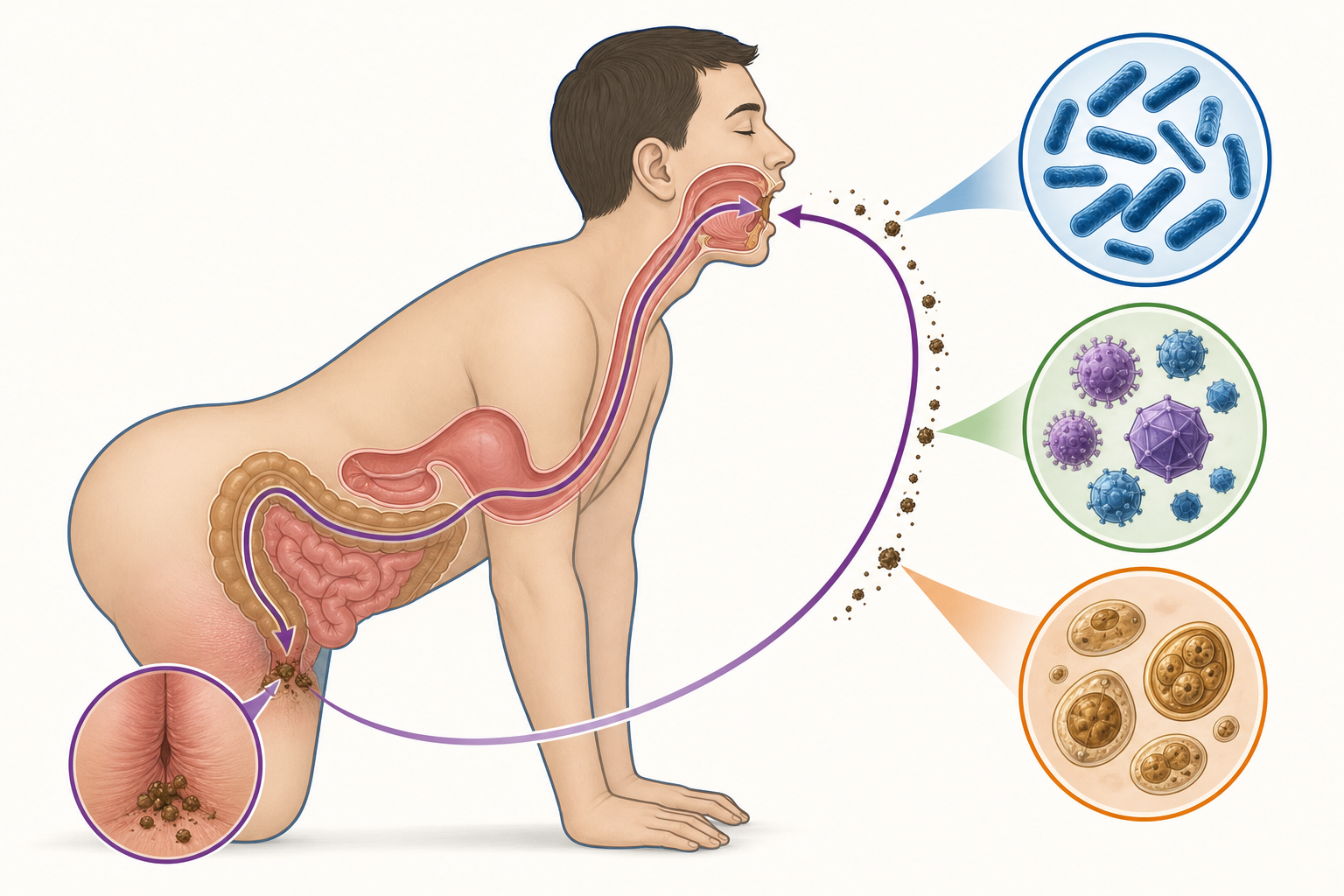
The fecal-oral route is the standard public-health term for any pathway that starts with fecal matter from one person and ends in the mouth of another. The amount needed to transmit infection is often tiny. Shigella sits at the low end of the dose-response curve for enteric bacteria; the U.S. CDC describes shigella as easily transmitted because it takes only a small amount of bacteria to make someone sick, a much lower infectious dose than most other gut bacteria require. That low dose is the reason rimming and similar practices carry real risk: the visible cleanliness of the area says very little about whether infectious microbes are present on the skin around the anus.
In a sexual context, three contact patterns dominate. Anilingus (oral-anal contact, often called rimming) is the most direct route. Hand-to-mouth transfer after touching the anal area, including after digital penetration, comes second. Shared sex toys that move between the anus and the mouth or genitals make a third. Standard penile-vaginal or condom-protected penile-anal sex is not the typical fecal-oral route, though both can still spread infections through other mechanisms.
The term STI formally covers organisms that evolved sexual transmission as their primary route (HIV, chlamydia, syphilis). The gut pathogens covered below are sexually transmissible without being sexually adapted: they spread the same way regardless of whether the exposure happened at a kitchen sink or in a bedroom. Most of these are diagnosed by a stool sample at a clinic, not by an at-home STI test.
Three contact patterns drive sexual fecal-oral transmission: anilingus (oral-anal contact), hand-to-mouth transfer after touching the anal area or after digital penetration, and shared sex toys that move between the anus and the mouth or genitals. The barriers, hand-washing, and toy-cleaning recommendations later in this article all target these three specific routes.
Can sex involving fecal contact transmit STIs?
Yes. The main organisms that spread this way are hepatitis A, shigella, giardia, entamoeba histolytica, campylobacter, salmonella, and certain strains of E. coli. The bloodborne STIs (HIV, hepatitis B and C, syphilis) don't transmit through fecal matter itself but often share the same exposure event. A reasonable post-exposure plan: get the hepatitis A and B vaccines if you aren't already covered, see a clinic for stool testing if gut symptoms appear within one to four weeks, and screen at home for bloodborne STIs after the appropriate window period.
Bacterial infections from oral-anal contact
Most of the bacteria that cause acute gastrointestinal illness can transmit through the fecal-oral route during sex. Four show up most often in sexual-health surveillance data.
Shigellosis (caused by Shigella sonnei and Shigella flexneri) produces watery or bloody diarrhea, fever, and abdominal cramping, usually starting one to two days after exposure. The U.S. CDC has tracked sustained shigella outbreaks among men who have sex with men since the 2000s, and several recently circulating strains are resistant to commonly used antibiotics. Shigella is a notifiable disease in most jurisdictions, which means a lab-confirmed case triggers an automatic public-health follow-up.
Campylobacteriosis (most often Campylobacter jejuni) causes diarrhea (which can be bloody), cramping, and fever for about a week. The infection is usually self-limited, but a small fraction of cases trigger reactive arthritis or, rarely, Guillain-Barré syndrome. The fecal-oral transmission route is the same as for shigella, and the diagnostic workup is identical: a stool culture or stool PCR panel at a clinic.
Salmonella infection (non-typhoidal salmonellosis) presents with diarrhea, fever, and cramping anywhere from six hours to six days after exposure. Most adults clear it without antibiotics, but salmonella does occasionally cause bloodstream infections in immunocompromised people, which is one reason the testing recommendation is the same: a stool sample at a clinic if symptoms develop.
Pathogenic E. coli (especially the diarrheagenic strains like enteroaggregative and shiga-toxin-producing E. coli) round out the bacterial picture. Symptoms range from mild diarrhea to severe bloody diarrhea with risk of hemolytic uremic syndrome in the case of shiga-toxin strains.
None of these are part of an at-home STI test panel; you screen for them with a stool sample at a clinic. The symptom profile (acute diarrhea, fever, cramping starting one to seven days after a high-risk contact) is the trigger to seek care, not a positive home test. If you develop gut symptoms within a week of oral-anal contact, mention the exposure to your clinician explicitly. It changes the stool-test panel they order.
Viral infections: hepatitis A and hepatitis E
Two viral hepatitis strains spread by the fecal-oral route, and both have well-documented sexual transmission patterns.
Hepatitis A (HAV) is the more common and clinically relevant of the two in higher-income countries. The CDC and WHO both classify it as sexually transmissible in the context of oral-anal sex, even though it isn't a "classic" STI. According to the WHO's hepatitis A fact sheet, the incubation period is usually 14 to 28 days, with symptoms that include fatigue, nausea, abdominal discomfort, jaundice (yellowing of the skin and whites of the eyes), and dark urine. Most adults recover fully within two months, but acute liver failure does happen in a small fraction of cases, and recovery can drag on for six months or more in some people.
The most important practical point about HAV: it's vaccine-preventable. The standard hepatitis A vaccine is a two-dose series given six months apart. The same WHO fact sheet linked above lists men who have sex with men, people with chronic liver disease, and travellers to regions where hepatitis A is endemic among the groups for whom hepatitis A vaccination is specifically recommended. If you engage in oral-anal sex and aren't sure of your hepatitis A vaccination status, asking for the vaccine at any clinic is one of the highest-yield actions you can take in this whole topic.
Hepatitis E (HEV) is more common in lower-resource settings and is usually waterborne, but the fecal-oral route during sex is recognized as a transmission pathway. In most healthy adults it produces a self-limited acute hepatitis similar to HAV. The big exception is pregnancy: HEV during pregnancy carries a substantially higher risk of fulminant hepatic failure, particularly in the third trimester. There is no widely available HEV vaccine in most countries (a vaccine exists in China and has limited availability elsewhere).
Note that hepatitis B and hepatitis C, the two bloodborne hepatitis viruses, do not transmit through fecal matter itself. They share the same exposure context (anal sex carries the highest per-act HIV and hepatitis B risk of any sexual practice), which is why screening for both is recommended after any high-risk encounter. We sell rapid at-home tests for hepatitis B and C through this site; the product link below goes to our combined Hep B and Hep C kit page.
Parasitic infections from fecal exposure
Three parasites round out the standard list of fecal-orally transmitted organisms with documented sexual transmission.
Giardiasis (caused by Giardia duodenalis, also called Giardia lamblia) is the most common. After exposure, symptoms develop in one to three weeks and include watery diarrhea, greasy or foul-smelling stools, bloating, cramping, gas, and weight loss. Untreated giardia can persist for weeks to months. Diagnosis is by stool antigen or stool ova-and-parasite exam at a clinic. Treatment is straightforward (typically metronidazole or tinidazole) and effective.
Amoebiasis (caused by Entamoeba histolytica) is less common in higher-income countries but can be severe. Most infections are asymptomatic; the symptomatic minority produce dysentery (bloody diarrhea with mucus), abdominal pain, and occasionally invasive disease that spreads to the liver as an amoebic abscess. Treatment requires both an amoebicide and a separate luminal agent to clear cysts; relapse is possible without the second drug.
Cryptosporidiosis (caused by Cryptosporidium species) tends to produce watery diarrhea and cramping for one to two weeks in immunocompetent adults. In people with weakened immune systems (advanced HIV disease, transplant recipients, certain chemotherapies) it can become chronic and severe. There's no consistently effective antibiotic for crypto in immunocompetent adults; supportive care is the main treatment.
Giardia, amoebiasis, and cryptosporidiosis are not detectable on any at-home STI panel. Diagnosis requires a stool ova-and-parasite exam or stool PCR panel at a clinic. The trigger is symptoms (persistent diarrhea, cramping, gas, weight loss) appearing within one to four weeks of the exposure, not the exposure itself.
Other STIs that share the same exposure event
A reader who is thinking about fecal-oral risk is usually also asking about the broader STI panel, because the activities that drive fecal-oral exposure (rimming, anal sex, multiple partners) also elevate the risk of the classic sexually transmitted infections. A few specific points worth making clean.
HIV doesn't transmit through fecal matter itself. It transmits through blood, semen, vaginal fluid, and rectal fluid. The reason HIV comes up in this conversation is that receptive anal intercourse is the highest per-act-risk sexual route for HIV acquisition, and rimming often occurs in the same session. Screening at home with a fingerstick HIV antibody test is well established; rapid antibody tests reliably pick up infections roughly 23 to 90 days after exposure depending on the assay, per CDC testing guidance.
Syphilis primary lesions (chancres) can develop in the anus and rectum and are often painless, which means they're easy to miss after receptive anal contact. The chancre stage is when syphilis is most transmissible. Rapid blood-based syphilis tests detect treponemal antibodies, which appear roughly 3 to 12 weeks after the chancre develops.
Chlamydia and gonorrhea can both colonize the rectum after receptive anal sex, and the rectal infection is often asymptomatic. They can also colonize the throat after oral sex. The complicating factor for at-home testing: the chlamydia and gonorrhea kits we sell are swab-based and validated for genital self-collection (vaginal or penile). They are not validated for rectal or pharyngeal self-collection, which is the sample type a clinic-based NAAT would use after anal or oral exposure specifically. If your exposure was receptive anal or oral and you want a site-specific test, a clinic visit is the right answer for that one.
HPV can transmit to anal and oral tissues, and anal HPV is the leading cause of anal cancer. Screening for anal HPV is a clinic procedure (anal Pap or HPV DNA), not an at-home test. Our HPV at-home rapid swab is a vaginal self-collection kit, validated for women only.
Herpes simplex virus (HSV-1 and HSV-2) can cause anal lesions and is transmitted by skin-to-skin contact, including during rimming. Blood antibody tests confirm past seroconversion roughly 12 weeks after exposure; lesion swabs at a clinic confirm an active outbreak in the moment.
The CDC's prevention guidance for sexually active people frames Shigella as easily spread during sex, including oral-anal contact and sex involving shared toys, and recommends both barrier use during rimming and thorough toy cleaning between partners. (Source: <a href="https://www.cdc.gov/shigella/prevention/preventing-shigella-infection-among-sexually-active-people.html" target="_blank" rel="noopener">CDC: Preventing Shigella infection among sexually active people</a>.)
Reducing the risk: barriers, hygiene, and vaccination
A working risk-reduction plan for oral-anal and adjacent sexual practices has four components. The first three reduce the chance of any single exposure transmitting infection; the fourth reduces the consequences if an exposure does happen.
Barriers. Dental dams (or a condom cut open and laid flat, which works in a pinch) physically block the transfer of fecal matter and skin secretions during rimming. They are imperfect. A dental dam can slip out of place during use, and the unprotected sides matter. But the barrier substantially reduces the dose of microbes transferred to the mouth, and dose matters with low-infectious-dose organisms like shigella. For anal intercourse, condoms substantially reduce HIV, gonorrhea, chlamydia, syphilis, and hepatitis B transmission per act when used correctly and consistently. Effectiveness drops sharply with inconsistent use.
Hygiene. Washing the anal and perineal area with soap and water before sexual activity reduces (without eliminating) surface microbial load. Wash hands with soap and water (not hand sanitizer alone, which is less effective against shigella and norovirus) between handling the anus and touching the mouth or genitals. Avoid moving a finger, toy, or penis from anus to mouth or vagina without washing or changing condom in between. Toys used anally should ideally have a flared base and be cleaned thoroughly between uses; toys with seams or porous surfaces are harder to clean and worth replacing.
Vaccination. Three vaccines materially reduce the consequence of this kind of exposure. The hepatitis A vaccine (two doses, six months apart) prevents the most common sexually transmissible viral hepatitis. The hepatitis B vaccine (three doses over six months, or the newer two-dose Heplisav-B series) prevents hepatitis B, which is bloodborne and shares the same exposure context. The HPV vaccine (Gardasil 9, three doses if started after age 15) prevents the high-risk HPV strains responsible for most anal cancers; routine vaccination is recommended through age 26, with shared clinical decision-making for adults aged 27 to 45 per the U.S. ACIP.
Behavioral risk reduction is the fourth piece. Reducing the number of partners, knowing partners' STI status, and using barrier methods consistently each lower aggregate risk. None of these turns a higher-risk practice into a no-risk one; the combination is what matters.
Prevention hierarchy
- Vaccinate against hepatitis A and hepatitis B before any high-risk exposure. These are the highest-yield preventive actions and protection lasts for years.
- Use dental dams (or a condom cut open and laid flat) for rimming, and condoms for anal intercourse, consistently and correctly.
- Wash hands with soap and water (hand sanitizer alone works poorly against shigella and norovirus) between handling the anus and touching the mouth or genitals.
Testing after a known exposure
Post-exposure testing has two completely separate tracks, and conflating them is the most common mistake.
Track one is the bloodborne STI panel. If you've had a high-risk encounter (unprotected anal sex, rimming with bleeding gums, broken condom with a partner of unknown status), the items on this list have established window periods and at-home rapid tests:
- HIV: rapid antibody tests window 23 to 90 days after exposure depending on the kit; a clinic-based fourth-generation HIV antigen-antibody test can detect infection 18 to 45 days after exposure, which is earlier than antibody-only rapid kits.
- Hepatitis B: HBsAg detectable 30 to 60 days post-exposure on most rapid kits; clinic testing also looks at HBcAb and HBsAb to distinguish acute, chronic, recovered, and vaccinated states.
- Hepatitis C: antibody tests window 8 to 12 weeks; a clinic HCV RNA PCR can detect infection earlier (around 2 to 3 weeks).
- Syphilis: treponemal antibody tests detect infection roughly 3 to 12 weeks after a chancre develops; a clinic-based RPR and FTA-ABS pair gives the most actionable result.
These are all on the at-home rapid-test market and are reasonable to do yourself if you want privacy, fast results, and don't need a clinician's interpretation in the moment. Confirmatory testing at a clinic after any positive at-home result is the standard recommendation.
Track two is gut pathogen testing, which is symptom-triggered, not exposure-triggered. If you develop diarrhea, cramping, fever, or jaundice within one to four weeks of an exposure, go to a clinic and explicitly mention the recent sexual contact. The standard workup is a stool ova-and-parasite exam plus a stool PCR panel that covers shigella, campylobacter, salmonella, E. coli, giardia, entamoeba, and cryptosporidium in a single test. This is not something to do at home.
Pharyngeal and rectal swabs for chlamydia and gonorrhea after specific oral or receptive-anal contact are clinic-only. The at-home swab-based tests on our shelf (chlamydia, gonorrhea) are validated for genital self-collection and aren't a substitute. If site-specific testing is what you need, a sexual-health clinic visit is the right answer.
When to see a doctor instead of testing at home
Several symptoms after a fecal-exposure contact warrant a clinic visit, not a home test. The reason is that the diagnostic question changes: home tests answer "do I have this specific infection now?", but the symptoms below need a clinician to determine which of several possible infections is causing them and to start treatment quickly if needed.
Red flags after a relevant exposure:
- Bloody diarrhea, or diarrhea lasting more than 48 hours
- Fever above 38.5 degrees C / 101 degrees F
- Jaundice (yellowing of the skin or whites of the eyes), dark urine, pale stools, or right upper abdominal pain (possible acute hepatitis)
- Severe abdominal cramping that doesn't respond to over-the-counter analgesics
- Rectal pain, discharge, or bleeding (proctitis is a recognized sexually transmitted syndrome)
- Signs of dehydration: dizziness on standing, very dark urine, inability to keep fluids down
- Any of the above in a person who is pregnant, immunocompromised, or has underlying liver disease
If you're systemically unwell after a recent oral-anal exposure, the right move is a clinic or urgent-care visit with a clear mention of the exposure, not a multi-day wait for home test results.
Stay safe, stay informed
Sex involving fecal contact carries real and measurable infection risk, but it is not a uniquely catastrophic category. The same prevention principles that work for any sexual-health planning (barriers, hygiene, vaccination, regular screening) apply here, with the addition that the most relevant viral infection (hepatitis A) is fully vaccine-preventable.
If you've had a recent exposure you're worried about, the simplest version of the plan is: get the hepatitis A and hepatitis B vaccines if you aren't already covered, watch for gut symptoms over the following one to four weeks and see a clinic if any appear, and screen for the bloodborne STI panel at home or at a clinic after the relevant window periods have passed. Regular screening every three to six months is the standard recommendation for people with multiple partners or frequent unprotected contact.
Your 3-step post-exposure plan
- Vaccinate (or check status): hepatitis A and hepatitis B are both vaccine-preventable and cover the highest-yield viral risks from this exposure type.
- Watch for gut symptoms for one to four weeks: diarrhea, cramping, fever, or jaundice warrant a clinic visit with explicit mention of the sexual exposure so the right stool panel is ordered.
- Screen the bloodborne STI panel at home or at a clinic after each test's window period: HIV (23-90 days), hepatitis B (30-60 days), hepatitis C (8-12 weeks), syphilis (3-12 weeks).
Frequently asked questions
- Can rimming actually transmit serious infections?
- Yes. Hepatitis A, shigellosis, giardia, and entamoeba histolytica all transmit by the fecal-oral route during rimming. Shigella in particular has a very low infectious dose, which is why thorough cleaning before contact reduces but does not eliminate risk.
- Does the area need to look visibly soiled for transmission to happen?
- No. The amounts of fecal matter required to transmit shigella or hepatitis A are too small to see. The visible cleanliness of the perianal skin is a poor proxy for whether infectious microbes are present.
- Is hepatitis A actually classified as an STI?
- The CDC and WHO classify hepatitis A as sexually transmissible in the context of oral-anal contact. It is not a "classic" STI in that it didn't evolve sexual transmission as its primary route, but the public-health classification recognizes the sexual transmission pattern, and the standard recommendation is vaccination for adults at increased risk.
- Can a condom or dental dam fully prevent these infections?
- Both reduce risk substantially but neither eliminates it. Dental dams can slip during use; condoms can break or be used incorrectly. Layered prevention (hygiene plus barriers plus vaccination plus regular screening) is the realistic approach.
- Does at-home rapid testing detect shigella or giardia?
- No. At-home kits screen for the bloodborne STIs (HIV, syphilis, hepatitis B, hepatitis C) and certain genital infections (chlamydia, gonorrhea, HPV in women, trichomoniasis in women, HSV). Gut pathogens like shigella, salmonella, campylobacter, giardia, entamoeba, and cryptosporidium need a stool sample tested at a clinic.
- How soon after exposure should I test for bloodborne STIs?
- Window periods vary by test. HIV antibody tests window 23 to 90 days depending on assay; hepatitis B surface antigen 30 to 60 days; hepatitis C antibody 8 to 12 weeks; syphilis treponemal antibody 3 to 12 weeks. Earlier detection is possible at a clinic with combination antigen-antibody assays and PCR tests.
- Should I get the hepatitis A vaccine if I engage in oral-anal sex?
- Yes, if you aren't already vaccinated. The WHO hepatitis A fact sheet lists men who have sex with men and other adults at increased risk of fecal-oral exposure among the groups for whom vaccination is specifically recommended. The standard schedule is two doses six months apart. Most insurance covers it and many public-health clinics offer it at low or no cost.
- What symptoms should send me to a clinic right away?
- Bloody diarrhea, fever above 38.5C/101F, jaundice or dark urine, severe abdominal pain, or rectal bleeding or discharge. Also any of these symptoms in pregnancy, immunocompromise, or pre-existing liver disease. Mention the recent sexual contact explicitly so the clinic orders the right panels.
- U.S. Centers for Disease Control and Prevention. Preventing Shigella infection among sexually active people, including transmission routes during oral-anal contact and through shared sex toys, plus antimicrobial-resistance trends among sexually transmitted strains.
- U.S. Centers for Disease Control and Prevention. About Shigella infection, including the low-infectious-dose framing and basic transmission information.
- World Health Organization. Hepatitis A fact sheet covering global incidence, severity, transmission routes, incubation period (14 to 28 days), risk groups including men who have sex with men, and vaccination guidance.
- U.S. Centers for Disease Control and Prevention. HIV testing guidance, including window periods for antibody, antigen-antibody, and nucleic acid tests.
- Mayo Clinic. Giardia infection: symptoms, causes, diagnosis, and clinical course.
- World Health Organization. Sexually transmitted infections fact sheet covering global burden, transmission categories, and screening recommendations.
