Published: November 2025 | Last updated: May 2026 | Editorial review and quality control: Martina N.
How do home syphilis tests work, and why do they matter for public health?
A fingerprick blood sample on a lateral-flow cassette detects antibodies to Treponema pallidum in about 15 minutes. The test is reliable from roughly 6 weeks after exposure, with full confidence by 12 weeks. Any reactive home result needs clinic confirmation, an RPR or VDRL titer, before treatment, because only a rising titer confirms active infection rather than past treated disease.
Syphilis is one of the oldest documented sexually transmitted infections in Europe and one of the few that can be cured outright with a single antibiotic. What keeps caseloads high is late diagnosis: people who do not test until symptoms have progressed through one or two stages, or who never notice the symptoms of the early stages at all. For most of human history, getting tested meant a clinic visit, a blood draw, and a wait of days. In the last fifteen years, lateral-flow rapid tests have changed the bottleneck: a fingerprick of blood on a small cassette gives a result at home in about fifteen minutes.
This article walks through where syphilis came from, what the bacterium does inside the body, who should test and how often, and how at-home rapid tests fit into a modern testing strategy. It also explains when a home test is the right tool and when a clinic visit cannot be skipped.
This article is published by stdrapidtestkits.com, a retailer of at-home STI testing kits. The aim is to give you enough information to use a home test well, or to recognize when you need something else. A reactive home result needs clinic confirmation regardless of which kit produced it.
Key takeaways
- Syphilis is curable with a single penicillin injection if caught early. U.S. cases of all stages reached 207,255 in 2022, the highest count since 1950, so testing matters more rather than less than it did a decade ago.
- Home rapid blood tests detect antibodies to Treponema pallidum from about 6 weeks post-exposure. They complement a clinic visit, they do not replace one when a result comes back reactive.
Where syphilis came from
The first well-documented European outbreak of syphilis occurred during and after the Siege of Naples in 1494 to 1495, when soldiers and camp followers spread a new and disfiguring illness across the continent. Within a generation, it had reached most of Europe and parts of Asia. Each affected country tended to name the disease after its perceived neighboring enemy: the French called it the Italian disease, the Italians called it the French disease, the Russians called it the Polish disease. The pattern of naming itself is a useful historical record of how stigma and infection have traveled together for as long as syphilis has been documented.
The Columbian hypothesis, that crewmen returning from the New World brought a novel infection back with them, has been the most widely cited origin theory. Recent paleogenomic work on pre-Columbian skeletal remains is more equivocal. Treponemal infections, of which syphilis is one variant alongside yaws and bejel, may have circulated in both hemispheres before 1492 and exchanged genetic material afterwards. The deeper origin story is still being rewritten by ancient-DNA studies.
The bacterium responsible, Treponema pallidum, was identified in 1905 by Fritz Schaudinn and Erich Hoffmann. The Wassermann blood test followed in 1906, the first practical way to diagnose the infection in someone who was not yet symptomatic.
Diagnostic milestones at a glance
- 1494 to 1495: First well-documented European epidemic during and after the Siege of Naples.
- 1905: Treponema pallidum identified by Schaudinn and Hoffmann.
- 1906: Wassermann complement-fixation test introduced as the first practical pre-symptomatic blood diagnostic.
- 1943: John Mahoney demonstrates that penicillin cures syphilis.
What the infection does inside the body
Treponema pallidum is a corkscrew-shaped bacterium that enters through tiny breaks in skin or mucous membranes during sexual contact, including oral and anal sex. After entry, it spreads quickly through lymph and blood, but the visible disease unfolds in four distinct stages (CDC, About Syphilis; Mayo Clinic, Syphilis). Each stage is detectable differently and treated slightly differently.
Primary syphilis appears 10 to 90 days after exposure, with an average around 21 days, as a single firm, painless ulcer at the contact site, called a chancre. The chancre often goes unnoticed when it forms inside the vagina, on the cervix, in the anus, or in the throat. It heals on its own in three to six weeks, which gives the false impression that the infection has cleared.
Secondary syphilis appears weeks to a few months later as a body-wide rash, often involving the palms and soles, plus mild fever, sore throat, swollen lymph nodes, mucous patches in the mouth, and patchy hair loss. The rash also resolves on its own, again falsely suggesting recovery.
Latent syphilis is the silent stage that follows. The bacterium persists in tissue without producing symptoms, sometimes for decades. Latent infection is detectable only by blood antibody tests.
Tertiary syphilis develops in roughly one in three untreated cases, ten to thirty years after the initial infection. It causes destructive lesions in the cardiovascular system (most often the aorta), the nervous system (neurosyphilis can cause stroke, dementia, and movement disorders), the eyes (ocular syphilis), the inner ear (otosyphilis), and skin and bone. Treatment at this stage prevents further damage but does not reverse what has already been lost. Neurosyphilis can also occur much earlier than the tertiary stage, especially in people living with HIV.
Primary chancres heal on their own in three to six weeks. Secondary rashes resolve in days to weeks. Latent infection is silent by definition. A person can have transmissible syphilis for months or years without symptoms that prompt a doctor visit. Routine antibody screening is the only reliable way to detect infection during these silent intervals.
Who should consider regular syphilis testing
Anyone sexually active can acquire syphilis, but a few groups carry enough additional risk that public-health bodies recommend regular screening rather than only-when-symptoms-appear testing. The CDC names these groups specifically (CDC, Syphilis):
- Pregnant people, ideally at the first prenatal visit and again in the third trimester for those with ongoing risk.
- Gay and bisexual men, with at least annual screening, and every 3 to 6 months for those with multiple partners.
- People living with HIV, with screening at HIV diagnosis and at least annually after that.
- People taking PrEP for HIV prevention, with screening every 3 to 6 months as part of routine PrEP follow-up.
- Anyone whose recent partner has been diagnosed with syphilis or another sexually transmitted infection.
For everyone else who is sexually active and worried about a specific exposure, or who simply wants periodic peace of mind, an at-home syphilis test is a reasonable first screen. The 15-minute result and total privacy are the practical reasons most readers reach for one.
Syphilis screening is part of every standard prenatal panel because untreated maternal syphilis can cause miscarriage, stillbirth, premature birth, and congenital syphilis in the baby. Home testing is reasonable as a between-visits check, but it does not replace the laboratory screen your prenatal provider runs. Treat any reactive home result as urgent and contact your provider the same day.
How a rapid lateral-flow blood test actually works
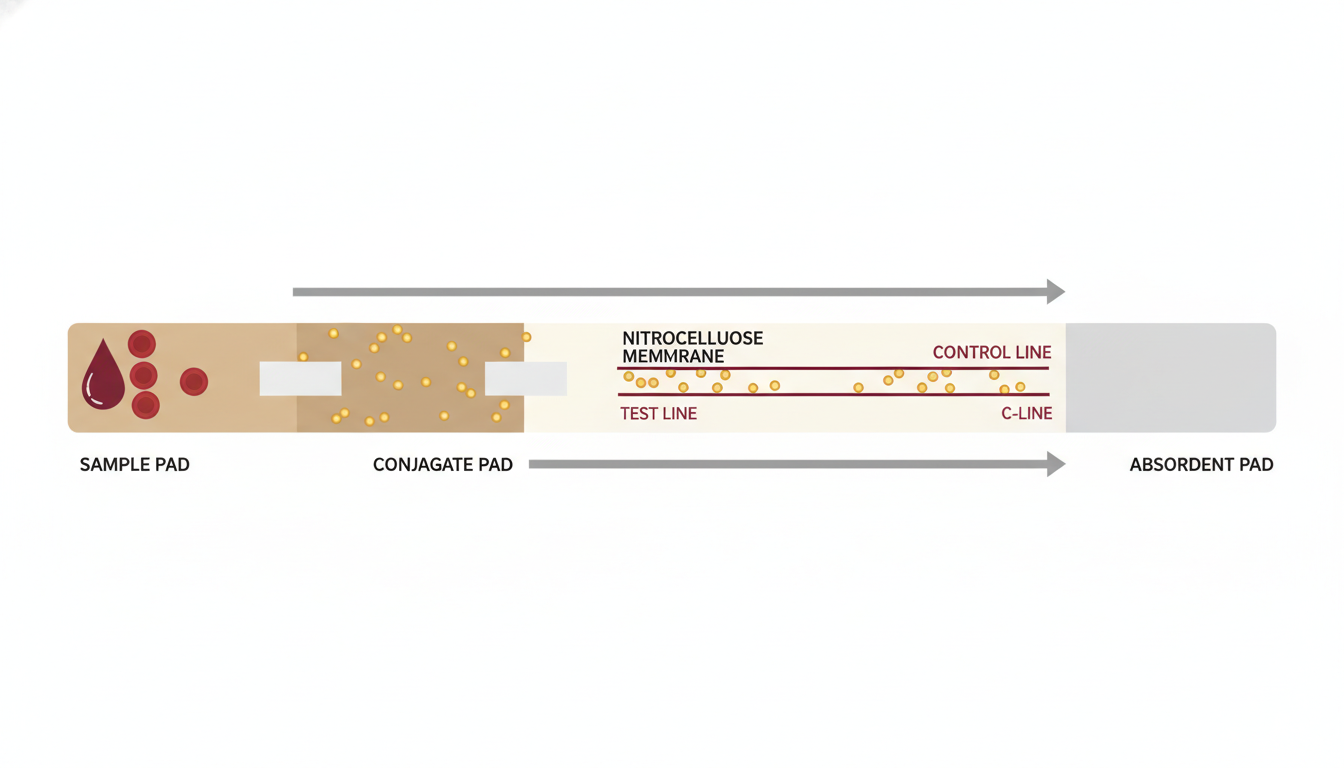
A lateral-flow rapid test is a thin paper strip housed in a plastic cassette. The strip has four functional regions in sequence: a sample pad on one end, a conjugate pad pre-loaded with antibodies tagged to colored particles (usually colloidal gold), a nitrocellulose membrane carrying the Test line and the Control line, and an absorbent pad at the other end. The kit also includes a small lancet, an alcohol pad, a pipette or capillary tube, and a small bottle of buffer solution.
The procedure itself is short. Wash and dry your hands, prick the side of a fingertip with the lancet, collect a small drop of blood with the pipette, place that drop into the well on the cassette, add two or three drops of buffer, and wait. Fluid wicks across the strip by capillary action. If antibodies against Treponema pallidum are present in your blood, they bind the gold-tagged antigen at the conjugate pad. The complex flows forward and is captured at the Test line, producing a visible colored band. The Control line uses a different binding pair to confirm the test ran correctly.
The home rapid test gives one of three outcomes. Two visible lines, one in the control region and one in the test region, is a reactive (positive) result: treponemal antibodies were detected. A single Control line is non-reactive (negative): no antibodies were detected. A blank Control line means the test failed and the result is invalid regardless of what shows at the Test line. Repeat with a fresh cassette. The chemistry is the same one used for at-home pregnancy tests, COVID-19 antigen tests, and HIV self-tests. One trade-off comes with that convenience: lateral-flow assays are slightly less sensitive than laboratory enzyme immunoassays for very early infections, where antibody levels are still low.
Treponemal vs non-treponemal: what each test detects
The Wassermann test of 1906 was the first practical syphilis blood test, and modern diagnostics still rely on the same basic principle that the body produces detectable antibodies against the infection. Two categories of antibody test exist, and clinics typically run one of each on the same blood draw, because each one answers a question the other cannot.
- Treponemal tests detect antibodies that bind directly to Treponema pallidum proteins. The TPPA, FTA-ABS, EIA, and rapid lateral-flow strip tests fall in this category. They become positive within 2 to 6 weeks of infection in most people and stay positive for life, even after successful treatment. A treponemal test answers, "Has this person ever had syphilis?"
- Non-treponemal tests detect antibodies against cardiolipin, a fat molecule released when cells are damaged by the infection. The RPR and VDRL fall in this category. They produce a titer (a number such as 1:8 or 1:64) that rises during active infection and falls after treatment. A non-treponemal test answers, "Is there active disease right now, and how is it responding to treatment?"
A reactive treponemal test plus a reactive non-treponemal test with a meaningful titer indicates active or recently treated infection. A reactive treponemal alone, with a negative non-treponemal, often indicates past treated infection or rarely a false positive in low-prevalence settings.
At-home rapid lateral-flow tests are treponemal antibody tests in the same family as clinic-grade strip tests. They are validated for screening use after the window period closes, with sensitivity and specificity figures that vary by manufacturer and assay generation. They do not distinguish active from past-treated infection, which is why clinic confirmation with a non-treponemal RPR titer is the required next step for any reactive result. The titer is what tells a clinician whether the infection is active and what dose of penicillin to use.
| Attribute | Clinic lab test | At-home rapid test |
|---|---|---|
| Sample type | Venous blood draw, or lesion swab if a chancre is present | Single fingerprick blood drop |
| Test technology | Treponemal EIA plus non-treponemal RPR or VDRL titer | Treponemal lateral-flow antibody strip only |
| Time to result | 1 to 5 business days | About 15 minutes |
| Window period | 3 to 6 weeks for most people, up to 12 weeks for a small fraction | 3 to 6 weeks for most people, up to 12 weeks for a small fraction |
| Distinguishes active vs treated | Yes, via RPR titer | No, treponemal positive only |
| Treatment guidance | Direct, with prescription written the same day | Refer to clinic for staging and dosing |
| Cost | Often covered by insurance, free at many public-health clinics | Out-of-pocket, no clinic visit required |
When to test
Antibodies do not appear instantly after exposure. The interval between exposure and detectable antibody is the window period. For syphilis treponemal antibody tests, the window is typically 3 to 6 weeks for most people, with a small fraction not seroconverting until 12 weeks. A negative result before the window has closed does not rule out infection.
Practical guidance for the most common scenarios:
- Known specific exposure, asymptomatic. Wait at least 6 weeks for a single confident test. A negative result at 6 weeks rules out infection in most people. For full reassurance, retest at 12 weeks.
- You have a chancre or a secondary rash and want answers now. Antibody tests may already be positive at this stage, but a clinic visit is more useful than a home test in this scenario. The clinic can swab the lesion for darkfield microscopy or PCR and start treatment the same day, without waiting for antibody titers.
- Routine screening, no specific exposure. The CDC's screening intervals for higher-risk groups (above) are comfortably outside the window for any infection acquired more than 6 weeks before the draw.
Antibody-based home tests are not the right tool for very recent exposures. Antibody levels take 3 to 6 weeks to become reliably detectable, even with a high-sensitivity assay. If you have an active sore at the contact site, a clinic darkfield exam or PCR of the lesion can confirm syphilis directly and start treatment the same day, weeks before any antibody test would turn positive.
What happens if syphilis is not treated
Untreated primary syphilis transitions into secondary in a matter of weeks. Untreated secondary syphilis transitions into latent in a few months. Latent syphilis can persist quietly for the rest of a person's life, or progress to tertiary disease in roughly one in three cases over ten to thirty years.
Cardiovascular tertiary syphilis damages the wall of the aorta, eventually causing aneurysm or aortic-valve insufficiency. Neurosyphilis is the broad term for any infection of the central nervous system, which can occur at any stage of disease, not only late. Symptoms include stroke, headaches, vision and hearing loss, personality change, dementia, and tabes dorsalis, a degenerative spinal-cord syndrome that causes shooting pains and loss of coordination. Gummatous syphilis produces soft destructive lesions in skin, bones, and organs.
Untreated maternal syphilis during primary or secondary infection transmits to the fetus in 60 to 100% of cases, per the CDC's STI Treatment Guidelines. Congenital syphilis causes stillbirth, neonatal death, or lifelong damage to the bones, teeth, vision, hearing, and brain in surviving infants. Per CDC STI surveillance data, the U.S. recorded 3,882 cases of congenital syphilis in 2023, the highest count in three decades, and roughly 90% of those cases were judged preventable through timely maternal screening and treatment.
Co-infection biology adds a separate hazard. An active syphilis chancre is a portal that increases HIV transmission and acquisition risk by an estimated two- to fivefold, per WHO and CDC co-infection guidance. That risk is highest during primary syphilis when the chancre is open and the mucosal barrier is broken, and it drops substantially after the lesion heals. Anyone testing positive for syphilis should be offered an HIV test at the same clinical visit, and the reverse holds: a new HIV diagnosis warrants an immediate syphilis screen. PrEP does not protect against syphilis, which is why people taking PrEP for HIV prevention are among the groups for whom routine syphilis screening is explicitly recommended. Treatment for syphilis therefore doubles as one of the more effective tools available for slowing onward HIV spread in populations where both infections circulate.
3,882 U.S. infants were diagnosed with congenital syphilis in 2023, the highest annual count in more than three decades. CDC case-review analysis estimates that roughly nine in ten of those cases were preventable through timely maternal screening and a single dose of penicillin during pregnancy. Antenatal syphilis screening is the single most cost-effective infection-prevention measure on every public-health priority list that includes it.
Treatment and follow-up
Penicillin remains the only first-line treatment for syphilis, more than eighty years after John Mahoney first demonstrated its effectiveness in 1943. Long-acting benzathine penicillin G is given as a single intramuscular injection for primary, secondary, and early latent syphilis under one year of duration. Late-latent and tertiary syphilis require three weekly injections. Neurosyphilis, ocular syphilis, and otosyphilis are treated with intravenous aqueous penicillin G for 10 to 14 days (CDC STI Treatment Guidelines).
Non-pregnant adults with penicillin allergy can use doxycycline for early disease as an alternative regimen. Pregnant patients with allergy are desensitized so that penicillin can be used, because no other antibiotic crosses the placenta reliably enough to treat the baby.
Follow-up is part of the treatment plan, not optional. The clinic repeats non-treponemal blood tests (RPR or VDRL) at 6 and 12 months after treatment to confirm that the antibody titer is falling, the marker that the antibiotics worked. Treponemal antibody tests, including any at-home rapid lateral-flow test, will remain positive for life. The CDC and NHS both note that sexual contact should be avoided for at least one to two weeks after treatment is completed, and that partners from the past 90 days (longer for late-stage infection) need to be notified and tested.
Penicillin regimens by stage (CDC treatment guidelines)
- Primary, secondary, or early latent syphilis (less than one year): single intramuscular injection of benzathine penicillin G 2.4 million units.
- Late latent or tertiary syphilis of unknown duration: three weekly intramuscular injections of benzathine penicillin G 2.4 million units.
- Neurosyphilis, ocular syphilis, or otosyphilis: aqueous crystalline penicillin G intravenously, 10 to 14 days in hospital.
- Penicillin-allergic pregnant patients: desensitization, then standard penicillin protocol; no alternative regimen reliably prevents fetal transmission.
- Cure confirmation: fourfold drop in non-treponemal RPR titer over 6 to 12 months.
Why testing matters more now than five years ago
Syphilis rates in the United States have risen sharply through the late 2010s and early 2020s. The CDC's 2022 STI Surveillance Report recorded 207,255 reported syphilis cases of all stages, the highest annual number since 1950 and roughly an 80% increase over five years (CDC STI Surveillance). Primary and secondary syphilis, the most infectious stages, reached 53,975 cases in 2022. Congenital syphilis cases reached 3,882 in 2023, more than ten times the 2012 figure.
Three drivers are most often cited. Sexual networks shift faster than testing infrastructure can adapt. Public-health funding for STI control has been roughly flat in real-dollar terms since the 1990s while caseloads multiplied. And the early stages of syphilis are easy to miss without a deliberate test, so caseload growth tends to compound silently before it becomes visible in surveillance data.
Globally, the WHO estimated 8 million new adult syphilis infections in 2022 (WHO Syphilis fact sheet). The biggest disease burden remains in low- and middle-income countries, where lab-based testing access is limited. Lateral-flow rapid tests have been a meaningful tool in that setting since the WHO endorsed dual HIV-syphilis rapid tests for antenatal screening, and the same technology now reaches private homes in higher-income countries.
Syphilis is a sexually transmitted disease that can cause serious health problems without treatment. Infection develops in stages, and each stage can have different signs and symptoms.
Why a syphilis test is rarely the only test you want
Syphilis disproportionately co-occurs with other STIs. Among 2022 U.S. primary and secondary syphilis cases for whom HIV status was reported, a substantial fraction of cases in men who have sex with men were also living with HIV. Chlamydia and gonorrhea co-infection is common in any population being screened for syphilis at all. Hepatitis C transmission has expanded into sexual networks where it was previously rare.
If you are testing yourself for syphilis because of a specific exposure event, the same exposure event almost certainly warrants testing for HIV, hepatitis B, and (depending on contact type) chlamydia and gonorrhea as well. Combined home test panels exist exactly because the underlying epidemiology overlaps.
The window-period rules differ across infections. Antibody tests for HIV close their window at about 18 to 45 days for fourth-generation antigen-antibody tests and at 23 to 90 days for antibody-only tests. Chlamydia and gonorrhea swab tests close earlier, around 14 days. Syphilis closes at 3 to 6 weeks for most people. A combined panel run six weeks after exposure catches most newly acquired infections, though a residual gap remains for slow-seroconverting HIV; a follow-up panel at three months closes that gap across every infection in the kit.
CDC surveillance shows that a substantial share of 2022 U.S. primary and secondary syphilis cases among men who have sex with men also involved a co-existing HIV diagnosis. Routine practice in any sexual-health clinic is to order HIV, hepatitis B, hepatitis C, chlamydia, and gonorrhea testing alongside syphilis when any one of those infections is the presenting concern, because the risk factors and exposure events overlap.
Choosing the right home test for your situation
Different home test products fit different situations. The decision usually comes down to three questions.
Are you testing for one specific concern, or for the family of infections that travel together? A standalone syphilis kit works when syphilis is the only plausible exposure: a partner has disclosed, you have a healing chancre you want to confirm, or your annual screening is due. For most exposure events, a multi-pathogen panel is a better fit because the same blood draw and the same wait covers four to ten infections.
Is your exposure recent, or are you outside any window period? Within the first three weeks, no antibody test (lab or home) will reliably catch a new syphilis infection. A clinic darkfield exam of a chancre is the only test that works that early. After 6 weeks, home antibody testing is informative.
Do you need a documented result for a clinic, employer, or partner? Home rapid tests are not designed to produce a paper trail. The reading is real and clinically valid, but a clinic-issued lab report is what most third parties accept as documentation. A home test works for personal information; a clinic test is the right choice when paperwork has to follow the result.
When to skip the home test and go straight to a clinic
Some situations call for a clinic visit straight away, with or without a home test in hand. For everything else (regular periodic screening, peace of mind after a specific exposure, a routine annual STI check) a home rapid test is a sensible first step, with the understanding that any reactive result triggers a clinic visit. The list below covers the scenarios where the home test simply is not the right tool.
Skip the home test, go straight to a clinic, when:
- You have an active sore in the genital, anal, or oral area. A clinician can take a swab for direct PCR or darkfield microscopy, both of which detect syphilis well before antibodies become measurable in blood.
- You have a rash on the palms or soles after a recent unprotected encounter. This fits the classic secondary-syphilis pattern and deserves an in-person evaluation.
- You are pregnant, regardless of risk profile. Prenatal screening is universal in most healthcare systems, and a home test is a supplement, not a replacement.
- You have neurological or visual symptoms (severe headache, vision changes, hearing loss, balance problems) in the context of any possible STI exposure. These can indicate neurosyphilis, ocular syphilis, or otosyphilis and need urgent treatment.
- Your partner has been diagnosed with primary, secondary, or early latent syphilis. The CDC recommends presumptive treatment for sexual contacts even before the contact's own test results return.
Stigma, privacy, and why home testing exists
For most of the 20th century, public health departments used named-partner notification to interrupt syphilis transmission. The system worked, and it carried a social cost. Patients learned to avoid the testing system rather than disclose partners. The same dynamic still exists in more muted form. National household surveys in the U.S. and U.K. consistently find that fear of judgment, fear of being seen at a sexual-health clinic, and concern about insurance or employer disclosure are among the top reasons sexually active adults skip recommended screening.
A home test does not eliminate stigma. It removes one specific barrier, which is the clinic visit itself. Any test taken is more useful than a clinic test deferred, which is why removing the clinic-visit barrier has public-health value even when the home result requires clinic confirmation. Clinic testing remains the gold standard when you can access it, and confirmation at a clinic is part of what makes a reactive home result actionable.
Public-health programs in several U.S. states (Iowa, Alaska, Maryland, among others) and the NHS in England have integrated mail-order home test kits exactly on this rationale, with reported uptake increases among populations that historically tested less often. The trade-off is the loss of the clinical conversation that a clinic visit normally provides. The mitigation is built into the workflow: a reactive result requires clinic confirmation, and that visit handles partner notification, staging, treatment dosing, and follow-up titers.
Iowa, Alaska, and Maryland have integrated state-funded mail-order STI test kits into their public-health programs. The NHS in England runs a similar mail-order syphilis and HIV testing service. Each program has reported testing-uptake increases among populations that historically did not visit clinics, while continuing to route reactive results into in-person clinic confirmation, treatment, and partner notification.
What to do after reading this
Has it been at least 6 weeks since the exposure you are concerned about?
Yes: Use a home rapid syphilis test now. A non-reactive result at 6 weeks rules out infection for most people. For full confidence, retest at 12 weeks, which closes the window for the small fraction who seroconvert late.
No: Wait until the 6-week mark before testing. Antibodies are not reliably detectable earlier than that with any rapid lateral-flow assay. If you have an active sore at the contact site right now, see a clinic for darkfield exam or PCR, which can confirm syphilis directly weeks before antibodies appear.
Is your home test result reactive (positive)?
Yes: Book a sexual-health clinic appointment within the same week for a confirmatory RPR or VDRL titer. Do not start antibiotics on your own; the stage of infection determines whether a single penicillin injection is enough or whether three weekly injections are needed.
No: If your result is non-reactive at the 6-to-12-week mark, your specific exposure is closed. Continue with the routine screening interval that fits your risk profile (every 3 to 6 months for higher-risk groups, annually for most others).
Have you completed clinic-prescribed syphilis treatment?
Yes: Return for non-treponemal RPR follow-up draws at 6 months and 12 months to confirm the titer is falling. Avoid sexual contact for at least one to two weeks after the final injection, and notify partners from the past 90 days (longer for late-stage infection) so they can be tested.
No: If you have not been treated yet but have a known reactive result, treatment is the priority. Call a sexual-health clinic, primary-care provider, or public-health STI service today; treatment of early syphilis is a single intramuscular penicillin injection.
A short decision pathway for using a home syphilis test well.
Frequently asked questions
- How long after a possible exposure should I take a home syphilis test?
- Wait six weeks before testing if you can. That gives most people's immune systems time to produce detectable antibodies, so a negative result at six weeks is genuinely informative. A small fraction of people seroconvert later, so if you want full certainty, retest at twelve weeks. A test taken in the first three weeks after exposure is essentially uninformative.
- Will a home rapid test still show positive after I have been treated for syphilis?
- Yes, and that is expected, not a sign of treatment failure. Treponemal antibody tests, including every rapid lateral-flow kit on the market, stay positive for life once you have been infected. You will need a clinic RPR or VDRL titer to confirm that treatment worked; the home strip cannot do this. Falling RPR titer at the 6- and 12-month follow-up draws is the actual marker of cure.
- Can I treat syphilis at home with antibiotics?
- No. Syphilis treatment uses penicillin G given as an injection, and the dose, formulation, and number of injections depend on the stage of the infection. Self-treatment with oral antibiotics is unreliable and can mask the infection without curing it. Confirmation and treatment both belong in a clinical setting.
- Can I get syphilis from oral sex?
- Yes. Treponema pallidum transmits through any sexual contact that involves skin or mucous-membrane exposure, including oral, vaginal, and anal sex. Oral chancres on the lips, tongue, or throat occur and are easy to mistake for cold sores or canker sores. The home blood test will detect oral-acquired syphilis the same way it detects genital-acquired syphilis, after the antibody window has closed.
- Can I use a home syphilis test during pregnancy?
- Yes, as a between-visits check. Standard prenatal care already includes a laboratory syphilis screen, and a home test does not replace that. If the home test is reactive at any point during pregnancy, contact your prenatal provider the same day. Untreated syphilis during pregnancy can cause miscarriage, stillbirth, and congenital syphilis in the baby.
- What if my home test result is invalid?
- An invalid result (no control line, or only a test line with no control line) means the test did not run correctly, often because of insufficient sample volume, expired buffer, or incorrect timing. Repeat with a fresh cassette, paying close attention to the sample-and-buffer steps. Two consecutive invalid results from the same lot are worth flagging to the manufacturer.
- Is the rash on my hands and feet always syphilis?
- No. The rash of secondary syphilis classically involves the palms and soles, but most rashes in those locations are not syphilis. Drug reactions, hand-foot-and-mouth disease (in children), eczema, and Rocky Mountain spotted fever can all produce palm-and-sole rashes. Testing is the only way to differentiate.
- How do I tell my partner if I test positive?
- Direct, factual disclosure works best. State the specific infection, when you were tested, and that they should be tested too because of the high likelihood of shared exposure. Public-health departments offer anonymous partner-notification services in most U.S. states if direct disclosure is not safe or feasible. The CDC's partner-services framework outlines a step-by-step approach for both options.
- U.S. Centers for Disease Control and Prevention. Sexually Transmitted Infections Surveillance, including all-stage syphilis incidence, primary and secondary case counts, and congenital syphilis trend data referenced for U.S. statistics in this article.
- U.S. Centers for Disease Control and Prevention. About Syphilis: disease stages, transmission, symptoms, and complications referenced in the staging and tertiary-disease sections.
- U.S. Centers for Disease Control and Prevention. Syphilis canonical landing page with screening recommendations for high-risk groups, the source for the testing-frequency intervals named in the 'who should test' section.
- U.S. Centers for Disease Control and Prevention. Sexually Transmitted Infections Treatment Guidelines, the source for benzathine penicillin G dosing, doxycycline alternative for non-pregnant penicillin-allergic adults, allergy-desensitization in pregnancy, the 60-to-100% maternal vertical-transmission rate, and follow-up RPR titer monitoring at 6 and 12 months.
- World Health Organization. Syphilis fact sheet covering global incidence estimates (8 million new adult infections in 2022), antenatal screening, rapid point-of-care testing endorsements, and the two- to fivefold elevated HIV transmission risk during active syphilis.
- National Health Service (UK). Syphilis symptoms, transmission, testing, treatment, and post-treatment abstinence guidance used as a cross-check for the disease-stage descriptions and at-home-testing context.
- Mayo Clinic. Syphilis: symptoms and causes overview used as an additional clinical cross-check for the four-stage disease description.
