
Published: July 2025 | Last updated: May 2026 | Editorial review and quality control: Martina N.
Why do herpes outbreaks happen right before my period?
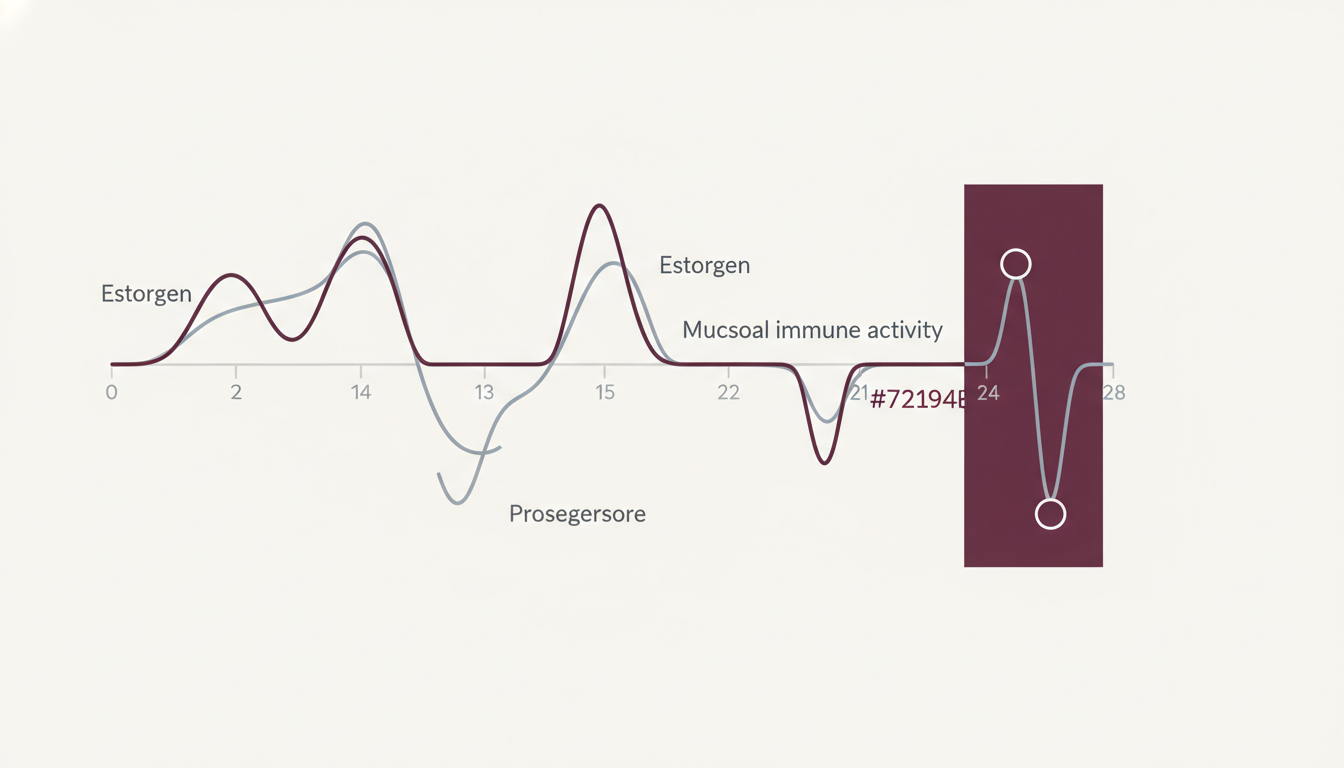
The week before your period is the late luteal phase, when estrogen and progesterone fall and mucosal immunity dips. PMS-related cortisol adds another immune dip. Latent HSV uses that opening to reactivate along the same nerve it used before, so flares cluster on the same week each cycle and recur in the same spot. Clinicians call it catamenial herpes.
If your herpes outbreaks land on the same week of every cycle, that pattern is not a coincidence. In the days before bleeding, estrogen and progesterone fall, mucosal immune surveillance dips, and PMS-related stress drives cortisol up. Latent herpes simplex virus recognizes that combination and reactivates along nerve roots it has used before, which is why outbreaks tend to repeat in the same anatomical spot. The pattern is consistent enough that clinicians have a name for it: catamenial herpes.
This explainer covers the biology behind cycle-linked flares, what a flare feels like, the other infections that can worsen around your period, how to tell herpes from the conditions that mimic it (yeast, BV, razor burn, contact dermatitis), what testing actually answers, and when to ask a clinician about suppression. This is editorial summary work and does not replace personal medical advice. For an active sore you have not seen before, see a clinician for a same-day swab.
Key Takeaways
- Cycle-linked outbreaks usually land in the late luteal week, when estrogen, progesterone, and mucosal immune activity all drop together. The same nerve root reactivates, so flares tend to repeat in the same spot.
- If you get six or more outbreaks a year, ask a clinician about daily suppressive antivirals or pre-period episodic dosing. Tracking your symptoms across two or three cycles gives them the data to time the prescription.
Catamenial herpes: when outbreaks track your cycle
Catamenial herpes is the term clinicians use for genital herpes flares that reliably coincide with menstruation. It is not a different infection, and it does not mean the virus has changed. It means the conditions that favor reactivation line up at roughly the same point in every cycle, so the same nerve pathway lights up at roughly the same time. Many people notice the pattern before any provider names it, which is part of why the term is worth knowing.
If your flares show up in the same anatomical spot one to three days before bleeding starts, with the same prodromal tingling or burning each time, that consistency points to your cycle as the trigger. The cause is physiological: it reflects your hormones and immune rhythm rather than anything you did.
Catamenial herpes is the clinical term for herpes outbreaks that reliably coincide with menstruation. The trigger is hormonal and immune-related, not behavioral. Many clinicians do not name the pattern explicitly, which is why patients often discover it themselves before their provider does.
Why your premenstrual week is a reactivation window
Your menstrual cycle has four working phases, and the late luteal phase (the five to seven days before bleeding starts) is the one that matters here. Estrogen and progesterone both fall during this window so the uterine lining can shed. The same hormone shift changes how the immune system behaves at mucosal surfaces like the vulva, vagina, and cervix.
Estrogen normally supports antibody production and helps maintain mucosal barrier integrity. When estrogen drops, those barriers thin and immune surveillance softens. The softening is brief and reversible, but herpes simplex virus has been waiting for exactly this kind of window. After the original infection, HSV retreats up the sensory nerve roots that serve the genital area and stays dormant in the dorsal root ganglia (the nerve cell clusters that run alongside the spinal cord). What you experience as an outbreak is the dormant virus traveling back down the same nerve to the same patch of skin or mucosa.
The World Health Organization lists menstrual periods alongside fever, illness, sun exposure, surgery, and emotional stress as known reactivation triggers (WHO HSV fact sheet). The NHS includes the menstrual cycle on its trigger list as well, and notes the trigger is unavoidable rather than something you can prevent through behavior change (NHS genital herpes).
So if your outbreaks recur in the same anatomical spot every cycle, it is because the same nerve root is reactivating, not because you have done anything new or wrong. Once your period starts and hormones begin to climb again, the immune environment recovers, and most outbreaks resolve within seven to ten days regardless of treatment.
What a cycle-linked flare feels like
Recurrent herpes flares are usually milder than a first-ever outbreak. They tend to open with a prodrome, a tingling, itching, or burning sensation in the spot where sores will appear, followed by a small cluster of blisters that break, crust, and heal over several days. When your period is the trigger, that prodrome usually shows up in the one to three days before bleeding begins, and the lesions follow shortly after.
The signs below are what people most often notice cycle to cycle. They are a starting point for recognizing the pattern, not a way to self-diagnose. If you have never had a confirmed HSV diagnosis, treat them as a prompt to test rather than a verdict.
Signs of a cycle-linked herpes flare
Having one or more does not confirm herpes; only a test can do that. The look-alike table further down covers what else these signs can mean.
- Tingling, itching, or burning near the genitals, inner thighs, or buttocks one to three days before bleeding Common
- Small clusters of red bumps or fluid-filled blisters that burst and crust over, usually in the same spot each cycle Common
- Increased skin sensitivity, especially when wiping or during sex Common
- Mild pelvic ache or deep discomfort that can be mistaken for cramps Less common
- Pain or stinging on urination if sores sit near the urethra Less common
PMS, cortisol, and the stress multiplier
Hormones are not the only thing changing in the days before bleeding. PMS often brings poor sleep, irritability, mood changes, and physical symptoms like cramps, bloating, and breast tenderness. Each of those is a low-grade physiological stressor, and the body responds to stress by raising cortisol.
Cortisol is useful in short bursts but suppresses certain immune functions when it stays elevated, including the cell-mediated activity that holds latent HSV in check. The combined picture in the late luteal week is therefore a hormone-driven dip in mucosal immunity stacked on top of a stress-driven dip in cellular immunity. HSV does not need much; a quiet window of a day or two is often enough for replication to start.
Sleep matters here too. Short or fragmented sleep raises cortisol the next day and reduces the natural-killer-cell activity that helps suppress viral reactivation. Many people sleep worse the week before their period because of cramps, hot flashes from progesterone withdrawal, or anxiety. Add a busy work week or a major life event, and the baseline dip becomes a deeper one.
Cortisol suppresses cell-mediated immunity, the immune branch that holds latent HSV in check. Poor sleep and PMS-related stress in the premenstrual week raise cortisol further, compounding the hormone-driven dip already underway. That is why two cycles can look identical hormonally and still produce very different outbreak patterns.
Why genital tissue is more vulnerable during bleeding
The mucosa lining the vulva, vagina, and cervix is already adapting to bleeding when an outbreak starts. Vaginal pH rises during menstruation because menstrual blood is mildly alkaline, which shifts the local microbiome and weakens the barrier function of the surface cells. Tampons, pads, and panty liners create friction. Wiping is more frequent. All of those mechanical and chemical changes can produce microabrasions on the same vulvar surface where reactivating HSV is heading.
HSV preferentially replicates in damaged or thin epithelium, which is one reason outbreaks often appear at the labial fold, the perineum, or the vestibule rather than uniformly distributed across the area. Some people experience internal symptoms like cervical sensitivity, painful intercourse, or unexplained pelvic discomfort during bleeding, which can reflect cervical reactivation that is not visible without a pelvic exam.
Practical adjustments for the bleeding week can shorten lesion healing and reduce the discomfort of an active flare:
- Switch to cotton underwear, softer pads, period underwear, or a menstrual cup or disc during outbreaks; reduce tampon use if friction is a problem.
- Skip waxing or shaving the genital area in the late luteal week to avoid microabrasions in the reactivation zone.
- Use plain water or salt water rather than perfumed wipes during bleeding; the NHS recommends plain or salt water for keeping outbreak skin clean (NHS).
- Cool compresses on the affected area can reduce swelling and give sensation relief during the worst day or two.
- A topical anesthetic such as lidocaine on intact skin can ease discomfort if your provider has cleared it.
- Avoid tight synthetic clothing during outbreaks; let the area breathe.
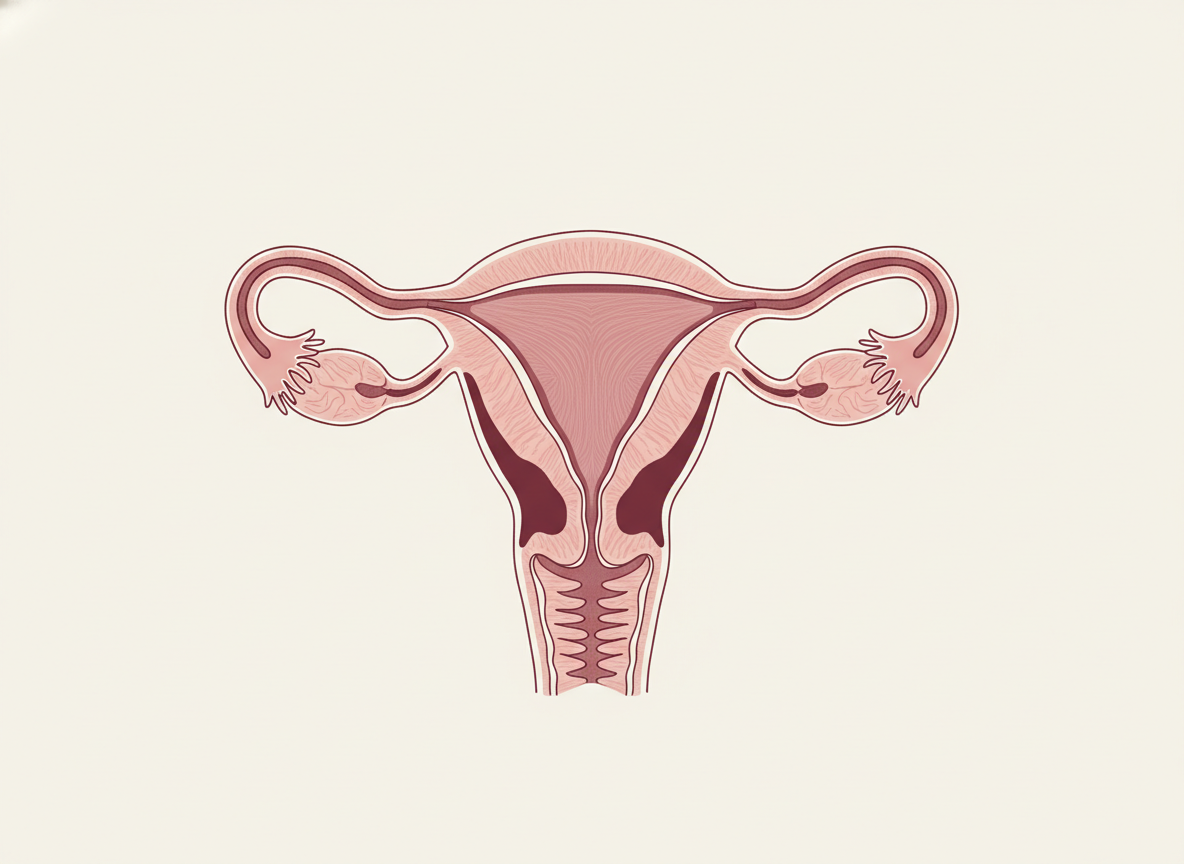
The mucosa illustrated here lines the vulva, vagina, and cervix. During menstruation, surface cells turn over more rapidly, pH rises, and friction from period products can produce microabrasions. HSV preferentially replicates in damaged or thin epithelium, which is why pre-period outbreaks tend to recur in the same anatomical spot rather than spreading widely. If you can map your last few outbreaks to one or two specific locations, that consistency is part of what makes a clinician confident the pattern is HSV rather than a generalized irritation.
Other infections that can flare around your period
Herpes is the best-studied period-related flare, but it is not the only infection that can feel worse around menstruation. Bacterial vaginosis, trichomoniasis, and chlamydia can all present more noticeable symptoms in the days before, during, or right after bleeding. The reason is mostly chemistry: menstrual blood shifts vaginal pH and the balance of bacteria that normally keep the area stable. Pads and tampons also trap warmth and moisture, which can amplify existing irritation.
The chart below summarizes what people often notice cycle by cycle. Symptoms vary widely, so use this as a starting point, not a diagnosis. If you have never had a formal HSV diagnosis and your premenstrual symptoms could fit any of these, the look-alike comparison further down covers how to distinguish them on visible signs alone.
| Infection | Why periods affect it | Symptom shift around bleeding |
|---|---|---|
| Herpes (HSV-1, HSV-2) | Hormonal drop, friction, immune dip | Tingling, sores, and pain become more noticeable |
| Chlamydia | Cervical inflammation is heightened | Spotting, pelvic ache, and pain on urination can worsen |
| Trichomoniasis | pH shifts amplify symptoms | Frothy discharge and itching often intensify |
| Bacterial vaginosis | Microbiome disruption fuels imbalance | Fishy odor and grey discharge spike before or after bleeding |
Daily suppression versus pre-period antiviral dosing
If your outbreaks are predictable enough to mark on a calendar, antivirals are the most useful tool you have. Three medications are standard: acyclovir, valacyclovir, and famciclovir. They all work by blocking viral DNA replication, and they all work best when they are already in your bloodstream as reactivation starts.
The CDC's STI Treatment Guidelines state that daily suppressive therapy reduces the frequency of genital herpes recurrences by 70 to 80 percent among people who have frequent recurrences, and daily valacyclovir also lowers the risk of passing HSV-2 to a partner who does not have it (CDC STI Treatment Guidelines, genital herpes). The NHS uses six or more outbreaks per year as the practical threshold for considering ongoing antiviral suppression, and notes such a course may run six to twelve months before review (NHS genital herpes).
Three approaches exist for cycle-linked outbreaks, and the right one depends on how predictable and how frequent your flares are. The table below summarizes the trade-offs. Each needs a clinician's prescription and a dose plan; none is a self-prescribed regimen. The CDC also notes that suppressive therapy is reviewed periodically, often yearly, because outbreak frequency tends to drop over time, so a year of daily antivirals does not commit you to forever.
| Approach | When it fits best | Daily commitment | Notes |
|---|---|---|---|
| Daily suppression | Six or more outbreaks per year, severe outbreaks, partner without HSV, or you want to stop tracking flares | One pill every day for months at a time | Reviewed periodically with a clinician; outbreak frequency often drops over time |
| Pre-period episodic dosing | Outbreaks reliably tied to menstruation, fewer than six per year overall | Pills for seven to ten days each cycle | Start three to five days before your expected period; clinician sets the exact window |
| At-onset episodic | Unpredictable outbreaks, mild and infrequent | Pills from first prodrome through resolution | Most effective when started within 24 hours of prodromal tingling or burning |
Telling herpes from the conditions that mimic it
Recurring discomfort in the same spot before your period does not automatically mean herpes. Several other conditions cluster around menstruation and produce similar symptoms. The table below summarizes how the patterns differ, but a clinician's exam is the only way to tell for sure when the pattern is new or unclear.
The combinations that most strongly suggest HSV are blistering or ulcerated lesions in the same anatomical spot every cycle, paired with prodrome (tingling, burning, or shooting nerve pain) one to two days before lesions appear. The combinations that point elsewhere are thick discharge with itching (yeast), a fishy odor (bacterial vaginosis), bumps that follow shaving (folliculitis), or a rash that responds to switching pads (contact dermatitis).
If you cannot tell, swab during the active phase rather than guessing. A clinician can take a viral PCR swab from a fresh lesion that gives a definitive answer in days. Treating an HSV outbreak as if it were a yeast infection wastes time and lets the lesions worsen; treating yeast as if it were HSV puts you on antivirals you do not need and misses the real problem.
| Condition | Timing relative to period | Visible signs | Other clues |
|---|---|---|---|
| Genital herpes (HSV) | One to three days before bleeding, same spot each cycle | Fluid-filled blisters that break and ulcerate | Tingling or burning prodrome before lesions appear |
| Yeast infection | Often peaks before period | No true ulcers; surface redness possible | Thick white discharge, intense itching, vulvar swelling |
| Bacterial vaginosis | Can flare around bleeding | No sores | Thin grey discharge, fishy odor, mild irritation |
| Contact dermatitis from pads or wipes | Tied to product exposure, not cycle phase | Red rash, no defined edges, no blisters | Resolves within days of switching products |
| Razor burn or folliculitis | Within days of shaving or waxing | Pustules or papules, often with central hair shaft | Follows the shave pattern, no recurring prodrome |
Testing options: lesion swab versus blood antibody
There are two ways to test for genital herpes, and they answer different questions. Picking the right one matters more for HSV than for many other STIs, because the wrong test at the wrong time produces confusing results. You do not have to wait for your period to end before testing; the relevant question is which test you use, and the cycle day matters less than picking the right one. (For transparency: this guide is published by stdrapidtestkits.com, which sells at-home STI kits. We point to the test that fits your concern rather than the most expensive one.)
Lesion swab (clinician-administered). A clinician swabs an active sore or blister and runs PCR on the sample. This is the most direct way to confirm an active herpes outbreak and to identify whether it is HSV-1 or HSV-2. It works best on a fresh lesion, ideally within the first 48 hours, and accuracy drops as the sore heals. If a sore appears in the days before your period, that is the right time to book a same-day or next-day clinic visit, even if your bleeding has started.
Blood antibody test (at-home or lab). A blood test detects antibodies your immune system has produced against HSV-1 or HSV-2. A positive result means you have been infected at some point and have seroconverted. A negative result means you have not, with one caveat: most people develop detectable antibodies within 12 weeks of a new exposure, though some individuals take longer to seroconvert, so very recent exposures can produce false negatives. Menstrual flow does not affect a fingerprick blood result, so an at-home herpes blood test can be run on any cycle day.
For the cycle-linked outbreak picture, blood antibody testing is most useful when:
- You have never had a confirmed diagnosis but you suspect HSV based on the recurring pre-period pattern.
- You want to confirm exposure before asking a clinician for suppressive antivirals.
- Your last potential exposure was at least 12 weeks ago, so the antibody window has opened for most people.
It is less useful when you have an active sore right now and need to know whether that specific lesion is HSV. For that case, a clinician-administered lesion swab is the right tool, even when a blood test is more convenient.
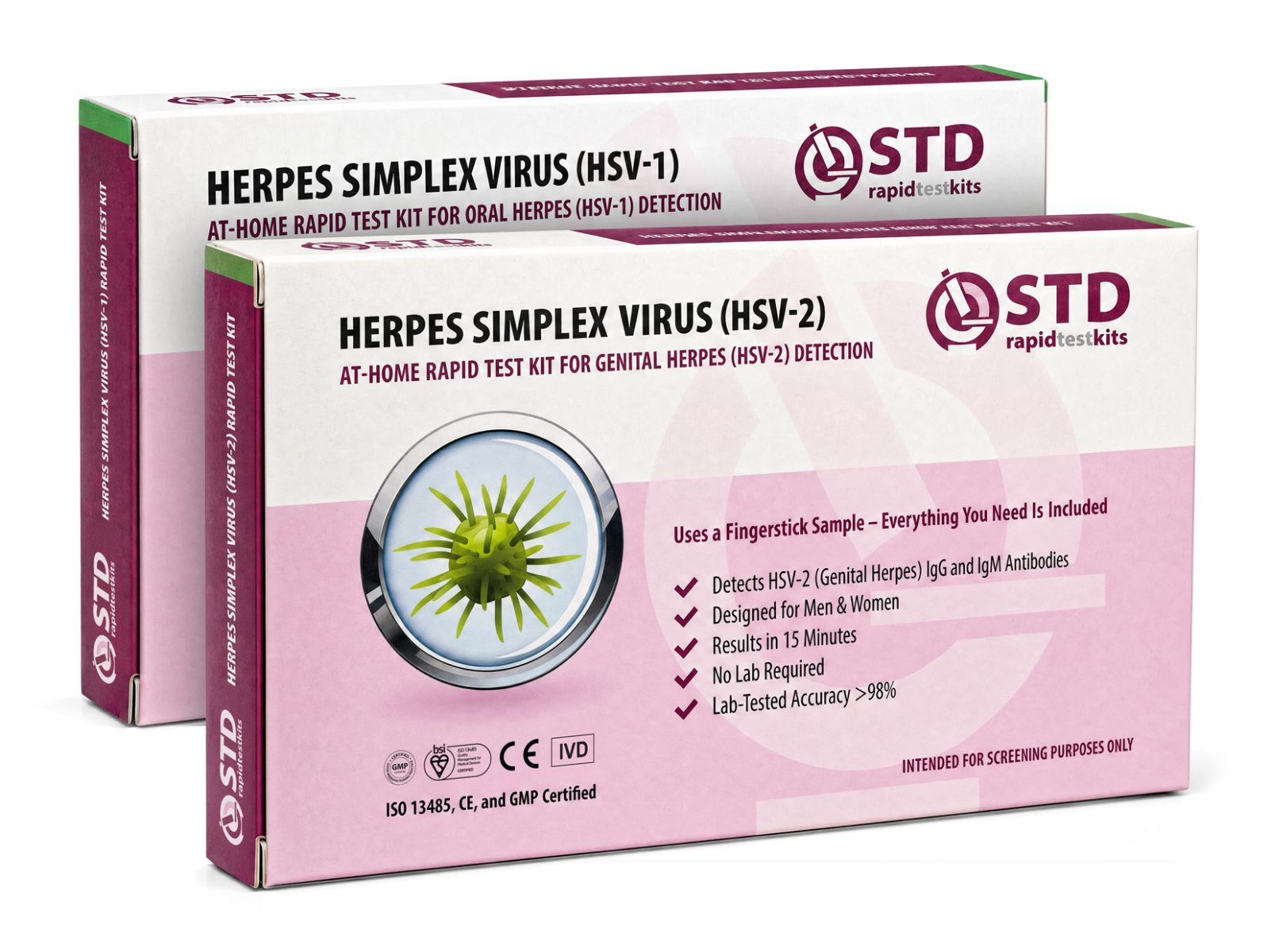
Our at-home herpes test is a fingerstick blood antibody test, not a lesion swab. It uses lateral-flow chemistry to detect antibodies to HSV-1 and HSV-2 in a small fingerprick blood sample. That is the right test for confirming past exposure and seroconversion, useful at least 12 weeks after a suspected new exposure for most people (some individuals take longer to seroconvert). It does not diagnose whether a specific sore is herpes; that requires a clinician-administered lesion swab with PCR. Many people use both: blood antibody to confirm HSV exposure at home, then a clinic swab during the next active outbreak if they want lesion-level confirmation. Lateral-flow rapid tests are a screening tool; a positive result is worth confirming with a lab antibody test or a clinician's evaluation.
Sex during a cycle-linked flare: what to consider
Active herpes sores shed more virus and raise the risk of passing HSV to a partner. The bleeding itself does not raise transmission risk; the active sore does, because shedding is higher during an outbreak. Friction during sex while you are flaring can also slow your own healing. Standard public-health guidance is to avoid sexual contact from the first prodromal symptom until lesions are fully healed and skin has returned to normal.
You do not need a complicated explanation if you would rather not have sex during a flare. A short sentence works: "I'm having some irritation right now and I'd rather wait a few days until it settles." If your partner does not yet know you have herpes and you are not ready to disclose, that is your call. The boundary stands either way.
If you choose to have sex during a flare, condoms reduce transmission risk because they cover some of the skin where the virus may be present. They do not eliminate the risk entirely, since HSV can shed from skin outside the condom's coverage. Suppressive antiviral therapy reduces shedding and lowers transmission risk further. The two approaches stack: using both is more protective than either alone. Your provider can help you decide which combination fits your situation, including how often you flare and whether your partner already has HSV.
Suppressive therapy reduces frequency of genital herpes recurrences by 70%–80% among patients who have frequent recurrences.
Living with the pattern
HSV-2 affects roughly 13 percent of people aged 15 to 49 worldwide, around 520 million people, and HSV-1 reaches an estimated 64 percent of the under-50 population, around 3.8 billion people, much of it acquired in childhood and never causing a single visible sore (WHO HSV fact sheet). Recurrences also tend to become less frequent over time, especially after the first year of infection (MedlinePlus). Cycle-linked outbreaks are common because two of the conditions HSV favors, lower hormones and higher cortisol, line up with a menstrual phase that returns every month.
These flares occur in long-term monogamous partnerships and during celibate stretches alike, because the trigger is internal hormonal change rather than current sexual exposure. The pattern you are tracking is a measurable physiological response that has nothing to do with your behavior or your relationship.
Knowing the pattern also supports better partner conversations. People who know their HSV status can plan around it: avoid genital contact during prodrome and visible outbreaks, use antivirals to reduce shedding, and talk with new partners before sex rather than after a flare.
Practical steps to take this cycle
- Track cycle and flare dates in the same app to find your personal prodrome gap across two or three cycles.
- Keep episodic antiviral medication on hand so you can start at the first tingle, not after a sore appears.
- Bring two or three cycles of data to your next clinic visit when you want to discuss pre-period or daily suppression.
When to see a clinician this cycle
Most cycle-linked outbreaks are uncomfortable but not dangerous. A clinic visit is worth scheduling when:
- You have a sore in the genital area you have never had before, especially if it has appeared rapidly or with pain you do not recognize.
- Outbreaks are happening more than six times a year, or are getting longer, more painful, or harder to predict.
- You are pregnant or planning a pregnancy and have a known HSV diagnosis; the NHS recommends a clinical assessment because antiviral treatment may be offered from week 32 onward to reduce risk to the baby (NHS).
- You have a fever, swollen lymph nodes, body aches, or pelvic pain that does not match a typical outbreak; a primary (first-ever) outbreak can present with these systemic symptoms and is worth confirming with a same-day swab.
- You want to start suppressive or pre-period antivirals and need a prescription with a dose plan.
What to do this cycle
Do you have a genital sore you have not seen before, or one with fever or swollen glands?
Yes: Book a same-day or next-day clinic visit for a PCR lesion swab. A fresh lesion gives the most accurate result, so do not wait for your period to end.
Have you never had a confirmed HSV diagnosis but suspect the pre-period pattern is herpes?
Yes: Run an at-home HSV blood antibody test at least 12 weeks after any suspected exposure to confirm seroconversion, then take the result to a clinician.
Are you getting six or more outbreaks a year, or do flares reliably track your cycle?
Yes: Bring two or three cycles of tracking data to a clinician and ask about daily suppressive or pre-period antivirals.
No: Keep tracking your cycle and flares, and keep episodic antivirals on hand to start at the first tingle.
Guidance only; a clinician can advise based on your specific situation.
FAQs
- Can my period trigger a herpes outbreak?
- Yes. Clinicians call this pattern catamenial herpes. The hormone drop in the late luteal phase lowers mucosal immunity at the same time PMS-related cortisol rises, and HSV uses that window to reactivate. If the gap between your period starting and your first prodromal symptom is consistent across two or three cycles, that pattern is what most clinicians use as evidence before discussing pre-period dosing.
- How many days before my period do outbreaks usually start?
- Most people who get cycle-linked outbreaks notice prodromal symptoms (tingling, burning, sensitivity) one to three days before bleeding starts, with visible lesions appearing shortly after. Tracking two or three cycles is the easiest way to find your personal pattern. Log the first day of bleeding plus the first day of symptoms, and the gap will become clear.
- Are daily suppressive antivirals different from pre-period dosing?
- The difference is the schedule. Daily suppression runs continuously every day; pre-period dosing runs for roughly seven to ten days each cycle, timed to your luteal phase. Predictable cycle-linked flares point to timed dosing; scattered or unpredictable flares are usually better covered by daily suppression.
- Is it safe to have sex on my period if I'm flaring?
- A flare during your period is no more harmful to you than a flare at any other time. The concern is your partner: active sores shed more virus, raising the chance of transmission. Most clinicians advise abstaining from genital contact from the first prodromal symptom until lesions are fully healed. If you do have sex during a flare, condoms reduce risk and suppressive antivirals reduce shedding; using both is more protective than either alone.
- Should I avoid tampons during a herpes outbreak?
- Most clinicians suggest switching to pads, period underwear, or a menstrual cup or disc during an active outbreak. Tampons can apply friction to internal lesions and slow healing. Pads or period underwear with cotton liners and frequent changes reduce mechanical irritation during the bleeding week.
- Can hormonal birth control make herpes flares worse?
- It can in some people. Hormonal birth control changes your baseline estrogen and progesterone levels, which can subtly shift how often the virus reactivates. Research on this question is mixed and the effect varies by person and by the specific contraceptive method. If your flare frequency changed noticeably after starting or switching a method, that is worth raising with your provider.
- How accurate are home blood antibody tests for herpes?
- Sensitivity depends on timing more than on the test itself. Most people develop detectable HSV-1 or HSV-2 antibodies within 12 weeks of a new exposure; a rapid lateral-flow kit run before that window can read negative even when infection is present. Past 12 weeks, a validated kit is reliable for screening. One thing it cannot do at any point: confirm whether a sore you have today is herpes. That answer comes from a clinician-administered PCR swab of the active lesion.
- How long does a cycle-linked herpes flare usually last?
- Most recurrent flares clear within about seven to ten days, from the first prodrome to fully healed skin, and they are usually milder than a first episode. A first-ever (primary) outbreak can last two to three weeks and may come with fever or swollen glands. Antiviral medication started at the first tingle can shorten a recurrence by a day or two, which matters when the flare overlaps with your period.
- What should I track if I suspect my outbreaks are cycle-linked?
- Track three things across two or three cycles: the first day of your period, the first day of any prodromal symptoms (tingling, burning, sensitivity), and visible lesion onset. Note also stress, sleep, illness, and travel. A clinician can use that log to time pre-period antivirals or recommend daily suppression based on the actual pattern.
- World Health Organization. Herpes simplex virus fact sheet. Global prevalence figures (HSV-1 affects roughly 64 percent of under-50s, around 3.8 billion people; HSV-2 affects roughly 13 percent of 15 to 49 year olds, around 520 million people) and reactivation triggers including menstrual periods, fever, illness, sun exposure, surgery, and emotional stress.
- U.S. Centers for Disease Control and Prevention. Genital herpes patient information. Recurrence patterns (repeat outbreaks usually shorter and less severe than the first), symptom duration, and overview of treatment options.
- U.S. Centers for Disease Control and Prevention. STI Treatment Guidelines, genital herpes. Suppressive antiviral therapy reduces recurrences by 70 to 80 percent in people with frequent recurrences; standard dosing for acyclovir, valacyclovir, and famciclovir; daily valacyclovir reduces HSV-2 transmission risk.
- UK National Health Service. Genital herpes patient information. Menstrual cycle listed among unavoidable reactivation triggers; six or more annual outbreaks as the threshold for a six-to-twelve-month antiviral course; plain or salt water for keeping outbreak skin clean; antiviral treatment from week 32 of pregnancy.
- U.S. Centers for Disease Control and Prevention. Bacterial vaginosis overview for patients, including symptom presentation (thin grey discharge, fishy odor) and treatment guidance.
- MedlinePlus, U.S. National Library of Medicine. Genital herpes overview for patients. Recurrence pattern (more frequent in the first year, declining over time) and symptom progression.
