Published: November 2025 | Last updated: April 2026 | Editorial review and quality control: Martina N.
Gonorrhea in men can feel like almost anything except an STI. A sting after a strong coffee. A bit of friction after a long ride. The kind of vague soreness you blame on a new pair of jeans, a roommate's laundry detergent, or just a long week. By the time the symptoms get loud enough to worry about, the bacteria has often been multiplying for a week or longer, and you may have already passed it to a partner who is also still feeling fine.
This guide walks through the nine most common signs of gonorrhea in men, including the awkward sites (throat, rectum, eyes, joints) that most checklists skip. The CDC describes gonorrhea as very common in the United States, especially among young people ages 15 to 24 (CDC fact sheet on gonorrhea). Most of those cases never started with a textbook symptom. They started, if anything, with the kind of small body weirdness that sits at the bottom of the worry list.
The good news: every infection on this page is curable with a single course of antibiotics, and at-home testing has shrunk the gap between thinking about getting checked and having a result in hand. The less-good news: every day you wait makes both the medical and the relational consequences a little harder to clean up.
What does gonorrhea look like in men?
Most urethral gonorrhea infections in men cause symptoms within 2 to 7 days: burning during urination, a yellow, green, or white penile discharge, and sometimes one-sided testicle pain. Throat and rectal infections are usually silent. The CDC recommends testing based on exposure, not just symptoms, because you can carry and pass gonorrhea while feeling completely fine (<a href="https://www.cdc.gov/std/treatment-guidelines/gonorrhea-adults.htm" target="_blank" rel="noopener">CDC STI treatment guidelines</a>).
Key takeaways
- Gonorrhea symptoms in men usually appear 2 to 7 days after exposure, but rectal and throat infections are commonly silent.
- Untreated gonorrhea can cause epididymitis, fertility damage, and a higher chance of catching or passing HIV, so testing after a new exposure matters even when you feel fine.
Why Gonorrhea Hides So Easily in Men
Two things make gonorrhea harder to catch in time. First, the early symptoms mimic everyday irritations: dehydration burn, post-shower itch, soreness from a workout, the kind of crusting you might blame on poor sleep or a new soap. Second, gonorrhea infects more than the urethra. The same bacterium (Neisseria gonorrhoeae) sets up shop in the throat after oral sex, in the rectum after receptive anal sex, and very rarely in the eyes when infected fluids reach mucous membranes. Throat and rectal infections seldom announce themselves with discharge or pain, which is why the CDC's screening guidance is exposure-based, not symptom-based (CDC STI treatment guidelines).
The CDC notes that gonorrhea frequently produces no symptoms, particularly at pharyngeal and rectal sites. The Cleveland Clinic's overview frames the practical implication clearly: anyone with a recent exposure should be tested even when nothing feels wrong (Cleveland Clinic on gonorrhea). Either way, feeling fine is not a substitute for getting tested after a new or unprotected exposure.
Urethral gonorrhea in men usually announces itself with burning and discharge within 2 to 7 days. Throat and rectal infections, by contrast, are silent in the majority of cases. Exposure history matters more than symptom status. If you have had a new or unprotected contact, test regardless of how you feel.
1. Burning When You Urinate (Urethritis)
The classic first sign of gonorrhea in men is burning, stinging, or scalding during the first second or two of urination. Major clinical references describe this dysuria as one of the earliest indicators of gonococcal urethritis, the inflammation of the urethral lining. Some men describe the sensation as deep in the shaft rather than at the tip, and many notice it pause them mid-stream the first few times.
It is also the most commonly misread symptom. Plenty of men chalk it up to dehydration, an energy drink, sex without enough lubrication, or a brand-new soap. The tells that point toward gonorrhea rather than dehydration: the burn shows up suddenly, lasts more than a day, often arrives within a week or two of a new sexual contact, and frequently comes with even a small amount of penile discharge. Burning plus any new discharge is gonorrhea or chlamydia until proven otherwise.
Drinking more water, switching soaps, or waiting it out will not fix it. Antibiotics will, and only after a positive test confirms what you are actually treating.
UTIs are uncommon in young men with no urinary tract abnormalities. If you are under 50, sexually active, and developed sudden burning during urination, an STI is statistically the more likely cause than a UTI. Test before assuming dehydration, soap, or friction.
2. Yellow, Green, or White Penile Discharge
Discharge from the penis is the second most common symptom of urethral gonorrhea, and the one most men describe to a doctor. The color ranges from cloudy white to bright yellow to greenish; the texture from thin and watery to thick and pus-like. It often appears in the morning, before urination, or after physical activity. Some guys notice only a small crust at the tip of the penis on waking, which is why the slang "morning drip" caught on in clinic forums.
Discharge is your urethra trying to flush an infection it cannot clear on its own. Even one episode of unexplained discharge, even if it disappears the next day, is worth a test. In mild or early infections, discharge may appear once and then vanish for days, which is exactly the kind of pattern that lulls people into ignoring it.
| Discharge appearance | What it often signals | Likely STI link |
|---|---|---|
| Clear or cloudy | Mild urethral inflammation, possibly an early infection | Chlamydia or gonorrhea |
| Yellow or green | Heavier bacterial inflammation of the urethra | Gonorrhea (often with chlamydia) |
| Pink or blood-tinged | Irritation deep in the urethra or prostate | Get tested promptly; do not assume the cause |
3. Testicle Pain or Swelling on One Side
If one testicle starts to ache, feel heavier, or look swollen without any obvious injury, gonorrhea may have spread to the epididymis, the coiled tube behind each testicle that stores and matures sperm. The resulting condition (epididymitis) is one of the most painful complications of male gonorrhea, and it is most often one-sided.
The discomfort can feel like a dull drag when you walk, a sharp pinch when you sit, or a heat behind the scrotum that no ice pack settles. NHS guidance lists testicular pain and swelling as a recognized gonorrhea symptom and a reason to seek same-day care (NHS on gonorrhoea symptoms). Untreated, the inflammation can scar the tubes that move sperm and reduce fertility, sometimes permanently.
One-sided testicular pain plus a recent unprotected sexual contact deserves a clinical look the same day, both to confirm gonorrhea and to rule out testicular torsion, which is a surgical emergency.
Sudden severe one-sided testicle pain, especially with nausea or vomiting, can be testicular torsion (a twisted spermatic cord that cuts off blood flow). Torsion needs surgery within roughly six hours to save the testicle. Do not wait this out and do not try a home test first. Get to an emergency department.
4. Anal Pain, Itching, or Mucous Discharge
Receptive anal sex is the route by which gonorrhea reaches the rectum, and most rectal infections produce no clear symptom at all. When they do, they read like hemorrhoids: itching inside the anus, faint mucous on toilet paper, a feeling of fullness, occasional pain during bowel movements, or small streaks of blood. Many men spend weeks treating "hemorrhoids" before a partner's positive result prompts a swab.
Standard urine tests do not catch rectal gonorrhea. The right test is a rectal swab, which most sexual health clinics will perform if you ask, and which is part of standard CDC screening guidance for men who have receptive anal sex. Our at-home rapid kits use a urethral self-swab and are not validated for rectal screening; if you have had receptive anal exposure and any of these symptoms, a clinic visit is the right call.
If your exposure was oral sex or receptive anal sex, our at-home rapid kits will not catch it. The right tests are throat and rectal swabs, collected at a sexual health clinic, urgent care, or your primary care provider. One visit can cover all three sample sites at once.
5. A Sore Throat That Will Not Quit
Pharyngeal gonorrhea, the throat version, can develop after performing oral sex on someone with the infection. The CDC notes that pharyngeal infections are usually asymptomatic, but when symptoms do appear they look like a low-grade sore throat, scratchiness, or mild swelling of the lymph nodes in the neck (CDC STI treatment guidelines).
The pattern that distinguishes throat gonorrhea from a virus is straightforward: the soreness lingers without the usual cold script, with no runny nose, no fever spike, and no rapid improvement after a few days. A common antibiotic for strep throat can mask, but not clear, a gonorrhea pharyngeal infection. The only reliable test is a throat swab, which urgent care clinics and sexual health clinics can run; it is not part of standard at-home rapid kits, and our kits do not cover it.
Many urgent care clinics will not test the throat unless you ask. If you had oral sex in the past two to four weeks and have a lingering sore throat, request a pharyngeal gonorrhea swab when you go in. A negative urine test does not rule out a throat infection.
6. Red, Burning, Sticky Eyes (Gonococcal Conjunctivitis)
Adult eye gonorrhea is rare, but it is real. It happens when infected genital fluid reaches the eye, usually by hand contact during or after sex without washing in between. The eye becomes red, the lids stick together with thick yellow discharge, and the sensation tends to be burning rather than itchy, which is one of the cleaner clues that this is not a typical pink eye.
Untreated, gonococcal conjunctivitis can scar the cornea and damage vision; published case reports describe permanent visual loss when treatment is delayed by even a few days. If one eye suddenly turns red and produces pus and you have no obvious allergen or trauma, mention any recent sexual contact to whoever sees you.
7. Blood in Semen or Painful Ejaculation
This one panics people, and reasonably so. Pink-tinged or rust-colored semen, or a sharp pain at the moment of ejaculation, can happen when gonorrhea has spread upstream from the urethra into the prostate or seminal vesicles. The inflammation of those tissues can cause tiny amounts of blood to leak into the semen and produce a stinging or burning sensation during climax.
Most causes of blood in semen are not cancer (the medical term is hematospermia, and many cases resolve on their own), but new or repeated episodes deserve a same-week clinical visit and a full STI panel. After confirmed treatment for gonorrhea, the bleeding usually settles within days. Persistent or recurrent symptoms warrant follow-up with a urologist to rule out prostate or seminal-vesicle issues unrelated to infection.
In men under 40, hematospermia is most often caused by inflammation or minor trauma rather than cancer. Get tested for gonorrhea and chlamydia first, treat what you find, and follow up with a urologist if the bleeding persists past a course of antibiotics.
8. Joint Pain or Flu-Like Aches (DGI)
Disseminated gonococcal infection (DGI) is what happens when gonorrhea bacteria escape into the bloodstream. It is uncommon but serious. Early signs include sudden joint pain (especially knees, wrists, or ankles), low-grade fever, and small red or purple skin spots on the limbs. Some men have no genital symptoms at all and present with what looks like reactive arthritis or even an autoimmune flare; clinicians have described patients misdiagnosed for weeks before a sexual-health panel was ordered.
If you have had a new sexual contact in the past 2 to 4 weeks and develop unexplained joint swelling or skin lesions, ask the clinician treating you to consider DGI on the differential. Treatment is intravenous antibiotics for several days, sometimes followed by a longer oral course, and recovery is usually complete when caught early.
Suspected disseminated gonococcal infection is a hospital workup, not a home swab decision. If you have new joint swelling, fever, or red or purple spots on the limbs along with a sexual exposure in the last 2 to 4 weeks, get to urgent care the same day and tell the clinician about the exposure.
9. Nothing at All, and Still Contagious
The most dangerous sign of gonorrhea in men is no sign at all. The CDC's treatment guidelines note that the majority of pharyngeal infections are asymptomatic, and rectal infections often behave similarly (CDC STI treatment guidelines). The Cleveland Clinic adds that gonorrhea often does not cause symptoms, which makes it easy to pass on without knowing (Cleveland Clinic on gonorrhea). Carriers feel fine, look fine, and pass the bacteria to every partner during the infectious window.
This is why both the CDC and WHO frame screening as exposure-based rather than symptom-based: if you have had a new partner, condomless sex, or a partner who tested positive for any STI, get tested even if nothing feels off. Routine screening is also recommended for sexually active men who have sex with men at every site of exposure, typically every 3 to 6 months.
This article is published by stdrapidtestkits.com, which sells at-home STI testing kits. We recommend products based on fit-for-purpose for the reader's concern, not commercial benefit. Where the right test is something we do not sell (throat swab, rectal swab, lab NAAT urine), we say so plainly.
Gonorrhea Symptom Timeline by Infection Site
Where the infection lives changes both how soon symptoms appear and whether they show at all. The CDC's clinical guidance treats each anatomical site as its own diagnostic question, with its own swab, its own incubation window, and its own asymptomatic rate (CDC STI treatment guidelines).
| Infection site | Typical onset | How often symptomatic | Test that catches it |
|---|---|---|---|
| Urethra (penis) | 2 to 7 days after exposure | Most men do develop symptoms | Urethral swab or first-catch urine NAAT |
| Throat (pharynx) | Variable; often unnoticed | Usually silent | Throat swab (clinic only) |
| Rectum | 1 to 2 weeks if any symptoms appear | Usually silent or mild | Rectal swab (clinic only) |
| Bloodstream (DGI) | 1 to 4 weeks after exposure | Joints, fever, skin spots | Blood culture and synovial fluid (hospital) |
What Happens If You Wait Too Long
Gonorrhea does not clear on its own. Untreated, the infection moves from the urethra to deeper male reproductive structures, with consequences that compound the longer it sits.
Epididymitis. Painful inflammation of the tube behind the testicle, with potential scarring of the sperm duct and reduced fertility. Cases can require weeks of antibiotics; severe ones occasionally need surgery.
Prostatitis. Inflammation of the prostate gland, which can cause chronic pelvic pain, painful ejaculation, urinary urgency, and difficulty fully emptying the bladder.
Disseminated gonococcal infection. Bloodstream spread leading to joint, skin, and (rarely) heart involvement. Hospital-grade IV antibiotics are usually needed.
Higher chance of acquiring or transmitting HIV. Active gonorrhea inflames genital and rectal tissue and recruits immune cells to the surface, which lowers the mucosal barrier that normally limits HIV entry. The CDC and WHO both reference an elevated HIV acquisition risk during untreated bacterial STI infection, and successfully treating gonorrhea reduces that elevated risk (WHO STI fact sheet).
Antibiotic-resistant gonorrhea (sometimes called "super gonorrhea") is also rising, which the WHO has flagged as a global priority threat. Strains that shrug off the older oral antibiotics make early diagnosis and the correct injection regimen more important than they were a decade ago.
None of this is intended to alarm. The point is to flatten the false reassurance that "if it were really bad, I would feel something". You very often will not.
Complications worth knowing
- Epididymitis (painful testicle inflammation that can scar sperm ducts and reduce fertility)
- Prostatitis (chronic pelvic pain, painful ejaculation, difficulty emptying the bladder)
- Disseminated gonococcal infection (bloodstream spread to joints, skin, rarely heart)
- Higher chance of acquiring or transmitting HIV through inflamed mucosal tissue
Testing for Gonorrhea: What We Sell, What Needs a Clinic
Where to test depends on where you may have been exposed.
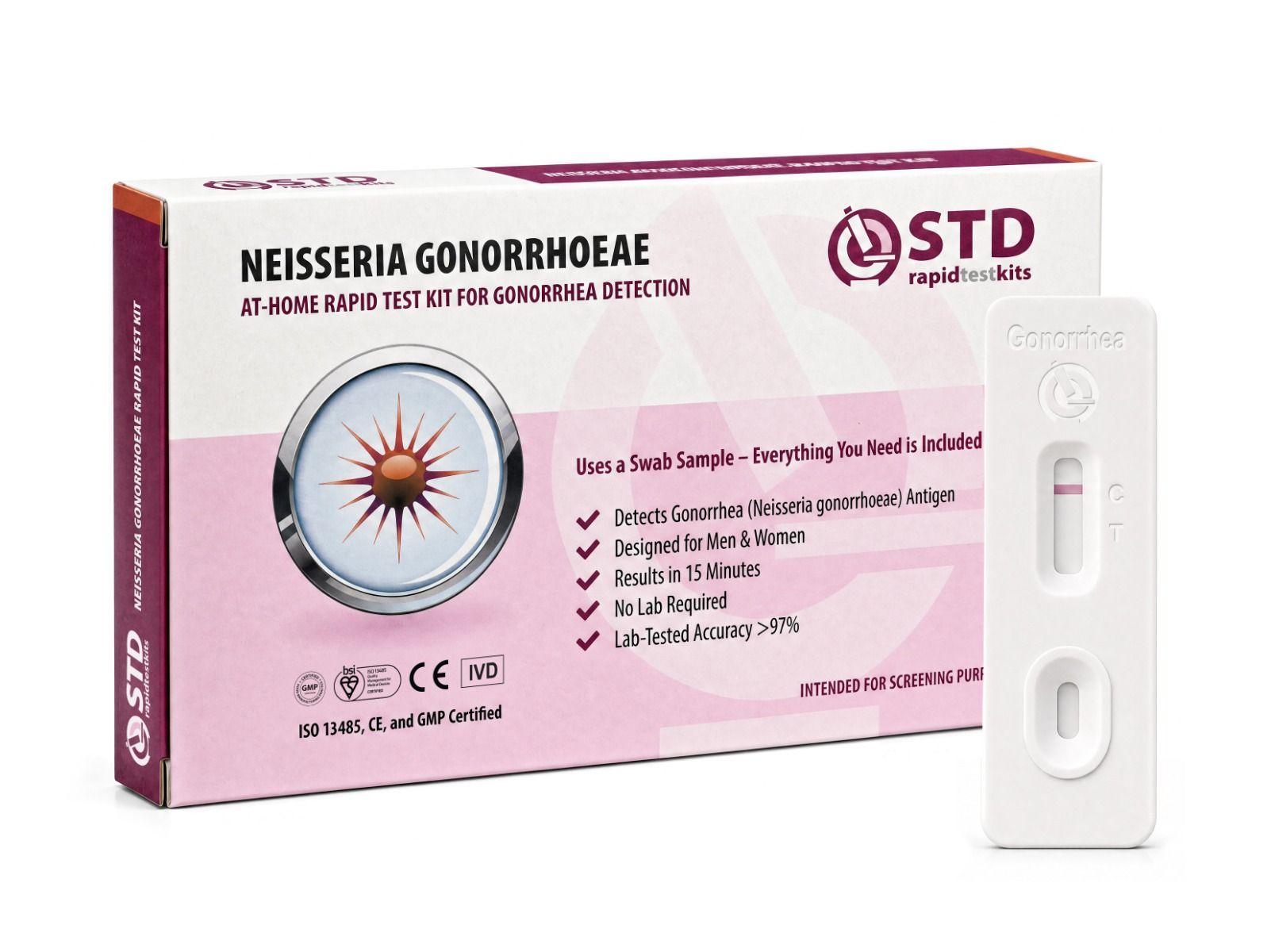
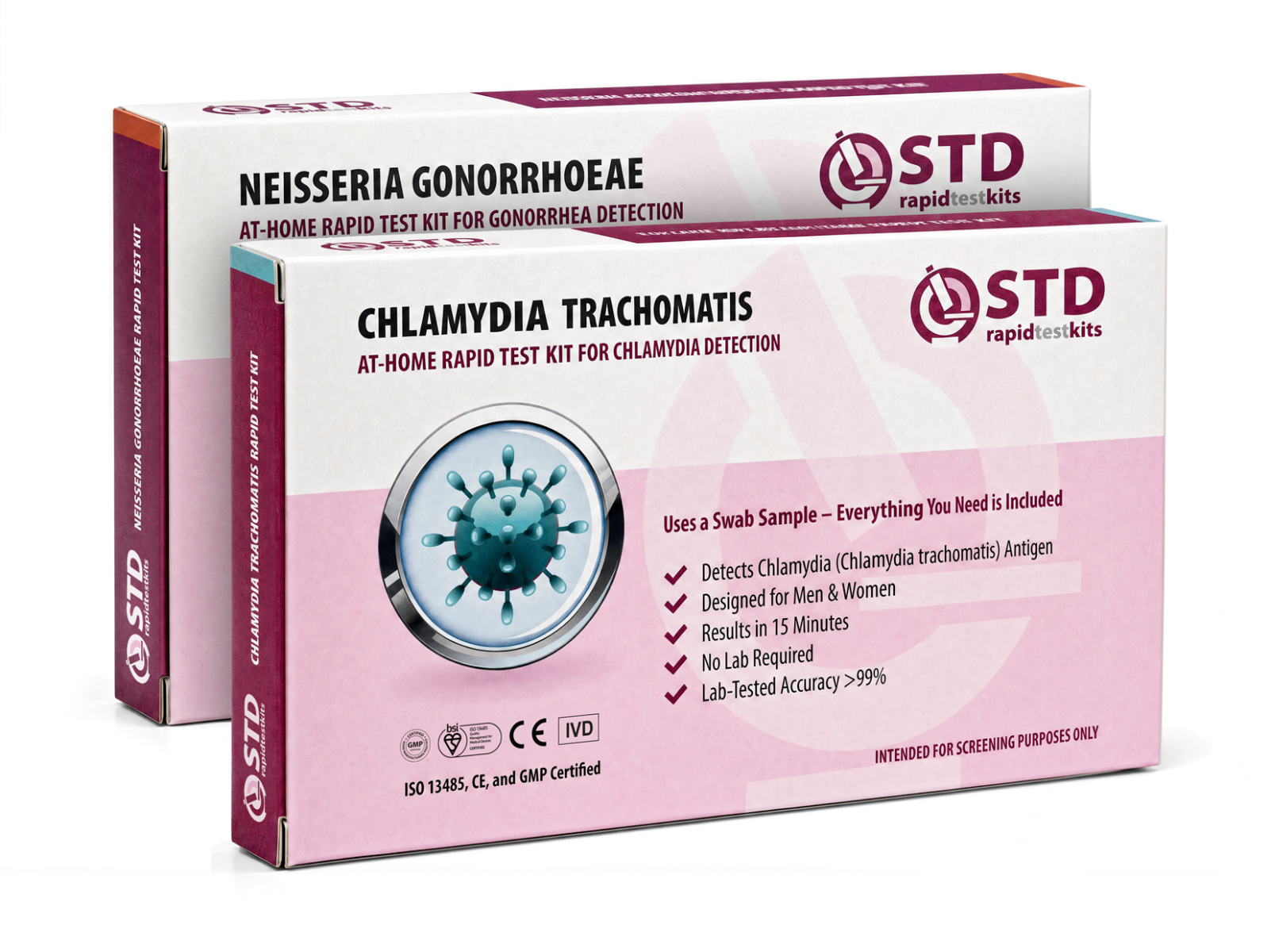
Genital (penile) exposure. Our at-home rapid swab kits use a urethral self-swab and detect gonorrhea infection at the genital site. The chemistry is a lateral-flow immunoassay, which gives a screening-grade result in about 15 minutes. A positive result is worth confirming with a lab nucleic acid amplification test (NAAT) through a clinic, since NAAT is the laboratory gold standard the CDC recommends. The two technologies are complementary: lateral-flow trades some analytical sensitivity for speed, privacy, and cost; NAAT is more sensitive but slower and clinic-based.
Throat or rectal exposure. Our home kits are not validated for throat or rectal swabs. If you had unprotected oral sex or receptive anal sex, the right test is a throat or rectal swab at a sexual health clinic, urgent care, or your primary care provider. Many sexual health clinics will collect all three sites in one visit, which is the most efficient way to clear an exposure window if you have had multiple kinds of contact.
Bloodborne signs (joint pain, fever, skin lesions). Suspected DGI is a hospital workup, not a home swab decision. Get to urgent care the same day if you have these signs along with a recent sexual exposure.
When to test relative to exposure. For symptomatic urethral cases, testing 2 to 7 days after exposure is reliable. For asymptomatic screening, testing roughly 1 to 2 weeks post-exposure is a sensible window for gonorrhea; if you test earlier and get a negative result during ongoing symptoms or known partner positivity, retest at the 14-day mark.
Whichever route you take, the CDC's current first-line treatment for uncomplicated gonococcal infection is a single 500 mg intramuscular injection of ceftriaxone, sometimes paired with oral doxycycline for chlamydia coverage. That means you will need a clinic for the actual treatment regardless of where you tested (CDC STI treatment guidelines).
The majority of gonococcal infections of the pharynx are asymptomatic.
Frequently asked questions
- Can a man have gonorrhea and feel completely fine?
- For urethral gonorrhea, most men do develop symptoms (typically burning and discharge within 2 to 7 days), which is what drives most of them to seek care. The asymptomatic burden is substantially higher for throat and rectal infections, where many carriers feel nothing at all. Either way, if you have had a new or unprotected exposure, the CDC guidance is to test rather than wait for a symptom.
- How soon do gonorrhea symptoms appear in men?
- When symptoms do appear, they typically show up 2 to 7 days after exposure for urethral infections. Throat and rectal infections, when symptomatic at all, can take longer or never produce a clear sign, which is why the screening recommendation is exposure-based rather than wait-for-symptoms.
- What does gonorrhea discharge look like?
- Penile discharge from gonorrhea ranges from cloudy white to bright yellow to green. It can be thin and watery or thick and pus-like, and it often shows up in the morning or after physical activity. Even one episode of new, unexplained discharge is worth a test.
- Will it go away on its own if I wait?
- No, gonorrhea does not self-resolve. The infection persists, can move to the testicles, prostate, joints, or bloodstream, and remains contagious throughout. Antibiotic treatment (a 500 mg ceftriaxone injection per current CDC guidance) is the only reliable cure.
- Can I test for gonorrhea at home?
- Yes for genital infection. Our at-home rapid lateral-flow kits use a self-swab and give a screening result in about 15 minutes. They are validated for the genital sample only, so throat or rectal exposure needs a clinic-collected swab.
- Are home rapid tests as accurate as a lab NAAT?
- Not quite. NAAT, the lab standard the CDC recommends, is more analytically sensitive than at-home lateral-flow chemistry. The at-home rapid format trades some sensitivity for speed, privacy, and cost. A positive home result is worth confirming with a lab NAAT, and a negative result during a high-risk window is worth retesting.
- Does using a condom mean I cannot get gonorrhea?
- Condoms substantially reduce transmission risk for vaginal and anal intercourse, but they are not perfect, and they do not fully cover oral transmission. Test after a new exposure even if you used a condom every time.
- What should I do if my partner tested positive but I have no symptoms?
- Get tested anyway, and abstain from sex until you have a result and (if positive) have completed treatment. The CDC recommends partner notification and treatment because reinfection through an untreated partner is one of the most common reasons gonorrhea recurs.
- U.S. Centers for Disease Control and Prevention. About gonorrhea: incidence, transmission, and core symptom information for the U.S. population, particularly among young people ages 15 to 24.
- U.S. Centers for Disease Control and Prevention. STI treatment guidelines for gonococcal infections in adolescents and adults, including the current 500 mg ceftriaxone first-line regimen, exposure-based screening guidance, and the verbatim 'majority of gonococcal infections of the pharynx are asymptomatic' language used in the article's pull quote.
- UK National Health Service. Gonorrhoea symptoms in men, including urethral, rectal, throat, and eye presentations and when to seek same-day care.
- Cleveland Clinic. Gonorrhea overview: that gonorrhea often does not cause symptoms, complications including epididymitis and prostatitis, and reinfection risk.
- World Health Organization. Sexually transmitted infections fact sheet, including current antimicrobial resistance trends in gonorrhea, global incidence, and elevated HIV acquisition risk during active bacterial STI.
