Published: August 2025 | Last updated: May 2026 | Editorial review and quality control: Martina N.
What herpes test do I actually need?
For routine status, a type-specific IgG blood test shows whether you carry HSV-1, HSV-2, or both. For an active sore, a PCR swab is more accurate. Standard STI panels skip both, so request herpes testing or use an at-home antibody kit. Recurrent cold sores, a new partner, or a planned pregnancy are all reasons to test.
Cold sores are herpes. That single sentence catches a lot of people off guard, because most of us grew up calling the blistering on a lip a "cold sore" and the thing your doctor warns you about a "herpes infection," as if they were unrelated. They are the same viral family. Herpes simplex virus type 1, abbreviated HSV-1, is the most common cause of cold sores, and the World Health Organization estimates roughly 3.8 billion people under age 50 carry it worldwide (WHO herpes simplex virus fact sheet). In the United States, NHANES data published by the CDC's National Center for Health Statistics put HSV-1 seroprevalence at about 47.8% in adults aged 14 to 49, and most of those people have never been told (CDC NCHS Data Brief No. 304, NHANES 2015 to 2016).
The next surprise is that a standard STI panel almost never includes herpes. So the people who would most benefit from clarity, anyone with recurring cold sores, anyone starting a new relationship, anyone planning a pregnancy, anyone living with infants or immunocompromised relatives, often have no test result to point to. This article walks through why routine testing matters, how to tell a cold sore from the lesions it gets confused with, when to test for the most accurate result, what at-home antibody tests actually do, and what to do with whatever the result tells you.
Key Takeaways
- Cold sores are caused by HSV-1, a form of herpes. About 47.8% of U.S. adults aged 14 to 49 carry it per CDC NHANES data, and most standard STI panels do not include herpes testing unless you specifically request it.
- At-home fingerstick antibody tests can confirm HSV-1 or HSV-2 status. The 12-week mark after possible exposure is the standard retesting checkpoint that catches the slowest seroconverters.
Cold Sores Are Herpes, and That Distinction Matters
HSV-1 has spent decades being mentally sorted into a "safe" bucket. The reasoning goes something like this: it shows up on your lip during exam week, it goes away, it comes back, it's not a big deal. That framing is partly correct and very incomplete. The U.S. Centers for Disease Control and Prevention notes that most people who carry HSV-1 do not know they have it, because many infections cause mild or no symptoms at all (CDC about genital herpes).
Two things make HSV-1 worth taking seriously. First, it transmits to skin and mucosa other than the lip. Oral-to-genital contact moves the virus south, and CDC clinical guidance now identifies HSV-1 as an increasingly common cause of new genital herpes diagnoses, particularly among adolescents and young adults (CDC STI Treatment Guidelines, genital HSV section). Second, the virus can shed when the skin looks perfectly normal, a phenomenon called asymptomatic viral shedding. You can be contagious between outbreaks, and there is no warning sign on your face when it happens.
That combination is why "I only get the lip ones" stops being a useful safety claim around new partners, around infants, and around immunocompromised people in your household. The vocabulary gap matters too. "Cold sore" sounds harmless; "herpes" sounds catastrophic. They are the same virus, and that reframe is part of why straightforward testing and disclosure work better than silence.
- About 47.8% of adults aged 14 to 49 carry HSV-1 (CDC NCHS Data Brief No. 304, NHANES 2015 to 2016).
- Most people who carry it have never been formally diagnosed, because many primary infections cause mild or no symptoms at all.
- HSV-1 is now an increasingly common cause of newly diagnosed genital herpes in adolescents and young adults, per CDC clinical guidance.
Common Myths That Keep People From Testing
A handful of stubborn myths keep people from ever checking their status. Most of them collapse under one fact: cold sores and genital herpes come from the same family of virus, and it spreads more easily and more quietly than its reputation suggests.
What people get wrong about cold sores and herpes
Myth: Cold sores are not an STD.
Fact: Cold sores are almost always caused by HSV-1, a herpes virus that can pass through kissing, oral sex, and direct skin contact.
Myth: Only genital herpes is worth worrying about.
Fact: Oral HSV-1 can transmit to a partner's genitals during oral sex and cause a lifelong genital infection, which is why CDC guidance now links HSV-1 to a growing share of new genital herpes cases in young adults.
Myth: If I am not having sex, I cannot have herpes.
Fact: Most people acquire HSV-1 in childhood through ordinary contact like a kiss from a relative or a shared cup, well before any sexual activity begins.
Myth: Herpes is included in every routine STD panel.
Fact: It is not. Type-specific HSV antibody tests are added on request, not by default, per CDC screening guidance for asymptomatic adults.
Why Most STI Panels Skip Herpes Testing
The CDC's STI screening recommendations explicitly do not include routine herpes testing for asymptomatic adults (CDC STI Treatment Guidelines, genital HSV section). IgG antibody tests can throw false positives at low-positive index values, which can cause real psychological harm without a real infection to manage. And because HSV is so prevalent, blanket screening would generate a flood of positive results in people who already knew, or who would not change their behavior meaningfully.
That logic works at the population level. It is less helpful for individuals who have a specific question they want answered. If you have outbreaks and want to know which type you carry, a test answers that. If you are about to enter a relationship and want a clean conversation about what each of you brings to the table, a test makes that conversation possible. If you are pregnant or trying to conceive, knowing your status matters for delivery planning and antiviral suppression decisions in the third trimester.
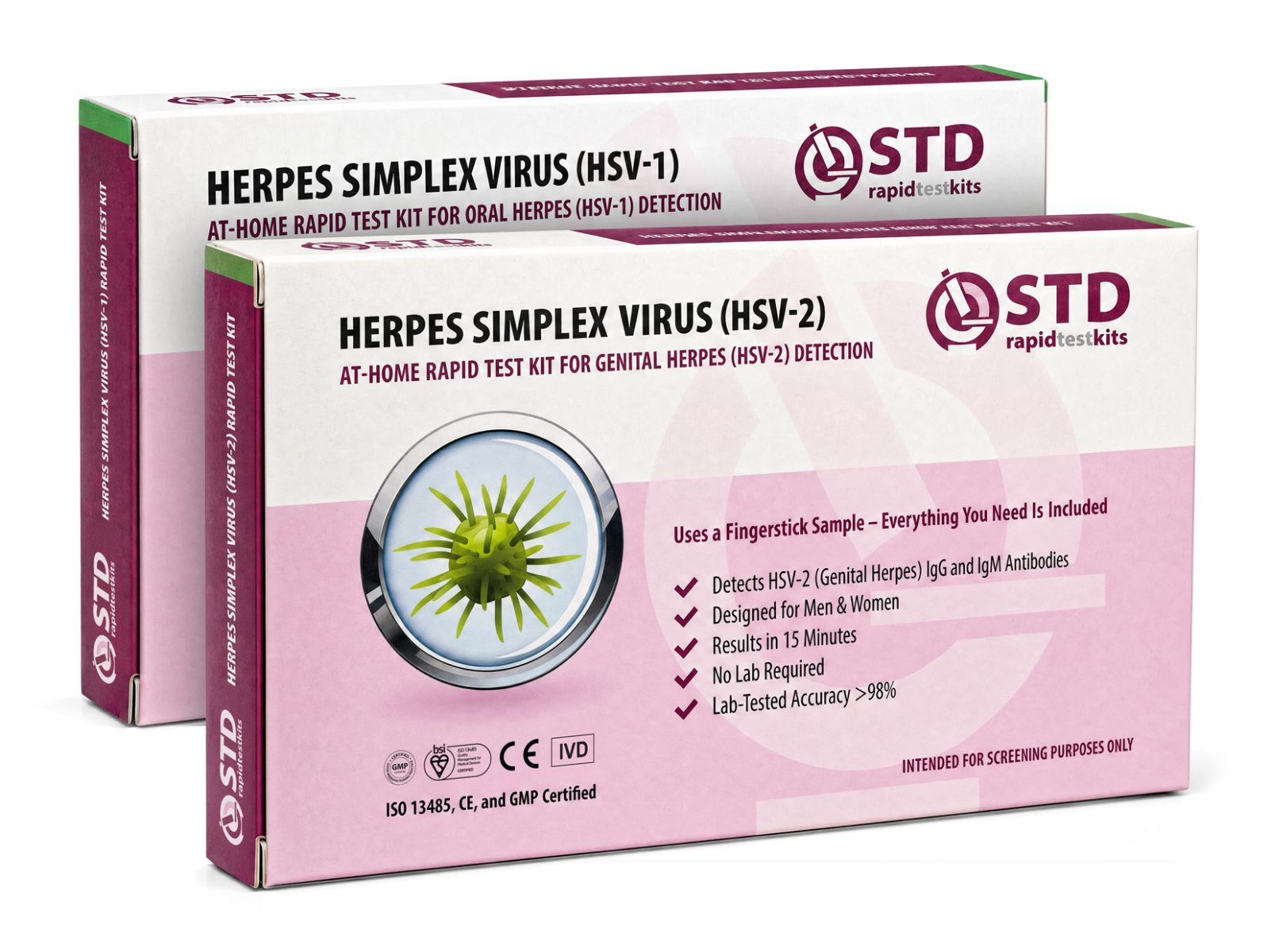
The gap between population guidance and individual need is what at-home testing has stepped into. Herpes testing has become something patients increasingly arrange themselves, either by asking a clinician to add it to a panel or by using an at-home herpes test on their own schedule. To be transparent: this site sells at-home rapid herpes test kits, so the product links in this article point to our own store; we suggest them only where a test genuinely fits your situation.
- You get recurring cold sores and want to confirm which type you carry.
- You are starting a new relationship and want a clear, factual conversation about status.
- You are pregnant or planning a pregnancy and want your status on record for delivery planning.
- A partner has tested positive and you want to know whether you also carry the virus.
How to Tell a Cold Sore from Other Mouth Sores
Before talking about testing, it helps to be sure you are actually looking at a cold sore. The three lesions people most often confuse are HSV-1 cold sores, canker sores (also called aphthous ulcers), and the early tingle-and-redness prodromal stage of an outbreak. The differences are small but consistent (NHS cold sores guidance).
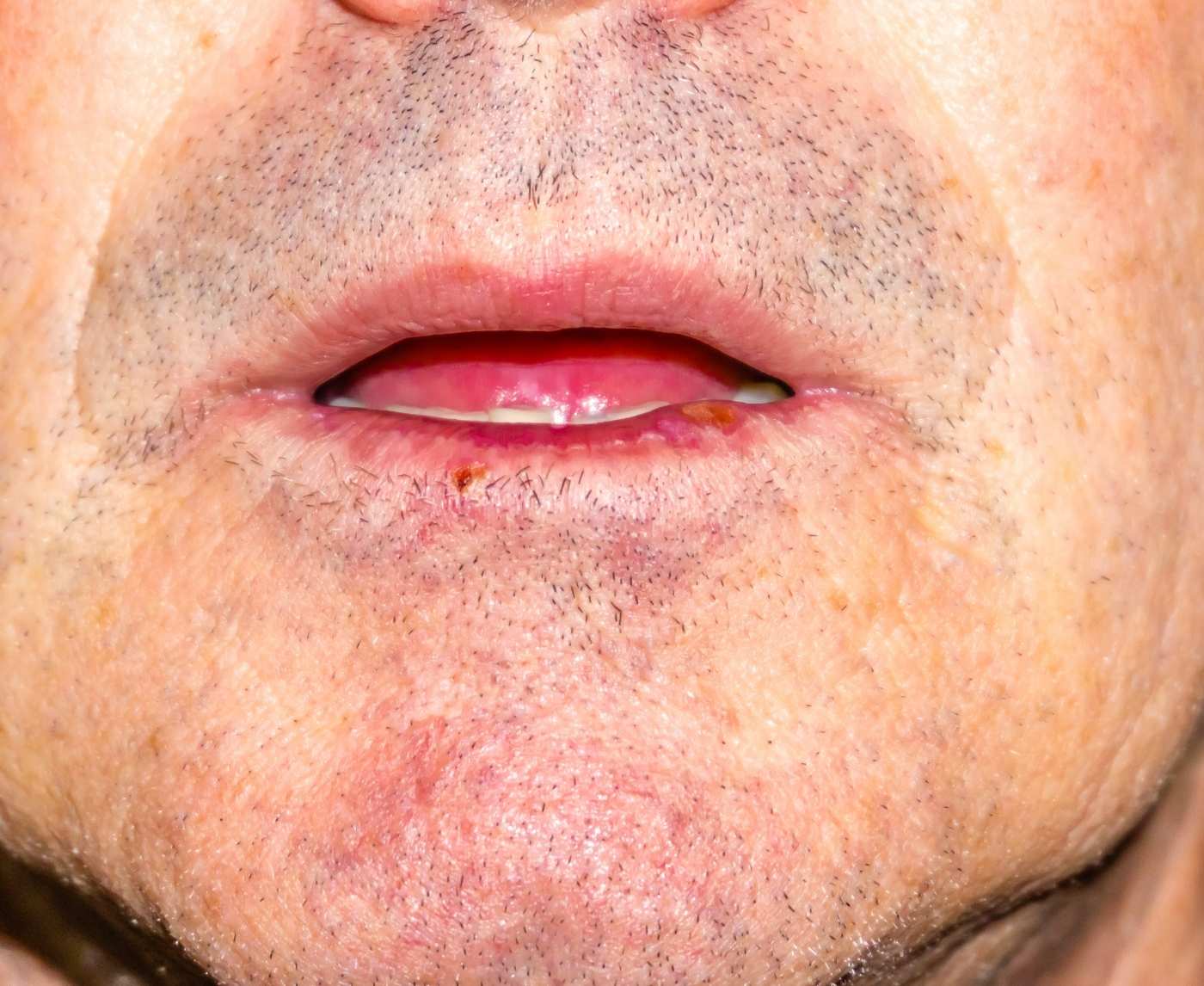
HSV-1 cold sores live on the outside of the lip, at the outer edge of the lip (called the vermilion border) or just above it. They start with tingling and a focal patch of redness, then form a tight cluster of small clear blisters, then break open and crust over within several days. The whole arc usually runs a week to ten days.
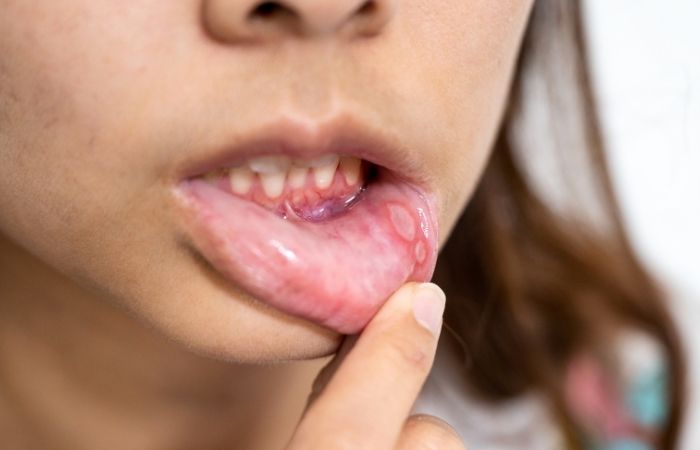
Canker sores live inside the mouth: on the inner cheeks, under the tongue, or on the gums. They look like a round shallow crater with a yellow-white fibrinous center and a red halo. Canker sores hurt but do not blister, and they are not caused by herpes at all. They are the body responding to small triggers like trauma, stress, or food sensitivities, and they tend to heal on their own in one to two weeks.
Location settles most cases. Outside the lip and blistering points toward HSV-1. Inside the mouth and crater-shaped points toward a canker sore.
When to Test for the Most Accurate Result
Timing is the single biggest factor in herpes test accuracy. The CDC's STI Treatment Guidelines note that type-specific and type-common antibodies to HSV develop during the first weeks after infection, and that retesting roughly 12 weeks out is the standard checkpoint for confirming a negative after a known or suspected exposure (CDC STI Treatment Guidelines, genital HSV section). MedlinePlus puts the same idea in plainer terms: your body can take up to three months to make HSV antibodies, so a blood test done too soon can read negative even when infection is present (MedlinePlus herpes test overview). In practice, most people will have detectable IgG well before 12 weeks, but a small fraction take the full window, which is why the retesting interval is set where it is.
For a swab-based PCR test, the opposite timing rule applies. The virus is easiest to detect at the start of a visible outbreak, when the sore is fresh and full of virus particles. Once the sore starts to crust and heal, viral load drops, and a swab can miss the infection. If a sore appears and you want it confirmed, plan to swab within about 48 hours.
| Situation | Best time to test | Recommended test |
|---|---|---|
| Visible cold sore or genital lesion right now | Within 48 hours of the sore appearing | PCR swab of the lesion |
| Past cold sores, no current sore | Anytime; repeat 12 weeks after the most recent outbreak if uncertain | IgG blood test for HSV-1 and HSV-2 |
| Possible exposure, no symptoms | 12 weeks after the exposure (earlier tests may miss late seroconverters) | IgG blood test for HSV-1 and HSV-2 |
| Planning a pregnancy or early pregnancy | Before conception, or at first prenatal visit | IgG blood test for HSV-1 and HSV-2; PCR if any active lesion appears |
How HSV-1 Travels Beyond the Mouth
It is worth slowing down here because the mechanics of HSV-1 spread are often where the misconceptions live. The virus moves via direct skin-to-skin or skin-to-mucosa contact with infected secretions. That includes kissing during an outbreak, sharing utensils or drinks when a sore is active, oral sex with an oral sore present, and oral sex when no sore is visible because of asymptomatic shedding.
The asymptomatic shedding rate is not theoretical. Studies of people with documented HSV infection have found detectable virus in saliva or genital secretions on a meaningful fraction of symptom-free days, which is part of why the CDC explicitly warns that HSV can transmit even when there are no visible signs of infection (CDC STI Treatment Guidelines, genital HSV section). That baseline of silent shedding explains why a person who has had cold sores in the past can transmit HSV-1 to a new partner during a stretch with no symptoms whatsoever.
Transmission to babies and young children is a separate consideration. Neonatal HSV is rare but serious, and the American Academy of Pediatrics treats it as a medical emergency when it occurs. Standard pediatric guidance asks adults with active cold sores to avoid kissing infants on the face or sharing pacifiers, utensils, or drinks, and to wash hands carefully if any cold-sore secretions might be on the skin.
- Childhood non-sexual contact such as a kiss from a relative or a shared cup or spoon. Most people acquire HSV-1 this way, well before any sexual activity begins.
- Adult kissing or skin-to-skin contact with the lip or perioral area of someone who carries the virus.
- Oral sex, which can transfer HSV-1 from the mouth area to a partner's genitals and cause a lifelong genital infection.
- Asymptomatic viral shedding during stretches when no cold sore is visible. This accounts for a smaller share of total transmission than active outbreaks, but it explains most of the cases people describe as coming "out of nowhere."
At-Home Herpes Tests: What They Actually Do
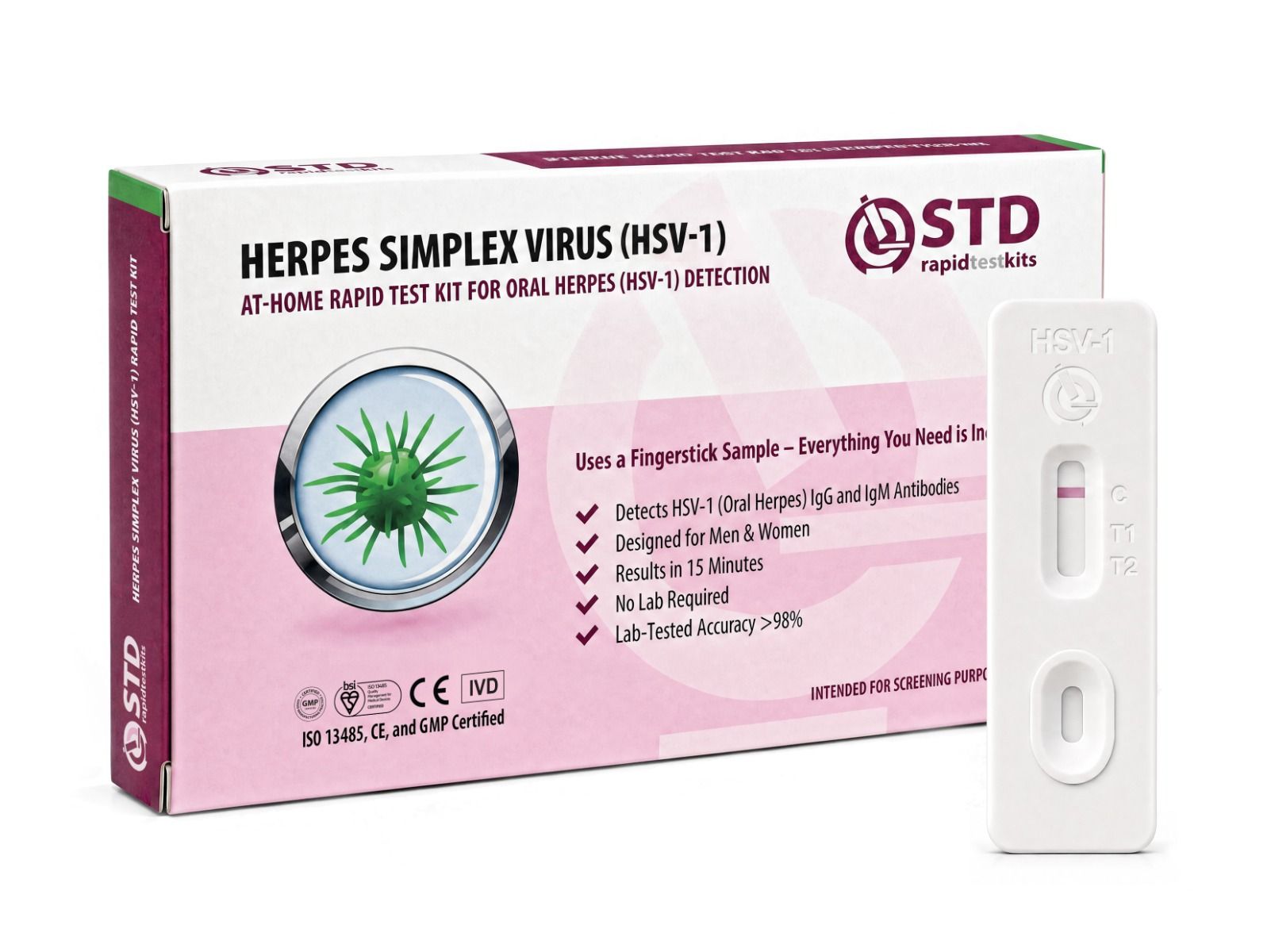
At-home herpes tests fall into two practical categories. The most common is a fingerstick blood test that detects IgG antibodies to HSV-1, HSV-2, or both. You prick your fingertip with a small lancet, drop blood into a sample well, add a buffer fluid, and read the result like a pregnancy test. Some at-home kits, including ours, return results in about 15 minutes using lateral-flow chemistry. Other formats are mail-in, where you send a dried-blood sample to a lab and read the result online a few days later.
It is worth being precise about what these rapid tests are. They are lateral-flow immunoassays, not laboratory NAAT or PCR tests. Lab-based herpes serology run on automated platforms is the analytical gold standard. A rapid lateral-flow test is meaningfully faster and more private, and reports high sensitivity and specificity when used correctly (specific figures vary by kit, so check the relevant product page for the manufacturer-stated values). An unexpected positive result is always worth confirming through a clinician, especially at low-positive index values.
The second at-home category is a self-collected swab kit that you mail to a lab for PCR analysis. That format is best when a visible sore is available to swab. Our product line focuses on the blood antibody format, which fits the routine-status-check use case most readers are looking for. The table below lays out which test answers which question.
| Test Type | How It Works | Best Use |
|---|---|---|
| IgG (immunoglobulin G) blood test | Detects antibodies to HSV-1 or HSV-2 that your immune system has produced | Confirming long-standing status, especially in asymptomatic people, several weeks after possible exposure |
| PCR swab | Detects viral DNA directly from an active sore or lesion | During an active outbreak (cold sore on the lip or genital lesion), ideally within 48 hours of appearance |
| IgM (immunoglobulin M) blood test | Detects an early antibody class | Generally not recommended; IgM is unreliable for distinguishing recent versus old herpes infections |
What to Do If Your Result Looks Confusing, or Comes Back Positive
A negative result is not always the end of the story. If you tested within a few weeks of a possible exposure, your immune system may not have built enough antibodies for the test to register yet. The fix is straightforward: repeat the IgG test about 12 weeks after the exposure. If you have an active sore, ask a clinician for a swab-based PCR. A swab can confirm active infection even when antibodies have not yet developed.
A positive IgG result at a low index value (often described as low-positive) is the most common source of test-related anxiety. False positives are real, and the CDC notes that low-positive index values warrant confirmation testing before a definitive diagnosis is given (CDC STI Treatment Guidelines, herpes diagnosis section). A clinician can order a confirmatory assay, such as a Western blot or a repeat test on a different platform, before you act on the result.
A clearly positive result is information, not a sentence. Genital herpes is common in the United States, with the CDC estimating 572,000 new infections in 2018 among people aged 14 to 49 (CDC about genital herpes). You are in extremely common company. Antiviral medications, including acyclovir and valacyclovir, shorten outbreaks and reduce asymptomatic viral shedding, which lowers transmission risk to partners and household contacts (NHS genital herpes guidance). Many people find that life after a confirmed diagnosis looks much like life before it, with the practical addition of a clear vocabulary for outbreaks and disclosure.
Intermittent asymptomatic shedding occurs among persons with HSV-2 genital herpes infection, even those with longstanding clinically silent infection.
Telling a Partner Without Apologizing for a Virus
Disclosure is the part most people freeze on. Frame it as a brief, factual heads-up that gives the other person enough context to make their own choice, rather than a confession. Talking about it earlier rather than later helps, because it removes the weight of "I have been hiding something" from the conversation. You do not have to disclose on a first date, but the conversation belongs before any kissing or oral contact begins, when there is still room to ask practical questions and decide together.
A few framings that tend to land calmly:
- I get cold sores sometimes, which is HSV-1. It is incredibly common, but I wanted to tell you before things get physical so you can ask whatever you want.
- I tested positive for HSV-2. I want you to have the information so we can decide together what makes sense, including whether you want to test too.
- I have not had an outbreak in years, but I take daily antivirals and use barriers, which substantially lowers the risk of transmission.
Practical Ways to Protect Partners, Babies, and Yourself
Once you know your status, the protective steps are concrete and low-cost. Most are routines you can keep up without thinking about them much.
- During an active oral outbreak: skip kissing, oral sex, sharing drinks, sharing utensils, and lip balm. Avoid kissing infants under one year old or anyone immunocompromised in your household until the sore is fully crusted and healed.
- Wash hands carefully after touching the sore. HSV-1 can autoinoculate other body sites, including the eyes (herpes keratitis is a real, sight-threatening complication).
- Antiviral medication: episodic treatment shortens outbreaks; daily suppressive therapy reduces asymptomatic shedding and lowers transmission risk to a partner. A clinician can recommend which approach fits your pattern.
- Barrier protection during sex reduces but does not eliminate transmission risk, because HSV can shed from skin areas a condom does not cover. Combining barriers with suppressive therapy gives the strongest reduction.
- Pregnancy planning: tell your obstetric provider your HSV status early. If active genital lesions are present at delivery, your obstetric team will discuss cesarean delivery to reduce neonatal HSV transmission risk. The decision depends on your individual circumstances (see <a href="https://www.nhs.uk/conditions/genital-herpes/" target="_blank" rel="noopener noreferrer">NHS genital herpes guidance</a>).
Stigma Hurts More Than the Virus Does
For most people who carry HSV-1 or HSV-2, the medical impact of the virus over a lifetime is modest: occasional outbreaks, manageable with medication, sometimes none after the first year. The harder part is the cultural baggage. People hide a diagnosis they would mention casually if it were shingles, even though shingles is also a herpes-family virus. The silence is what isolates people, not the biology.
That silence is also why HSV-1 spreads quietly: people who would never describe themselves as having herpes will casually mention they get cold sores, and the gap in vocabulary keeps the practical conversation about prevention, testing, and disclosure from happening. Reframing the two as the same virus is often what makes those conversations manageable for both people involved.

Routine Testing Is Quiet Self-Care
Herpes testing does not have to be a dramatic event. For many people, the right cadence looks like this: a baseline IgG panel when you are between partners or at the start of a serious relationship, a repeat 12 weeks after any meaningful possible exposure, and a swab on the rare occasion when a fresh sore appears and you want to know exactly what is happening. Most months there is no test at all, and no reason for one.
The at-home rapid antibody test fits that pattern because the cost of running it is low and the result is private. If you are between primary-care visits, or you live somewhere with limited clinic access, or you simply do not want a chart note for something a clinician would not have screened for anyway, the home format takes the friction out. A clearer answer to "do I carry this virus?" is the practical payoff.
If your concern is oral HSV-1 specifically, a single-infection antibody test answers that one question on its own. For deeper context on what cold sores look like at each stage and how home care compares to clinical evaluation, MedlinePlus has a plain-English consumer resource on cold sores (MedlinePlus cold sores resource). Use the quick decision aid below to figure out which test fits where you are right now.
Which herpes test fits your situation?
Do you have a visible cold sore or genital lesion right now?
Yes: Ask a clinician for a swab-based PCR within about 48 hours of the sore appearing, while viral load is highest and the result is most reliable.
Has it been at least 12 weeks since a possible exposure, with no current sore?
Yes: An at-home IgG fingerstick blood test can confirm your HSV-1 and HSV-2 status now.
Did you test soon after a possible exposure and get a negative result?
Yes: Repeat the IgG test about 12 weeks after the exposure to catch a late seroconversion.
No: If outbreaks are frequent, ask a clinician about daily suppressive antiviral therapy to reduce shedding and lower transmission risk.
Guidance only. A healthcare provider can advise based on your specific circumstances.
Frequently Asked Questions
- Are cold sores really herpes?
- Yes. Cold sores are caused by herpes simplex virus type 1 (HSV-1), which is in the same viral family as genital herpes (HSV-2). They are the same kind of infection in different anatomic locations.
- How do I tell a cold sore from a canker sore?
- The decisive clue is anatomy. Cold sores blister on the outer lip surface, at the vermilion border or just above it, and are caused by HSV-1. Canker sores appear inside the mouth (inner cheeks, under the tongue, or on the gums) and form shallow craters with a yellow-white center rather than blisters; they have no link to herpes.
- How do people usually get HSV-1 in the first place?
- Most people acquire HSV-1 in childhood through ordinary non-sexual contact, such as a kiss from a relative or a shared cup or spoon, well before any sexual activity begins. Once acquired, the virus stays for life and can later pass to a partner's genitals during oral sex.
- Can I transmit HSV-1 to someone just from kissing?
- Yes, especially during an active outbreak. HSV-1 can also be shed from the mouth between outbreaks (asymptomatic viral shedding), which is why people with a history of cold sores can transmit the virus even when no visible sore is present.
- Can I pass HSV-1 to a baby?
- Yes. Neonatal HSV is rare but serious. Standard guidance from the CDC and the American Academy of Pediatrics is to avoid kissing infants under one year old on the face if you have an active cold sore, avoid sharing pacifiers or utensils, and wash hands carefully after touching the sore.
- My HSV test was negative, but I have had cold sores. What is going on?
- Antibody tests can miss the infection if you tested very early after the initial infection, since it can take up to 12 weeks for IgG to fully develop. A few people simply have low or undetectable antibody levels. A PCR swab of an active sore is the most reliable confirmation if you have a sore at the moment.
- Should I disclose oral HSV-1 to a partner?
- Yes. HSV-1 can transmit from mouth to genitals during oral sex, and CDC clinical guidance now identifies HSV-1 as an increasingly common cause of newly diagnosed genital herpes in young adults. A short, factual heads-up gives a partner the information they need to make their own decisions about timing and barriers.
- Can I test for herpes at home, or do I need a clinic?
- Both work. At-home rapid blood tests detect HSV-1 and HSV-2 antibodies from a fingerstick in about 15 minutes and are designed for private screening. A clinic is the right choice when you have an active sore that needs a swab-based PCR, or when you want a lab-quality confirmation after an at-home positive.
How we sourced this article: We combined current public-health guidance from the U.S. Centers for Disease Control and Prevention (including the National Center for Health Statistics NHANES data brief on HSV seroprevalence), the World Health Organization, the U.K. National Health Service, and the U.S. National Library of Medicine (MedlinePlus). Where prevalence statistics or transmission rates appear, we cite the specific source inline. The article reflects editorial summarization of these sources and does not substitute for individualized clinical advice.
- World Health Organization. Herpes simplex virus fact sheet, including global HSV-1 and HSV-2 prevalence estimates (3.8 billion people under 50 with HSV-1) and transmission overview.
- U.S. Centers for Disease Control and Prevention, National Center for Health Statistics. Data Brief No. 304, Prevalence of Herpes Simplex Virus Types 1 and 2 in Persons Aged 14 to 49: United States, 2015 to 2016. Source for the 47.8% U.S. HSV-1 seroprevalence figure.
- U.S. Centers for Disease Control and Prevention. About Genital Herpes, including patient-facing information and the estimate of 572,000 new genital herpes infections in 2018 among people aged 14 to 49.
- U.S. Centers for Disease Control and Prevention. STI Treatment Guidelines, genital HSV section, on type-specific antibody testing, IgG development timing, asymptomatic shedding, HSV-1 as an increasingly common cause of new genital herpes in adolescents and young adults, false-positive index values, and confirmatory assays.
- U.K. National Health Service. Genital herpes overview, antiviral treatment, and pregnancy-related guidance (including the case-by-case discussion of cesarean delivery when active lesions are present).
- U.K. National Health Service. Cold sores overview, including lesion stages and the differential against canker sores.
- U.S. National Library of Medicine, MedlinePlus. Cold sores consumer resource, including symptom progression and home care versus clinical evaluation.
- U.S. National Library of Medicine, MedlinePlus. Herpes (HSV) test overview, including the up-to-three-month antibody window and test interpretation.
