

Published: August 2025 | Last updated: April 2026 | Editorial review and quality control: Martina N.
More than 2.2 million cases of chlamydia, gonorrhea, and syphilis were reported in the United States in 2024 alone, per the CDC's most recent surveillance release. Those are only the infections that got tested and reported; the actual burden runs higher. Closing that gap takes more than building more clinics. Increasingly, it means putting accurate testing in the places people will use it, which means at home.
If you have ever hesitated outside a clinic door, or wondered whether a kit you can order online is genuinely reliable, you are in the same boat as a lot of people. The rapid test kits available in 2026 are a long way from the early DIY era. Below: what the science says about reliability, what the FDA finally cleared, when to test for an accurate result, and how to pick a kit that fits your situation.
Are at-home STD test kits reliable?
Yes, when you use them correctly. Well-manufactured rapid lateral-flow kits track in the 95 to 99 percent range for sensitivity and specificity on the most common STIs (the FDA-authorized Visby Medical at-home test, for example, hit between 97 and 100 percent across chlamydia, gonorrhea, and trichomoniasis in its validation data, per <a href="https://www.cidrap.umn.edu/chlamydia/fda-approves-home-test-sexually-transmitted-infections" target="_blank" rel="noopener">CIDRAP's coverage of the FDA clearance</a>), comparable to many clinic-collected screening tests. The two things that make or break the result are timing your test after the correct window period and following the sample-collection steps closely. The FDA cleared the first fully at-home rapid STI test in March 2025, and more authorizations are following. Confirm any positive at-home result with a clinic-based laboratory test before starting treatment.
Key Takeaways
- Rapid at-home STD kits typically report sensitivity and specificity in the 95 to 99 percent range for common infections, but only when used after the correct window period (14 days for chlamydia, 6 weeks for HIV and syphilis, 8 to 11 weeks for hepatitis C).
- FDA marketing authorization arrived for the first fully at-home rapid STI test in March 2025, signaling a regulatory shift that is now expanding to more kits and more infections.
Why the demand for at-home STD testing exploded
The need has always been there. Sexually transmitted infections do not care whether you have a car, a flexible work schedule, or the kind of doctor you can casually ask to add an STI panel to your bloodwork. For a large share of sexually active Americans, especially younger people, people in rural areas, and anyone navigating stigma, clinic-based testing comes with friction that keeps a lot of would-be testers from following through.
Then COVID-19 rewired how people think about testing at home. Pregnancy tests had already normalized self-collection. COVID rapid tests made it ubiquitous. The idea of swabbing or pricking your own finger and reading a result on your bathroom counter went from strange to standard in about eighteen months. Several state public-health departments leaned into the shift, with programs in Alabama, Alaska, and Maryland mailing free at-home STI test kits directly to residents (per CDC's general STD program guidance).
The case for that approach rests on the prevalence numbers. CDC prevalence estimates suggest tens of millions of Americans currently carry an undiagnosed STI, and the overwhelming majority do not know it. They are not getting tested, they are not getting treated, and they are passing infections on.
CDC prevalence research consistently estimates that tens of millions of Americans currently carry an STI, and most do not know it. That gap is the central reason public-health departments are moving toward at-home testing programs: it is not solvable with more clinics alone.
What does "accurate" actually mean? Sensitivity vs specificity
Two numbers do most of the work when a test kit advertises accuracy, and they are not interchangeable.
Sensitivity is the proportion of genuinely infected people the test correctly flags as positive. A test with 99 percent sensitivity will catch 99 of every 100 true infections and miss 1 (a false negative). High sensitivity is what you want from a screening tool, because the cost of missing an infection is real: untreated chlamydia, untreated syphilis, and untreated HIV all have serious downstream consequences for the person carrying them and for their partners.
Specificity is the proportion of genuinely uninfected people the test correctly flags as negative. A test with 99 percent specificity will correctly clear 99 of every 100 uninfected people and falsely flag 1 as positive (a false positive). High specificity matters because a false positive triggers anxiety, follow-up testing, and sometimes unnecessary treatment.
"Accuracy" as a single number is a marketing simplification. A reliable kit reports both figures. The well-manufactured rapid lateral-flow kits sold for at-home STI screening generally land in the 95 to 99 percent range for both sensitivity and specificity on the common infections they cover, when used inside the correct window period.
Sensitivity = the proportion of true positives the test catches. A 99% sensitivity test misses 1 of every 100 actual infections (false negative).
Specificity = the proportion of true negatives the test clears. A 99% specificity test wrongly flags 1 of every 100 uninfected people as positive (false positive).
Reliable rapid kits report both figures separately. Treat any single "accuracy" percentage in marketing copy as marketing copy.
The FDA has finally caught up, and that matters
For years, the regulatory status of at-home STD tests was a real reason public-health experts and cautious consumers kept their distance. Without FDA oversight, there was no standardized accuracy bar that companies had to clear. Lab-developed tests sat in a gray zone overseen by the Centers for Medicare and Medicaid Services rather than the FDA, which left consumers without a clean signal for what "accurate" meant in practice.
That picture has shifted in the last two years. The FDA granted marketing authorization in March 2025 to the first fully at-home diagnostic test for chlamydia, gonorrhea, and trichomoniasis, the Visby Medical Women's Sexual Health Test. It is a self-collected vaginal swab test that delivers results to a connected app in about thirty minutes and does not require a prescription. The validation data was strong: it correctly identified more than 97 percent of positive samples and more than 98 percent of negative samples across all three infections.
The implications go beyond a single product clearance. The authorization opened a 510(k) pathway that other manufacturers can now follow, which means FDA involvement in this category is accelerating rather than slowing. The agency had previously cleared the first at-home syphilis test in 2024 and the first at-home sample-collection kit for chlamydia and gonorrhea in 2023.
Practically, FDA authorization is a quality signal worth checking, but its absence does not automatically mean a kit is inaccurate. Plenty of rapid lateral-flow tests are manufactured using the same antibody and antigen chemistries used in clinical screening labs, and the result of a well-made rapid kit is meaningfully reliable as a screen. Two cautions worth keeping in mind: at-home rapid kits (including the kits sold on this site) are lateral-flow immunoassays, not laboratory NAAT (nucleic acid amplification test) or PCR tests, and any positive screening result should be confirmed by a clinic laboratory before treatment.
This article is published by stdrapidtestkits.com, which sells at-home STI testing kits. We recommend products based on fit-for-purpose for your concern, not commercial benefit, and we link to public-health authorities (CDC, WHO, NHS) for source claims throughout.
How an at-home rapid kit works
The mechanics are simple, which is part of why the technology has spread so fast. A rapid lateral-flow kit contains a small cassette or strip with antibodies (or antigens) embedded in a test line. You apply your sample to the device, the sample wicks across the strip, and any target molecules in the sample bind to the embedded reagents and produce a visible line. A control line confirms the test ran correctly. The whole readout takes 15 to 20 minutes, no electricity or lab equipment required.
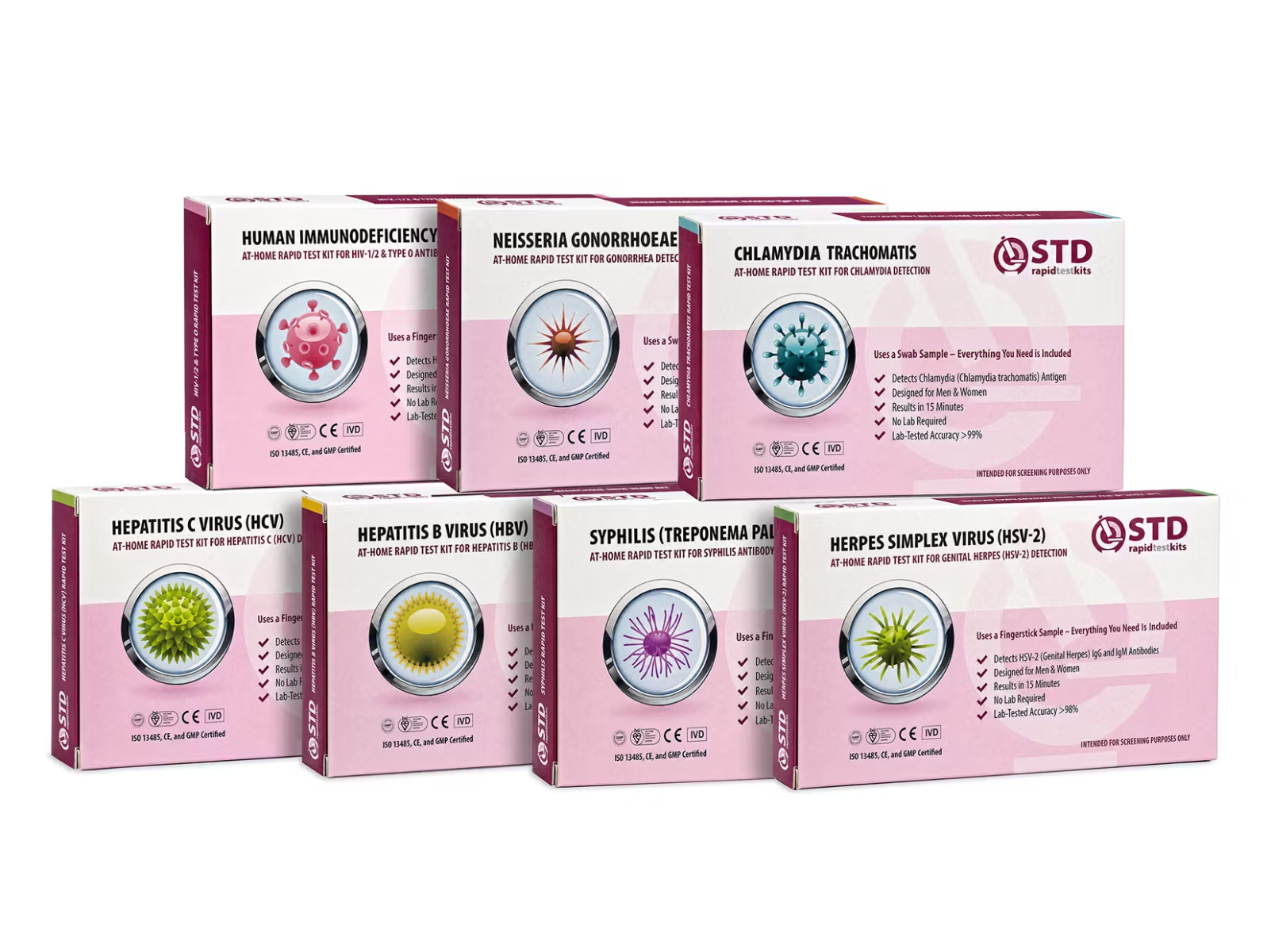
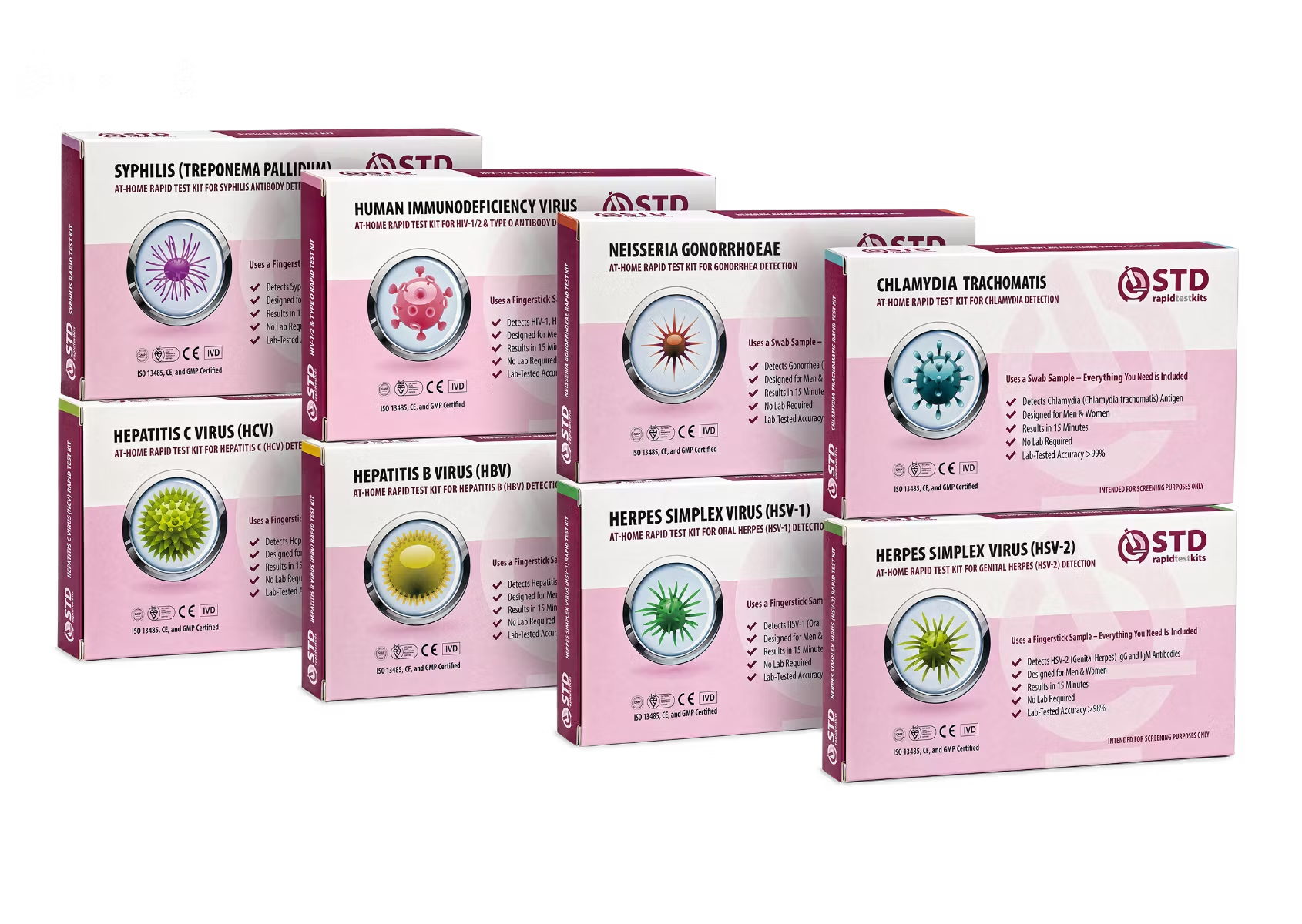
The sample type depends on the infection. Chlamydia, gonorrhea, trichomoniasis, and HPV are screened from a self-collected genital swab. HIV, syphilis, both herpes types, and hepatitis B and C are screened from a fingerstick blood drop. The home-kit category does not currently include throat or rectal swab tests; those still require a clinic visit. The table below shows which sample type goes with which infection in the at-home format.
| Infection | Sample type (at home) | Self-collection method |
|---|---|---|
| Chlamydia / Gonorrhea | Vaginal or penile swab | Self-swab the genital area; rapid kits do not use urine |
| Trichomoniasis (women-only kit) | Vaginal swab | Self-collected vaginal swab |
| HPV (women-only kit) | Vaginal swab | Self-collected vaginal swab |
| Syphilis | Whole blood | Fingerstick lancet |
| HIV | Whole blood | Fingerstick lancet for at-home rapid tests |
| Herpes HSV-1 / HSV-2 | Whole blood (antibody test) | Fingerstick lancet |
| Hepatitis B / Hepatitis C | Whole blood | Fingerstick lancet |
When should you test? The window-period question
Here is the part most readers get wrong: testing too soon after exposure does not give you a negative because you are clean. It gives you a negative because the infection has not had time to be detectable yet. That is a false negative, and the gap between exposure and detectability is called the window period. The length of that window varies by infection.
Imagine a possible exposure two days ago and a knot of anxiety in your chest. Testing today might genuinely reassure you, or it might miss something that is quietly building toward a positive result. Timing the test correctly is not a technicality. Get the window right and the result is one you can trust; test before the window closes and you may walk away with false reassurance. The table below summarizes the windows the CDC and major lab manufacturers cite for their respective assays.
| Infection | Test from | Notes |
|---|---|---|
| Chlamydia | 14 days after exposure | Symptoms are often absent; do not wait for signs |
| Gonorrhea | 3 weeks after exposure | Genital swabs only at home; clinic visit needed for throat or rectal screening |
| Syphilis | 6 weeks after exposure | The primary chancre may heal before testing; still test |
| HIV (rapid antibody) | First indicator at 6 weeks; retest at 12 weeks for confirmation | Lab fourth-generation tests can detect earlier (around 18 to 45 days) |
| Herpes HSV-1 and HSV-2 (blood antibody) | 6 to 12 weeks after exposure | Most carriers have no outbreak; antibody test is the practical home option |
| Hepatitis B | 6 weeks after exposure | Can be asymptomatic for months |
| Hepatitis C | 8 to 11 weeks after exposure | Longer window; do not assume an early result is conclusive |
Who buys at-home STD test kits, and why
The consumer profile for at-home STD testing is broader than most people picture. It includes people who had a recent exposure and want a fast answer, of course. It also includes people who test routinely as part of their sexual-health maintenance, the way you might schedule a dental cleaning or a blood-pressure check. People taking PrEP (a once-daily medication that significantly reduces HIV risk) need regular STI screening as part of their standard monitoring protocol, and many of them rely on at-home kits to test on their own schedule between quarterly clinic visits.
Privacy is a major driver across age groups. For someone in a small town where the pharmacist knows their family, or for an adolescent who cannot risk a parent seeing an insurance claim, the ability to test discreetly matters enormously. Young people face some of the highest STI rates of any age group per longstanding CDC surveillance, yet they face some of the highest practical barriers to clinic-based testing: transportation, time, cost, and fear of judgment. A kit that arrives in a plain box and processes the result on a phone app addresses all of those barriers at once.
Cost is still a real obstacle. Most direct-to-consumer kits are out-of-pocket purchases and are usually not covered by health insurance the way a clinic-collected screen would be. HSA and FSA funds can often pay for them. Public-health clinics offer free or sliding-scale testing and remain the right answer for many people, especially anyone without disposable income. At-home kits extend that public-health safety net rather than replacing it.
Privacy: kits ship in plain packaging, no clinic check-in or pharmacist conversation. Transportation and time: no clinic visit, no waiting room, no scheduled appointment. Insurance footprint: kits are out-of-pocket, so a parent or partner does not see an insurance claim. Cost coverage: HSA and FSA funds usually qualify, even though standard insurance typically does not reimburse direct-to-consumer kits. For free or sliding-scale options, contact your local public-health department.
What can go wrong, and how to avoid it
The published accuracy figures assume the kit is used correctly. Most of the situations where home tests under-perform are user-controllable. Five common failure modes are worth knowing about before you open the box.
Testing inside the window period. The single most common reason a home test "fails" is that the user tested too soon. Read the kit's stated window before you collect, and if you are inside it, wait. A few extra days of uncertainty is worth a result you can trust.
Not enough sample. A fingerstick test needs a generous drop of blood; a swab needs the swab tip rotated against the appropriate tissue for the time the instructions specify. Skimping on either step lowers sensitivity and can produce an inconclusive or false-negative result.
Reading the result outside the result window. Lateral-flow strips have a defined readout window (typically 15 to 20 minutes). Reading the strip 45 minutes later can produce evaporation lines or color changes that are not real positives. Set a timer.
Heat or humidity damage. The reagents on a lateral-flow strip are sensitive to extreme conditions. A kit left in a hot mailbox in summer or a humid bathroom for months may degrade. Store the kit in its sealed pouch in a normal indoor environment until you use it.
Using an expired kit. Every kit has an expiry date printed on the pouch. Past it, accuracy is not guaranteed. Check the date before you collect.
Five at-home test failure modes to avoid
- Testing inside the window period: the most common cause of a wrong result. Wait the kit's stated window from exposure before collecting.
- Not enough sample: skimping on the blood drop or under-rotating the swab lowers sensitivity.
- Reading outside the result window (15 to 20 minutes is typical): later readings can show evaporation lines that look like positives.
- Heat or humidity damage: a kit left in a hot mailbox or humid bathroom for months may degrade. Store sealed at room temperature.
- Using an expired kit: every kit has a printed expiry date. Past it, accuracy is not guaranteed.
What the STD landscape looks like in 2026
The latest CDC data carries genuinely encouraging news mixed with sobering reminders. The combined total of the three nationally reportable STIs (chlamydia, gonorrhea, and syphilis) declined about 9 percent from 2023 to 2024, marking the third consecutive year of decrease and the first sustained multi-year decline in over a decade. Chlamydia dropped 8 percent. Gonorrhea fell 10 percent. Primary and secondary syphilis dropped nearly 22 percent after years of relentless increase, per the CDC's 2024 STI surveillance summary.
The progress is real, and public-health experts are cautiously optimistic. The overall burden is still substantial: more than 2.2 million STI cases were reported in 2024 alone, and that figure only captures the infections that were diagnosed and reported. Congenital syphilis, transmitted from pregnant individuals to their newborns, rose again in 2024 and is now roughly 700 percent higher than in 2015, reinforcing why broad testing access, including at home, remains a priority for public-health agencies (see the CDC's 2025 surveillance press release).
Reported cases of chlamydia, gonorrhea, and primary and secondary syphilis combined declined about 9 percent from 2023 to 2024, the third consecutive year of decline.
Rapid tests vs. lab-send tests: the practical difference
Not every "at-home STD test" works the same way, and the distinction matters when you choose. Two formats dominate the market: rapid tests that produce a result at home in minutes, and mail-in tests where you collect a sample at home, package it, and ship it to an accredited laboratory for analysis.
Rapid tests, including the kits sold on this site, use lateral-flow immunoassay chemistry. That is the same platform behind COVID-19 rapid antigen tests and home pregnancy tests. You collect your sample, apply it to the device, and read the result in roughly 15 to 20 minutes. No lab. No three-day wait for an email. The trade-off is that lateral-flow rapid tests are designed to screen for the most common STIs, the collection step has to be done correctly to be reliable, and a positive result should always be confirmed by a clinic laboratory before treatment.
Mail-in lab tests can offer broader detection or laboratory-grade NAAT analytical sensitivity for the same swab sample, but they require time. The sample has to be packaged correctly, shipped, processed in the lab, and the result returned (typically a few business days later). For the fastest possible answer after an exposure, rapid kits win; for laboratory NAAT confirmation or panels covering infection types we do not currently sell as a home kit (such as throat or rectal screening), a clinic visit is the right step.
| Feature | Rapid lateral-flow kit | Mail-in lab test |
|---|---|---|
| Turnaround | 15 to 20 minutes at home | A few business days after the lab receives the sample |
| Technology | Lateral-flow immunoassay (antibody/antigen) | Laboratory NAAT or serology |
| Sample collection | Self-collected at home | Self-collected at home, then shipped |
| Best use case | Fast answer after a possible exposure or routine self-screening | Confirmatory testing or panels we do not sell as a home kit (throat or rectal screening) |
| Confirmation needed for a positive | Yes, confirm with a clinic lab | Yes, most labs include confirmatory protocols |
What a positive result actually means, and what to do
A positive on a home rapid kit is a screening positive. The right next step is to schedule a clinic visit for a confirmatory laboratory test before any treatment decision. Confirming at a clinic laboratory before treatment is standard clinical screening practice, including in clinic settings. A primary-care doctor who runs a rapid finger-prick HIV test will also send a confirmatory lab draw to validate a positive before prescribing antiretrovirals.
The good news on the treatment side is that most STIs caught early are very treatable. Chlamydia and gonorrhea respond to a short course of antibiotics. Syphilis, in its early stages, is curable with a single penicillin injection. Hepatitis C is now curable in the majority of cases with an 8 to 12 week course of direct-acting antivirals. HIV has no cure. Modern antiretroviral therapy lets people with HIV live long, healthy lives and reduces transmission risk to effectively zero when the virus is suppressed to undetectable levels.
If a positive result feels overwhelming, that is a normal reaction. Most kits include a phone or chat line to a healthcare counselor; community sexual-health clinics also offer post-test counseling regardless of where the test was done. You do not have to navigate the confirmatory step alone.
1. Schedule a confirmatory lab test. A clinic NAAT or serology test (depending on the infection) is the right next step before any treatment decision.
2. Notify recent partners. Most public-health departments offer free anonymous partner-notification services so partners can also test.
3. Begin treatment under a clinician's care. Most STIs caught early are very treatable; do not sit on a confirmed positive.
The road ahead for at-home STD testing
Regulatory momentum is now firmly behind expansion. The FDA's authorizations of the first rapid at-home diagnostic tests for multiple STIs in 2024 and 2025 opened a clear pathway for other manufacturers to follow, which historically means more competition, lower prices, and broader availability. Public-health professionals have argued for years that genuinely accessible at-home STI testing could double or triple the volume of annual screening if it became as routine as a home pregnancy test.
The cultural shift is already underway. Talking about sexual health, testing on a regular cadence, and knowing your status is becoming the norm rather than the exception, particularly among younger generations. At-home testing accelerates that shift by removing nearly every logistical and psychological obstacle between someone and the information they need.
If you are sexually active and you have not tested recently, the case for ordering a kit is straightforward. Testing on a regular cadence is a normal part of looking after your own health, similar to a dental cleaning or a yearly physical. Choose a kit that matches the exposure type and timing in your situation, follow the collection steps carefully, and confirm any positive at a clinic.
1. Match the kit to the exposure type. Genital swab kits cover chlamydia, gonorrhea, trichomoniasis (women), and HPV (women); fingerstick blood kits cover HIV, syphilis, herpes, and hepatitis B/C; combo kits bundle both. 2. Wait out the window period before testing. 14 days for chlamydia, 3 weeks for gonorrhea, 6 weeks for HIV/syphilis/hepatitis B, 8 to 11 weeks for hepatitis C, 6 to 12 weeks for herpes antibody tests. 3. Confirm any positive at a clinic. A home rapid result is a screen; clinic NAAT or serology is the next step before starting treatment.
Frequently asked questions
- Are at-home STD test kits reliable?
- Most well-made rapid lateral-flow kits land in the 95 to 99 percent sensitivity range for the infections they cover, provided you test after the correct window period and follow the collection steps closely. A positive is a screening result that warrants confirmatory follow-up at a clinic laboratory before any treatment decision.
- Do I need a prescription to buy an at-home STD test?
- No prescription is required for the rapid lateral-flow kits sold on this site or for most other direct-to-consumer at-home STI tests. The FDA's recent authorizations have also opened the door for more over-the-counter options, and that trend is accelerating.
- How soon after sex can I test for STDs?
- It depends on the infection. Test from 14 days after exposure for chlamydia, 3 weeks for gonorrhea, 6 weeks for syphilis and rapid-antibody HIV, 6 to 12 weeks for herpes (blood antibody), 6 weeks for hepatitis B, and 8 to 11 weeks for hepatitis C. Testing earlier risks a false negative because the infection has not had time to be detectable yet.
- What happens if my at-home STD test comes back positive?
- A positive on a home rapid kit is a screening positive. Follow up with a healthcare provider for a confirmatory laboratory test before starting treatment. Most STIs caught early are very treatable, so do not sit on a positive result. If a positive feels overwhelming, most kits include a counselor phone line, and community sexual-health clinics offer post-test counseling regardless of where the test was done.
- What is the difference between a rapid test and a mail-in STD test?
- A rapid lateral-flow kit gives you a result at home in 15 to 20 minutes with no shipping or lab wait. A mail-in test has you collect a sample, ship it to an accredited lab, and wait for the lab's result via app or email (usually a few business days). Rapid kits are faster; mail-in tests can offer laboratory NAAT analytical sensitivity. Both are legitimate options for screening.
- Can I test for multiple STIs at once at home?
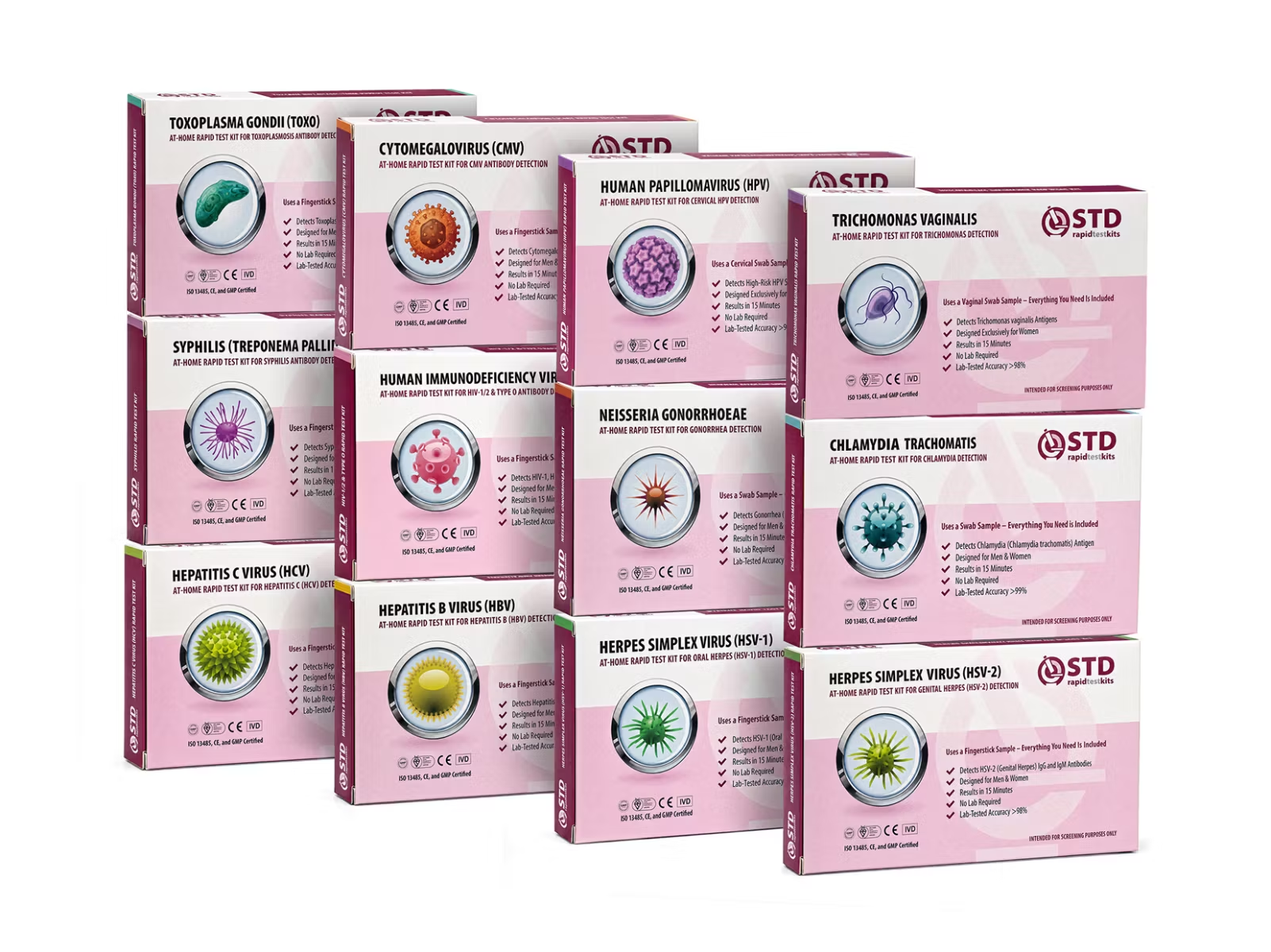
- Yes. Combination kits cover anywhere from 2 to 10 infections in a single order. If you had an exposure and you are not sure which infections to screen for, a multi-infection panel removes the guesswork and gives you a more comprehensive picture.
- Are at-home STD tests covered by insurance?
- Most direct-to-consumer at-home STI test kits are paid out of pocket and are not reimbursed by standard health insurance. HSA and FSA funds can usually be used. If cost is a barrier, community health clinics and public-health departments often offer free or sliding-scale testing.
- Do at-home STD tests check for herpes?
- Yes. At-home rapid blood tests for herpes detect HSV-1 and HSV-2 antibodies from a fingerstick blood sample. Because most carriers do not have a recognizable outbreak, an antibody blood test is the practical way to know your status outside an active lesion. Test from 6 to 12 weeks after a possible exposure for the most reliable result.
- U.S. Centers for Disease Control and Prevention. 2024 National STI Surveillance Data release (September 2025), used for the about 9 percent decline in chlamydia/gonorrhea/syphilis combined, the nearly 22 percent drop in primary and secondary syphilis, and the congenital syphilis figure cited in this article.
- U.S. Centers for Disease Control and Prevention. Sexually Transmitted Infections Surveillance, 2024 (annual surveillance index), used for the 2.2 million case count and trend figures across chlamydia, gonorrhea, and syphilis.
- U.S. Centers for Disease Control and Prevention. STD information hub, used for general guidance on screening, transmission windows, and treatment.
- World Health Organization. Sexually transmitted infections (STIs) fact sheet, used for global incidence context and screening guidance.
- NHS. Sexually transmitted infections (STIs) overview, used for symptom and testing guidance.
- CIDRAP. Coverage of the FDA's March 2025 marketing authorization for the first fully at-home rapid STI diagnostic test (Visby Medical Women's Sexual Health Test), used for the 97 to 100 percent sensitivity and specificity figures across chlamydia, gonorrhea, and trichomoniasis.
