
Published: September 2025 | Last updated: May 2026 | Editorial review and quality control: Martina N.
Gonorrhea is a bacterial infection caused by Neisseria gonorrhoeae. It spreads through vaginal, anal, and oral sex, and a pregnant person can pass it to a newborn during delivery. Most readers searching this question fall into one of three groups: someone with new symptoms (burning urination, unusual discharge), someone whose partner just disclosed an infection, or someone preparing for a routine sexual-health check. The sections below cover all three.
Gonorrhea is fully curable when treated early with the right antibiotic. Untreated, it can cause pelvic inflammatory disease, infertility in both sexes, ectopic pregnancy, and a higher risk of acquiring or transmitting HIV. The U.S. Centers for Disease Control and Prevention lists gonorrhea among the most commonly reported notifiable diseases in the country, with several hundred thousand cases reported every year (CDC STI surveillance data).
This guide is written for general readers, not clinicians. It summarizes current public-health and clinical guidance from the CDC, the World Health Organization, and the U.K.'s National Health Service. If you have symptoms or a confirmed exposure, see a licensed provider; the goal here is to help you decide what to do next, not to replace a clinical visit.
Key takeaways
- Gonorrhea is fully curable with one antibiotic injection, but most women who have it carry no specific symptoms, so screening matters more than waiting for a sign.
- CDC updated its first-line treatment in late 2020 to a single 500 mg intramuscular dose of ceftriaxone; dual therapy with oral azithromycin is no longer the standard regimen for most cases.
How gonorrhea spreads
Gonorrhea passes from one person to another through contact with infected fluid (semen, pre-ejaculate, or vaginal fluid) or with mucous membranes of the genital tract, rectum, mouth, or throat. The bacterium survives only briefly outside the human body, so the route is sexual contact, not toilet seats, towels, or shared cutlery (CDC About Gonorrhea).
Specifically, transmission can happen during:
- Vaginal sex with an infected partner of any anatomy.
- Anal sex, which can produce a rectal infection. Receptive anal sex carries higher risk for the receiving partner.
- Oral sex, both giving and receiving. Pharyngeal (throat) gonorrhea is often silent and can transmit on to genital mucosa during subsequent oral sex.
- Birth, when an infected pregnant person delivers vaginally. The newborn can develop gonococcal conjunctivitis, which the NHS notes can cause permanent eye damage if untreated (NHS gonorrhoea overview).
Ejaculation is not required for transmission. A condom that slipped, broke, or was not used at all is enough exposure to consider testing. Sharing sex toys without cleaning them or covering them with a fresh condom between partners can also pass the infection on.
Throat infections caused by gonorrhea rarely produce a sore throat the way strep does. They are usually picked up only on a clinic-administered pharyngeal swab, which means people who only had oral exposure often assume they have nothing to test. Oral sex transmits in both directions: genitals to throat, and throat to genitals. If you only used a condom for vaginal or anal sex, the oral exposure is still on the list of things to test for, even if your throat feels fine.
Symptoms: what to watch for
Gonorrhea is sometimes called a silent infection because many people carrying it never feel anything wrong. When symptoms do show, they typically begin within about two weeks of exposure. Signs differ by anatomy and by the body site infected (CDC About Gonorrhea).
Symptoms in men
The classic male presentation is urethritis: a burning sensation when urinating, plus a yellow, white, or green discharge from the penis. Some men also notice swollen, painful testicles or a swollen foreskin. These signs can be mistaken for a urinary tract infection, which is why a urine test or urethral swab is the deciding step rather than guessing from symptoms alone.
Symptoms in women
Female symptoms are easy to miss because they overlap with normal cycle changes or with a yeast infection. They can include increased vaginal discharge, burning urination, bleeding between periods or after sex, and pain in the lower abdomen. The most clinically important pattern is no symptoms at all; CDC notes most women with gonorrhea do not have specific symptoms (CDC About Gonorrhea).
Rectal symptoms
Rectal gonorrhea can produce anal itching, soreness, bleeding, or discharge, but it is also commonly silent. Receptive anal sex is the usual route. A throat-only infection is almost always asymptomatic.
Throat symptoms
Pharyngeal gonorrhea rarely causes a sore throat the way strep does. Throat infections are typically picked up on routine screening rather than from symptoms, which is why people with oral exposure shouldn't rely on how their throat feels to decide whether to test. For the pharyngeal swab itself you need a clinic; we do not sell at-home throat-swab kits.
Eye symptoms
Gonococcal conjunctivitis happens when infected fluid reaches the eye, either by touching the eye after handling genital secretions or, in newborns, during delivery. Symptoms are eye pain, redness, and a thick yellow discharge. This is a clinical emergency and needs in-person care.
Why so many infections are silent
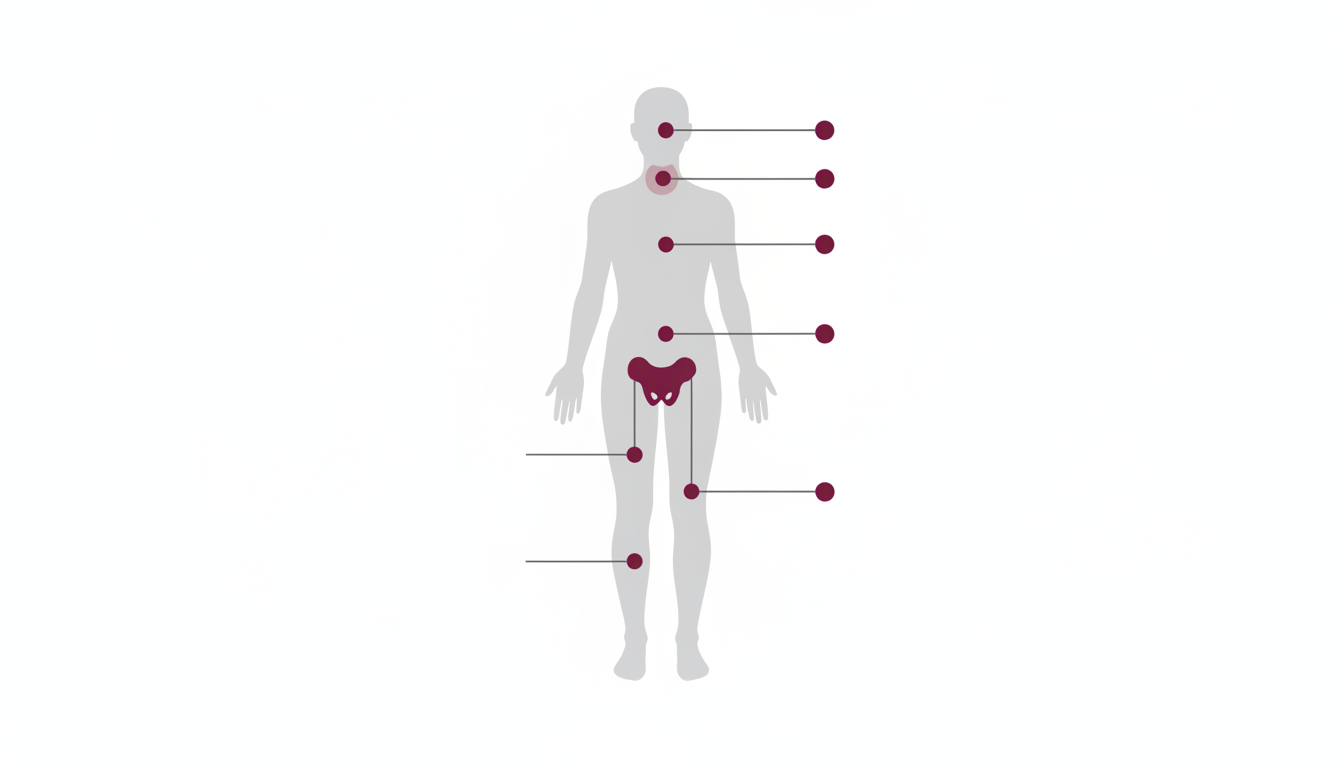
The single most useful fact about gonorrhea for the average reader is this: a person can carry it without any symptoms at all, which is what drives most undetected spread. Most women infected with gonorrhea report no specific symptoms, and a smaller but meaningful share of men carry it without feeling anything (CDC About Gonorrhea). Throat infections are nearly always silent. Rectal infections are silent more often than not.
The implication: gonorrhea spreads quietly between partners who all assume they are fine because they feel fine. This is the public-health rationale for routine screening of sexually active people under 25 and for tying testing to exposure rather than symptoms. The U.S. Preventive Services Task Force and the CDC both recommend annual screening for sexually active women under 25 and for older women with risk factors such as new or multiple partners.
- Women with cervical infection: most have no specific symptoms, which is the main reason CDC recommends annual screening for sexually active women under 25.
- Throat infections: nearly always asymptomatic; usually picked up only on a clinic pharyngeal swab.
- Rectal infections: silent more often than not, with itching or discharge in a minority of cases.
- Men with urethral infection: more often symptomatic than women, but a meaningful share still feel nothing.
If your reason for considering a test is exposure rather than symptoms, that is the correct trigger. Symptoms are a poor screening tool for gonorrhea (<a href="https://www.cdc.gov/gonorrhea/about/">CDC About Gonorrhea</a>).
Risk factors
Gonorrhea risk is shaped less by who you are than by what an exposure looks like. Specific factors that raise the odds of acquiring it:
- Age 15 to 24. Reported infection rates are highest in this group; CDC surveillance attributes a disproportionate share of new cases to adolescents and young adults.
- New or multiple sex partners in the past 12 months, or a partner who has multiple partners.
- Inconsistent condom use, including condoms used only for vaginal sex but not oral or anal.
- Prior STI history, including a previous gonorrhea or chlamydia infection. Gonorrhea reinfection is common; CDC recommends a retest at three months after treatment.
- Men who have sex with men. CDC reports higher rates of pharyngeal and rectal gonorrhea in this population, partly because of how often these sites are exposed and how often they go unscreened.
- Sex work, drug use that lowers inhibitions, or transactional sex, which can compound exposure frequency and condom-use consistency.
Risk factors are cumulative, not categorical. A 22-year-old in a new relationship without recent screening has measurable risk even with one partner, because that partner's prior testing history matters.
Get tested even if you have no symptoms. Most exposed partners who turn out positive have no signs at all. Plan to abstain from sex until both you and your partner have completed treatment and any required test of cure. Continued sex during treatment is a leading cause of "ping-pong" reinfection between couples (<a href="https://www.cdc.gov/std/treatment-guidelines/gonorrhea-adults.htm">CDC treatment guidelines</a>).
Complications if gonorrhea is left untreated
Most of the harm from gonorrhea comes not from the acute infection itself but from what it does over weeks and months when it is not treated. The main complications:
Pelvic inflammatory disease (PID)
In women, untreated gonorrhea can ascend from the cervix into the uterus and fallopian tubes, causing PID. Symptoms include lower abdominal pain, fever, painful sex, and abnormal bleeding, but PID can also be subclinical and cause damage silently. CDC notes that PID can lead to scarring of the fallopian tubes, which raises the long-term risk of ectopic pregnancy and infertility; about one in eight women with a history of PID has trouble getting pregnant later (CDC About PID).
Infertility in both sexes
In women, fallopian-tube scarring from PID is a leading infectious cause of tubal-factor infertility. In men, untreated infection can lead to epididymitis, inflammation of the tube behind the testicle that stores and carries sperm. Severe or repeated epididymitis can damage sperm production and contribute to infertility.
Ectopic pregnancy
Tubal scarring after PID raises the chance that a fertilized egg implants in the fallopian tube rather than the uterus. Ectopic pregnancy is a medical emergency.
Higher risk of HIV acquisition and transmission
An active gonorrhea infection inflames mucosal tissue, which makes HIV acquisition easier on exposure and HIV transmission more efficient out of an HIV-positive person. WHO highlights this co-factor relationship in its gonorrhea fact sheet (WHO gonorrhoea fact sheet).
Disseminated gonococcal infection (DGI)
In a small share of untreated cases, the bacterium spreads through the bloodstream and causes a constellation of symptoms: skin lesions, joint pain or arthritis, tenosynovitis (inflammation of tendon sheaths), and rarely meningitis or endocarditis. DGI is uncommon, but it is the reason some clinicians treat gonorrhea aggressively even in mild presentations.
Pregnancy and newborn complications
Untreated gonorrhea during pregnancy is associated with higher risk of preterm birth, low birth weight, and chorioamnionitis. During delivery, the newborn can develop gonococcal conjunctivitis, which without treatment can scar the cornea and cause blindness; this is why most U.S. states require eye prophylaxis at birth.
- Pelvic inflammatory disease in women, with permanent scarring of the fallopian tubes possible.
- Tubal-factor infertility in women and epididymitis-driven infertility in men.
- Ectopic pregnancy, which is a medical emergency when it happens.
- Higher likelihood of acquiring or transmitting HIV during the active infection.
- Disseminated gonococcal infection (joints, skin, rare bloodstream involvement) when the bacterium escapes the original site.
How gonorrhea is diagnosed
Diagnosis depends on collecting a sample from the right body site and running the right kind of test. The two questions to answer are: where is the suspected exposure, and how sensitive a test do you need? Sample sites and testing methods are summarized below.
| Test type | Sample | Where it runs | Strengths | Limits |
|---|---|---|---|---|
| Lab NAAT (PCR) | Urine, urethral swab, vaginal swab, or rectal/pharyngeal swab | Clinic or lab | CDC's preferred test for diagnosis; very high sensitivity and specificity | Requires clinic visit and lab turnaround (1 to 5 days) |
| Home rapid lateral-flow swab | Self-collected vaginal or penile swab | At home | Result in about 15 minutes; private; useful as a screening step | Lower sensitivity than lab NAAT; positive results should be confirmed at a clinic |
| Throat or rectal swab (PCR) | Pharyngeal or rectal swab | Clinic only | Detects extragenital infection that genital tests miss | We do not sell home throat or rectal swabs; clinic visit required |
| Urine NAAT | First-catch urine | Clinic or lab | Convenient, especially for men with urethral exposure | Less sensitive than vaginal swab in women |
Lab NAAT versus home rapid testing: what to know
Laboratory nucleic-acid amplification testing (NAAT, sometimes called PCR) is the CDC's recommended diagnostic test for gonorrhea (CDC 2021 STI Treatment Guidelines). It is highly sensitive and specific, and it can be run on urine for men and on a self-collected vaginal swab for women.
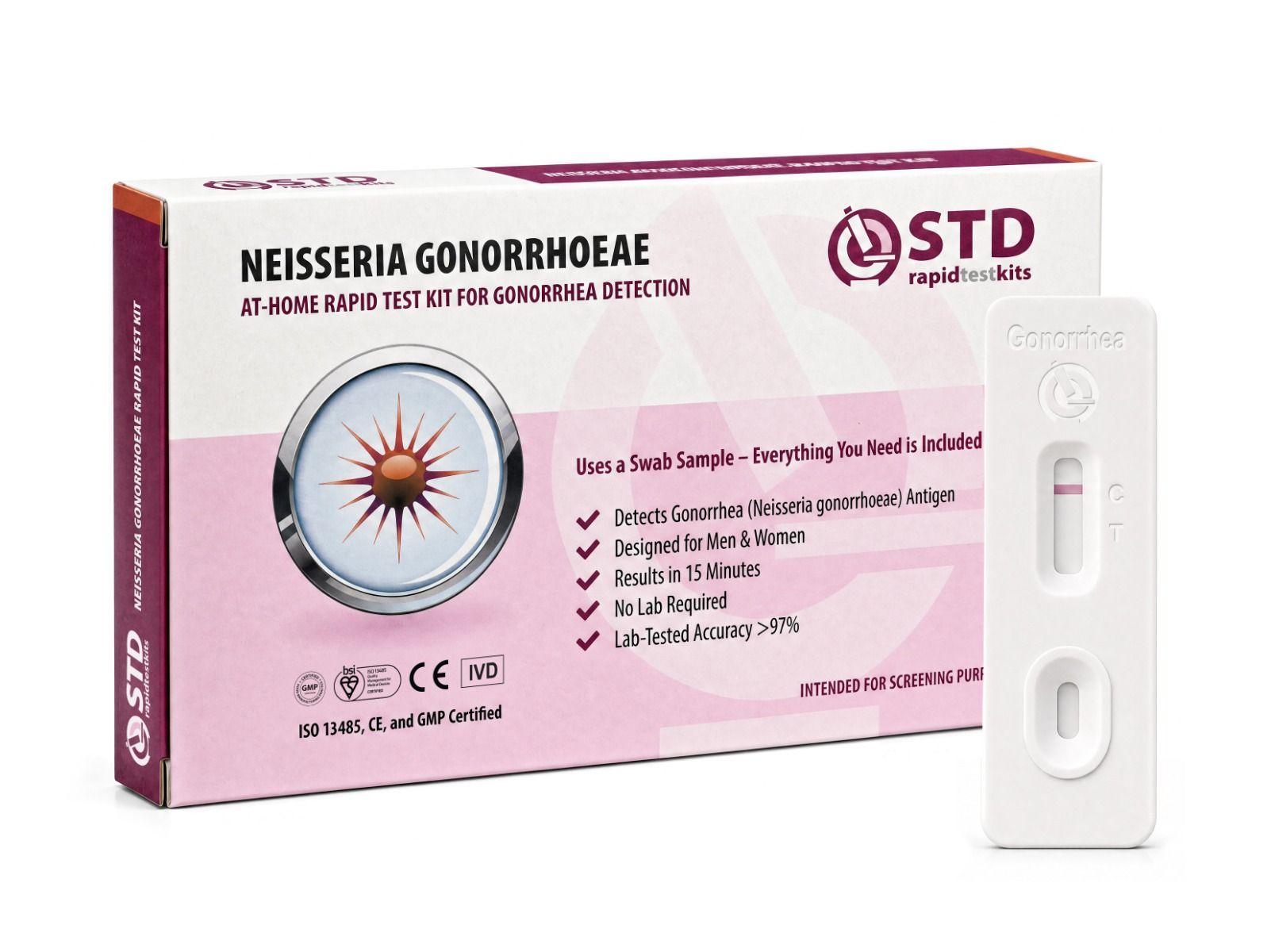
Home rapid lateral-flow tests use a different chemistry. They detect gonococcal antigens directly on a test strip, without amplifying genetic material the way a lab does. That trade-off buys you privacy and a result in about 15 minutes, at the cost of lower analytical sensitivity than a lab NAAT. Home rapid tests are best understood as a screening step: a positive at home is a strong cue to follow up with a clinic NAAT for confirmation, and a negative when you have meaningful exposure or symptoms is worth re-checking with a lab test.
If you have a suspected exposure that is throat-only or rectal-only, the home swab kits we sell will not cover that anatomic site. See a clinic for a pharyngeal or rectal swab; our rapid panel below covers the genital risk from the same exposure event.
This site sells the at-home rapid test linked below and earns a fee when readers purchase through our links. Recommendations are based on fit for the reader's concern, not commercial benefit.
Treatment: what changed in 2020
The treatment for gonorrhea changed meaningfully in late 2020. Older guidance, including the version that circulated on health-information sites for years, called for dual therapy: an injection of ceftriaxone plus a single oral dose of azithromycin. The CDC retired that recommendation.
The current first-line treatment for uncomplicated urogenital, anorectal, or pharyngeal gonorrhea in adults is:
- Ceftriaxone 500 mg, given as a single intramuscular injection (1 g for adults weighing 150 kg or more).
- Plus doxycycline 100 mg by mouth, twice daily for 7 days, only if chlamydial infection has not been excluded. If a NAAT has ruled out chlamydia, doxycycline is not added.
Source: CDC 2021 STI Treatment Guidelines, gonococcal infections.
The reason for the change is antimicrobial resistance. Neisseria gonorrhoeae has progressively developed resistance to nearly every antibiotic class once used to treat it: sulfonamides, penicillins, tetracyclines, and fluoroquinolones, in roughly that historical order. CDC and WHO both list multidrug-resistant gonorrhea as a serious public-health threat (WHO gonorrhoea fact sheet). Dropping azithromycin from routine dual therapy reflected concern that azithromycin resistance was rising and that dual therapy was driving resistance pressure on a back-up agent.
What this means for you:
- If a clinician offers you a treatment plan that does not match the current 500 mg ceftriaxone regimen, ask whether their guidance is current.
- Pregnancy does not change the first-line regimen; ceftriaxone is considered safe in pregnancy.
- Cephalosporin allergy or severe penicillin allergy needs a clinician decision; alternative regimens exist but are less reliable.
- Symptoms typically improve within a few days. Persistent symptoms after treatment can mean reinfection from an untreated partner, or, less commonly, treatment failure.
Antimicrobial resistance to gonorrhoea is a serious and growing problem, rendering many classes of antibiotics as ineffective with the risk of becoming untreatable.
Follow-up after treatment
The timeline continues after treatment with several follow-up steps that reduce the risk of reinfection and confirm the antibiotic worked.
Test of cure for pharyngeal infection
For throat infections, CDC recommends a test of cure 7 to 14 days after treatment, because pharyngeal sites are the hardest to clear and the most clinically important for resistance surveillance (CDC treatment guidelines). Test of cure is not routinely recommended for uncomplicated genital or rectal gonorrhea after standard ceftriaxone treatment, unless symptoms persist.
Retest at three months
Anyone treated for gonorrhea should be retested about three months after treatment, regardless of whether their partner was treated. The reason: reinfection from an untreated or new partner is the most common cause of a positive retest, and three months is the window where reinfection becomes detectable.
Tell your partners
Sex partners from the past 60 days (or the most recent partner, if it has been longer) should be notified, tested, and treated. Most U.S. states allow expedited partner therapy in some form, where the index patient's clinician prescribes treatment for the partner without a separate appointment. Many local health departments will help with anonymous partner notification if you prefer not to do it yourself.
Abstain until everyone is finished
You and your partners should abstain from sex until: (a) everyone has completed treatment, and (b) seven full days have passed since the last person finished antibiotics. Resuming sex earlier is the single most preventable cause of reinfection.
Get tested for the rest of the panel
A gonorrhea diagnosis is a flag to test for the other major STIs you could have picked up at the same exposure: chlamydia, syphilis, HIV, and hepatitis B and C if not vaccinated or previously screened. Co-infection with chlamydia is so common that empiric chlamydia treatment is standard whenever chlamydia has not been ruled out by NAAT. Pairing a gonorrhea retest with a chlamydia test on the same swab is the most efficient way to do this.
Follow-up checklist after treatment
- If your infection was pharyngeal, schedule a test of cure 7 to 14 days after the ceftriaxone shot.
- Retest at three months whether or not your partner was treated, because reinfection is the most common reason for a positive retest.
- Notify sexual partners from the past 60 days so they can be tested and treated; many states allow expedited partner therapy.
- Abstain from sex until at least seven full days after the last person finishes their antibiotics.
- Add chlamydia, syphilis, HIV, and hepatitis B and C to the same testing visit; co-infection is common.
How to prevent gonorrhea
The protective measures that reduce gonorrhea risk are the same ones that reduce most STI risk. None is perfect on its own; together they cover most exposure routes.
- Use condoms consistently and correctly for vaginal and anal sex. Latex or polyurethane condoms substantially reduce gonorrhea transmission, especially genital-to-genital. Effectiveness drops when condoms are used only some of the time or are put on partway through.
- Use barriers for oral sex. Condoms cover penile-receptive oral sex; dental dams cover vulva- or anus-receptive oral sex. This is the protection most people skip and the route that drives unsuspected throat infections.
- Reduce the number of concurrent partners. Mutual monogamy with a tested partner is statistically the most protective pattern; non-monogamy with consistent barrier use and routine screening is the next most protective.
- Screen on a regular schedule. Sexually active people under 25 should be screened annually for gonorrhea and chlamydia per CDC guidance. People with new partners, multiple partners, or known exposure should screen more frequently.
- Have honest conversations about testing. Asking a new partner when they were last tested, and for what, is awkward but more reliable than guessing from how they look or behave.
Vaccination is not yet an option for gonorrhea, though several gonorrhea-vaccine candidates are in clinical development as of 2026. Some health authorities have observed partial cross-protection from the meningococcal-B vaccine in observational studies, but this is not yet a recommended use.
This article is published by stdrapidtestkits.com, which sells at-home STI testing kits. We recommend products based on fit-for-purpose for the reader's concern, not commercial benefit. Where the right test for your situation is a clinic-only one (such as a pharyngeal or rectal swab), we say so plainly.
Frequently asked questions about gonorrhea
- Can gonorrhea go away on its own?
- No. The infection does not become less harmful over time. Without antibiotics, gonorrhea can ascend from the urethra or cervix into the upper reproductive tract within weeks, causing PID or epididymitis before symptoms become obvious enough to seek care. Surface symptoms may fade as the infection moves to less obvious sites or becomes chronic, but the bacterium remains and continues to cause damage and to be transmissible.
- How long after exposure should I test?
- Symptoms, when they appear, typically begin within about two weeks of exposure (<a href="https://www.cdc.gov/gonorrhea/about/">CDC About Gonorrhea</a>). For lab NAAT (PCR) testing, your provider can advise on timing for your specific exposure; testing too soon after exposure may produce a false negative. If a first test comes back negative after a high-risk exposure, repeat at the two-week mark or speak with a provider about repeat timing.
- Can I get gonorrhea from oral sex?
- Yes. Oral sex transmits gonorrhea in both directions: genital-to-throat (causing pharyngeal infection) and throat-to-genital (causing urethritis or cervicitis). Pharyngeal gonorrhea is usually silent, which is why clinics screen the throat in people with oral exposure. Our home swab kits do not cover the throat; a clinic visit is required for that swab.
- Is gonorrhea curable?
- Yes, with the right antibiotic, taken correctly, and combined with abstinence during treatment. Current CDC first-line therapy is a single 500 mg intramuscular dose of ceftriaxone. Antimicrobial resistance is rising globally, but ceftriaxone-resistant strains are still rare in the U.S., and the recommended regimen remains highly effective in practice.
- Can you get gonorrhea twice?
- Yes. Treatment cures the current infection but does not produce lasting immunity. Reinfection from an untreated partner is the most common cause of a positive test 3 months after treatment, which is why CDC recommends a routine retest at that interval.
- Are at-home gonorrhea tests accurate?
- They are designed as screening tools, not as diagnostic ones. Home rapid lateral-flow tests have lower analytical sensitivity than laboratory NAAT (PCR), so the use-case matters: they are best for routine screening, partner-disclosure follow-up, or a private first check before deciding to see a clinic. A positive at-home result is a confirmation-worthy signal that a clinic NAAT should resolve before treatment. A negative paired with significant exposure or persistent symptoms is worth re-checking at a lab.
- Should my partner also get tested?
- Yes. Most U.S. states allow expedited partner therapy, which means your clinician can write a prescription for your partner without requiring them to book a separate appointment. The clinical guideline covers sex partners from the past 60 days, or the most recent partner if it has been longer than 60 days. If you would rather not handle notification yourself, your local health department will often help anonymously.
- Can gonorrhea cause infertility?
- Yes, when left untreated. In women, gonorrhea can ascend into the fallopian tubes and cause pelvic inflammatory disease, which scars the tubes and can result in tubal-factor infertility or ectopic pregnancy. In men, repeated epididymitis from untreated gonorrhea can damage sperm production. Both outcomes are largely preventable with timely treatment.
- U.S. Centers for Disease Control and Prevention. About Gonorrhea: transmission routes, symptoms by sex, treatment overview, and complications.
- U.S. Centers for Disease Control and Prevention. 2021 STI Treatment Guidelines, gonococcal infections section: current first-line treatment with 500 mg ceftriaxone IM and follow-up testing recommendations.
- U.S. Centers for Disease Control and Prevention. STI Statistics: hub for the most recent surveillance reporting on chlamydia, gonorrhea, and syphilis in the United States.
- World Health Organization. Gonorrhoea (Neisseria gonorrhoeae infection) fact sheet: global burden, antimicrobial-resistance threat, prevention guidance, and HIV co-factor relationship.
- U.K. National Health Service. Gonorrhoea overview: symptoms, transmission, and clinical pathway in the U.K. context.
- U.S. Centers for Disease Control and Prevention. About Pelvic Inflammatory Disease (PID): long-term complications including tubal-factor infertility and ectopic pregnancy, with the one-in-eight statistic on subsequent fertility difficulty.
