Real STD Stories: How Casual Sex Exposed Careful People
Stories that show how careful people still end up exposed




- Most early STIs cause no symptoms or look like razor burn, a UTI, or a sore throat. Testing is the only way to know.
- Window periods matter: a test taken too soon can miss an infection, so a negative result on day three is not the same as a clean bill of health.
Published: November 2025 | Last updated: May 2026 | Editorial review and quality control: Martina N.
The stories in this article are composites. Names and identifying details have been changed; the patterns these stories illustrate come from CDC surveillance trends, public-health helpline data, and published patient testimonials. Real people will recognize themselves in pieces of each one.
Casual sex does not have to end in regret. It does, however, expose you to a small but real probability of an infection that can stay quiet for weeks or months before it announces itself. Knowing what to watch for, when a test will actually pick something up, and how to handle a positive result is the difference between one careful weekend and a long-term health problem you did not see coming.
Key Takeaways
- Most early STIs cause no symptoms or look like razor burn, a UTI, or a sore throat. Testing is the only way to know.
- Window periods matter: a test taken too soon can miss an infection, so a negative result on day three is not the same as a clean bill of health.
“I Was Just Having Fun”: When Symptoms Show Up Late, or Not at All
Nina, 26, considered herself careful. She used condoms, asked partners about testing, and trusted them when they said they were clean. Ten days after a weekend in Las Vegas, she woke up with raw pain while urinating. She assumed it was a urinary tract infection. A swab at urgent care said otherwise: gonorrhea.
“I felt dirty. I felt stupid. The worst part was that I did not feel sick until it was already in my body.”
Nina’s timing was typical. Gonorrhea and chlamydia are notorious for staying quiet in the early stages, particularly in women. The World Health Organization notes that many people with chlamydia have no symptoms or only mild symptoms, and infections in women in particular often go undetected long enough to migrate toward the reproductive organs, where they can cause pelvic inflammatory disease and long-term fertility problems.
One night does not feel like a health event. That is precisely how silent infections spread, and how a single weekend can quietly become a year-long medical detour.
If UTI-like symptoms (raw burning, urgency, pelvic ache) appear within two weeks of a new sexual contact, ask the clinic to run an STI swab alongside the urine culture. Gonorrhea and chlamydia routinely get mistaken for a bladder infection, and the antibiotics used for a standard UTI do not cover them.
When It’s Not a Pimple: STD Symptoms People Always Miss
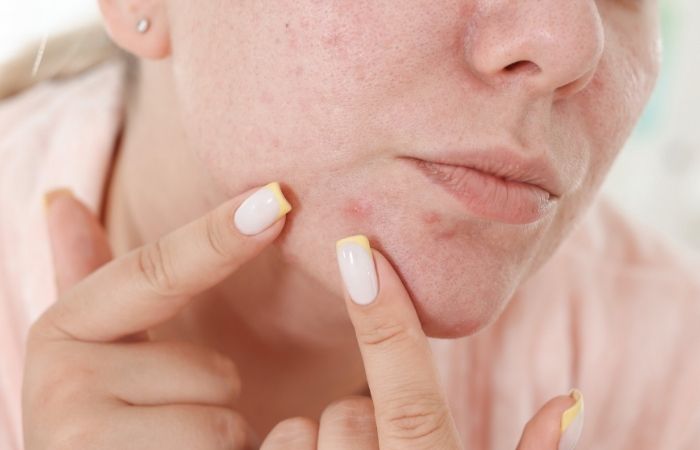
For Marcus, 32, the red bump appeared three days after an oral hookup. He assumed it was an ingrown hair from shaving and ignored it. A week later it blistered. Two weeks later, a clinic visit confirmed HSV-1 genital herpes.
That misread cost him more than time. The woman he was seeing at the time ended things when he disclosed the diagnosis, afraid she had been exposed. She had not been, but the fear was enough to break the relationship.
The line between a harmless skin irritation and an early STI symptom is rarely clear. Herpes, syphilis, and HPV can all start as something that looks like a pimple, a rash, or a dry patch. The table below shows the most common first-symptom patterns and what people typically mistake them for.
| STI | Common First Symptom | What It Gets Mistaken For |
|---|---|---|
| Herpes (HSV-1 or HSV-2) | Red bump or fluid-filled blister | Pimple, ingrown hair, allergic reaction |
| HPV (genital warts) | Small skin-colored growth | Skin tag, razor bump |
| Syphilis (primary stage) | Painless sore (chancre) | Canker sore, bug bite, friction injury |
| Chlamydia | Unusual discharge or burning urination | UTI, yeast infection |
| Gonorrhea | Throat soreness, urethral discharge, pelvic ache | Strep throat, UTI, period cramps |
“We Used Protection,” But It Still Happened
Condoms reduce the risk of many STIs, but they do not make anyone invincible. Tyrese, 29, used condoms with every casual partner. What he did not realize: a recent partner had a small herpes sore on her upper thigh, outside the area a condom covers. Two weeks later, he had his first outbreak.
Herpes, HPV, and syphilis can spread through skin-to-skin contact alone, no penetration required. So even when a condom is used correctly, the surrounding skin is still vulnerable. Condoms also break, slip, or get put on partway through more often than people admit.
The table below summarizes how reliably condoms reduce transmission for the most common infections, and where the gaps are.
| STI | How Well Condoms Reduce Risk | Why It Can Still Spread |
|---|---|---|
| Chlamydia | High | Only if the condom is on from start to finish; pre-ejaculate can carry the bacteria |
| Gonorrhea | High | Oral sex without a barrier can still transmit the throat form |
| Herpes (HSV-2) | Partial | Skin-to-skin contact outside the condom area can transmit the virus |
| HPV | Partial | Spread through skin contact even when no warts are visible |
| Syphilis | Partial | Chancre sores can sit on skin a condom does not cover |
| HIV | High when used correctly every time | Risk rises sharply with breakage or partial use |
When You Get Ghosted After a Positive Test
Jess, 24, stared at her phone, thumb hovering over Send. Her at-home rapid test showed two faint lines next to the herpes marker. She had been symptom-free before that night. He had insisted on skipping the condom because he was clean, his word. He never replied to her message. He blocked her.
“I was not angry. I was scared. I just wanted him to know, in case he had to warn other people. He vanished.”
Getting ghosted after a disclosure call is one of the most quietly devastating parts of post-hookup STI experience. It mixes shame, silence, and the feeling of being used. The truth, though, is that his disappearing act does not erase her right to seek treatment, nor does it define what she is worth. Disclosing a positive result after a casual encounter takes real courage; how someone responds to that disclosure says more about them than about the person disclosing.
Jess told a close friend, saw her doctor, and started antiviral therapy. Suppressive medication has lowered her risk of transmitting the virus and the frequency of her own outbreaks. She is dating again.
Keep it short, factual, and free of apology. A workable script: “I just tested positive for X. I wanted to let you know so you can get tested.” That is the entire obligation. The other person’s reaction belongs to them, not to you. State health departments and services like Tell Your Partner offer anonymous notification if a direct conversation feels unsafe or impossible.
“I Thought It Was the Flu”: When It’s Actually HIV
Ryan, 30, never thought of himself as reckless. After a late-night encounter where alcohol made the condom feel optional, he chalked the whole thing up to chemistry and bad judgment. A week later he had chills, a fever, a sore throat, and felt wrecked for several days. Classic flu, except for the timing. He searched “flu after unprotected sex” at 2 a.m. and ran straight into an article about acute HIV.
Ryan tested at a community clinic, then again with a confirmatory PCR. He was positive. The flu-like illness was seroconversion, the body’s initial immune response to a new HIV infection. The CDC notes that most people develop flu-like symptoms within two to four weeks of HIV infection, during the acute stage when the virus is replicating rapidly and the person is highly contagious. Many miss the connection and do not test until much later, when the virus has had time to do real damage.
Early detection changed Ryan’s outcome. He started antiretroviral therapy within days. His viral load became undetectable within months, which under the U=U principle (Undetectable equals Untransmittable) means he cannot pass the virus to a sexual partner.
If you develop unexplained fever, sore throat, swollen lymph nodes, or a body-wide rash within two to four weeks of a high-risk encounter, ask for an HIV test. A 4th-generation antigen-antibody HIV test reliably detects most infections by about four to six weeks; an HIV RNA (PCR) test can pick up the virus as early as ten to fourteen days after exposure. Time matters: starting antiretroviral therapy early dramatically improves long-term outcomes.
Testing After a Scare: What You Need to Know
You may be reading this because you felt a bump, because someone ghosted you, or because you cannot stop running through the timeline of last weekend. Whatever brought you here, the next move is yours, and it is not too late.
Getting tested does not mean you have done something wrong. It means you are taking your health seriously. Testing too early, however, can mislead you. Each STI has its own window period, the time between exposure and when a test can reliably detect it. Test before the window closes and a real infection can come back negative; test inside the window with confidence and you may walk away certain about a result that is actually too early to trust.
One disclosure: stdrapidtestkits.com sells the at-home rapid kits this article references, so we have a commercial interest in recommending testing. We try to make that recommendation honest. The table below lists the typical detection windows for the most common infections, drawn from CDC and WHO guidance, and applies whether you test at home, at a clinic, or through a lab.
| STI | Earliest Reliable Test | Best Time to Confirm |
|---|---|---|
| Chlamydia | 5 to 7 days | 14 days or later |
| Gonorrhea | 5 to 7 days | 14 days or later |
| Syphilis | 3 weeks | 6 to 12 weeks |
| HIV (4th-gen Ag/Ab) | 2 to 3 weeks | 4 to 6 weeks |
| HIV (PCR/RNA) | 10 to 14 days | After 4 weeks if symptoms persist |
| Herpes (HSV antibody) | 4 to 6 weeks | 12 weeks for full seroconversion |
| Hepatitis B | 3 to 6 weeks | 8 to 12 weeks |

When the Guilt Hits Harder Than the Symptoms
Leila, 22, tested positive for trichomoniasis a month after a festival weekend. She could not have named which of three partners exposed her, all hookups, none with a condom. The discharge and itch were uncomfortable, but the part that flattened her was the shame. The fear that this meant she was the kind of girl people judged.
STI stigma is powerful. It keeps people from disclosing. It fuels ghosting. It makes the experience hurt more, because it isolates. Here is the part that matters: an STI is not a moral failure. It is a medical event, with a treatment plan, the same way strep throat or a sinus infection is. Trichomoniasis in particular is curable with a single course of antibiotics.
Leila completed treatment, contacted the partner she could still reach, and started talking to a therapist about the rest. She talks about the experience publicly now, and hears regularly from people in similar situations. None of them are alone. Neither was she.
Public-health surveys consistently find that fear of judgment, more than fear of the diagnosis itself, is what keeps people from testing and disclosing. If shame is sitting heavier than your symptoms, that is normal and it is also the part that responds best to talking to one trusted person, your provider, or a peer support service. The infection has a treatment plan. The shame deserves one too.
“I Got a Negative Test, Then It Came Back Positive”
Anthony, 35, was relieved when his first test came back negative after a high-risk encounter. Two weeks later, the sore on his shaft had not gone away. It got worse. A retest revealed primary syphilis.
His first test was not wrong. It was just done too soon. Many STIs, including syphilis and herpes, do not show up immediately on antibody-based tests because the body needs time to build the antibodies the test detects. Clinical guidance notes that syphilis antibody tests may take several weeks to turn positive after exposure, with the standard recommendation being to retest after the suspected window has closed if the first result is negative but symptoms or exposure history are concerning.
Early negative results are a snapshot, not a guarantee. Retesting matters, especially if symptoms appear, if a partner discloses something later, or if the original exposure was high-risk.
“That early negative gave me false peace. I told someone I was negative and then had to walk it back. That hurt worse than the diagnosis.”
If symptoms persist past the first test, retest after the window closes. A clinical syphilis test (RPR/VDRL plus a treponemal test) is the standard for confirmation; primary syphilis is straightforwardly cured with a single dose of penicillin when caught early.
The most common reasons a test misses a real infection: testing inside the window period, testing the wrong sample type for the infection, and a low antibody response in the first weeks. Retest after the window closes if you had a high-risk exposure or any persisting symptom, even if the first result said “clear.”
When Symptoms Are Silent, but Damage Isn’t
Emily, 28, did not know she had chlamydia for almost a year. It came up at a fertility checkup, when her doctor noticed scarring in her fallopian tubes. The scarring traced back to an untreated pelvic infection, the long-term consequence of silent chlamydia.
Chlamydia is sometimes called the silent infection. According to the World Health Organization, many people with chlamydia have no symptoms or only mild symptoms. The bacterium keeps doing damage internally even when nothing on the outside flags it.
Other STIs follow the same pattern. Untreated gonorrhea, trichomoniasis, and chlamydia together are leading causes of pelvic inflammatory disease, infertility, ectopic pregnancy, and chronic pelvic pain. The WHO STI fact sheet places the global burden in the millions of new cases each year, the bulk of them unnoticed at the time of infection.
Emily now talks to college students about her experience. She was not reckless; she simply was not informed enough to test routinely. Her message is the one most people who have lived through this end up sharing: do not wait for symptoms that may never come.

What At-Home STI Tests Can (and Can’t) Tell You
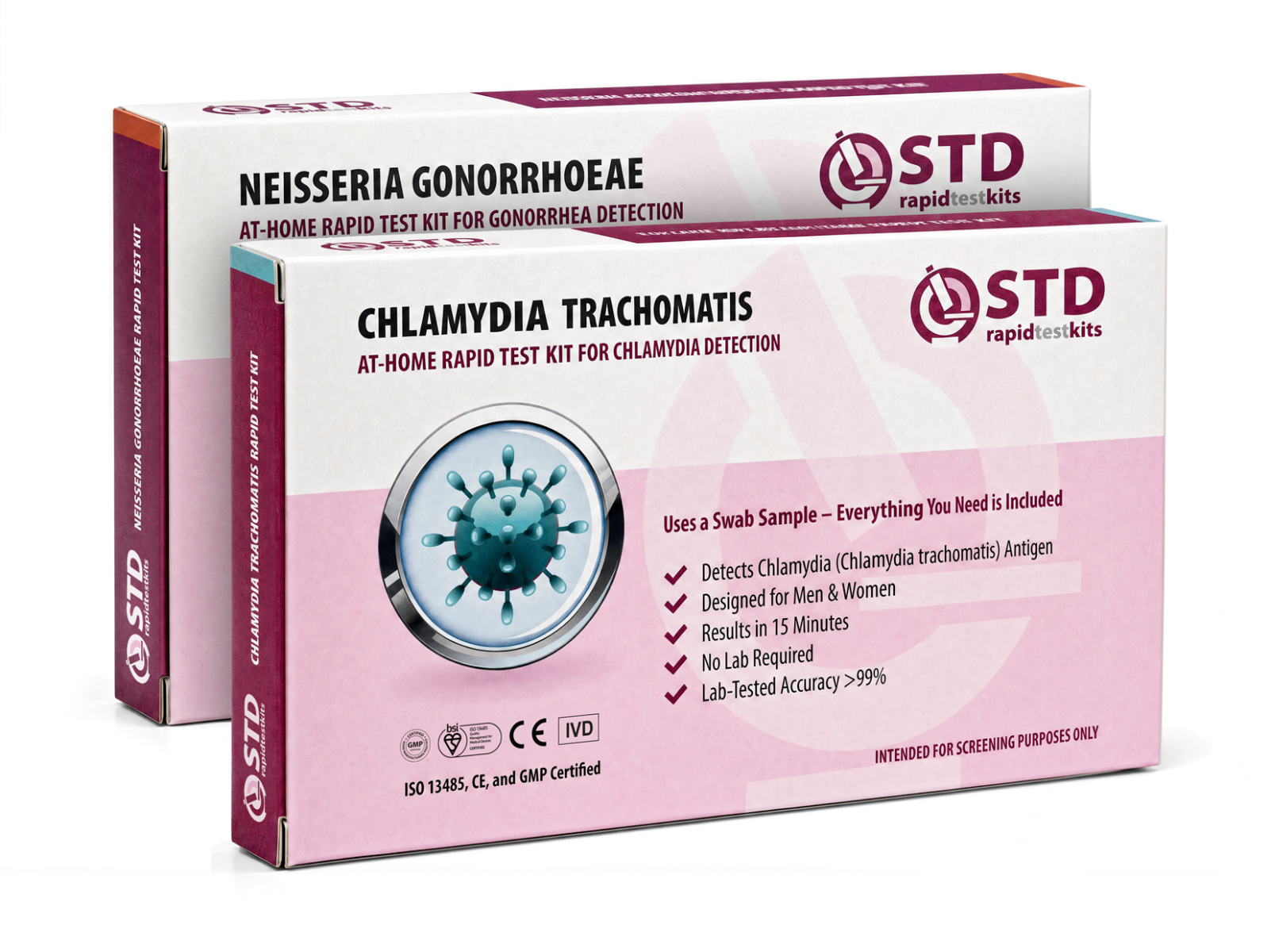
Rapid at-home tests are useful tools. They are private, they cost less than a clinic visit in most cases, and they deliver results within minutes. They are not, however, equivalent to laboratory NAAT or PCR tests, and the difference matters when an infection is right at the edge of the window period.
At-home rapid tests use lateral-flow chemistry: a sample reacts with antibodies or antigens fixed to a strip, and a colored line appears if the target is detected. This works well once the body has produced enough of the marker the test looks for. Lab NAAT testing amplifies genetic material directly and can detect smaller quantities earlier in the infection. The two approaches are complementary, not interchangeable.
Here is what the most common at-home test types cover and how they collect a sample.
| Test Type | STIs Detected | Sample Type | Time to Result |
|---|---|---|---|
| Chlamydia rapid test | Chlamydia | Self-collected vaginal or urethral swab | About 15 minutes |
| Gonorrhea rapid test | Gonorrhea | Self-collected vaginal or urethral swab | About 15 minutes |
| Combo 7-in-1 kit | HIV, syphilis, hepatitis B, hepatitis C, herpes, chlamydia, gonorrhea | Fingerstick blood plus self-collected swab | About 15 minutes |
| Herpes rapid test | HSV-1 or HSV-2 antibodies | Fingerstick blood | 10 to 15 minutes |
| HPV rapid test (women only) | High-risk HPV | Self-collected vaginal swab | About 15 minutes |
| Trichomoniasis rapid test (women only) | Trichomoniasis | Self-collected vaginal swab | 10 to 15 minutes |
Why We Tell These Stories
There is no single moral here. Anyone, no matter how careful or how informed, can find themselves Googling “burning after sex” at 2 a.m. Ghosting does not mean you were wrong to disclose. Testing is an act of care, not confession. What happened in one night does not have to define a year, much less a life.
These stories are also not cautionary tales designed to scare anyone out of intimacy. Casual sex, when it is consensual and informed, is a normal part of many adult lives. The risk that comes with it is manageable. What comes after a scare is sometimes regret, but more often it is awareness, then action. Sometimes it is one small step: opening a test kit, reading the result, and finally knowing what is going on inside your own body. That step is what changes the rest.
What actually moves the needle
- Talk first. Ask a new partner about their last test and what it covered before clothes come off, not after.
- Use the condom from the start. Mid-encounter is too late for several infections.
- Know your test windows. Day three is too soon for almost everything except a PCR HIV test.
- Lower the threshold for testing. A weird symptom plus a recent exposure is enough reason.
Frequently Asked Questions
- Can I really get an STI from just one night?
- Yes. A single skin-to-skin contact or fluid exchange is enough for several common infections, particularly herpes, HPV, gonorrhea, and chlamydia. The probability per encounter varies by infection and by anatomy, but it is never zero. The stories in this article all started with a single night.
- I have no symptoms. Should I still get tested?
- Yes. Most chlamydia and gonorrhea infections in women are asymptomatic, and many HIV, hepatitis B, and herpes infections cause no early symptoms at all. Routine testing after a new partner, or every six to twelve months for sexually active people, is what catches silent infections before they cause damage.
- How soon after sex can a test detect an STI?
- If you only remember one number, remember 14 days: by then chlamydia and gonorrhea are reliably detectable, which covers the two most common exposures. HIV needs longer (PCR around 10 to 14 days, standard antibody testing 4 to 6 weeks). Syphilis and herpes can take 6 to 12 weeks to fully seroconvert. The decision rule is simple: test once at the earliest reliable point for the infection you are worried about, and again after the window closes if the exposure was high-risk.
- If the condom did not break, am I safe?
- Safer, not invincible. Condoms reduce HIV, gonorrhea, and chlamydia transmission substantially when used correctly from start to finish. Herpes, syphilis, and HPV can still spread through skin-to-skin contact in areas a condom does not cover, including the upper thigh, scrotum, or pubic mound.
- I tested negative, but something still feels off. What should I do?
- Trust the symptom. Early tests can miss infections, particularly if you tested inside the window period. If symptoms persist or worsen, retest after the window has closed, and consider asking your provider for a clinical NAAT, PCR, or full-panel screen. A negative rapid test is a snapshot, not a guarantee.
- What do I do if I tested positive?
- Confirm with a clinical lab test, then start treatment. Most bacterial STIs (chlamydia, gonorrhea, syphilis, trichomoniasis) are fully curable with antibiotics. HIV is treatable with antiretroviral therapy that can drive the viral load to undetectable levels. Herpes and HPV are managed long-term, not cured, but suppressive therapy and routine screening keep both manageable. Tell recent partners so they can test too.
- How do I tell a partner I might have exposed them?
- Direct works best. A short message such as “I just tested positive for X. I wanted you to know so you can get tested too” is enough. Some health departments offer anonymous partner-notification services if a direct conversation is not possible. The framing is health, not blame.
- Do at-home rapid STI tests actually work?
- When used at the right time, yes. Most at-home rapid lateral-flow tests use the same antibody or antigen targets clinics rely on for screening. They are useful as a private first step. A positive result is worth confirming with a clinical NAAT or PCR, and a negative result inside the window period should be retested once the window closes.
- U.S. Centers for Disease Control and Prevention. Sexually Transmitted Infections overview, including symptom patterns and screening recommendations.
- U.S. Centers for Disease Control and Prevention. About Genital Herpes, including transmission and asymptomatic shedding.
- U.S. Centers for Disease Control and Prevention. About HIV, including the acute stage of infection and the flu-like symptoms most people develop within two to four weeks of exposure.
- U.S. Centers for Disease Control and Prevention. About Syphilis, including stages, transmission, and treatment.
- World Health Organization. Chlamydia fact sheet, including the prevalence of asymptomatic and mildly symptomatic infection.
- World Health Organization. Gonorrhoea (Neisseria gonorrhoeae) fact sheet, covering global burden and complications of untreated infection.
- World Health Organization. Sexually Transmitted Infections fact sheet, including incidence and complications of untreated infection.