

Published: November 2025 | Last updated: April 2026 | Editorial review and quality control: Martina N.
A quiet ache in one testicle is one of the easiest symptoms to talk yourself out of. There is no discharge, no burning, no rash, just a dull pressure that drifts in over a few days and won't quite settle. The reflex is to chalk it up to a long bike ride, a heavy gym session, or sleeping in an awkward position. Sometimes that is the answer. Other times, the same quiet ache is the only signal a chlamydia infection is giving you, and waiting it out can cost more than peace of mind.
Chlamydia is the most commonly reported bacterial STI in the United States, and in men under 35 it is also the leading infectious cause of epididymitis, the inflammation of the small coiled tube that sits at the back of each testicle. The tricky part is that the genital infection itself is usually silent. By the time the testicle starts complaining, the bacteria have already traveled. This guide walks through how that happens, how to tell low-key STD pain apart from a strain or a true emergency, when a home swab test is actually reliable, and what the next steps look like if a result comes back positive.
Can a sore testicle on its own really mean chlamydia?
Most testicular aches have a mechanical cause and resolve within a few days. Chlamydia is the realistic STI possibility when the ache is one-sided, lingers past 48 to 72 hours without a clear physical trigger, and follows a recent unprotected exposure. Chlamydia often causes no symptoms in men (<a href="https://www.cdc.gov/chlamydia/about/index.html" target="_blank" rel="noopener">CDC, About Chlamydia</a>), so a quiet testicular ache can be the first outward sign of chlamydia-related epididymitis. A self-collected swab home test becomes reliable about 7 to 14 days after the suspected exposure. If the pain is sudden, severe, and one-sided with nausea or vomiting, treat it as possible testicular torsion and go to an emergency department now, not a home test.
Key takeaways
- Chlamydia often causes no urethral symptoms in men; a one-sided testicular ache may be the first outward warning sign.
- Sudden, severe one-sided testicle pain with nausea is a torsion emergency, not a wait-and-see STI symptom.
Why a sore testicle gets mistaken for anything but an STD
Most men carry a mental script for what an STD is supposed to look like. There is a burning sensation when peeing. There is yellow or cloudy discharge. There is a rash, a sore, a smell, something obvious. When none of those show up, the brain reaches for any other explanation: a tweaked groin from leg day, a pinched nerve from cycling, sitting too long on a hard chair. The first three days of mild testicular discomfort almost always get filed under strain.
Chlamydia is built to slip past that script. The CDC notes that chlamydia often has no symptoms in either men or women (CDC, About Chlamydia), and the agency's STI treatment guidelines describe asymptomatic infection as common in both sexes. That is why this infection is the most commonly reported bacterial STI in the country, and why it is also the most commonly missed.
The pattern looks like this. A man in his mid-twenties has a hookup. The condom slips, or there was no condom for the oral portion, or the partner reported being tested but the timing of that test was wrong. Two to three weeks later, a low ache shows up on one side of the scrotum. He stretches, switches bike seats, and waits it out. The ache stays, sometimes a little heavier in the evenings or after standing for a long stretch. There is nothing to point at, so there is nothing to act on, until the discomfort starts pulling at his attention every hour.
That is the moment that matters. Pain that does not improve within 48 to 72 hours, or that creeps up without any specific physical trigger, is the body's clue that something more than a muscle is involved. The CDC's epididymitis guidelines specifically name Chlamydia trachomatis and Neisseria gonorrhoeae as the most likely causes in sexually active men under 35 (CDC, STI Treatment Guidelines: Epididymitis). By the time the testicle hurts, the bacteria may have been replicating in the urethra for two to three weeks already.
Sudden, severe pain in one testicle, especially if the testicle sits higher than usual or the pain comes with nausea or vomiting, may be testicular torsion. Torsion cuts off blood flow and is a surgical emergency with a window of roughly 6 hours to save the testicle. Do not order a home test, do not wait it out. Go to an emergency department.
The pattern this article describes (a quiet, dull, gradually building ache over days) is the opposite of torsion. Both deserve attention; the urgency is just very different.
How chlamydia reaches the epididymis
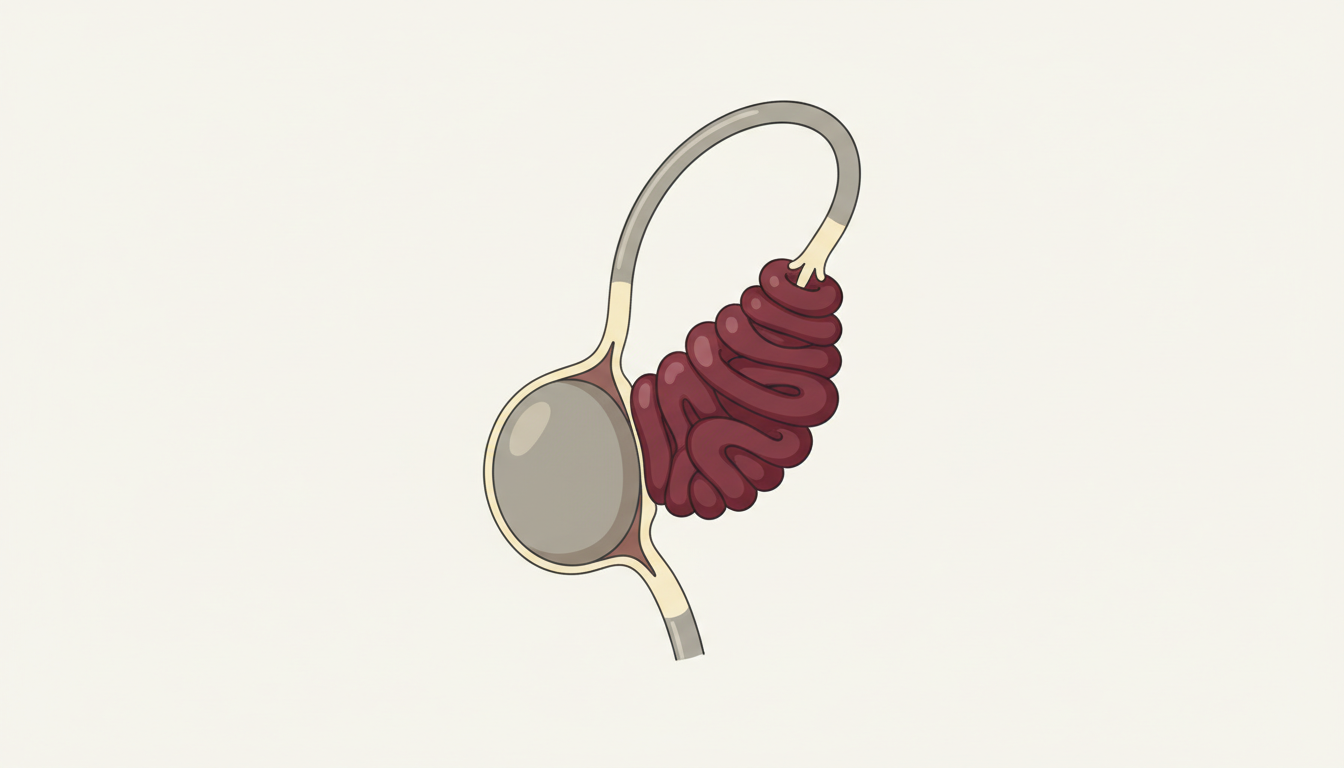
The infection starts at the urethra. Chlamydia trachomatis binds to the cells lining the urethral tract and replicates there for days to weeks. In men with no symptoms, that is often where the story pauses. In a smaller fraction, usually weeks in, the bacteria climb upward through the vas deferens, the muscular tube that carries sperm, and settle in the epididymis on one side.
The epididymis is a tightly coiled tube about six meters long if you stretched it out, packed into a small comma-shaped structure pressed against the back of each testicle. Its job is to mature and store sperm. When chlamydia colonizes that tissue, the body responds with inflammation: swelling, increased blood flow, warmth, and tenderness. That inflammatory response is what the patient feels as a dull, one-sided ache, sometimes a heaviness, sometimes pain on touch, occasionally accompanied by a low-grade fever or a slight reddening of the scrotum on the affected side.
Because the inflammation is concentrated at the back of the testicle rather than inside it, the pain often feels deep but slightly off-center. Many men describe it as pressure, not stabbing. The CDC's STI treatment guidelines describe the typical clinical picture as unilateral testicular pain and tenderness with palpable swelling of the epididymis (CDC, STI Treatment Guidelines: Epididymitis).
Two extra wrinkles make this presentation easy to miss. First, urethral symptoms are inconsistent. Some men with chlamydia-related epididymitis still have no burning urination and no discharge by the time the testicle hurts. Second, the body can run a quiet, low-grade infection for a long time without producing classic systemic symptoms like fever or chills. The NHS lists testicular pain and scrotal swelling as the defining symptoms of epididymitis (NHS, Epididymitis), and the same page notes the pain can build either suddenly or gradually. When that pattern shows up after a recent unprotected exposure, the next step is a swab test in the right detection window.
Other causes of one-sided testicle pain
Chlamydia is one cause on a longer list. Before testing or treatment, it is worth knowing what else can produce the same general complaint, because the urgency is wildly different across the differential. Some of these are emergencies. Some are benign and need only reassurance. Knowing which bucket you are in helps decide whether the right next step is a home swab, a clinic visit, or an ER trip.
The table below summarizes the most common causes, the symptom patterns that suggest each, and how urgent action should be. None of this replaces a real exam if pain persists or worsens, but it can help orient where to start.
| Cause | Typical pattern | Sex-related? | Urgency |
|---|---|---|---|
| Chlamydia or gonorrhea epididymitis | Dull, one-sided ache building over days; possible heaviness, mild swelling, low-grade fever | Yes | Test within 7-14 days; treat promptly |
| Testicular torsion | Sudden, severe, one-sided pain; testicle may sit higher; nausea or vomiting | No | Emergency, go to ER now |
| Inguinal hernia | Groin bulge or pressure that worsens with lifting or coughing | No | Surgical evaluation needed |
| Varicocele | Soft, ropey feel above the testicle; dull ache that worsens after standing | No | Usually benign; checkup if uncomfortable |
| Trauma or sports injury | Localized pain after a clear impact; possible bruising or swelling | Sometimes | Variable; severe trauma needs imaging |
| Urinary tract infection | Pain or burning with urination; frequent urge to pee; possible fever | Sometimes | Test and treat with antibiotics |
| Mumps orchitis (rare) | Swelling of one or both testicles, often after parotid gland swelling | No | Clinical evaluation; supportive care |
Detection windows for STDs linked to testicle pain
Timing is the single most overlooked variable in home STI testing. Test too early, after a recent exposure but before the bacteria have replicated to detectable levels, and a negative result can give a false sense of safety. Test in the right window, and a negative is meaningful. The window varies by infection and by sample type, which is why the same person can need different timing for different tests.
For chlamydia specifically, most rapid swab tests become reliable about 7 to 14 days after exposure, and lab-based nucleic acid amplification (NAAT) testing reaches peak sensitivity around the 14-day mark. The CDC's chlamydia treatment guidelines describe the test of cure and retesting protocols that depend on this window (CDC, Chlamydia Treatment Guidelines). The numbers below summarize windows for the infections most often linked to testicular pain.
| Infection | Earliest reliable detection | Peak accuracy window | Linked to testicle pain? |
|---|---|---|---|
| Chlamydia | 7 days post-exposure | 14 days and beyond | Yes, via epididymitis |
| Gonorrhea | 5-7 days post-exposure | 7-14 days | Yes, often with discharge |
| Mycoplasma genitalium | 14 days post-exposure | 3-4 weeks | Less common cause of epididymitis |
| Trichomoniasis (men) | 1-4 weeks post-exposure | 2-3 weeks | Rare, usually urethritis |
| E. coli or other UTI bacteria (older men) | Symptoms guide testing | N/A | Yes, especially over age 35 |
Choosing the right kind of test
Two main testing technologies dominate the chlamydia landscape, and they answer slightly different questions. Lab-based nucleic acid amplification testing (NAAT) is the analytical gold standard. It detects the genetic material of the bacterium directly and has the highest sensitivity and specificity figures published. A clinic, urgent care, or sexual-health center will typically use NAAT on a urine sample, a urethral swab, or a self-collected swab depending on the protocol and the suspected infection site.
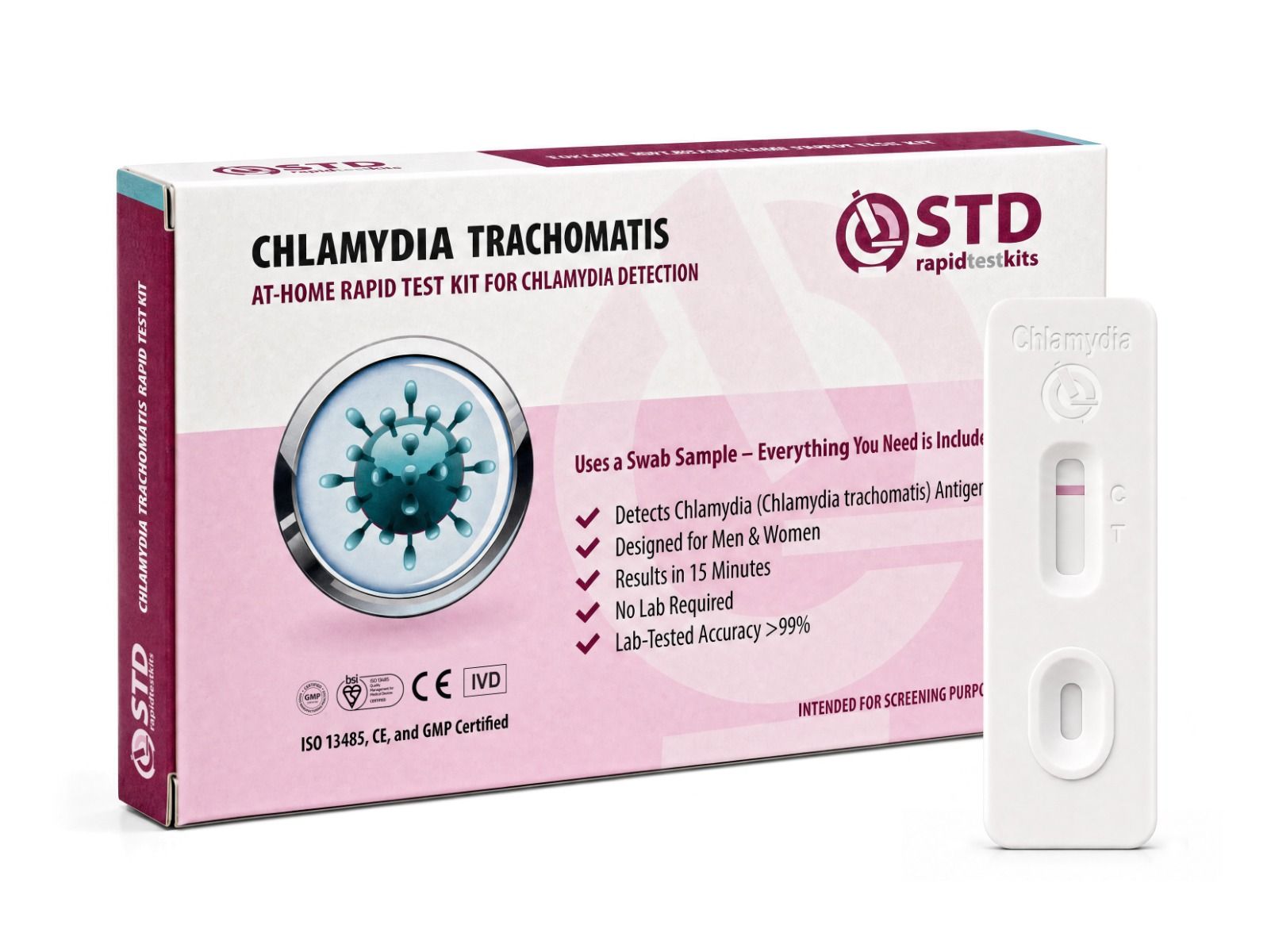
Home rapid tests, including the swab-based kits sold here, use lateral-flow immunoassay chemistry: the same general technology family as a home pregnancy test or a COVID-19 rapid antigen test, applied to chlamydia antigens. They are not NAAT and are not equivalent to a lab NAAT in analytical sensitivity, especially in genuinely asymptomatic infections. They are a screening tool, useful for getting a fast, private answer when symptoms are present, when an exposure is on your mind, or when waiting for a clinic appointment is not realistic.
A positive home result is worth acting on right away (call a clinician, get the prescription, notify partners). A negative home result during the right window is reassurance, but it does not have the analytical depth of a lab NAAT. If pain persists after a home negative, follow up with a clinic for confirmation. The two tools are complementary, not interchangeable.
For testicle pain specifically, a self-collected genital swab is the relevant home option. Urine testing, NAAT-grade panels, and pharyngeal or rectal swabs are not products this site sells; if you need those (for example, throat swabbing after oral exposure), a clinic remains the right route. The self-swab kit answers the genital-route question quickly and privately, which covers the most likely source for chlamydia epididymitis.
What a positive result means and how treatment works
The good news, and it is genuinely good, is that chlamydia is one of the simpler STIs to treat. The current CDC first-line regimen is doxycycline 100 mg orally twice a day for 7 days for uncomplicated genital chlamydia (CDC, Chlamydia Treatment Guidelines). For chlamydia-related epididymitis specifically, the CDC recommends a combination regimen of ceftriaxone (a single intramuscular dose to cover possible co-infection with gonorrhea) plus doxycycline 100 mg twice a day for 10 days (CDC, Epididymitis Treatment Guidelines). No surgery. No procedures. Just a prescription, a few days of antibiotics, and pain management with rest, scrotal elevation, and over-the-counter anti-inflammatories while the inflammation calms down.
Pain usually starts to improve within 48 to 72 hours of starting antibiotics, though residual tenderness can linger for two to four weeks as the inflammation fully resolves. If symptoms are not improving by day three of the antibiotic course, that warrants a follow-up to rule out other causes (such as gonorrhea co-infection that needs different coverage, or a non-bacterial cause).
A few important practical notes. Doxycycline can be hard on an empty stomach; take it with food and a full glass of water. Avoid strong sun exposure during the course because doxycycline causes photosensitivity. Skip sex or use condoms for at least seven days after starting treatment, and longer if symptoms persist. And expect a follow-up: the CDC recommends retesting men treated for chlamydia about three months after treatment, not as a test of cure, but to catch reinfection from untreated partners.
Among sexually active men aged less than 35 years, acute epididymitis is most frequently caused by C. trachomatis or N. gonorrhoeae. Acute epididymitis caused by sexually transmitted enteric organisms also occurs among men who are the insertive partner during anal sex.
Retesting, reinfection, and the fertility question
A negative result is not always the end of the story. There are three scenarios where retesting really matters, and each one trips up readers who assume they are done after a single test.
The first is the early-window negative. If a swab is taken three days after a suspected exposure and comes back negative, that result has limited weight because the bacteria may not have replicated to detectable levels yet. If symptoms (especially that one-sided testicular ache) are persisting, retesting around day 14 catches infections that were too small to register on day 3.
The second is a persistent symptom after treatment. Most men feel substantially better within a week of starting antibiotics. If a testicular ache, swelling, or tenderness is still present three to four weeks after the prescription is finished, follow up with a clinician. The most common explanation is residual inflammation that simply needs more time, but it can also flag treatment failure, an antibiotic-resistant strain, or a missed co-infection that needs a different regimen.
The third is reinfection. The CDC recommends a follow-up test about three months after chlamydia treatment for both men and women, regardless of whether their partners were also treated. Reinfection rates are high enough, particularly when partners go untreated, that this three-month re-screen is part of the standard protocol (CDC, Chlamydia Treatment Guidelines).
The fertility question is the one most readers actually want answered, and the honest answer has two parts. For most men, a single episode of chlamydia caught and treated promptly leaves no measurable long-term reproductive impact. The infection clears, the inflammation resolves, sperm transport returns to normal. The risk profile changes when chlamydia goes untreated for months or recurs repeatedly. Chronic or repeated epididymitis can scar the epididymis or vas deferens, narrowing the channels sperm travel through. The CDC's epididymitis treatment guidelines specifically list infertility and chronic pain as complications the antibiotic regimen aims to prevent (CDC, Epididymitis Treatment Guidelines). Waiting and reinfection are the two things that move the needle on fertility risk.

Telling a partner without the spiral
Partner notification is the part of the testing process most people would skip if they could, and it is also the part that most determines whether the infection comes back. Untreated partners reinfect treated ones at high rates, which is why the CDC's three-month retest exists in the first place. The choice is not whether to handle this conversation. It is how.
For a current or recent partner, a calm, direct message tends to land better than an apology spiral. Most people, in the moment, are grateful to be told. The script flips when the conversation starts with shame, so leading with the facts and the practical next step usually works better than leading with the feeling.
For situations where a face-to-face message is not safe or possible, anonymous partner notification services exist. Many state and county health departments offer them, and several telehealth platforms now run text-based versions where a former partner gets a notification of possible exposure with a link to testing resources, without identifying the sender. The CDC and most state STI programs maintain referral lists.
If a partner says they were tested and are clean, treat that information at face value, but check the timing. A negative test taken before the right window does not rule out a recent exposure. If their earlier test sat in the wrong window, ask them to repeat it at day 14 or later.
Hey, I tested positive for chlamydia. It is treatable with a short course of antibiotics, and you should get tested too. Here is the link to the same swab test I used.
Short, factual, no apology required. If you would rather not say it directly, most state and county health departments offer anonymous partner-notification services that send a discreet message on your behalf.
Why quiet symptoms deserve a loud response
The reason this article exists is that the most common chlamydia presentation in men is no presentation at all. When the body finally does signal something is off, the signal is often quiet, a one-sided ache, a heaviness, a sense that something is not right. Quiet signals are easy to ignore and easy to misattribute, and the cost of ignoring them is measured in weeks of unchecked inflammation, increased reinfection risk, and a small but real chance of long-term reproductive impact.
The fix is not panic. It is a fast, accurate test in the right window, a short course of antibiotics if the result is positive, a clear conversation with a partner, and a three-month follow-up to confirm the infection is truly gone. None of those steps is dramatic. All of them are easier than waiting and wondering.
Product: STD-8
FAQs
- Can chlamydia really cause testicle pain with no other symptoms?
- Yes. Chlamydia's progression to the epididymis can happen with no urethral warning, no discharge, and no burning urination. The testicular ache, when it appears, may be the first and only outward sign, sometimes weeks after the original exposure. The mechanism is the same regardless of how loud the upstream infection was: bacteria climb from the urethra through the vas deferens and inflame the epididymis on one side.
- How long after sex would chlamydia cause testicle pain?
- Pain that starts within 24 to 48 hours of sex is rarely chlamydia; that is usually a strain or irritation. Chlamydia-related epididymitis tends to show up one to three weeks post-exposure, sometimes later. If a recent unprotected exposure lines up with a quiet ache, that timing fits.
- What does chlamydia testicle pain actually feel like?
- Most men describe it as a dull, one-sided ache or pressure that builds over hours to days, not a sharp stab. The affected testicle often feels heavier, sometimes warm or slightly swollen. Pain may worsen with prolonged standing or after activity, and it does not reliably improve with rest the way a muscular strain does.
- When should I worry that it is testicular torsion instead?
- Sudden, severe one-sided pain, especially with nausea or vomiting, or a testicle that sits visibly higher than the other, is potential torsion. That is a surgical emergency with a roughly 6-hour window to save the testicle. Skip the home test and go to an ER. The slow, gradual ache pattern this article describes is the opposite of torsion.
- Does the at-home chlamydia test use urine or a swab?
- Swab. A self-collected genital swab, with a result at home in about 15 minutes. If it comes back positive, contact a clinician right away for the antibiotic prescription and partner-notification steps. A negative result during the right detection window (about 7 to 14 days after exposure) is reassurance; if symptoms persist, follow up at a clinic for a confirmatory NAAT.
- If I test negative but the pain stays, what next?
- First, check the timing. A test taken within the first week after exposure may be too early; retesting around day 14 catches infections that were too small to register earlier. If a properly-timed test is still negative and pain continues, see a clinician. Other causes such as bacterial UTI, mycoplasma, varicocele, hernia, or non-infectious epididymitis can mimic the same pattern.
- Will this affect my fertility long-term?
- For one episode caught and treated promptly, the long-term reproductive impact for most men is minimal. The risk rises with chronic or repeated infections that scar the epididymis or vas deferens. The single biggest predictor of long-term outcome is not how serious the infection looks now, but how quickly it gets treated and whether reinfection is prevented.
- Should I avoid sex until I get my results back?
- Yes, until you know. If a test comes back positive, the CDC recommends abstaining or using condoms for at least seven days after starting treatment, and until both partners are clear. If pain is present, sex is also more likely to be uncomfortable; pausing serves both diagnostic clarity and basic comfort.
- U.S. Centers for Disease Control and Prevention. About Chlamydia: overview, common asymptomatic presentation, and complications.
- U.S. Centers for Disease Control and Prevention. STI Treatment Guidelines: Epididymitis (clinical presentation, causes in men under 35, recommended ceftriaxone plus doxycycline regimen, infertility and chronic pain as complications).
- U.S. Centers for Disease Control and Prevention. STI Treatment Guidelines: Chlamydial Infections (first-line doxycycline regimen, retesting at three months, asymptomatic infection note).
- NHS. Epididymitis: presentation, common causes including chlamydia and gonorrhoea, and when testicular pain warrants medical assessment.
- World Health Organization. Sexually transmitted infections (STIs) fact sheet: global burden of chlamydia and other STIs, general background on transmission and prevention.
