Published: October 2025 | Last updated: May 2026 | Editorial review and quality control: Martina N.
When is testicle pain or swelling a medical emergency?
Treat it as an emergency when pain starts suddenly and severely, especially with nausea, a high-riding testicle, or rapid swelling. Those signs point to testicular torsion. Per the <a href="https://my.clevelandclinic.org/health/diseases/15382-testicular-torsion" target="_blank" rel="noopener noreferrer">Cleveland Clinic</a>, nearly all testicles are saved within four to six hours; only about half survive past twelve. Slow-building swelling with fever or urinary symptoms usually means infection, not torsion.
A sudden, sharp pain in one testicle is one of the very few medical situations where the clock genuinely matters. Most causes of scrotal swelling are infections that respond to antibiotics, mild fluid buildup, or strain that resolves on its own. A smaller fraction are different in character: a twist of the spermatic cord that pinches off the testicle's own blood supply. The body has roughly six hours from the moment the cord twists before tissue starts dying, so the cost of waiting and Googling is measured in hours, not days.
The guide below separates those patterns: which symptoms call for the ER that night, which can wait for a same-day clinic, and how infections like chlamydia and gonorrhea produce a slow-building swelling that gets mistaken for both extremes. The goal is to replace the spiral of "is this serious?" with a clear next step.
Key Takeaways
- Sudden, severe one-sided testicle pain is testicular torsion until a doctor proves otherwise. Treatment within roughly six hours saves the testicle in most cases; the chance drops sharply after twelve hours.
- Slowly building swelling, especially with burning urination, discharge, or recent unprotected sex, usually means epididymitis from chlamydia or gonorrhea and needs same-day clinic care, not the ER.
Why Doctors Treat Sudden Testicle Pain as a True Emergency
The testicles get their blood supply through the spermatic cord, a narrow bundle of arteries, veins, and nerves that runs from the abdomen down into the scrotum. Mechanically, this arrangement is fragile. If the cord rotates around its own axis, it can pinch off its own blood supply in seconds, the same way a kink in a garden hose stops the water.
Without circulation, the testicle starts running out of oxygen. According to the Cleveland Clinic, almost everyone keeps the testicle when treatment happens within four to six hours. By twelve hours, the success rate falls to roughly fifty percent. After twenty-four hours, only about one in ten testicles can be saved. The clinical reference StatPearls (Acute Scrotum Evaluation) reports the same window, with salvage approaching 100 percent inside six hours and dropping below 50 percent past the 12-to-24-hour mark.
That biology is the reason emergency physicians take sudden one-sided testicle pain seriously even when the patient looks otherwise fine. The condition the ER is screening for is testicular torsion. Two related diagnoses sit close behind it on the list: torsion of a small appendage of the testicle (less dangerous but with similar pain) and a strangulated inguinal hernia. All three are time-sensitive surgical problems that look similar from the outside.
When torsion is caught early, surgery to untwist the cord usually restores normal function and the testicle heals fully. When it is caught late, the testicle often has to be removed.
Sudden one-sided testicle pain is the body asking for an emergency room visit, not more reading. The Cleveland Clinic salvage curve is steep: nearly all testicles are saved within four to six hours of onset, about half by twelve hours, only about ten percent after twenty-four. The cost of getting checked and finding out it's something else is one ER copay. The cost of waiting on actual torsion is the testicle itself.
The Warning Signs That Mean Go to the ER Now
Most testicular emergencies follow a recognizable shape. The pain shows up suddenly, often in the middle of normal activity or even during sleep, and it does not ease when the person sits, lies down, or shifts position. One side hurts; the other side feels normal. The testicle on the affected side may sit higher in the scrotum or sit at an unusual angle.
Nausea and vomiting often track with the pain. Severe internal pain can trigger the same vomiting reflex that drives motion sickness, so the urge to throw up alongside testicle pain pushes the suspicion of torsion up considerably. Cleveland Clinic lists nausea, vomiting, abdominal pain, and a high-riding testicle as classic accompanying signs.
If two or more of the signs below appear together, do not wait for a primary-care appointment. Go to the emergency department, ideally one with surgical capability available overnight.
ER-Worthy Warning Signs
Two or more of these appearing together strongly raises the suspicion of torsion. Do not wait, do not call a same-day clinic; go straight to an emergency department.
- Sudden, severe one-sided testicle pain (treated as testicular torsion until proven otherwise) Common
- One testicle sitting visibly higher than the other or angled abnormally Common
- Nausea or vomiting that started together with the pain Common
- Pain that woke you from sleep with no clear trigger Common
- Rapid scrotal swelling within hours of onset Less common
- Severe tenderness with a hard, tense scrotum on the affected side Less common
How Onset Speed Sorts the Causes
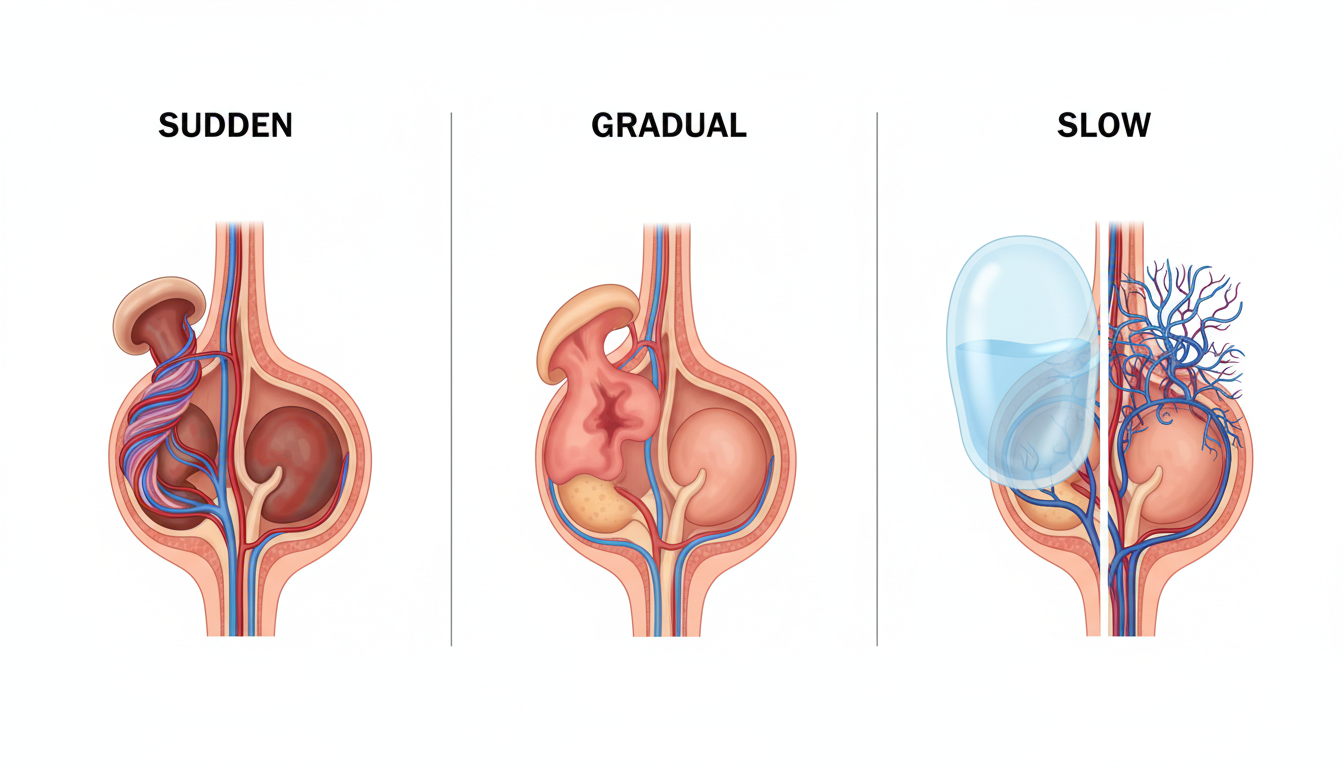
How fast the pain arrived is the single most useful question a provider or patient can ask. Onset speed sorts most of the conditions on the differential into the right urgency bucket before any imaging happens. Sudden onset (minutes to a couple of hours) is the dangerous pattern. Gradual onset (one to three days) is the infection pattern. Slow onset (weeks to months) is usually a non-emergency, like a hydrocele or varicocele.
That speed pattern is so consistent that it is the first question any urgent-care or ER provider will ask.
When Swelling Builds Slowly: The Infection Pattern
Not every swollen testicle is an emergency. A common alternative pattern looks completely different from torsion. Swelling that builds gradually over twenty-four to seventy-two hours, an ache that gets worse with walking or sitting, sometimes a low-grade fever, sometimes a burning sensation when urinating; that constellation usually points to infection rather than a twisted cord.
Behind this slow-build pattern, the most frequent diagnosis is epididymitis, an inflammation of the epididymis (the small coiled tube behind the testicle that stores sperm as it matures). Per the NHS, epididymitis usually develops over a few days, and the ache typically worsens with walking, sitting, or other movement. Recovery often starts within a few days of antibiotics, though full resolution can take up to three months.
The cause depends heavily on age. In men under thirty-five, a sexually transmitted infection is the most common driver, with chlamydia and gonorrhea responsible for the bulk of cases (per the CDC STI Treatment Guidelines and MedlinePlus). In older men, or in men with a history of urinary tract problems, enteric bacteria such as E. coli are usually the source instead. Treatment is similar either way: a targeted course of antibiotics, supportive care, and rest, though the specific regimen shifts depending on whether the underlying organism is sexually transmitted or enteric.
Timing and progression separate the two conditions. Torsion peaks within hours and stays severe; epididymitis builds over days and usually shows infection signals (fever, urinary symptoms, discharge) that torsion almost never produces. An ultrasound usually settles the question in minutes when the clinical picture is ambiguous.
Gradual swelling over one to three days, plus burning urination, discharge, or low-grade fever, points to epididymitis, not torsion. Torsion peaks within hours and almost never produces fever or urinary symptoms. If your symptom set includes infection signals, you have time to call a same-day clinic. If it doesn't, treat it as the ER pattern.
Common Causes Behind a Swollen Testicle
A handful of conditions account for almost every case of scrotal swelling. Knowing the shortlist helps reduce the panic that comes with a Google search returning every possible diagnosis. The table below maps the most common causes onto their typical symptom pattern and urgency level.
| Condition | Typical symptoms | Urgency level |
|---|---|---|
| Testicular torsion | Sudden severe pain, nausea, high-riding testicle | Emergency, ER tonight |
| Epididymitis (often STI-driven in younger men) | Gradual swelling, tenderness, urinary burning, sometimes fever | Same-day clinic |
| Orchitis | Inflammation of the testicle, often viral or bacterial | Same-day clinic |
| Hydrocele | Painless fluid buildup, gradual enlargement | Routine evaluation |
| Varicocele | Enlarged veins causing dull ache or heaviness | Routine evaluation |
| Inguinal hernia | Bulge that may extend into scrotum, worse with strain | Same-day if painful |
| Trauma or strain | Pain and swelling after a clear injury | Urgent care if severe |
How Chlamydia and Gonorrhea Trigger Epididymitis
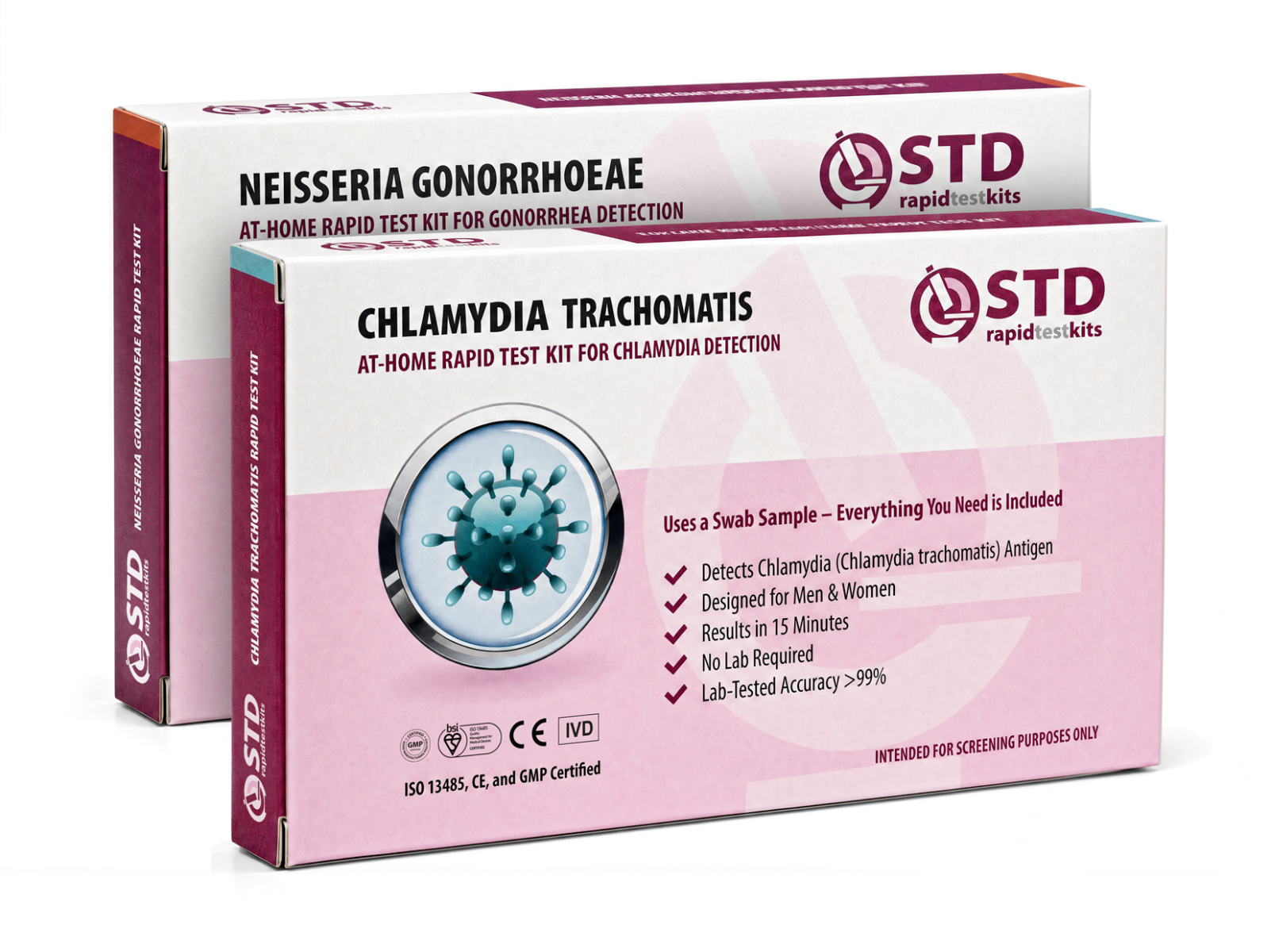
The link between sexually transmitted infections and a swollen testicle is more direct than most people realize. Chlamydia and gonorrhea are bacterial infections that start in the urethra and can travel upward through the reproductive tract. When they reach the epididymis, they trigger inflammation of the tube wall and the surrounding tissue, which produces the heavy, dragging ache and swelling behind the testicle. That is why an at-home chlamydia and gonorrhea test is the first useful screen when this pattern shows up.
Symptoms follow a consistent pattern. There is often a slow build over one to three days. Many patients also notice a burning sensation when urinating, a thin discharge from the tip of the penis, or a feeling of pelvic discomfort. The affected side feels heavy, tender, and warm to the touch. Importantly, this can happen without any of the usual STI signs first. No discharge, no sores, just a one-sided ache that does not let up. That gap is exactly why STI-linked epididymitis often gets ignored.
The connection between recent unprotected sex and this kind of swelling is high enough that the NHS recommends testing both the patient and any recent sexual partners when an STI is the suspected cause. Untreated infections can spread further through the reproductive tract and, in a small percentage of cases, lead to fertility issues (per the Cleveland Clinic epididymitis page and the same CDC treatment guidance). Catching the infection early with the right antibiotic course usually clears both the swelling and the underlying organism.
Disclosure: stdrapidtestkits.com sells rapid at-home lateral-flow swab tests for both infections. A positive home result still warrants clinic confirmation and a prescription for antibiotics; we recommend the kit below because it fits this specific clinical picture, not because it replaces a clinician.
How Doctors Tell Torsion From Infection
One of the most stressful parts of testicle pain is the uncertainty. The symptoms can feel dramatic, and many men worry about whether they are overreacting or, worse, ignoring something serious. In the emergency department, the workup follows a fairly structured path that usually takes less than an hour.
When torsion is suspected, providers start with a physical exam. They look at scrotal skin color, the testicle's position, the cremasteric reflex (a small upward muscle twitch normally produced when the inner thigh is stroked, often absent on the affected side in torsion, though StatPearls notes it is less diagnostically reliable than once believed), and whether gently lifting the testicle eases or worsens the pain. Pain that improves on lifting is sometimes called Prehn's sign and points toward epididymitis, though clinicians treat it as suggestive rather than definitive.
Imaging usually settles the question. A scrotal Doppler ultrasound is the standard test. The Doppler view shows whether blood is flowing into the testicle. Reduced or absent flow on one side is the strong sign of torsion and triggers an immediate move toward surgery. Normal or increased flow on a swollen side points the workup toward infection or fluid buildup, with urinalysis and STI testing as the next steps.
If the clinical picture strongly suggests torsion, surgeons may proceed straight to the operating room without waiting for full imaging. The reason is simple: every additional thirty minutes of waiting is thirty minutes the testicle is without blood. A practical scope note: rapid at-home tests can help identify a bacterial STI cause behind suspected epididymitis, but they cannot diagnose torsion. Torsion is a Doppler-ultrasound diagnosis in the ER.
Two diagnostic results settle most scrotal-pain visits quickly. An absent cremasteric reflex (the small thigh-stroke twitch that disappears when the cord is twisted) raises suspicion sharply. A scrotal Doppler ultrasound showing reduced or absent blood flow on the affected side confirms it. Together, those two findings justify moving straight to the operating room without further testing.
What Happens If You Wait Too Long
Many men delay seeking help because they hope the symptoms will fade on their own. The hesitation comes from a mix of embarrassment, uncertainty about whether the symptoms are "serious enough," and a habit of waiting to see how things develop. With most aches that habit is fine. With sudden testicle pain it is the wrong call.
One specific trap is intermittent torsion. The spermatic cord can twist, briefly untwist (which feels like the problem resolved), and then twist again, often worse than before. Each cycle damages tissue. Pain that fades is not the same as pain that has resolved, and an episode of severe one-sided pain that calmed on its own still warrants evaluation to confirm the cord is stable.
The cost of waiting depends on the cause. Waiting a day with mild epididymitis usually does not change the outcome much; antibiotics still work, the swelling still resolves, and full recovery takes the usual few weeks. Waiting six hours with torsion can cost the testicle entirely. Waiting twenty-four hours with torsion almost always costs it.
Untreated infections do not stay still either. Bacterial epididymitis can spread to the testicle itself (orchitis), can scar the reproductive tract, and the Cleveland Clinic notes that in rare cases it can affect long-term fertility. Most of those complications happen when an infection goes untreated for an extended period, so prompt antibiotic treatment is the main way to prevent them.
Almost everyone keeps their testicle if they get treatment within four to six hours. Around half of people keep their testicle if they get treatment after 12 hours. Only around 10% of people keep their testicle if they get treatment after 24 hours.
Common Myths That Cost People Time
Delay rarely happens because someone wants to ignore a serious symptom. It happens because of small, plausible-sounding stories the brain tells in the moment. Clinical reviews of missed or delayed torsion cases turn up the same handful of assumptions over and over (per StatPearls, Acute Scrotum Evaluation). Naming them helps short-circuit them.
Beliefs That Cost Testicles
Myth: If it were truly serious, the pain would be unbearable from the start.
Fact: Torsion can begin at moderate intensity and ramp up over minutes to hours. By the time the pain is unbearable, the salvage window may already be closing. Severity is a poor proxy for urgency; onset speed is the better signal.
Myth: It eased on its own for a while, so it probably fixed itself.
Fact: The spermatic cord can twist, partially untwist (feeling like resolution), and then re-twist, often worse. Each cycle damages tissue. A sudden severe episode that calmed deserves an evaluation, not relief.
Myth: I'm too young and healthy for something like torsion.
Fact: The opposite is true. Torsion is most common in adolescents and men under 25. The Cleveland Clinic flags age 12 to 18 as the peak risk window, with a smaller secondary peak in the first year of life.
Myth: It's probably just from rough sex or working out hard.
Fact: Strain and blunt trauma can cause real pain, but new severe one-sided testicle pain after any cause still needs evaluation. Trauma can trigger torsion in someone with a predisposing anatomical setup, so a clear cause does not rule out a serious effect.
Myth: I'll give it overnight and see how it looks in the morning.
Fact: Overnight is often the difference between saving and losing the testicle. The six-hour window starts when the cord twists, not when you decide to take it seriously. Going in at 2 a.m. is the right move when symptoms fit the torsion pattern.
Painless Swelling Is Still Worth a Check
One of the most overlooked patterns is swelling without pain. Many men assume that if it does not hurt, it cannot be serious. That assumption misses a few important conditions. Hydroceles (fluid collections around the testicle) and varicoceles (enlarged scrotal veins) are usually painless and slow-developing; they are non-emergencies but still benefit from a urology evaluation, especially when they affect comfort or fertility.
The condition that makes painless evaluation genuinely important is testicular cancer. It typically presents as a firm, painless lump on or attached to the testicle itself, sometimes with a feeling of heaviness on the affected side. Testicular cancer is most common in men aged fifteen to thirty-five, per the National Cancer Institute, and survival rates are very high when caught early. Urologists routinely recommend a scrotal ultrasound for any new, persistent lump or asymmetry, even when nothing hurts.
None of these painless causes need an ER visit. They do, however, deserve a primary-care or urology appointment within the next week or two rather than indefinite waiting.
Testicular cancer is most common between ages fifteen and thirty-five and typically shows up as a firm, painless lump rather than as pain. Survival rates are very high when caught early, and a brief outpatient ultrasound is usually all the workup needed to start sorting out the cause. If you've found a new lump or one side feels heavier than the other, book a urology or primary-care visit in the next one to two weeks.
A 60-Second Self-Assessment When You're Not Sure
If symptoms have appeared in the past hour or the past day and the right next step is not obvious, run the questions below. They mirror the triage questions used in emergency departments. Each "yes" in the top three rows raises the suspicion of an emergency enough to skip the wait-and-see option and go straight to the ER.
| Question | If yes | What to do |
|---|---|---|
| Did the pain start suddenly within the past few hours? | Yes | Go to the ER tonight |
| Is the pain severe and getting worse fast? | Yes | Go to the ER tonight |
| Are you nauseous or vomiting alongside the pain? | Yes | Go to the ER tonight |
| Did severe pain briefly ease then return? | Yes | Possible intermittent torsion; go to the ER |
| Did swelling build slowly over a day or more? | Yes | Same-day clinic visit |
| Is there burning urination or unusual discharge? | Yes | Likely STI epididymitis; test and see clinician |
| Did symptoms start after a clear injury? | Yes | Urgent care if severe; otherwise watch closely |
| Painless lump that is not changing much? | Yes | Routine urology appointment in 1-2 weeks |
When At-Home STI Testing Fits the Picture
At-home testing is not a replacement for the ER when sudden pain points at torsion. Home STI tests detect specific infections; they cannot evaluate blood flow to the testicle, which is the job of a Doppler ultrasound. They are a useful tool in the slow-building, infection-pattern case, especially after a recent unprotected encounter. The two questions a home test can answer quickly: is this likely an STI-driven infection, and which one. The clinical visit still matters for treatment (antibiotic prescriptions need a provider), but walking in with a positive home result already in hand shortens the diagnostic loop.
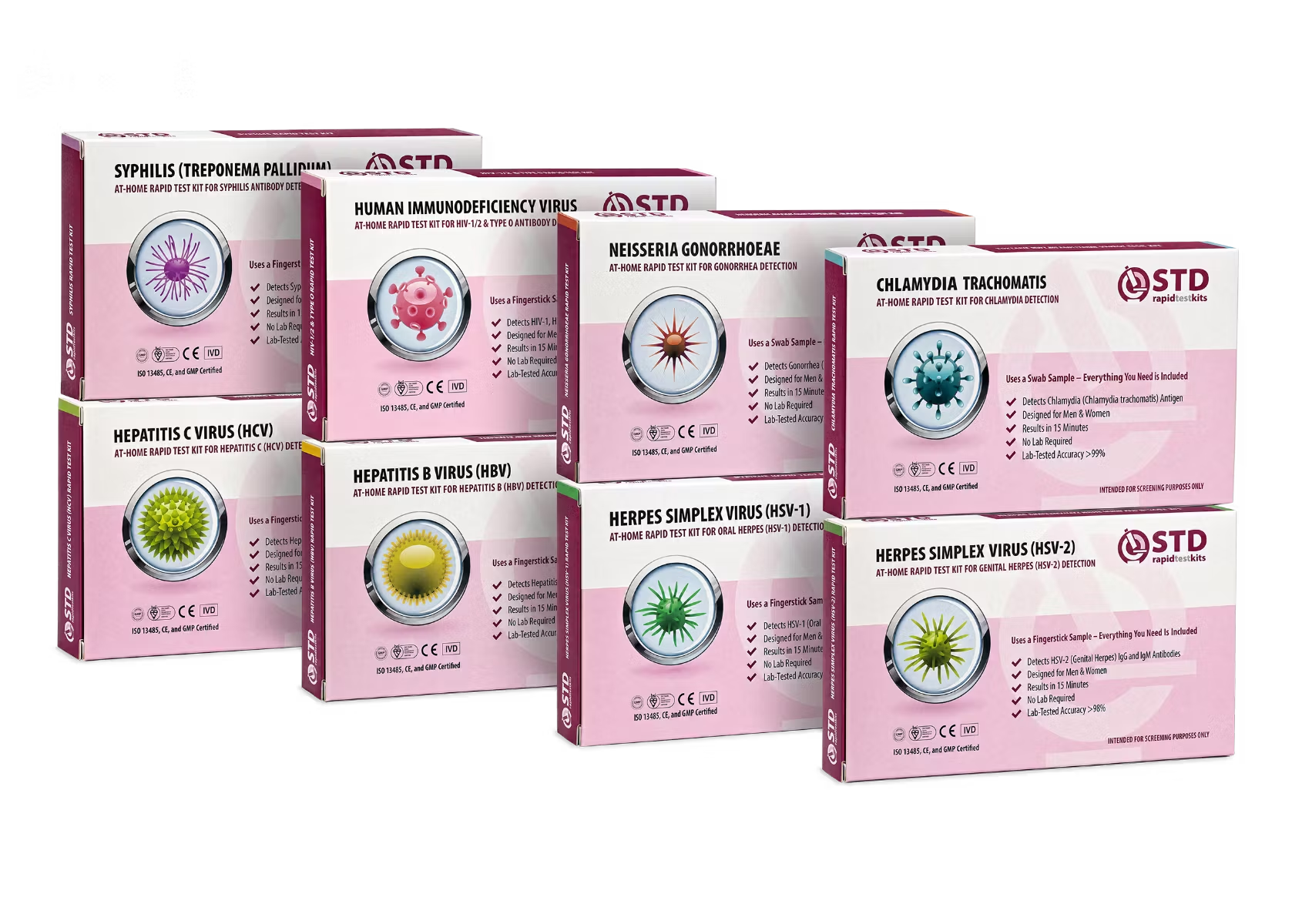
The relevant home tests for scrotal swelling are the rapid lateral-flow swab kits for chlamydia and gonorrhea (the two main bacterial drivers of epididymitis under thirty-five), and the broader multi-infection panels that add HIV, syphilis, hepatitis B, and hepatitis C blood-screen components for a fuller risk picture. The lateral-flow kits are screening tests, not lab-grade NAATs; a positive result is worth confirming with a clinician and a lab test before starting any treatment, but a positive result is also reliable enough to act on the same day. Our kits also do not cover urine samples, rectal swabs, or throat swabs; for those, a clinic visit is the right channel.
What to Expect at the ER or Same-Day Clinic
Walking into the ER with testicle pain feels intimidating, partly because of the body part involved and partly because most people have not done it before. The actual visit is more efficient than expected. After triage and a brief history (when pain started, what it feels like, any recent sexual activity, any injury), the workup usually moves through a focused physical exam, a urinalysis, and a scrotal Doppler ultrasound. The whole sequence often takes under ninety minutes.
If torsion is confirmed or strongly suspected, the next step is the operating room. Surgery to untwist the cord (orchiopexy) takes about an hour and usually involves stitching both testicles to the inner scrotal wall to prevent recurrence. Most men go home the same day or the next morning.
If infection is the diagnosis, the path is simpler. Antibiotics are prescribed (often a combination targeting both chlamydia and gonorrhea while waiting for confirmatory test results), an anti-inflammatory like ibuprofen helps with pain, and rest with scrotal support speeds recovery. Symptoms typically improve within a few days; full resolution can take several weeks. Sexual partners should also be tested if an STI is confirmed. The NHS recommends notifying partners from the past six months, while the CDC STI Treatment Guidelines use a 60-day window prior to symptom onset. Follow whichever threshold your provider or local public-health authority recommends.
Your Next Step Based on Symptom Pattern
Sudden severe one-sided testicle pain, nausea or vomiting with the pain, or a testicle riding visibly higher?
Yes: Go to the ER now. Do not wait for a clinic to open and do not wait to see whether the pain settles on its own. The salvage window for torsion is roughly four to six hours.
Slow-building swelling over one to three days, with burning urination, discharge, or recent unprotected sex?
Yes: Book a same-day clinic visit for likely epididymitis. Consider an at-home chlamydia and gonorrhea lateral-flow screen to bring to the appointment so the provider can act on the result faster.
New, firm, painless lump with no other symptoms?
Yes: Book a primary-care or urology appointment within one to two weeks for a scrotal ultrasound.
No: If your symptoms do not match any of the patterns above but are persisting longer than two days or worsening, contact a clinician for an in-person evaluation.
Match the pattern that fits your situation right now. When you cannot decide between two paths, the ER is always the safer default.
Frequently Asked Questions
- I woke up with sudden testicle pain. Is this an emergency?
- Yes, treat it as one until proven otherwise. Sudden one-sided pain that wakes a person from sleep is one of the more concerning torsion patterns; pain does not gradually build during sleep. Go to the emergency department now rather than waiting for morning. The Cleveland Clinic notes that almost all testicles are saved when treatment happens within four to six hours of onset, and the rate drops sharply after twelve hours.
- What does testicular torsion actually feel like?
- Torsion pain is distinctive because it starts severe rather than building. Many men can name the exact minute it began, often while asleep or at rest. The testicle may sit noticeably higher or feel tilted, and nausea or vomiting often follow within minutes. Resting, lying down, or holding the area provides little to no relief, which is one of the clearest differences from a strain or muscle pull.
- How do I know if it is torsion or just an infection?
- Onset speed is the strongest clue. Torsion appears suddenly, often within minutes, peaks at severe pain, and frequently brings nausea or vomiting. Infection-related epididymitis builds over one to three days, often comes with burning urination or discharge, and may include a low-grade fever. The two can look similar enough that a Doppler ultrasound is what actually confirms the diagnosis in the ER.
- The pain eased on its own. Am I in the clear?
- Not necessarily. Get evaluated regardless. Intermittent torsion happens when the cord twists, partially untwists, and re-twists; each cycle permanently damages tissue even if the pain fades between episodes. A single episode that resolved on its own does not mean the anatomy is stable, and the next twist may not self-resolve.
- Is it normal for one testicle to be slightly bigger than the other?
- Yes. Most men have a small natural asymmetry, with one testicle hanging slightly lower or appearing slightly larger than the other. The pattern that is not normal is a sudden change in size, position, firmness, or pain over a short window of hours or days. Any new asymmetry that develops quickly is worth a same-day check.
- Can chlamydia or gonorrhea cause testicle pain?
- Yes, and it is one of the most common causes of unexplained scrotal swelling in men under thirty-five. Both infections start in the urethra and can travel up the reproductive tract to the epididymis, the small tube behind the testicle, and trigger inflammation. The pattern is gradual swelling and dull ache rather than sudden severe pain. The CDC STI Treatment Guidelines list these two infections as the most common bacterial drivers in younger men.
- Can rough sex or a hard workout cause swelling?
- Yes, friction, blunt impact, heavy lifting, or long cycling sessions can all cause temporary scrotal soreness or mild swelling. The expected pattern is steady improvement over twenty-four to forty-eight hours of rest. If swelling instead worsens, lasts more than a few days, or pairs with fever or urinary symptoms, the explanation is more likely infection than strain.
- What if there is swelling but no pain at all?
- Any new firm painless lump in a man between fifteen and thirty-five deserves a urology appointment within one to two weeks. Testicular cancer most often presents as exactly that kind of lump, and outcomes are excellent when it is caught early. Hydroceles and varicoceles are the other usual culprits for painless swelling and are routine to evaluate, so the visit is not necessarily a cancer diagnosis. It is the check that confirms which of the three is in play.
- Do at-home STI tests help in this situation?
- At-home tests help when the picture looks like slow-build infection. They cannot help when the picture looks like sudden-pain emergency. Rapid home tests can identify chlamydia or gonorrhea quickly, which speeds up a clinic visit for suspected epididymitis. Torsion is a different question entirely: it requires a Doppler ultrasound to assess blood flow, and that only happens in the ER.
- Cleveland Clinic. Testicular Torsion overview, including the four-to-six hour, twelve hour, and twenty-four hour treatment outcome windows used for the timing claims in this article, and the peak adolescent age window for the myths section.
- Cleveland Clinic. Epididymitis patient page, used as the source for treatment expectations and possible complications including chronic scrotal pain and rare fertility issues.
- U.S. Centers for Disease Control and Prevention. STI Treatment Guidelines, Epididymitis section. Source for chlamydia and gonorrhea as the most common bacterial drivers of acute epididymitis in sexually active men and for the 60-day partner-notification window.
- U.K. National Health Service. Epididymitis page, used for the gradual-onset symptom pattern, worsening with movement, and the six-month partner-testing recommendation.
- MedlinePlus (U.S. National Library of Medicine). Epididymitis encyclopedia entry, used to corroborate chlamydia and gonorrhea as the most common cause in young heterosexual men and for the symptom progression description.
- StatPearls (NCBI Bookshelf). Acute Scrotum Evaluation. Clinical reference used for the salvage-rate windows, the cremasteric reflex and Prehn's sign exam findings, the intermittent-torsion concept, and patterns underlying the common-myths section.
- National Cancer Institute. Testicular Cancer topic page, source for the 15-35 age range claim used in the painless-swelling section.
