Tested Positive for Chlamydia Without Having Sex? Here's Why
How chlamydia spreads beyond intercourse and what to do next.




- Chlamydia spreads through mucous-membrane contact and infected genital fluids, not just penetration. Genital-to-genital rubbing, oral sex, and shared unwashed sex toys are documented (though uncommon) transmission routes.
- Treatment is short and effective: a 7-day course of doxycycline clears most uncomplicated infections. The CDC recommends retesting about three months later because reinfection from an untreated partner is common.
Published: September 2025 | Last updated: May 2026 | Editorial review and quality control: Martina N.
Can you really get chlamydia without intercourse?
Yes. Chlamydia transmits through mucous-membrane contact and infected genital fluids, so genital-to-genital rubbing, oral sex, and shared unwashed sex toys can all carry it between partners. These routes are uncommon compared with penetrative sex, but they are medically documented. A positive test means the bacterium found a route your sex-ed class never covered.
A positive chlamydia test, when you have not had penetrative sex, lands like a contradiction. Your body is saying yes; your understanding of how STIs work is saying no. Both can be true at the same time. Chlamydia trachomatis, the bacterium behind one of the most commonly reported bacterial STIs in the United States, does not read the same definitions of "sex" a high-school health class drew on a whiteboard. It travels through mucous-membrane contact, infected genital fluids, and occasionally shared objects. Penetration is the most efficient route. It is not the only route.
The U.S. reports more chlamydia diagnoses each year than any other notifiable bacterial STI (CDC chlamydia overview), and the WHO estimates 129 million new chlamydia infections worldwide annually. Asymptomatic carriage means a large share of those infections never get counted at all. What follows is a plain-English walk through the real (and rare) non-penetrative transmission paths, what a positive result tells you about your body, what to do next, and when to retest. The goal is to swap shame for information, because feeling blindsided by your own diagnosis is a public-health-education failure, not a personal one.
Key Takeaways
- Chlamydia spreads through mucous-membrane contact and infected genital fluids, not just penetration. Genital-to-genital rubbing, oral sex, and shared unwashed sex toys are documented (though uncommon) transmission routes.
- Treatment is short and effective: a 7-day course of doxycycline clears most uncomplicated infections. The CDC recommends retesting about three months later because reinfection from an untreated partner is common.
How chlamydia actually spreads beyond penetration
Chlamydia trachomatis is a bacterium that lives inside the cells of mucous membranes: the genital tract, the urethra, the rectum, the throat, and (less often) the eye. It needs that warm, moist tissue to survive. It does not live for long on dry skin, gym benches, toilet seats, or laundry. Transmission almost always involves direct mucous-membrane contact or the transfer of infected genital fluids (CDC chlamydia overview).
The textbook routes are the ones sex-ed covers: vaginal sex, anal sex, and oral sex with an infected partner. The non-textbook routes get less airtime, even though clinicians recognize them. They include:
- Genital-to-genital rubbing without penetration. Sometimes called outercourse. If both partners' mucous membranes touch (vulva to vulva, vulva to penis without entry, scrotum to vulva with fluid contact), bacteria can transfer.
- Oral sex. Performing oral sex on an infected partner can deposit the bacterium at the back of the throat, where it sometimes causes mild pharyngitis but more often causes nothing at all. Receiving oral sex from a partner whose mouth carries the bacterium can introduce it to the urethra or vulva.
- Hands or fingers carrying infected fluid. If a hand contacts fresh infected genital fluid and then touches another person's mucous membranes (or eyes), transfer is technically possible. The risk per encounter is low, but it is not zero.
- Shared sex toys used between partners or between body sites without cleaning. Toys can carry chlamydia on their surface long enough to transfer. Cleaning between uses, or covering a toy with a fresh condom for each partner, eliminates the risk.
- Mother-to-newborn transmission during childbirth. An untreated chlamydia infection in a pregnant person can pass to the baby during delivery, sometimes causing conjunctivitis or pneumonia in the newborn. Routine prenatal screening prevents most cases.
- Eye involvement via infected genital fluid. Adult inclusion conjunctivitis is a rare but documented presentation in which infected genital secretions reach the eye through fingers or a shared towel during the same encounter. It presents as a stubborn red, watery, mucousy eye that does not respond to standard antibiotic drops.
Public-health agencies are clear about what does not transmit chlamydia: the bacterium is fragile outside the body, and viral social-media claims about gym equipment, swimming pools, or shared clothing have been repeatedly debunked by clinicians.
You cannot catch chlamydia from a toilet seat, a swimming pool or hot tub, briefly sharing a towel, gym equipment, or hugging someone. The bacterium needs warm, moist mucous-membrane contact (or fresh genital fluid transfer) to survive long enough to transmit. Casual contact in public spaces is not a documented route.
How often does non-penetrative transmission happen?
Most reported chlamydia cases in the United States and the UK come from penetrative sex. Non-penetrative cases are real but uncommon, and the exact percentage is hard to pin down because patients rarely describe their full sexual history with the granularity an epidemiologist would want.
What the data does show clearly: chlamydia is widespread, often silent, and easy to acquire from a partner who does not know they are infected. The CDC's chlamydia overview notes that chlamydia often has no symptoms, particularly in the early weeks, and that when symptoms do appear they may not show up until several weeks after exposure. That asymptomatic pattern is why "I didn't sleep with anyone risky" is not a reliable filter; the partner you trust may be infected without knowing it.
The reinfection statistic also matters. The CDC STI treatment guidelines consistently show that a meaningful share of treated patients test positive again within a few months, almost always because a partner was not treated. The CDC recommends retesting roughly three months after treatment to catch exactly these cases.
Common Misconceptions About Chlamydia Transmission
Myth: If I have no symptoms, I cannot pass chlamydia to someone else.
Fact: Asymptomatic carriage is the norm. Most people with chlamydia never feel a symptom, and the CDC recommends routine screening for sexually active women under 25 precisely because waiting for symptoms means most infections go undiagnosed and continue spreading.
Myth: Non-penetrative contact like oral sex or genital rubbing cannot transmit chlamydia.
Fact: Oral sex, genital-to-genital rubbing, and shared unwashed sex toys are all documented transmission routes. The bacterium needs mucous-membrane contact with infected genital fluid, and penetration is not the only way that happens.
Why "I am still a virgin" does not protect you biologically
The word "virgin" is a social label, not a biological one. Bacteria do not check whether your encounter "counted" by your community's standards. They follow tissue contact and fluid exchange. If your culture, school, or family never named oral, anal, or toy-based contact as "real" sex, you might not realize when you have been exposed. That definitional gap sits on a public-health system that has done a poor job of giving people accurate vocabulary for their own bodies.
Picture a college freshman. She and her partner have spent months on what they describe as fooling around: kissing, grinding, hand-on-genital play, occasionally a toy. They do not consider any of it sex. One week she notices a faint burn while urinating and a discharge that does not match her usual cycle. She reads forums at two in the morning. The patterns line up. She orders an at-home chlamydia test. It comes back positive.
Stories like that are common in clinic intake notes. The shock is consistent, because no one prepared her for the gap between "I have not had sex" and "I have an STI." Both statements are true; they just measure different things.
What this means practically: if any part of your sexual history involved skin-to-skin contact in the genital area, fluid contact, oral contact, or shared toys, you are inside the testing population. You do not have to renegotiate your identity around the word "sex" to be eligible for a chlamydia screen.
If any part of your history involved genital skin-to-skin touch, fluid exchange, oral contact, or a shared toy, you are eligible for a chlamydia screen. You do not need to redefine the word "sex" to qualify, and you do not need a clinician's permission to ask for the test.
What chlamydia feels like, when it feels like anything
Most people with chlamydia have no symptoms at all (CDC chlamydia overview). When symptoms do appear, they typically show up one to three weeks after exposure, and they are easy to mistake for something less serious: a yeast infection, a urinary-tract infection, or razor burn.
For people with a vagina and cervix, the most common signs are an increase or change in vaginal discharge, light bleeding between periods or after sex, a burning sensation while urinating, and a low, dull ache in the pelvis. For people with a penis, the urethra is the usual site: a clear or whitish discharge, burning while urinating, and tenderness or swelling in the testicles. Anal infection can cause discomfort, discharge, or bleeding. Pharyngeal (throat) infection most often causes nothing at all, which is why testing matters even when nothing feels wrong.
Untreated chlamydia is the bigger concern. In people with a uterus, ascending infection can cause pelvic inflammatory disease (PID), scarring of the fallopian tubes, ectopic pregnancy, and tubal infertility (CDC PID overview; the Mayo Clinic's patient guide provides a fuller list of complications by anatomy). In people with a penis, untreated infection can cause epididymitis (inflammation of the tube that carries sperm from the testicle) and, more rarely, fertility issues. Untreated chlamydia also inflames the genital mucosa, and biological studies link that inflammation to a higher risk of acquiring or transmitting HIV during a separate exposure.
Symptoms That May Indicate Chlamydia
Most people with chlamydia have no symptoms at all. Having one or more of these does not confirm infection; only a test can do that.
- Unusual discharge from the vagina, penis, or rectum Common
- Burning or pain when urinating Common
- Light bleeding between periods or after sex Common
- Low, dull ache or pulling sensation in the pelvis Less common
- Tenderness or swelling in the testicles Less common
- Red, watery, mucousy eye that does not respond to standard antibiotic drops Rare
What to do if your test comes back positive
Chlamydia is one of the most treatable bacterial infections in modern medicine. The current first-line guideline from the CDC STI treatment guidelines is doxycycline, 100 milligrams taken twice a day for seven days. For people who cannot take doxycycline (pregnancy, allergy), azithromycin remains an alternative under a clinician's direction. Both clear most uncomplicated infections.
Second, pause sexual contact. That includes oral and manual contact, not just penetrative sex. The standard guidance is to wait until the full 7-day doxycycline course is finished, and until any partners have also completed treatment, before resuming sexual activity.
Third, notify recent partners. Anyone you had sexual contact with in roughly the previous sixty days deserves a heads-up so they can test. The conversation does not require an apology. A short message ("I tested positive for chlamydia. You may want to get tested.") is enough. Several public-health departments offer anonymous notification services if you would rather not say it directly. Partner notification is the practical step that stops the bacteria moving through a friend group.
Fourth, ask about co-testing. Chlamydia frequently travels with gonorrhea, and the CDC STI treatment guidelines explicitly recommend testing for HIV, gonorrhea, and syphilis on any chlamydia diagnosis. A multi-condition home kit can cover this in a single sitting; a clinic visit can run the same panels through a NAAT lab.
Finally, plan a retest. The standard is three months from the date of treatment, to catch reinfection from any partner who was not adequately treated. Mark a calendar reminder.
Post-treatment non-negotiables
- Finish the entire antibiotic course, even if symptoms clear in two days.
- Avoid sexual contact until the 7-day doxycycline course ends (or for 7 days after a single-dose regimen).
- Notify any sexual partner from the past 60 days so they can be tested and treated.
- Retest at three months. Reinfection is common; this is not a test of cure.
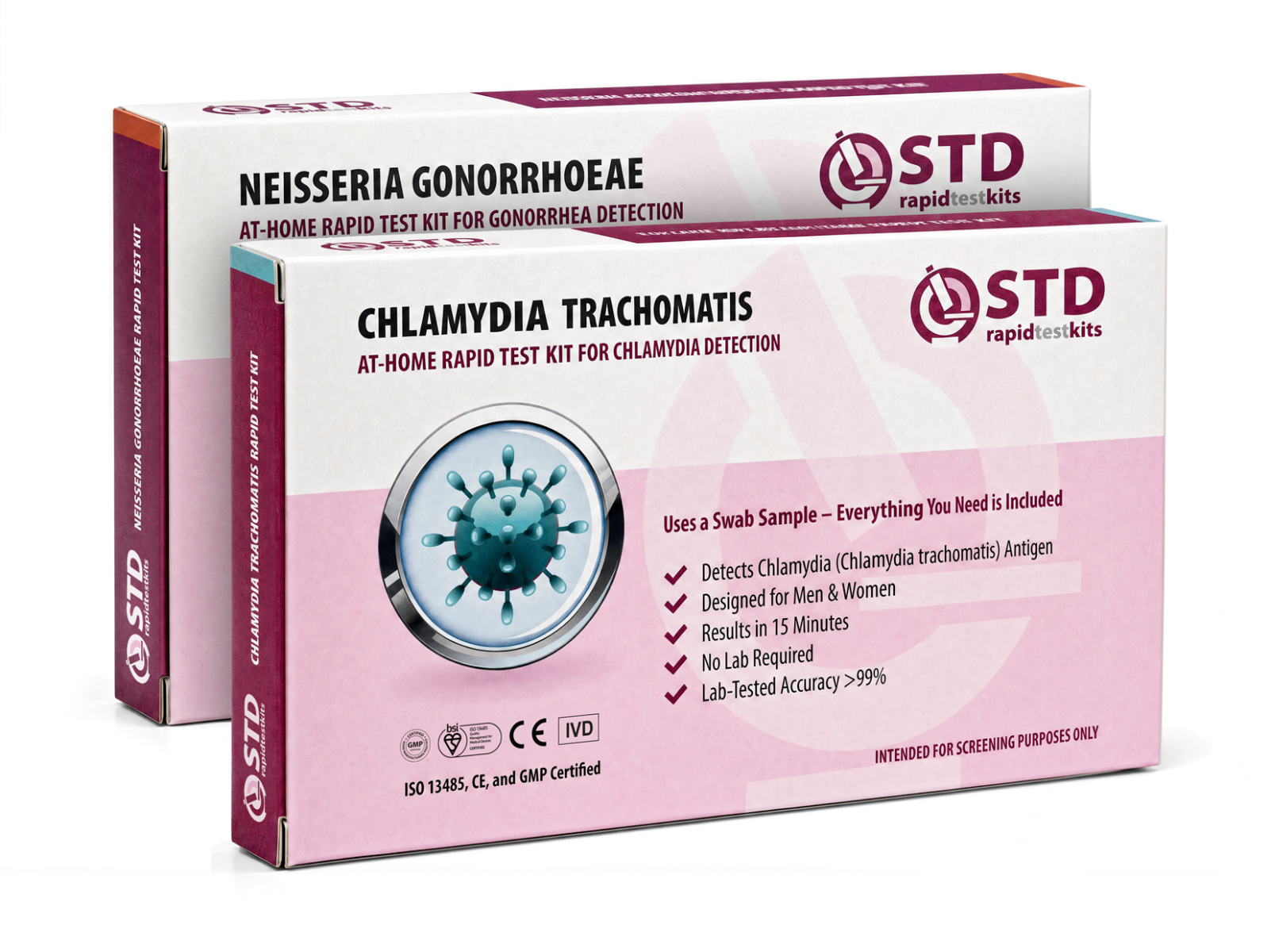
This article is published by stdrapidtestkits.com, which sells at-home STI testing kits. We recommend products based on fit-for-purpose for the reader's concern, not commercial benefit.
How long should you wait before retesting?
Two clocks matter here, and they answer different questions.
The "have I cleared the infection?" clock. A test of cure is generally not needed for uncomplicated chlamydia treated with doxycycline. DNA from dead bacteria can linger in tissue for weeks, making early follow-up tests confusingly positive. If a clinician does request a test of cure (most often during pregnancy, per the NHS chlamydia guidance), they will typically wait at least three to four weeks after the end of treatment so that residual DNA is no longer detectable.
The "have I been reinfected?" clock. The CDC and most public-health agencies recommend retesting roughly three months after the initial treatment. A meaningful share of treated patients pick up chlamydia again within ninety days, almost always from an untreated partner. Three months is the window where most reinfections surface.
If you used an at-home rapid test for the original screen, an at-home retest is a reasonable choice for the three-month check, especially if cost or scheduling is a barrier to a clinic visit. Just respect the window: the rapid lateral-flow chemistry needs the bacterial load to be high enough to detect, which is why testing too soon after a new exposure can miss it.
Chlamydia Testing and Retesting Timeline
- Day 0 Exposure
Chlamydia transmits; bacterial load is too low to detect
- Day 7 NAAT may detect
Lab NAATs can catch some infections by day 7, though a negative this early is not conclusive
- Day 14 Rapid test reliable
At-home lateral-flow tests are most accurate from about 14 days post-exposure
- Day 21 Treatment complete
7-day doxycycline course finished; resume sexual activity once partner is also treated
- Day 90 Reinfection retest
CDC-recommended retest to catch reinfection from an untreated partner
The initial test window closes around day 14; the reinfection check happens at three months post-treatment.
Privacy, access barriers, and testing on your own terms
The hardest part of getting tested, for many people, is not the swab. It is the question they ask themselves on the way: Should I even be here? Is this overreacting? Shame is a learned response to sex-education curricula that drew a hard line between abstinent and sexually active and assumed nothing happened in between. The body does not respect that line.
If you are worried, if you have symptoms, or if you simply want a baseline, those are sufficient reasons to test. Sexual health is a routine medical category, like cholesterol or blood pressure; it does not require a confession to access it.
Access barriers compound the problem. CDC surveillance reports have documented persistently elevated chlamydia rates among American Indian and Alaska Native populations, with the gap driven by structural factors rather than individual risk-taking (CDC STI Surveillance). Distance from clinics, underfunding of Indian Health Service facilities, abstinence-leaning curricula, and confidentiality concerns in small communities where the front-desk staff may be a neighbor all play a role. Similar access gaps affect rural communities, uninsured patients, and young people navigating parental consent rules.
Options exist beyond the local clinic. Federally funded Title X clinics serve adolescents confidentially in most states regardless of parental consent rules. Community health centers and mobile testing programs run pop-up testing days that bypass the standard clinic visit entirely. At-home rapid kits ship in plain packaging with no clinical labels visible from the outside, and the result reads at home in roughly fifteen minutes. No intake form, no waiting room.
If your at-home test is positive, take that result to a clinic for confirmation and treatment. The lab gold standard for chlamydia is a NAAT (nucleic acid amplification test), which is more sensitive on low bacterial loads and on extragenital sites like the throat or rectum. If the result is negative but you have symptoms, ask a clinician about a NAAT anyway. The two technologies are complementary: the home kit answers fast and privately; the clinic NAAT confirms the result, expands the sample sites, and connects you to treatment.
Most people who have chlamydia have no symptoms. If you do have symptoms, they may not appear until several weeks after you have sex with an infected partner.

When you cannot figure out where it came from
The mental loop that catches many people after a positive result is timeline math. Who, when, how long ago, could it have been that one time, was it the toy, was it the kissing, what counts. Sometimes the timeline reconstructs cleanly. Often it does not.
If you cannot trace it, that is not evidence that you missed something. The CDC's chlamydia overview notes that the infection can stay asymptomatic for weeks or months, which means the exposure that produced today's positive result might predate your last clear memory of "anything happening." A previous partner may not have known they had it. A brief encounter you did not categorize as risky might have been the path.
Tracing the source rarely changes what happens next. Treatment is the same, partner notification covers the same recent window, and the three-month retest applies regardless. Focus on the actionable list: complete the antibiotic course, notify the partners you can reach, plan a three-month retest, and consider a multi-condition screen so you are not chasing one infection while overlooking another.
If the spiral of "where did this come from" is genuinely interfering with sleep or function, that is a signal to talk to a clinician or therapist about the anxiety side of the diagnosis, not just the medical side.
Complete treatment, notify partners from the past 60 days, retest at three months, and consider a multi-infection screen. Tracing the original exposure rarely changes any of these steps.
Looking beyond chlamydia alone
If the encounter you are worrying about could have exposed you to more than one infection, a single-test kit is not the whole answer. The CDC STI treatment guidelines recommend testing for HIV, gonorrhea, and syphilis on every chlamydia diagnosis, which is why clinicians screen broadly rather than one infection at a time.
Three signals that a broader panel is worth considering:
- You had unprotected oral, vaginal, or anal contact and do not know your partner's recent test history.
- You have had more than one partner in the past year and have never been screened for the full set of common STIs.
- You are about to start a new relationship and want a clean baseline before you stop using barriers, or you are pregnant or planning a pregnancy and have not yet had prenatal STI screening.
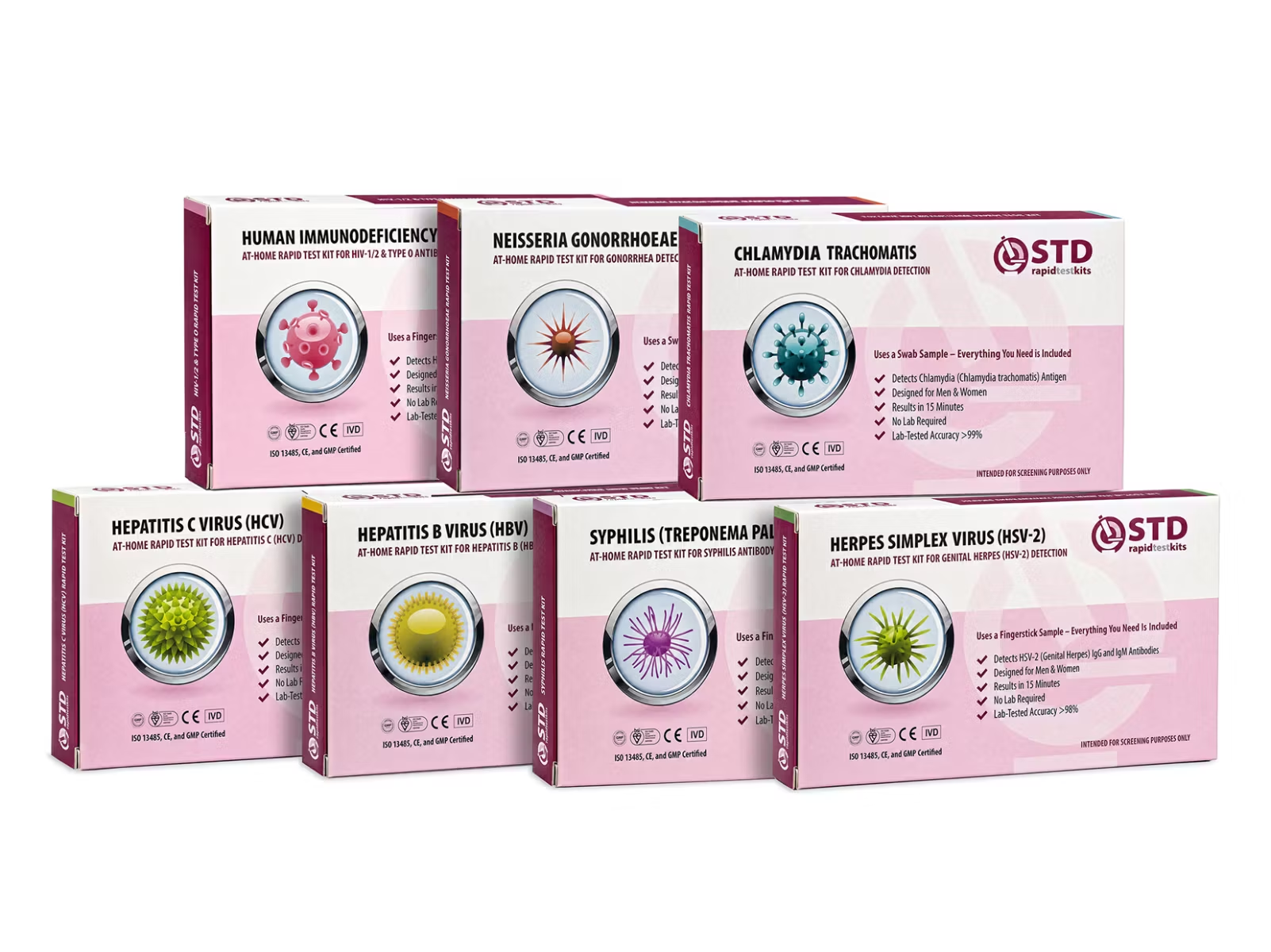
A combination home kit covers several common infections in a single shipment, with mixed swab and fingerstick samples self-collected in one sitting. It is not a replacement for clinical confirmation of a positive result.
Do You Need a Broader STI Panel?
Did you have unprotected oral, vaginal, or anal contact with a partner whose recent test history you do not know?
Yes: A multi-infection panel is a reasonable first step. Test for chlamydia, gonorrhea, syphilis, and HIV at minimum.
Have you had more than one partner in the past year without being screened for the full set of common STIs?
Yes: A comprehensive panel covers the most common infections in one sitting. Consider a 7-in-1 kit or equivalent clinic panel.
No: A single chlamydia test (or chlamydia + gonorrhea combo) may be sufficient. Retest at three months if positive, and revisit if your situation changes.
Guidance only; a healthcare provider can advise based on your specific situation.
Frequently Asked Questions
- Can you get chlamydia without penetrative sex?
- Documented routes include genital-to-genital rubbing without penetration, oral sex, and shared unwashed sex toys. All three involve mucous-membrane or fluid contact that lets the bacteria transfer between people. Hand-to-genital transfer of fresh infected fluid is also technically possible. Risk per non-penetrative encounter is lower than for penetrative sex, but asymptomatic partners make any contact a potential source.
- How long after a possible exposure should I test?
- Most rapid lateral-flow chlamydia tests are most accurate from about 14 days after exposure. Lab NAATs can detect the bacteria a little earlier, usually from around day seven, but a confirmatory negative is most reliable at two weeks or later. If you test before the window closes and the result is negative, retest after fourteen days to be sure.
- Do most people with chlamydia have symptoms?
- No. Asymptomatic infection is the norm rather than the exception, especially in women. The CDC recommends annual screening for sexually active women under 25 precisely because most cases produce no warning signs at all. Waiting for symptoms means most infections go untreated and continue to spread.
- I tested positive but my partner says they are negative. How is that possible?
- Two common explanations. First, your partner may have an asymptomatic infection that has not been picked up yet, especially if they tested very early after exposure or only at one body site (a urethral test will not catch a rectal or pharyngeal infection). Second, your infection may predate the current relationship; chlamydia can stay silent for weeks or months. Both partners should retest after the standard window and complete treatment together to break the loop.
- Can a baby be born with chlamydia?
- Yes. A pregnant person with untreated chlamydia can pass the bacterium to a newborn during vaginal delivery, where it usually presents as eye infection (neonatal conjunctivitis) or pneumonia. This is one reason routine prenatal screening for chlamydia matters, and it is one of the few non-sexual transmission routes the medical community recognizes clearly.
- What happens if I do not treat chlamydia?
- Untreated chlamydia is one of the bacterial STIs most commonly linked to pelvic inflammatory disease in women, which can produce chronic pelvic pain, ectopic pregnancy, and infertility. In men, untreated infection can cause epididymitis and, more rarely, fertility issues. Untreated chlamydia also inflames the genital mucosa, and biological studies link that inflammation to a higher risk of acquiring or transmitting HIV during a separate exposure.
- Do I really need to tell my partner?
- Partner notification breaks the reinfection cycle. Without it, a treated person can pick up chlamydia again from the same untreated partner within weeks. Reach anyone from the past 60 days. A short, factual message is sufficient. Most local health departments offer anonymous notification if you prefer not to say it directly.
- Is at-home testing as accurate as a clinic test?
- At-home rapid tests use lateral-flow chemistry; clinic labs use NAAT (nucleic acid amplification testing). NAAT is more sensitive at low bacterial loads and across extragenital sites (throat, rectum). At-home rapid tests are designed for screening: they are accurate when used after the recommended window, and a positive result is worth confirming with a clinic NAAT. Treat the at-home kit as a fast first answer that connects you to treatment, not as a replacement for a confirmatory lab test.
- U.S. Centers for Disease Control and Prevention. Chlamydia overview, including transmission routes (vaginal, anal, oral), asymptomatic carriage, annual screening recommendation for sexually active women under 25, and prenatal screening guidance.
- U.S. Centers for Disease Control and Prevention. STI treatment guidelines for chlamydial infections, covering first-line doxycycline (100 mg twice daily for 7 days), azithromycin alternatives, co-testing for HIV/gonorrhea/syphilis on any chlamydia diagnosis, and three-month retest timing.
- National Health Service (UK). Chlamydia: symptoms, antibiotic treatment, 7-day regimen guidance, and retesting four weeks after treatment during pregnancy.
- U.S. Centers for Disease Control and Prevention. STI surveillance data portal, including annual reported case counts for chlamydia and demographic disparity data.
- World Health Organization. Sexually transmitted infections fact sheet, estimating 129 million new chlamydia infections globally per year and the importance of treating sexual partners to interrupt transmission.
- U.S. Centers for Disease Control and Prevention. Pelvic inflammatory disease (PID), including its link to untreated chlamydia, infertility risk (1 in 8 women with PID history), and ectopic pregnancy.
- Mayo Clinic. Patient-facing overview of chlamydia symptoms by anatomy, complications, diagnosis methods, and treatment options.