
Published: July 2025 | Last updated: May 2026 | Editorial review and quality control: Martina N.
Why does talking to teens about STDs matter more now?
People aged 15 to 24 receive roughly half of all new STI diagnoses each year, per <a href="https://www.cdc.gov/sti-statistics/index.html" target="_blank" rel="noopener noreferrer">CDC surveillance</a>. Teens whose parents discuss sexual health openly delay first intercourse longer and use condoms more consistently. A calm, fact-based conversation paired with private testing options like at-home rapid kits gives your teen actionable tools before a crisis forces the topic.
The STI talk does not need to be a single dramatic moment. Whether the trigger is a condom wrapper in a backpack, a news headline, or simple curiosity, it works best as a steady, layered conversation that meets your teen wherever they are. The reason it matters is mathematical. People aged 15 to 24 are about a quarter of the sexually active U.S. population, but they account for roughly half of all new sexually transmitted infections each year, as reported by the CDC STI surveillance program.
Today's teens absorb sexual content earlier than most parents realize, often through social media, and many will fill silence at home with whatever TikTok or a friend says first. This guide gives you a calm, fact-first way to be the better source: concrete words to use, what to watch for, where the privacy and legal lines fall, and how to make testing feel like routine self-care instead of punishment.
Key Takeaways
- People aged 15 to 24 receive roughly half of all new STI diagnoses each year, despite making up only about a quarter of the sexually active U.S. population (CDC STI surveillance).
- Most teen STIs are silent. Most chlamydia infections cause no symptoms, especially in women, so testing at the right window is the only reliable way to know.
Why the Conversation Matters More Now
Your teen will learn about sex from someone. The question is whether the first source they trust is you, a search bar, or a comment thread. CDC STI surveillance consistently shows that adolescents and young adults aged 15 to 24 carry roughly half of new STI diagnoses despite making up about a quarter of the sexually active population.
The drivers are partly biological and partly social. Younger cervical and oral tissues are more susceptible to several infections. Teens are less likely to use condoms consistently, less likely to notice subtle symptoms, and more likely to delay care because of cost or fear of being found out. Sex education in U.S. schools varies dramatically by district, and social media fills the gaps with myths: posts that frame oral sex as risk-free or claim appearance alone reveals infection status spread fast, often uncorrected.
A useful reframe: if your teen had a persistent sore throat, you would not hesitate to ask the pediatrician for a strep swab. The genital and bloodborne equivalents deserve the same neutral, factual treatment. Parental guidance is one of the most consistent protective factors in adolescent sexual health. The CDC's parent conversation resources summarize evidence that teens whose parents discuss sex and protection openly are more likely to delay first intercourse and more likely to use condoms when they do become active. The U.S. Preventive Services Task Force also recommends routine behavioral counseling on STIs for sexually active adolescents at increased risk.
Repeated short conversations outperform one big talk. Per CDC parent conversation guidance, teens whose parents discuss sex and protection openly delay first intercourse longer and use condoms more consistently when they do become active. Tone and repetition do most of the work, not a single perfect script.
Common Myths Teens Believe (And What to Say Instead)
Even smart, curious teens absorb misinformation about STIs. Peer groups and social media spread these claims fast, and CDC parent-conversation guidance flags the same three over and over. Leave your teen with one accurate sentence per myth that they can repeat to themselves the next time the bad version comes up.
Three Myths Worth Correcting
Myth: You cannot get an STI from oral sex.
Fact: Oral contact transmits chlamydia, gonorrhea, herpes, syphilis, and HPV. Pharyngeal gonorrhea is common in sexually active teens and often has no symptoms. A calm counter: "Oral is one of the most common ways teens pick up gonorrhea. Let's talk about how to lower the risk."
Myth: If they look clean, they're clean.
Fact: Most STIs cause no visible signs, especially early on. People who carry an infection often do not know it. A calm counter: "Most infections do not show. Testing is the only reliable way to know, for them and for you."
Myth: Condoms protect against everything.
Fact: Condoms substantially reduce risk for fluid-borne infections but do not fully cover skin-to-skin transmission of herpes or HPV. A calm counter: "Condoms are a strong layer, not a force field. Some infections spread through skin contact outside the covered area, which is why testing still matters."
How to Start the Conversation Without Making It Weird
There is no perfect script. There is, however, a perfect opportunity: the next moment you decide to be calm rather than silent. Whether it happens in the car, at the kitchen counter, after a TV scene, or in the days after a health class, your tone matters more than your timing.
The phrases that land with teens tend to share three traits: they are short, non-accusatory, and they offer support without demanding a confession. Examples that open the door:
- "I want you to have real facts about this stuff, not just whatever school or TikTok says. Can we talk for a minute about how to stay safe?"
- "If you ever want to get tested, no matter what is going on, we can figure it out together. It does not mean I am mad. It means I care."
- "Whatever choices you make, I want you to be informed. You deserve to know how to protect yourself."
Phrases that shut the door all force a confession teens refuse to give: "You better not be doing anything you are not ready for" or "If you have something, tell me right now."
If your teen pushes back or rolls their eyes, that is a normal first response, not a failure. Many teens act bored or annoyed during the talk and then circle back days or weeks later with a real question. Trust builds in layers. The first conversation is the seed; what they remember is whether you kept your cool and named the resource clearly enough that it could be found later. If they ask a question you cannot answer, say so, then look it up together. That single move models that adults also research health questions.
What Testing Actually Looks Like
A lot of teen anxiety about STD testing comes from imagining the worst version: stirrups, a pelvic exam, a clinic where a classmate's parent might be at the front desk. Modern testing is far simpler. Lab nucleic-acid amplification tests (NAATs) are the clinical gold standard for chlamydia and gonorrhea and can run on a self-collected swab with no pelvic exam required.
Home rapid tests, including at-home STI test kits, use a similar self-collected sample and return a result in roughly 15 minutes. The chemistry is different: home lateral-flow strips are designed for fast screening and are typically less sensitive than a lab NAAT, particularly in asymptomatic infections. A positive home result is meaningful and should be confirmed with a clinical test. A negative result soon after exposure may need to be repeated after the relevant window period. Walking your teen through the process beforehand, explaining that it is a swab or a fingerstick and nothing more, removes the mystery that keeps many from testing at all.

STI Symptoms That Get Mistaken for Other Things
Most chlamydia infections cause no symptoms at all, especially in women, per CDC chlamydia guidance. Even when symptoms appear, they are easy to misread: vaginal discharge gets blamed on a yeast infection, burning during urination on a UTI, small bumps on razor irritation. Untreated chlamydia in adolescent girls can progress to pelvic inflammatory disease and long-term fertility issues, which is why the CDC recommends annual screening for sexually active women under 25 regardless of symptoms. The WHO STI fact sheet identifies delayed or missed screening as a leading global driver of preventable STI complications. If your teen mentions any pattern in the table below, the right response is a low-key offer of help, not interrogation.
| Infection | How it tends to appear in teens | Why it gets missed |
|---|---|---|
| Chlamydia | Often silent. Sometimes mild discharge or burning when urinating | Easily blamed on a UTI, hormonal change, or yeast infection |
| Gonorrhea | Discharge, between-period bleeding, sore throat after oral exposure | Frequently asymptomatic, especially in females and in pharyngeal cases |
| Herpes (HSV) | Tingling skin, then small painful blisters; sometimes flu-like symptoms | First outbreak gets called a cold sore, ingrown hair, or razor irritation |
| HPV | Often silent. Genital warts in some strains; abnormal Pap results in others | Warts may be small, painless, or hidden; most strains never show outward signs |
| Trichomoniasis | Frothy, discolored discharge with odor; itching | Teens may be too embarrassed to describe the symptoms accurately |
| Syphilis | Painless sore (chancre) at the contact site, then later body rash | The sore is painless and goes away on its own, so it gets ignored |
Window Periods: When a Test Will Actually Catch It
Testing too early is a common cause of false reassurance. Each infection has a window period: the gap between exposure and when a test can reliably detect it. The numbers below are typical windows for the rapid lateral-flow tests sold for at-home use. Lab NAATs can detect some bacterial infections sooner, so a clinic test is the right move after a recent high-risk exposure. The safe pattern is one early test plus a confirmatory retest at the end of the longest applicable window.
| Infection | At-home rapid test type | Earliest reliable test | Best confirmation window |
|---|---|---|---|
| Chlamydia | Self-collected swab (lateral flow) | About 14 days post-exposure | 14 days or later |
| Gonorrhea | Self-collected swab (lateral flow) | About 14 days post-exposure | 14 days or later |
| Trichomoniasis (vaginal) | Self-collected vaginal swab | 5 to 7 days post-exposure | About 14 days |
| HIV | Fingerstick blood antibody | About 23 days for most rapid tests | About 90 days for full window |
| Syphilis | Fingerstick blood antibody | About 3 weeks | 6 to 12 weeks |
| HSV-2 | Fingerstick blood antibody | About 6 weeks | 12 weeks (up to 16 weeks in a small number of cases) |
At-Home Testing, Privacy, and Minor Consent
Privacy is one of the largest barriers to teen testing. Many adolescents will not book a clinic visit because they fear an insurance Explanation of Benefits arriving in a parent's mail or an awkward waiting-room encounter. The legal landscape is supportive: according to the Guttmacher Institute, every U.S. state allows minors to consent to STI testing and treatment without parental permission to some degree, though specific age thresholds differ. The table below illustrates the range; it is not legal advice, and the Guttmacher tracker is the right place to check current rules.
What complicates things is rarely the law; it is the paperwork. An Explanation of Benefits mailed to the policyholder can disclose the visit type or facility. Two workarounds keep the test off the insurance trail: paying cash at a public-health clinic, or using an at-home rapid test kit shipped in plain packaging. A rapid swab or fingerstick blood test taken at home gives a private result in about 15 minutes. The trade-off worth naming honestly: home rapid tests use lateral-flow chemistry rather than the lab-grade NAAT a clinic runs, so a positive result is worth confirming at a clinic, and a negative result close to the start of the window period is worth repeating at the end. Privacy matters for parents too; at-home testing removes the waiting-room friction for everyone in the household.
This article is published by stdrapidtestkits.com, which sells at-home STI testing kits. We recommend products based on fit-for-purpose for the reader's concern, not commercial benefit.
| State | Minor consent for STI testing | Parent notification required? |
|---|---|---|
| California | Yes, at any age | No |
| Texas | Yes, age 14+ | No (unless billing reveals it) |
| Florida | Yes, no minimum age | No |
| Alabama | Yes, age 12+ | No |
| New York | Yes, all ages | No |
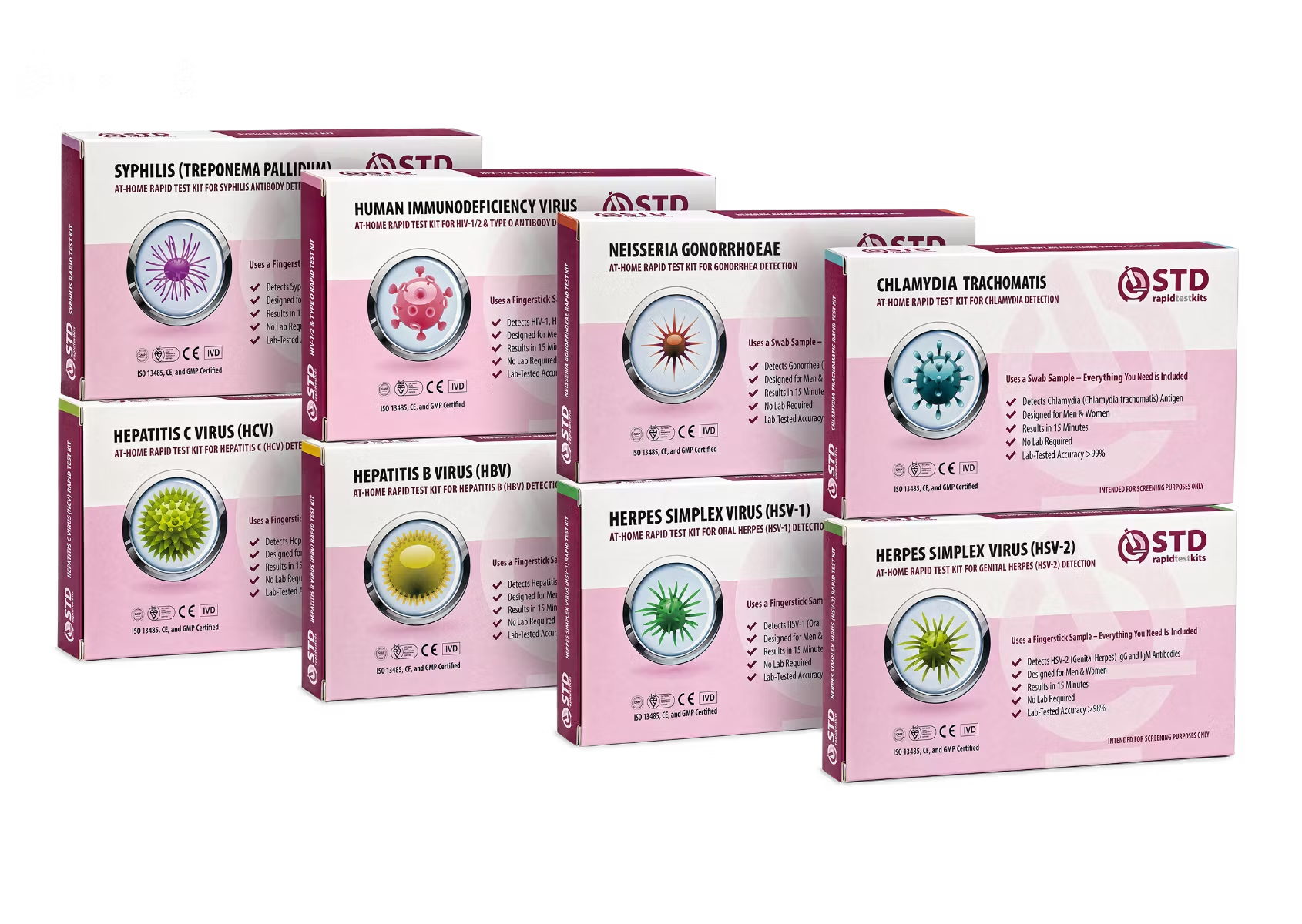
If Your Teen Tests Positive
A positive STI result does not mean your teen did anything wrong. The CDC estimated roughly 26 million new STI infections in the U.S. in 2018, the most recent full national estimate, and most are managed with a short course of antibiotics or, for chronic infections, ongoing care that lets people live full lives. How the first ten seconds go usually determines whether your teen shares more or shuts down. A useful version: "Okay. We will figure this out. You are not dirty. You are not doomed. You are not alone."
Confirm a positive rapid result with a clinical test before any treatment decisions. Help your teen think through partner notification; many health departments offer anonymous notification tools. Reinforce the basics: abstain from sex during treatment, finish every dose, and retest at the recommended interval. For teens under 18, most public-health clinics offer confidential follow-up. Watch for the emotional response; shame and isolation are common, and they ease faster when an adult treats the situation calmly. A line that helps: "Thank you for telling me. I am proud of you for getting tested. We will figure this out together."
Curable (chlamydia, gonorrhea, trichomoniasis, syphilis): a short course of antibiotics resolves the infection, with a test of cure or repeat screening to confirm.
Managed (HIV, HSV, HPV): modern treatment controls transmission and long-term consequences. Either path is straightforward when caught early.
Inclusion: Teen Girls, LGBTQ+ Teens, and Disparities in Care
Adolescent females and LGBTQ+ youth face disproportionate STI risk and barriers to care. Teen girls often have early symptoms attributed to UTIs or yeast infections, delaying correct diagnosis. CDC chlamydia guidance recommends annual screening for sexually active women under 25 regardless of symptoms. HPV deserves a separate mention: most infections clear on their own, but high-risk strains can drive cervical, anal, and oropharyngeal cancers. The HPV vaccine, recommended for routine vaccination through age 26 with shared clinical decision-making through age 45, provides strong protection. The NHS STI overview notes that most people with an STI have no symptoms, which is why routine screening matters even when nothing feels wrong.
LGBTQ+ teens may avoid care because they fear being outed, lectured, or misgendered at intake. Inclusive parenting means normalizing how STIs spread across all types of contact, not just heterosexual intercourse. A short line said clearly once carries weight: "However you identify, I want you to have the information and tools to stay healthy." If your usual clinic does not feel safe for a queer or trans teen, your local Planned Parenthood likely is. One practical point: a complete screen for someone with oral or anal exposure routes sometimes includes throat or rectal swabs, which at-home kits do not cover. A clinic visit handles site-specific testing; the home panel is a strong baseline screen between visits.
Our at-home rapid kits cover standard genital and bloodborne infections via self-collected vaginal or penile swabs and fingerstick blood. They do NOT cover throat or rectal swab sites. If oral or anal exposure is part of the picture, plan on a clinic visit for site-specific testing, with the home kit serving as a faster baseline screen between visits.
When Your Gut Says Something Is Off, or Worse
Some parents notice a pattern before a teen says anything: a mood shift, secret symptom searches, withdrawal from a partner. The instinct to confront rarely works. A gentler approach is to name what you observed without claiming to know the meaning: "I noticed you seemed worried about a health thing this week. You are not in trouble. If you want to look into it, we can figure out a private way to do that."
If a teen may have been sexually assaulted, the testing conversation changes entirely. Priority goes to emotional safety, not data collection. Pressing for details or rushing them to a clinic without consent can intensify trauma. A useful sentence: "You do not have to say anything right now. But if anything happened that you did not want, and you want to check your body, you have every right to." Most rape crisis centers offer free, confidential post-assault care, including STI testing, emergency contraception, and HIV post-exposure prophylaxis (PEP) when started within 72 hours.
RAINN National Sexual Assault Hotline: 1-800-656-HOPE (4673). Free, confidential, available 24 hours a day. Online chat at <a href="https://hotline.rainn.org/" target="_blank" rel="noopener noreferrer">hotline.rainn.org</a>. Connects callers to local rape crisis centers that offer post-assault medical care, including STI testing, emergency contraception, and HIV prophylaxis.
Building a Home Where the Topic Does Not Feel Loaded
Prevention is also the environment your teen lives in. A home that treats sexual health as part of regular health raises the odds your teen will speak up early. Small gestures work: a CDC page bookmarked on the family computer, a discreet at-home kit in the bathroom drawer with a note that says "no judgment, just here if you want it."
Some parents test alongside the teen, framed as "I have not tested in a while either. Let us both make sure we are good." That removes the dynamic where testing is something the teen does because they are under suspicion. It models that routine sexual-health screening is a normal part of adult care. If your teen wants to be more involved, let them help choose the kit and walk through the directions together. Whether they use it next week or never, the act of preparing teaches them that caring for their body is a skill, not a confession.
1. Pick up an at-home test kit and leave it somewhere visible in the home, framed as available rather than assigned.
2. Say the sentence out loud, once, in a low-stakes moment: "Whatever happens, we will handle it together." That is the part they remember.
Should Your Teen Test?
Deciding when and whether to test can feel complicated. The short version: any sexually active teen benefits from routine screening. The CDC recommends at least annual chlamydia and gonorrhea testing for sexually active young women under 25 and for sexually active men who have sex with men. The decision flow below walks through the most common scenarios.
Should Your Teen Test?
Is your teen sexually active or likely to become sexually active soon?
Yes: Routine STI screening is recommended for all sexually active teens. Start with the two most common bacterial STIs in this age group: chlamydia and gonorrhea.
Has your teen had a new partner or unprotected contact in the past three months?
Yes: Test now if the relevant window period has passed (14+ days for chlamydia and gonorrhea, 23+ days for HIV, 3+ weeks for syphilis). Repeat at the end of the longest applicable window for a definitive result.
Is your teen showing symptoms such as unusual discharge, burning during urination, bumps, sores, or unexplained rash?
Yes: See a clinician promptly for evaluation. A home rapid test can screen the most common infections in the meantime.
No: Routine annual screening is still recommended for sexually active teens under 25, even without symptoms. A private at-home rapid test kit is a low-pressure way to make screening part of regular self-care.
Guidance only. A healthcare provider can advise based on your teen's specific situation.
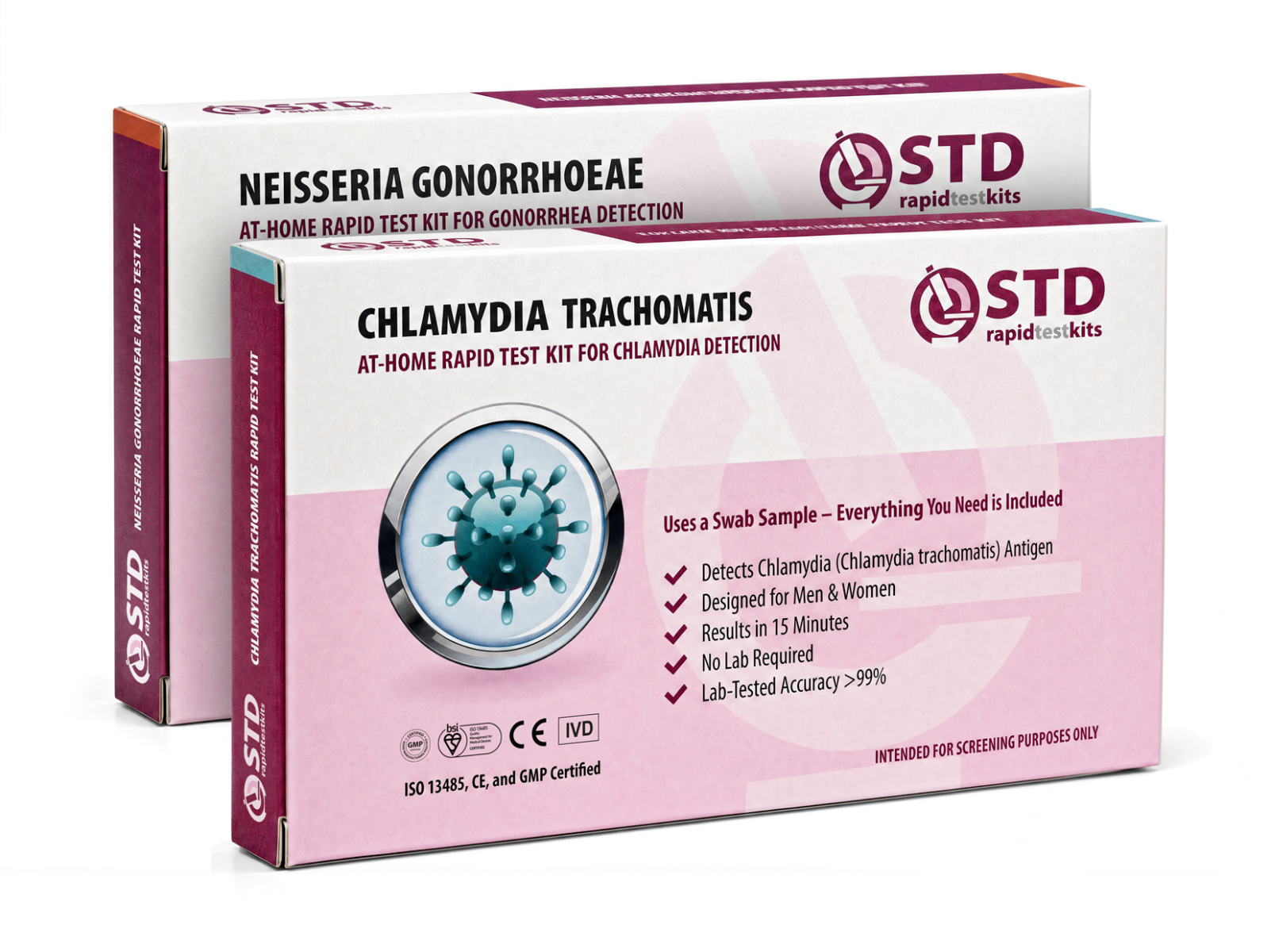
Many STDs do not cause symptoms, especially in the early stages. So the only way to know for sure if you have an STD is to get tested.
FAQs: Talking to Teens About STDs
- At what age should I start talking to my teen about STIs?
- When they start asking about dating, kissing, or body changes, the moment has arrived. That can be 11, 12, or 14 depending on the kid. Treat it as a series of short check-ins rather than one big talk. Earlier conversations work because they reach your teen before peers, social media, or first experiences set the frame.
- Can my teen really get an STI from oral sex?
- Yes, and it is the route teens are most likely to underestimate. Gonorrhea and chlamydia can colonize the throat after oral sex with no sore throat, no drainage, nothing that reads as an infection. Herpes, syphilis, and HPV follow similar logic. A pharyngeal gonorrhea case can linger undetected for months because there is no visible signal, which is why routine testing matters for sexually active teens whose relationships include oral contact.
- Are at-home STI tests reliable for teenagers?
- Yes, when the kit is from a reputable manufacturer and used after the appropriate window period. Home rapid tests are lateral-flow immunoassays, similar in form to a COVID home test, and they perform well as screening tools. They are typically less sensitive than a lab NAAT, especially in asymptomatic infections. A positive result is worth confirming at a clinic, and a negative result close to the start of the window period is worth repeating at the end of it.
- Can my teen get tested without my involvement?
- Yes, and the bigger obstacle is usually not the law but the insurance paperwork. Two routes bypass it: a cash visit to a public-health or Planned Parenthood clinic (no EOB generated) or an at-home rapid test kit shipped in plain packaging. The Guttmacher Institute tracks state-specific consent ages if your teen wants to know the exact rule where you live.
- What if my teen tests positive?
- Confirm a positive rapid result with a clinical test before any treatment decisions, then move into practicalities. Bacterial STIs are typically curable with a single antibiotic course, and viral STIs are managed long-term with effective modern treatment. The first ten seconds of your reaction matter most. Stay calm, say some version of "we will figure this out together," and save the practical details for later.
- How often should a sexually active teen get tested?
- The CDC recommends at least annual chlamydia and gonorrhea screening for sexually active young women under 25 and for any sexually active man who has sex with men. More frequent testing makes sense after a new partner or after unprotected sex. Anyone with symptoms should test promptly rather than waiting for the next routine screen.
- Is STD testing going to traumatize a teen?
- Modern STD testing is far less invasive than most teens picture. A self-collected swab or a fingerstick blood draw covers most of the panel. A pelvic exam is not required for routine chlamydia and gonorrhea screening. At-home rapid tests give teens complete control over timing and location, which is what most of them say they need to feel comfortable. Walking them through the process beforehand helps.
- What if my teen says they are not sexually active?
- Believe them, and still talk. Prevention information is for the curious, the considering, and the not-yet-but-eventually. Front-loading the facts means your teen does not have to scramble for them in a panic later. The conversation is also an investment in trust, which pays off whenever the situation changes.
- U.S. Centers for Disease Control and Prevention. STI surveillance program: annual STI Surveillance Report and underlying datasets quantifying infection share by age band, including the finding that people aged 15 to 24 account for roughly half of new STI diagnoses.
- U.S. Centers for Disease Control and Prevention. About chlamydia: signs and symptoms, screening recommendations for sexually active women under 25, asymptomatic-infection guidance, and link to pelvic inflammatory disease.
- U.S. Centers for Disease Control and Prevention. Healthy Youth parent resources: conversation tips, STI testing guidance for families, and evidence that parental communication is a protective factor in adolescent sexual health.
- U.S. Preventive Services Task Force. Sexually Transmitted Infections: Behavioral Counseling. Evidence-based recommendation for routine STI behavioral counseling in sexually active adolescents and adults at increased risk.
- World Health Organization. Sexually transmitted infections (STIs) fact sheet: global burden, transmission routes, delayed screening as a driver of preventable complications, and the importance of early detection.
- National Health Service (UK). Sexually transmitted infections overview: symptoms, the prevalence of asymptomatic infection, testing procedures, and treatment approaches for the most common STIs.
