
Published: July 2025 | Last updated: May 2026 | Editorial review and quality control: Martina N.
The best conversation about STIs (sexually transmitted infections, often called STDs) with a teenager looks nothing like the dramatic single talk most parents picture. It works through many short, calm exchanges that begin before your teen needs them and continue as they grow. Parents who get this right don't have a magic script. They share one trait: they don't panic, and their teens know it. This guide gives you the actual words, the timing, the testing options, and the responses for the moments that catch you off guard.
How do I talk to my teen about STDs without making it weird or making them shut down?
Drop the "the talk" framing entirely. Build a pattern of short, calm, judgment-free check-ins that start before they're sexually active and continue through their relationships. Lead with curiosity, not interrogation. Treat testing as routine self-care, the way you'd treat a dental cleaning. When they share something hard, your job is to listen first and problem-solve second.
Key Takeaways
- About half of new STIs in the U.S. occur in people aged 15 to 24, even though they make up a much smaller share of the population.
- Most chlamydia and gonorrhea infections produce no symptoms, so testing is the only reliable way for a teen to know.
Why This Conversation Carries More Weight Than You Think
The numbers behind teen sexual health have shifted in ways most parents don't realize. According to CDC STI surveillance, people aged 15 to 24 account for roughly half of new STI diagnoses each year, despite being a much smaller slice of the population. Chlamydia, gonorrhea, and syphilis rates have all climbed in this age group over the past decade.
The infections themselves are usually treatable when caught early. The harder problem is detection: most cases produce no symptoms, so without a routine screening habit, infections move silently through young social networks. The World Health Organization notes that the majority of curable STIs worldwide are asymptomatic, which is why screening matters more than waiting for a sign.
This conversation is harder than most safety topics for a cluster of connected reasons. Teens get their information from social media, friends, and pornography long before they get it from a parent or a clinician. Persistent myths circulate freely: that you can tell by looking, that oral sex doesn't count, that condoms cover every infection. And shame around testing remains strong, especially for teens who are figuring out their identity or whose social circles haven't normalized it.
You don't need to be the medical expert. Your teen needs steady access to accurate information from a parent who stays calm. When teens know they won't be punished for asking, they ask sooner, and earlier asking shortens treatment timelines for everything that's actually treatable.
CDC STI surveillance shows that adolescents and young adults aged 15 to 24 account for about half of new STI diagnoses each year. Most chlamydia and gonorrhea cases produce no symptoms, so without a regular screening habit, infections move silently between partners. Routine testing turns silent infections into treatable ones, often with a single course of antibiotics.
When to Start (and Why Earlier Is Almost Always Better)
"Start before they need it" sounds vague, so here's the practical version. Public-health guidance from the U.S. Department of Health and Human Services suggests opening basic conversations about bodies, consent, and sexual health well before any specific risk shows up. The point isn't to deliver a comprehensive sex-ed unit at the dinner table. The point is to set the precedent that this is a normal household topic, like nutrition, sleep, or money.
Most teens won't bring this up first, even when they're worried. The first time you raise it doesn't have to be perfect. It just has to happen. Awkwardness fades, and the topic gets easier each time you return to it.
Practical entry points by age
- Ages 10 to 12: short conversations about how bodies change, what consent means, why privacy matters. STIs can come up briefly without a full medical breakdown.
- Ages 13 to 15: more direct talk about how STIs spread, what protection options exist, and why testing is part of looking after yourself.
- Ages 16 to 18: specific scripts for navigating partners, asking about testing history, and accessing confidential care. This is when at-home testing becomes most useful.
- After breakups, new relationships, or any rumored exposure event in their friend group: a low-key check-in, never a cross-examination.

Words That Open the Door (and Words That Slam It Shut)
The wrong opening can shut down a conversation for years. Honesty matters more than smoothness. Most parents default to the question style they were raised with: interrogation. The caring is there. The framing turns it into something a teen reads as threat, and threat shuts down disclosure.
Below is a side-by-side of phrases that tend to land well versus phrases that almost always backfire. If you find yourself reaching for one of the bad-opening phrases mid-conversation, name it out loud: "I just said something I didn't mean. Let me try again." The correction itself, naming the bad phrase and trying again in front of your teen, is the model you're trying to set.
| What tends to work | What tends to backfire |
|---|---|
| "I'd rather you have real info from me than guess from rumors." | "Are you having sex?!" (turns talk into interrogation) |
| "You can come to me with anything, even things you think I'll be mad about." | "You better not be doing anything stupid." (shame kills trust) |
| "Getting tested is just smart. It isn't a confession." | "You're too young to be thinking about this." (closes the door) |
| "I didn't get good info at your age. I'm trying to do better with you." | "This is what happens when you don't listen." (links shame to sexuality) |
When Your Teen Says "I Think I Have Something"
This is the moment most parents brace for. It usually arrives in a way you didn't expect: a brief mention while you're driving, a text after they've been in their room all evening, an offhand "this is probably nothing, but…" Your reaction in the first 30 seconds will set what they tell you for the next several years.
Soften your face first. Body language registers before words do. Even if your stomach drops, keep your face calm and your voice low. Then thank them for telling you: "I'm really glad you came to me with this." That single sentence does more than any later advice.
Ask before solving. "Do you want help figuring out next steps, or do you want me to just listen for a minute?" This restores their sense of agency, which is exactly what they need before they can take action. Move to practical care quickly but gently: "When you're ready, we can look at testing options. There are private ways to do this that don't involve a clinic visit if that feels easier."
Postpone the partner conversation. Asking "who?" or "how could you let this happen?" before care is in motion creates fear, not safety. Those questions can come later, after testing, after treatment, after their nervous system settles. If they don't have an STI, the conversation costs you nothing. If they do, you've just bought them a head start on care that prevents long-term complications.
When they're hesitant to share: "You don't have to tell me anything you're not ready to. I'm here whenever you want to come back to it."
When they share something scary: "Thank you for telling me. Let's figure this out together. You're not in trouble."
When you don't know the answer: "I don't know. Let's find out together."
Why At-Home Testing Genuinely Fits Teens
Many teens avoid clinics for reasons that aren't irrational. They worry about being seen by a neighbor in the waiting room, getting a lecture from a provider who doesn't know them, having to give a urine sample with the door not quite closed, or being asked questions in front of a parent. At-home rapid lateral-flow tests (the same strip-based technology behind over-the-counter COVID tests) remove most of those friction points.
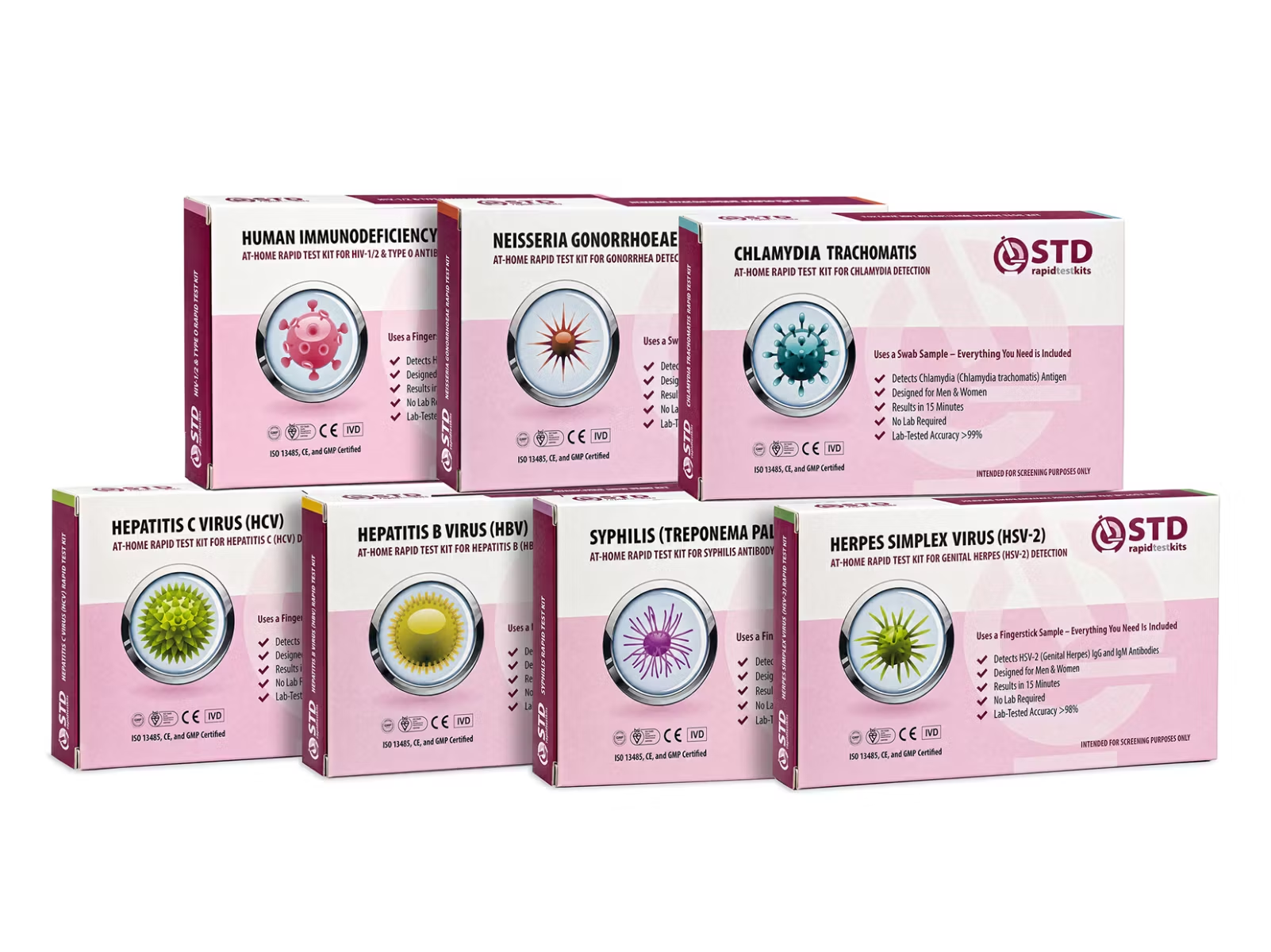
Here's what at-home rapid testing looks like for a teenager. The kit ships discreetly: no prescription, no clinic appointment, no front-desk awkwardness. The sample is self-collected. For chlamydia, gonorrhea, trichomoniasis, and HPV, that's a swab. For HIV, syphilis, hepatitis, and herpes antibodies, it's a small fingerstick blood drop. Results from the lateral-flow strips arrive in about 15 minutes.
A positive result is a screening signal, not a final diagnosis. It means "go to a clinic to confirm and get treatment," and the kit instructions walk through that exact next step. A negative result, taken outside the early window period after exposure, is genuinely reassuring. Lab NAAT testing remains the gold standard for some infections; the at-home rapid test is a screening tool that complements lab testing rather than replacing it. For most teens, the value is access to a test they can actually bring themselves to take.
Frame at-home testing as an option, not an instruction. "There's a test you can do at home if a clinic feels like too much. I can help you order it, or you can do it on your own. Either is fine." Teens who feel in control of the process are more likely to follow through. (We sell at-home rapid test kits, and the product pages linked below include current pricing and kit contents.)
What Your Teen Can Access Without You
This part surprises most parents: in much of the U.S., teens can legally access confidential STI testing and treatment on their own. Many states allow minors to consent to STI care without parental notification, often starting at age 12, 13, or 14. The exact age and scope vary by state and by service (testing, vaccination, treatment), so the responsible move is to check your state's minor-consent laws or ask a local clinic directly.
Why does this matter for your conversation? It changes both the leverage and your role at once. Your teen doesn't need your permission to get tested in many places. What they need is a calm parent, transparent information, and a path that feels manageable. If you turn this into a power struggle, they may simply go around you, sometimes with worse outcomes.
You become a logistical ally rather than a gatekeeper. You're the helpful adult who knows where the clinics are, who can drive them, who can pay for what insurance doesn't cover, who can sit in the parking lot and bring them iced coffee afterward. Frame yourself that way and your teen will use you that way.
Practical confidentiality pointers
- Minor-consent rules for STI care vary state by state. Many states allow minors to consent starting between ages 12 and 14.
- Confidentiality usually covers diagnosis and treatment but may not cover billing if the visit goes through a parent's insurance. Ask the clinic in advance.
- Title X clinics, school-based health centers, and local public-health departments often offer the strongest confidentiality protections at low or no cost.
- Your state's minor-consent rules are typically listed on state public-health websites; a local clinic intake nurse can also confirm in one phone call.
Talking With Your LGBTQ+ Teen About Sexual Health
LGBTQ+ teens often get skipped in school sex-ed, which leaves them piecing together health information from friends and online forums. Your conversation matters more, not less, when their school curriculum doesn't cover their reality.
Practical adjustments that help. Use inclusive language by default rather than retrofitting it after they come out. Ask what kind of information would be useful rather than assuming. Acknowledge that some risk profiles differ: anal sex, for example, has different transmission dynamics for HIV and certain bacterial STIs, and rectal infections often need a clinic-administered swab that an at-home kit cannot provide. Be honest about what at-home tests cover and what they don't. The fingerstick HIV and hepatitis tests work the same regardless of who your teen is partnering with; the genital swabs cover genital exposure, not pharyngeal or rectal.
If your teen needs a sample type our kits don't cover (pharyngeal swab, rectal swab), say so plainly and help them find a clinic that does extragenital testing without judgment. A primary care provider, a Planned Parenthood location, or an LGBTQ+-friendly community health center can usually do all three sample types in one visit.

Keeping the Conversation Alive Year After Year
One conversation isn't enough. Sexual health is a moving target across the teen years, and the topics that mattered at 13 are different from the ones that matter at 17. The goal is to build a maintenance habit instead of delivering a one-time lecture.
Useful re-entry points across the year include the start of a new school year (different social circle, different exposure landscape), the start of a new relationship ("have you two talked about testing?"), after breakups (when teens are most emotionally vulnerable and most likely to underrate their risk), and news cycle moments (a celebrity disclosure, a public health story, a friend's situation). These are natural launching points for a 10-minute talk that doesn't feel staged.
Be honest about not knowing things. "I'm not sure how that one works. Let's look it up together." Teens trust adults who don't pretend. Share resources from people they already trust. A short YouTube explainer from a doctor with a teen-friendly channel often lands better than a parent's lecture. The CDC and HHS both maintain plain-language pages for teens that you can text directly without much commentary.
HPV vaccination deserves a specific mention here. Per CDC vaccination guidance, routine HPV vaccination is recommended through age 26 if a teen wasn't fully vaccinated earlier. For adults aged 27 through 45, vaccination is based on shared clinical decision-making with a provider. If your teen missed the routine schedule, it isn't too late, and a single conversation with their doctor can sort out timing.
Public-health research summarized by <a href="https://odphp.health.gov/myhealthfinder/health-conditions/hiv-and-other-stds/talk-your-teen-about-preventing-stis" target="_blank" rel="noopener">HHS MyHealthfinder</a> consistently links regular parent-teen conversations about sexual health to later first sex, more consistent contraceptive use, and higher rates of STI testing among adolescents. The cumulative effect of many short conversations matters more than the impact of any single one.
If They Test Positive: What Comes Next
A positive at-home rapid test is an early signal, not a final answer. The next steps are straightforward, and walking through them with your teen ahead of time removes panic from the moment a positive result appears.
Step one is confirmation at a clinic with a lab-grade test, typically a NAAT (nucleic acid amplification test) for bacterial infections like chlamydia and gonorrhea, or a confirmatory antibody test for HIV and hepatitis. Most rapid screening tests have high specificity, meaning a positive is usually correct, but confirmation protects against the small chance of a false positive and gives the clinic the documentation needed to prescribe treatment.
Step two is treatment, which for bacterial STIs is usually a short course of antibiotics. Viral infections like HIV, hepatitis, and herpes have ongoing management protocols rather than a cure, and modern treatments are highly effective at keeping people healthy and reducing transmission. Step three is the partner notification conversation. This is the hardest part for many teens. Most state and local health departments offer anonymous partner notification services that contact recent partners on the teen's behalf without revealing their name. Frame this as a public-health responsibility rather than a punishment.
Reinfection is common in young people who don't retest after treatment. The CDC recommends retesting roughly three months after treatment for chlamydia and gonorrhea regardless of whether the partner was treated. Make that follow-up part of the plan, not an afterthought.
FAQs
- When is the right age to start talking to my teen about STDs?
- Earlier than most parents think. Basic conversations about bodies, consent, and privacy can start between ages 10 and 12. Specific STI content fits naturally between 13 and 15, before most teens are sexually active. The exact age matters less than the pattern: short, calm, repeated conversations rather than one big talk.
- What if my teen shuts down or refuses to engage?
- Don't push. Say something like "It's okay if you don't want to talk right now. I'm here when you're ready." Then bring it up again later in a different context, like a car ride or a walk. Teens often process information better in low-eye-contact settings. Persistence without pressure is the goal.
- How do I respond if my teen says they think they have an STD?
- Soften your face. Thank them for telling you. Ask whether they want help with next steps or just want you to listen first. Hold off on questions about who or how until care is in motion. Your reaction in the first 30 seconds shapes what they tell you for years.
- Can my teen get tested for STDs without me knowing?
- In much of the U.S., yes. Many states allow minors to consent to confidential STI testing and treatment, sometimes starting as young as 12 or 14. The specific age and scope vary by state. Knowing this changes your role from gatekeeper to logistical ally.
- How often should sexually active teens get tested?
- CDC guidance suggests at least annual testing for sexually active people under 25, and more often when there's a new partner or unprotected sex. Specific tests (HIV, syphilis, hepatitis) may have different recommended frequencies based on individual risk. A primary care doctor or local clinic can tailor the schedule.
- Is HPV vaccination still relevant if my teen is older?
- If your teen missed the routine schedule, the window stays open through age 26 with no extra shared-decision step required. For ages 27 to 45, a quick conversation with a provider sorts out whether catch-up makes sense for their situation. In most cases it's worth scheduling at the next annual visit, since protection against the highest-risk HPV strains is still meaningful even after some sexual activity.
- How do I talk to my LGBTQ+ teen about sexual health?
- Use inclusive language by default. Ask what information would be useful rather than assuming. Be honest about which at-home tests fit their situation and which require clinic-administered sample types (like pharyngeal or rectal swabs). Many LGBTQ+ teens get skipped in school sex-ed, so your role matters more, not less.
- What if I don't have all the answers?
- You don't need to. Be honest: "I don't know, but let's find out together." That models trust, curiosity, and the habit of looking up reliable sources rather than guessing. Teens trust adults who don't pretend to know everything.
Your Next Step
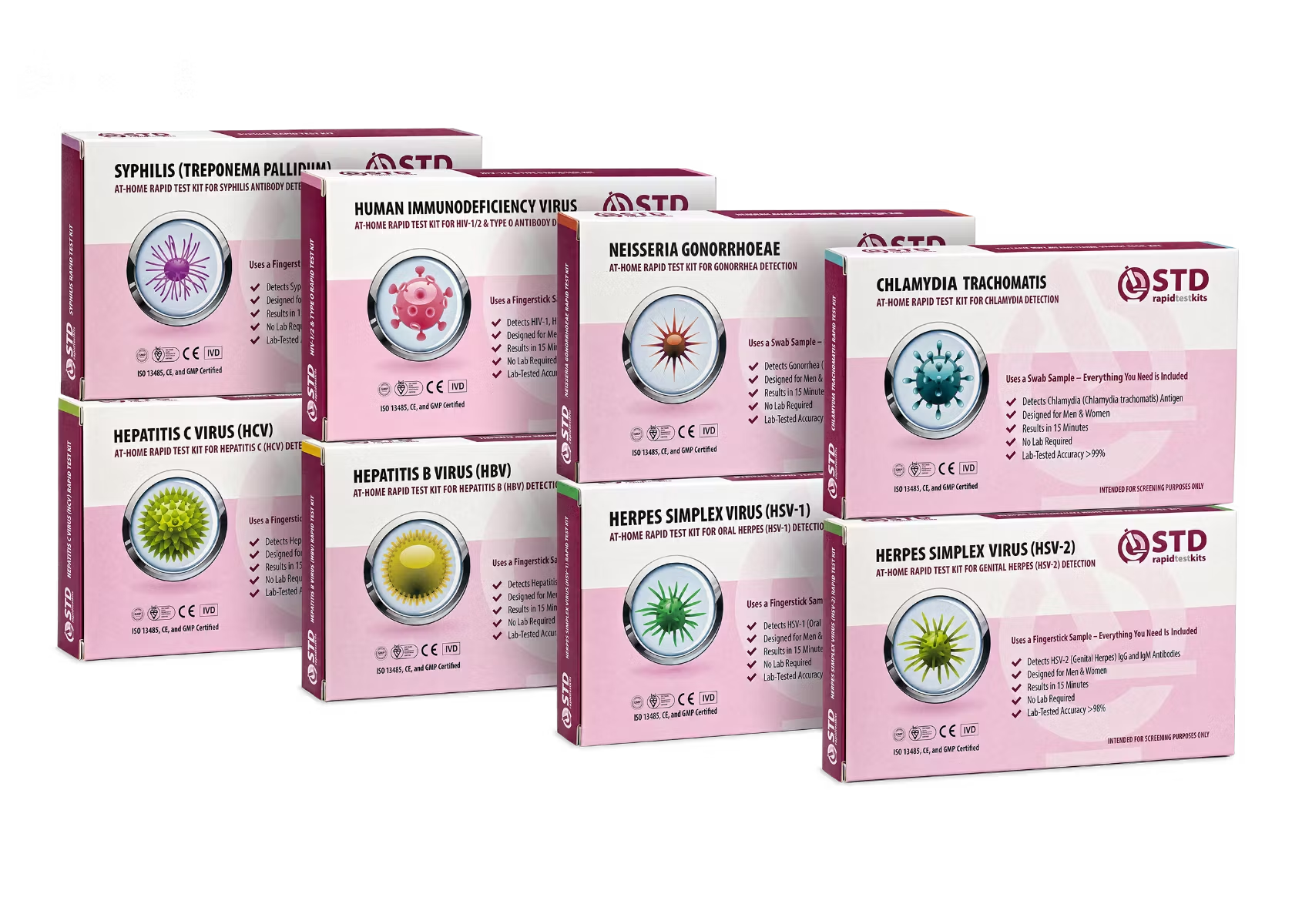
If this conversation is prompting you to set up testing, the comprehensive kit below covers the most common infections in one discreet package and is validated for both men and women. Order it, leave it accessible, and let your teen decide when to use it. That single piece of preparation removes one of the biggest friction points in the moment a teen actually wants to test.
- U.S. Centers for Disease Control and Prevention. STI surveillance data, including age-group breakdowns of new diagnoses among adolescents and young adults aged 15 to 24.
- U.S. Department of Health and Human Services, MyHealthfinder. Talk With Your Teen About Preventing STIs: parent-facing guidance on timing and conversation framing, plus research summary on benefits of regular parent-teen sexual-health conversations.
- U.S. Centers for Disease Control and Prevention, Healthy Youth Parent Resources. General conversation tips for parents talking with teens about sexual health and STIs.
- U.S. Centers for Disease Control and Prevention, HPV topic page. Routine vaccination recommendation through age 26 and shared clinical decision-making for adults aged 27 to 45.
- World Health Organization. Sexually transmitted infections (STIs) fact sheet, including data on the asymptomatic nature of most curable STIs.
- American Sexual Health Association. Be an Askable Parent: communication frameworks and practical scripts for parents discussing sexual health with their children.
