
Published: November 2025 | Last updated: May 2026 | Editorial review and quality control: Martina N.
Noticing a new bump near the genitals and wondering if it might be a wart can pull the floor out from under a person. The medical diagnosis itself is rarely the hard part. What follows, figuring out how to tell a partner, processing the shame that arrives uninvited, deciding whether to keep dating, is where most people get stuck.
This guide is here for that part. It walks through what to say, when to say it, and how to think about the whole topic without letting stigma drive the conversation. Genital warts are common, they are caused by certain strains of HPV (the human papillomavirus), and they are treatable. The conversations around them are also learnable, even when they feel impossible at first.
Two facts are worth holding from the start. First, a single visible wart does not say anything meaningful about a person’s hygiene, sexual history, or worth as a partner. Second, the conversations that have to happen because of that wart are skills, not personality traits. Skills can be practiced. They get easier with repetition. The rest of this article walks through that practice.
Key Takeaways
- HPV is a common virus that spreads through skin-to-skin sexual contact, and most people who carry it never develop visible warts or know they have it.
- Disclosure conversations land better when you lead with calm information rather than apology. Most partners respond to clear facts about what HPV actually means.
Why Genital Warts Trigger Outsized Shame
Unlike some sexually transmitted infections, genital warts are visible. That single fact changes how the diagnosis feels. A blood test result that says “positive” lives inside a chart; a small flesh-colored bump on the body lives in the mirror, in the shower, on the surface of every shared moment. The visibility is what makes shame so loud, even though the medical facts do not justify it.
The strains of HPV that cause visible warts (most commonly types 6 and 11) are sexually transmitted, and they spread through skin-to-skin contact rather than only through fluid exchange. Condoms reduce risk, though they do not eliminate it, because HPV can live on areas that condoms do not cover. Long incubation periods are common, with warts sometimes appearing weeks, months, or even years after the original exposure. None of that fits a clean narrative about who is “responsible” for an infection, and that ambiguity is medical reality.
Most people with HPV never know they have it. The U.S. Centers for Disease Control and Prevention describes HPV as a common virus that spreads through skin-to-skin sexual contact. The agency’s genital HPV infection fact sheet notes that in most cases the body clears the infection on its own within about two years. Visible warts are one of the more recognizable expressions of HPV, but they say nothing about a person’s character or sexual history.
The HPV strains that produce visible genital warts (most commonly types 6 and 11) are different from the strains most often linked to cervical, anal, and oropharyngeal cancers (most commonly types 16 and 18). A warts diagnosis is not, on its own, a marker of elevated cancer risk. The two strain groups behave differently, and a full breakdown appears later in the article.
When to Have the Conversation
The “how” of disclosure is what people rehearse in their head; the “when” is often what matters more. Timing depends on context. There is no single rule, though a few patterns hold across most situations.
The best moment is the one where you can speak without shame hijacking the words. If gathering yourself takes a few days, that is fine. What does not work is letting silence stretch into weeks. The longer the delay, the harder the conversation gets, and the more trust starts to erode in relationships where you do want to keep the partner close. The table below shows how the timing tends to vary by context.
| Situation | When to bring it up | Why timing matters |
|---|---|---|
| Ongoing relationship | Within a few days of diagnosis, before resuming sex | Builds trust and lets you both decide together on testing and care |
| New partner before sex | Before first sexual contact, ideally in a calm setting | Reduces transmission risk, sets expectations, signals respect |
| Casual or one-time encounter | Before sex if possible; afterward if circumstances changed | Health honesty matters even when the relationship is brief |
| Symptoms but not yet diagnosed | Once you notice something, before sex resumes | Lets you both pause and get clarity instead of guessing |
How to Actually Say the Words
This is where most people freeze. The voice in your head turns the conversation into a confession; the actual conversation rarely needs to be that. Disclosure works when it is calm, brief, and rooted in care for the other person.
The basic structure is three sentences. One sentence to flag that you have something health-related to share. One sentence to name it, plainly. One sentence to say what is and is not happening medically. Something like: “Before things go further, I want to share something. A few months ago I was diagnosed with genital warts, which is a kind of HPV. They were treated and are gone now, though I know HPV can stick around in the body, so I wanted to be upfront.”
That is the whole script. No build-up, no apology, no fishing for reassurance. The partner now has the information they need to ask questions. Most people will, and most of those questions will be the same: Can I catch it? Did you sleep with someone else? Should I get tested?
It helps to lead with ownership and a single fact, then let the conversation breathe. A few openers that work:
- “I want to tell you something health-related because I respect you.”
- “You deserve to know I had genital warts last year. It is really common, and I want to be transparent about it.”
- “This is awkward for me, and I would rather be honest than risk your health or your trust.”
The exact words matter less than the steadiness behind them. Say it in your own voice. You do not need to sound like a clinician or a textbook. You just need to be specific enough that the person can decide what they want to do next.
A few patterns to avoid: long apologies that invite the partner to manage your feelings (“I am so sorry, this is awful, I should have told you sooner…”), oversharing the medical details before the partner has asked, or framing the disclosure as a test of the relationship (“if you stay with me after this…”). Each of those puts the partner in a role they did not sign up for.

What If You Don’t Have a Diagnosis Yet
Most people notice something strange before they see a clinician. A small bump near the labia, a rough patch at the base of the shaft, a flat skin-colored growth tucked inside the foreskin. The first instinct is usually to wait and see. The second is often to panic. Neither is great for the disclosure conversation.
If you are mid-uncertainty and a new partner is on the horizon, the honest move is to pause sexual activity and say so, without dressing it up as a confession. Something like: “I noticed something on my skin that I am getting checked out before we have sex. I do not know what it is yet, and I wanted to be upfront.” That signals care, not guilt. You are not accusing yourself of an STI. You are giving the situation a beat to resolve.
If a clinic visit is hard to schedule, or if you want to rule out other infections first, at-home rapid testing for the more common bacterial and viral STIs can fill that information gap while you wait for an in-person look at the bump itself. Genital warts are visually diagnosed by a clinician (there is no at-home test that confirms HPV from a wart), but you can rule in or out other infections that often travel with HPV exposure: chlamydia, gonorrhea, syphilis, HIV, herpes, and the hepatitis viruses. Per the CDC’s anogenital warts treatment guidance, visual exam remains the standard approach for wart diagnosis.
Disclosure note: STD Rapid Test Kits sells the at-home panels described in this article. The product recommendations reflect what fits the clinical context being described; HPV itself has no at-home test, and we say so where it matters rather than substituting an unrelated kit.

What If Your Partner Reacts Badly
The fear of a bad reaction is often heavier than the bad reaction itself. People imagine being ghosted, screamed at, treated like they are contagious forever. Sometimes that happens. More often, the partner gets quiet, asks an awkward question, and then catches up to the information once the initial wave of feeling passes.
One common reaction is the cheating accusation. HPV’s long, unpredictable timeline gives it a reputation for showing up after a person has been monogamous for years. A partner who does not know that can easily land on “you must have slept with someone else” as the only explanation that makes sense. Explaining the dormancy timeline, calmly, usually shifts the conversation. The goal is not to win the argument; it is to share the medical reality so the partner has something useful to think with.
If a partner does react badly even after the facts are on the table, that response says more about their relationship with risk and stigma than about you. A phrase that helps in the moment: “I understand this is a lot to hear. I respect your feelings, and I also need to take care of my health. This does not define who I am.”
HPV is a common virus that spreads through skin-to-skin sexual contact. In most cases, HPV goes away on its own within two years and does not cause health problems.
Myths That Make This Harder
A lot of what makes the disclosure conversation hard is what the other person already thinks they know about HPV. Five myths show up most often, and being ready for them is half the work.
| Myth | Reality |
|---|---|
| If warts appear suddenly, someone cheated | HPV can stay dormant for months or years before warts appear, so a sudden appearance is not evidence of recent infection |
| Genital warts mean a person is “dirty” | Warts are a visible expression of a very common virus, not a hygiene issue or a moral judgment |
| A diagnosis means no more sex or dating | Many people live full sexual lives with HPV by combining honest conversations, protection, and treatment when needed |
| Only people with many partners get HPV | HPV can pass through a single skin-to-skin contact, and condoms reduce risk without eliminating it |
| If the warts are gone, the virus is gone | Treatment removes visible warts; the underlying virus may linger for months while the immune system clears it |
When Identity Adds a Second Layer
Disclosure is already vulnerable. For people whose identities are routinely judged in medical settings, queer and trans patients, BIPOC patients, sex workers, fat patients, anyone who has been talked down to by a clinician, the conversation carries a second layer of risk. The fear is not only about being seen as someone with an STI; it is about being seen as a stereotype.
The same disclosure script still works, and the framing can lean harder on shared decision-making. That language puts both people on the same side of the conversation.
Identity does not increase the medical risk of HPV. It can increase the social risk of disclosure, which is a real thing to plan around. Choose the moment and the setting that feel safest. If a partner uses the disclosure as a reason to dismiss, minimize, or fetishize you, that is information about them.
“Because I care about my health and yours, I want to share something. I had genital warts treated a while ago, and while they are gone, I think transparency is worth more than not bringing it up. I am happy to answer questions, and I am also happy to point you to a CDC page if you would rather read on your own.”
This phrasing puts the partner in the role of co-decider rather than judge, which lowers the temperature in conversations where you are already navigating other social risk.
What HPV Actually Is
HPV is among the most common sexually transmitted infections, with more than 200 known strains of the virus. Most cause nothing visible and are cleared by the immune system within one to two years. A small subset causes visible genital warts; a different, mostly distinct subset causes the cellular changes that can develop into cervical, anal, oropharyngeal, and other cancers over time.
The strains that cause warts (most commonly types 6 and 11) are different from the strains most often associated with cancer (most commonly types 16 and 18). Having one does not predict the other. There is no single “HPV status” test for the general body. Cervical screening (a Pap smear with or without an HPV DNA test) checks for specific cancer-associated strains in the cervix. Visible warts are diagnosed by clinical examination. Anal screening exists for higher-risk populations though is not yet routine. The table below shows how the strain groups break down.
| HPV strain group | What it does | How it gets diagnosed |
|---|---|---|
| Types 6 and 11 | Cause most visible genital warts; very low cancer risk | Visual exam by a clinician |
| Types 16 and 18 | Cause most HPV-related cervical, anal, and oropharyngeal cancers; usually no visible symptoms | Cervical Pap smear with or without HPV DNA test; anal screening in higher-risk groups |
| Other low-risk strains | Often asymptomatic; usually cleared by the immune system | Generally not tested unless warts appear or screening flags abnormal cells |
The HPV Testing Asymmetry
The asymmetry of HPV testing matters for the disclosure conversation. A partner cannot get tested for “HPV” in any general sense the way they can for chlamydia or HIV. What they can do is keep up with routine cervical screening if relevant, watch for visible warts at home, and get evaluated by a clinician if anything new appears. Per CDC treatment guidelines, visual examination is the standard approach for diagnosing genital warts.
That asymmetry is sometimes frustrating, and understanding it prevents the conversation from getting stuck on tests that do not exist. It also clarifies what the partner can usefully do next: a baseline panel for other STIs that do have reliable tests, attention to their own skin during showers, and an unhurried clinical exam if anything new shows up. Give the partner doable actions, not vague anxiety.
- No general HPV test exists for blood or urine. Cervical screening covers cancer-risk strains in the cervix only.
- Visible warts are confirmed by a clinician on visual exam.
- A standard STI panel can rule out the bacterial and viral infections that do have reliable tests.
- Self-monitoring means glancing during showers and getting anything new evaluated by a clinician without delay.
Vaccination Still Matters, Even After a Diagnosis
The HPV vaccine (currently Gardasil 9 in the United States) protects against nine strains, including types 6 and 11 (the wart-causing ones) and types 16 and 18 (the highest cancer-risk ones). The CDC recommends routine vaccination at age 11 or 12, with catch-up vaccination available through age 26. For adults aged 27 to 45, vaccination becomes a shared clinical decision based on individual risk and history.
If you have already had warts from one strain of HPV, the vaccine can still protect against the other strains you have not been exposed to. The vaccine does not treat existing warts, and it reduces the risk of acquiring new strains later. For people who started their sexual lives before HPV vaccination was routine, talking to a clinician about catch-up shots is worth doing, especially before significant changes in relationship status. The CDC’s HPV resource page has current guidance on age windows and dosing schedules.
Gardasil 9 age-window cheat sheet
- Routine vaccination: ages 11 to 12 (can start as early as age 9).
- Catch-up vaccination: through age 26 for anyone not adequately vaccinated as a child.
- Shared clinical decision: ages 27 to 45, based on individual risk profile and likelihood of future HPV exposure.
- After a wart diagnosis: still useful, since the vaccine protects against eight other strains you may not have encountered.
How Testing Fits Into the Conversation
One useful pivot, once the initial disclosure lands, is to talk about testing as a shared project rather than a one-sided burden. A partner who hears “you should get tested” feels accused. A partner who hears “I am going to get tested for a few other things just to have a clean baseline. Do you want to do it together?” feels included.
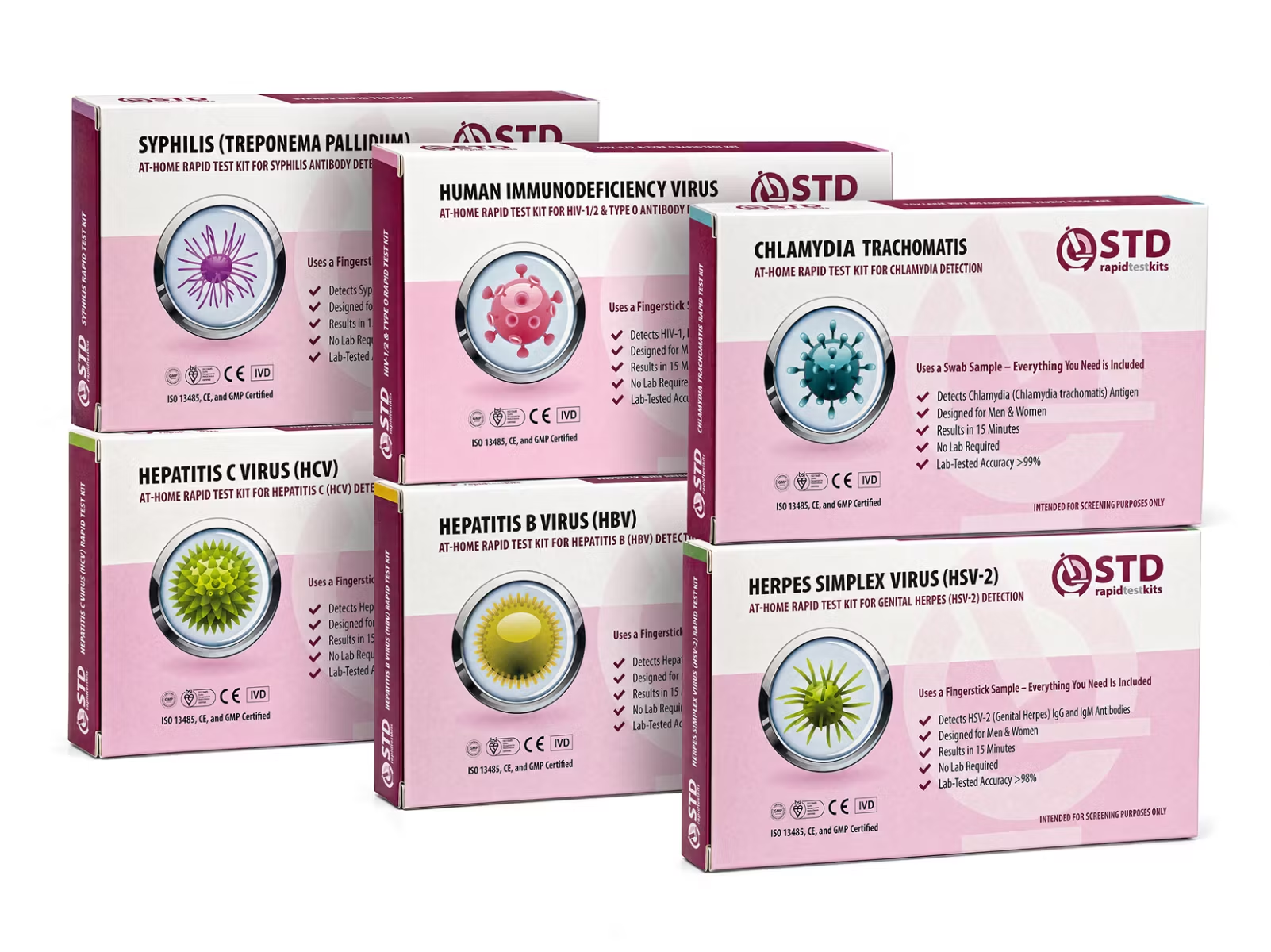
At-home rapid testing has lowered the friction of that conversation considerably. A combo panel that screens for several common bacterial and viral STIs can be done privately, with results in minutes, and the kits arrive in discreet packaging. The point is to make the first step less of a hurdle, since clinic-based care is still important for confirmatory testing after a positive home result and for the visual diagnosis of HPV itself. A lot of “I have been meaning to get tested” energy stalls at the front desk of a clinic. A kit on the kitchen table moves faster.
If You Are the One Being Told
Half the disclosure conversation is the person on the other side of it. If a partner tells you they have or have had genital warts, the most useful response is also the simplest: “Thanks for telling me. What does that mean for us right now?” That short reply does three things. It acknowledges the trust they just extended, it opens the door to information instead of judgment, and it centers the next step instead of the past.
You do not have to have a reaction worked out in the moment. It is reasonable to say you need a day to read, think, or ask your own clinician questions. What is not useful is to disappear into silence or to escalate the moment into a referendum on whether the partner is “safe.” A person who has just disclosed something vulnerable will read silence as rejection. Even a short message (“I am still thinking, and I will get back to you tomorrow”) protects the conversation from running off the rails.
If you decide you want to keep dating, the next move is logistical, not moral. Schedule your own STI panel. Read the CDC fact sheet so you are not relying on the partner to be your teacher. Talk about what protection makes sense for you both. If you decide you do not want to keep dating, say so respectfully and quickly.
“Thanks for telling me. What does that mean for us right now?”
It acknowledges the trust they just extended, opens the door to information rather than judgment, and centers what comes next instead of relitigating the past. You can still ask follow-up questions, take a day to think, or read up on your own. Lead with this one line and the conversation has a much higher floor.
When the Conversation Turns Into a Plan
Some partners will move quickly from “you told me” to “what do we do.” Disclosure is built for exactly this response. It usually starts with one of three questions: should I get tested, can we still have sex, and what does this mean long-term. Each has a calm answer.
On testing: HPV itself does not have a routine test for people without cervixes. If the disclosing partner has been treated and has no current visible warts, the other partner’s main option is a visual exam at their next routine visit, plus standard STI screening for the infections that do have reliable tests. Volunteering to do that screening as a pair lowers the temperature significantly.
On sex: when no visible warts are present, transmission risk is lower, though not zero, because the virus can shed from skin without obvious lesions. Many couples decide together that the risk is acceptable, especially since most HPV exposures clear without consequence. Condoms during the period when warts are active or being treated are standard advice.
On long-term meaning: a single past HPV exposure does not predict future cervical or anal cancer in any individual case. Routine cervical screening continues at the schedule a clinician recommends, which for most people is every three to five years from their early twenties. Routine cervical screening remains the most important long-term safeguard, more than anything specific to the warts.
It also helps to name what is not on the table. You are not committing to a forever-decision in the disclosure conversation. The partner does not have to decide right then whether they are okay with the long-term implications, and neither do you. A reasonable script for that: “You do not have to figure all of this out today. If you want to read, think, or ask your own clinician, I will be here.”
- Should I get tested? Standard STI panel for the infections that do have reliable tests, plus a visual exam at the next routine visit. There is no general HPV blood or urine test.
- Can we still have sex? Yes. Risk is lower once visible warts are treated and cleared, though not zero. Condoms during active treatment are standard.
- What does this mean long-term? A past HPV exposure does not predict future cancer in any individual case. Routine cervical screening continues on the usual schedule.
The Real Skill Is Repetition
Disclosure gets easier the more times you do it, and that is the part nobody tells you in advance. By the third or fourth disclosure, the dread shrinks to something proportional to a normal grown-up conversation: you have a sentence you know works, you can read within a minute or two how the other person is going to land, and the whole topic stops occupying your entire mental real estate. None of that means you should disclose to people you do not need to. It means that once you have done it cleanly a few times, the weight comes off.
A small reframe that helps along the way: the conversation is not about asking permission. It is about giving information. Permission language (“is it okay if we…”) puts you in a one-down position before the discussion even begins. Information language (“here is what I know about this, here is what I am doing about it, here is what I would like to figure out together”) keeps you both adult. The first time you try the second framing, the difference in how the conversation feels is noticeable from the first sentence.
If something on your body has been worrying you for more than a few days, the next move is a clinic visit or a video appointment for the visual diagnosis, plus an at-home panel for the other common infections. The combination usually closes most of the open questions inside a week.
This is not about asking permission. It is about giving information. Permission language (“is it okay if we…”) starts the conversation one-down. Information language (“here is what I know, here is what I am doing about it, here is what I would like to figure out together”) keeps both people adult. Try it once and the shift is immediate.
FAQs
- How long after exposure do genital warts appear?
- Anywhere from a few weeks to a year or more, with many cases appearing two to three months after the original HPV exposure. The long window is part of why people often cannot pinpoint who they got it from, and why a sudden appearance is not evidence of recent infidelity.
- Are genital warts the same as herpes?
- No. Different viruses, different presentations. Genital warts are caused by certain strains of HPV (most commonly types 6 and 11) and look like flesh-colored or grayish bumps that are usually painless. Herpes is caused by HSV-1 or HSV-2 and usually shows up as painful blisters or ulcers that come and go in outbreaks. A clinician can usually tell them apart on visual exam.
- Do I have to tell every past partner?
- There is no formal obligation for past partners, though partners you were with around the suspected exposure window deserve a heads-up so they can do their own visual checks. Some states have anonymous notification services if direct contact feels too hard. For future partners, disclosure before sex is the standard ethical move.
- Can I still have sex while I have visible warts?
- It is safer to wait until visible warts are treated and cleared, because active warts shed virus more readily. Once treated, the risk of transmission drops without going to zero, since HPV can shed from surrounding skin even without visible lesions. Many people maintain active sex lives during this period with honest conversation and condom use.
- Do condoms protect against genital warts?
- Partially. Condoms reduce HPV transmission risk significantly, and they do not eliminate it, because HPV can live on areas of skin that condoms do not cover (such as the base of the shaft, the vulva, the scrotum, and the perianal area). Condoms remain a major risk reducer, just not a guarantee.
- Will the warts come back after treatment?
- They can. Recurrence is common in the first few months after treatment because the underlying HPV virus may still be present in the skin even after the visible warts are gone. Most people see fewer recurrences over time as their immune system clears more of the virus. Recurrences are usually treated the same way the initial outbreak was.
- Is the HPV vaccine still useful if I have already had warts?
- Yes. Gardasil 9 protects against nine HPV strains. Having had warts from one strain does not mean you are immune to the others, and the vaccine can prevent acquisition of strains you have not encountered. Catch-up vaccination is approved through age 26 in the United States, with shared clinical decision-making through age 45.
- What is the best way to get checked discreetly?
- An in-person clinical visit (primary care, gynecologist, dermatologist, or a sexual health clinic) is the only way to confirm a visual diagnosis of genital warts. To rule out other STIs while you wait for that appointment, at-home rapid kits can screen for the most common bacterial and viral infections privately, with fast results and discreet packaging.
- U.S. Centers for Disease Control and Prevention. HPV resource hub with current vaccination guidance, age windows, and dosing schedules.
- U.S. Centers for Disease Control and Prevention. STI treatment guidelines for anogenital warts, including diagnosis approach (visual exam) and treatment options.
- U.S. Centers for Disease Control and Prevention. About genital HPV infection fact sheet, with patient-facing context on transmission, asymptomatic course, and natural clearance within about two years.
- U.S. National Library of Medicine, MedlinePlus. Patient-facing overview of genital warts and HPV.
- NHS (UK National Health Service). Genital warts overview, including treatment options and recurrence guidance.
