
Published: September 2025 | Last updated: May 2026 | Editorial review and quality control: Martina N.
How do I tell a partner I have an STD without destroying trust?
State the fact clearly, name the infection, and explain that you are telling them so they can get tested. Skip apologies and blame; give them a concrete next step like a testing timeline or a trusted resource. Most partners respond better than people fear, and public-health partner-services programs exist for when direct contact feels unsafe.
You just got an STD result you weren't expecting, or you found out someone you slept with did. Now there is a conversation to have, and it feels enormous. Most people freeze here. The fear of being judged, rejected, or labeled careless makes a five-line message feel like a confession. This is not a confession; it is information someone needs to take care of their own body, and it can be delivered in plain language without making yourself or anyone else into a villain.
This guide walks through exactly what to say, how to time the talk, the look-back windows that decide who needs to know, anonymous options when direct contact is not safe, the legal question (briefly), and the medical and emotional support that helps couples move forward. Most sexually transmitted infections are treatable, and the chronic ones are manageable. Open communication almost always puts less strain on a relationship than the silence of hiding a diagnosis.
Key Takeaways
- Disclosure framed as "this is how we move forward together" tends to preserve a relationship better than any exact wording, and every U.S. state runs a free, confidential partner-services program built for this situation.
- If direct contact is unsafe or impossible, anonymous notification through your health department can deliver the medical information without revealing your name.
Why this conversation feels so heavy
What makes this conversation heavy is usually not the treatment. It is the shame, and the worry that telling someone will look like a confession. STD stigma operates on three layers at once: medical, cultural, and personal. A clinical fact, a positive test that any pharmacist would treat as ordinary, can land like a moral verdict. People hear the diagnosis and brace for accusations: that they cheated, that they were careless, that they are now somehow contaminated. Partners on the receiving end often jump to the same scripts.
Take what often happens with herpes. Someone notices what looks like a shaving cut, a routine exam picks up HSV-2, and the diagnosis lands on a relationship that is months or years old. The first instinct is to assume recent transmission. The clinical reality is different, because HSV can stay dormant for long stretches before a first outbreak, which means a positive test is rarely a timestamp for when the infection started. The same is true for HPV and even chlamydia, where most cases produce no early symptoms at all, according to the U.S. Centers for Disease Control and Prevention.
Silence carries real consequences. Untreated chlamydia or gonorrhea can move into the upper reproductive tract and cause pelvic inflammatory disease, ectopic pregnancy risk, and fertility complications. Unaware partners frequently reinfect the original index case after that person finishes treatment, which is one of the main reasons reinfection rates in the U.S. stay so stubbornly high. Public-health programs were built around this exact problem, and every U.S. state offers some form of partner-services notification, often confidential and frequently anonymous on the patient's end. None of this requires you to explain how the infection happened, apologize for being human, or narrate your sexual history out loud.
This article is published by stdrapidtestkits.com, which sells at-home STI testing kits. We recommend products based on fit for the reader's concern, not commercial benefit. The disclosure guidance here applies whether you test at home, at a clinic, or through a public-health program.
What the research says about couples who stay together
Public-health research on partner notification consistently finds that disclosure does not predict breakups as strongly as people fear. The deciding factor is how the news is delivered, whether it comes wrapped in shame and silence or as an open invitation to handle the situation as a team. Clinicians describe the same pattern: partners who hear "I tested positive, here is what we know, here is what comes next" tend to respond with care and questions rather than panic.
The numbers behind the diagnosis matter for context. The CDC reports that millions of new STIs occur in the United States every year. The World Health Organization estimates that more than a million curable infections are acquired worldwide every day, with about 374 million new cases of the four most common curable STIs in 2020 and roughly 520 million people living with genital herpes that same year. Most of those people are dating, in relationships, raising children, and having sex with partners who know their status.
Antibiotics cure chlamydia, gonorrhea, syphilis, and trichomoniasis. Antivirals suppress herpes outbreaks and lower transmission risk. Antiretrovirals make HIV functionally non-transmissible to sexual partners when treatment is consistent. It is stigma, far more than biology, that fuels the belief an STD ends a love life.
Partner services are a free and confidential service offered by state and local health departments. Disease intervention specialists work with patients to identify and contact their sex or needle-sharing partners so the partners can get tested and treated.
How to actually have the STD conversation
There is no script that makes this conversation feel painless, and you do not need one. A handful of moves consistently keep it productive. Start with the setting: a quiet, private place where neither of you can be overheard or interrupted. Avoid bringing it up during sex, during an argument, or in the middle of a busy day when one of you is heading out the door.
Frame the message with care rather than apology. Saying "I'm so sorry" turns the conversation into a confession and invites blame, while saying "I want to be honest with you because I care about your health" frames the same news as shared information. The CDC's partner-notification guidance recommends a similar opener: say what you tested positive for, that you are getting treatment, and that you want them to be able to get tested too. Three principles do most of the work: name the test result, say why you are reaching out, and give them what they need to act.
The Core of a Clear Disclosure Message
- Name the infection directly, as in "I tested positive for chlamydia," so they can search accurately instead of imagining worst cases.
- State why you are reaching out: "I want you to be able to get tested and treated if needed." That framing removes blame.
- Keep it to the medical information, and leave guilt and speculation about who passed it first out of it.
- Give a concrete next step: a testing window, a trusted resource link (CDC, NHS, or MedlinePlus), or an offer to test together.
Opening lines for different situations
The right words depend on the relationship. A long-term partner needs a different tone than someone you have not spoken to in months, and a person you are nervous about telling in person may be easier to reach in writing. If a text feels too cold for an ongoing relationship, a short voice note or an in-person sentence works just as well. The medium matters less than the delivery, and silence is the only option that truly fails. The openers below have worked for real people across different contexts, so adjust the wording to your own voice.
| Situation | Sample opener |
|---|---|
| Long-term partner | "I just got my results back. I tested positive for chlamydia. It's curable with antibiotics, and I want us both to get tested and treated together so we can move forward." |
| New relationship, before sex | "Before we get more physical, I want to be honest about my health. I have HSV-2. I take daily medication to lower transmission risk, and I'm happy to answer anything you want to know." |
| Casual partner or recent hookup | "Heads up. I just tested positive for gonorrhea. I'm telling you so you can get tested and treated. It's bacterial and clears up with antibiotics." |
| Someone you haven't spoken to in months | "I know this is out of the blue. I tested positive for an STI and there's a chance you were exposed during the time we were together. I'd recommend getting tested." |
| When you're afraid of the in-person reaction | "This is hard for me to say in person, so I'm writing it. I tested positive for [infection] and I want you to be able to get tested. I'm here if you want to talk." |
Timing the talk: medical and emotional at once
Medically, sooner beats later. The earlier someone knows they may have been exposed, the faster they can test, start treatment if needed, and stop passing the infection forward. For chlamydia and gonorrhea, that window matters because both can sit symptomless for weeks while quietly causing damage. For HIV, early antiretroviral treatment dramatically lowers long-term complications and onward transmission risk.
Emotionally, sooner is harder. The first 24 hours after a positive result are usually a fog of disbelief, googling, and second-guessing. Sending a panicked 2 a.m. text in that state often makes the conversation worse. The middle ground is short: take a day or two to ground yourself, draft what you want to say, then send it. Anything past about a week starts to weigh on both of you in different ways, because the silence accumulates and people sense it.
A rough framework, not a countdown clock:
| Time since diagnosis | What to do medically | What to do emotionally |
|---|---|---|
| First 24 hours | Confirm the result. Ask the clinician about treatment and the look-back window. | Do not send anything in panic. Ground yourself first. |
| 1 to 3 days | Start treatment if prescribed. Identify partners inside the look-back window. | Draft the message. Read it aloud once. Consider how you would feel receiving it. |
| 4 to 7 days | Send direct messages where safe; route the rest through your health department. | Silence accumulates. Imperfect is fine; missing is not. |
| Past 7 days | Send anyway. A late message still gives the partner the chance to test and treat. | Apologize once for the timing if it feels right, then move past the apology. |
How far back do you have to go?
"Do I have to tell everyone I have ever slept with?" is the wrong question. The right one is which partners fall inside the exposure window for this specific infection and are reachable. The look-back period varies by pathogen and depends on what your clinician knows about your testing history.
For chlamydia and gonorrhea, the CDC's STI treatment guidelines refer recent sex partners, defined as those who had sexual contact within the 60 days before symptom onset or diagnosis, for evaluation, testing, and presumptive treatment (CDC chlamydia treatment guidelines). Trichomoniasis notification commonly uses a similar 60-day window. For syphilis, the window depends on stage: roughly 90 days for primary, up to six months for secondary, and longer for early latent. For HIV, the look-back extends further and is often handled case-by-case with the local health department, since the asymptomatic period can be long and the disclosure carries more weight.
If your last negative test was three months ago and you have had two partners since, the relevant universe is those two people. You are not retroactively responsible for partners outside that window, and trying to be exhaustive usually backfires by adding messages that serve no medical purpose. If the list still feels overwhelming, start with one. Send the message you can send today, then the next.
Look-Back Windows by Infection
| Feature | Chlamydia / Gonorrhea | Trichomoniasis | Syphilis (primary) | Syphilis (secondary) | HIV |
|---|---|---|---|---|---|
| Look-back window | 60 days | 60 days | ~90 days | Up to 6 months | Case-by-case |
| Why this length? | Often asymptomatic; reinfection cycles drive a longer look-back | Frequently asymptomatic, especially in men | Incubation up to 3 months before a chancre appears | Symptoms can lag well behind original exposure | Long asymptomatic phase; partner-services teams involved |
| Notification approach | Direct message or EPT | Direct message or EPT (where approved) | Direct or health department DIS route | Health department DIS often standard | Usually managed by health department DIS |
The exposure window determines which partners need to be notified, not your entire sexual history.
When direct disclosure isn't safe or possible
Sometimes the direct talk is not an option. The relationship was a single encounter and you do not have a number. The connection ended badly and you have been blocked. Or, most importantly, you are worried that disclosing directly could put you at risk of violence or stalking. In any of these cases, anonymous partner-notification services exist for exactly this situation, and the public-health system is built around the assumption that direct contact is not always safe.
Most U.S. state and county health departments offer some form of disease intervention specialist (DIS) service. You give the DIS the names and contacts of people who may have been exposed, and they reach out without naming you. They are trained for the conversation and connect each partner to testing and treatment resources. Different states call the service different things, but the basic structure is consistent, and in some jurisdictions this is the standard pathway for HIV and syphilis notifications.
Web-based notification tools such as TellYourPartner.org (verify current availability before relying on it) have historically let users send a text or email through a third-party system without revealing their identity. The CDC also recommends, where state law allows, Expedited Partner Therapy (EPT), in which your clinician writes a prescription for your partner without examining them, specifically for chlamydia and gonorrhea. If safety is the concern, talk to a clinician or a domestic-violence advocate before you reach out, and they can help you choose the lowest-risk path.
State or county Partner Services (DIS): contact your local public-health department. A disease intervention specialist can reach the partner on your behalf, without naming you, and connect them with free testing. This pathway is available through every U.S. health department and is the most reliable option.
Expedited Partner Therapy (EPT): in states where it's permitted, your clinician can write a prescription for your partner for chlamydia or gonorrhea without examining them first. Ask whether your state allows it.
Third-party web tools like TellYourPartner.org have historically offered anonymous email or text notifications; verify the service is currently operational before relying on it.
Reactions to expect, and how to hold steady
You can prepare your delivery, but you cannot script your partner's reaction. Most reactions fall into one of four buckets, and knowing them in advance makes it easier to stay grounded. You can control your wording, the medium you choose, and the written record of what you said. You cannot control their first reaction, their timeline for processing, or whether they reply at all.
Supportive. They thank you for telling them, ask practical questions, and want to know what happens next. This is more common than people expect, especially when the disclosure is calm and specific.
Confused or scared. They go quiet, ask the same question three times, or look stunned. This is a normal first response and usually softens within an hour or a day. Don't fill the silence. Give them time to absorb.
Blaming. They accuse you of cheating, demand a timeline, or threaten to tell others. Stay neutral and factual. You can say, "I don't know exactly when this started, and infections can be silent for months. I'm telling you because you deserve the chance to test." If they stay stuck in anger, you do not have to stay there with them.
Walking away. Some people do leave. It hurts, and it shows you something true: that they were not the partner who could meet you in a real conversation about health. The disclosure revealed a limit that was already there rather than one you created.
A common pattern is two-part: an initial flash of anger or panic, then a quieter follow-up days or weeks later, often after the person has tested and processed. The first message is not the final word. People who feel ambushed by health information rarely respond well in the first sixty seconds, and that has more to do with their own fear than with your delivery.
How to hold steady through any reaction
- Supportive: answer their practical questions and propose mutual testing as the next step.
- Confused or scared: stay quiet and let them absorb. An hour or a day usually softens the first response.
- Blaming: stay neutral and name the silent-infection timeline. If they stay stuck in anger, you do not have to stay there with them.
- Walking away: their decision is not yours to fix. You delivered the truth, and that part is done.
When guilt arrives, and it usually does
After the message is sent, or sometimes while drafting it, a particular flavor of guilt tends to show up. It is heavier than ordinary embarrassment, and it does a specific kind of damage: it tells you the infection is proof of failure, that good people do not get STDs, that you have proven something about yourself by testing positive. None of that is medically true. STIs are widespread in the U.S. population, and the CDC reports millions of new infections each year, a figure that includes people who use condoms consistently, get tested regularly, and communicate openly.
There is a useful distinction between accountability and self-punishment. Accountability is the message you just sent: owning the information and handing the next decision to the other person. Self-punishment is the loop afterwards, replaying the encounter, rehearsing what you should have done differently, building a case against yourself that nobody else is making.
If guilt is sticking, two things help. First, get retested for any infections you have not yet screened for, so the next conversation is grounded in current information rather than worst-case imagination. Second, tell one person who is not a partner: a friend, a therapist, a peer-support line. Saying it out loud once, to someone whose health is not on the line, takes the secrecy out of it.
The CDC reports that millions of new STI infections occur every year in the United States. That figure includes people who use condoms consistently, get tested regularly, and communicate openly with partners. A positive test puts you inside a very large and ordinary group.
The legal question, briefly
Most STDs do not carry a criminal disclosure requirement in the United States. HIV is the major exception. Some states still have laws on the books that criminalize non-disclosure before sexual contact, although enforcement and the exact statutes vary significantly. A handful of states have modernized those laws to require actual transmission or specific intent rather than the older standard. Jurisdiction-specific guidance is best obtained from a local legal-aid organization or your health department.
Civil liability is a separate question and usually turns on whether you knew you were positive at the time of contact. The relevant facts are whether you had a positive test result, whether you had sex anyway, and whether transmission actually occurred. If you tested positive today and are reaching out to past partners, you are doing the opposite of what those statutes are designed to penalize. You are notifying as soon as you knew, which is the protective posture the law is built to encourage.
Fear of legal trouble is sometimes weaponized by partners after a disclosure ("you broke the law", "I could sue you"). That is overwhelmingly bluffing. If you are genuinely worried, call your local health department or a legal-aid line before talking to that person again.
HIV disclosure laws vary by state, and several states have modernized their statutes to require intent or actual transmission. If you tested positive and notified partners promptly, you are taking the protective action the statutes are designed to encourage. A local legal-aid line or your health department can give jurisdiction-specific guidance.
When the diagnosis surfaces an affair
There is a harder version of this conversation: you tested positive, and the timing makes it clear, or strongly suggests, that you had a sexual contact outside a primary relationship. Now there are two disclosures to make, one to the outside partner who may have been exposed, and one to the primary partner who needs to test as well.
One principle simplifies the choreography: health information moves first. Both people need to know they may be at risk, and both need access to testing. The conversation about the affair itself is a separate one, and it can happen alongside or afterwards, but it should not gate the disclosure that lets someone protect their body. Untreated pelvic inflammatory disease or syphilis progression is a permanent kind of harm, while the relationship rupture is painful but rarely in the same category.
In practice this often looks like two short, separate messages, both honest, neither over-explained. Some primary partners will end the relationship, some will not, and some will need time. None of those outcomes is changed by withholding the test result, and at least one of them, the medical one, gets meaningfully worse if you do.
| Recipient | Sample opener |
|---|---|
| Outside partner | "I tested positive recently. I wanted to let you know so you can get tested." |
| Primary partner | "I need to tell you something hard. I had a contact outside our relationship, and I just tested positive. You should get tested too. I will answer whatever questions you have, but the test comes first." |
Prevention and protection as acts of care
Once the conversation is behind you, the medical side is often the simplest part. Each infection has a clear playbook, and modern treatment makes ongoing intimacy realistic for almost every situation.
For bacterial infections (chlamydia, gonorrhea, syphilis, trichomoniasis), antibiotics typically clear the infection within a week or two, and the only firm requirement is that both partners complete treatment before resuming unprotected sex, as recommended by the NHS. Skipping the partner step creates the bacterial ping-pong cycle clinicians see most often.
For HSV, daily suppressive antiviral therapy lowers the risk of transmitting HSV-2 to a partner by roughly half, per the CDC's STI guidance, and consistent condom use lowers it further. Avoiding sex during active outbreaks lowers risk again. Combined, these steps make discordant relationships, where one partner has herpes and the other does not, safer than most people realize.
For HIV, the most important fact to know is U=U: people on antiretroviral therapy who maintain an undetectable viral load have effectively no risk of transmitting HIV to a sexual partner, as confirmed by the CDC. PrEP for the negative partner adds another layer. For HPV, vaccination prevents most of the strains that cause cancer, and screening catches changes early.
| Infection type | Protection plan |
|---|---|
| Bacterial: chlamydia, gonorrhea, syphilis, trichomoniasis | Antibiotics for both partners. Wait until both have completed the course before resuming sex without a barrier. |
| HSV-1 / HSV-2 | Daily suppressive antiviral cuts HSV-2 transmission risk by roughly half. Add condoms during sex and avoid sex during active outbreaks. |
| HIV | Antiretroviral therapy for the positive partner to maintain an undetectable viral load (U=U). PrEP for the negative partner adds a second layer. |
Testing together builds trust
One of the most underrated moves a couple can make is testing together, either after a diagnosis or before a relationship gets sexual. It shifts the dynamic from "your problem" to "our information." Both partners sit down, run the test, and read the results side by side. The act itself signals shared responsibility, and CDC partner-services guidance recommends treating both partners together, or sequentially before resuming sex, to break the reinfection cycle that keeps couples bouncing the same infection back and forth.
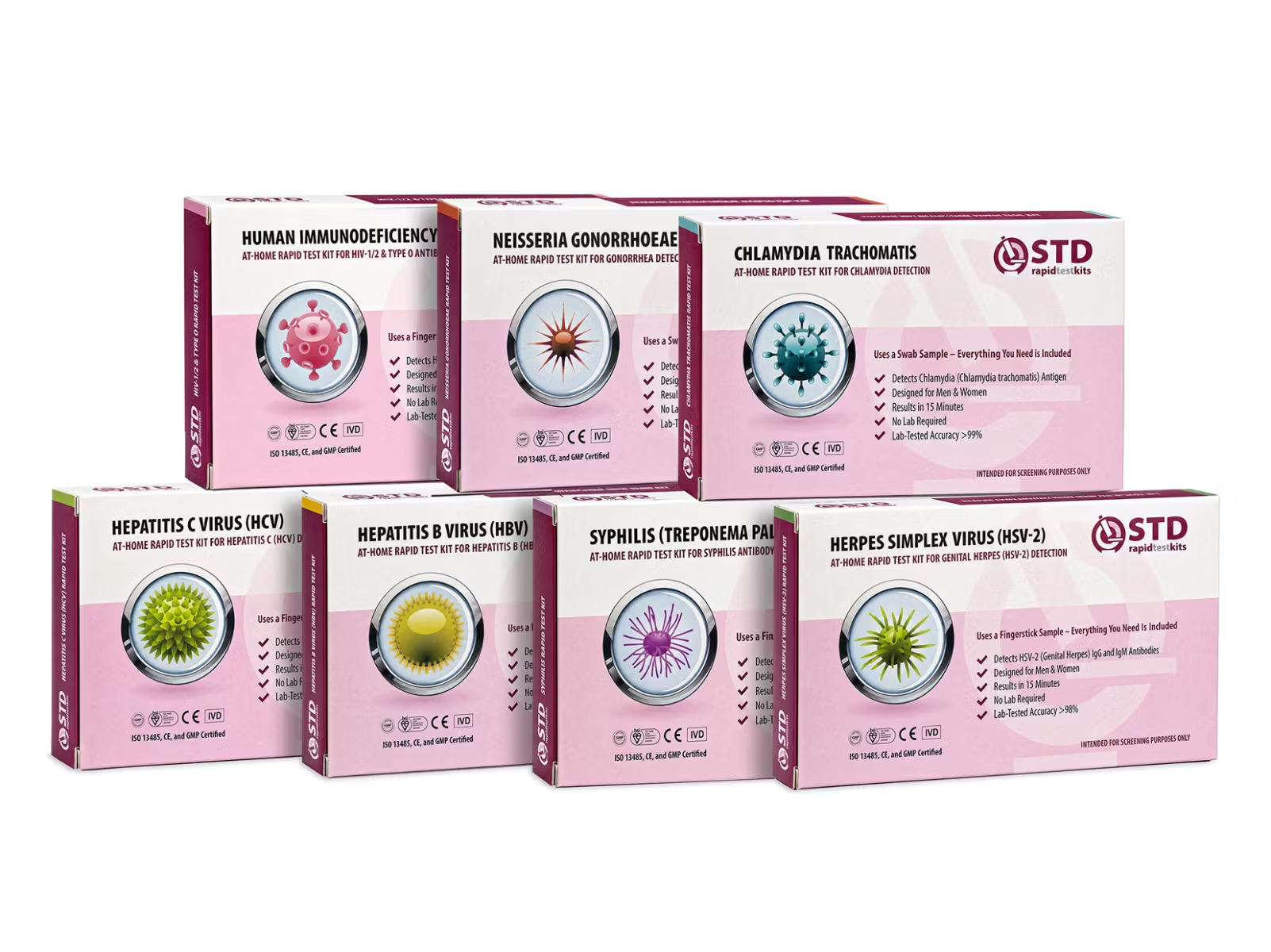
This used to require a clinic visit and a half-day off work. At-home STI test kits make it private and fast: you order discreetly, run the test at home, and have a result inside a window comparable to a single conversation. These are rapid lateral-flow screens rather than lab NAAT tests, so the CDC notes that any positive at-home result should be confirmed with a laboratory test, and treatment is straightforward once a clinician reviews it. For couples who already know one partner has tested positive, testing together gives both people a baseline to work from. For couples early in a relationship, the same approach lets them start from a place of clarity.

How to support a partner who is scared after you tell them
If they reply, the most common follow-up is some version of "what does this mean for me?" That can sound like clinical curiosity, panic, anger, or a long silence followed by a wall of texts at 1 a.m. You do not need to be a doctor. You need to be reachable and to point them somewhere accurate.
The useful posture is short and steady: tell them what you know, tell them what you do not know, and link them to a trusted resource like the MedlinePlus overview of STIs rather than a random forum thread. NHS and CDC pages on the specific infection are good defaults too. If the infection is one of the lifelong ones (HSV-1, HSV-2, HPV, HIV), expect them to spiral once, and expect the spiral to subside once they have real information instead of imagined worst cases.
Helpful things to offer: the name of the infection so they can search accurately, the testing window so they know when a test will mean something, and a sentence about treatment so they do not assume they have been handed a life sentence. Most STIs are curable, and the chronic ones are manageable with daily medication or routine monitoring. Sometimes support also looks like distance, so if they need a few days to process, give them the space; a reply that arrives three days later is still a reply.
Concrete ways to support a scared partner
- Name the infection clearly so they can search accurately instead of imagining worst cases.
- Give them the testing window for that specific infection so they know when a test will be meaningful.
- Point them to CDC, NHS, or MedlinePlus pages on the infection, not forum threads.
- Offer space if they need a few days to process, since the delay is part of how people absorb hard news.
Myths that keep couples stuck
A handful of false beliefs keep otherwise functional couples from having a productive talk after a positive test. Naming them out loud is usually enough to defuse them. Here are the most common ones and what the clinical evidence says.
Common Misconceptions About STD Disclosure
Myth: An STD always means recent cheating.
Fact: Many infections, including HPV, HSV, syphilis, and even chlamydia, can stay silent or dormant for months or years. A positive test is rarely a reliable timestamp for when transmission happened.
Myth: If I had no symptoms, I don't have it.
Fact: The CDC notes that most chlamydia cases produce no symptoms, and the same is true for many gonorrhea, HSV, and HPV infections. Testing is the only way to know.
Myth: You can't have a normal sex life after a diagnosis.
Fact: Most STIs are curable, and the chronic ones such as HIV and HSV are manageable with daily medication. Millions of people in stable, sexually active relationships have a positive status.
Myth: At-home tests aren't reliable.
Fact: Rapid lateral-flow self-tests can perform well for screening when used correctly after the right window period, and a reactive result is confirmed with a laboratory test, the same follow-up step a clinic screen would trigger.
Myth: Telling them ends the relationship.
Fact: Studies of disclosure outcomes find that honesty is generally met with appreciation, especially when it is delivered calmly. The larger relationship damage usually comes from the silence around the diagnosis.
When to walk away from the conversation
Not every disclosure ends well, and you do not have to keep arguing your case once you have delivered the information. If the person responds with cruelty, refuses to consider testing, demands proof of your medical records, or tries to weaponize what you shared, the conversation is over. Your job was to give them honest information about their health, and what they do with it is their choice.
If retaliation feels like a real risk, document the exchange by screenshotting the message you sent, and consider whether anonymous notification through a health department would have been the safer pathway. There is no rule against switching methods if the situation gets harder than you expected, and you can hand the rest to a disease intervention specialist at any point.
Signals the conversation is over
- Responds with cruelty, insults, or threats.
- Demands medical records, dates, or proof before they will consider what you said.
- Threatens to share your diagnosis with other people.
- Refuses to get tested or treated, even when the exposure is on the table.
You deserve peace, too
STD conversations feel heavy because the culture around them is heavy, not because the underlying medical reality is. After you have sent the message, the hardest part is behind you, and what you have done is exactly what public-health systems were built to support. Whatever the response turns out to be, you have already handled the piece that was yours.
The next step is often retesting yourself, both to confirm the current diagnosis is being treated effectively and to check for any infections you have not yet screened for. A multi-test home kit can be a practical way to do this without another clinic appointment, especially if travel, work, or anxiety made the first round of testing harder than it should have been.
In any given month, hundreds of thousands of people in the United States navigate a positive result and a difficult conversation. A diagnosis does not mark you as an outlier or a failure. You are doing the right thing, in plain language, even when it is uncomfortable, and you are far from alone in it.
Should You Test After This Conversation?
Did you test positive today and haven't tested for co-infections?
Yes: Test now using an at-home multi-panel kit. A full baseline reduces the chance another infection gets missed.
No: If this was a past diagnosis and you've already tested for other infections, you're likely covered. Consider re-testing at the end of the window period for any infection you treated.
Is your partner agreeing to test?
Yes: Offer to test together. It collapses blame and gives you both actionable information.
No: If they refuse, the anonymous notification services through your health department can still deliver the message. Your responsibility is to share the information.
Guidance only. A test gives you both a baseline and protects future partners.
Frequently Asked Questions
- Can a relationship survive an STD diagnosis?
- Yes, and most do when the disclosure is calm, factual, and offered as shared information rather than a confession. Public-health guidance from the CDC consistently shows that delivery shapes the outcome more than the diagnosis itself. Couples who treat the news as shared information, then test and treat together, tend to come through it intact.
- Do I really have to tell them if it was a one-time hookup?
- If the timing falls inside the look-back window for the infection, yes. One contact is enough to transmit. A short message stating that you tested positive and suggesting they get checked is enough, and you do not owe anyone an explanation beyond the test result.
- How far back do I need to go in my partner list?
- The CDC's chlamydia and gonorrhea treatment guidelines refer partners from the 60 days before symptoms or diagnosis; primary syphilis runs to roughly 90 days, secondary up to six months, and HIV is handled case-by-case. If you had a clean test less than 60 days ago, anyone after that test is your list.
- What if we used condoms the whole time?
- Condoms reduce transmission but do not eliminate it, especially for skin-contact infections like HSV, HPV, and syphilis sores that can appear outside the area a condom covers. Disclose anyway. Giving someone the choice to test is better than assuming protection was complete.
- Can I wait until I finish treatment before telling them?
- It is better not to wait. Your treatment window and their testing window rarely line up neatly, and waiting risks them passing the infection on or developing symptoms in the meantime. It is perfectly fine to send a message that says you are mid-treatment and they should get tested.
- What if I cannot find contact information for an old partner?
- Your local health department's disease intervention specialists (DIS) sometimes have tools to locate a partner. If they cannot reach the person either, you have done what is reasonably possible.
- Can we still have sex after a diagnosis?
- Yes. Bacterial infections clear with antibiotics, with a wait of seven days after a single-dose treatment or until a multi-dose course finishes. Herpes outbreaks are managed with daily antivirals. People with HIV who maintain an undetectable viral load have effectively no risk of sexual transmission (U=U).
- What if they get angry and threaten to sue me?
- Most STIs carry no criminal disclosure requirement in the U.S. HIV is the main exception, and even there the laws have been narrowing toward intent and actual transmission. If you tested positive and reached out promptly, you are acting protectively. A legal-aid line or your local health department can give jurisdiction-specific guidance.
- U.S. Centers for Disease Control and Prevention. STI Treatment Guidelines: Chlamydial Infections. Source for the 60-day recent-sex-partner look-back window referenced throughout this article (the gonorrhea guidelines state the same window).
- U.S. Centers for Disease Control and Prevention. STI Treatment Guidelines: Clinical Partner Services. Source for the structure, confidentiality, and free availability of the state and local disease-intervention services that handle partner notification on the patient's behalf.
- U.S. Centers for Disease Control and Prevention. Expedited Partner Therapy (EPT) Clinical Guidance. Source for clinician-prescribed partner treatment for chlamydia and gonorrhea without examining the partner first.
- U.S. Centers for Disease Control and Prevention. About Sexually Transmitted Infections. Source for the statement that millions of new STIs occur in the United States each year.
- World Health Organization. Sexually transmitted infections fact sheet. Source for the global figures of more than one million curable STIs acquired daily, about 374 million new cases of four curable STIs in 2020, and roughly 520 million people living with genital herpes.
- NHS. Sexually transmitted infections (STIs): symptoms, partner notification, and treatment, including post-treatment abstinence recommendations.
