Chlamydia Swab vs Urine Test: Which Should You Choose?
Both swab and urine samples can detect chlamydia accurately, but the right choice depends on your anatomy, your symptoms, and where the exposure happened. Here is how to decide calmly, what each test actually catches, when to take it for trustworthy results, and how at-home kits fit into the picture.
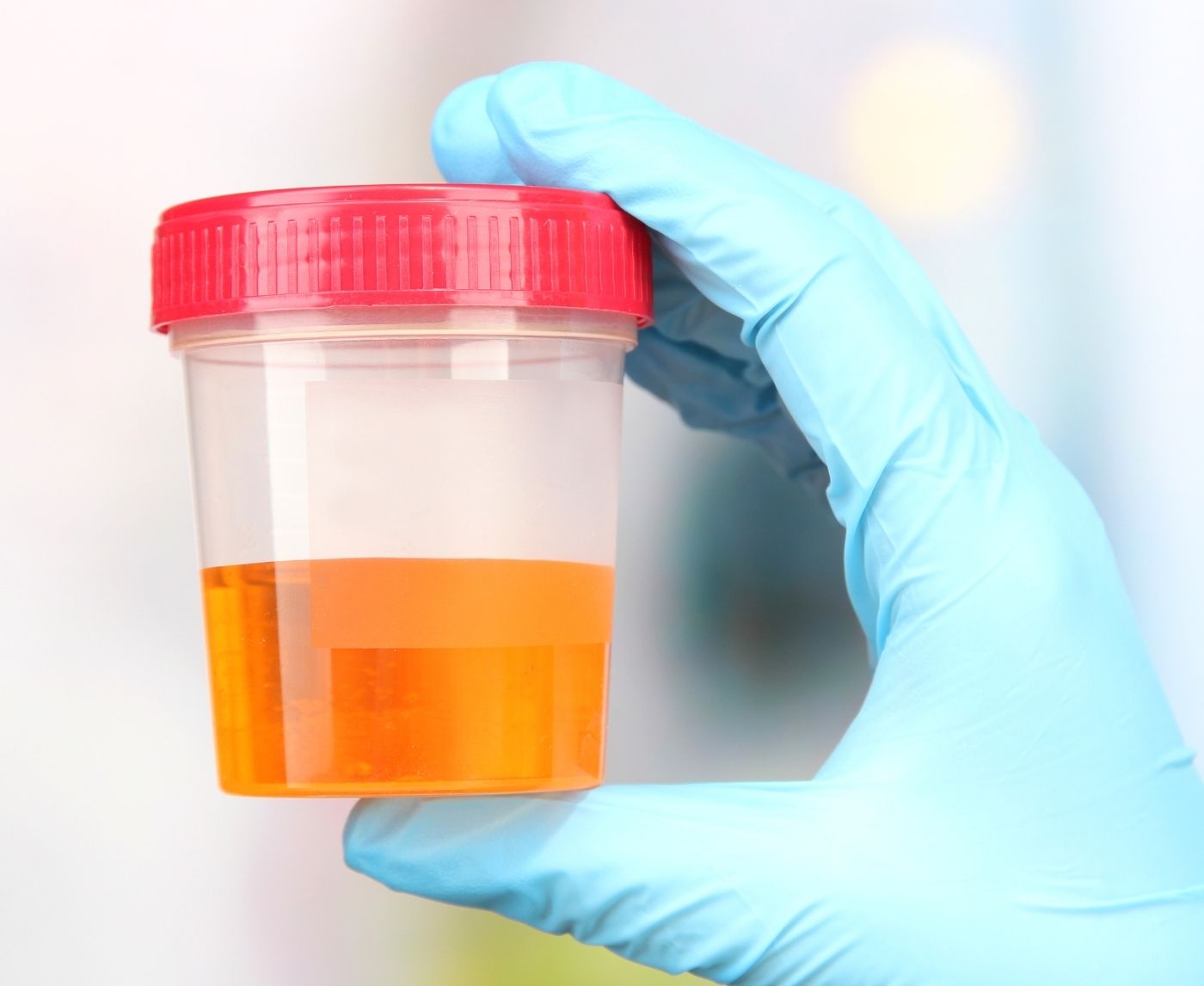



- A first-catch urine sample works well for people with penises and for screening when no symptoms are present, while a vaginal swab is the preferred sample for people with vaginas per the CDC.
- Most chlamydia tests reach their highest accuracy 14 days after exposure; testing in the first week risks a false negative.
Published: November 2025 | Last updated: May 2026 | Editorial review and quality control: Martina N.
The choice between a swab and a urine sample for chlamydia is not a trick question. Both tests look for the same bacterium (Chlamydia trachomatis), and when they are run as nucleic acid amplification tests (NAATs) in a clinical lab, both can be highly accurate. What changes is where the sample comes from, and that matters more than most people realize. A urine sample shows what is happening in the urethra. A swab shows what is happening at the cervix, the vagina, the rectum, or the throat. If the infection is hiding somewhere a urine stream cannot reach, only a swab from that site will find it.
The right test, then, is the one that matches your anatomy, your symptoms, and the kind of sex you had. This guide walks through how each method works, when each is preferred by the CDC, how to read the testing window so you are not falsely reassured by a too-early result, and how at-home rapid tests fit into the larger picture (with a clear note about what those home kits do and do not cover).
Key Takeaways
- A first-catch urine sample works well for people with penises and for screening when no symptoms are present, while a vaginal swab is the preferred sample for people with vaginas per the CDC.
- Most chlamydia tests reach their highest accuracy 14 days after exposure; testing in the first week risks a false negative.
What is actually different between a swab and a urine test?
Both methods are looking for the genetic material of Chlamydia trachomatis. Urine tests use the first 20 to 30 milliliters of the stream (the "first-catch" portion, not the midstream cup you might be used to for a urinary tract infection), because that is where urethral cells and any chlamydial DNA collect. Swab tests collect cells directly from a mucosal surface: the cervix or vagina, the rectum, or the throat.
According to the CDC's chlamydia treatment guidelines, NAAT-based tests are the recommended laboratory method for diagnosing chlamydia regardless of whether the sample is a swab or urine. The chemistry is the same; the question is whether you sampled the place where the infection actually lives.
For people with a vagina, the CDC's laboratory recommendations for chlamydia and gonorrhea identify a self-collected or clinician-collected vaginal swab as the preferred sample, with first-catch urine listed as an acceptable alternative. For people with a penis, first-catch urine is the preferred sample.
| Test Type | Sample Collected | Best For | Discomfort Level | Lab NAAT Sensitivity |
|---|---|---|---|---|
| Urine Test | First-catch urine (first 20 to 30 ml) | People with penises; screening when asymptomatic | None | About 87 to 97 percent |
| Vaginal Swab | Self-collected or clinician swab of vaginal wall | People with vaginas; CDC-preferred sample | Mild | About 96 to 98 percent |
| Rectal Swab | Cells from the rectal lining | Receptive anal sex or rectal symptoms | Moderate | About 93 to 97 percent |
| Throat Swab | Tonsillar pillars and posterior pharynx | Receptive oral sex (especially with a known-positive partner) | Mild (gag reflex) | About 85 to 95 percent |
When a swab is the right tool
Swab tests carry a stigma they do not deserve. Many people assume swabs only happen in a clinic, that they hurt, or that they are reserved for "serious" cases. None of that is accurate. Self-collected vaginal swabs perform as well as clinician-collected ones in head-to-head studies, and the technique is closer to inserting a tampon than to anything painful or invasive.
A swab is the right choice when the suspected infection site is not the urethra. Chlamydia can settle in the cervix, the vagina, the rectum, or the pharynx, and each of those sites is invisible to a urine sample. Someone who had unprotected receptive anal sex but only tests a urine sample may be told they are clear when a rectal infection is still active. Someone who gave oral sex to a partner with chlamydia will not see that exposure in a urine test either, because the urethra is not where the bacterium took up residence.
The clinical relevance of this is well documented. The CDC's STI screening recommendations specifically advise extragenital (rectal and pharyngeal) testing for men who have sex with men and for any patient whose sexual history includes those exposures, because urine-only testing systematically misses extragenital infections.
Cervix, rectum, pharynx. Each of these sites requires its own site-specific swab. A urine result only speaks to the urethra, so a negative urine test in someone with rectal or oral exposure does not rule out an extragenital infection.
When a urine sample makes sense
For people with a penis, the urethra is the most common site of chlamydia infection, and first-catch urine is the standard sample. The collection is simple, noninvasive, and the diagnostic performance is close to that of a urethral swab without any of the discomfort. The CDC explicitly endorses first-catch urine as the preferred sample for men in its laboratory recommendations.
Urine is also a reasonable screening sample for women who are asymptomatic and being screened opportunistically (for example, during a primary-care visit or as part of an annual sexual-health check). The performance is a few percentage points lower than a vaginal swab, but it is still in the high 80s to mid 90s for sensitivity. The caveat is that if symptoms are present, or if the exposure was anal or oral, a urine sample alone may give false reassurance.
One practical thing worth knowing: a first-catch urine sample is not the same as the midstream cup used for urinary tract infections. For a chlamydia test, you want the first part of the stream and you should not have urinated in at least an hour beforehand.
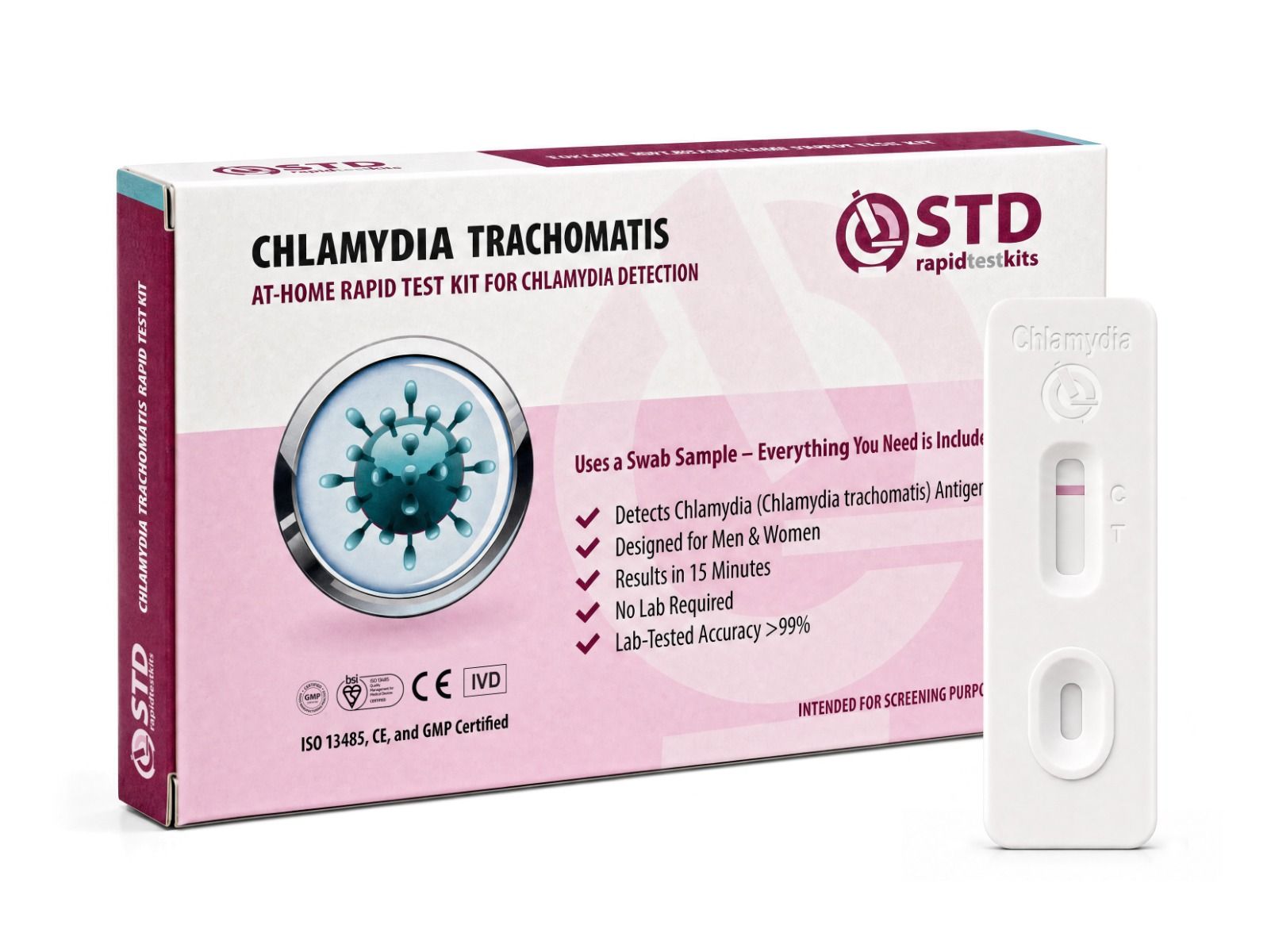
Our at-home chlamydia kit is a genital self-collected swab (vaginal or penile, rapid lateral-flow). We do not sell an at-home urine-cup chlamydia kit, an at-home rectal swab kit, or an at-home throat swab kit. If you need any of those sample types, a sexual-health clinic or your primary-care provider can collect them. Our kit is designed for the most common scenario: a genital infection you want to check on quickly at home.
How accurate are lab tests versus rapid at-home tests?
It helps to separate two different technologies that often get blurred together. Laboratory NAAT testing (the kind a clinic sends to a lab) amplifies tiny amounts of bacterial DNA and reports sensitivity figures in the high 90s for vaginal swabs, and in the high 80s to mid 90s for urine. Rapid at-home tests, including ours, use lateral-flow immunoassay chemistry. They look for chlamydial antigens directly on the swab and produce a visible line within minutes. The two technologies are complementary, not equivalent.
What that means practically: an at-home rapid swab is excellent for getting a fast answer in the privacy of your own bathroom, and a positive result is highly meaningful. A negative result late in the testing window is also reassuring for a genital infection. If the stakes are high (a known-positive partner, pelvic pain, recurrent symptoms), a follow-up lab NAAT from a clinic adds an extra layer of analytical sensitivity.
Lateral-flow rapid test: antigen detection on the swab, result in about 15 minutes, designed for home use. Lab NAAT: DNA amplification in a clinical lab, result in roughly 1 to 3 days, highest analytical sensitivity. Use lateral-flow to screen quickly at home; follow up with lab NAAT when the stakes are high.
Does it matter when you take the test?
Yes, more than most people expect. Chlamydia has an incubation period of roughly 7 to 21 days; the bacteria need time to multiply to levels a test can detect. Testing before day 14 risks a false negative even with an active infection, and any negative result from the first week should be confirmed with a repeat test at or after day 14.
This is the most common reason people get false reassurance. A urine test taken three days after a condom break can come back negative even though chlamydia is actively colonizing. A week later, symptoms may surface, and a repeat test (sometimes from a different site, like a rectal swab) can pick up what the early one missed.
| Time Since Exposure | What Testing Tells You | Risk of a False Negative |
|---|---|---|
| 0 to 3 days | Generally too early. Test only if symptoms are clearly present, then plan to retest. | Very high |
| 4 to 6 days | Still early. A negative here is not definitive; plan to retest at day 14. | High |
| 7 to 13 days | A first test here is reasonable, especially with symptoms. Recheck at day 14 if negative. | Moderate |
| 14 days and beyond | Recommended window for the most reliable result. | Low |
Choosing based on your anatomy and your risk
Gender, anatomy, and the kind of sex you had all shape the right choice. A few common scenarios make the logic easier:
If you have a vagina and any symptoms (unusual discharge, pain during sex, spotting between periods, lower abdominal ache), a vaginal swab is the recommended sample. It collects directly from the site the bacteria most commonly affects, and the CDC identifies it as the preferred sample type for that anatomy.
People with a penis and no symptoms can typically rely on a first-catch urine sample, which is the standard screening choice for a recent vaginal or oral exposure.
Receptive anal sex changes the picture: only a rectal swab can detect infection at that site, and the CDC recommends extragenital testing whenever that exposure is part of the sexual history. Our at-home kit does not cover rectal swabs; a sexual-health clinic does.
Oral sex on a partner whose status is unknown calls for a pharyngeal swab, which detects throat infection (usually asymptomatic). Like rectal testing, this is a clinic-administered sample, not an at-home one.
For mixed or unknown exposures, the safest approach is to test the urogenital site at home and add clinic-collected rectal or throat samples if those exposures applied. Doing so prevents a negative genital test from quietly missing an extragenital infection.
Most people with chlamydia do not have symptoms. Untreated, the infection can cause serious health problems. CDC recommends yearly chlamydia testing for sexually active women under 25 and for older women with risk factors.
Swab or urine sample, which one should I pick for chlamydia?
If you have a vagina, a vaginal swab is the CDC-preferred sample and slightly outperforms urine for genital chlamydia. If you have a penis, first-catch urine is the standard recommended sample. For receptive anal or oral exposure, a rectal or throat swab from a clinic is the only sample type that detects infection at those sites. Both swab and urine samples reach reliable accuracy 14 or more days after exposure.
What if your chlamydia test comes back positive?
A positive result is upsetting; it is also fixable. Chlamydia is curable with a short course of antibiotics, typically a 7-day course of doxycycline (the CDC's currently preferred regimen for most patients) or a single dose of azithromycin in specific clinical scenarios. The earlier the infection is caught, the simpler the treatment and the lower the risk of complications like pelvic inflammatory disease.
The practical steps after a positive at-home result are: confirm with a clinician (most urgent-care centers and sexual-health clinics will accept your home result as a starting point), get a prescription and finish the full course, avoid sex until at least 7 days after treatment finishes and until any partners have been treated, and tell recent partners so they can test. Partner notification can feel awkward, but the framing that tends to land best is short and factual: "I tested positive for chlamydia. It is treatable, but you should get tested too because most people do not feel any symptoms."
The CDC also recommends a test of reinfection about three months after treatment, regardless of whether you think you have been exposed again.
When to retest after a chlamydia test
Retesting answers a different question from initial testing. Four common situations call for a repeat test, and the rules of thumb come straight from CDC guidance.
Four situations that call for a retest
- A negative test taken within seven days of exposure: retest at day 14 or later, because the bacterial load may still be below the detection threshold.
- After completing antibiotic treatment: retest about three months later to check for reinfection, even if symptoms have cleared.
- Unprotected sex with a new partner between your test and your treatment: that counts as a new exposure and warrants another test in the 14-day window.
- Partner positive with your own negative: retest 7 to 14 days later, and confirm you sampled the right site (genital sample at home for genital exposure; clinic-collected rectal or throat swab for those exposures).
Privacy, packaging, and why people choose home testing
One of the practical reasons people pick a home test is the simple fact of not having to walk into a clinic. At-home kits arrive in discreet packaging without obvious medical branding, results stay between you and the test (no chart entry, no staff visible to you in a waiting room), and the timing is yours to choose. For people in rural areas, on the road, or living somewhere a clinic visit is logistically hard, that access matters.
None of that replaces clinical care for the things at-home rapid tests do not cover (extragenital sites, complications, complex co-infections), but for the most common chlamydia question ("do I have it on the genital site I am worried about right now"), the home option is a reasonable first step.

Before you panic, here is the short version
If you have a vagina and a possible exposure or symptoms, a vaginal swab is the sample with the strongest evidence behind it. If you have a penis and no symptoms, first-catch urine is the standard. Both lab and home rapid versions reach their most trustworthy results around the 14-day post-exposure mark, so timing is as important as method.
If oral or anal sex was part of the exposure, a clinic-collected throat or rectal swab is the only way to rule out an infection at those sites, and our at-home kit does not include those swab types. For everything else, a self-collected genital sample at home is a reasonable first answer.
The most important thing is that you test at all. Most chlamydia infections cause no symptoms; the only way to know is to check. Whether that check happens with a swab, a urine cup, at home, at a clinic, or some combination, the act of testing is what protects your future fertility and the health of any partners.
Decision shorthand
- Vagina, with symptoms or a recent exposure: vaginal swab, taken 14 or more days post-exposure.
- Penis, no symptoms: first-catch urine, taken 14 or more days post-exposure.
- Receptive anal or oral exposure: book a clinic-collected rectal or throat swab in addition to any home genital test.
Frequently asked questions
- Is a self-collected vaginal swab as accurate as one a clinician collects?
- Yes. Multiple studies summarized in the CDC's laboratory recommendations show that self-collected vaginal swabs perform comparably to clinician-collected swabs for chlamydia NAAT testing. The collection technique is forgiving, and the swab does not need to go deep; about 2 inches and a slow 20 to 30 second rotation against the vaginal wall is sufficient.
- Can I test too early and get a false negative?
- Yes, and this is one of the most common pitfalls. Chlamydia has an incubation period of roughly 7 to 14 days, and tests are most reliable from about day 14 onward. A negative result in the first week after an exposure should be confirmed with a repeat test at or after day 14, especially if symptoms develop or the exposure was high-risk.
- Does the swab hurt?
- Self-collected vaginal swabs are usually painless; the sensation is closer to inserting a tampon than anything medical. Some mild discomfort or light spotting can occur near a period, which is normal. Rectal and pharyngeal swabs are mildly uncomfortable but not painful, and they finish in seconds.
- Do I need a swab if I have a penis?
- Usually not for a routine genital chlamydia screen; first-catch urine is the recommended sample for the urethra. A swab becomes relevant only if you had receptive anal or oral sex and want to check those sites, in which case a clinic-collected rectal or throat swab is the appropriate sample (not available as an at-home kit).
- Can I take a urine chlamydia test from home?
- Not as an at-home rapid test that we sell. Our home chlamydia kit is a self-collected swab. At-home urine-based options that mail samples to a clinical lab exist from some providers, but they are mail-in lab kits rather than rapid home tests. For an immediate at-home result, the swab is the available option.
- How soon can I trust an at-home rapid result?
- Take the test 14 or more days after the suspected exposure for the most reliable result. A positive earlier than that is meaningful and should be acted on. A negative earlier than 14 days should be confirmed with a repeat test at day 14, because the bacterial load may still be below the detection threshold.
- What if my partner tested positive but my home test was negative?
- Two reasons this can happen: you tested too early, or the infection is at a site your sample did not cover (rectal or throat rather than genital). Retest at day 14 or later, and if the exposure included receptive anal or oral sex, ask a clinic for a rectal or pharyngeal swab. The home test only speaks to the genital site.
- How long after treatment should I retest?
- Three months is the CDC standard, even if you feel fine and your symptoms have cleared. One practical caution: avoid retesting sooner than three weeks after treatment finishes, because residual non-viable bacterial DNA can still trigger a false positive during that window.
How We Sourced This Article: We combined current guidance from the U.S. Centers for Disease Control and Prevention, the World Health Organization, and the Cleveland Clinic with peer-reviewed evidence on chlamydia NAAT performance and product information from our own at-home test kit. Specific recommendations on sample type, window period, and retesting reflect the CDC's published treatment and laboratory guidelines.
- U.S. Centers for Disease Control and Prevention. Chlamydia: Basic Fact Sheet (general overview of transmission, symptoms, and recommended screening).
- U.S. Centers for Disease Control and Prevention. STI Treatment Guidelines: Chlamydial Infections (recommended antibiotic regimens, test of reinfection at 3 months).
- U.S. Centers for Disease Control and Prevention. Laboratory Recommendations for the Detection of Chlamydia trachomatis and Neisseria gonorrhoeae (preferred sample types by anatomy).
- U.S. Centers for Disease Control and Prevention. STI Screening Recommendations (extragenital testing for relevant exposures).
- World Health Organization. Sexually transmitted infections (global epidemiology and screening rationale).
- Cleveland Clinic. Chlamydia Test: What It Is, Purpose, Procedure & Results (patient-facing overview of sample types).