Published: September 2025 | Last updated: May 2026 | Editorial review and quality control: Martina N.
Gonorrhea used to be straightforward to treat. A single antibiotic could clear the infection in most cases, and most people never thought about it again. The headline term now is 'super gonorrhea,' shorthand for strains of Neisseria gonorrhoeae that resist most of the antibiotics that once cleared them. The risk is real; for a US reader in 2026, the picture is more measured than the headlines suggest, and the steps to take are clear. This piece walks through what the term covers, where resistance has actually been documented, how current treatment works, and the testing and prevention steps that still matter.
Key Takeaways
- Ceftriaxone, given as a single 500 mg intramuscular injection, is still the only first-line treatment recommended for gonorrhea in the United States. Globally, ceftriaxone treatment failures have been documented in Japan, the UK, and Australia; the US has reported lab isolates with reduced susceptibility but no verified clinical treatment failures to date.
- Most readers now face a treat-then-retest workflow rather than the older one-shot model. Regular screening, a post-treatment test of cure when indicated, and partner notification catch resistant strains before they spread, and two new oral antibiotics are in late-stage regulatory review.
What 'super gonorrhea' means
'Super gonorrhea' is not a separate species or a single strain. It is shorthand for Neisseria gonorrhoeae isolates that show reduced or absent susceptibility to the antibiotics doctors rely on. Resistance has built up across decades, drug class by drug class. Penicillin lost effectiveness by the 1980s. Tetracyclines followed. Fluoroquinolones (drugs like ciprofloxacin) were dropped from US treatment guidelines in 2007 once resistance climbed past the 5 percent threshold that public health agencies use as the trigger to change treatment. Oral cefixime, ceftriaxone's cousin, was dropped from first-line use in 2012. By 2020, rising minimum inhibitory concentrations for azithromycin led the CDC to remove it from the standard dual-therapy regimen. That leaves ceftriaxone, a single 500 milligram intramuscular injection, as the only first-line treatment for uncomplicated gonorrhea in the United States, the United Kingdom, Australia, and most other countries with formal STI guidelines.
The CDC raised the recommended dose from 250 milligrams to 500 milligrams in late 2020, in part because slightly higher serum concentrations are more likely to clear an isolate with reduced susceptibility. The dose change bought some headroom. It did not reverse the underlying resistance trend.
When clinicians and researchers talk about 'extensively drug-resistant' (XDR) gonorrhea, they mean an isolate that survives ceftriaxone plus at least one other major antibiotic class. The United Kingdom reported its first ceftriaxone-resistant case in 2018. Australia, Japan, and several other countries followed within a few years. In 2023, the US confirmed two cases in Massachusetts that showed reduced susceptibility to ceftriaxone and several other drugs, the first documented isolates of that profile in the country.
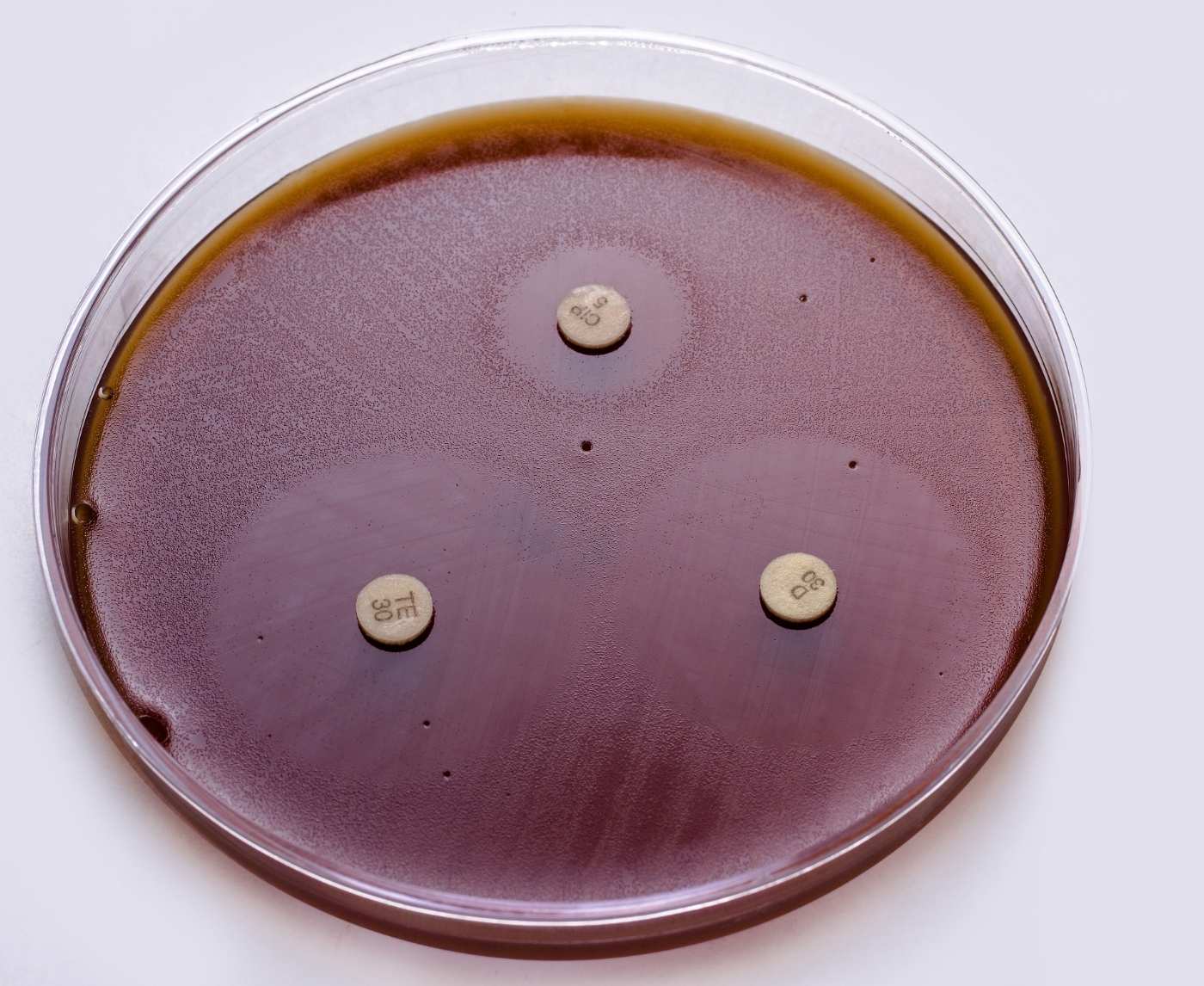
A lab result for 'resistant' is not a yes-or-no flag. It is a measured minimum inhibitory concentration (MIC), the lowest drug level that stops the organism from growing. The CDC's Gonococcal Isolate Surveillance Project (GISP) has tracked rising ceftriaxone MICs across US samples since 2018.
The WHO 5 percent threshold and why it matters
The 5 percent figure that keeps appearing in resistance reporting is not arbitrary. According to WHO guidance, public health surveillance programs use a 5 percent resistance threshold as the standard trigger for revising first-line treatment. Above that level, empirical therapy fails often enough that you cannot reasonably treat a patient without first culturing their sample and testing the isolate against the drug.
Empirical therapy, meaning treatment given before lab results come back, is the foundation of how STI clinics operate. A clinician examines you, takes a sample, and treats you the same day. If 5 percent or more of cases in a region will fail that standard treatment, the clinic either needs a different first-line drug or has to wait days for a susceptibility profile. Most clinics cannot absorb either cost.
The number itself comes from coordinated public-health surveillance. Labs in programs like the CDC's GISP in the United States, GRASP in the United Kingdom, and similar systems in Australia, the European Union, and across Asia culture a portion of the gonorrhea samples coming through participating clinics. The cultured isolates are tested against a panel of antibiotics, ceftriaxone among them. When the percentage with elevated MICs creeps past 5 percent in the regional pool, the threshold has been crossed.
That triggers the public-health response: change the recommended treatment, change the dose, or add a second drug. The threshold is a deliberate early-warning trigger, not a point at which the drug has stopped working altogether. Past that line, individual patients still respond to higher doses or alternative regimens. The shift is from confident routine treatment to cautious, susceptibility-led treatment.
Is super gonorrhea common in the US right now?
No. Documented ceftriaxone treatment failures in the US are still rare. The CDC has confirmed only a handful of isolates with reduced susceptibility to multiple antibiotics, and all of them have been successfully treated with higher-dose regimens. Rising minimum inhibitory concentrations suggest the safety margin is shrinking, even if clinical failures have not yet appeared. For an individual reader, regular testing after a possible exposure and a test of cure after any positive treatment are the most useful actions.
Where ceftriaxone resistance has actually been documented
Most of the data over the past several years has come from a handful of national surveillance systems. Headlines paint super gonorrhea as a near-term existential threat. The picture from those surveillance systems is more measured, and worth understanding before deciding what to do about it.
Globally, the World Health Organization estimates roughly 82 million new gonorrhea infections among people aged 15 to 49 each year. The share with documented resistance to at least one major antibiotic class is rising annually.
Japan was the first country to report a ceftriaxone treatment failure, with the H041 strain documented in Kyoto in 2009. Resistance has since been confirmed in additional Japanese isolates, and some regional reports now exceed the 5 percent threshold for decreased susceptibility. The United Kingdom's GRASP program has tracked a small but persistent stream of ceftriaxone-resistant cases since 2018. Most were imported from travel, often from East Asia, and the national figures remain below the 5 percent line. Australia documented an extensively drug-resistant strain in 2022 and has since updated its treatment guidelines to recommend higher ceftriaxone doses or alternative regimens when resistance is suspected. Some Australian regional surveillance pools have reported sample-level resistance above 5 percent.
Vietnam, parts of China, South Africa, and Kenya have all published data in the past several years showing isolates with resistant or decreased-susceptibility profiles. In some sub-regional pools the proportion exceeds 5 percent, though exact figures vary year to year and depend on which clinics participate in surveillance.
In the United States, total reported gonorrhea cases declined modestly in 2023 after years of steady increases. The two Massachusetts cases in 2023 were the first US isolates with reduced susceptibility to ceftriaxone and multiple other drugs. Both patients were treated successfully with higher doses, but the genetic markers matched strains circulating in the UK and Asia. International transmission is part of the story.
One reason public health agencies push so hard on screening and clearance: untreated or incompletely cleared gonorrhea increases the risk of both acquiring and transmitting HIV, so a positive result carries weight beyond the immediate infection.
| Country / region | Threshold status | Notes |
|---|---|---|
| Japan | Some regional pools above 5% | First reported ceftriaxone treatment failure (Kyoto, H041 strain, 2009) |
| Australia | Some regional pools above 5% | XDR strain documented 2022; treatment guidelines updated |
| United Kingdom | Below 5% nationally | GRASP has tracked imported resistant cases since 2018 |
| Vietnam | Sub-regional pools above 5% | Resistant and decreased-susceptibility isolates in published data |
| China | Sub-regional pools above 5% | Resistant clusters documented in recent surveillance |
| South Africa, Kenya | Sub-regional pools above 5% | Resistant and decreased-susceptibility isolates in surveillance |
| United States | Below 5% nationally | GISP surveillance shows elevated MICs; two 2023 Massachusetts isolates with reduced susceptibility; no verified clinical failures |
Why gonorrhea outpaces antibiotics
Neisseria gonorrhoeae is a textbook case of fast bacterial evolution. The bacterium acquires and exchanges DNA easily through a process called transformation, which lets it pick up resistance genes from related bacteria living in the throat or genital tract. A handful of well-characterized mutations show up repeatedly in resistant strains: mosaic penA alleles that change the shape of the protein ceftriaxone binds to, mtrR mutations that activate efflux pumps which push the drug back out of the bacterial cell, and ponA changes that further reduce drug binding.
The pharynx is a key reservoir. Pharyngeal (throat) infections are usually asymptomatic, which means people carry them without knowing, do not get tested, and do not get treated. The throat is also where N. gonorrhoeae shares space with related Neisseria species that already carry low-level resistance genes. The two swap DNA, and resistant gonococcal strains emerge. Public health programs in cities with high screening rates for oral and rectal sites tend to catch resistance earlier.
Travel and dense sexual networks accelerate the spread of any resistant strain that does emerge. A single resistant infection in one city can seed cases in another within weeks. Genomic markers from the 2018 UK case, the 2019 Australian cases, and the 2023 Massachusetts cases overlap, evidence that resistant strains move between continents within months. Under-dosing, meaning incomplete or substandard antibiotic courses common in places where antibiotics are sold without a prescription, compounds the selective pressure, as does over-prescribing antibiotics for unrelated infections.
Three genetic levers behind ceftriaxone resistance
- Mosaic penA alleles: rearrange the protein that ceftriaxone binds to, lowering drug effectiveness at the target site.
- mtrR mutations: activate bacterial efflux pumps that physically push the drug back out of the cell.
- ponA changes: further reduce ceftriaxone binding, often in combination with penA changes for an additive effect.
Symptoms, and the red flag to watch for
Drug-resistant gonorrhea looks the same as standard gonorrhea until treatment doesn't work. There are no symptoms that uniquely signal a resistant strain at first presentation. What distinguishes it is persistence after a treatment course, or recurrence within weeks.
Common symptoms of gonorrhea, resistant or not:
- Painful or burning urination
- Unusual penile or vaginal discharge (often white, yellow, or green)
- Pelvic pain in women; testicular pain in men
- Rectal pain, itching, discharge, or bleeding
- Sore throat that lingers, sometimes with no other symptoms
- Pain or unusual bleeding during or after sex
Many infections produce nothing at all. The CDC estimates that roughly half of gonorrhea infections in women cause no noticeable symptoms, and oral infections are usually silent regardless of sex. Screening, not symptom-watching, is the useful tool for people who have had a possible exposure. Most routine clinical tests are nucleic acid amplification tests (NAATs), which detect the bacterium but do not characterize its drug sensitivity.
Any of these patterns after a treatment course warrants culture-based antibiotic susceptibility testing, the lab method that maps an organism's resistance profile:
- Symptoms persisting past 14 days after treatment
- Symptoms returning without a new exposure
- A still-positive test of cure at 7 to 14 days
- A treated partner reporting the same pattern
How it spreads
Transmission routes for super gonorrhea match those for any gonorrhea: unprotected vaginal, anal, or oral sex with an infected partner. Resistance does not make the bacteria more contagious. It makes the infection harder to clear once acquired.
A few features make resistant strains particularly mobile:
- Pharyngeal (throat) infections are usually symptomless, so they go undetected for longer and can spread further
- Shared sex toys can carry infected fluids between partners
- Reinfection from an untreated partner is one of the most common causes of a positive test after treatment
- Travel-associated cases account for a meaningful share of the resistant isolates first detected in any country
Practical implications follow from this. Condoms substantially reduce risk for all sites of sex, though they are not perfect, especially for oral transmission; latex allergies can be addressed with polyisoprene or polyurethane condoms, which offer comparable protection without the natural-rubber proteins. Screening throat and rectal sites when you have receptive oral or anal sex catches infections that genital-only screening misses. And partner notification is essential: an untreated partner re-exposes you, and a treatment course in one person does not end a chain on its own.
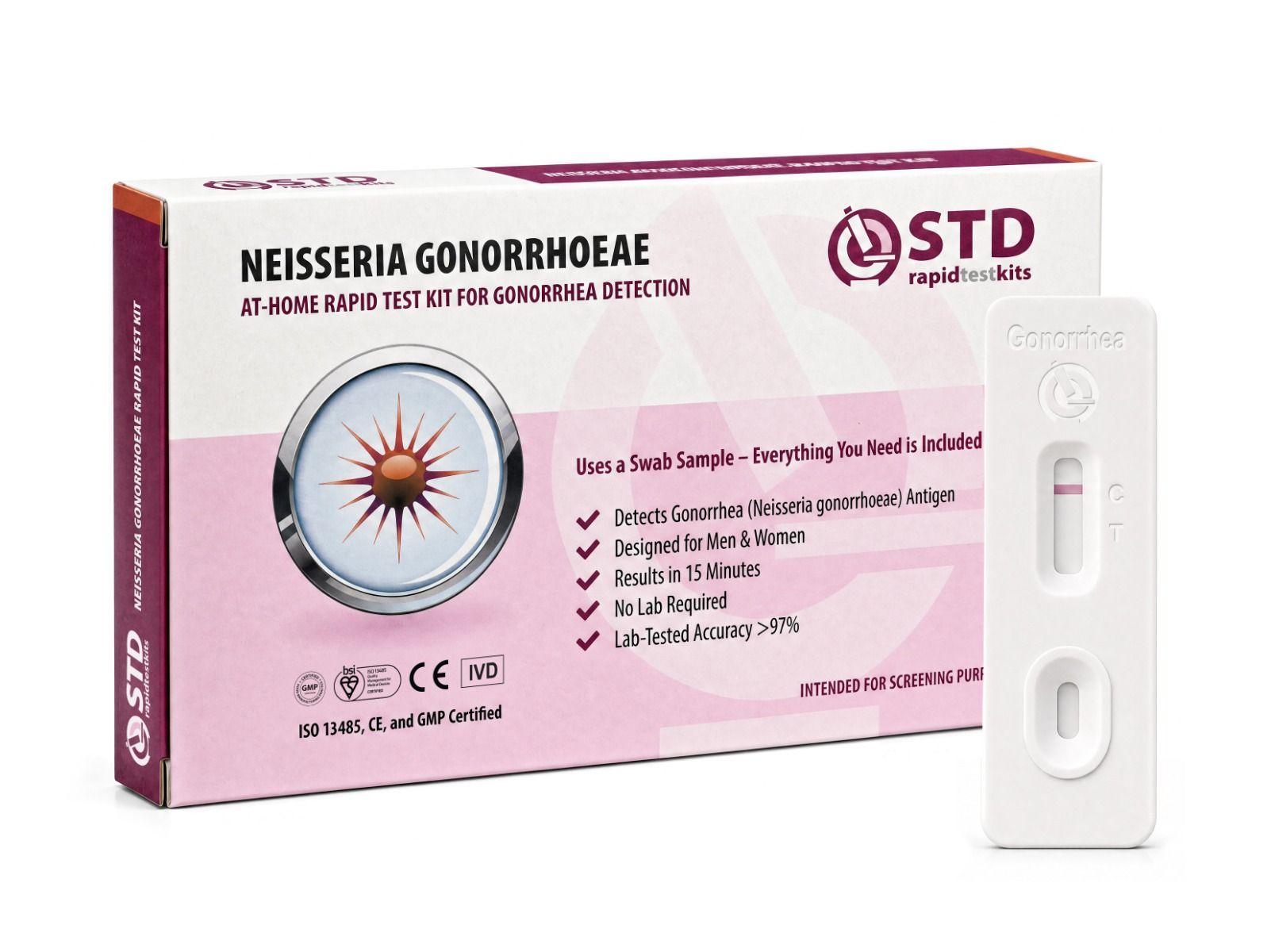
Note: stdrapidtestkits.com sells rapid at-home STI tests, including the gonorrhea kit shown below. Product recommendations are based on fit-for-purpose for the reader's concern, not commercial benefit. Our home swab kits screen genital samples only; pharyngeal or rectal screening still needs a clinic.
How current treatment works
For an uncomplicated gonorrhea infection diagnosed in the United States in 2026, the CDC's recommended first-line treatment is a single 500 milligram intramuscular injection of ceftriaxone. For people with a cephalosporin allergy, gentamicin combined with azithromycin is the recommended alternative, with the caveat that azithromycin resistance is now common enough that a test of cure is essential afterward.
Co-treatment for chlamydia is no longer added by default. Doxycycline is given only when chlamydia is confirmed or strongly suspected, since dual therapy creates additional resistance pressure without consistent benefit.
If a treatment course fails, the response escalates. Higher doses of ceftriaxone, dual therapy with another class, or in the most severe cases intravenous antibiotics in a hospital setting. Specimens are sent for culture and antibiotic susceptibility testing so the local public health department can track the resistance pattern.
For most readers, treatment has shifted from one-and-done to treat-then-confirm. A test of cure, meaning repeat testing roughly 7 to 14 days after treatment to confirm the infection has cleared, is now recommended routinely for pharyngeal (throat) gonorrhea, and for genital or rectal infections when resistance is suspected. The CDC also recommends retesting at 3 months after any positive gonorrhea diagnosis, primarily to catch reinfection, which is more common than treatment failure.
Current US treatment at a glance
- First-line: single 500 mg intramuscular injection of ceftriaxone for uncomplicated gonorrhea.
- Cephalosporin allergy: gentamicin plus oral azithromycin as the recommended alternative regimen.
- Test of cure: routinely 7 to 14 days after treatment for pharyngeal infections, and for genital or rectal infections when resistance is suspected.
- Retest at 3 months after any positive result, primarily to catch reinfection rather than treatment failure.
What happens when first-line treatment fails
If a standard ceftriaxone shot does not clear the infection, the patient stays infectious longer and the bacteria have more time to reach body sites where they cause serious complications.
In women, untreated or under-treated genital gonorrhea can ascend to the upper reproductive tract and cause pelvic inflammatory disease (PID). PID can scar the fallopian tubes, increasing the risk of ectopic pregnancy and infertility. The CDC notes that untreated gonorrhea can lead to pelvic inflammatory disease, with study estimates of PID development among women with untreated chlamydia or gonorrhea varying meaningfully across populations.
In men, untreated gonorrhea can cause epididymitis, a painful swelling of the testicular tubing, and more rarely, infertility.
In either sex, untreated infection can spread through the bloodstream and cause disseminated gonococcal infection (DGI), which presents with skin lesions, tenosynovitis, and arthritis. DGI is uncommon but serious. It can require hospitalization and intravenous antibiotics. Pregnancy adds the risk of preterm birth and transmission to the newborn's eyes during delivery, a condition called ophthalmia neonatorum.
Most of these outcomes are still preventable today. Clinical management of treatment failure follows a standard sequence: re-test, culture for susceptibility, escalate to higher-dose ceftriaxone or to a dual-therapy regimen with another agent, and follow up to confirm clearance.
Effective treatment options for gonorrhea are dwindling. Continued use of ceftriaxone for treating gonorrhea is critical, and clinicians should be alert to suspected treatment failure.
Where the research is heading
Two new antibiotics are in late-stage development for gonorrhea.
Zoliflodacin, developed by Innoviva in partnership with the Global Antibiotic Research and Development Partnership, completed Phase 3 trials in late 2023 for uncomplicated urogenital and rectal gonorrhea. It acts on bacterial type II topoisomerase by a mechanism distinct from existing fluoroquinolones, which means an isolate resistant to fluoroquinolones will not automatically be resistant to zoliflodacin. Trial results showed it was non-inferior to standard ceftriaxone-based therapy, delivered as a single oral dose. The drug is under regulatory review in multiple jurisdictions; commercial availability varies by country and is not yet universal.
Gepotidacin, an oral antibiotic from GSK already approved for uncomplicated urinary tract infections in women under the brand name Blujepa, targets two bacterial DNA-replication enzymes at once, which makes it harder for the bacterium to mutate around. Phase 3 results published in 2024 showed non-inferiority to the standard ceftriaxone regimen for gonorrhea. Gonorrhea is not yet an approved indication, but the data is in front of regulators.
A vaccine is a longer story. There is no licensed gonorrhea vaccine. Observational studies in the UK, Australia, and New Zealand have estimated that the meningococcal B vaccine known as 4CMenB, which targets a related Neisseria species, offers meaningful cross-protection against gonorrhea, estimated in the range of 30 to 40 percent in some analyses, though figures vary by study population. The UK began offering 4CMenB to people at higher risk in 2023. The US Advisory Committee on Immunization Practices is reviewing the evidence. A purpose-built gonorrhea vaccine remains in earlier-stage trials.
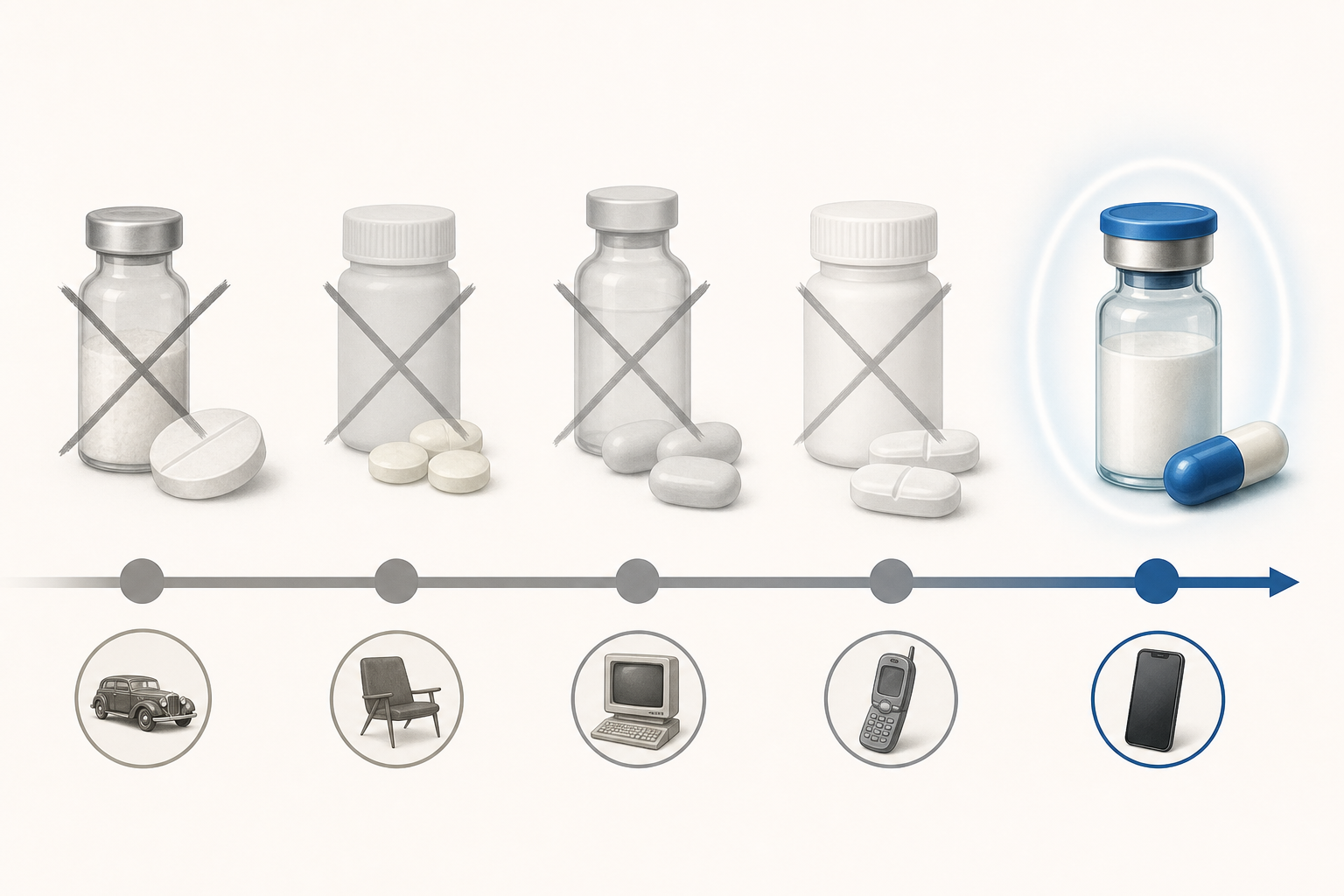
For the next two to three years: one or two new antibiotic options entering the market, partial vaccine coverage available in some countries for higher-risk populations, and continued reliance on testing, treatment, and partner notification.
Pipeline at a glance
- Zoliflodacin: Phase 3 complete (late 2023); non-inferior to ceftriaxone-based therapy; regulatory submissions underway.
- Gepotidacin: Phase 3 gonorrhea results positive (2024); already approved for UTIs as Blujepa; gonorrhea indication pending.
- 4CMenB vaccine: meaningful cross-protection observed in observational studies, with estimates in the 30 to 40 percent range varying by study population; offered to higher-risk groups in the UK since 2023.
- Purpose-built gonorrhea vaccine: earlier-stage research only.
Steps that change your risk
A short, high-leverage list of actions, in order of how often each one matters in practice. Test, treat, retest, notify, repeat as needed.
- Test after any new partner or condomless encounter that worries you. Standard lab panels and at-home rapid swab kits both work for screening genital infection; throat and rectal screening still need a clinic.
- If you test positive, complete the full treatment course and return for a test of cure when your clinician recommends it. Easing symptoms are not proof the medication worked.
- Notify recent partners. Most US states allow expedited partner therapy, where a clinician can issue medication for a partner who has not been seen. Without partner treatment, the infection cycles back.
- If symptoms persist or return after treatment, ask specifically for culture-based testing. Routine clinical tests for gonorrhea are NAATs, which detect the organism but do not reveal its resistance profile. A culture is what catches a resistant strain in the lab.
- Reduce transmission risk where you can. Condoms cut risk substantially for vaginal and anal sex; condoms and dental dams help for oral. Oral risk is lower than genital but not zero, and the throat is the site where resistance most often takes hold.

Common misconceptions worth correcting
A few persistent myths get in the way of timely testing and treatment.
'It only happens to people with many partners.' Resistance is about exposure to a resistant strain. The number of partners is not the predictor. A single encounter with an infected partner is enough.
'If I have no symptoms, I'm fine.' Roughly half of gonorrhea infections in women are asymptomatic, and oral infections rarely show signs at all. Symptom-watching is the wrong tool. Screening after a possible exposure is the right one.
'Antibiotics always work eventually.' Most still do for now. The few that do not are why the surveillance system exists. Treatment failure is rare enough that most clinicians have not seen one, common enough that the CDC tracks every confirmed case nationally.
'One treatment course is enough.' Reinfection from an untreated partner is the most common reason for a positive result after treatment, separate from any true treatment failure. The CDC recommends a 3-month retest after any gonorrhea diagnosis for that reason.
'Condoms don't help against resistant strains.' They do. Resistance changes how the bacterium responds to antibiotics, not how it transmits. Consistent condom use prevents the great majority of genital-to-genital transmission, resistant or not.
'At-home rapid tests are NAAT-equivalent.' They are not. At-home rapid lateral-flow tests are screening tools, more accessible than a clinic visit and a reasonable first step for someone with a possible exposure. A positive result is worth confirming with a lab NAAT when possible. A negative result outside the window period and without symptoms is usually reassuring.
If symptoms return after treatment, or a test of cure is still positive, ask your provider for culture-based susceptibility testing rather than only a repeat NAAT. A culture is the lab method that maps which antibiotics still work against your specific isolate, and it is the step that catches a resistant strain.
Frequently Asked Questions
- Is super gonorrhea common in the US right now?
- US gonorrhea surveillance data through 2023 shows no verified clinical ceftriaxone treatment failures. Lab isolates with reduced susceptibility have been identified, but all were successfully treated with modified regimens. Rising minimum inhibitory concentrations remain the early signal of resistance building before clinical failures appear.
- What does it mean that ceftriaxone resistance has crossed 5 percent in some regions?
- The 5 percent figure is the WHO threshold for changing first-line antibiotic treatment. When more than 1 in 20 recent gonorrhea isolates in a region stop responding to a drug, that drug can no longer be reliably used as empirical treatment, meaning treatment given before lab results are back. Regional surveillance pools in Japan, parts of Australia, Vietnam, and several others have reported ceftriaxone resistance at or above 5 percent over the past several years. The US has not crossed the line nationally.
- Can I tell from my symptoms if I have a resistant strain?
- No. There are no symptoms that distinguish a resistant strain from a non-resistant one at first presentation. The signal is what happens after treatment: symptoms that persist past 7 to 14 days, return without re-exposure, or show on a post-treatment test.
- Which antibiotic do doctors use to treat gonorrhea now?
- In the United States, the recommended first-line treatment for uncomplicated gonorrhea is a single 500 milligram intramuscular injection of ceftriaxone. Azithromycin is no longer part of the dual-therapy default. Gentamicin plus azithromycin is the recommended alternative for people with a cephalosporin allergy.
- How long should I wait to retest after gonorrhea treatment?
- For pharyngeal (throat) infections, a test of cure 7 to 14 days after treatment is recommended routinely. For genital and rectal infections, a routine retest at 3 months is recommended primarily to catch reinfection. If symptoms persist or return, get tested sooner.
- Can a home rapid test detect drug-resistant gonorrhea specifically?
- Home rapid tests detect the presence of gonorrhea but not its resistance profile. To characterize a strain's resistance, a clinical lab needs to run culture-based antibiotic susceptibility testing. A positive home test is the trigger for clinical follow-up, including that lab work when resistance is suspected.
- Are new antibiotics coming?
- Two are in late-stage development. Zoliflodacin completed Phase 3 trials in 2023 with results comparable to current treatment and is moving toward regulatory approval. Gepotidacin, already approved for urinary tract infections under the brand name Blujepa, has shown activity against gonorrhea in Phase 3 trials. Availability for gonorrhea varies by country.
- Is there a gonorrhea vaccine?
- Not yet. The closest available option is the meningococcal B vaccine known as 4CMenB, which targets a related bacterium and has shown meaningful cross-protection in observational analyses, with estimates often in the 30 to 40 percent range varying by study population. Some countries, including the UK, offer it to people at higher risk. A purpose-built gonorrhea vaccine is in earlier-stage trials.
- U.S. Centers for Disease Control and Prevention. Drug-Resistant Gonorrhea, clinician guidance on current resistance trends, GISP surveillance, and treatment escalation pathways.
- U.S. Centers for Disease Control and Prevention. Gonorrhea topic hub, including treatment overview, complications such as pelvic inflammatory disease, and screening recommendations.
- World Health Organization. Multi-drug-resistant gonorrhoea fact sheet, including global resistance trends, the HIV co-infection link, and urgency for new antibiotic development.
- World Health Organization. Sexually Transmitted Infections fact sheet, including global incidence estimates for gonorrhea among adults aged 15 to 49.
- UK Health Security Agency. Gonococcal Resistance to Antimicrobials Surveillance Programme (GRASP) annual reports tracking ceftriaxone-resistant cases in the UK since 2018.
- U.S. National Library of Medicine, MedlinePlus. Gonorrhea overview, symptoms, transmission routes, and patient-facing testing and treatment information.
