
Published: December 2025 | Last updated: May 2026 | Editorial review and quality control: Martina N.
You can carry chlamydia for two years and feel nothing at all. You can be living with HIV for a decade and still feel basically fine, give or take an unusually persistent cold. You can pass herpes to a partner during a stretch when you have zero visible sores and zero idea anything is happening. None of that is dramatic exception territory. It is the default behavior of most sexually transmitted infections.
This guide is for anyone whose internal monologue lately sounds like “I feel fine, so I am probably fine.” That logic works well for indigestion. It fails badly for STIs. The next sections walk through which infections stay silent the longest, the difference between when a test can detect them and when symptoms might appear, and how to build a testing plan that catches what your body has not bothered to mention.
Key Takeaways
- Most STIs run silent. Chlamydia, gonorrhea, herpes, syphilis (after the chancre fades), and HIV can all stay symptom-free for months or years; HIV's chronic stage typically lasts about 10 years without treatment (NIH). Feeling fine is not evidence of being uninfected.
- Window period (when a test becomes reliably positive) and incubation period (when symptoms might appear) are two different clocks. A test taken too early in its window can miss an active infection, even when symptoms have already shown up.
The dangerous comfort of feeling fine
The most common myth in sexual health is that infections announce themselves. They do not. The CDC's chlamydia overview is blunt about the pattern: the infection often has no symptoms (CDC chlamydia overview). Gonorrhea behaves similarly in many women, especially when the infection sits in the cervix or rectum rather than the urethra. The pelvis simply does not always advertise an infection.
Herpes is sneaky in a different way. After exposure, the herpes simplex virus retreats into nerve cells and stays there. A first outbreak might show up two weeks after exposure, or it might not show up for years, or in some people it never causes recognizable symptoms at all. During quiet periods the virus can still shed onto skin and mucous membranes, so transmission to partners happens without anyone noticing a sore.
HIV runs a different but related play. Acute HIV (the first few weeks after infection) sometimes causes a flu-like illness with fever, fatigue, and swollen lymph nodes. Many people miss it entirely or chalk it up to a cold. After acute infection passes, HIV typically enters a clinical latency stage that usually advances to AIDS in about 10 years or longer without treatment (NIH stages of HIV), during which someone can feel fine while the virus quietly reduces immune function.
Many STIs have no symptoms or may only cause mild symptoms, so people can have an infection but not know it.
Which STIs stay silent, and for how long
Different infections have different patterns of silence. Some are bacterial and could in theory be cleared early if caught, but they hide because they cause minimal inflammation in many people. Others are viral and persist quietly because the virus has evolved mechanisms to live alongside the immune system without provoking it. The table below summarizes typical patterns drawn from CDC and NIH timing guidance and standard clinical references.
| STI | Typical time until symptoms (if any) | How long it can stay hidden |
|---|---|---|
| Chlamydia | 1 to 3 weeks (often none) | Months to years |
| Gonorrhea | 2 to 7 days (often subtle or missed in women) | Several months |
| Herpes (HSV-2) | 2 to 12 days for the first outbreak; some people never have a recognized outbreak | Indefinitely; latent between outbreaks |
| Syphilis | 10 to 90 days for the primary chancre (avg 21 days) | Years; latent stage between secondary and tertiary |
| HIV | 2 to 4 weeks for acute symptoms (or none) | About 10 years or longer of clinical latency without treatment (NIH) |
| Trichomoniasis | 5 to 28 days (often none, especially in men) | Months |
| Hepatitis C | 2 to 12 weeks (often none in early infection) | Decades; many cases discovered only on routine screening |
Window period vs incubation period: two different clocks
Two clocks start running after exposure to an STI, and confusing them is one of the most common mistakes that produces false reassurance.
The incubation period is how long after exposure symptoms might appear, if they appear at all. The window period is how long it takes for the infection to reach detectable levels in a test. These are not the same number, and they are not measured against the same biological event. Symptoms come from your immune response. Test positivity comes from antibody levels (or pathogen RNA, depending on the test). The two follow different curves.
Take HIV as an example. The CDC's testing guidance reports that fourth-generation antigen-antibody lab tests can usually detect HIV between 18 and 45 days after exposure (CDC HIV testing). Acute HIV symptoms, when they appear, typically show up 2 to 4 weeks after exposure. So a person could feel acute symptoms (sore throat, fever, fatigue) at week 3, test at week 3, get a clean result back, and still be HIV-positive. The symptoms came earlier than the test could confirm.
Window periods also depend on which test technology you use. Lab-based fourth-generation HIV tests close their window faster than rapid antibody-only tests. Lateral-flow rapid blood tests for syphilis and HIV are accurate when used after the window closes, but they typically have longer windows than lab-confirmed antigen-antibody assays.
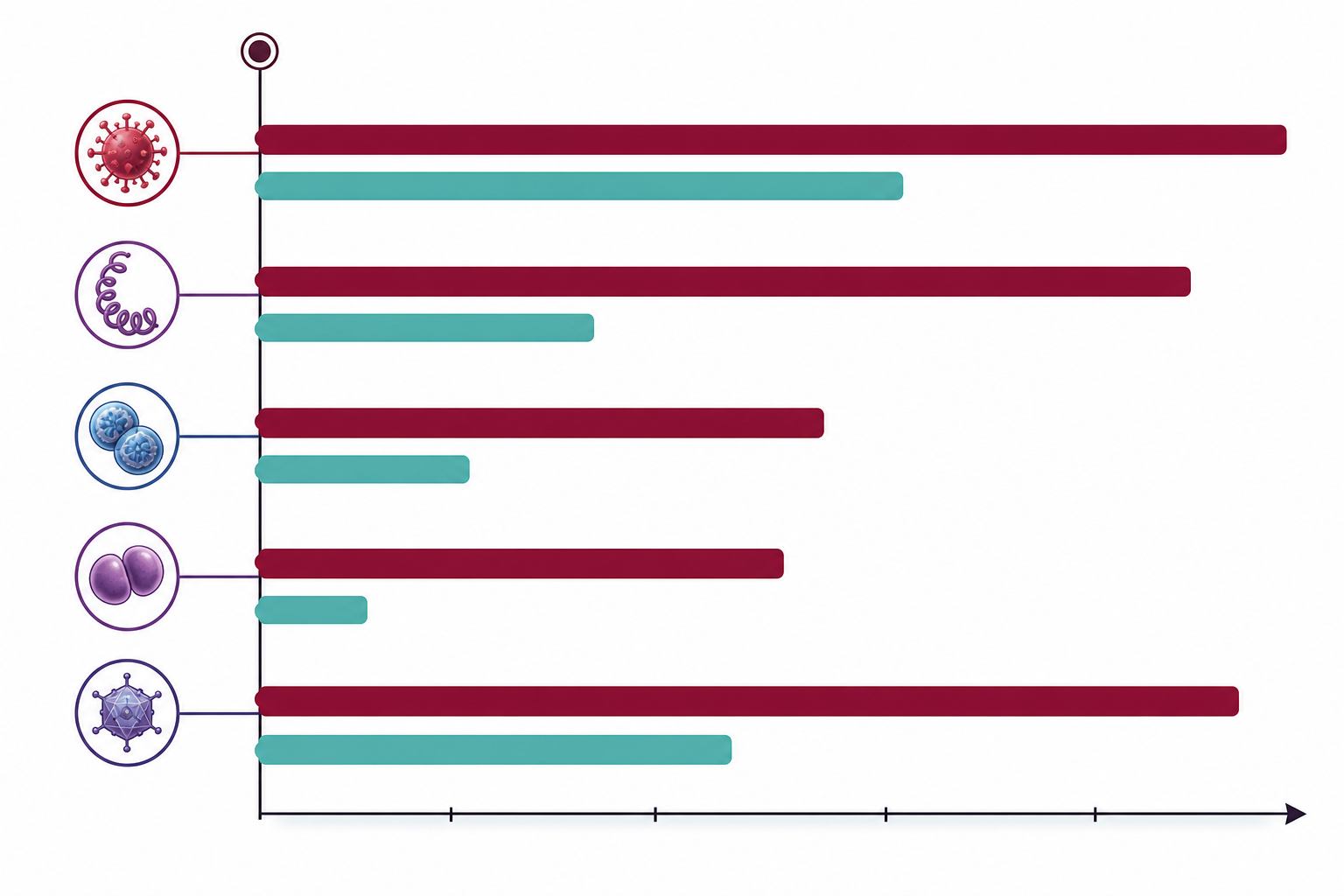
Test detection windows at a glance
The numbers below come from CDC testing guidance and standard manufacturer labeling for at-home rapid tests. They are starting points, not guarantees: individual immune responses vary, and some people seroconvert outside the typical range.
| STI | Window period (test accuracy begins) | Incubation period (symptoms may start) |
|---|---|---|
| HIV (fourth-gen lab) | 18 to 45 days | 2 to 4 weeks (or none) |
| HIV (rapid antibody) | 23 to 90 days | 2 to 4 weeks (or none) |
| Syphilis | 3 to 6 weeks | 10 to 90 days |
| Chlamydia (NAAT) | 1 to 3 weeks | 1 to 3 weeks (or none) |
| Gonorrhea (NAAT) | 1 to 2 weeks | 2 to 7 days (or none) |
| Herpes HSV-2 (antibody) | Up to 12 weeks | 2 to 12 days for first outbreak; can delay months or years |
| Hepatitis C (antibody) | 8 to 11 weeks | 2 to 12 weeks (often none) |
Why some infections hide longer than others
The infections that stay silent the longest tend to share a feature: they cause minimal early inflammation. The body's symptom-generating machinery runs largely on inflammation. When a pathogen does not provoke much immune response, you do not feel much.
Trichomoniasis is a textbook case. The parasite establishes itself in the urethra or vagina with very little inflammation in most people, especially men. The CDC reports that about 70 percent of people with trichomoniasis have no signs or symptoms (CDC trichomoniasis). The infection can persist for months without changing how anything feels.
Chlamydia behaves similarly in the cervix and urethra. It infects epithelial cells quietly. Most carriers feel nothing. The danger arrives later: if the bacteria ascend to the upper reproductive tract, they can cause pelvic inflammatory disease (PID), which can scar fallopian tubes and reduce fertility. PID itself often goes unrecognized in its mild form, so the chain of consequences plays out invisibly.
Herpes and HIV use a different strategy: viral latency. Herpes simplex retreats into the dorsal root ganglia (clusters of nerve cell bodies near the spinal cord) and parks there indefinitely. It only re-emerges when the immune system relaxes its surveillance, typically during stress, illness, hormonal shifts, or for no obvious reason. During those latent phases, asymptomatic viral shedding still occurs intermittently, which is the main route by which herpes spreads to partners who have never had a recognizable outbreak. HIV embeds itself in long-lived immune cells and forms reservoirs that even effective treatment cannot fully clear.
Syphilis adds a third pattern: cycling stages. After the initial chancre (often painless, easy to miss, and clearing on its own in 3 to 6 weeks) heals, the infection can enter a secondary stage with widely variable symptoms (rash on palms and soles, fatigue, sore throat). After the secondary stage, syphilis often enters a latent stage that can last years before causing late-stage cardiovascular or neurological damage, according to the CDC syphilis overview.
Low inflammation: chlamydia, gonorrhea (in women), and trichomoniasis often do not provoke enough immune response to produce noticeable symptoms. Without inflammation, there is no pain, discharge, or rash to alert the carrier.
Viral latency: herpes simplex and HIV survive by retreating into long-lived cells (nerve ganglia for herpes, immune-cell reservoirs for HIV). The infection is still active and transmissible during latent phases; it just is not generating symptoms.
Testing while you feel fine: a timing strategy for asymptomatic exposure
The mechanics: you cannot rely on symptoms to tell you when to test, so timing has to come from the calendar of your last possible exposure.
A reasonable approach for someone with one recent exposure of unknown status, drawn from standard post-exposure care patterns:
- At 2 weeks: NAAT-based chlamydia and gonorrhea testing can sometimes detect infection by then. Antibody-based tests for HIV, syphilis, and herpes will not be reliable yet.
- At 6 weeks: Most HIV cases are detectable on a fourth-generation antigen-antibody test. Most syphilis cases are also detectable. Chlamydia and gonorrhea remain detectable.
- At 12 weeks: Most HSV-2 antibody seroconversion is complete. This is the final retest checkpoint for the slowest-seroconverting infections.
If you have had multiple exposures spread over months, the most useful approach is usually a baseline test now, and a retest in 6 to 12 weeks based on what the first round shows.
For routine screening (no specific recent exposure), the CDC's STI screening recommendations include annual chlamydia and gonorrhea screening for sexually active women under 25 and for older women with risk factors, and routine HIV screening at least once for everyone aged 13 to 64. Higher-frequency screening (every 3 to 6 months) is appropriate for anyone with multiple partners, men who have sex with men, and anyone whose partner has tested positive.
This article is published by stdrapidtestkits.com, which sells at-home STI testing kits. We recommend products based on fit-for-purpose for the reader's concern, not commercial benefit. For symptoms or treatment decisions specific to your situation, see a licensed clinician.

When a negative test does not actually mean negative
False negatives during the window period are common enough to be predictable rather than surprising. If you tested 10 days after a possible exposure and got a clean panel back, that is informative for a test where the window period is short, and it is not informative for a test where the window period is long. The result is real for what it covers and silent on what it does not.
A useful rule: any negative result taken before the test's published window period closes should be treated as preliminary, not as a definitive answer. Confirmatory retesting at the appropriate window distance is standard practice in post-exposure clinical care.
There are also test-technology factors. Lateral-flow rapid antibody tests (the at-home format) are accurate when used after the window period closes, but they detect antibodies, not the pathogen itself. They will be falsely negative during the period before antibodies have developed. Lab-based NAAT (for chlamydia and gonorrhea) detects bacterial RNA directly and can therefore close its window faster than antibody-based tests.
Any negative result taken before the test's published window period closes is preliminary, not final. If your last possible exposure was less than the window period away, schedule a confirmatory retest once the window has closed.
How long is too long to wait?
If you are sitting on a possible exposure from six months ago, or even three years ago, testing today is still useful, and arguably more useful than testing during the early window. Late-stage syphilis, chronic hepatitis B, untreated HIV, and untreated chlamydia all cause progressive damage that worsens the longer they go untreated. Testing late will not undo damage that has already accumulated, but it stops the clock and starts treatment.
Some infections clear on their own. The CDC notes that most HPV infections (about 9 out of 10) go away by themselves within 2 years (CDC HPV). Many other infections do not clear without treatment. Bacterial STIs (chlamydia, gonorrhea, syphilis) require antibiotics; they do not resolve without medication. The longer they sit, the more cumulative damage they have done by the time anyone notices. The bottom line is simple: there is no expiration date on the value of testing.
Many sexually transmitted infections cause no symptoms. The only way to know for sure if you have an STI is to get tested.
Your action plan, in six steps
If your stomach is turning a little reading this, that is normal. It does not mean you have done anything wrong. It means you are paying attention. Here is a concrete sequence:
- Map your exposure history. Think about your last few partners or encounters. Did you test afterward? Did your partner?
- Check your testing calendar. How long has it been since your last full panel? Has it been more than 12 months?
- Schedule a test if it has been longer than 3 months. If you have never tested at all, schedule one this week. Discreet at-home options exist for anyone who would rather skip the clinic visit.
- Order a panel that matches your situation. A combo kit covers the highest-incidence infections (HIV, syphilis, hepatitis B and C, chlamydia, gonorrhea, herpes, trichomoniasis) without the friction of multiple appointments.
- Plan a retest if you had recent exposure. If your last exposure was less than 12 weeks ago, schedule a retest 4 to 6 weeks after your initial test to catch late seroconversion.
- Follow through. The result, whatever it says, is more useful than uncertainty. Treatment exists for almost every STI, and silent infections cause more cumulative damage than known ones.

What to do if you test positive after feeling fine
A positive result without symptoms is emotionally jarring. It is also clinically common. Many people do not learn they are carriers until a partner discloses or until a routine screen catches it. The status is the status; how you got there is less important right now than what comes next.
The next steps depend on the infection.
- Bacterial infections (chlamydia, gonorrhea, syphilis): treatable with antibiotics. Treatment is usually a single course. Re-test 3 months after treatment to confirm clearance.
- Viral infections (HIV, HSV): not curable but highly manageable with antiviral medication. Modern HIV treatment can suppress the virus to undetectable levels, at which point sexual transmission does not occur (the U=U principle).
- Hepatitis B and C: chronic hepatitis B has antiviral treatment; hepatitis C is now curable in most cases with direct-acting antivirals.
Disclosure to current and recent partners is the responsible next step. Anonymous partner-notification services exist if direct conversation feels impossible. Most infections, once treated, are not life-altering.
For HIV specifically: a person on effective antiretroviral therapy whose viral load has been suppressed to undetectable levels for at least six months cannot sexually transmit the virus. This is the U=U principle, supported by major HIV research bodies and adopted by the CDC. A positive HIV test today is the start of a treatment plan that protects both your own health and your partners'.
FAQs
- Can you really have an STI for years and not know it?
- Yes, and it is the rule rather than the exception for several common infections. Chlamydia, herpes, syphilis after the chancre fades, hepatitis B and C, and HIV can all stay symptom-free for months or years. The CDC describes chlamydia as often producing no symptoms, and the NIH reports that untreated HIV typically progresses to AIDS in about 10 years or longer of clinical latency. Routine testing is the only reliable way to know.
- Which STI is the most commonly silent?
- Chlamydia and trichomoniasis are tied for the position. Both cause minimal inflammation in many people, so most carriers feel nothing. The CDC reports about 70 percent of trichomoniasis carriers have no signs or symptoms. Herpes also stays silent in many people, though differently: it cycles between dormant phases (no symptoms) and outbreaks. If you have to pick one to screen for in an asymptomatic adult under 25, the CDC recommends annual chlamydia screening because it is so common and so often missed.
- I tested negative last month. Am I in the clear?
- That depends on three things: how long ago your last possible exposure was, what test you took, and what infections it covered. If you tested before the window period closed for the test you used, the negative is preliminary, not final. A clean rapid HIV antibody test taken 10 days after exposure means very little; the same test taken 3 months after exposure means quite a lot. If you are unsure, a follow-up test 6 to 12 weeks after exposure is standard clinical practice.
- Is it worth testing if I have no symptoms?
- Yes. Symptom-based testing alone misses most STIs, because most STIs are mostly silent. Routine screening is how public-health systems catch infections before they cause damage and before they spread. Annual chlamydia and gonorrhea screening is the CDC recommendation for sexually active women under 25, and routine HIV screening at least once is recommended for everyone 13 to 64.
- Can someone with no symptoms still transmit an STI?
- Yes. Asymptomatic transmission is the main way most STIs spread. Herpes can shed onto skin during dormant phases. HIV is transmissible whenever the virus is detectable in body fluids, regardless of symptoms (this is what makes the U=U principle so important: when treatment suppresses the virus to undetectable levels, sexual transmission does not occur). Chlamydia and gonorrhea are transmissible whenever the bacteria are present, with or without symptoms.
- Will an STI eventually show itself if I leave it alone?
- Sometimes, and often the showing happens after damage has already accumulated. Untreated chlamydia can cause pelvic inflammatory disease and infertility before producing acute symptoms. Late-stage syphilis can affect the brain, heart, or spinal cord. HIV eventually progresses to AIDS without treatment. The pattern is consistent: waiting for symptoms is waiting for harm.
- I am scared to test. What if I do not want to know?
- That fear is common and valid. Two facts that may help: most common STIs are treatable, and all are manageable. Bacterial infections clear with antibiotics. Viral infections (HIV, HSV) are managed with antiviral medication; modern HIV treatment can suppress the virus to undetectable, untransmittable levels. The not-knowing usually does more long-term emotional damage than the knowing.
- How often should I test if I am sexually active and asymptomatic?
- Once a year is the baseline for most sexually active people. Past that, frequency depends on risk: every 3 months is the right cadence if you have multiple new partners, your partner has tested positive, or you are in a non-monogamous arrangement. For people in long-term monogamous relationships where both partners have tested negative, retesting only when circumstances change is reasonable. The single test most adults should never skip is a one-time HIV screen between ages 13 and 64.
How we sourced this article: We summarize current guidance from the CDC, NIH, and WHO, and we link to the canonical source for every specific number you read here. We do not provide clinical diagnosis. For symptoms or follow-up testing decisions specific to your situation, see a licensed clinician.
- U.S. Centers for Disease Control and Prevention. Chlamydia overview, including the statement that chlamydia often has no symptoms.
- U.S. Centers for Disease Control and Prevention. About Sexually Transmitted Infections (STIs), including the absence-of-symptoms note used as a pull quote.
- U.S. Centers for Disease Control and Prevention. STI Screening Recommendations, including annual chlamydia and gonorrhea screening for women under 25 and one-time HIV screening for adults aged 13 to 64.
- U.S. Centers for Disease Control and Prevention. HIV Testing, including window-period ranges for fourth-generation lab tests and rapid antibody tests.
- U.S. National Institutes of Health, HIVinfo. Stages of HIV Infection, including the statement that untreated chronic HIV usually advances to AIDS in 10 years or longer.
- U.S. Centers for Disease Control and Prevention. About Trichomoniasis, including the figure that about 70 percent of carriers have no signs or symptoms.
- U.S. Centers for Disease Control and Prevention. About HPV, including the statement that most HPV infections (about 9 out of 10) clear within two years.
- U.S. Centers for Disease Control and Prevention. About Syphilis, including primary chancre timing, secondary stage rash, and latent stage progression.
