
Published: July 2025 | Last updated: May 2026 | Editorial review and quality control: Martina N.
An STI result can land like a verdict on who you are. The diagnosis itself is medical: a virus or bacterium that responds to treatment or to ongoing management. The emotional weight is something else entirely, and it deserves its own honest reckoning. You may feel exposed, foolish, broken, or unlovable, even when nothing about your day-to-day life has actually changed.
That gap, between the medical reality and the emotional one, is where most of the damage to self-esteem happens. The good news is that the gap is well documented, the pattern is predictable, and the tools that close it are evidence-based rather than mystical. Sexual health is one of the most stigmatized health categories there is. It is also one of the most common, and the most quietly recoverable.
This article walks through why an STI diagnosis lands so hard on self-esteem, what current public-health and clinical-psychology evidence says about stigma, how to talk to yourself and to partners without compounding the harm, and the concrete steps that help people rebuild confidence and dating lives. Most importantly, it makes one thing plain: your worth is not on the test result. It never was.
Key Takeaways
- STIs are common health conditions, not character verdicts. The CDC estimates about 1 in 5 people in the U.S. has an STI on any given day, most of them quietly going about ordinary lives.
- The hit to self-esteem after a diagnosis is real and well documented, and it responds to the same tools that work for other forms of internalized stigma: accurate information, language change, structured disclosure, and professional support when needed.
Why an STI Diagnosis Hits Self-Esteem So Hard
An STI result can land like a public verdict, even when nobody else has been told. The first instinct is often shame, sometimes followed by replay loops of who, when, and how. Some of that reaction is wired in. Sexual health sits close to our sense of identity, and a positive result can feel like an exposure of the most intimate part of us. The rest of the reaction is learned, picked up from decades of cultural messaging that frames STIs as failures of character rather than ordinary infections.
Three forces typically pile on at once:
- Sexual-identity exposure. Our sexual self-image is built quietly over years. A diagnosis can feel like it overwrites that image in a single afternoon, leaving the person staring at a version of themselves they did not choose.
- Moral myths. Society still casts STIs as punishments for being “irresponsible,” ignoring the reality that many infections are asymptomatic, that they can be transmitted inside monogamous relationships, and that careful, consent-aware people get them all the time.
- Fear of rejection. The worry that future partners will judge, ghost, or walk away after disclosure is one of the most common emotional aftershocks of a diagnosis, and one of the most fixable with practice.
Naming these reactions out loud often softens them. They are predictable. They are not evidence that something is wrong with you, and they do not require you to apologize for existing.
The other thing worth saying directly: an STI diagnosis is not a referendum on your past. Plenty of infections sit dormant for years before showing up on a test, and the timing of a positive result reveals almost nothing about how you got there. Detective work is rarely helpful here. Care is.
The <a href="https://www.cdc.gov/std/" target="_blank" rel="noopener">CDC’s 2018 STI prevalence and incidence report</a> estimated that roughly 1 in 5 people in the U.S. had an STI on any given day. Globally, the World Health Organization estimates that more than 1 million curable STIs are acquired every day in people aged 15 to 49, per the <a href="https://www.who.int/news-room/fact-sheets/detail/sexually-transmitted-infections-(stis)" target="_blank" rel="noopener">WHO STI fact sheet</a>. For HPV specifically, the CDC estimates that nearly every sexually active person will be exposed at some point. Your diagnosis is statistically ordinary, even if it does not feel that way at 2 a.m.
Stigma and Self-Worth: What the Research Shows
If your confidence collapsed after a diagnosis, that is not melodrama. Researchers have measured the link directly. Research reviewed by the Guttmacher Institute has documented that internalized stigma correlates with lower self-esteem, higher anxiety, and meaningful delays in seeking testing or care, especially in adults under 30.
The downstream effects show up in fairly consistent patterns:
- Negative self-talk. Looping internal scripts like “I am disgusting,” “I should have known better,” or “no one will want me now.” The scripts often sound like the voice of an older relative or a critical ex; that is rarely a coincidence.
- Social withdrawal. Avoiding dating, sex, and sometimes non-sexual friendships, on the assumption that closeness will inevitably lead to exposure.
- Rumination. Replaying the exposure, the test moment, or every passing symptom in obsessive loops that crowd out the rest of life.
The body reacts too. Stigma-driven stress can elevate cortisol, disturb sleep, and worsen baseline anxiety, which then loops back to lower mood and lower confidence in a self-reinforcing cycle. The WHO’s STI fact sheet identifies stigmatization as one of the direct impacts of STIs on sexual and reproductive health worldwide, which means the problem is cultural as well as personal.
The takeaway is not that you should suppress what you feel. It is that the feelings have a name, a documented arc, and a path through them that does not require you to wait it out alone.

The Words You Use Shape How You Feel
One of the most casually corrosive habits in sexual-health conversation is the use of “clean” to describe a negative test result. The implied opposite is “dirty,” and that single word does real damage to anyone who has tested positive, including the person saying it if they ever do. The phrase travels everywhere: dating-app bios, locker-room conversations, even some clinical intake forms that should know better.
Language reshapes how we think about ourselves over time. The internal monologue that runs in the background after a diagnosis is built out of phrases we picked up before we ever needed them. Swapping “dirty” for accurate, neutral phrasing is not a small gesture. It rewires that monologue.
A short translation key, useful both for talking to others and for talking to yourself:
| Stigmatizing phrase | Neutral, accurate alternative |
|---|---|
| I am clean. | My most recent screen was negative. |
| She gave me an STD. | I tested positive after a recent exposure. |
| I am dirty / damaged / ruined. | I am managing a treatable, common condition. |
| I got caught. | I caught it early because I tested. |
| Are you clean? | When was your last STI screen, and what was tested? |
Rewriting the Inner Story
You cannot always control which diagnosis you receive. You can almost always control the story you tell yourself about it. Cognitive reframing is one of the most evidence-supported tools in clinical psychology for adjusting to chronic or persistent conditions, and it works particularly well on the inner monologue that tends to dominate after an STI result.
The mechanics are straightforward. You catch the harsh self-statement in motion, write it down word for word, then write a more accurate replacement next to it. The replacement does not have to be cheerful; it has to be true. Cheerful affirmations that you do not believe usually backfire. Accurate, slightly kinder statements that you can stand behind are the ones that stick.
Three reframes worth practicing, written out and read back daily for at least two weeks:
- Old thought: “I am unlovable because I have an STI.” New thought: “I am worthy of love and capable of honest conversations. A diagnosis does not change either of those.”
- Old thought: “This ruined my life.” New thought: “This is a chapter, not an ending. I have a plan and a person I can talk to.”
- Old thought: “No one will want me now.” New thought: “The right people will see past a diagnosis, and I will see past it too, with practice.”
Writing the reframes by hand, even just once, helps them stick. So does saying them out loud, alone, in a normal speaking voice. Both engage parts of the brain that silent reading alone does not, which is why therapists ask their clients to do it instead of just thinking it.
Pick one of the reframes above. Each morning for two weeks, write or speak the old thought, then the new one, out loud in a normal voice. Two minutes is enough. The point is repetition, not perfection. By the end of the second week, the new version is usually the one that surfaces first when the old phrasing tries to start.
Dating, Disclosure, and the Fear of Rejection
The fear of rejection is, for many people, the heaviest part of an STI diagnosis. The fear is reasonable. Some partners will react badly. Some will end things, sometimes cruelly. Pretending otherwise is patronizing and does not help.
What is also true, and more important: most people with chronic or treated STIs go on to have full dating lives and lasting relationships. The disclosure conversation, while uncomfortable the first few times, gets easier with structure and practice.
The first part is the hardest: name the condition plainly. “I want to share something about my sexual health. I have herpes,” or “I had chlamydia recently and finished treatment,” or “I have antibodies to HSV-2 from a past exposure.” Once the plain statement is out, the conversation can actually start.
From there, provide the relevant medical context. Transmission risk, current treatment status, what testing or precautions you take. A few sentences is enough; you are not delivering a lecture, and a long monologue can make it sound like you are arguing with yourself. If the other person wants more, they will ask.
Then invite a response without performing reassurance. “I am happy to answer questions, and I understand if you need time to think.” Then you stop talking. The pause is uncomfortable. It is also fair. You are not asking permission to exist; you are sharing information so the other person can make an informed choice.
When someone rejects you after a disclosure, it usually says more about their familiarity with sexual-health information than about your worth. If the rejection is angry or cruel, that information matters: it tells you what their reaction to other inconvenient news would have looked like later.
Rehearse the three steps out loud, alone, before the actual conversation. Many people find it helps to plan it for a private setting where neither person has somewhere else to be in the next thirty minutes. Avoid the version of the talk where you blurt it out at the door or in a public restaurant. The setting changes how the news is received as much as the wording.
Testing as an Act of Self-Care, Not Punishment
One of the more useful framings to adopt after a diagnosis is to stop treating testing as a confessional and start treating it as a routine health step, in the same category as a dental check-up or a cholesterol panel. The CDC, the NHS, and the WHO all recommend regular STI screening for sexually active adults, with frequency tailored to risk factors. None of those bodies frame testing as a moral act. None of them attach the words “irresponsible” or “promiscuous” to anyone who walks in.
For people working through a recent diagnosis, comprehensive multi-infection testing serves two practical purposes:
- Clarity. Knowing your full status across the common infections removes the “what else might be in there” anxiety that often spirals after a single positive result. A complete panel turns a vague fear into a specific, addressable picture.
- Disclosure completeness. A conversation backed by a recent comprehensive screen is harder to second-guess than one based on a partial result from months ago.
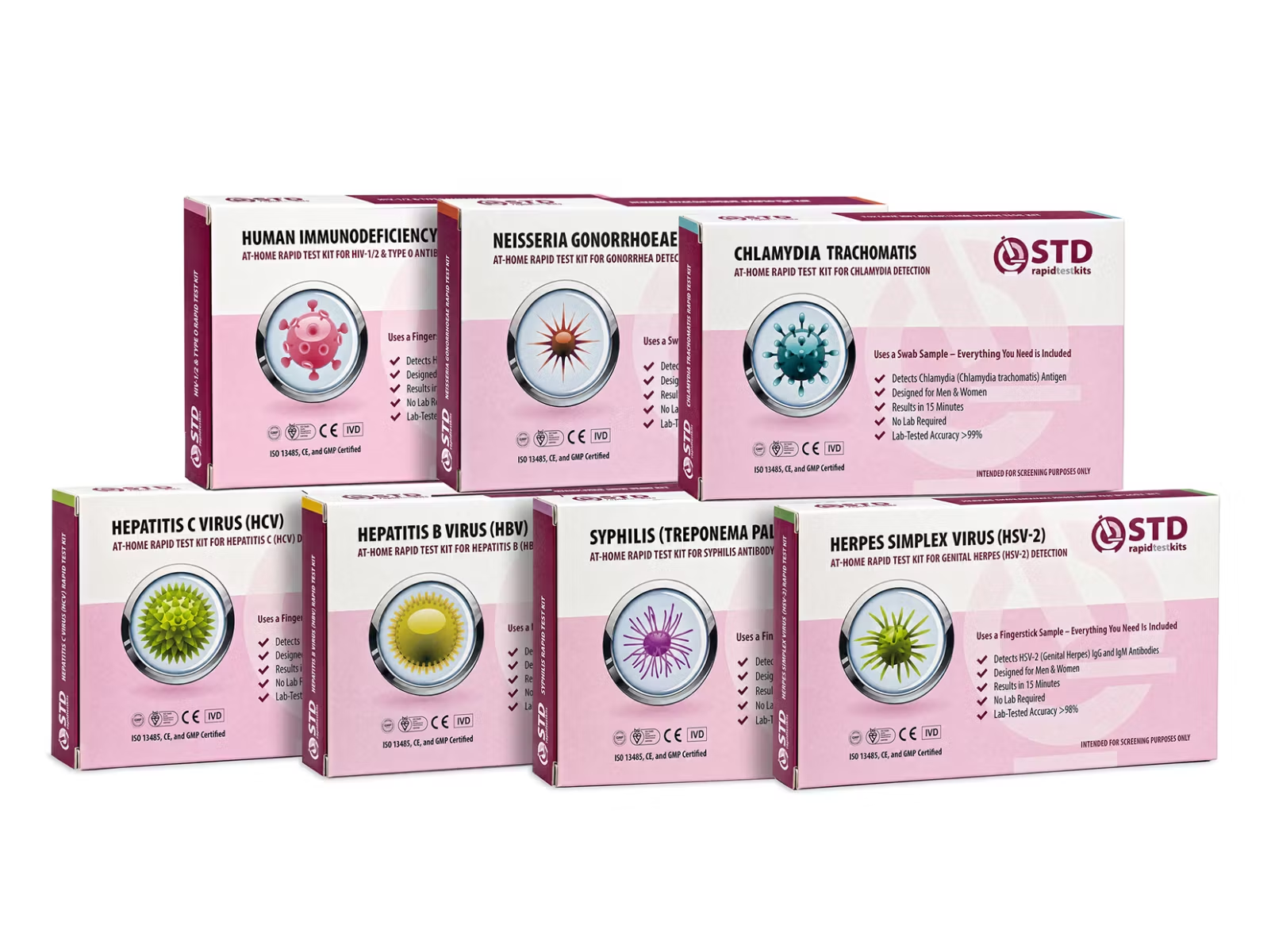
At-home rapid tests are not a replacement for clinic confirmation when you are symptomatic or recently exposed, and they are not a substitute for the lab-based NAATs that providers use as the diagnostic standard. They are, however, a low-friction way to keep your screening current between provider visits, and to bring a recent baseline into the next disclosure or partner conversation. We sell at-home rapid panels for that purpose; we recommend them when they genuinely fit a reader’s situation rather than as a replacement for clinic care.
When to Seek Professional Mental-Health Support
For most people, the emotional impact of an STI diagnosis settles within a few weeks. The first disclosure conversation is hard, the second is easier, and somewhere around the fifth or sixth, the rehearsal in the shower stops. For other people, the shame goes deeper and stays longer, particularly when the diagnosis intersects with prior sexual trauma, with coercive or non-consensual exposure, or with a recent relationship betrayal.
Signs that talking to a therapist would help, rather than waiting it out:
- Persistent self-loathing, intrusive thoughts of being “unworthy” of love or care, or sustained low mood that lasts more than a few weeks after the diagnosis.
- Avoiding any form of intimacy, including non-sexual closeness with friends or family, for months after the diagnosis.
- Panic attacks, flashbacks, or sleep disturbances triggered by reminders of the diagnosis or the exposure event.
- Thoughts of self-harm or suicide. If this is happening, contact a crisis line right now (see below).
When choosing a therapist, look for sex-positive, trauma-informed, and shame-aware framings in their bio. Many therapists explicitly list STI-related shame and post-diagnosis adjustment as treatable concerns. Some specialize in it. Insurance coverage, sliding-scale practices, and online options have all expanded substantially in the past few years, which means cost and geography are smaller barriers than they used to be. Calling and asking, “Do you work with clients on sexual-health-related shame?” is a fair and normal screening question.
If you are having thoughts of harming yourself, contact a crisis line immediately. In the U.S., call or text 988 for the <a href="https://988lifeline.org/" target="_blank" rel="noopener">Suicide and Crisis Lifeline</a>. In the U.K. and Ireland, call Samaritans on 116 123. International directories are available at <a href="https://findahelpline.com/" target="_blank" rel="noopener">findahelpline.com</a>. You do not have to wait until you are sure something is wrong, and you do not have to know what to say when you call.
More than 1 million curable sexually transmitted infections are acquired every day worldwide among people aged 15 to 49, the majority of which are asymptomatic.
Frequently Asked Questions
- Why does an STI diagnosis hit my confidence so hard, even when I know it is just an infection?
- STIs affect about 1 in 5 people in the U.S. on any given day, yet most of us grew up hearing about them as moral failings rather than ordinary infections. That mismatch between how common they actually are and how they were framed in childhood and in the media is what makes the diagnosis feel like a verdict on your character instead of a piece of health information.
- Is it normal to feel ashamed even if nobody else knows about my diagnosis?
- Yes. Internalized stigma does not require an audience. You can carry shame loudly even when the diagnosis is invisible to everyone around you, because the harsh voice you are hearing was installed long before the test result. Naming that voice and writing alternative scripts is one of the most effective ways to quiet it.
- Can I still date, have sex, or get married with an STI?
- Yes. Millions of people living with herpes, HPV, HIV, and other STIs are in healthy, long-term relationships, including new ones started years after diagnosis. The shifts that help most are practiced disclosure, accurate information about transmission and treatment, and a partner pool that values honesty over the absence of any health history.
- How accurate are at-home rapid STI tests compared to clinic testing?
- Performance varies by infection and by device, so check the individual product page for the manufacturer figures on each kit. As a category, home rapid lateral-flow tests are screening tools, not lab-grade diagnostics. Clinics use NAAT or PCR for confirmation, and a positive home result should be followed up with a clinical test.
- What do I say when I disclose to a new partner, and when in the relationship should I do it?
- Before any sexual contact. A short three-step script works for most people: name the condition plainly, share the relevant medical context in two or three sentences, then invite questions and stop talking. Do not perform reassurance. Most partners who respond well were going to respond well; you do not need to convince them.
- Should I tell my friends or family about my diagnosis?
- Only if you feel safe and only if you want to. Many people find relief in confiding in one trusted friend or family member, because shame loses some of its power when it is spoken aloud. Others prefer to keep the diagnosis between themselves and their healthcare provider. Both choices are reasonable.
- Can therapy actually help with STI-related shame, or is that overkill?
- Therapy is particularly useful when shame intersects with trauma, depression, anxiety, or a recent relationship rupture. Look for therapists who describe themselves as sex-positive, trauma-informed, and shame-aware. Many practitioners offer sliding-scale fees and online sessions, which means the practical barriers are lower than they used to be.
- How do I stop calling myself dirty in my own head?
- Two weeks of daily practice usually quiets it. Each morning, say one neutral phrase out loud in a normal voice, for example, “I am managing a treatable condition,” instead of letting the old word run unchallenged. Spoken rehearsal rewires self-talk faster than silent reading or thinking alone, which is why therapists ask for the spoken version rather than the inner one.
- U.S. Centers for Disease Control and Prevention. Sexually transmitted infections homepage and overview of common infections, transmission, and screening guidance.
- U.S. Centers for Disease Control and Prevention STI homepage, used here for the agency’s 2018 STI prevalence and incidence report estimating that about 1 in 5 people in the U.S. had an STI on any given day.
- World Health Organization. Fact sheet on sexually transmitted infections, including global daily-incidence estimates and stigmatization as one of the direct impacts of STIs on sexual and reproductive health.
- National Health Service (United Kingdom). Sexually transmitted infections overview, screening recommendations, and patient guidance.
- Guttmacher Institute. Research and journal coverage on STI-related stigma, shame, and self-esteem, including Perspectives on Sexual and Reproductive Health.
- 988 Suicide and Crisis Lifeline. U.S. crisis line resources and the underlying directory of regional and international hotlines.
