Published: July 2025 | Last updated: May 2026 | Editorial review and quality control: Martina N.
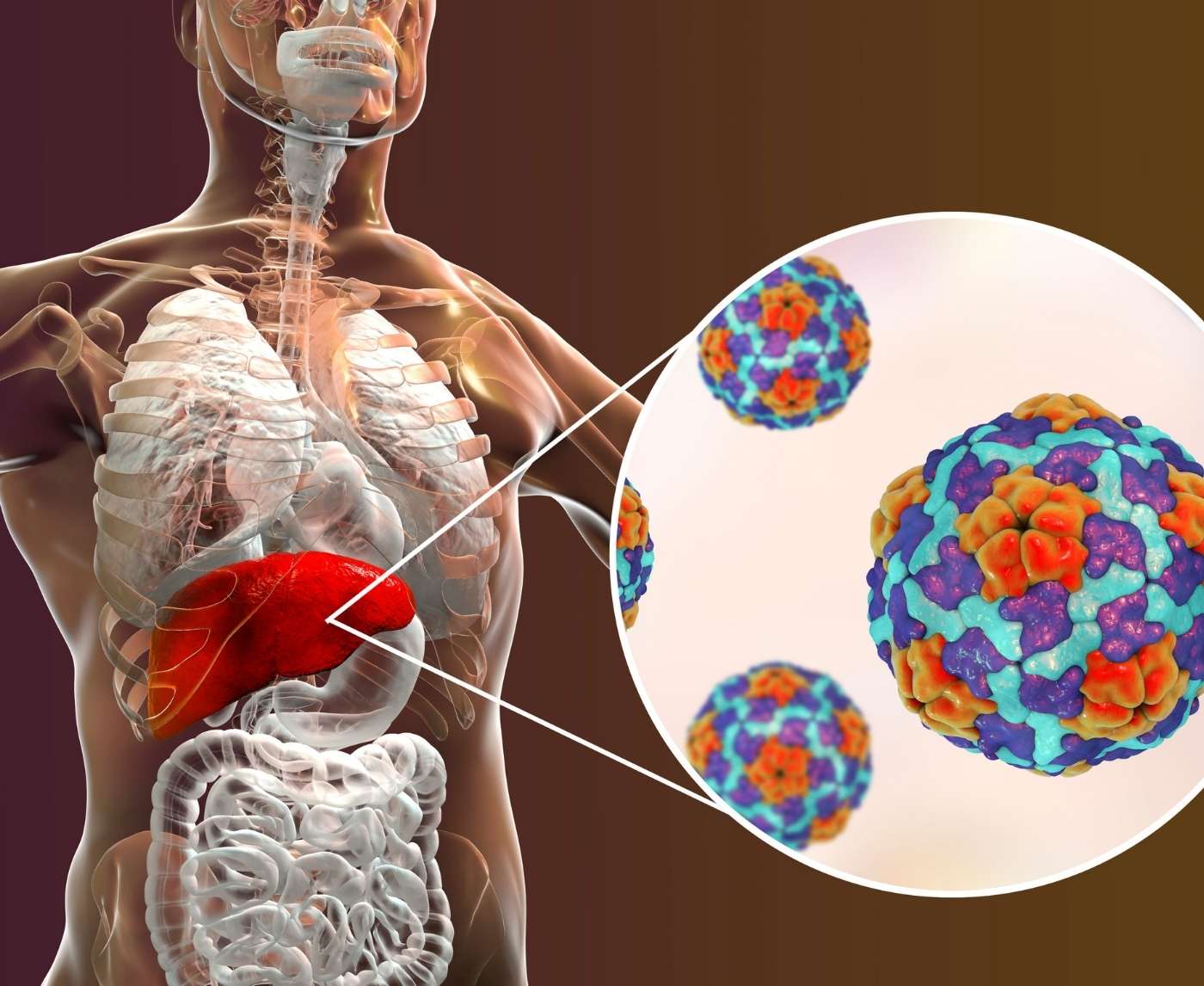
Hep C produces years of low-grade immune inflammation in liver tissue that has no pain fibers, so scar tissue (fibrosis) accumulates silently. Roughly 15 to 30 percent of untreated chronic infections progress to cirrhosis within 20 years. Most people only learn they are infected when routine labs or imaging catches the damage.
Hepatitis C is the slow-moving liver disease most people never feel coming. The virus can sit in the bloodstream and the liver for a decade or longer, quietly inflaming tissue and laying down scars while routine bloodwork looks normal and life feels fine. By the time something does feel off, the damage has often crossed into territory medicine can manage but not fully undo. In many cases the diagnosis arrives at the same time as the cirrhosis it caused.
That gap between infection and recognition is the single most important thing to know about hep C. The good news is that the gap is closeable. A single blood test resolves the uncertainty, and modern antiviral pills clear the virus in more than 95% of cases when the diagnosis comes early. This guide explains how silent liver damage actually unfolds, what the early and late warning signs look like, who needs to test, and where an at-home rapid kit fits in alongside lab confirmation.
Key takeaways
- Roughly 1 in 4 people with untreated chronic hepatitis C develop cirrhosis within 20 years, and most have no symptoms until late in the disease.
- Modern antiviral pills cure more than 95% of cases in 8 to 12 weeks, but only if you know you have it. A simple blood test is the difference between catching the virus early and discovering it on an ultrasound report.
How hepatitis C quietly damages the liver
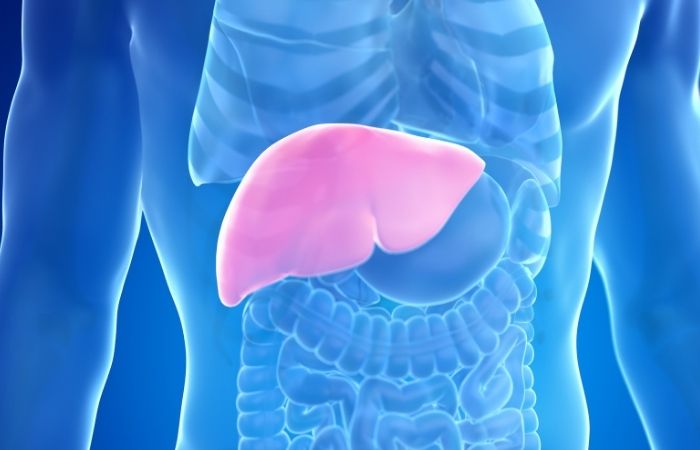
The liver is one of the body's most patient organs. It filters toxins from the blood, processes nutrients, makes the clotting factors that stop a small cut from becoming a problem, and stores energy reserves. It can also lose a sizable share of its working capacity, often quoted at up to 70 percent, before a person feels anything is wrong. Hepatitis C, a virus spread mainly through blood-to-blood contact, takes advantage of that patience.
Once HCV enters the bloodstream and reaches the liver, it sets up shop inside hepatocytes (the liver's working cells). The virus replicates without killing those cells outright, but it provokes a continuous low-grade immune response. Each cycle of immune assault and tissue repair leaves behind a small amount of collagen scar tissue, the process clinicians call fibrosis. Years of low-grade inflammation turn isolated scars into bands of fibrous tissue that connect, stiffen, and gradually distort the organ's shape. That endpoint is cirrhosis.
None of this is fast. For most chronic infections, the slide from initial inflammation to full cirrhosis runs 20 to 30 years per current CDC hepatitis C guidance. The deeper layers of the liver have no pain fibers of their own, so the injury accumulates with no internal alarm. Routine labs may show liver enzymes (ALT and AST) drifting just above the normal range, often not high enough to flag during a checkup.
Why symptoms stay hidden for so long
Acute hepatitis C, the first six months after infection, causes obvious illness in only a minority of people. Around three in four new infections produce no symptoms at all, per current CDC summaries of acute HCV. The body either clears the virus on its own (around 15 to 30 percent of acute cases per WHO and natural-history estimates) or settles into a chronic infection that drags on for decades.
Chronic hep C is even quieter. The symptoms it produces are notoriously nonspecific: a low background hum of fatigue, occasional brain fog, mild joint aches, an on-and-off dip in appetite. Per NHS guidance on hepatitis C, most people with chronic infection have no obvious symptoms for many years and only learn the diagnosis on routine testing. Anyone working a stressful job, sleeping poorly, or moving through their forties can easily attribute those feelings to something else.
The U.S. Preventive Services Task Force and CDC now recommend that every adult be screened for hep C at least once in their lifetime, precisely because the infection is so hard to spot any other way. Many positive results in the clinic come from people who felt completely well the day they walked in.
Two structural realities make this infection so easy to miss. The liver carries enough reserve capacity that day-to-day function rarely suffers until late in the disease, and hep C produces no distinctive symptom pattern the way acute mononucleosis or hepatitis A does. Together those two facts explain why most positive results in clinic today come from routine screening rather than from someone feeling sick.
The four stages from fibrosis to cirrhosis
Clinicians describe liver scarring in stages, most often using the METAVIR system that runs from F0 (no fibrosis) to F4 (cirrhosis). A blood-based fibrosis score (FIB-4 or APRI), transient elastography (the non-invasive imaging test marketed as FibroScan), or in some cases a liver biopsy places a patient on that ladder. Treatment decisions, follow-up frequency, and cancer-screening plans all hinge on the stage.
The pace of progression varies enormously between individuals. WHO data places the 20-year cirrhosis risk for chronic hep C in the range of 15 to 30 percent. CDC figures sit toward the upper end of that range, around 25 percent. Age at infection, alcohol use, coinfections, and metabolic health all influence where a given individual lands. The staging table below summarizes what each step typically looks like, both inside the liver and to the person carrying the infection.
| Stage | What is happening in the liver | How it usually feels |
|---|---|---|
| F0 to F1 (none to mild fibrosis) | Inflammation with little or scattered scarring; liver structure mostly intact. | Usually no symptoms; routine labs may show slightly elevated ALT. |
| F2 (moderate fibrosis) | Scar tissue thickens around portal areas; the liver still compensates well. | Vague fatigue or no symptoms at all. |
| F3 (bridging fibrosis) | Scar bands connect across the lobes, distorting blood flow. | Tiredness, brain fog, mild abdominal discomfort; still often missed. |
| F4 (cirrhosis) | Widespread scarring permanently alters liver architecture and function. | Jaundice, fluid retention, easy bruising, confusion as damage progresses. |
Compensated versus decompensated cirrhosis
Doctors divide cirrhosis into two broad stages, compensated and decompensated, and the gap between them shapes the entire prognosis.
In compensated cirrhosis, the liver is heavily scarred but is still managing its core jobs. Blood gets filtered, proteins are produced, clotting factors are made, and bile is cleared. The person can feel essentially normal. Many people with compensated cirrhosis go years without symptoms; with antiviral treatment and lifestyle changes, some remain in this stage for life. They still need ongoing surveillance for liver cancer and esophageal varices, but day-to-day life can continue largely unchanged.
In decompensated cirrhosis, the liver crosses a threshold where it can no longer keep up. This is when ascites, jaundice, hepatic encephalopathy, and variceal bleeding appear. Five-year survival drops substantially, and the medical priority shifts toward managing complications and evaluating for transplant when appropriate. Clearing the virus even at this stage still improves outcomes.
The transition from compensated to decompensated is the most dangerous moment in the trajectory of chronic liver disease. It can be triggered by infections, alcohol use, medications that stress the liver, or simply the slow accumulation of injury. Treating hep C even at the compensated stage measurably reduces the risk of crossing into decompensation.
Compensated vs decompensated cirrhosis at a glance
| Clinical feature | Compensated cirrhosis | Decompensated cirrhosis |
|---|---|---|
| Day-to-day symptoms | Minimal to none; person can feel essentially well | Ascites, jaundice, confusion, variceal bleeding, muscle wasting |
| Liver imaging | Small nodular liver on ultrasound | Marked nodularity plus signs of portal hypertension |
| Liver enzymes / labs | Often mildly elevated; albumin and INR still normal | Bilirubin and INR usually abnormal; albumin often low |
| Five-year outlook | Often stable for years with antiviral cure and monitoring | Survival drops sharply; transplant evaluation often needed |
| What antiviral cure changes | Cure prevents decompensation in the majority of cases | Cure still improves outcomes but does not reverse structural damage |
Crossing from compensated to decompensated cirrhosis is the single most dangerous moment in chronic liver disease; antiviral cure is what prevents most crossings.
Early signs of liver damage from hep C
Most people with chronic hep C stay asymptomatic until fibrosis has progressed substantially. When symptoms do show up, the first ones tend to be vague and easy to dismiss. They overlap with the ordinary complaints of busy adult life, which is exactly why so many cases sit undiagnosed for years even in someone who feels mildly off. The checklist below collects the early signs most often traced back to hep C after the diagnosis is made.
None of these signs is diagnostic on its own. The right read is contextual: if more than one is persistent, especially alongside any of the risk factors covered later in this article, a one-time antibody test is a low-cost way to rule the question out.
Early signs that may eventually trace back to hep C
These signs are nonspecific and can have many causes. They warrant a hep C antibody test when present alongside any of the risk factors covered below; they do not on their own confirm infection.
- Persistent fatigue that rest does not fix Common
- Mild upper-right abdominal discomfort or fullness Common
- Itchy skin (pruritus) without a visible rash, often from bile acids building up under the skin Common
- Joint or muscle aches Common
- Brain fog or trouble concentrating, sometimes from ammonia the liver is no longer fully clearing Less common
- Loss of appetite or unintended weight loss Less common
- Bruises that take longer to fade, or small cuts that bleed longer than usual Less common
Late-stage signs that need urgent evaluation
Later signs, which usually mean the liver has reached F3 or F4 on the staging ladder, are more specific and more urgent. They reflect the liver failing to perform its core jobs (clearing bilirubin, producing albumin, making clotting factors, processing ammonia) rather than vague background inflammation. They warrant a clinic visit the same day they appear, not a home test.
- Jaundice, a yellow tint to the skin or whites of the eyes.
- Dark, tea-colored urine and pale stools.
- Ascites, fluid build-up that makes the abdomen swell.
- Easy bruising or bleeding gums from impaired clotting.
- Spider angiomas, small red vessels visible on the chest, face, or shoulders.
- Muscle wasting, especially around the temples and shoulders.
- Confusion, sleep changes, or hand tremors from hepatic encephalopathy.
Many of these later signs are partially reversible if the underlying cause is treated, though some are not. Yellowing of the sclera (the whites of the eyes) usually shows up before the skin discoloration is obvious, and it tends to be the most reliable visible flag that decompensation is either imminent or already underway.
Jaundice, ascites, confusion, or vomiting blood are signs of decompensated cirrhosis. They warrant urgent evaluation, not a wait-and-see approach. If any of these appear, seek emergency or same-day medical care; do not start with a home test.
The cascade of complications cirrhosis sets in motion
Cirrhosis sets up a chain of complications that often define the clinical course more than the underlying scarring itself.
Portal hypertension is the root mechanism. As scarring obstructs blood flow through the liver, pressure builds in the portal vein system upstream. The body opens collateral channels, smaller blood vessels that reroute the trapped blood. Some run through the lower esophagus and stomach. When they swell under pressure they become varices, and varices can rupture. Variceal bleeding is a medical emergency that produces vomiting of bright red blood, a rapid drop in blood pressure, and a high risk of death without urgent endoscopic treatment.
Ascites, the accumulation of fluid in the abdominal cavity, is another consequence of portal hypertension combined with the liver's reduced production of albumin (a blood protein that holds fluid inside vessels). Ascites can become infected. Spontaneous bacterial peritonitis may present with only mild fever, mild belly tenderness, or new confusion, but it can be fatal if not treated promptly with antibiotics.
Hepatic encephalopathy occurs when the failing liver can no longer clear nitrogen-rich compounds, especially ammonia, from the bloodstream. These compounds reach the brain and disrupt cognition. Early signs include forgetfulness, slowed speech, and reversal of sleep patterns. Advanced cases can progress to disorientation, asterixis (a flapping tremor of the hands), and coma.
The most serious long-term complication is hepatocellular carcinoma, the most common form of primary liver cancer. Cirrhosis from any cause substantially raises the annual risk of liver cancer, and that elevated risk persists even after hep C has been cured if cirrhosis was already established (NIDDK cirrhosis overview). That is why twice-yearly surveillance with abdominal ultrasound remains the standard of care for anyone with cirrhotic livers, regardless of viral status.

Co-factors that speed up scarring
Two people with the same strain of hep C, infected at the same age, can land on completely different parts of the fibrosis ladder twenty years later. The virus is one variable in the equation; the body it lives in is the other. Cofactors that consistently push progression faster include:
- Alcohol use. Even moderate drinking accelerates fibrosis in people with chronic hep C. Heavy drinking can compress a 20-year progression timeline into half that, and there is no clearly safe daily threshold for someone with active infection.
- Coinfection with HIV or hepatitis B. Sharing the liver with another chronic viral infection roughly doubles the rate of fibrosis progression. HIV in particular keeps the immune system in a continuous low-grade inflammatory state, which translates to faster scarring even when antiretroviral therapy is suppressing HIV itself.
- Metabolic risk factors. Type 2 diabetes, obesity, and non-alcoholic fatty liver disease add inflammatory burden on top of the viral injury, so the two injuries compound rather than running in parallel. People with these conditions may show advanced fibrosis years earlier than otherwise predicted.
- Older age at infection. Acquiring hep C after age 40 is associated with faster scarring than picking it up in early adulthood, partly because the immune response that drives fibrosis shifts with age.
- Male sex. Men progress to cirrhosis slightly faster than women on average, although the gap narrows after menopause.
- Genetic variants. Variants in fibrosis-regulating genes such as PNPLA3 and IL28B tilt the odds in either direction, which is one reason siblings with the same exposure history can have very different outcomes.
None of these is destiny. Stopping alcohol, treating co-infections, controlling weight and blood sugar, and starting antiviral therapy all measurably slow or halt the damage.
The two cofactors that compress the timeline most aggressively are heavy alcohol use and HIV coinfection. Either one alone roughly doubles the rate of fibrosis progression; together they can cut a 20-year timeline in half. Anyone in either category has a stronger reason than most to test now rather than later.
Modern treatment has rewritten the outlook
The story of hep C over the past decade is genuinely good news. Direct-acting antivirals (DAAs), short-course pills taken once daily for 8 to 12 weeks, cure more than 95 percent of treated infections according to the World Health Organization. The WHO further notes that the cure substantially reduces death from cirrhosis and liver cancer, though access to diagnosis and treatment remains uneven. Side effects are typically mild (fatigue, headache, occasional nausea) compared with the older interferon-based regimens that defined hep C treatment through the 2000s, which required weekly injections, caused flu-like symptoms for months, and cured only about half of patients. Most U.S. insurance plans now cover DAAs.
A cure is defined as sustained virologic response 12 weeks after the end of treatment (SVR12), meaning no viral RNA is detectable. People who achieve SVR12 stay virus-free in the vast majority of cases, and reinfection requires a new exposure event.
Treatment now starts in primary care for most uncomplicated cases, so a hepatologist referral is not always the first step. Anyone who already had cirrhosis when they were cured still needs ultrasound surveillance for liver cancer every six months, indefinitely. Cure resets a lot of the risk picture; it does not reset all of it.
What a successful cure changes
- New fibrosis stops on the day the virus clears; early-stage scarring often softens to near-normal stiffness within one to two years.
- In compensated cirrhosis, the liver does not become non-cirrhotic again, but complication rates and decompensation risk drop sharply.
- Liver cancer risk falls by roughly two-thirds in people who already had cirrhosis at the time of treatment, though it does not return to baseline.
- Established cirrhosis still needs twice-yearly ultrasound surveillance for liver cancer indefinitely, plus periodic endoscopy if varices are present.
Who should test, and when
Current U.S. screening guidance from the CDC is broad on purpose: every adult aged 18 to 79 should be tested for hepatitis C at least once, regardless of risk factors. Anyone who is pregnant should be tested during each pregnancy. People with ongoing exposure risks should be tested periodically. Silent infection plus an effective cure equals a strong case for universal screening. The 1945 to 1965 birth cohort still has higher prevalence due to past medical and transfusion practices, and remains a high-priority group for testing.
Beyond that baseline, the following groups carry higher risk and warrant a lower threshold for repeat testing:
- Anyone who has ever injected drugs, even once, even decades ago.
- People who received a blood transfusion, organ transplant, or clotting-factor product before 1992 (when U.S. blood-supply screening began).
- Healthcare workers exposed to a needlestick involving HCV-positive blood.
- People with HIV infection, especially men who have sex with men with new or multiple partners.
- Children born to a parent with hepatitis C.
- People who have received a tattoo or piercing in an unregulated setting.
Sexual transmission of hep C is uncommon but not zero. The risk rises with rough sex that involves bleeding, sex during menstruation, multiple partners, coexisting STIs that cause genital ulcers, and HIV coinfection. For mutually monogamous heterosexual couples without other risk factors, the rate is low enough that routine partner testing is generally not required, although one-time screening is still recommended for both partners.
Two groups should be tested first if they have not been screened already: anyone who has ever injected drugs (even once, even decades ago) and anyone born between 1945 and 1965. Both groups have meaningfully higher prevalence than the general adult population, and both routinely turn up positive results in people who feel completely well.
Testing options, from home to clinic
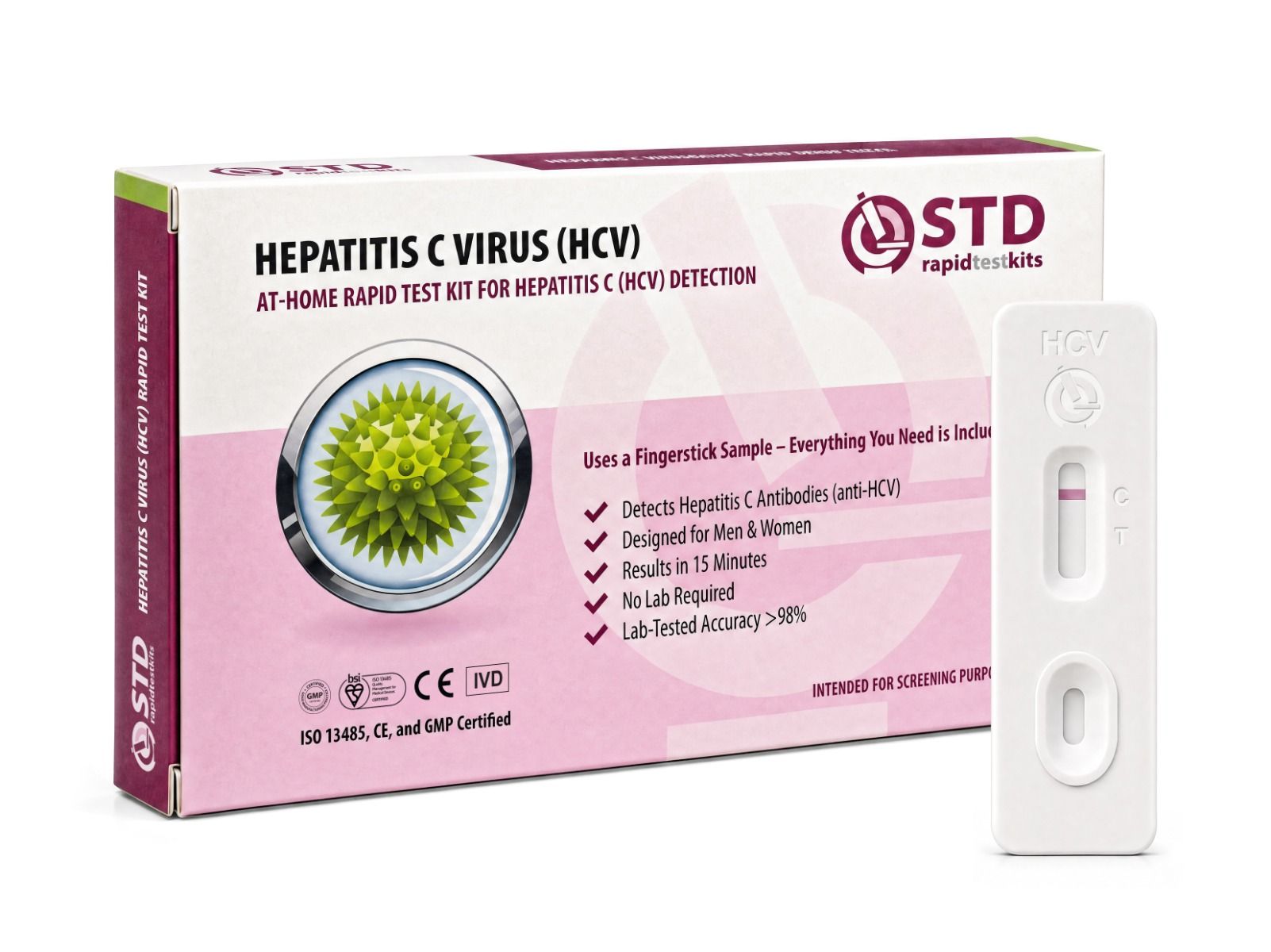
This article is published by stdrapidtestkits.com, which sells at-home rapid antibody kits for the screening step described here; we recommend products where they fit the reader's concern, not commercial benefit, and a positive home result always needs a lab RNA test to confirm active infection.
The diagnostic process for hep C runs in two steps:
- Antibody test (the screen). Detects whether the body has ever produced antibodies against HCV. A positive result confirms past or current exposure but cannot, on its own, distinguish a current infection from one that was already cleared. Rapid lateral-flow antibody tests, including at-home kits, are designed for this step. Antibodies typically become detectable 8 to 11 weeks after exposure, with a small share of cases taking up to six months.
- RNA test (the confirmation). A polymerase chain reaction assay (HCV RNA) detects the virus's genetic material directly, confirming an active infection and quantifying viral load. This step requires a laboratory; it cannot be done at home with current technology.
An at-home rapid test is most useful as the first step. A negative result on a properly timed antibody test (at least 8 to 11 weeks after a possible exposure, ideally repeated at six months for high-risk exposures) is genuinely reassuring. A positive result is not a final diagnosis; it is an instruction to book a lab RNA test to determine whether the infection is currently active.
Once chronic infection is confirmed, clinicians usually assess liver health before starting therapy. Tools include the FIB-4 index (calculated from age and routine labs), transient elastography to measure liver stiffness, and abdominal ultrasound to look for nodularity, splenomegaly, or signs of portal hypertension. In selected cases, biopsy provides definitive staging.
If hep C is one of several worries from a single exposure event, a multi-infection panel can be more efficient than a series of single tests. Combinations most relevant to liver risk are hepatitis B plus hepatitis C, or a broader STI panel that includes hep B, hep C, HIV, and syphilis. The right kit depends on the exposure profile, not the symptoms.
Why testing now beats waiting
Hepatitis C is one of the very few chronic infections where modern medicine offers a near-complete answer. The slowest-moving part of the system is the patient deciding to get tested. The virus replicates, the liver lays down scar tissue, and the damage compounds, all on a timeline measured in decades rather than weeks. The only impatience anywhere in the picture has to come from the person who might be carrying the infection.
The decision to test is small, while the decision to keep wondering carries downstream consequences. An at-home antibody test costs less than a meal out, takes about fifteen minutes, and gives you a starting point. A negative result lets you stop wondering. A positive result starts a conversation with a clinician that ends, in most cases, with a successful eight-to-twelve-week course of antiviral pills and a normal liver follow-up plan from there.
If your exposure history involves more than one possible bloodborne risk, a combined hepatitis B and C kit is the most useful starting point. Both viruses are bloodborne, both can quietly scar the liver, and both have effective treatments (suppression for hep B, cure for hep C) once a diagnosis exists.

Your next step on hepatitis C
Have you ever had a hepatitis C antibody test in your lifetime?
Yes: If the result was negative and you have no ongoing risk factors, you are current with the universal adult screening recommendation. If you have ongoing exposure risks (injection-drug history, HIV coinfection, sexual partners with hep C, or were born between 1945 and 1965 and were not previously screened), test again now using an at-home antibody kit.
Has an at-home or clinic antibody test come back reactive (positive)?
Yes: Book a lab HCV RNA test promptly. A reactive antibody result alone does not distinguish current active infection (which is curable) from past exposure that has already cleared.
No: If RNA testing confirms active infection, ask your primary-care provider about starting a direct-acting antiviral course. Most uncomplicated cases are treated in primary care, not by a specialist. If cirrhosis is already established, keep your twice-yearly abdominal ultrasound appointments regardless of viral status.
A short decision flow for readers who want a clear action plan.
Frequently asked questions
- How long does it take hepatitis C to cause cirrhosis?
- Without treatment and without accelerating cofactors, roughly 20 to 30 years. With heavy alcohol use, HIV coinfection, or significant metabolic disease, sometimes half that, occasionally less than 10 years. WHO estimates the 20-year cirrhosis risk at 15 to 30 percent; CDC figures sit near the upper end of that range.
- Can you feel hepatitis C in the early years?
- Rarely, and only if you know what to look for. Chronic hep C produces background noise like persistent tiredness, occasional brain fog, and mild joint aches that most people attribute to stress or aging rather than a liver infection. Universal adult screening exists precisely because the symptom picture is too nonspecific to flag the infection any other way.
- Why doesn't liver damage from hep C cause pain?
- The deep liver tissue has no pain fibers of its own, so it cannot signal injury the way a joint or muscle does. The capsule that wraps the liver does have pain fibers, but it is only stretched when the organ enlarges acutely, which is uncommon in chronic hep C. Chronic low-grade inflammation can run for decades without any pain signal.
- Does everyone with chronic hep C eventually get cirrhosis?
- No. Roughly one in four to one in three people with untreated chronic hep C develop cirrhosis over a multi-decade period. The share is much higher in people with additional risk factors (heavy drinking, HIV coinfection, metabolic disease) and much lower in people without them. Antiviral treatment, started before cirrhosis develops, prevents this outcome in the vast majority of cases.
- What is the difference between compensated and decompensated cirrhosis?
- Compensated means the liver is still functioning despite heavy scarring; most people feel normal and can stay stable indefinitely with treatment and monitoring. Decompensated means the liver can no longer compensate, so ascites, jaundice, confusion, or variceal bleeding appear and five-year survival drops sharply. The threshold between them is what antiviral treatment aims to prevent crossing.
- Can liver damage from hepatitis C heal after treatment?
- Mild to moderate fibrosis can partially or fully regress after successful antiviral cure, especially in younger patients without other liver stressors. Stiffness scores often return to near-normal within one to two years. Advanced cirrhosis is generally considered permanent, but viral cure still substantially reduces the risk of further damage, decompensation, and liver cancer.
- Does cirrhosis from hepatitis C always lead to liver cancer?
- No, but a cirrhotic liver carries a substantially higher annual risk of liver cancer than a non-cirrhotic one. That is why guideline-based ultrasound screening every six months is recommended for anyone with cirrhosis, even after a successful viral cure. Catching liver cancer at an early, treatable stage is the entire point of that surveillance schedule.
- When is the right time to do an at-home hepatitis C test after a possible exposure?
- Eight to eleven weeks post-exposure is the practical minimum for an antibody test to be meaningful. For higher-risk exposures, retesting at six months closes the remaining window. Whatever the result on a home kit, a positive finding always needs a follow-up lab RNA test to confirm active infection.
- What happens after hep C is cured if cirrhosis was already present?
- Curing the virus halts further viral damage and reduces complication rates, but cirrhosis remains a chronic condition. Twice-yearly abdominal ultrasound to monitor for liver cancer is recommended indefinitely, along with periodic endoscopy to check for varices if portal hypertension is present. Many people with cured hep C and compensated cirrhosis live well for years with this surveillance plan.
- U.S. Centers for Disease Control and Prevention. Viral Hepatitis C main page, including current screening recommendations for adults 18 to 79, transmission routes, progression overview, and liver-cancer surveillance guidance.
- World Health Organization. Hepatitis C fact sheet, covering global prevalence, spontaneous clearance rate, progression to cirrhosis and liver cancer, and the over-95-percent direct-acting antiviral cure rate.
- U.S. National Institute of Diabetes and Digestive and Kidney Diseases. Cirrhosis overview, including causes, complications, stage definitions, portal hypertension, ascites, hepatic encephalopathy, and liver-cancer surveillance.
- U.S. National Institute of Diabetes and Digestive and Kidney Diseases. Hepatitis C overview, including symptoms, transmission, complications, and direct-acting antiviral treatment.
- U.K. National Health Service. Hepatitis C overview, including transmission routes, the asymptomatic nature of chronic infection, testing pathway, and treatment outcomes for U.K. patients.
- World Health Organization. Hepatitis C fact sheet (referenced for the 15 to 30 percent 20-year cirrhosis estimate and direct-acting antiviral cure rate over 95 percent).
