

Published: August 2025 | Last updated: April 2026 | Editorial review and quality control: Martina N.
Being under 18, queer, and living in a state where your existence gets debated on the news makes a basic question feel impossible: where can I get tested for sexually transmitted infections without being outed, shamed, or sent home for a parent's signature? The honest answer is that you have more legal protection than most adults realize, but the strength of that protection varies by state, by clinic, and by how the bill gets paid.
This guide walks through what minor-consent law actually grants you, how to recognize a clinic that will respect your identity, the insurance and billing trapdoors that quietly out a lot of teens, and what at-home rapid testing can do when nothing nearby feels safe to schedule.
Can a queer teen in a conservative state get an STD test confidentially?
Yes in most cases. All 50 U.S. states allow minors to consent to STI and HIV testing without parental permission. The variable is how confidential the paperwork stays, especially if you are on a parent's insurance plan. Title X clinics, Planned Parenthood, LGBTQ-affirming providers found through directories like the LGBTQ+ Healthcare Directory and OutCare's OutList, and at-home rapid test kits all give you concrete ways to test without your household finding out. Federal HIPAA rules also let any patient (including minors) file a confidential-communications request to redirect insurance paperwork.
Key Takeaways
- Every U.S. state lets minors consent to STI and HIV testing without a parent. What varies is whether the visit, the bill, and the result stay confidential once insurance, EOB notices, and follow-up are involved.
- The clinic matters as much as the test. Title X providers, Planned Parenthood, and LGBTQ-affirming directories like the Tegan and Sara Foundation's LGBTQ+ Healthcare Directory and OutCare keep both your privacy and your dignity intact.
Why a Queer Teen Needs Different Information About Testing
Most sexual-health information is written for adults with insurance, addresses they control, and a baseline assumption that asking a doctor a question is safe. None of those assumptions hold automatically for a queer 17-year-old in Tennessee, Alabama, or Texas. The body has the same biology, but the path to a confidential test is shaped by state law, clinic culture, and household dynamics that abstinence-only sex-ed class never covered.
The numbers explain why this matters. People aged 15 to 24 account for nearly half of all new sexually transmitted infections in the United States according to the CDC's most recent surveillance data, drawn from the agency's STI surveillance program. LGBTQ youth specifically are screened less and diagnosed later than their straight peers, partly because they avoid clinics that have shamed them or other queer patients in the past.
Less screening at younger ages means more onward transmission and more long-term complications: pelvic inflammatory disease, infertility, untreated HIV progression, congenital syphilis if pregnancy is involved later. Those are not abstract risks. They are the reason public-health groups push initiatives like the CDC's Get Yourself Tested campaign aimed specifically at adolescents.
This article is published by stdrapidtestkits.com, which sells at-home STI testing kits. We recommend products based on fit-for-purpose for the reader's situation, not commercial benefit. Where the right answer is a clinic visit (throat swabs, rectal swabs, or treatment for a positive result), we say so plainly.
Not Every Clinic Is Safe, Even Ones That Advertise Free Testing
Search “free STD test near me” and the first results often include crisis pregnancy centers operating under names like “Hope Women's Center” or “Choices Resource Clinic.” These look like medical clinics. Some genuinely offer STI testing. Most are religiously affiliated facilities whose mission is to discourage abortion and same-sex relationships, and their counseling reflects that mission.
Public-health researchers have documented this pattern repeatedly: a legal right to confidential STI care does not guarantee that every clinic honors it. Crisis pregnancy centers may withhold results, delay treatment, push abstinence-only counseling, or refuse to discuss PrEP and queer-specific risk. The mismatch between the law on paper and the experience on the ground is widest in conservative counties where these centers cluster.
What you want instead are clinics that name LGBTQ care explicitly, list pronouns on intake forms, advertise PrEP availability, and treat sexual-health screening as routine medicine.
- Faith-based mission statements without explicit affirmation that LGBTQ patients are welcome
- Heavy emphasis on “counseling” or “pre-test conversation” instead of actual testing logistics
- No mention of PrEP, queer health, gender-affirming care, or trans-specific intake
- Names like “Women's Resource Center” or “Pregnancy Help Line” that imply a pregnancy-only scope
- Reviews that mention being shamed, misgendered, or pressured into a religious counseling session
Affirming Clinic Directories That Vet for You
Three national tools do most of the work of separating safe clinics from hostile ones, and none of them require parental access to use.
The LGBTQ+ Healthcare Directory, run by the Tegan and Sara Foundation in partnership with GLMA: Health Professionals Advancing LGBTQ Equality, lists providers who self-identify as affirming and have voluntarily created profiles on the platform. You search by zip code, and results include the kinds of services offered (STI testing, PrEP, gender-affirming care). Self-identification is not a guarantee of safe care, so use it as a starting list and corroborate with reviews or a phone call before booking.
OutCare's OutList is broader in provider coverage and lets you filter by specialty, location, and state. Call or message listed providers directly to confirm they see patients under 18 and know your state's consent rules.
Planned Parenthood is the largest network of clinics that consistently provides confidential STI care to minors regardless of state. Staff are trained on minor-consent law in each state where they operate, which matters because the rules differ between, for example, Alabama and Vermont. Many locations also offer telehealth, which can be useful if the nearest physical clinic is hours away.
When you call any clinic, three questions get you the most useful information in the shortest time:
- Do you offer confidential STI testing for patients under 18 without parental notification?
- If I am on a parent's insurance plan, will the visit show up on the explanation of benefits?
- Do you serve LGBTQ patients, and is your intake form set up for non-binary or trans patients?
The way a receptionist answers tells you nearly everything about how the visit will go. A clinic that pauses, asks why, or pushes back on the first question is signaling that they are not the right place. A clinic that walks you through the answer calmly is the right place even before you walk in the door.
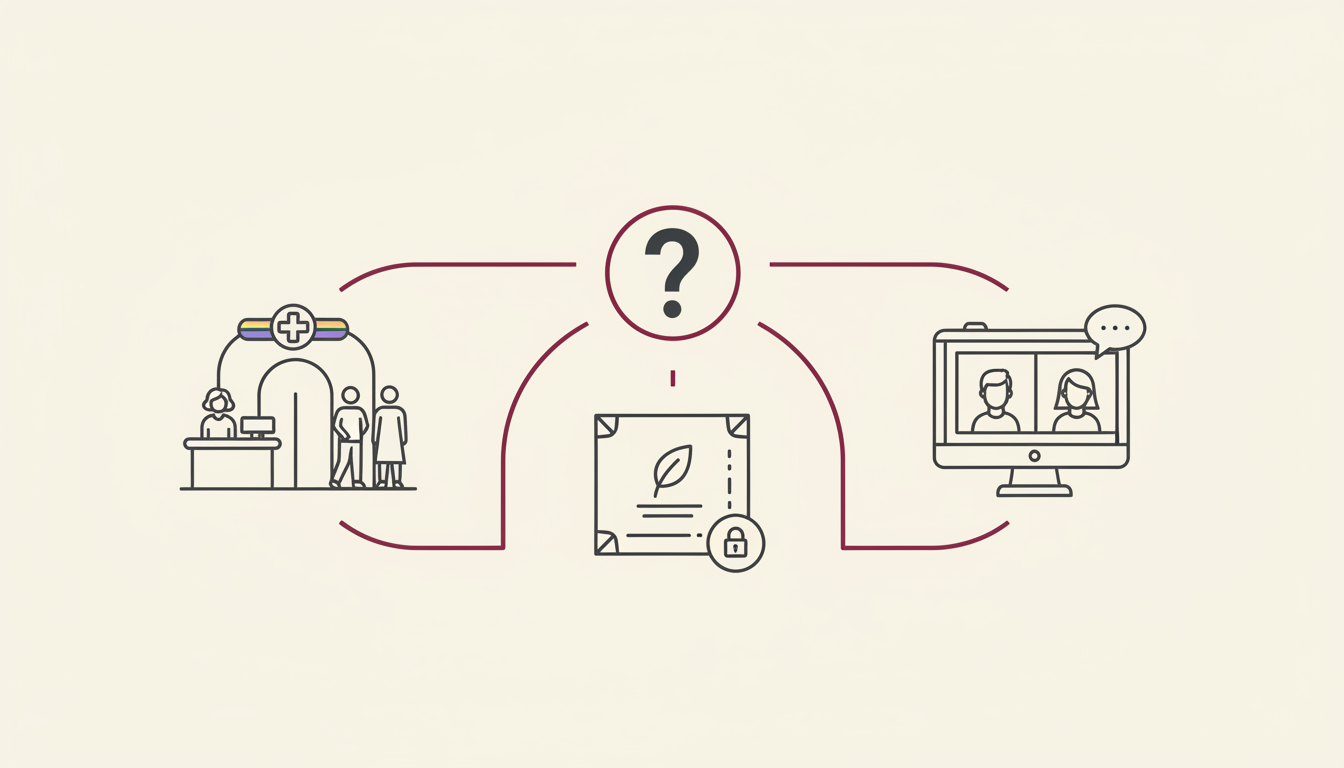
What Minor-Consent Law Actually Says
All 50 U.S. states allow minors to consent to STI testing and treatment without parental permission. This is one of the most uniform pieces of public-health law in the country, and it includes HIV testing in every state. The Guttmacher Institute's state-policy research on minor consent shows that while consent is universal, the exact age threshold and the included services vary by state.
What varies, and what trips most teens up, is confidentiality protection. Some states require clinics to keep STI care confidential from parents, even when the teen is on a parent's insurance plan. Others have no such requirement, which means a clinic can be perfectly legal and still send results, billing notices, or appointment reminders to the policyholder (your parent or guardian).
A small but important number of states have enacted explicit confidentiality protections for sensitive health services on family insurance plans. In these states you can request that explanation-of-benefits notices for confidential services be redirected, suppressed, or sent to a different address. In other states, the request is at the insurer's discretion under federal HIPAA rules.
The practical implication: knowing your right to test is only half the question. The other half is knowing how the visit will be paid for and where the paperwork lands. A clinic that knows your state's rules cold will walk you through this proactively. A clinic that does not is a clinic that will accidentally out you.
Two safe defaults if your state is unclear or unfriendly:
- Use a Title X clinic. These are federally funded, sliding-scale, and see minors regularly. They are explicitly less likely to bill insurance for confidential services. The HHS Office of Population Affairs runs a Title X clinic finder at opa.hhs.gov.
- Pay cash for the visit. Most STI panels cost less than a phone case if you skip insurance entirely. Ask the clinic for the self-pay rate up front.
These states have laws that strengthen a minor's right to redirect or suppress explanation-of-benefits notices for sensitive services on a family insurance plan:
- California
- Colorado
- Maryland
- New York
- Oregon
- Washington
If your state is not on this list, federal HIPAA section 164.522 still lets you file a confidential-communications request with your insurer, but the insurer has more discretion in how they respond.
The Insurance Trapdoor and How to Get Around It
Health insurance is the single most common way confidential teen visits accidentally become non-confidential. The mechanism is the explanation of benefits (EOB) document. When you use your parent's insurance for any visit, the insurer mails or emails an EOB to the policyholder showing the date, the clinic, the service codes, and the amount billed. Even with names redacted, an EOB that reads “Planned Parenthood, lab work, $145” is informative enough to start a conversation you may not be ready to have.
Three workarounds get used most often.
The first is a confidential-communications request. Federal HIPAA rules let any patient (including minors) ask their insurer to send communications to a different address: a friend's house, a P.O. box, or an email address you control. This is a legal right, not a favor. The phrasing to use on the phone with the insurer is: “I would like to file a confidential-communications request for sensitive health services under HIPAA section 164.522.” Most insurers handle this routinely once asked. State law in California, Maryland, New York, Oregon, Washington, Colorado, and several others gives this request additional teeth.
The second is a Title X visit. Title X clinics serve patients on a sliding-fee scale and do not bill private insurance for confidential services to minors. The visit either costs nothing or costs whatever you can pay. The HHS clinic locator covers the network nationwide.
The third is at-home testing paid by debit card or gift card. No insurance is touched, no EOB is generated, and the kit ships in unmarked packaging. This is the option many teens reach for first because it sidesteps the entire insurance question.
None of these workarounds requires lying to your parents or breaking any law. They are designed-in privacy mechanisms that exist because public-health agencies recognized decades ago that teens who fear surveillance simply stop seeking care, and the cost of that avoidance lands on the same teens later as untreated infections.
- HIPAA confidential-communications request. Call the insurer, cite section 164.522, and ask for EOBs to be redirected to an address you control.
- Title X clinic visit. Federally funded, sliding-scale, does not bill private insurance for confidential teen services.
- At-home rapid kit paid by debit or gift card. No insurance is touched, no EOB is generated, and the kit ships in plain packaging.
What Counts as Sex, and What Counts as Risk
School health classes, when they exist at all, tend to define sex narrowly: penis-in-vagina, with pregnancy as the main concern. That definition leaves out most of the ways STIs actually transmit. Knowing the real list helps you decide whether and what to test for.
The phrase “I have not had penetrative sex” does not rule out an STI. Plenty of queer teens receive a chlamydia or gonorrhea diagnosis from oral contact, or an HSV-2 diagnosis from skin-to-skin contact during an encounter that did not involve intercourse.
For testing decisions, this matters in two ways. First, if your only sexual activity has been oral, a clinic-administered throat-swab gonorrhea or chlamydia test is more sensitive than a urine sample, because pharyngeal infections do not always show up in urine. Second, blood tests for HIV and syphilis are useful regardless of which sexual activities you have engaged in, because they detect systemic infection rather than testing one anatomical site.
| Activity | STIs that can transmit | Best screening tool |
|---|---|---|
| Oral sex (giving or receiving) | Gonorrhea, chlamydia, syphilis, HSV-1, HSV-2, HPV | Clinic-administered throat swab (most sensitive); blood test for syphilis |
| Anal sex (receptive) | HIV, gonorrhea, chlamydia, syphilis, HSV, HPV, hepatitis B and C | Clinic rectal swab plus blood panel for HIV, syphilis, hepatitis |
| Vaginal sex | Same as anal plus trichomoniasis; pregnancy risk separately | Genital swab for chlamydia, gonorrhea, trich; blood for HIV, syphilis |
| Skin-to-skin genital contact (no penetration) | Herpes (HSV-1, HSV-2), HPV, syphilis chancre, pubic lice | Visual exam plus HSV/syphilis blood panel if symptoms or known exposure |
| Sharing sex toys without cleaning | Any of the above depending on partners and surfaces | Same panel as the activity the toy was used for |
| Fingering | Generally low risk; HSV/HPV theoretically possible with broken skin | Test only if symptoms appear or partner discloses infection |
At-Home Testing When Nothing Nearby Feels Safe
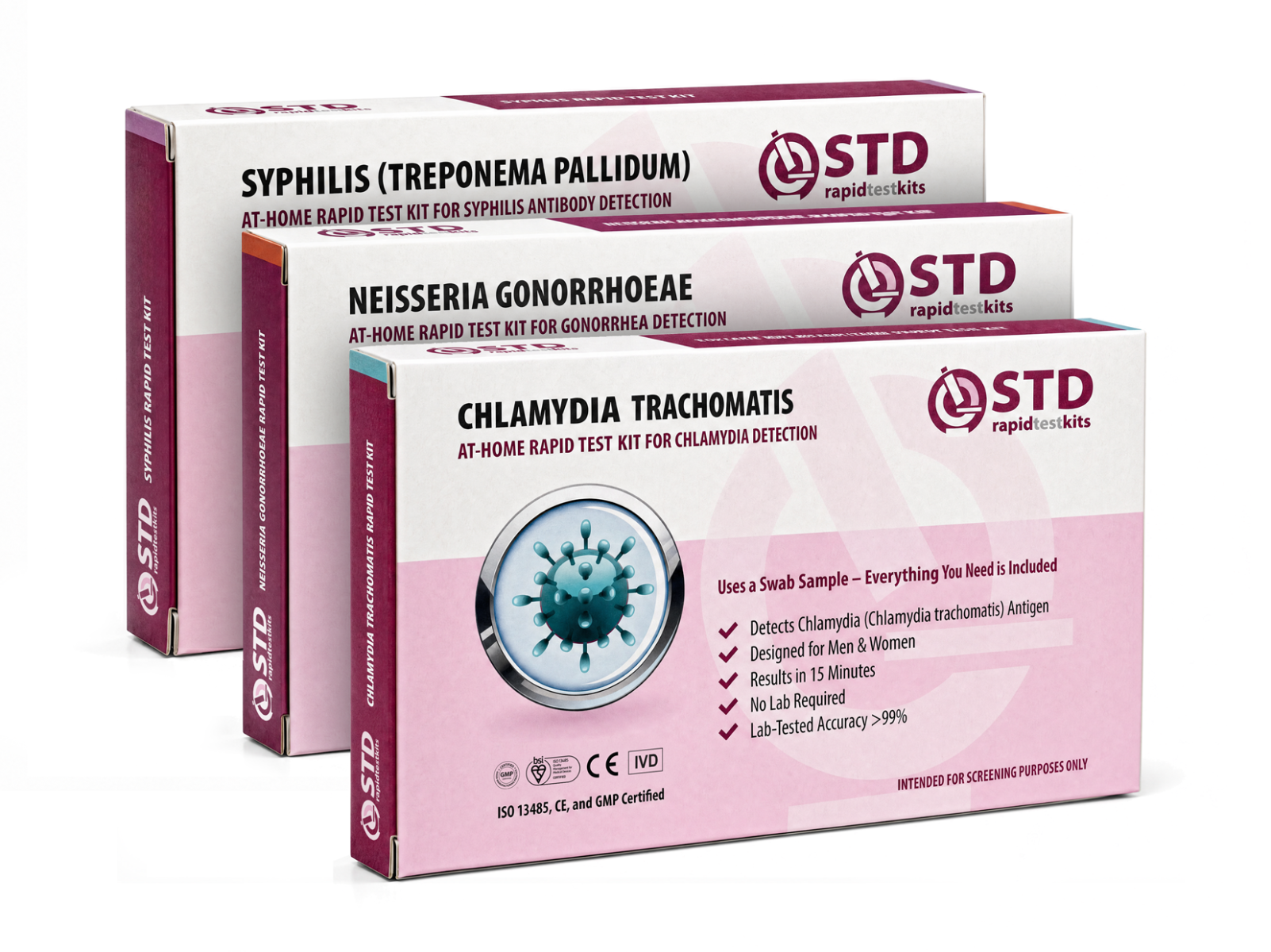
At-home rapid testing has become the practical answer for queer teens whose nearest affirming clinic is hours away or whose household situation makes a clinic visit unsafe to schedule. The kits available through stdrapidtestkits.com cover the most common screening targets:
- Chlamydia and gonorrhea via self-collected swab
- HIV, syphilis, hepatitis B, and hepatitis C via fingerstick blood
- Combined panels (3-in-1, 6-in-1, 7-in-1) that bundle the tests above into one kit
The mechanics are straightforward. The kit ships in plain packaging with no medical wording on the outside. You collect your own sample (a swab for chlamydia and gonorrhea, a fingerstick blood drop for HIV and syphilis), follow the instructions, and read the result in roughly 15 minutes, with no lab visit, no appointment booking, and no insurance involved.
The at-home rapid kits are lateral-flow immunoassays, the same chemistry used in many clinic point-of-care tests. They are useful for screening, especially when used after the relevant window period for each infection. A positive result on a rapid test should be confirmed at a clinic with a NAAT or PCR test, which is the laboratory method with the highest analytical sensitivity. The two technologies are complementary, not equivalent.
The home kits also do not cover throat-swab or rectal-swab testing, which require clinic-administered sampling. If your only sexual activity has been oral, a rapid swab kit can still screen for genital colonization, but a clinic throat swab is the more sensitive option. The same applies to receptive anal sex and rectal screening: a clinic visit is the right tool there.
- Plain packaging. Outer box has no medical wording or sender branding visible.
- Any address you control. Ships to a friend's house, a dorm, or a P.O. box if home delivery is not safe.
- No insurance, no EOB. Paid by debit, credit, or gift card. Nothing goes to a policyholder.
- Result on the device. You read it yourself in about 15 minutes. Nothing posts to a portal automatically.
After You Test: What Each Result Actually Means
A negative result on a rapid test, taken after the relevant window period, is reassuring. The window matters. HIV antibodies take several weeks to develop after exposure (the CDC notes the window for fourth-generation antigen-antibody tests is roughly 18 to 45 days; for antibody-only rapid tests it can extend up to 90 days). Syphilis antibodies typically appear within 3 to 6 weeks. Chlamydia and gonorrhea become detectable on swab within 1 to 2 weeks. Testing too early is the most common reason a true infection shows up negative on a rapid screen.
Treat a positive screen as the starting point for confirmation and care, not a final diagnosis. The next step, in every case, is to confirm the result at a clinic and start treatment if needed. Chlamydia and gonorrhea are bacterial and curable with a short course of antibiotics. Syphilis is curable in early stages with penicillin. HIV is not curable but is fully manageable with daily antiretroviral medication that brings the virus to undetectable levels (and undetectable means untransmittable, a principle the CDC and major health agencies endorse). Herpes and HPV are managed rather than cured, and most carriers have minimal symptoms long-term.
If you test positive at home, your follow-up depends on which infection. Bacterial STIs need a prescription, which means a Planned Parenthood telehealth appointment, a Title X clinic, or any urgent-care provider who handles STI treatment. HIV and syphilis follow-up should always go through a clinic that can do confirmatory laboratory testing.
Two practical reassurances worth holding onto. First, you will not be reported to your parents, your school, or the state simply for testing positive at the age of 16 or 17. Public-health reporting works at the level of de-identified surveillance data, not personal notification. Second, partner notification (telling people you may have exposed) can be done anonymously through services like Tell Your Partner or through the clinic that confirms your diagnosis.
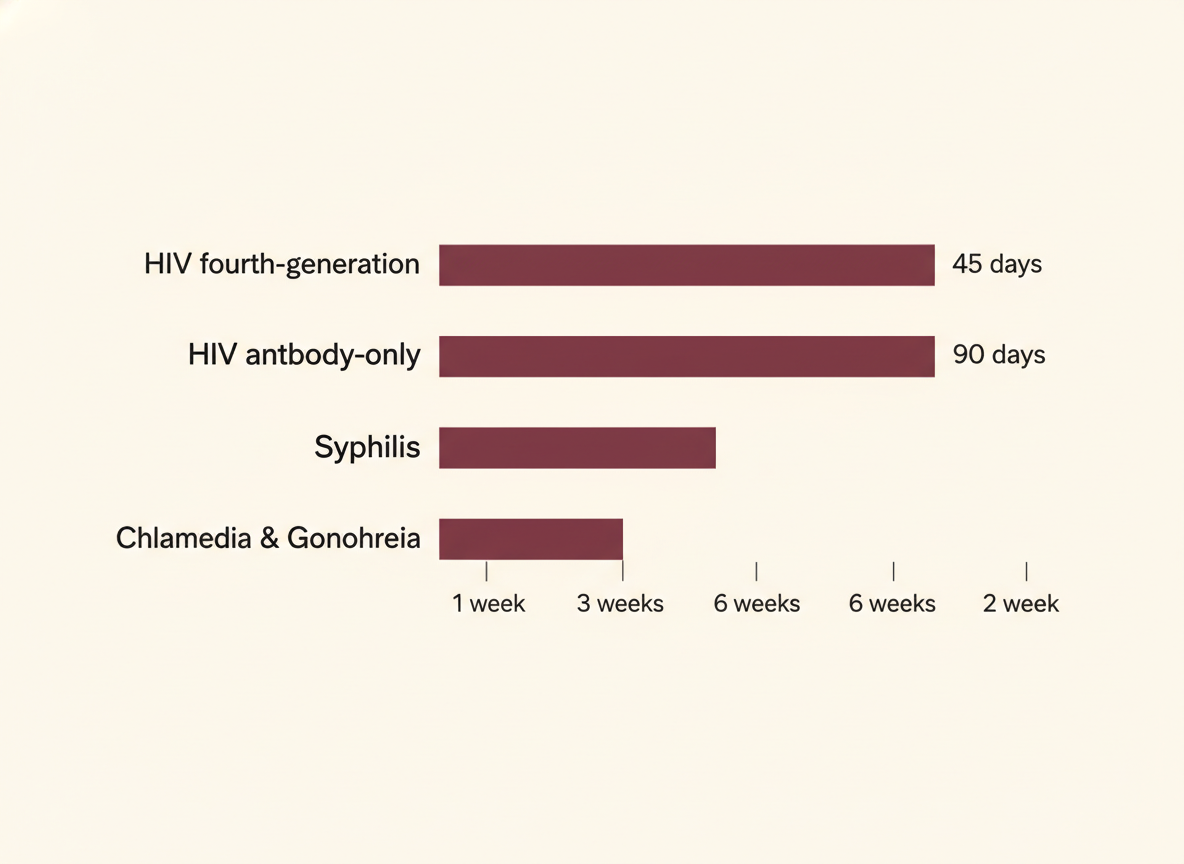
The window-period figures matter most when the exposure is recent. A test taken three days after a worrying encounter will not catch HIV, syphilis, or even chlamydia reliably. Use the timeline as a planning tool: if it is too early to test today, mark a date on your calendar for the right week and test then. If you cannot wait, test now for reassurance about anything you might have been exposed to before this most recent encounter, then test again at the right interval.
Sexually transmitted infections are common, costly, and pose serious health threats. Routine screening among sexually active adolescents and young adults is critical to early diagnosis and treatment.
Frequently Asked Questions
- Can I really get tested without my parents finding out?
- In almost every situation, yes. The consent right is universal across all 50 states; the harder question is where the EOB ends up. The three cleanest options are a Title X clinic that does not bill private insurance, a HIPAA confidential-communications request if you are on a parent's plan, or an at-home kit that never touches insurance at all.
- What is the difference between confidential and anonymous testing?
- Confidential means the clinic records your name and the result but does not share either with anyone (including your parents) without your consent. Anonymous means the clinic does not collect your legal name at all, so there is nothing to share even if asked. Most clinic STI testing is confidential. Some Title X clinics and walk-in HIV-testing sites offer anonymous testing as well.
- I am on my parent's insurance. How do I block the EOB?
- Call your insurer and cite HIPAA section 164.522. This entitles you to ask that EOBs go to an address you control rather than the policyholder. California, Maryland, New York, Oregon, Washington, and Colorado give this request extra statutory weight. Most insurers process it in a few days. If in doubt, pay cash or use a Title X clinic that does not bill private insurance.
- The nearest LGBTQ-affirming clinic is three hours away. What now?
- Telehealth and at-home testing are the practical answer. Planned Parenthood telehealth covers most U.S. states for STI consults, prescriptions, and PrEP. Some affirming clinics run mobile-clinic or community-outreach services that travel to rural counties; the LGBTQ+ Healthcare Directory and OutCare can help locate them. At-home rapid kits ship to any address, including a friend's address if home delivery is not safe.
- Is an at-home rapid test as accurate as a clinic test?
- For screening purposes, yes, when used correctly and after the relevant window period. At-home rapid kits use lateral-flow immunoassay chemistry, the same technology used in many clinic point-of-care tests. Laboratory NAAT and PCR tests have higher analytical sensitivity, especially for very early or very low-load infections. A positive at-home result should always be confirmed at a clinic. A negative result, taken at the right time, is generally reliable for screening.
- I had only oral sex. Do I still need to test?
- Yes. Oral sex transmits chlamydia, gonorrhea, syphilis, herpes, and HPV. Throat infections are often asymptomatic and missed without testing. The most sensitive test for pharyngeal gonorrhea or chlamydia is a clinic-administered throat swab; at-home rapid kits do not include throat swabs. If a clinic visit is not possible right now, an at-home swab still screens for genital colonization, and a blood-based syphilis and HIV panel covers systemic infections.
- Can a clinic legally refuse to treat me because I am trans or queer?
- Mostly no, but the answer depends on state law and the clinic's funding. Federal anti-discrimination protections under Section 1557 of the Affordable Care Act prohibit sex- and gender-identity-based discrimination at most clinics that accept federal funds, which includes nearly all hospitals, Planned Parenthood, and Title X clinics. Independent religiously affiliated clinics can sometimes claim religious exemptions. Affirming-care directories filter these out for you.
- How often should a sexually active teen get tested?
- The CDC recommends at least annual screening for sexually active people under 25, and more frequently (every 3 to 6 months) for those with multiple partners or in higher-risk situations. CDC screening guidance for men who have sex with men recommends every 3 to 6 months across all sites of exposure (genital, rectal, throat). Treat testing as routine maintenance, not as a response to symptoms.

- U.S. Centers for Disease Control and Prevention. STI surveillance, prevention, and screening guidance for adolescents and young adults.
- U.S. Centers for Disease Control and Prevention. Get Yourself Tested (GYT) campaign and adolescent STI testing recommendations.
- Guttmacher Institute. State-policy research on minor consent for STI and HIV testing and treatment.
- U.S. Department of Health and Human Services, Office of Population Affairs. Title X family planning program and confidential services for minors; clinic finder available at the OPA site.
- Planned Parenthood. Nationwide network offering STI testing and treatment, including telehealth and sliding-fee services for minors.
- Tegan and Sara Foundation in partnership with GLMA. LGBTQ+ Healthcare Directory of self-identified affirming providers nationwide.
