Published: November 2025 | Last updated: May 2026 | Editorial review and quality control: Martina N.
How accurate are at-home STD rapid tests, and how soon after exposure can I use one?
At-home rapid STD tests deliver sensitivity in the 97% to 99% range across covered infections when used after the correct window period (per manufacturer specifications on each product page). Window periods range from 14 days for chlamydia to 90 days for a definitive HIV antibody result (<a href="https://www.cdc.gov/hiv/testing/" target="_blank" rel="noopener noreferrer">per CDC HIV testing guidance</a>).
At-home STD testing has moved from a niche option to a mainstream screening choice. CDC-supported self-test distribution programs have expanded substantially year over year, and the same trajectory extends across syphilis, gonorrhea, hepatitis, herpes, chlamydia, trichomoniasis, and HPV: rapid at-home tests are now a standard alternative to clinic-based screening (per CDC testing guidance).
This guide covers how rapid test kits actually detect infection, how they differ from laboratory testing, which infections they reliably screen for, exactly when to test after a possible exposure, how accurate the results really are, how the major at-home STI test kits compare side by side, and what to do with whatever the test tells you.
This article is published by stdrapidtestkits.com, which sells at-home STI testing kits. We recommend products based on fit-for-purpose for the reader's concern, not commercial benefit.
Key Takeaways
- Rapid at-home STD kits deliver roughly 97% to 99% sensitivity across covered infections (per manufacturer specifications on each product page). Result reliability depends almost entirely on testing after the correct window period has elapsed.
- A reactive (positive) result needs lab confirmation before treatment begins; a negative result taken after the correct window reliably rules out infection from that exposure. Most STIs are asymptomatic early on, so symptom-watching is not a substitute for testing.
How rapid STD test kits work
The underlying principle is the same one behind a pregnancy test or a COVID antigen test. You apply a biological sample to a cassette containing specific reagents, and those reagents react (or do not) to markers tied to a particular infection. For STIs, those markers are usually antibodies your immune system has produced in response to a pathogen, or in some cases antigens (proteins from the pathogen itself).
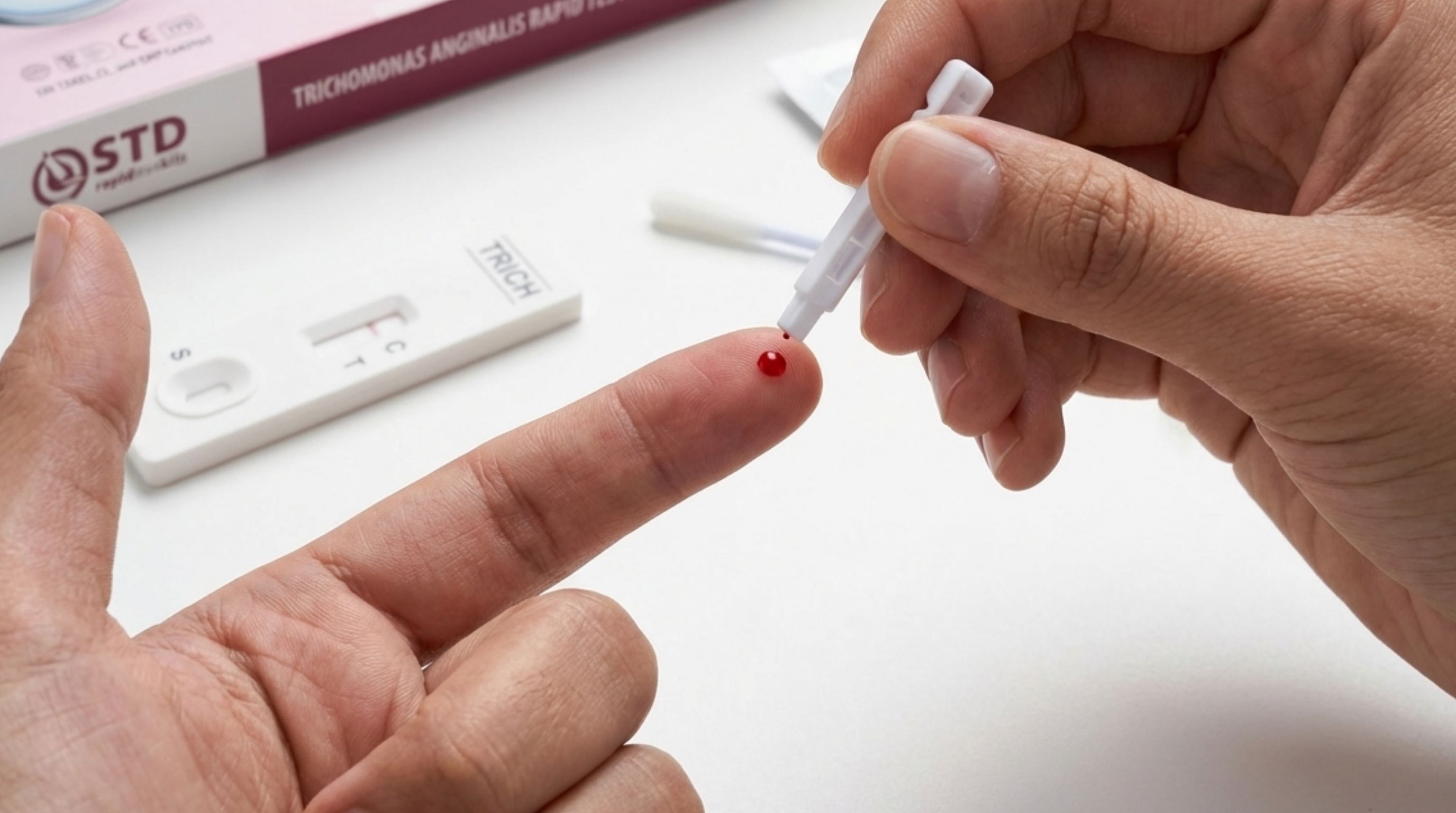
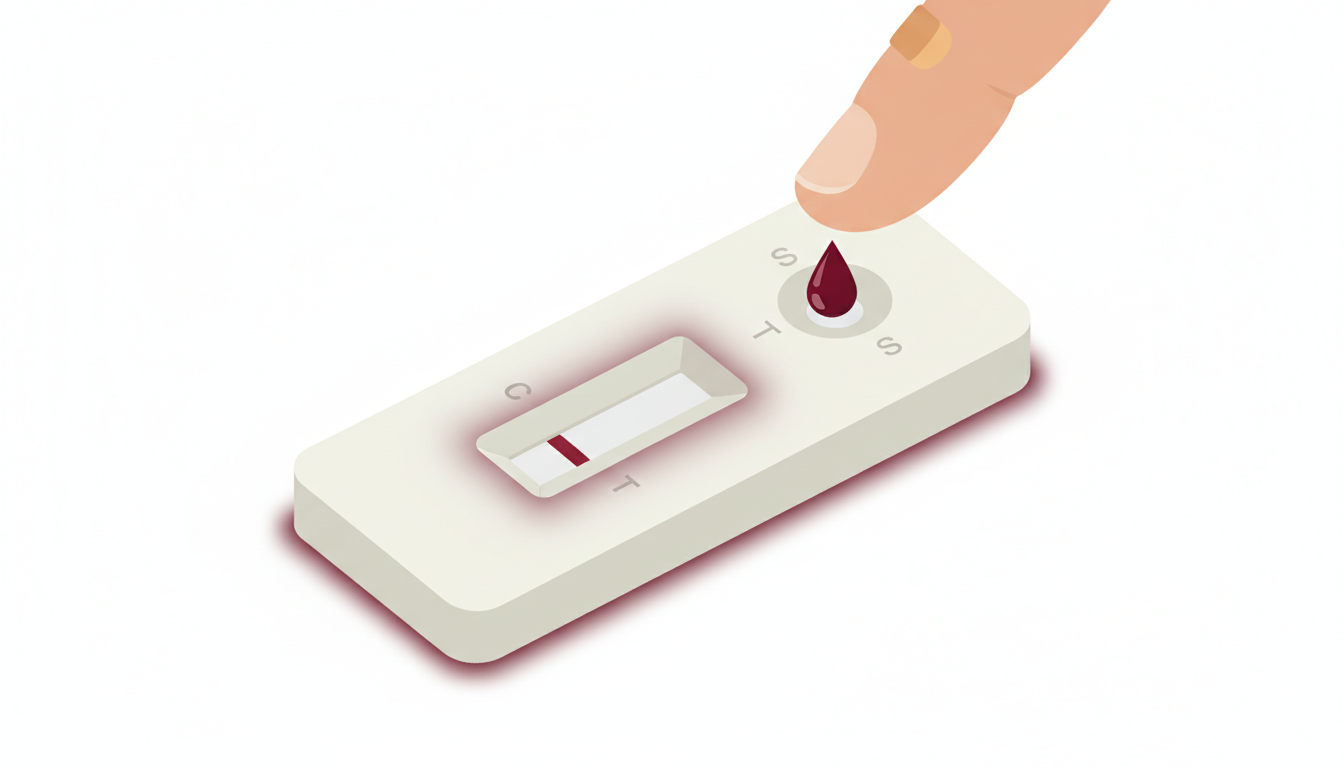
You collect your sample (a fingerstick blood drop or a self-collected genital swab) and apply it to the test device. A buffer solution carries the sample along a lateral-flow strip. One line always appears regardless of result; that is the control line, confirming the test ran correctly. A second line in the test zone means reactive (positive). No second line means non-reactive (negative).
Sample type follows the biology of each infection. Blood-based fingerstick tests cover HIV, syphilis, hepatitis B, hepatitis C, and herpes because the immune markers for those circulate systemically. Swab tests cover gonorrhea, chlamydia, trichomoniasis, and HPV because those organisms shed from the urogenital tract. Choosing the wrong sample type for the wrong exposure site gives an unreliable result; sampling the wrong tissue is the problem, not the kit.
| Infection | Sample Type | What the Test Detects |
|---|---|---|
| HIV 1 & 2 | Fingerstick blood | Antibodies to HIV-1 and HIV-2 |
| Syphilis | Fingerstick blood | Antibodies to Treponema pallidum |
| Hepatitis B | Fingerstick blood | HBsAg surface antigen |
| Hepatitis C | Fingerstick blood | Anti-HCV antibodies |
| Herpes HSV-1 & HSV-2 | Fingerstick blood | IgG antibodies to HSV-1 or HSV-2 |
| Gonorrhea | Self-collected genital swab | Neisseria gonorrhoeae antigens |
| Chlamydia | Self-collected genital swab | Chlamydia trachomatis antigens |
| Trichomoniasis (women only) | Self-collected vaginal swab | Trichomonas vaginalis antigens |
| HPV (women only) | Self-collected vaginal swab | HPV 16 & 18 antigens |
How at-home rapid tests differ from lab tests
Laboratory testing for bacterial infections like chlamydia and gonorrhea uses NAAT (nucleic acid amplification testing), which detects the bacteria's actual genetic material. The CDC describes NAAT as the recommended laboratory method for these infections because of its high analytical sensitivity. Lab blood testing for HIV typically uses fourth-generation antigen-antibody combination assays with confirmatory follow-up for any reactive result.
At-home rapid tests use a different chemistry called lateral-flow immunoassay. The cassette uses antibody-coated test strips that produce a visible colored line within roughly 10 to 15 minutes. Both technologies are clinically valid; the lab NAAT is the analytical gold standard for chlamydia and gonorrhea, while the at-home rapid test is a convenient, accurate, low-friction option for screening. A reactive result on a rapid test should be confirmed with a lab before treatment begins.
Two manufacturing standards are worth checking before you buy. CE marking is a legal requirement for diagnostic medical devices sold to consumers in the UK and EU; it indicates the test passed independent assessment for safety and performance by a notified body. ISO 13485 is the international quality-management standard for medical-device manufacturers. A kit carrying both has had its accuracy claims and production process independently audited rather than self-attested.
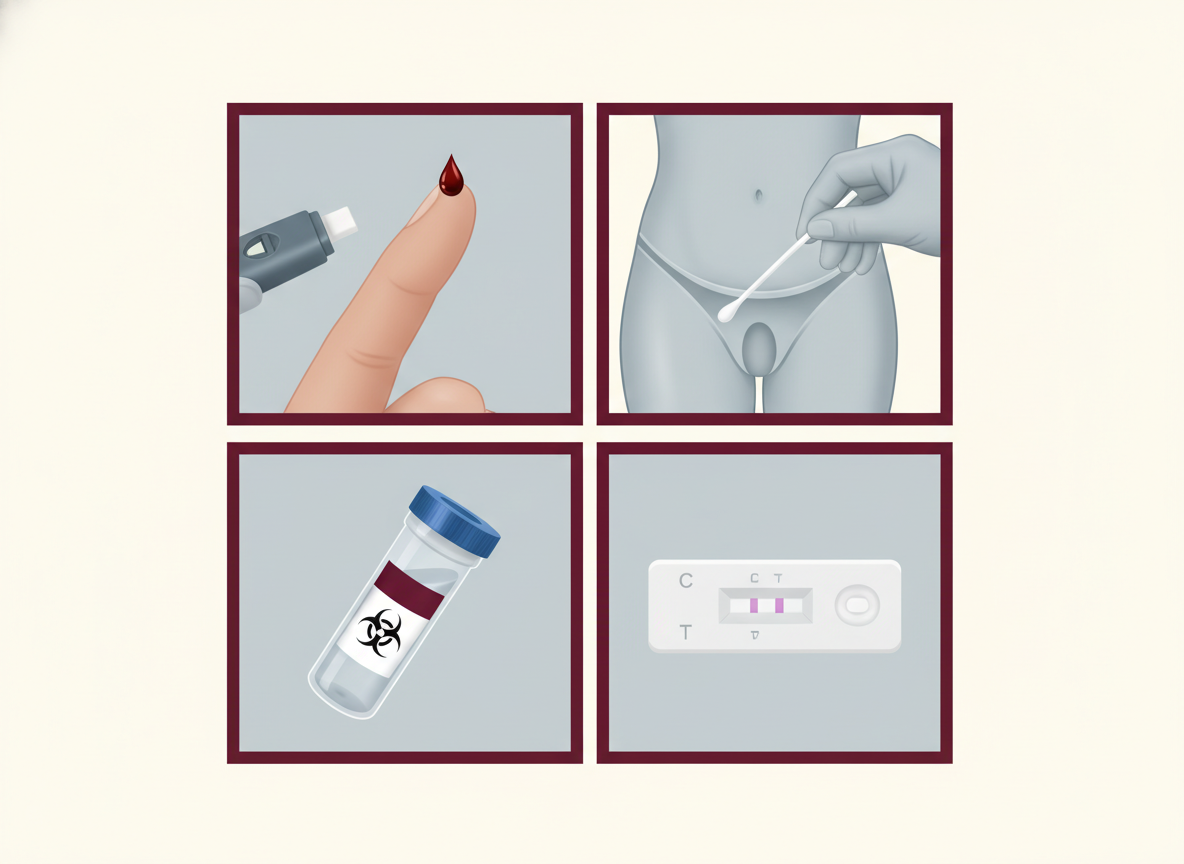
Each infection maps to a specific sample type based on biology, not convenience. Blood-based fingerstick tests work for HIV, syphilis, hepatitis B, hepatitis C, and herpes because the immune markers for those infections circulate in the bloodstream. Self-collected swabs work for chlamydia, gonorrhea, trichomoniasis, and HPV because those organisms shed from the urogenital tract. Throat or rectal infections require site-specific clinical swabs that we do not sell as home kits; for those exposures, see a clinic.
Window periods: when each test becomes reliable
Testing too soon after an exposure does not mean you are in the clear. It means your immune system has not had time to produce detectable antibodies, or the pathogen has not reached concentrations the test can pick up. A negative result during this period can be falsely reassuring at exactly the wrong moment.
Every infection has its own window period: the minimum time that must pass after exposure before a test reliably detects it. These come from the biology of each pathogen and the detection threshold of each test format. The UK National Health Service notes that some STIs can take up to seven weeks to show up on a test. MedlinePlus (NIH) likewise emphasizes that many STIs do not cause symptoms, making timed testing the only reliable way to know your status.
| Infection | Earliest Reliable Test | Why This Window |
|---|---|---|
| Chlamydia | 14 days after exposure | Bacterial replication needs to reach the cassette's detection threshold. |
| Gonorrhea | 2 to 3 weeks after exposure | Same biology as chlamydia; bacterial load takes time to build. |
| Syphilis | 6 weeks after exposure | Antibody response to Treponema pallidum takes weeks to develop. |
| HIV (antibody rapid test) | 23 to 90 days; retest at 90 days for certainty | Per CDC guidance; antibody seroconversion can take up to 90 days. |
| Herpes HSV-1 & HSV-2 | 6 to 12 weeks after exposure | Antibody seroconversion can occasionally take up to 16 weeks. |
| Hepatitis B | 6 weeks after exposure | Surface antigen and antibody response window. |
| Hepatitis C | 8 to 11 weeks after exposure | Anti-HCV antibody response is slower than other viral markers. |
How accurate are at-home rapid tests?
Highly accurate when used correctly and after the correct window has elapsed. The rapid kits in our catalog carry sensitivity ratings between roughly 97% and 99%, depending on the infection (per manufacturer specifications listed on each product page). For screening purposes, that sits in the same range as point-of-care tests used in clinics. Almost all unreliable results trace to testing before the window period has elapsed or to technique errors during sample collection.
Three things go wrong most often: testing inside the window period (the most common cause of a misleading negative), sample-collection error (not enough blood on the strip, swab not rotated long enough, buffer added in the wrong order), and reading the result outside the read window (10 to 20 minutes; reading later can produce evaporation artifacts that look like a faint line). The instruction leaflet packed in every kit is required reading.
Two important caveats. First, a reactive (positive) result on any rapid test should always be confirmed by a healthcare provider with laboratory testing before treatment begins. Second, a negative result after the correct window reliably rules out infection from a single discrete exposure, but it does not protect you against future exposures. If your sex life involves new partners or inconsistent condom use, retesting every 3 to 6 months is the standard practice for sexually active adults, per CDC STI screening guidance.
A reactive at-home result is a strong screening signal, not a final diagnosis. Before starting any treatment, contact a clinician or community sexual-health clinic for a confirmatory laboratory test. Lab confirmation rules out the rare false positive that any rapid technology can produce, and it connects you to the right treatment plan for your specific result.
Comparing at-home STD test kits side by side
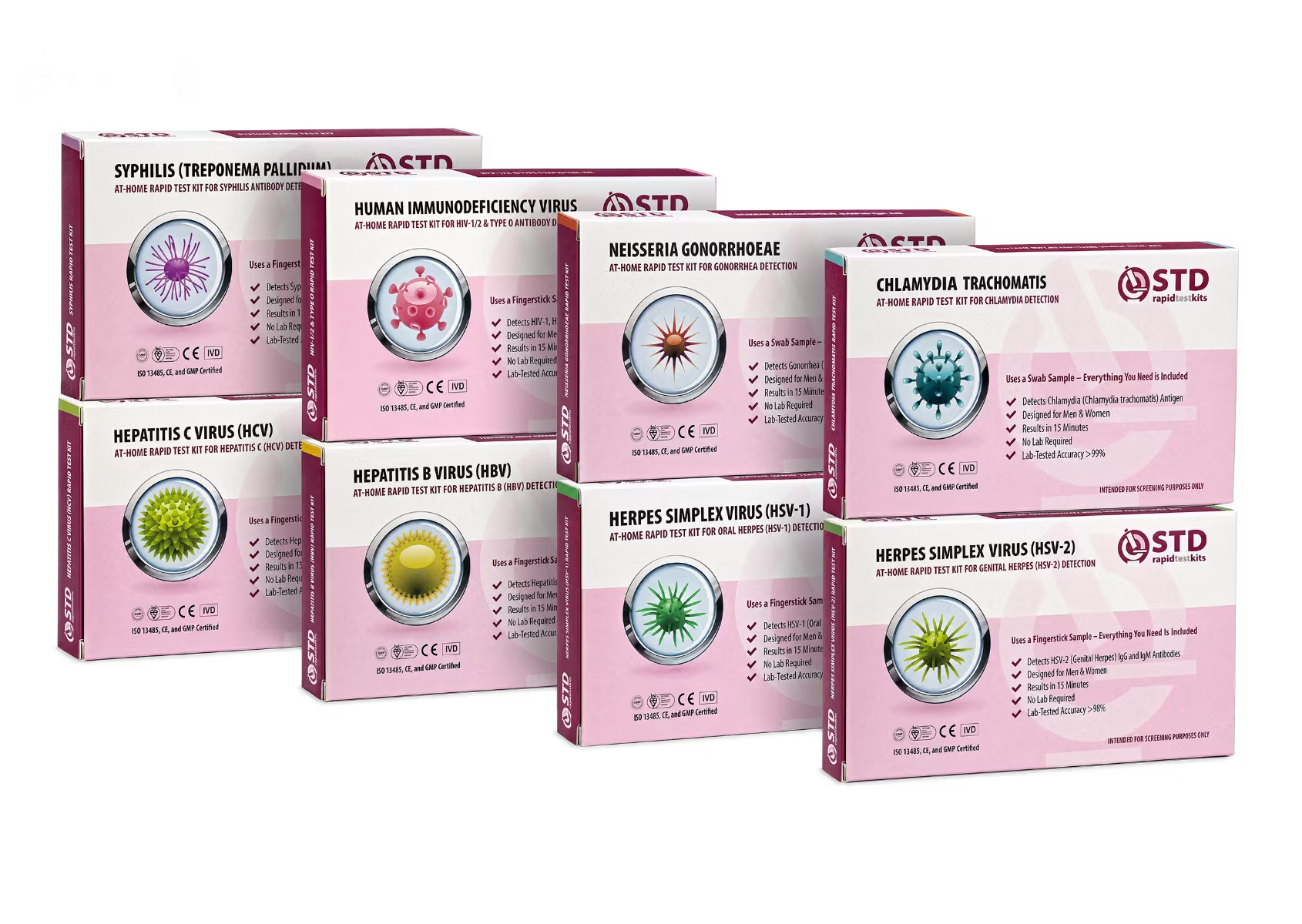
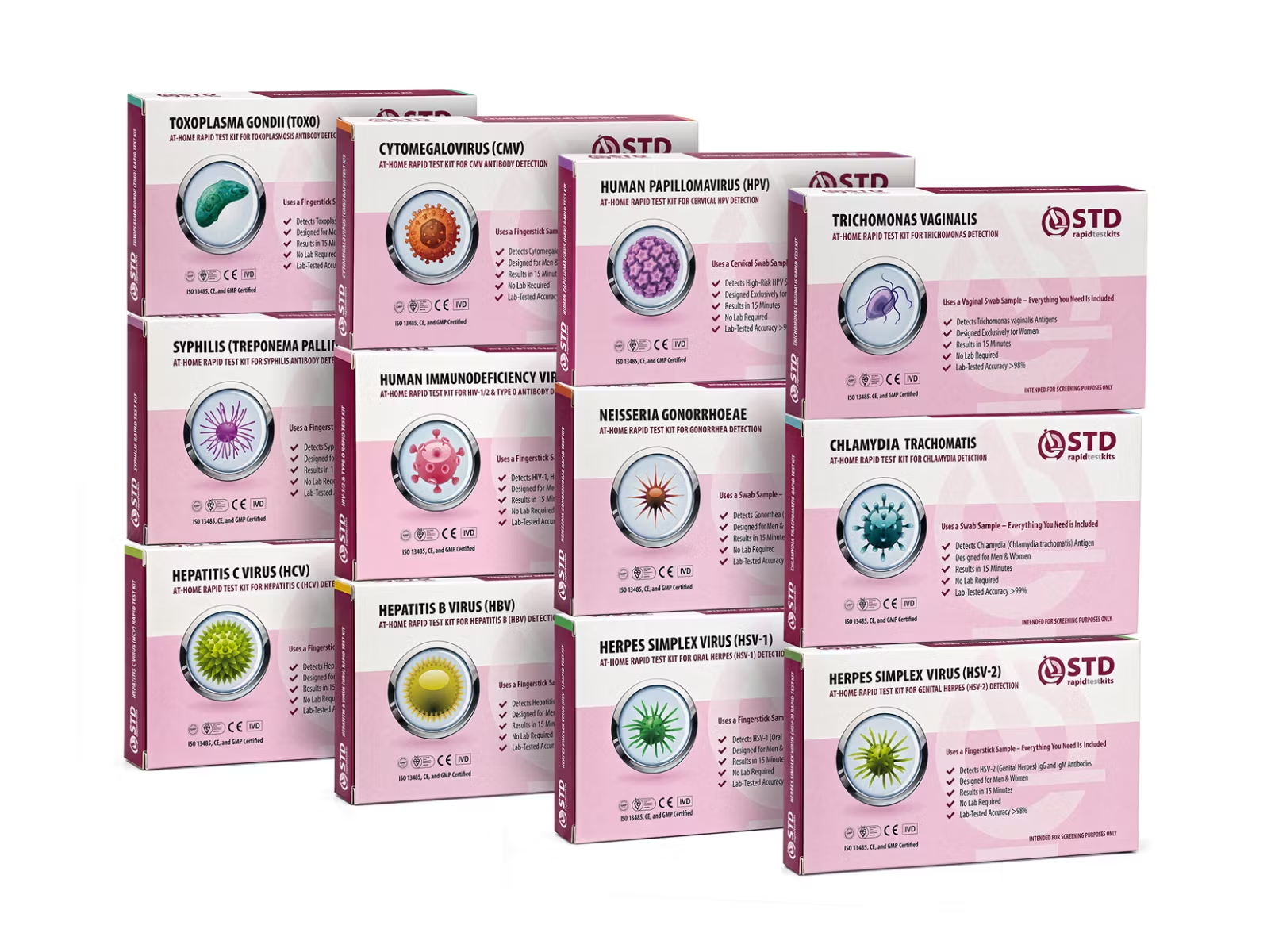
The table below covers the core lineup of rapid lateral-flow tests you can complete at home with results in roughly 10 to 15 minutes. All kits ship in plain unmarked packaging and include everything needed for sample collection (lancet, swab, cassette, buffer, instructions). Manufacturer-published sensitivity figures are shown; check each product page for specificity details. Combination kits are usually the better value when you do not know exactly which infection to screen for.
| Kit | What It Tests | Published Sensitivity | Sample Type |
|---|---|---|---|
| Chlamydia rapid test | Chlamydia | About 99% | Swab |
| Gonorrhea rapid test | Gonorrhea | About 99% | Swab |
| Syphilis rapid test | Syphilis | About 99% | Blood |
| HIV 1&2 rapid test | HIV-1 and HIV-2 | About 99.7% | Blood |
| HSV-1 rapid test | Herpes Simplex Virus 1 | About 98% | Blood |
| HSV-2 rapid test | Herpes Simplex Virus 2 | About 98.2% | Blood |
| Hepatitis B rapid test | Hepatitis B | About 99% | Blood |
| Hepatitis C rapid test | Hepatitis C | About 98% | Blood |
| Chlamydia + Gonorrhea 2-in-1 | Chlamydia, gonorrhea | About 98%+ | Swab |
| 8-in-1 complete kit | Chlamydia, gonorrhea, syphilis, HIV, hep B, hep C, HSV-1, HSV-2 | About 99% | Swab + blood |
| Women's 10-in-1 kit | All above plus trichomoniasis and HPV 16/18 | About 99% | Swab + blood |
Using a rapid test: step by step
Start by reading the instruction leaflet completely before touching anything else. Each kit has slightly different protocols around the order of steps, the exact volume of buffer to add, and the precise reading window. Lay everything out on a clean surface first: the test cassette, the lancet (for blood) or swab (for genital), the alcohol prep pad, the collection pipette or vial, and the buffer solution.
For blood-based tests, clean the side of your fingertip with the alcohol pad and let it dry. Use the lancet on the side of the fingertip rather than the pad; nerve endings on the pad make it more painful, and blood flow there is poorer. Squeeze gently to produce a drop and collect it as instructed. For swab tests, insert the swab to the indicated depth and rotate as the instructions specify; under-collected swabs are a frequent cause of invalid results.
Once sample and buffer are applied, set a timer. Do not read the result early, and do not read it after the stated reading window (usually 10 to 20 minutes), because line intensity changes after that point and can produce a misleading interpretation. Two lines (including a very faint second line) in the test zone means reactive. One line means non-reactive. No control line means the test did not run correctly; retest with a fresh kit.
What to do after you read your result
If the result is negative and you tested within the correct window period, that is a meaningful result. The test has not detected an infection at a point where detection should have been possible. Any symptoms you noticed may be due to something unrelated, or your concern about exposure may simply not have led to transmission.
If the result is negative but you tested early, the result is essentially uninformative. The right response is to retest once the appropriate window has passed and treat the early negative as too soon to know.
If the result is positive, contact a healthcare provider for laboratory confirmation, then follow their treatment guidance. Most bacterial STIs (chlamydia, gonorrhea, syphilis) are fully curable with antibiotics. Viral infections (HIV, herpes, hepatitis B and C) have effective ongoing treatment options. Modern HIV care in particular allows people on suppressive treatment to live full, healthy lives with effectively zero transmission risk to partners (per CDC HIV treatment guidance).
Regarding testing frequency: per the CDC, sexually active women under 25 should test annually for chlamydia and gonorrhea, HIV testing at least once is recommended for everyone aged 13 to 64, and anyone with multiple partners or inconsistent condom use should test every 3 to 6 months. Those guidelines describe a floor, not a ceiling.
The only way to know your STI status is to get tested. Many STIs do not cause any symptoms, so a person can be infected and not know it.
Common myths about at-home STD testing
Misconceptions about rapid testing persist despite strong evidence to the contrary. The World Health Organization estimates that more than one million curable STIs are acquired every day worldwide, the majority of them asymptomatic, yet myths about testing continue to delay people from screening when they should. The four below are the ones that matter most.
Myths vs. Facts: At-Home STD Testing
Myth: At-home tests are not as accurate as lab tests.
Fact: For screening purposes, CE-certified rapid lateral-flow kits perform in the 97% to 99% sensitivity range. They are not analytically equivalent to laboratory NAAT (which is more sensitive in very-early infection windows), but they are clinically useful for the screening role they fill. A positive should be lab-confirmed before treatment regardless of where the screening test was taken.
Myth: Only people at high risk need to test.
Fact: The CDC's universal HIV testing recommendation applies to everyone aged 13 to 64 at least once, regardless of perceived risk. Many people who test positive for HIV, syphilis, or hepatitis C report no risk factors they considered significant before diagnosis.
Myth: If I have no symptoms, I do not need to test.
Fact: Most STIs are asymptomatic in early stages, and some never produce noticeable symptoms. Chlamydia is asymptomatic in the majority of cases, most herpes infections never produce a recognizable outbreak, and syphilitic chancres heal on their own. Symptom-watching as a screening strategy does not work.
Myth: Home testing is too expensive compared to a clinic visit.
Fact: Single rapid kits typically cost less than a clinic co-pay plus the time cost of an appointment. Combo kits price in well under ordering individual tests separately. No insurance billing means no explanation-of-benefits paperwork sent to a policyholder.
Choosing the right kit for your situation
The right kit comes down to three questions: which infections you were potentially exposed to, which body sites were involved, and whether you want a targeted result or a comprehensive one. A single defined exposure to one infection means a single test is fine. Broader screening, a new relationship, or a higher-risk exposure usually means a combo kit. For women wanting full coverage including trichomoniasis and HPV, the 10-in-1 panel is the only at-home option that covers those two (validated for vaginal self-swab only; male readers needing trichomoniasis or HPV testing should see a clinic).
If your exposure involved a throat or rectal site, see a clinic for site-specific swabs. We do not sell pharyngeal or rectal swab kits, and substituting a genital-swab test for those exposure sites will not give you a reliable answer. The blood-based tests (HIV, syphilis, hepatitis, herpes) still cover systemic infections from any exposure route.
Which Kit Fits Your Situation?
Was your exposure exclusively oral or rectal (no genital contact)?
Yes: See a clinic for site-specific throat or rectal swabs. Our at-home kits cover genital swabs and systemic blood tests only. The blood tests (HIV, syphilis, hepatitis B, hepatitis C, herpes) still apply to any exposure route.
Do you know exactly which single infection you were exposed to?
Yes: A single-infection rapid test for that specific STI is the most targeted and cost-efficient option. Match sample type to the infection (swab for chlamydia/gonorrhea, blood for HIV/syphilis/hepatitis/herpes).
Are you screening broadly, starting a new relationship, or unsure what you were exposed to?
Yes: A combination kit removes the guesswork and costs less per test. The 8-in-1 covers eight major STIs for any gender. Women wanting trichomoniasis and HPV coverage need the 10-in-1 panel (validated for vaginal self-swab only).
No: If none of the above fits your situation, contact a sexual-health clinic for personalized guidance on which tests to run.
Guidance only; a healthcare provider can advise based on your specific circumstances.
Frequently Asked Questions
- How soon after a possible exposure can I take a rapid test?
- It depends on the infection. For chlamydia, the minimum reliable window is 14 days. For gonorrhea, 2 to 3 weeks. For syphilis, 6 weeks. For herpes, 6 to 12 weeks (antibody seroconversion can occasionally take up to 16 weeks). For HIV, CDC guidance gives 23 to 90 days for antibody-only rapid tests, with a 90-day retest if an earlier result is negative. For hepatitis C, 8 to 11 weeks. Testing earlier produces unreliable results because the markers the test detects have not yet reached detectable levels.
- I have symptoms already. Should I test right away?
- Symptoms and detectability run on different timelines. For bacterial infections, the bacteria need to replicate to a detectable concentration. For viral infections, your immune system needs time to produce antibodies the test can find. If symptoms are bothering you and the window has not yet closed, see a clinic for clinical evaluation; the clinician can prescribe based on symptoms while the lab work confirms. Plan your at-home retest for after the window closes.
- What is the difference between a swab test and a blood test?
- Swab tests detect the pathogen itself at the infection site; blood tests detect your immune system's antibody response to an infection. Swab kits are used for chlamydia, gonorrhea, trichomoniasis, and HPV. Blood kits are used for HIV, herpes, syphilis, and hepatitis B and C. The home kit panel you choose has to match the infection biology.
- Can I test for multiple STIs at once?
- Yes. Combo kits cover several infections from a single collection session, ranging from a 2-in-1 (chlamydia plus gonorrhea) to a 10-in-1 panel that covers every major STI in one sitting. If your exposure could have transmitted more than one infection, a combo kit is almost always the more useful choice and tends to cost less per test than buying single-infection kits.
- What does a positive at-home rapid test mean?
- It means the test detected markers associated with that infection, which is a strong screening signal but not a final diagnosis. Contact a healthcare provider for laboratory confirmation before starting any treatment. Effective treatment exists for every infection these kits cover.
- How is at-home rapid testing different from a postal lab kit?
- Postal lab kits ask you to collect a sample at home, then mail it to a laboratory for processing. The lab uses the same NAAT or antibody assays it would use for clinic-collected samples, so analytical sensitivity is high, but you typically wait 3 to 7 business days for the result and pay shipping both ways. Rapid lateral-flow home tests run the assay on the cassette and produce a result in 10 to 15 minutes. Many people use rapid kits as the first-line screen and reserve a clinic visit or postal lab for confirmation.
- Can rapid tests detect a throat or rectal infection?
- Not directly. Our at-home kits cover fingerstick blood samples and self-collected genital swabs only; we do not sell pharyngeal or rectal swab kits. After unprotected oral or anal sex with a possible gonorrhea or chlamydia exposure, see a clinic for a site-specific swab. The blood-based tests in our kits (HIV, syphilis, hepatitis B, hepatitis C, herpes) cover the systemic infections from any exposure route.
- Is at-home rapid testing private?
- Yes. Kits ship in plain unmarked packaging with no external indication of contents. You collect the sample on your own time in your own space, and the result is yours alone. No insurance claim is filed, so no explanation-of-benefits statement is sent to anyone. You decide whether to share the result with a partner, a clinician, or no one.
- U.S. Centers for Disease Control and Prevention. 2024 National STI Surveillance Data Release, including chlamydia, gonorrhea, and syphilis case totals and year-over-year trends.
- U.S. Centers for Disease Control and Prevention. HIV testing recommendations for adolescents and adults, including the universal-testing recommendation (everyone aged 13 to 64) and test-type-specific window periods (18 to 45 days for fourth-generation lab tests, 23 to 90 days for antibody tests).
- World Health Organization. Sexually Transmitted Infections Fact Sheet, including the estimate that more than one million curable STIs are acquired daily worldwide and the asymptomatic-presentation note.
- U.S. Centers for Disease Control and Prevention. Hepatitis B and C topic pages covering surveillance numbers, transmission routes, and screening recommendations.
- U.S. Centers for Disease Control and Prevention. STI screening cadence, NAAT laboratory methodology, and prevention guidance for sexually active adults.
- UK National Health Service. Sexually transmitted infections (STIs) overview, including UK-context screening cadence, the up-to-seven-weeks-to-show-up note, and clinical-care pathways.
- U.S. Centers for Disease Control and Prevention. HIV program landing page, cited for treatment-as-prevention context (people on suppressive HIV therapy with sustained undetectable viral load have effectively zero risk of sexually transmitting HIV).
- U.S. National Library of Medicine, MedlinePlus. Sexually transmitted diseases overview, including the note that STIs often do not cause symptoms and that testing is essential even without signs of infection.
