
Published: November 2025 | Last updated: May 2026 | Editorial review and quality control: Martina N.
The morning after a night that ended in a blur sits in a strange space. Not every search for STI testing after a blackout is about a wild night out; some readers had one drink too many, others were drugged, others never agreed to what happened at all. Whatever shape the gap takes, testing is a quiet, practical step that gives you information on your own terms.
This guide covers what testing options exist, how long to wait before each one is reliable, what symptoms can and cannot tell you, and what happens after a positive or negative result. (Disclosure: this article is published by stdrapidtestkits.com, which sells at-home STI test kits; it serves readers regardless of whether they buy anything.)
Key Takeaways
- Sexual contact you do not fully remember can still pass an STI; testing is a practical next step, not an admission of anything.
- Most home rapid tests become reliable 2 to 6 weeks after a possible exposure. When the date is unclear, test now and again at 6 weeks for a clearer picture.
Do you still need to test if you don't remember having sex?
Short answer: yes, if there is any chance bodies came into contact. STIs do not always require vaginal or anal penetration to spread. Skin-to-skin contact, oral sex, shared sex toys, or any activity that exchanges fluids can transmit infections like herpes, HPV, gonorrhea, chlamydia, syphilis, or HIV. The U.S. Centers for Disease Control and Prevention covers the full transmission picture on its STI overview page.
What that means in practice: if you woke up with your clothing displaced, with new soreness in the genital area, or with someone in the room you did not expect, exposure is possible even without a clear memory of penetration. You do not need to prove anything to yourself, or to anyone else, to test.
Some readers worry that testing means assuming the worst. It does not. Testing is information. A negative result is reassurance. A positive result starts treatment that, for most STIs, is short and uncomplicated.
Herpes (skin-to-skin); HPV (skin-to-skin); gonorrhea (oral sex, shared objects); chlamydia (mucous-membrane contact); HIV and syphilis (blood or fluid exchange). If any of these contact routes happened, an STI screen is reasonable.
When should you test? Window periods, plainly
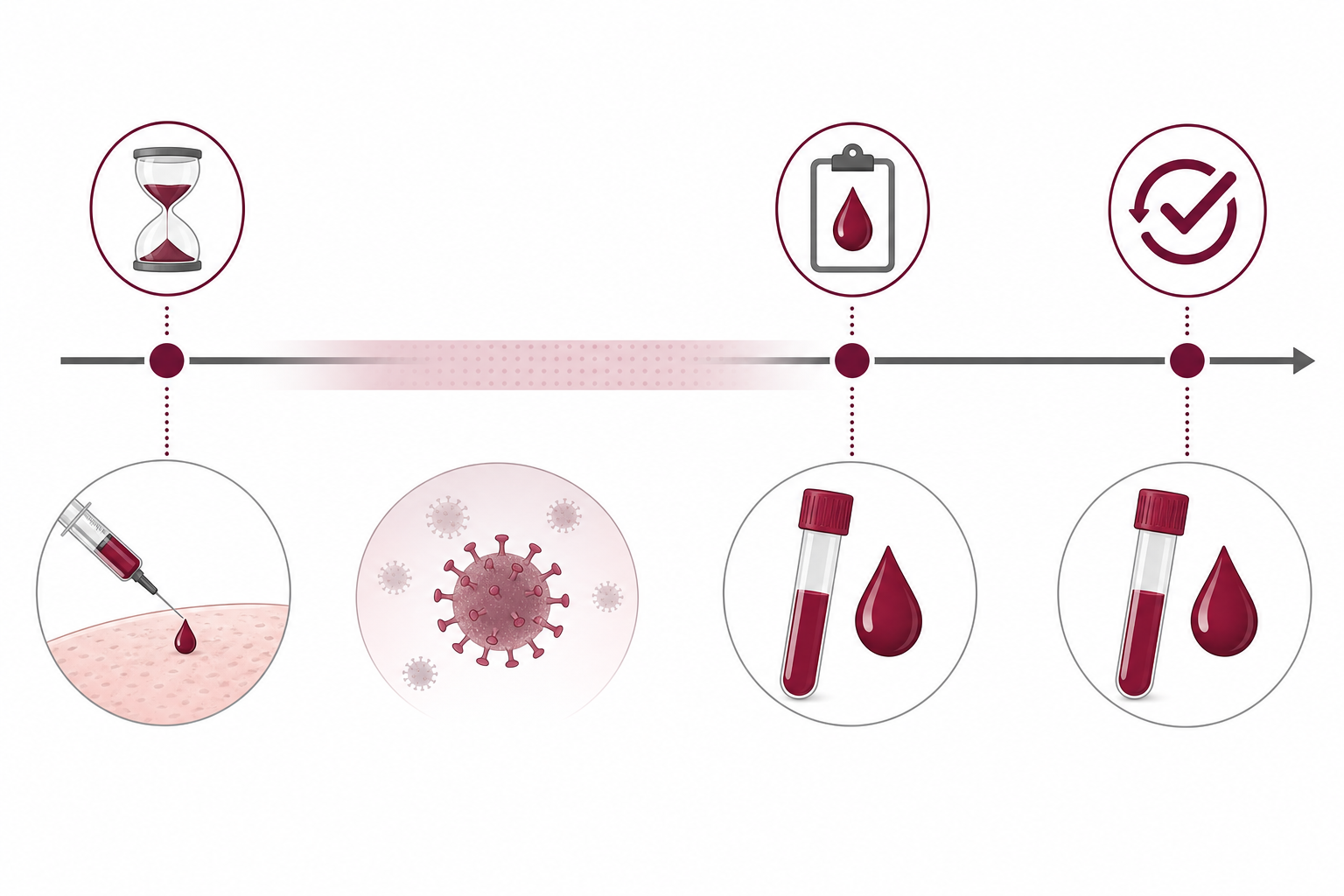
"Window period" is the time between a possible exposure and when a test can reliably detect an infection. Test too early and a real infection can be missed. Test too late and treatment for a curable infection is delayed. Different STIs cross the detectable threshold at different times, which is why one timing rule does not cover the whole panel.
The table below reflects window-period ranges consistent with CDC and WHO public-health guidance. For the HIV row specifically, the CDC HIV testing guidance linked in the sources documents the antigen/antibody and NAT windows in detail. If the exposure date is unclear, the practical answer is usually to test now and again about six weeks later; this catches both quick-incubating bacterial infections and slower seroconversions.
| Infection | Earliest a test can detect | Best testing window | Retest? |
|---|---|---|---|
| Chlamydia | ~7 days | 2 weeks after exposure | Yes, if first test was before day 14 |
| Gonorrhea | 5 to 7 days | 2 weeks after exposure | Yes, if first test was before day 14 |
| Trichomoniasis | ~5 days | 2 to 4 weeks | Optional |
| Syphilis (blood) | ~3 weeks | 6 to 12 weeks | Yes at 12 weeks |
| HIV (antigen/antibody blood) | ~4 weeks | 6 weeks to 3 months | Yes at 3 months for full confidence |
| HSV-2 antibody (blood) | 12 weeks | 12 weeks (some assays up to 16) | Antibody seroconversion only |
How long should you wait to test after an exposure you don't fully remember?
For chlamydia and gonorrhea, a swab test is reliable about 2 weeks after possible exposure. For HIV using a fingerstick antigen/antibody blood test, 6 weeks gives strong confidence, with a 3-month check for full closure. Syphilis blood tests are best at 6 to 12 weeks. When the exposure date is unclear, test now and again at 6 weeks.
What if you have no symptoms at all?
This is the most common reason people delay testing: the thought that "if I had something, I would feel it." For most STIs, that is not how the early stages look. Chlamydia is frequently asymptomatic, especially in women, per CDC public-health surveillance. Gonorrhea can also stay silent. The first herpes outbreak is sometimes mild enough to mistake for a paper cut or razor irritation. HPV can persist for years with no visible warts and no symptoms.
Chlamydia, gonorrhea, HPV, and herpes regularly produce no noticeable symptoms in the early weeks, which is exactly why public-health screening guidance runs on exposure history rather than on how someone feels. Most readers who eventually test positive on a home kit had no clear sign anything was wrong.
A sore throat after oral exposure can be the first sign of pharyngeal gonorrhea, and our at-home swab kits are not validated for that site; they collect a genital self-swab. A throat swab requires a clinic visit. The genital-swab and bloodwork panels covered in this article handle the rest of the standard screen.
Which test should you choose when you don't know what to test for?
When the event is fuzzy, the smartest move is usually a combination kit. Instead of guessing whether the relevant infection was chlamydia, herpes, HIV, or something else, a combo kit screens the most common bacterial and blood-borne STIs in one self-collection session. That removes the guesswork up front, and the testing flow becomes a single decision rather than a panel of separate ones.
Three broad options exist for home use:
| Option | Time to result | Sample type | Best for |
|---|---|---|---|
| At-home rapid lateral-flow kit | 15 to 20 minutes | Self-collected swab or fingerstick blood | Quick screen with a yes/no result in your hands |
| Mail-in lab kit | 2 to 5 days | Self-collected sample mailed to a lab | Highest analytical sensitivity (NAAT/PCR) for bacterial infections |
| Clinic visit | Same day to a week | Provider-collected sample | Persistent symptoms, same-visit treatment, throat or rectal swabs |

If you don't remember whether you consented
This part needs saying directly. If you think something happened and you did not agree to it, that matters. Whether or not you have a full memory. Whether or not you knew the person. Whether or not you said the word "no." You still have a right to care, support, and testing, without needing to prove anything to anyone, including yourself.
STI testing in this situation can feel loaded. Some people want to know as soon as possible; others want to wait and not know yet. Both responses are normal. At-home testing exists in the space between "go to a clinic and explain" and "do nothing." It gives you privacy, the option to delay until you are ready, and a result you control.
If you want support alongside testing, RAINN runs a 24/7 confidential hotline and online chat that does not require a police report or any law-enforcement involvement.
1-800-656-HOPE (4673) or live chat at rainn.org. Available 24/7. No police report required. Free and confidential.
If the first test is negative, should you retest?
Usually yes, especially if the first test was within two weeks of the exposure date. Different STIs cross the detectable threshold at different times, so one early test can come back negative for a real infection that a later test would catch. A follow-up test at six weeks closes the gap that one early test cannot close on its own.
A standard two-step plan: test about two weeks after exposure for chlamydia, gonorrhea, and trichomoniasis, then again at six weeks for the bloodwork panel including HIV antigen/antibody. For HIV alone, a 3-month follow-up using either a lab antigen/antibody or RNA test gives full confidence per CDC HIV testing guidance.
If the exposure date is unknown, the same logic applies. Test now to catch the quick-incubating infections, then again about six weeks later. Setting a calendar reminder for the retest, with a neutral label like "follow-up check," helps the second test actually happen.
Standard retest schedule
- Step 1: Swab test at 2 weeks for chlamydia, gonorrhea, and trichomoniasis.
- Step 2: Bloodwork retest at 6 weeks for HIV antigen/antibody and syphilis.
- Step 3 (HIV-specific): 3-month lab antigen/antibody or RNA test for full closure.
How accurate are at-home rapid tests?
For most FDA-cleared or CE-marked home rapid kits, sensitivity and specificity sit in the high 90s when used after the appropriate window period. HIV and syphilis blood rapid tests typically post the highest figures on their product data sheets, while rapid swab tests for chlamydia and gonorrhea show sensitivity that is lower than laboratory NAATs (which remain the analytical gold standard). The product's own data sheet is the authoritative source for the exact validated numbers; do not assume one kit's figures apply to another.
Two practical caveats apply.
First, accuracy figures assume the test is used after the correct window period. A test with high sensitivity at six weeks can return a false negative at five days. The numbers in the window-period table earlier in this article are not arbitrary; they mark when the validated math holds.
Second, treat any positive home result as the first step in a two-step process. For HIV and syphilis especially, where false positives are uncommon but possible, a clinic confirmation test (typically a NAAT for HIV, RPR plus Treponemal test for syphilis) is the standard next step before starting treatment.
A positive home result is a screening signal, not a diagnosis. For HIV or syphilis, confirm with a clinic-based test (NAAT for HIV; RPR plus Treponemal for syphilis) before starting treatment.
Privacy when you test at home
Privacy is the part of home testing that does not show up on any product spec sheet but matters most for a reader sorting through a confusing event. The kit arrives in unbranded packaging with no medical terminology on the box. Results stay with you; they are not reported to insurance, your doctor, or any registry unless you choose to share them.
For readers living with roommates, partners they do not trust, family members who would ask questions, or in communities where sexual-health testing carries stigma, this matters. Control over who knows what, and when, is part of the actual product.
Home rapid kits work best for the panels they were validated for. They do not replace a clinic visit when there are persistent symptoms, when a prior test was positive and treatment decisions are pending, or when a non-genital site (throat, rectum) is the concern.
What home-testing privacy actually looks like
- Unbranded packaging arrives with no medical terminology on the box.
- Results are not reported to insurance, your doctor, or any registry unless you share them.
- No login or account is required to use a rapid lateral-flow kit.

If the result is positive
Most bacterial STIs (chlamydia, gonorrhea, trichomoniasis, syphilis) are curable with a short antibiotic course. Viral infections (HIV, herpes, HPV, hepatitis B and C) are managed long-term with treatment that is far less burdensome than it was a decade ago. Modern HIV therapy can suppress the virus to undetectable levels, which the CDC's HIV public-health guidance describes as effectively untransmittable to partners.
The immediate next step after a positive home result depends on the infection.
For HIV or syphilis, confirm with a clinic-based NAAT (for HIV) or RPR plus Treponemal test (for syphilis) before starting treatment. False positives on rapid tests are uncommon but possible, and the treatment course for these infections is significant enough that confirmation matters.
For chlamydia or gonorrhea, a positive rapid swab is usually sufficient to start the antibiotic course, which is typically a single-dose or short multi-day regimen. Many telehealth services can issue the prescription after reviewing a kit photo. Treat the partner or partners as well, where you feel safe doing so, to prevent reinfection.
Partner notification is a sensitive topic in the context of an unclear exposure event. Some clinics offer anonymous partner-notification services that do not require you to share names with the partner. You do not need to have all the answers, or all the memories, to suggest that someone might want to get tested.
Many sexually transmitted infections cause no symptoms. The only way to know your status is to get tested.
Where you go from here
The work of caring for yourself after an event you cannot fully remember is small and concrete. Test at the right time. Retest at six weeks. Confirm a positive at a clinic if the infection warrants confirmation. Get support if you want it. You do not have to explain the gap in your memory to anyone to take any of these steps.
Whatever the result is, you are allowed to act on incomplete information. Most readers who test never find out exactly what happened, and most do not need to.
Your next steps
- Test at 2 weeks: swab for chlamydia, gonorrhea, trichomoniasis.
- Retest at 6 weeks: bloodwork for HIV and syphilis.
- Confirm any positive HIV or syphilis result at a clinic before treatment.
- Call RAINN 24/7 (1-800-656-HOPE) if you want support alongside testing.
Frequently Asked Questions
- Can I really get an STI if I don't remember having sex?
- Yes, if any physical contact happened. STIs spread through skin-to-skin contact, oral sex, shared sex toys, or any exchange of fluids. You do not need to remember full penetration for transmission to be possible. If you woke up to clear physical evidence of contact (clothing displaced, soreness, someone unexpected in the room), an STI screen is a reasonable step regardless of what you remember.
- How long should I wait before testing?
- For chlamydia, gonorrhea, and trichomoniasis, a swab test is reliable about two weeks after possible exposure. HIV antigen/antibody blood tests cross the detectable threshold around 4 to 6 weeks, with full confidence at 3 months. Syphilis blood tests are best at 6 to 12 weeks. If the exposure date is unclear, the usual advice is to test now and retest at 6 weeks.
- What does a negative result on day 5 actually mean?
- Very little, in practice. A chlamydia swab on day 5 will very likely return negative even if exposure happened, because the bacterium has not replicated to detectable levels yet. That negative is not reassurance; it is just an early read. The 2-week window is when the swab can pick up an established infection, not just exposure. Treat any pre-window negative as a baseline and retest at the proper window.
- Does no symptoms mean no STI?
- No. Chlamydia is frequently asymptomatic, especially in women. Gonorrhea can also stay silent. HPV often shows nothing for years. The first herpes outbreak is sometimes mild enough to mistake for irritation. CDC screening guidance is exposure-based, not symptom-based, for exactly this reason.
- Can I do this entirely on my own without seeing anyone?
- Yes. Home rapid kits are designed for full self-collection and self-reading. Packaging arrives unbranded. Results stay with you unless you choose to share them. The trade-off: home tests do not replace a clinic visit for persistent symptoms, for throat or rectal sites (which our kits do not cover), or for cases where a confirmatory NAAT is needed after a positive home screen (HIV, syphilis).
- What if I think I was assaulted and I'm not ready to deal with it?
- You have a right to test without filing a report, talking to police, or telling anyone what happened. Home testing exists in the space between doing nothing and walking into a clinic to explain. RAINN's confidential hotline (1-800-656-HOPE) and online chat at rainn.org are available without any reporting obligation if you want support alongside testing.
- Are at-home STI tests actually accurate?
- For most FDA-cleared or CE-marked kits, sensitivity and specificity sit in the high 90s when used after the correct window period. The exact figures live on each product's data sheet. The biggest accuracy variable is timing: a perfect test outside the window will still miss real infections. Read the kit's window-period instructions and follow them.
- If I test positive at home, what's the next step?
- For HIV or syphilis, confirm at a clinic with a NAAT or RPR/Treponemal test before treatment. For chlamydia, gonorrhea, or trichomoniasis, a positive rapid swab is usually sufficient to start the antibiotic course; many telehealth services can issue the prescription after reviewing a kit photo. For herpes or hepatitis B or C, follow up with a provider to discuss long-term management. None of these results are emergencies, and all are manageable.
How We Sourced This Article: This guide was constructed from current public-health and clinical guidance from the CDC, WHO, NHS, and RAINN, then translated into plain language. Window-period ranges and testing recommendations reflect guidance current as of the publication and review dates above. Treatment recommendations and screening timing can change, so always confirm with a clinician for your specific situation.
- U.S. Centers for Disease Control and Prevention. About sexually transmitted infections (STIs), including transmission and prevention overview.
- U.S. Centers for Disease Control and Prevention. HIV testing guidance, including antigen/antibody and NAT timing windows (18-45 days antigen/antibody; 10-33 days NAT).
- U.S. Centers for Disease Control and Prevention. HIV public-health guidance, including treatment as prevention and undetectable equals untransmittable.
- World Health Organization. Sexually transmitted infections (STIs) fact sheet, including global epidemiology and screening guidance.
- NHS. Sexually transmitted infections (STIs) topic page, including testing and treatment.
- RAINN (Rape, Abuse and Incest National Network). Confidential support hotline and resources for survivors of sexual violence.
