Published: September 2025 | Last updated: May 2026 | Editorial review and quality control: Martina N.
It's 2 AM. You're scrolling through your phone, eight tabs deep, comparing rashes you can barely see in the dim screen light. The intimate moment from last week, last month, or three months ago doesn't seem to matter anymore. One slightly itchy patch has convinced your brain something is wrong. If that sounds familiar, you're in good company, and you're not overreacting. Late-night health anxiety follows a predictable pattern that millions of people experience, and most sensations people spiral about turn out to be something far less serious than they fear. A calm framework makes that easier to see.
Key Takeaways
- Most random sensations people panic about at night, including a single tingle, a small bump, or mild itching, are caused by friction, dryness, ingrown hairs, or anxiety itself rather than active infection.
- If you've had a recent unprotected exposure or symptoms lasting more than 48 hours, an at-home rapid test offers faster clarity than another hour of Googling, provided you test inside the right window period.
Why Nighttime Turns STD Worry into a Spiral
The hours after midnight aren't built for calm thinking. During the day, work, friends, and small distractions fill the spaces where anxiety would otherwise grow. At 2 AM the distractions are gone. It's just you, your body, and a phone screen that will happily feed you worst-case scenarios for as long as you keep scrolling.
Health anxiety follows a predictable cycle. The NHS identifies repeated symptom-checking and reassurance-seeking as the core behaviors of health anxiety, a reinforcing loop in which noticing a sensation, interpreting it as evidence of serious illness, and seeking reassurance through more searching only briefly calms the worry before the next sensation triggers another round (NHS health anxiety overview). Sexual-health symptoms are particularly prone to this loop because they overlap with so many ordinary causes: friction from clothing, dryness, ingrown hairs, hormonal shifts, and mild allergic reactions to soap or laundry detergent.
The 2 AM version of you sees a pinkish patch and reads "early herpes lesion." The 9 AM version of you sees the same patch and notices it lines up with where the seam of your jeans rubbed for eight hours yesterday. Both versions are looking at the same skin. The difference is context, and quiet hours strip context away.
Brains under stress process ambiguous signals as threats. That is what anxiety evolved to do, and it happens to most people in high-uncertainty moments. Naming the pattern is the first useful step toward breaking it. The second step is replacing the open-ended search with a small, finite plan: a clear set of questions to ask yourself, and a clear next action when the answers point that way.
Before concluding something is wrong, commit to looking at the symptom again tomorrow in normal daylight. If it looks the same, you have a data point worth acting on. If it has faded or you can no longer find it, that is also information. The same sensation at the same intensity feels very different in two different lighting and stress states.
When a Search Becomes a Spiral
The internet is not built to give you peace of mind. Search engines optimize for engagement, not closure, so a single query about an itch can drop you into Reddit threads from terrified strangers, dramatic case reports from medical journals, and image search results that mix genuine clinical photos with stock images that have nothing to do with your situation. None of that is calibrated to your skin, your history, or the actual likelihood of any condition.
The pattern that follows is consistent. Uncertainty drives more searching, more searching surfaces more frightening possibilities, those possibilities feel like confirmation, and confirmation drives the next round of searching. People often describe spending three or four hours in this loop and ending up more convinced they're sick than when they started, even though no new information has actually appeared.
This loop has a name in psychology research: cyberchondria. It refers specifically to the way online health searching tends to escalate anxiety rather than reduce it, and people prone to health anxiety are the most vulnerable to it. The mechanism is straightforward: every search adds new fear without adding diagnostic certainty, and your nervous system can't tell the difference between "found new evidence" and "found new things to worry about."
Breaking the loop usually requires a hard stop, not a better search. Closing the tabs and writing down what you actually noticed, when you noticed it, and what specific exposure (if any) preceded it gives your thinking somewhere to land. From there a single concrete decision becomes possible: wait, watch for a defined window, or test.
A sensation triggers a search. The search surfaces more frightening possibilities. Those possibilities feel like confirmation. Confirmation triggers the next search. Breaking the loop requires a hard stop, not a better result.
Real Symptoms or Just Fear? How to Tell
Genuine STI symptoms exist and they matter, but they're often less dramatic than late-night searches suggest, and they overlap heavily with ordinary skin and urinary issues. The most reliable signs are unusual discharge, persistent pain or burning during urination, sores that don't heal within a couple of weeks, and rashes or bumps that appear in clusters rather than singly (CDC sexually transmitted diseases overview).
Many people who actually have an STI also have no symptoms at all, which is a key reason testing matters more than symptom-watching for sexually active people. CDC's STI treatment guidelines note that asymptomatic infection is common, especially for chlamydia and gonorrhea (CDC STI treatment guidelines).
The table below covers the most common late-night fears alongside the more likely non-STI explanations. It isn't a substitute for diagnosis, but it can help you decide whether the next reasonable step is a test or a glass of water and some sleep.
| Late-night fear | Common STI cause | Common non-STI cause |
|---|---|---|
| Itching in the genital area | Trichomoniasis, herpes, pubic lice | Dry skin, shaved-area irritation, synthetic underwear, yeast |
| Single small bump or pimple | Herpes (usually clusters), genital warts | Ingrown hair, friction blister, sebaceous cyst |
| Burning when urinating | Chlamydia, gonorrhea | Mild dehydration, urinary tract infection, soap irritation |
| Mild discharge change | Chlamydia, gonorrhea, trichomoniasis | Cycle-related variation, lubricant residue, condom material reaction |
| Sore throat after oral sex | Pharyngeal gonorrhea (clinic-tested) | Common viral pharyngitis, post-nasal drip, mouth breathing |
What Late-Night Searches Can't Tell You
Symptom checkers and search results have a structural limit. They can list possibilities, but they can't see your skin, examine your history, or run a lab test. They rely on your interpretation of what you're noticing, which late at night is filtered through anxiety. A barely-pink patch becomes "redness." A single bump becomes "clustered blisters." A faint tingle becomes "burning pain." Stress changes perception, and self-diagnosis from search results is unreliable for that reason.
The other limitation is harder to spot in the moment. Search results show you the most extreme version of every condition because dramatic case reports get clicks. A typical mild herpes outbreak looks very different from the textbook photographs that show up first in image search. A typical chlamydia infection has no visible signs at all. Calibrating to the worst-case images warps your sense of what's likely.
Two tools genuinely help. The first is a defined waiting window. If you can give a symptom 24 to 48 hours to resolve before deciding, friction-related and irritation-related issues usually fade on their own and the genuine ones become easier to characterize. The second is a real test, used at the right point in the window period for the infection you're worried about. A negative result inside the testing window doesn't fully reassure, but a negative result after the window closes usually does, and a positive result lets you move into treatment instead of wondering.
A defined waiting window of 24 to 48 hours for irritation-related issues to resolve, paired with a real test taken at the correct point in the window period for the infection you're concerned about. Either is more useful than another hour of searching.
How Anxiety Mimics STD Symptoms
Anxiety has measurable physical effects, and several of them can be mistaken for early STI symptoms. Stress increases muscle tension in the pelvic floor, which can cause pulling sensations, mild burning, or a vague urge to urinate. It also raises sensitivity to ordinary touch, so the seam of underwear or the edge of a chair feels noticeable in a way it normally wouldn't. Vasoconstriction can cause tingling that has nothing to do with infection.
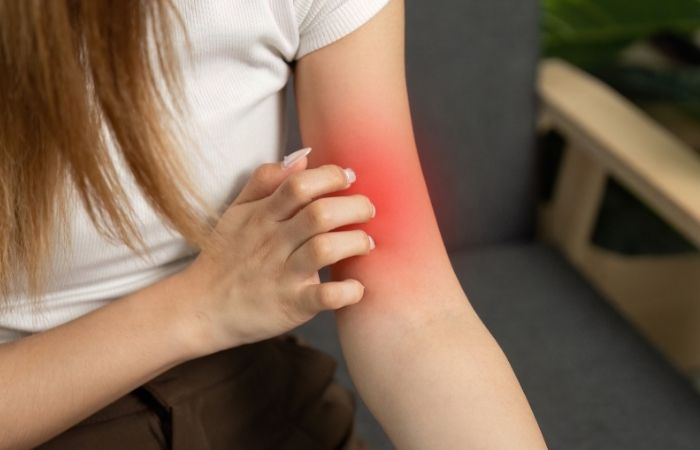
Sleep deprivation amplifies all of this. The longer you stay awake searching, the more your nervous system flags neutral sensations as threats. By 4 AM you're not feeling new symptoms; you're feeling the same ones with the volume turned up. The image below shows the kind of mild redness that often gets misread as the start of an STI lesion when it is actually friction or contact irritation, the most common non-infectious cause of "is this herpes" panic searches.
There's also a feedback loop worth knowing about. Worrying about your genitals makes you check them more often, which means more handling, more friction, more irritation, and more "new" symptoms to worry about. Stepping back physically helps. So does a basic comfort check: are you wearing the same fabric that always seems to bother you, did you shave or wax in the past 48 hours, did you try a new soap or laundry detergent, are you dehydrated.
None of this rules out a real infection. It does raise the bar for what counts as evidence, and it gives the morning version of you something more useful to evaluate.
When to Test (And When to Wait)
Testing too early is the most common mistake people make in symptom panic, and it backfires twice. The first false-negative result feels like reassurance for a few hours, then anxiety returns and the test you trusted suddenly feels untrustworthy. Knowing the testing window for each infection prevents the second spiral.
Window periods differ because each infection takes a different amount of time to either multiply enough to be detected directly, or trigger antibodies the test can pick up. The CDC's screening recommendations cover the standard windows for the most common infections (CDC STI treatment guidelines), and the specifics for HIV are on the agency's testing page (CDC HIV testing guidance).
A few practical rules follow from these windows. If you're inside the window, retesting at the recommended end of the window is what gives you a confident result, especially for HIV and syphilis. For HSV-2 antibody testing, the standard confidence window is around 12 weeks; some assay labels extend the window to about 16 weeks for borderline results, so check your kit's instructions if your result comes back ambiguous. If symptoms are severe, escalating, or include a sore that isn't healing, don't wait for any window: see a clinician. Window-period waiting is for symptom-free risk assessment and low-grade panic, not for active medical issues.
Our at-home rapid kits use lateral-flow chemistry on either a self-collected swab or a fingerstick blood sample. They're designed for screening at home, and a positive result is worth confirming with a lab test when possible. The advantage is privacy and speed in the cases where you've waited the right amount of time and you just want a result without scheduling a clinic visit. This site sells rapid at-home STI test kits; the recommendation below is based on clinical fit for the window-period context above, not commercial benefit.
| Infection | Earliest reliable test | Best window for confidence |
|---|---|---|
| Chlamydia | 5 to 7 days after exposure | 14 days or more |
| Gonorrhea | 5 to 7 days after exposure | 14 days or more |
| Syphilis | 3 weeks after exposure | 6 to 12 weeks |
| Trichomoniasis | 5 to 7 days after exposure | 14 days or more |
| HSV-2 (blood antibody) | 3 to 4 weeks | 12 weeks; up to 16 weeks for borderline results |
| HIV (rapid antibody) | 3 weeks | 6 to 12 weeks |
Should I test right now if I'm panicking at 2 AM?
Probably wait. If your last possible exposure was less than 5 to 7 days ago, even an accurate test will likely return a false negative because the infection hasn't reached detectable levels yet. Note the date of any exposure, then test at the right window for the infection you're worried about: about 14 days for chlamydia and gonorrhea, 6 to 12 weeks for syphilis, and for HIV roughly 18 to 45 days for a 4th-generation antigen/antibody lab test, or 3 to 12 weeks for a rapid antibody test (including most at-home kits).

How At-Home Testing Breaks the Spiral
The reason at-home testing helps with anxiety isn't only convenience. It removes one of the biggest amplifiers of late-night panic: the imagined gauntlet of a clinic visit. For people who've been putting off testing because of waiting-room anxiety, time off work, or a fear of the receptionist's expression, removing those barriers is what actually allows the test to happen.
Once a test is in motion, the cognitive shift is immediate. You stop generating possibilities and start waiting for a single answer. That's a much lower-stress mental state than the open-ended "what could this be" loop, even before the result arrives.
A useful way to think about it: testing is the action that takes you out of speculation and puts you in front of one piece of evidence. The result might confirm something you were worried about, or it might rule it out, but either way the answer becomes the basis for your next decision instead of more searching. Treatment for the most common bacterial STIs (chlamydia, gonorrhea, syphilis, trichomoniasis) is straightforward and curative, and antiviral options for HIV and herpes manage symptoms and transmission risk effectively.
If you're not sure which test fits your situation, the simplest framework is exposure type and timing. Recent unprotected exposure with a partner of unknown status usually justifies a broader combo screen. A specific concern about one infection is better served by a single-target test. And if your anxiety is the dominant symptom and there was no actual exposure, naming that often helps too.
Most people who have a sexually transmitted infection have no symptoms, which is why testing rather than symptom-watching is the foundation of detection.
What to Do After the Spiral
The morning after a panic night usually feels heavy. You've slept badly or not at all, your eyes are dry from screen time, and the symptom that felt unmistakable at 3 AM looks ordinary at 9. A short recovery routine helps reset.
First, water and food. Dehydration alone makes urinary symptoms more noticeable, and skipping breakfast keeps stress hormones higher than they need to be. Second, look at the symptom in normal daylight without a magnifying mirror. A large share of the time, the thing that looked alarming at night looks like irritation or a healed scratch in the morning.
Third, decide on one concrete action and write it down. Either schedule the test for the right date in the window period, or note a 48-hour check-in: "if this is still here on Friday, I'll test." Writing the decision down prevents the search loop from restarting. Open-ended worry feeds the cycle; a defined plan starves it.
Fourth, audit your search behavior. If late-night Googling has happened more than once or twice, consider a phone-level intervention: schedule "do not disturb" hours, log out of search apps after 10 PM, or use a content blocker for medical sites at night. The point is gathering information during hours when your brain can use it well.
If anxiety about your sexual health is happening regularly even when there's no specific reason for it, that pattern itself is worth talking to a clinician about.
Reclaiming Trust in Your Body
Most people want to escape the loop itself: the way an ordinary sensation can take over an entire night, the way one search leads to twenty more, the way the next morning starts with shame instead of relief.
Building trust in your body again is mostly a matter of consistency. Each time you respond to a sensation with a defined plan instead of an open-ended search, the loop weakens. Each time you test at the right point in the window period and get an actual result, you build evidence that the answers exist and you can find them without spending eight hours scrolling.
This doesn't mean ignoring real symptoms. Persistent pain, sores that don't heal, escalating discharge, or fever in combination with any genital symptom are clinical issues that deserve a clinician, not a 2 AM forum thread. The point of building the skill is to listen to your body's signals more accurately, with less interference from the parts of your brain that thrive on uncertainty.
The middle of the night will still happen. The next time it does, you'll have a routine to reach for instead of a search bar.
Three habits that shrink the spiral
- Respond to a new sensation with a defined plan (note it, watch for 24 to 48 hours, test if it persists) rather than an open-ended search.
- Test at the right window for the specific infection you're concerned about, not the day after the exposure that triggered the worry.
- If the anxiety pattern recurs without a specific exposure to explain it, name it out loud to a clinician; it's a separate issue from any single symptom.
FAQs
- Why does STD anxiety get worse at night?
- The same sensation feels different at 2 AM than at 2 PM because anxiety amplifies in quiet, low-distraction environments. Health anxiety in particular tends to peak when your brain has nothing else to focus on. The NHS describes this as a normal feature of how anxiety processes ambiguous information, not a sign that something is actually wrong.
- Can anxiety cause real STI-like symptoms?
- Yes. Stress raises pelvic-floor muscle tension and skin sensitivity, both of which can produce mild burning, itching, or pulling sensations. None of that means you have an infection, but the body genuinely feels what it feels. Sleep deprivation makes it more noticeable, which is why symptoms often seem worse the longer you stay up Googling.
- I found one red bump. Is it herpes?
- One bump is rarely enough to call anything. Herpes lesions usually appear as small clustered blisters that progress to shallow ulcers and then crust over. Single bumps are more often ingrown hairs, friction blisters, sebaceous cysts, or razor irritation. If a single bump is your only symptom and it resolves within a few days, the odds favor something benign.
- How long should I wait to test after a possible exposure?
- For chlamydia and gonorrhea, about 14 days gives a confident result. For syphilis, the standard window is 6 to 12 weeks. For HIV, the window depends on the test type. A 4th-generation antigen/antibody lab test detects infection in 18 to 45 days. A rapid antibody test, including most at-home kits, needs 3 to 12 weeks for a confident result. Testing earlier than the minimum window produces false negatives you will have to retake anyway.
- I tested negative. Why am I still anxious?
- A confident negative result outside the testing window for the infection you were worried about is reliable. The lingering anxiety usually comes from one of three sources: testing inside the window, worrying about a different infection than the one you tested for, or having generalized health anxiety that the result alone won't fully resolve. The first two are fixable with a follow-up test at the right time. The third is a separate pattern worth recognizing.
- Is it bad to use Google for symptom checking?
- Used briefly with a single trusted source like the NHS, CDC, or WHO, it can be useful. Used as an open-ended late-night search across multiple sites and forums, it usually escalates anxiety rather than resolving it. The deciding factor is whether you can stop after the first credible answer.
- I feel fine. Should I test anyway?
- If you've had unprotected sex with a partner whose status you don't know, yes. The most common STIs cause no symptoms in many people, especially in the first weeks, so feeling fine isn't a reliable signal that there's nothing to find. Routine screening is recommended for anyone sexually active outside of a long-term mutually monogamous tested relationship.
- What if my partner won't get tested?
- That's primarily a relationship and communication issue rather than a medical one. You can get yourself tested independently and protect yourself with barrier methods regardless of their decision. Sustained refusal to test in a sexual relationship is worth taking seriously as a signal about how the relationship handles risk and care.
How we sourced this article: We combined current guidance from the U.S. Centers for Disease Control and Prevention, the National Health Service (UK), and the World Health Organization with peer-reviewed clinical patterns on health anxiety and cyberchondria. The framing of nighttime symptom checking is editorial summary, not clinical advice. For symptoms that concern you or that don't resolve within a few days, see a licensed provider.
- National Health Service (UK). Health anxiety overview, used for the symptom-checking and reassurance-seeking behaviors that define the worry loop.
- U.S. Centers for Disease Control and Prevention. Sexually transmitted diseases hub, used for the symptom-pattern descriptions and routine screening framing.
- U.S. Centers for Disease Control and Prevention. STI treatment guidelines, used for screening recommendations and asymptomatic-infection framing for chlamydia and gonorrhea.
- U.S. Centers for Disease Control and Prevention. HIV testing guidance, used for window periods for antibody, antigen/antibody, and nucleic acid tests.
- World Health Organization. Sexually transmitted infections fact sheet, used for global context on asymptomatic infection and the importance of testing.
