
Published: October 2025 | Last updated: May 2026 | Editorial review and quality control: Martina N.
Does being polyamorous raise your STI risk?
Not on its own. Risk tracks with how often a network tests, how consistently condoms are used, and how fast partners disclose new contacts, far more than with partner count. An open network on a shared testing schedule can carry less risk than a closed couple where one partner has untested outside encounters.
For people in open or polyamorous relationships, the question of sexually transmitted infections is less about partner count and more about pattern. How often do you test? What happens between tests? Who in your network knows their current status, and who hasn't checked in months?
Those questions matter more than any headline about poly people and STI rates. The stigma tends to be loud ("you must have STDs," "that has to be unsafe"), while the biology is more forgiving than the assumptions. Transmission depends on exposure and timing rather than relationship structure, so honest non-monogamy with shared testing rhythms can be safer than a closed pairing where one partner has untested side encounters.
This guide is for anyone living outside the one-partner script: polyamorous, ethically non-monogamous, swingers, or still figuring out where they land. It covers what protecting a network looks like in practice: how infections move through it, when testing windows close, what to do when someone tests positive, and how to fold all of it into a rhythm that protects everyone in the loop.
This article is published by stdrapidtestkits.com, which sells at-home rapid STI test kits. The recommendations below reflect what we offer, with honest scope notes about where clinic testing is the better option.
Key Takeaways
- STI risk in non-monogamy is shaped less by partner count than by network testing habits, condom use, and the gap between exposure and the next test.
- Most common STIs can be asymptomatic for weeks or months. A regular testing rhythm, not a symptom check, is how partners actually protect each other.
How STIs Move Through Networks
Being polyamorous doesn't automatically raise your risk for an STI. The strongest drivers of new infections are condomless sex with new partners, delayed testing after exposure, and overlapping partnerships without aligned testing, all of which appear in the CDC overview of sexually transmitted infections. A person in a stated monogamous relationship who has untested side encounters can pose a far higher risk than someone in an open relationship with shared testing schedules and consistent barrier use.
That second case is more common than outsiders assume. Many people in closed relationships skip routine testing because they believe they're safe. When a partner cheats and doesn't disclose, no one in the pairing tests, and an infection can sit quietly for months. Polyamorous networks that normalize regular screening often catch those same infections earlier, simply because testing is built into the social rhythm.
What raises risk in any setup is network connectivity. In a polycule, or in any non-monogamous structure, infections travel through chains of people, and that chain stays intact when overlaps go unreported, testing gaps stack up, or assumptions replace conversations. Partner count is a much weaker predictor than testing rhythm, condom consistency, and the speed of disclosure when something changes.
This is why most public-health writing on non-monogamy frames the conversation around protocols rather than partner counts. A polycule of six people who all test every six weeks and disclose new contacts within a day will see fewer onward transmissions on average than a couple where one partner has untested encounters they don't mention.
The strongest driver of STI transmission in any relationship structure is the gap between an exposure and the next scheduled test, plus condom consistency in between. Partner count, by itself, is a weaker predictor than either.
Why "No Symptoms" Doesn't Mean "No Infection"
The most dangerous assumption in any sexual-health conversation is that feeling fine means you are clear. The NHS puts it plainly: many STIs have no symptoms, so you can carry one without knowing and pass it on during sex (NHS sexual health guidance). CDC's chlamydia overview notes the infection often causes no symptoms while still doing harm, and its herpes information explains that the virus can shed and transmit even between visible outbreaks. HPV often hides for years before any clinical sign appears.
When symptoms do show up, they often look like something else. Light discharge gets mistaken for normal cycle variance. A small sore gets read as a shaving cut. A sore throat gets blamed on weather or a cold. In poly and open dynamics, where exposure points are more numerous than in a closed pair, a single missed signal can ripple across a network before anyone connects the dots.
Trichomoniasis is a particularly silent example. CDC reports that about 70 percent of people with the infection have no signs or symptoms, and it can persist for months untreated. A routine panel before a new partner agreement is how most cases get caught in non-monogamous networks. Our at-home trichomoniasis test is validated for vaginal self-swab only; male readers who need a trichomoniasis test should request one at a clinic or sexual-health center.
More than 1 million curable sexually transmitted infections (STIs) are acquired every day worldwide in people 15 to 49 years old, the majority of which are asymptomatic.
Window Periods: Why Timing Matters as Much as Testing
When you test matters as much as whether you test. The window period is the gap between exposure and the point at which a test can reliably detect an infection. Test too early and you can get a clean result that turns positive a week later. Test too late and you may have already shared the infection with everyone in your network.
Window periods vary by infection and by test method. CDC HIV testing guidance states that an antigen/antibody lab test can usually detect HIV 18 to 45 days after exposure, while rapid antibody tests typically need 23 to 90 days, and a NAT can detect it in 10 to 33 days. CDC's STI treatment guidelines establish nucleic acid amplification testing (NAAT) as the laboratory standard for chlamydia and gonorrhea. Use the table below as a starting reference, not a substitute for any specific test manufacturer's instructions.
A negative test taken too early is not a clean bill of health, just a snapshot. Many people in non-monogamous networks use a two-test approach: an initial check shortly after a new exposure to catch infections with shorter windows, then a confirmation 12 to 16 weeks later for slower-developing infections like HIV and herpes.
| STI | Often Asymptomatic? | When to Test After Exposure | Testing Method |
|---|---|---|---|
| Chlamydia | Yes (common) | 7 to 14 days | NAAT (urine or swab) |
| Gonorrhea | Yes (common) | 7 to 14 days | NAAT (urine or swab) |
| Syphilis | Yes (early stages) | 3 to 6 weeks | Blood antibody (RPR + treponemal) |
| HIV | Yes (initially) | 18 to 45 days (4th-gen lab); 23 to 90 days (rapid) | Antigen/antibody, rapid test, or RNA NAAT |
| Herpes (HSV-1 & HSV-2) | Yes (very common) | 12 to 16 weeks (blood IgG); during outbreak (swab) | Blood IgG test or swab PCR |
| Trichomoniasis | Yes (especially in men) | 1 to 4 weeks | NAAT or rapid antigen |
Testing Rhythms That Work in Polycules
"Test regularly" is one of those phrases that sounds clear and isn't. Inside a five-person polycule with staggered relationships and ongoing new connections, what does it mean in practice?
Most non-monogamy educators converge on the same rough pattern: a baseline panel every one to three months, plus a fresh test before any change in barrier use or any new fluid-bonded partner. The rhythm matters more than the perfect interval. A closed triad with no outside contact can stretch the interval to every six to twelve months. A network with moderate partner turnover usually settles on every three to six months. People who routinely meet new partners or attend group events often choose every one to three months. People who set shared expectations and use visible calendars catch more infections early than people who rely on memory and good intentions.
None of this eliminates risk. It shrinks the window between a missed test and the next exposure.
Patterns that show up in non-monogamy health-literacy material
- Pause new fluid bonding until both people have tested within the last 10 to 14 days.
- Reset the polycule's testing clock when a new partner joins anyone's web.
- Treat a positive result as a community health event, not a private one.
- Document agreements in writing, so no one is reconstructing the rules from memory after an exposure.
Fluid Bonding: What It Changes for Risk
Fluid bonding is the decision to have sex without barriers, usually condoms or dental dams, with one or more specific partners. In poly networks it often marks deepening trust or a new structural commitment. From a transmission standpoint it is a meaningful change, because the barrier was doing real work.
CDC's STI prevention guidance lists consistent, correct condom use as a primary prevention strategy. NIH's MedlinePlus puts the limit honestly: correct condom use "greatly reduces, but does not eliminate, the risk" (MedlinePlus). For HIV specifically, CDC also recommends pre-exposure prophylaxis (PrEP) for people with ongoing exposure risk; taken as prescribed, it greatly lowers the chance of getting HIV from sex. PrEP is HIV-only and does not protect against other STIs, so it sits alongside condoms and regular testing rather than replacing them.
Once the barrier comes off with one partner, the exposure picture shifts for everyone they share fluids with, so the decision is rarely just between two people.
Most polycules handle fluid bonding with a plan rather than avoidance. The plan usually includes recent negative panels for the people involved, a shared retesting schedule that accounts for window periods, and a conversation about each partner's other current partners. The table below shows how a single missed test can ripple through a network when testing is not aligned.
| Day | Event | Exposure Risk Across the Network |
|---|---|---|
| Day 1 | Person A contracts gonorrhea from a new external partner | High (Person A asymptomatic) |
| Day 3 | Person A fluid bonds with Person B | Person B now exposed |
| Day 7 | Person B sleeps with Person C, who later sleeps with Person D | Indirect exposure spreads; no one has symptoms yet |
| Day 12 | Person C has mild symptoms but mistakes them for irritation | Goes untested |
| Day 20 | Person D sleeps with a new external partner, unaware of the exposure | Chain continues |
| Day 30 | Person A finally tests and learns the result is positive | Entire polycule must now test and notify others |
When Someone in the Network Tests Positive
A positive test is a community health moment, not a personal scandal. Most STIs are treatable with a short course of antibiotics, and CDC's STI treatment guidelines cover the standard protocols for chlamydia, gonorrhea, syphilis, and trichomoniasis. Herpes and HIV are managed long-term with effective medication; per CDC's HIV treatment guidance, a person with HIV who maintains an undetectable viral load does not transmit the virus through sex (Undetectable = Untransmittable).
The immediate task after a positive result is partner notification. Public-health departments offer anonymous notification services in most US states. Many non-monogamous networks use a similar pattern: a clear message to everyone potentially exposed in the relevant window period, with dates, the infection, and a recommended testing timeline. Speculation about the original source rarely helps. Testing everyone in the loop and following the treatment protocol does.
At-Home Testing for Polycules
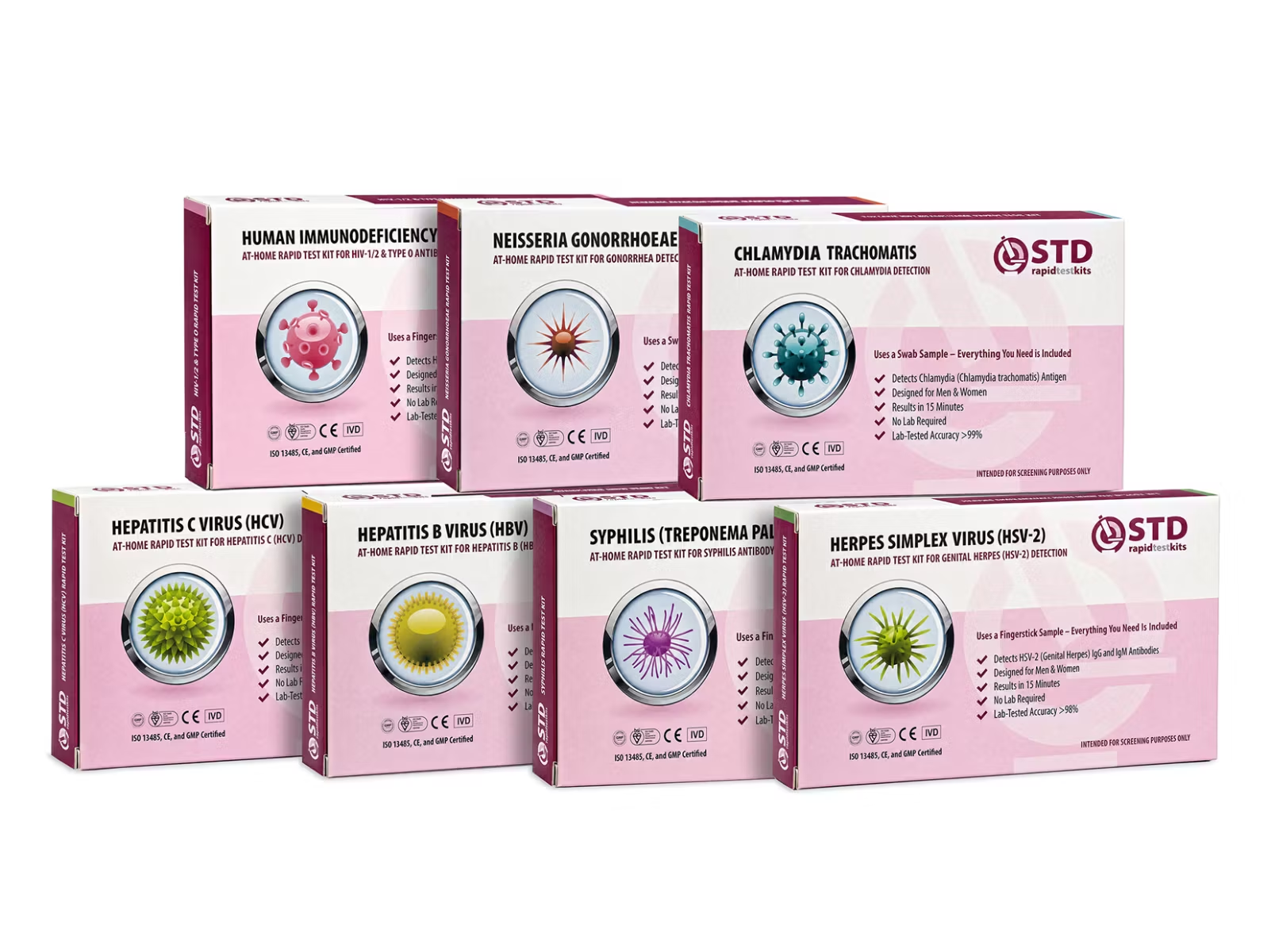
Home testing has changed how non-monogamous networks coordinate sexual-health care. Clinic-based testing still has its place, especially for confirming a positive home result and for infections that need a clinician-collected sample (pharyngeal or rectal swabs, for example, which we do not sell as home kits). For routine screening between partners, though, a home kit removes most of the friction that keeps people from testing on time. You can compare at-home STI test kits by the infections each one covers.
Quality varies between kits. Rapid lateral-flow tests, the kind that give a result in 15 to 20 minutes from a fingerstick or self-swab, are the technology behind most at-home STI panels sold direct to consumers. They use antibody or antigen detection chemistry similar to lab platforms, but with lower analytical sensitivity than lab NAATs for some pathogens. A positive home result is worth confirming at a clinic when possible, especially for HIV. A negative result taken close to a known exposure is worth repeating once the relevant window period closes.
The practical upside for poly networks is coordination: a panel arrives at home, everyone in the loop tests on an agreed day, and results come back fast enough to inform the next decision about barrier use or new partners.
Talking About Testing Without Killing the Mood
Bringing up STI testing before sex can feel like a record-scratch on intimacy, especially the first time. In practice the conversation lands better when it is framed as care rather than interrogation. "What's your testing rhythm look like?" reads very differently from "have you been tested?" The first invites mutual sharing; the second asks the other person to defend a private fact under pressure. Planned Parenthood frames safer sex the same way: condoms, open conversation with your partner, and regular testing are the three habits that make it work (Planned Parenthood).
In a polycule, where trust is spread across more than two people, this kind of conversation is not optional. Plenty of networks reframe results-sharing as part of intimacy rather than a hurdle, and the ones that treat it as normal partner communication report fewer surprises and faster responses when something does come back positive.
- Share your own rhythm first, before asking about theirs.
- Offer recent results plainly, without making it a performance.
- Treat the conversation as a normal part of any new sexual connection.
- Have it before clothes come off, when both people are clear-headed and there's no momentum cost to pausing.
When You're Waiting on a Result
The wait between test and result is its own small psychological event. Every itch becomes suspicious; every timeline gets retraced. In a network where other people are also waiting on coordinated panels, that anxiety can compound.
A few things tend to help. Most common STIs are treatable, and a positive test is the beginning of a treatable health event rather than the end of anything. Talking to a trusted partner or meta (a partner's other partner) during the wait reduces the sense of isolation that makes the anxiety worse. Reading up on the specific infection you're worried about often shrinks the worst-case scenario down to its real size; a fair share of the fears that drive a spiral come from outdated information.
If you tested very close to an exposure and got a negative result, plan the follow-up test now while you're thinking about it. Window-period blind spots are the most common reason someone tests negative and turns positive a few weeks later.
For an HIV antibody-only home test, retest at 90 days from exposure. For an antigen/antibody lab test, retest at 45 days. For an HSV IgG blood test, retest at 16 weeks. Putting the date on a calendar removes the question of whether to bother later.
Stigma, Shame, and Living Poly With an STI
Much of the fear around non-monogamy and STIs is really fear of judgment. An STI is an infection, not a verdict on your character or your relationship style. Most are curable with a short course of treatment, and the ones that are not are managed with medication that lets people live full, connected lives.
That includes staying polyamorous. People manage herpes, HIV, and HPV responsibly across multiple relationships every day. The work is the same as it is for anyone: disclosure before any risk applies, treatment or viral suppression where it exists, and clear agreements about barriers and timing. With HIV, an undetectable viral load means the virus is not transmitted through sex at all, which changes what a diagnosis means for a sexual network.
Networks that talk openly about results tend to catch infections earlier, while silence and shame are what let them spread unnoticed. When a status check is treated as ordinary rather than a confession, a positive result becomes a manageable health event instead of a crisis.
- Name it as an infection, not a character flaw: most are curable, and the rest are manageable with daily medication.
- Lead with what you are doing about it (treatment, suppression, barriers) rather than how it happened.
- For HIV, explain U=U plainly: an undetectable viral load means the virus is not passed through sex.
Make Testing Part of the Routine
Open relationships and polyamory don't increase STI risk on their own. Patterns do: condom consistency, testing frequency, and how quickly partners share what's changed. When those patterns are explicit and shared, a network of five people can have a lower transmission rate than a closed pair where one partner has untested encounters.
If you're new to non-monogamy or revisiting your polycule's agreements, the most useful next step is concrete. Pick a baseline interval. Decide what triggers an off-cycle test. Write the agreement somewhere everyone can see it.
What's Your Next Testing Step?
Has a new partner joined your network, or has anyone changed barrier use, since the last round of tests?
Yes: Test now, before any new fluid contact, and reset the network's testing clock from this date.
Did your most recent test fall within about a week of a new exposure?
Yes: Schedule a follow-up once the relevant window period closes: 45 days for an antigen/antibody HIV lab test, 90 days for a rapid antibody test, and 16 weeks for an HSV IgG blood test.
No: Pick a baseline interval (every one to three months is the common range for active networks), decide what triggers an off-cycle test, and write the agreement somewhere everyone in the network can see it.
Guidance only. A healthcare provider can advise based on your specific situation.
FAQs
- Does being polyamorous automatically mean higher STI risk?
- Partner count is a weak predictor on its own. Condom consistency, testing frequency, and how fast partners disclose new contacts are stronger ones. A six-person network on a shared six-week testing rhythm has different math than a closed pair where one partner has untested side encounters.
- How often should I test if I have multiple partners?
- Every three months is the working default for active networks with new partners coming and going. Always test before changing barrier use with a current partner or fluid-bonding with a new one; that single trigger catches more in-network transmissions than any fixed schedule alone. One caveat: if you test within a week of a new exposure, schedule a follow-up once the relevant window period closes, because testing too early can miss the infection.
- Can I have an STI with no symptoms?
- Yes. CDC reports trichomoniasis is asymptomatic in roughly 70 percent of people with the infection; chlamydia, HPV, and herpes can also be silent for long periods. Test on a schedule rather than waiting for a sign.
- What if a partner doesn't want to get tested?
- Refusing testing while remaining sexually active across a network is a meaningful signal about how someone thinks about shared health. Try framing it as care rather than accusation: ask about their previous testing experience, share your own pattern first, and offer to coordinate a panel together. If they still won't engage, you get to decide whether that fits the level of intimacy you're moving toward.
- Do condoms protect against everything?
- Skin-to-skin infections like herpes and HPV can spread from areas the condom doesn't cover, so the answer is no. That said, condoms remain the strongest single prevention tool for chlamydia, gonorrhea, HIV, and trichomoniasis when used consistently and correctly. PrEP adds a separate layer of HIV-specific protection for people with ongoing exposure risk.
- What does fluid bonding mean?
- It's the decision to stop using barriers with one or more partners. Before doing it, exchange recent negative panels, agree on a retesting interval, and disclose other current partners. In a polycule, that conversation expands to everyone whose risk profile shifts as a result.
- Someone in our polycule tested positive. What happens next?
- Notify every partner who had unprotected contact with the positive person within that infection's window period. A workable message reads: 'I tested positive for [infection] on [date]; anyone with unprotected contact after [exposure date] should test.' Most STIs covered in this article (chlamydia, gonorrhea, syphilis, trichomoniasis) are curable with one antibiotic course; herpes and HIV are manageable with effective long-term treatment. Acting fast on notification matters more than figuring out who passed what.
- Can I still be polyamorous if I already have an STI like herpes or HIV?
- Yes. The logistics are the same as for any poly person: disclose before any risk applies, use viral suppression where it exists (for HIV, an undetectable viral load means no transmission through sex), and put barrier and timing agreements in writing. A diagnosis narrows some choices; it does not remove the option to have multiple partners.
- Are at-home STI tests accurate?
- Only a result taken after the relevant window period has closed is reliable as a screen, so the timing question matters first. With that caveat, rapid lateral-flow chemistry is useful for screening, but a positive at-home result for any infection (HIV especially) should be followed up with a clinic test before treatment decisions are made.
How We Sourced This Article: We built this guide from current public-health guidance (CDC, WHO, NHS, NIH MedlinePlus, and Planned Parenthood) on STI transmission, asymptomatic infection rates, testing window periods, and condom effectiveness, then translated it into plain language for readers navigating open and polyamorous relationships. We do not provide individual clinical diagnosis. For symptoms that concern you or a positive result that needs confirmatory testing, see a licensed provider.
- U.S. Centers for Disease Control and Prevention. Overview of sexually transmitted infections, transmission, and prevention; notes that many STIs cause no symptoms.
- U.S. Centers for Disease Control and Prevention. HIV testing guidance: antigen/antibody (18 to 45 days), rapid antibody (23 to 90 days), and NAT (10 to 33 days) window periods.
- U.S. Centers for Disease Control and Prevention. Trichomoniasis overview, including that about 70 percent of people with the infection have no symptoms.
- World Health Organization. Sexually transmitted infections fact sheet: more than 1 million STIs acquired daily worldwide in people 15 to 49, the majority asymptomatic.
- UK National Health Service. Sexually transmitted infections overview: many STIs have no symptoms, so testing is the only way to know your status.
- U.S. National Library of Medicine, MedlinePlus (NIH). Sexually transmitted infections: correct condom use greatly reduces, but does not eliminate, the risk of STIs.
