Open Relationships and STIs: Risk, Testing, and Protection
Open networks raise the structural chance of STI transmission, and they also tend to produce better testing, condom use, and disclosure habits than undisclosed cheating. Here is an honest look at where each effect comes from and the cadence that keeps both halves working in your favor.




- Open-relationship networks raise structural exposure risk, and standard yearly screening misses too much when partner counts rise. Most clinicians suggest every 3 to 6 months for sexually active non-monogamous adults.
- A typical clinic STI panel covers chlamydia, gonorrhea, syphilis, and HIV. Herpes, HPV, and oral or rectal swabs are not included unless you ask. Knowing what your panel actually covers matters more than how often you take it.
Published: September 2025 | Last updated: May 2026 | Editorial review and quality control: Martina N.
The short answer is yes, with caveats. A monogamous couple exchanges biology with one person; a polycule of five connects with everyone those five connect with, and so on down the chain.
CDC reporting logged over 2.4 million combined chlamydia, gonorrhea, and syphilis cases in 2023 (CDC STI Surveillance), and research on consensual non-monogamy consistently finds a counterweight: openly negotiated agreements produce higher testing rates, more consistent condom use, and faster disclosure than undisclosed cheating. Open relationships expand the surface area for STI transmission, and the same communities have built habits that, applied consistently, shrink it back.
What the Latest STI Surveillance Numbers Show
The CDC's most recent STI Surveillance Report documented more than 2.4 million combined cases of chlamydia, gonorrhea, and syphilis in 2023. Syphilis cases nearly doubled in the United States between 2018 and 2022, with the steepest rises in adults aged 25 to 39, and congenital syphilis followed the same upward curve.
Those numbers describe the overall population, not just non-monogamous people. The relevant question for someone in an open relationship is how individual exposure stacks up. Prevalence does not have to change for personal exposure risk to rise. If chlamydia is present in roughly 1 in 20 sexually active adults in your age band per CDC modeling, a network of one partner offers one structural chance of exposure per encounter; a network of four partners offers four times the structural chance, before condom use and testing cadence enter the calculation.
What the surveillance data does not show is how a network's testing rhythm reshapes that picture. A four-partner network where everyone tests quarterly catches infections inside the window between exposure and onward transmission far more reliably than a monogamous pair who tested at the start and never tested again.
Numbers worth knowing
- Combined US chlamydia, gonorrhea, and syphilis cases: over 2.4 million in 2023.
- Syphilis cases nearly doubled in the United States between 2018 and 2022.
- The steepest increases were in adults aged 25 to 39, with congenital syphilis following the same upward curve.
Why Open Relationships Change the Risk Math
Each additional partner adds not just their own potential exposures, but everyone they are sexually connected to. Contact-tracing data published by state health departments consistently shows that an index case of gonorrhea or syphilis identifies on average between one and two additional exposed partners per traced case, and those secondary contacts often have their own connections in the same window.
Window-period overlap stacks on top. Most STIs have a delay between infection and when a test can detect them. Chlamydia and gonorrhea typically need 1 to 2 weeks. Lab-based fourth-generation HIV antibody/antigen tests detect most infections by 18 to 45 days (CDC HIV Testing). HSV-2 antibodies can take several weeks to months to develop fully, with seroconversion times varying by person and assay. In a network where partners change every few weeks, those windows overlap.
Information lag matters too. If one person in a polycule tests positive, every partner and many of their other partners has to be notified, and some of those people have already had downstream contacts. Speed of disclosure matters more in a network than in a closed pair, because the same delay costs more.
None of this makes non-monogamy reckless. The standard yearly-screening default that works fine for one stable partner simply does not match the exposure profile of a network of four or five.
Studies published in Archives of Sexual Behavior and the Journal of Sex Research have repeatedly found that people in consensually non-monogamous relationships are no more likely, and often less likely, to acquire an STI than monogamous people who have sex outside the primary relationship without disclosure. The protective factor is not the relationship structure itself. It is the disclosure norm. Openly negotiated agreements correlate with higher rates of testing, condom use with outside partners, and timely disclosure of positive results.
How Often Should People in Open Relationships Actually Test?
The CDC's STI Treatment Guidelines screening recommendations are built around a stable monogamous baseline plus modifiers for people with multiple partners. For sexually active adults reporting more than one partner in the past year, the CDC suggests at least annual screening for chlamydia, gonorrhea, syphilis, and HIV, with more frequent screening for people in higher-exposure networks. The phrase "more frequent" is not defined precisely in the guidance, which leaves the practical question open.
Clinicians working with non-monogamous patients tend to converge on the following intervals as a workable default. These are not regulatory cutoffs. They are pragmatic windows chosen to catch infections before onward transmission.
| Scenario | Suggested cadence | What it catches |
|---|---|---|
| Closed pair, both tested at start, no new outside contact | Annually | Asymptomatic chlamydia or gonorrhea slipping past at baseline |
| Open relationship, stable partners, no new outside contact | Every 6 months | Infections from any inadvertent network exposure |
| Open network, adding new partners regularly | Every 3 months | Tightens window before onward transmission |
| After a condom break or known exposure | Day 14 plus day 90 | Day 14 covers chlamydia and gonorrhea; day 90 covers HIV seroconversion and the typical HSV-2 antibody window |
What a Standard STI Panel Often Misses
A typical clinic STI panel includes chlamydia, gonorrhea, syphilis, and HIV. It does not usually include the following without an explicit request.
Herpes (HSV-1 and HSV-2). Standard panels skip herpes serology by default. The CDC recommends against routine HSV-2 screening in asymptomatic adults at the population level because specificity concerns at low prevalence can produce more false positives than true catches (CDC About Genital Herpes). For someone inside a higher-prevalence multi-partner network, an explicit conversation with the provider about screening is worthwhile. Most commercial rapid blood tests target HSV-2 antibody, not HSV-1.
HPV. Routine HPV testing in adults assigned female at birth is part of cervical cancer screening (Pap plus co-testing every 5 years from age 30 to 65), not part of a general STI panel. For partners with penile anatomy, no clinically validated HPV screening test exists outside of biopsy of visible lesions. The protective intervention is vaccination, routinely recommended through age 26 and available with shared clinical decision-making through age 45 (CDC HPV).
Trichomoniasis in male partners. Trich is routinely tested from vaginal samples, but no validated screening test exists for asymptomatic male carriers in most clinics. Our at-home trichomoniasis swab kit is validated for vaginal self-swab only; partners with penile anatomy needing a test should see a clinic.
Throat and rectal swabs. If you have receptive oral or anal sex, a urine sample or genital swab will not catch chlamydia or gonorrhea at those sites. Pharyngeal and rectal swabs are clinically available but require asking. Most clinics default to genital sampling only. We do not sell pharyngeal or rectal swab kits, so for that specific coverage a clinic visit is the right path.

Communication Patterns That Hold Up Under Pressure
The open-relationship participants with the lowest STI rates share a common set of habits. The protective effect comes from boring, repeated execution, not dramatic one-time actions.
1. Pre-contact disclosure as the default. Before sexual contact with a new partner, both people state when they last tested, what the panel included, and whether any current symptoms are present. Treating this exchange as routine rather than special reduces the awkwardness curve over time and removes most of the in-the-moment friction.
2. Explicit fluid-bonding agreements. Some networks designate one set of partners as fluid-bonded (no internal condoms) and use barriers with everyone outside that ring. The clarity of who is and is not inside the ring, plus a defined re-test trigger when someone new is added, is what makes the structure protective rather than aspirational.
3. Shared testing calendars. A spreadsheet, a Signal thread, or a shared calendar reminder set quarterly across the network. The point is friction reduction. When the prompt arrives, the test happens.
4. No-blame disclosure protocols. A positive test result triggers notification of all current and recent partners, with the framing that the test caught the infection before more transmission occurred. Treating disclosure as a protective contribution to the network, rather than a moral failure, is what keeps people willing to test in the first place.
The pattern across two decades of research on consensual non-monogamy is consistent. Networks that follow these habits do as well or better than monogamous comparison groups on STI outcomes. Networks that drift away from them converge quickly on background population rates.
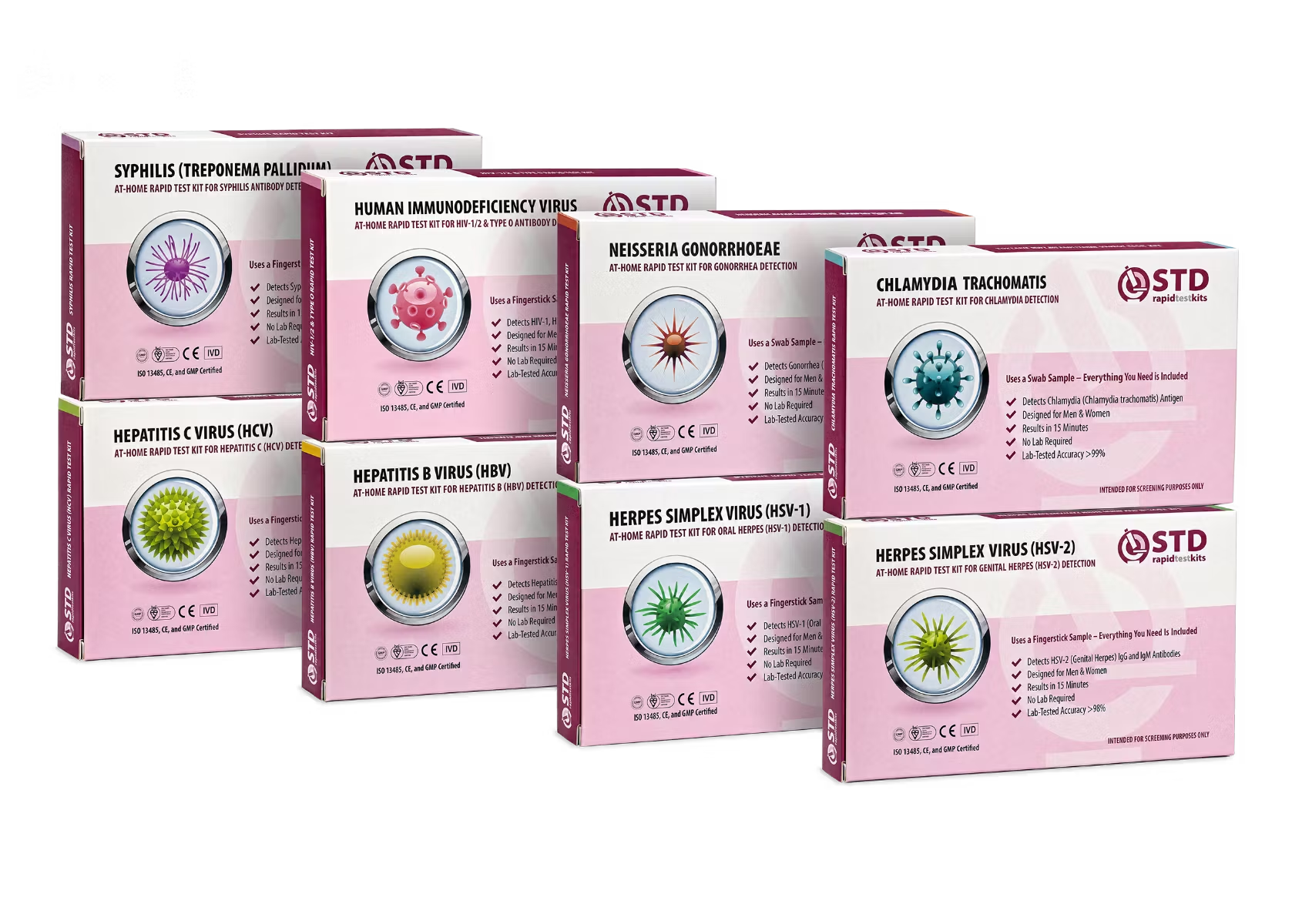
Many STDs don't cause any symptoms, so a person can have an STD and not know it. The only way to know for sure if you have an STD is to get tested.
Common Myths Worth Setting Straight
Myth: People in open relationships are reckless. The research record is the opposite for participants who follow disclosed-agreement frameworks. The STI risk profile of consensual non-monogamy with active testing looks closer to a stable monogamous couple than to an uninformed multi-partner exposure pattern.
Myth: Condoms eliminate STI risk. Condoms are highly effective against fluid-borne pathogens like HIV and meaningfully reduce transmission of chlamydia and gonorrhea. They will not protect against skin-to-skin infections like herpes and syphilis, because viral shedding and lesions can occur on uncovered skin (CDC Condom Effectiveness).
Myth: No symptoms means no infection. The CDC's chlamydia treatment guidelines note that asymptomatic infection is common among both men and women (CDC Chlamydia Treatment Guidelines). HSV-2 sheds virus for days at a time without visible sores. HPV is usually clinically silent. Symptoms are a late and unreliable signal.
Myth: Annual testing is sufficient for everyone. Annual screening is the CDC's baseline for stable monogamous adults reporting low risk. It does not match the exposure profile of someone with multiple concurrent partners.
Myth: Herpes is included in standard panels. It is not, unless you specifically request HSV serology and your provider agrees. The default panel covers chlamydia, gonorrhea, syphilis, and HIV.
Symptoms are a late and unreliable signal. Most STIs can be carried and transmitted without ever causing visible signs, which is why testing on a defined cadence matters more than waiting to feel sick.
FAQs
- Can you get an STI even if everyone in your polycule recently tested negative?
- Yes. Most STI tests have window periods between exposure and when the infection becomes detectable. Chlamydia and gonorrhea need about 1 to 2 weeks. Lab-based fourth-generation HIV antibody/antigen tests detect most infections by 18 to 45 days per the CDC HIV Testing page (https://www.cdc.gov/hiv/testing/). HSV-2 antibodies can take several weeks to months to develop fully, with seroconversion times varying by person and assay. Anyone exposed inside the relevant window can carry an infection and still test negative until that window closes.
- How often should non-monogamous people test?
- For stable open partnerships with no new outside contacts, every 6 months. For networks adding new partners or having frequent outside contact, every 3 months. After a known exposure, test at day 14 and again at day 90 to cover both bacterial and viral antibody windows. These intervals reflect the CDC's screening guidance for sexually active adults with multiple partners.
- Are at-home rapid STI tests accurate enough for use in an open relationship?
- At-home rapid lateral-flow tests are screening tools, not lab-grade diagnostics. Lab-based nucleic acid amplification tests (NAATs) remain the highest-sensitivity option, especially for very recent exposure. At-home rapid kits are well suited for frequent network-level screening; check the product page for the kit-specific sensitivity and specificity figures, and confirm any positive result or very recent exposure with a clinic visit.
- Do I need to use condoms with every partner in an open relationship?
- Not necessarily. Many networks designate a fluid-bonded inner group who do not use condoms internally, and use barriers with everyone outside that group. What matters is that the rules are explicit, agreed in advance, and accompanied by an agreed re-testing schedule whenever someone new is added.
- Can herpes spread when there are no visible sores?
- Yes. Asymptomatic viral shedding accounts for a substantial share of HSV-2 transmission and most HSV-1 genital transmission per CDC data. Suppressive antiviral therapy and consistent condom use both reduce, but do not eliminate, this transmission route.
- What if a partner refuses to test?
- Treat it as an open boundary conversation, not a moral judgment. Many people put off testing because of stigma, cost, or anxiety, not because of indifference. If a partner remains unwilling to test after that conversation, the refusal is itself information about whether the connection is the right fit for an open-network agreement.
- Should I disclose a cured STI to a new partner?
- For curable bacterial infections (chlamydia, gonorrhea, syphilis, trichomoniasis) that were treated and confirmed clear with a follow-up test, ongoing disclosure is not medically required. For viral STIs the body does not clear (genital herpes, some HPV strains, HIV managed with antiretrovirals), disclosure remains relevant for shared decision-making about protection.
- I tested positive. What is the right next step inside an open network?
- Treat it for curable infections, or start clinical management for chronic ones, then notify recent partners as quickly as possible so they can test inside their own window periods. State partner-notification programs can help anonymously if direct disclosure is difficult. Most jurisdictions provide free contact-tracing support through their STI clinic.
- U.S. Centers for Disease Control and Prevention. STI Surveillance: combined chlamydia, gonorrhea, and syphilis case totals, syphilis trend 2018 to 2022, and age-band breakdown.
- U.S. Centers for Disease Control and Prevention. STI Treatment Guidelines, Chlamydia: asymptomatic infection is common in both men and women, supporting the importance of routine screening.
- U.S. Centers for Disease Control and Prevention. About Genital Herpes: HSV-1 and HSV-2 transmission, viral shedding, and the rationale against routine asymptomatic screening at the population level.
- U.S. Centers for Disease Control and Prevention. HIV Testing: window periods for lab-based fourth-generation antigen/antibody tests (18 to 45 days) and nucleic acid tests.
- U.S. Centers for Disease Control and Prevention. HPV: vaccination guidance routine through age 26 and shared clinical decision-making through age 45.
- U.S. Centers for Disease Control and Prevention. Condom Effectiveness: efficacy against fluid-borne pathogens versus skin-to-skin infections.