
Published: November 2025 | Last updated: May 2026 | Editorial review and quality control: Martina N.
Discharge changes are one of the most commonly missed early signs of a sexually transmitted infection (STI) in women. The shift is often subtle: a slight tinge of yellow, a faint odor that wasn't there last week, a thicker or thinner texture than usual. Many people dismiss the change as a cycle quirk, a new laundry detergent, or stress. Sometimes that read is correct. Sometimes it isn't.
This guide walks through which discharge patterns commonly line up with which infections, when to test, what at-home rapid tests can and cannot tell you, and which discharge changes are usually not an STI at all. The goal is enough specificity that you can decide whether the change in your body deserves a screening test, a conversation with a clinician, or simply a calmer interpretation.
It is written for anyone with a vagina who has noticed something off and is trying to figure out what it means without spiraling into worst-case search results. It is not a replacement for clinical care, particularly when symptoms are severe (heavy bleeding, fever, sharp pelvic pain).
Key Takeaways
- If discharge changes after a new partner, a condom slip, or unprotected oral or vaginal sex, screening at 7 to 14 days post-exposure catches the most common bacterial STIs (chlamydia, gonorrhea, trichomoniasis).
- Color, smell, and consistency are the strongest discharge clues, but yeast, bacterial vaginosis, and hormonal shifts can mimic STI patterns. Testing is the only reliable way to tell them apart.
Why discharge changes get overlooked
Many people associate sexually transmitted infections with sores, pain, or burning. The reality is quieter. Discharge changes are often the only visible sign, and the change can be small enough to chalk up to ovulation, hormonal birth control, or a new partner's body chemistry. The CDC's overview of chlamydia notes that most chlamydia infections in women cause no symptoms at all (CDC: About Chlamydia), and gonorrhea in women is similarly often silent (CDC: About Gonorrhea). When symptoms do appear, abnormal discharge is one of the most common first clues.
The dismissal pattern is predictable. A small color shift gets blamed on diet. A faint odor gets blamed on a new gym. By the time pelvic pain or spotting joins the picture, the infection has had two or three weeks to progress. Acting earlier, when the only sign is a discharge change, is usually what separates a single-dose antibiotic course from a more involved follow-up such as a workup for pelvic inflammatory disease.
There is also a quieter cost to dismissing the change: each week without a diagnosis is a week the infection can pass to a partner. The asymptomatic majority is part of why community transmission stays high. People who feel fine do not test, and people whose symptoms read as "probably hormonal" do not test either. Treating discharge changes as a signal worth checking, not a signal to ignore, breaks that loop.
Untreated chlamydia or gonorrhea can ascend from the cervix into the upper reproductive tract and cause pelvic inflammatory disease (PID). According to the CDC, in a small proportion of women PID leads to scarring of the fallopian tubes, which can affect future fertility and increase the risk of ectopic pregnancy. The window of dismissed discharge is often the window where treatment would have prevented this progression entirely. Screening when the only sign is a discharge change usually means a single-dose antibiotic course rather than a PID workup later.
Healthy discharge vs STI signals: what to look for
Healthy discharge is not a single thing. It can range from clear and slippery (mid-cycle, around ovulation) to milky and creamy (luteal phase, on certain birth control) to thicker around menstruation. Hydration, stress, sexual arousal, and even underwear fabric can shift the picture slightly. The challenge with STI-related discharge is that infection often amplifies what is already happening, rather than producing a wildly novel appearance.
That said, there are recognizable patterns. Yellow-green pus-like discharge, a frothy texture, a strong fishy or foul odor, and discharge that arrives with spotting or pelvic pain all warrant a closer look. The table below maps the most common presentations clinicians see, drawn from CDC fact sheets and the NIH/NCBI vaginal discharge syndrome reference. Use it as a cross-check, not a diagnosis.
| Appearance | Common cause | Other signs to watch for |
|---|---|---|
| Clear or white, slippery, egg-white texture | Normal mid-cycle (ovulation) | No odor, no itching, no pain |
| Thick white, clumpy, like cottage cheese | Yeast infection (candidiasis) | Itching, redness, soreness, no strong odor |
| Thin gray or off-white, fishy odor | Bacterial vaginosis (BV) | Odor often stronger after sex, mild irritation |
| Yellow or green, pus-like, foul smell | Gonorrhea or chlamydia | May include spotting, pelvic pain, burning when urinating |
| Frothy yellow-green, bad smell | Trichomoniasis | Itching, soreness, pain during sex |
| Brown or blood-tinged, outside your period window | Hormonal shifts, cervicitis, sometimes STIs | If it persists after sex, consider STI testing |
When does STI discharge actually start?
Different infections have different incubation periods, the gap between exposure and detectable symptoms or test positivity. This is why testing too early can produce a false-negative even when an infection is present, and why "I tested negative two days after sex" is not the reassurance it might feel like.
Rough timelines, drawn from CDC fact sheets and the NIH/NCBI vaginal discharge syndrome chapter:
- Gonorrhea: Discharge changes can appear in as few as 5 to 7 days after exposure, sometimes faster. Most infections in women still stay asymptomatic, which is why annual screening is recommended even without symptoms (CDC: About Gonorrhea).
- Chlamydia: Discharge changes typically begin 7 to 14 days after exposure, sometimes later. Like gonorrhea, the majority of infections in women produce no symptoms at all.
- Trichomoniasis (CDC trichomoniasis page): Symptoms can appear anywhere from 5 to 28 days post-exposure. The classic presentation is frothy yellow-green discharge with a strong odor, but milder presentations are common.
- Genital herpes: Does not directly cause discharge in most cases. Sores or vesicles are the primary sign. Discharge can appear if a sore becomes secondarily infected.
- Syphilis: Early-stage syphilis rarely shows discharge. The initial sign is a painless ulcer (chancre), often missed because it doesn't hurt.
- HPV: Does not produce discharge. Genital warts are the visible sign of low-risk strains; high-risk strains are silent and detected through cervical screening.
- BV and yeast: Not STIs, but often triggered by new sexual activity, antibiotics, or pH changes. Symptoms can start within days of the trigger and respond to different treatments than bacterial STIs.
The practical implication: if you noticed discharge changes within 48 hours of sex, it's more likely irritation, BV, or yeast than a bacterial STI. If the changes started 5 days or more after a risk event and persist, an STI is on the table.
For at-home rapid swab tests covering chlamydia, gonorrhea, and trichomoniasis, screening at 7 to 14 days post-exposure catches most cases. Testing earlier than day 5 may produce a false-negative even when an infection is present.
When discharge isn't an STI: BV, yeast, hormones, irritation
If you test negative and discharge is still off, the next layer of explanations is usually bacterial vaginosis, a yeast infection, hormonal change, or local irritation. None of these are STIs in the technical sense, but several can be triggered by sex (semen shifts vaginal pH, new partners introduce different microbiomes) and several mimic STI symptoms closely enough to confuse self-diagnosis.
Bacterial vaginosis (CDC overview) typically produces a thin gray discharge with a fishy odor. Yeast infections (CDC vulvovaginal candidiasis guidance) usually bring thick white discharge with itching but no strong odor. Hormonal shifts from contraception, perimenopause, or early pregnancy can change discharge volume and texture without any infection at all.
| Cause | Discharge traits | Common triggers | Mimics STI? |
|---|---|---|---|
| Bacterial vaginosis | Thin, gray-white, fishy odor | pH change, new partner, douching, semen | Yes, odor overlaps with trichomoniasis |
| Yeast infection | Thick, white, no strong odor, itchy | Antibiotics, tight clothing, hormonal shifts, sex | Yes, itching can feel STI-like |
| Early pregnancy | Increased white or milky discharge | Hormonal surge | Sometimes, volume change can alarm |
| Hormonal fluctuations | Variable: clear, sticky, or creamy | Cycle, contraception, perimenopause | Not usually, but can shift markedly |
| Cervical irritation | Spotting or pinkish discharge | Rough sex, IUD insertion, recent pelvic exam | Yes, bleeding can mimic cervicitis |
When to test if discharge is your only symptom
The decision tree is simpler than most people think. The two variables that matter are timing and risk. Timing means how long ago the potential exposure happened. Risk means whether you have a specific reason to suspect exposure (a new partner, condom failure, a partner's positive result, unprotected oral or vaginal sex).
If it's been less than 5 days since a possible exposure, most rapid tests cannot reliably detect an early infection yet. Even if discharge has already started, screening too early can miss the infection. The exception is when symptoms are severe (heavy bleeding, sharp pelvic pain, fever); in that case, a clinic visit is more appropriate than a self-test.
Practical decision logic:
- Discharge change plus known risk event = test at 7 to 14 days post-exposure.
- Discharge change with no known exposure = if symptoms last more than 3 to 4 days or worsen, test for the common bacterial STIs and consider BV or yeast as alternative explanations.
- No symptoms but anxiety after a risk event = testing for peace of mind is reasonable, just wait until day 7 or later for a meaningful result.
For transparency: this site sells the at-home rapid STI tests referenced below. Recommendations here are based on which test fits the reader's specific concern, not on commercial benefit.
Should I test now or wait?
If discharge changed less than 5 days after a possible exposure, wait until day 7 to 14 to test. Earlier results are unreliable. If discharge changed more than a week after the exposure event, test now. Severe symptoms (heavy bleeding, fever, sharp pelvic pain) warrant a clinic visit, not a home test.
What at-home rapid tests can and cannot tell you
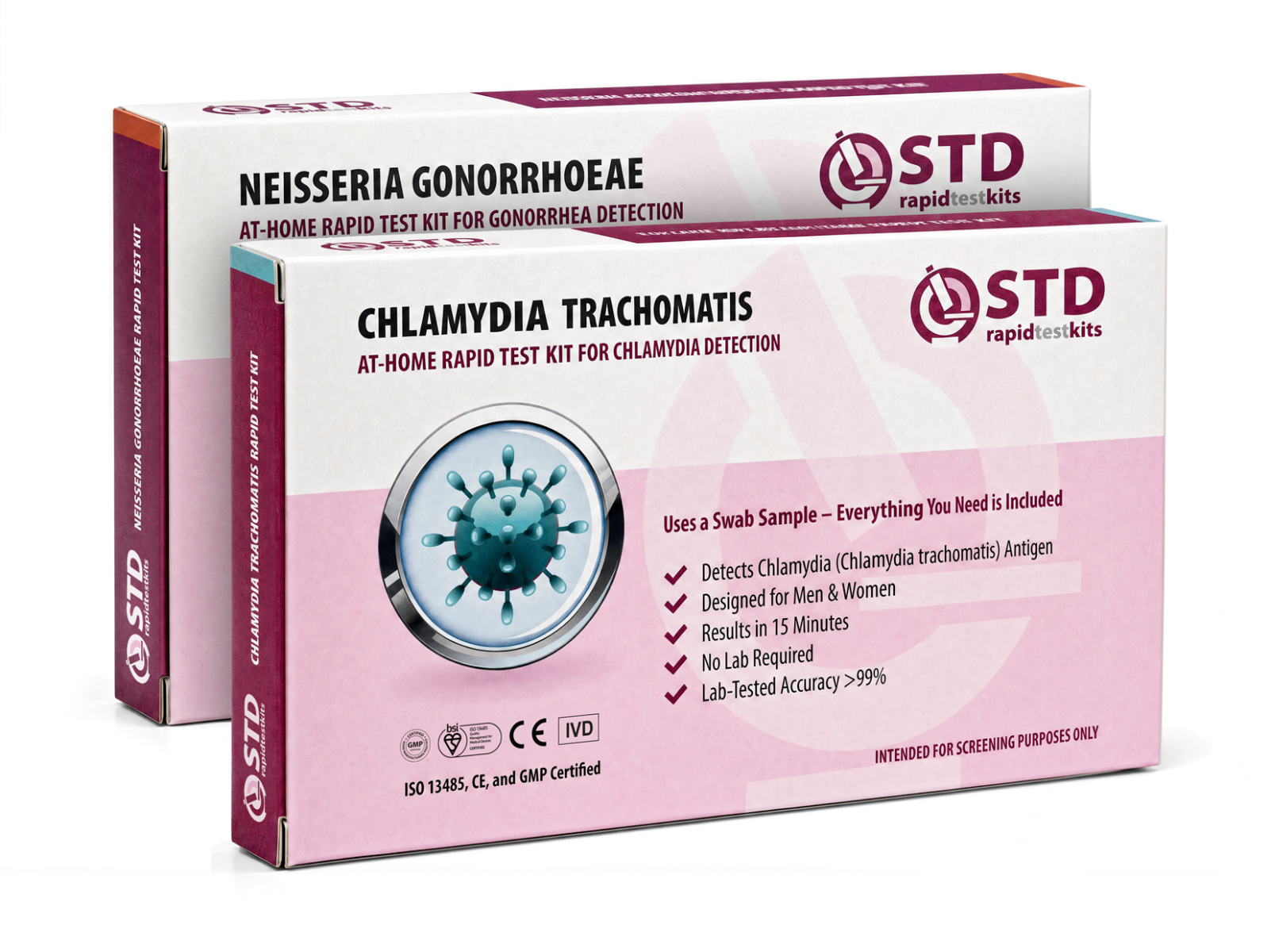
Our at-home rapid tests use lateral-flow chemistry, the same general technology as a home pregnancy test or a rapid COVID test. They are different from laboratory NAAT (nucleic acid amplification) testing, which is the standard for clinic confirmation. Both have their place. The home rapid test gives a quick screening answer in your bathroom, in about 15 minutes, with no clinic appointment. A laboratory NAAT runs at higher analytical sensitivity but takes a few days, requires sample shipment or a clinic visit, and costs more.
What this means in practice:
- A positive home rapid test is meaningful. It should prompt treatment from a clinician (often single-dose antibiotics for chlamydia or trichomoniasis) and a confirmatory clinic NAAT for gonorrhea before treatment, since gonorrhea has antimicrobial resistance considerations that affect drug choice.
- A negative home rapid test is useful but not absolute, especially if you tested early in the window or the sample wasn't optimal. If symptoms persist after a negative home test, a clinic visit for confirmatory NAAT is the next step rather than retesting at home.
- Home rapid tests are designed for screening, not for ruling out infection in someone with severe symptoms. Heavy bleeding, fever, or sharp pelvic pain warrant a clinic visit regardless of test result.
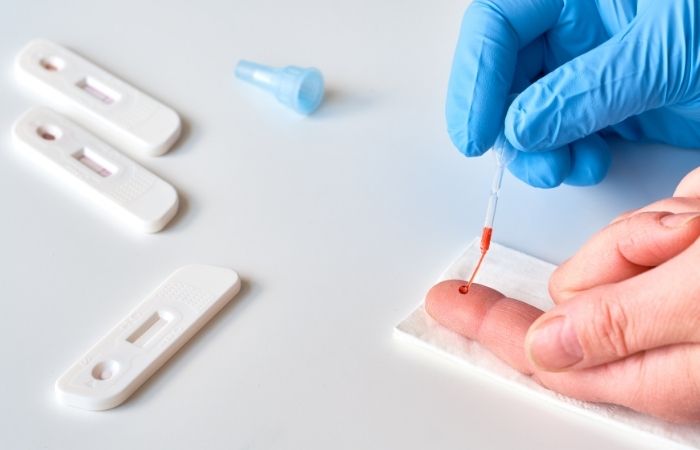
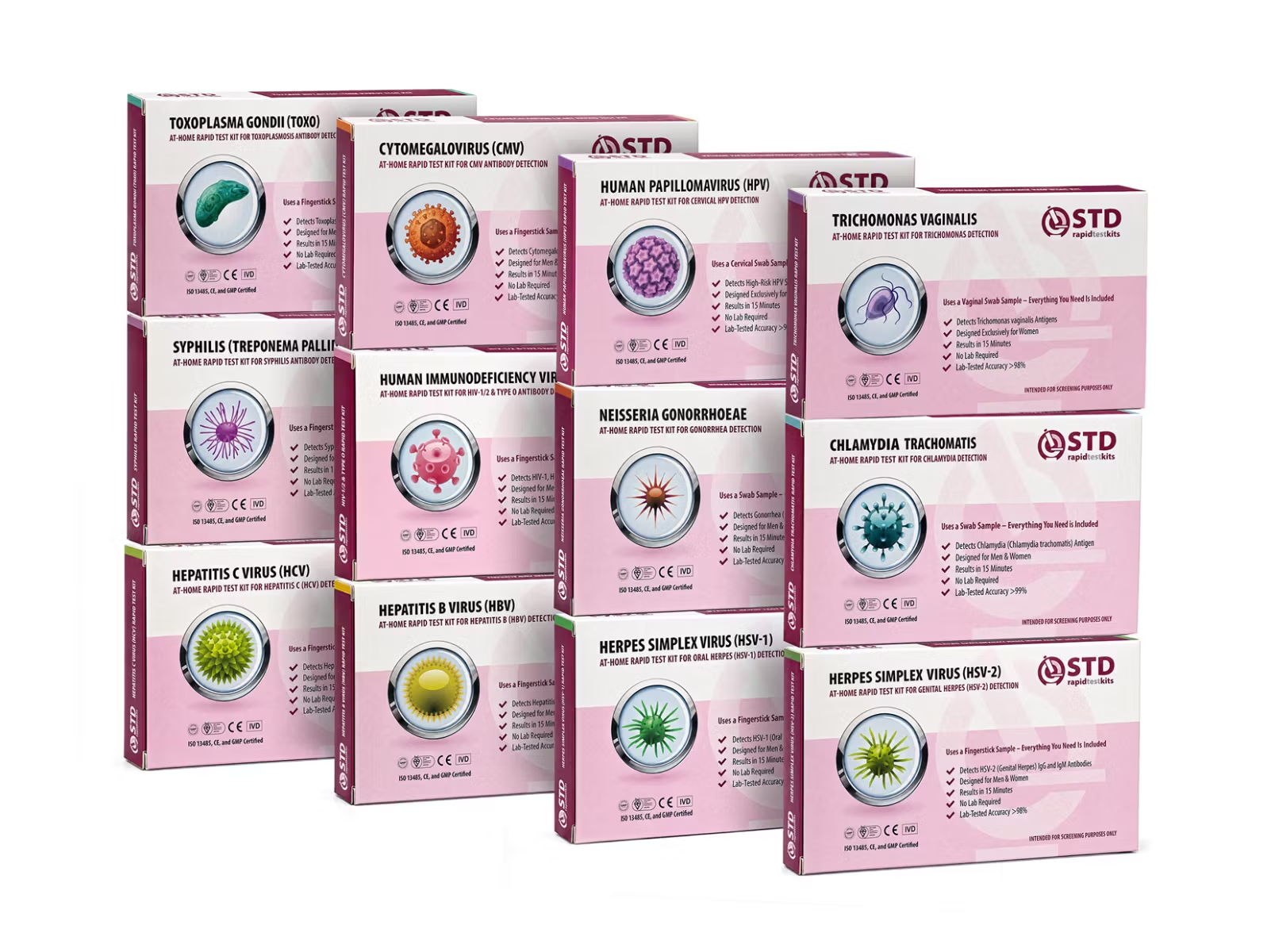
Sample type also matters. The discharge-causing infections covered in this article (chlamydia, gonorrhea, trichomoniasis) are screened with a self-collected vaginal swab. Other infections worth considering after a risk event, such as HIV, syphilis, hepatitis B, hepatitis C, and HSV-2 antibodies, are screened with a fingerstick blood draw instead. Combination kits like the women's 10-in-1 panel include both swab and blood components in a single box for that reason. The image below shows the fingerstick step from one of those blood-draw components.
Retesting after treatment
Treatment is rarely the end of the story. Two issues recur often enough to plan around. The first is reinfection: if a partner wasn't treated at the same time, sex after your own treatment can put you right back at the start. The second is test-of-cure timing: testing too soon after treatment can yield a false-positive because residual bacterial DNA or proteins can linger in the body for a few weeks.
CDC retesting guidance:
- Chlamydia and gonorrhea: Retest at about 3 months after treatment to catch reinfection, regardless of whether your partner was treated.
- Trichomoniasis: Retest within 3 months post-treatment, especially if symptoms recur.
- If symptoms come back at any point after treatment: Treat as a fresh exposure event. Retest, do not assume it's residual.
Retest windows at a glance
- Chlamydia and gonorrhea: retest about 3 months after completing treatment.
- Trichomoniasis: retest within 3 months, sooner if symptoms come back.
- Any recurrence of symptoms: treat as a new exposure event and retest, do not assume it is residual.
If a test comes back positive: what to do next
A positive result for chlamydia, gonorrhea, or trichomoniasis is not a crisis. All three are bacterial or parasitic infections with established short-course treatments, usually a single dose or a brief antibiotic course prescribed by a clinician. Most people clear the infection completely, and complications are largely preventable with timely treatment.
The practical sequence after a positive home result:
- Confirm with a clinician. Many providers will prescribe based on a positive home result plus symptoms; some prefer a confirmatory clinic NAAT first, especially for gonorrhea where resistance considerations affect drug choice.
- Take the full prescribed course, even if symptoms ease in 48 hours. Stopping early is one of the most common reasons infections recur.
- Avoid sex until you and any current partner have completed treatment, plus the wait period your clinician specifies (usually 7 days after a single-dose treatment).
- Notify partners from the relevant exposure window. CDC partner-notification guidance suggests looking back 60 days for chlamydia and gonorrhea. Anonymous partner-notification services exist if direct conversation feels too hard.
- Schedule the retest at the appropriate window above.
The emotional read on a positive can range from "manageable" to "ground-shifting" depending on the relationship context. Both reactions are valid. The clinical work and the emotional work do not need to happen on the same day.
Per the CDC's chlamydia fact sheet, most people with chlamydia have no symptoms at all, which is why annual screening is recommended for sexually active women under 25 and for older women with new or multiple partners. When symptoms are present in women, abnormal vaginal discharge and bleeding between periods are among the most commonly reported (<a href="https://www.cdc.gov/chlamydia/about/index.html" target="_blank" rel="noopener">CDC: About Chlamydia</a>).
Prevention going forward
Discharge often signals what came before: a condom that broke, a partner who skipped a screening, oral sex without a barrier. The infection itself is one event; the prevention pattern is ongoing. A few things shift the long-term odds.
Consistent barrier use comes first. Condoms and dental dams reduce transmission risk for chlamydia, gonorrhea, trichomoniasis, and HIV substantially. They are less effective against infections that spread through skin contact (HPV, herpes, syphilis), because exposed areas can still touch. That gap is part of why annual screening is recommended even when you use protection.
A sensible screening cadence comes second. CDC recommends annual chlamydia and gonorrhea screening for sexually active women under 25, and for older women with new or multiple partners. HIV testing at least once between ages 13 and 64, with retesting after risk events. HPV screening as part of cervical cancer screening on the schedule your clinician recommends. Syphilis testing during pregnancy and in higher-risk situations.
Open partner conversations come third. Most partners do not intend harm; they simply haven't tested in a long time, or they had a different definition of "clean" than you do. Asking when someone was last screened and for what is a reasonable adult question. Normalizing it makes the next discharge change easier to act on instead of hide.
Frequently asked questions
- Can a discharge change be the only STI symptom?
- Yes, often. Chlamydia and trichomoniasis frequently produce no other symptoms in women. If your discharge changed in color, texture, or smell after a possible exposure, that is enough reason to consider testing, even with no pain, no itching, and no spotting.
- What kind of discharge should make me test?
- Yellow or green discharge, frothy texture, strong fishy or foul odor, pus-like consistency, or new spotting after sex. Any of these warrant screening for chlamydia, gonorrhea, and trichomoniasis. Itchy thick white discharge is more typical of yeast and not usually an STI.
- I used a condom. Why would my discharge still change?
- Condoms reduce but do not eliminate STI risk, and HPV and herpes can transmit through skin contact in areas a condom doesn't cover. Condoms also break, slip, or get put on partway through. Oral sex without a barrier can transmit gonorrhea and chlamydia to the throat and from there to a genital partner.
- How soon after sex can discharge change because of an STI?
- If the change appeared in the first 48 hours, it almost certainly isn't a bacterial STI; these infections need at least 5 days to manifest. Beyond that, trichomoniasis can take anywhere from 5 to 28 days to cause noticeable symptoms. Gonorrhea may produce changes in as few as 5 to 7 days. Chlamydia is usually 7 to 14 days. Persistent discharge in any of those windows after a risk event is worth screening for.
- Can I tell yeast, BV, and an STI apart at home?
- Sometimes, but the overlap is real. Yeast is usually thick, white, and itchy. BV is thin, grayish, with a fishy odor. STI discharge tends toward yellow, green, or pus-like, often with odor or spotting. When it isn't clear, testing settles the question rather than guessing.
- My discharge is brown after sex. Is that an STI?
- Brown discharge is usually old blood, often related to your cycle, ovulation spotting, or minor cervical irritation from sex. If it happens repeatedly outside your period window, especially with pain or odor, screening for chlamydia, gonorrhea, and cervicitis is reasonable.
- I tested negative but the discharge still looks off. Now what?
- A negative rapid test is useful but not the final word. If symptoms persist past a few days, see a clinician for evaluation. BV, yeast, irritation from soap or lube, and hormonal shifts all produce discharge changes that bacterial-STI screening tests cannot detect.
- How accurate are at-home rapid tests for discharge-causing STIs?
- When used at the right window (7 to 14 days post-exposure), at-home rapid lateral-flow tests for chlamydia, gonorrhea, and trichomoniasis perform well as a screening tool, though sensitivity is generally lower than laboratory NAAT testing. A positive result should be confirmed by a clinician. A negative result with persistent symptoms should also prompt clinical follow-up.
- CDC: About Chlamydia. Asymptomatic presentation in women, common symptoms when present, and screening recommendations.
- CDC: About Gonorrhea. Frequently silent infection in women, onset window for symptoms, complications, and screening guidance.
- CDC: About Bacterial Vaginosis (BV). Symptoms, causes, and treatment of the most common cause of fishy-smelling vaginal discharge.
- CDC: About Trichomoniasis. Incubation period (5 to 28 days), symptoms, transmission, and treatment of the parasitic STI most commonly associated with frothy yellow-green discharge.
- NIH/NCBI: Vaginal Discharge Syndrome. Clinical management reference covering infectious causes of abnormal vaginal discharge including trichomoniasis, candidiasis, bacterial vaginosis, and cervical gonorrhea/chlamydia infections.
- Mayo Clinic: general overview of vaginal discharge symptoms, causes, and when to see a clinician (root domain).
