
Published: October 2025 | Last updated: May 2026 | Editorial review and quality control: Martina N.
The first reaction to a burning sensation in the genitals or during urination is usually a quiet panic about STDs. For most readers, the calmer answer is closer to the truth. Urinary tract infections, yeast infections, bacterial vaginosis, and skin irritation from soaps, condoms, or laundry detergent together cause far more cases of genital burning than sexually transmitted infections do. The possibility of an STD still deserves attention. Specific symptom patterns and recent exposures do point toward an STI, and those cases benefit from quick testing rather than waiting things out.
This article walks through what burning usually means, which STDs are actually associated with it, the non-STD causes that look almost identical, the symptom patterns that distinguish them, and how to test from home when an STD is plausible.
Is genital burning an STD?
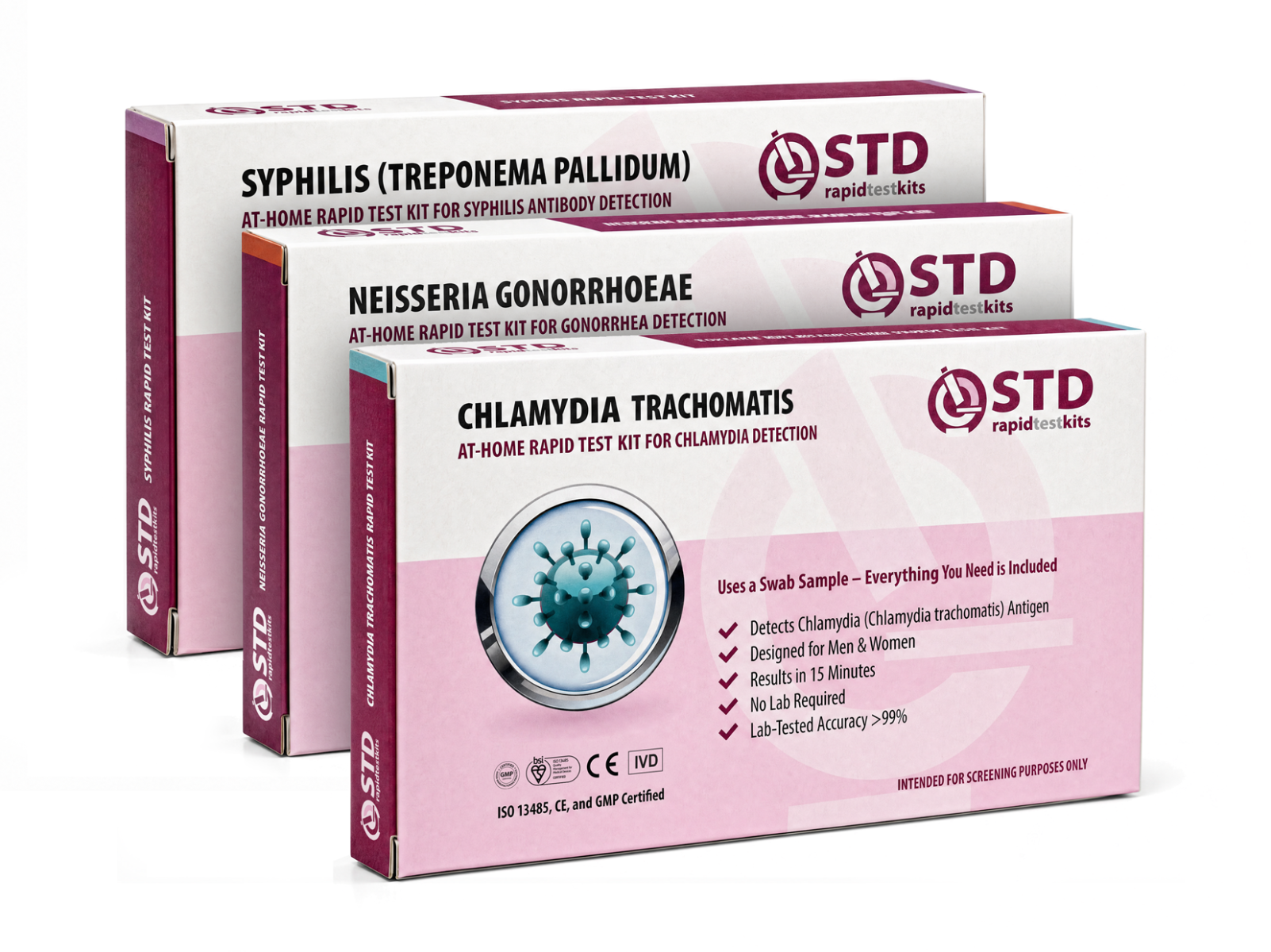
In most cases, no. The most common causes of genital burning, especially burning during urination, are urinary tract infections, yeast infections, bacterial vaginosis, and irritation from soaps, condoms, or new fabrics. STDs that do cause burning include chlamydia, gonorrhea, trichomoniasis, and genital herpes. Burning paired with unusual discharge, sores or blisters, recent unprotected sex with a new partner, or burning that lasts longer than three to four days is worth testing for. A 15-minute home rapid swab can screen for chlamydia and gonorrhea without a clinic visit.
Key Takeaways
- Most genital burning is caused by a UTI, a yeast infection, BV, or skin irritation, not an STD. Each of those non-STD causes has its own treatment, so getting the right diagnosis matters either way.
- Burning combined with unusual discharge, genital sores, recent unprotected sex, or burning that does not resolve within three to four days should prompt STD testing one to two weeks after the suspected exposure.
What "burning down there" usually means
The clinical term for painful urination is dysuria. A burn or sting as urine passes through the urethra is one of the most common reasons people search for sexual-health information online, and the everyday culprit is rarely an STD. Roughly half of women experience at least one urinary tract infection in their lifetime, and dysuria is the headline symptom (Mayo Clinic, urinary tract infection overview). UTIs alone account for the majority of urgent-care visits for genital burning in adult women.
The other common non-STD causes look similar from the outside. A yeast infection adds itching and a thick, white, cottage-cheese-textured discharge. Bacterial vaginosis adds a thin gray or off-white discharge with a fishy odor. Irritant or contact dermatitis from a new soap, scented wipe, lubricant, condom, or laundry detergent can produce a localized stinging sensation that mimics infection but resolves once the irritant is removed.
Burning that is mostly during urination, not between, points toward urinary tract or urethral causes. Constant burning that comes with itching points toward yeast or bacterial vaginosis. Burning concentrated at one spot of the genital skin, especially with a tingling prelude, points toward herpes. The categories overlap. Chlamydia and gonorrhea, the two most common bacterial STDs, both produce burning that feels nearly identical to a UTI, which is the central reason testing matters when an STD is even plausible.
Across primary-care and urgent-care visits, urinary tract infections account for the largest share of genital burning complaints in women. UTI burning is sharper toward the end of urination and is usually paired with frequency, urgency, and lower-abdominal discomfort. If the burning fits that pattern and there has been no recent unprotected sex with a new partner, a UTI is the more likely starting point. A clinic urine dipstick or a primary-care visit usually settles it within a day.
Which STDs actually cause genital burning?
Five infections account for nearly all STD-driven genital burning. Each has a slightly different fingerprint, which the next section turns into a side-by-side comparison.
Chlamydia is the most commonly reported bacterial STD in the United States. It frequently causes mild burning during urination, sometimes with thin clear or cloudy discharge from the urethra. The U.S. Centers for Disease Control and Prevention describe chlamydia as a "silent" infection because most infected people, especially women, develop no symptoms at all. When symptoms do appear, they typically develop within several weeks of exposure (CDC, chlamydia overview). Untreated chlamydia can ascend into the upper reproductive tract and cause pelvic inflammatory disease, which is the main pathway to chlamydia-related infertility.
Gonorrhea produces a similar burning pattern. In men, the burning tends to be more pronounced and is often paired with thick yellow or green penile discharge. In women, gonorrhea is usually quieter and is missed without testing. Both chlamydia and gonorrhea are bacterial and curable with antibiotics, and current CDC guidance recommends partner notification and concurrent testing whenever one partner is diagnosed (CDC, gonorrhea overview). Because the two infections co-occur often, most rapid swab kits screen for them together.
Trichomoniasis is a parasitic infection that causes burning, itching, and a frothy yellow-green vaginal discharge with a strong odor. In men trichomoniasis is usually asymptomatic, which is part of why it spreads. The CDC describes trichomoniasis as the most common curable STI and estimates more than two million trichomoniasis infections in the United States as of 2018 (CDC, trichomoniasis fact sheet). It is treated with a single oral course of metronidazole or tinidazole.
Genital herpes (HSV-1 or HSV-2) produces burning that feels different from the other infections on this list. The burning is usually localized to one part of the genital skin, may be preceded by prickling or tingling sensations in the same area, and concentrates around clusters of small fluid-filled blisters that ulcerate and crust over within a few days. Herpes burning can also flare without visible sores during asymptomatic shedding episodes (CDC, genital herpes information).
Syphilis does not typically cause burning during urination. Primary syphilis presents as a single painless ulcer (chancre) at the site of infection, which can be on the genitals, anus, lips, or inside the mouth. The chancre heals on its own in three to six weeks even without treatment, but the infection has not cleared. Secondary syphilis can include a non-itchy rash on the palms of the hands and the soles of the feet. If burning is accompanied by a painless ulcer or a palmar rash, syphilis testing is appropriate alongside chlamydia and gonorrhea testing (CDC, sexually transmitted infections hub).
Non-STD causes that mimic STD burning
Before assuming an STI, work through the four non-STD causes that produce nearly identical burning. Each has a distinct add-on symptom that helps differentiate it.
Urinary tract infections account for the largest single share of genital-burning complaints in women. The infection is bacterial, usually caused by E. coli moving from the bowel into the urethra and bladder. The hallmark pattern is burning sharpest at the end of urination, paired with urinary frequency (the urge to go again within minutes), urgency, cloudy or strong-smelling urine, and sometimes lower-abdominal pressure. Most uncomplicated UTIs respond to a short oral antibiotic course such as nitrofurantoin or trimethoprim-sulfamethoxazole. Untreated UTIs can ascend into the kidneys, which is why persistent burning with fever or flank pain warrants same-day care.
Yeast infections (vulvovaginal candidiasis) are caused by overgrowth of Candida species. The hallmark is intense external itching combined with a thick, white, cottage-cheese-textured discharge that does not have a strong odor. Burning during urination in a yeast infection is usually due to urine touching irritated vulvar skin rather than infection of the urinary tract itself. Most cases respond to over-the-counter antifungal creams or a single oral fluconazole dose.
Bacterial vaginosis is an imbalance of normal vaginal bacteria, with overgrowth of Gardnerella and other anaerobes. The hallmark is a thin gray or off-white discharge with a strong fishy odor that intensifies after sex. BV burning is usually milder than UTI or STD burning, and itching is less prominent than in yeast. BV is treated with metronidazole or clindamycin.
Irritant or contact dermatitis covers everything from a new perfumed body wash to a tight synthetic gym legging worn while sweating. Burning is usually localized to the area of contact, comes with redness and skin sensitivity, and resolves within a few days of removing the irritant. If switching products and rinsing with plain water clears the burning within 48 to 72 hours, that strongly suggests dermatitis rather than infection.
| Cause | Burning pattern | Discharge | Other clues |
|---|---|---|---|
| UTI | Sharp at end of urination | None typical | Urgency, frequency, cloudy urine, lower-abdominal pressure |
| Yeast infection | External, when urine touches irritated skin | Thick, white, cottage-cheese, no strong odor | Intense itching, vulvar redness |
| Bacterial vaginosis | Mild, intermittent | Thin gray or off-white, fishy odor | Odor strongest after sex, itching less prominent |
| Chlamydia | Mild burning during urination | Thin clear or cloudy from urethra (often none) | Often silent. Onset within several weeks of exposure |
| Gonorrhea | More pronounced burning during urination (men) | Thick yellow or green from urethra | Frequently co-occurs with chlamydia |
| Trichomoniasis | Burning with itching | Frothy yellow-green, strong odor | Most common in women. Men usually asymptomatic |
| Genital herpes | Localized, with tingling prelude | None typical | Clusters of small fluid-filled blisters that ulcerate |
| Contact dermatitis | Localized to area of contact | None | Onset within hours of new product, resolves on removal |
How to tell which one you actually have
No symptom checklist substitutes for a test, because the overlap between chlamydia and a UTI is large enough to fool experienced clinicians. The questions below do not deliver a diagnosis. They narrow the possibility set well enough to choose between a urine dipstick at primary care, a home rapid STI swab, or watchful waiting.
Has there been unprotected sex with a new or non-monogamous partner in the last three months? If yes, an STI screen is reasonable even if the burning fits a UTI pattern, because chlamydia and gonorrhea are both common and frequently silent. If no, the probability that the burning is an STI drops sharply, and starting with a UTI workup is sensible.
Is the burning paired with thick, colored, or strong-smelling discharge? Thick yellow or green discharge points toward gonorrhea or trichomoniasis. Thick white cottage-cheese discharge points toward yeast. Thin gray or off-white discharge with a fishy odor points toward bacterial vaginosis. Clear or cloudy thin discharge is consistent with chlamydia or with the early stages of a UTI.
Are there any visible sores, blisters, or ulcers? Painful clusters of small blisters point toward genital herpes. A single painless ulcer points toward primary syphilis. Both warrant clinical evaluation rather than self-treatment, because herpes treatment shortens episodes if started early, and untreated syphilis progresses through stages with worsening complications.
Does the burning come and go on its own? Burning that flares and then fades over hours, especially with a tingling sensation in the same spot, is more characteristic of herpes recurrences than of bacterial infection. Burning that gets steadily worse over a couple of days more closely fits a UTI or untreated bacterial STI.
Did anything change recently in soaps, lubricants, condoms, or clothing? If burning started within hours or days of a new product and resolves within 48 to 72 hours of stopping the product, contact dermatitis is the leading explanation.
A few patterns warrant urgent evaluation rather than waiting for a home test result. Burning paired with fever above 38°C / 100.4°F, flank or back pain, blood in the urine, severe pelvic pain, or pregnancy of any duration should be evaluated the same day. So should burning paired with a new genital ulcer in someone with unprotected sexual contact in the last six weeks. The home rapid kit is a powerful tool for asymptomatic screening and uncomplicated symptomatic workup, but acute systemic infection signs call for in-person evaluation instead.
When and how to test for STDs
Testing is most useful when the timing reflects the biology of the specific infection. Each STD has an incubation period during which the test cannot reliably detect it, called the window period. Testing inside the window period gives a falsely negative result, which is part of why retesting matters when symptoms persist.
Approximate window periods, drawn from CDC and NHS guidance current as of 2026, are:
- Chlamydia and gonorrhea: rapid swab and lab tests typically become useful within a couple of weeks of exposure. The NHS notes that some sexually transmitted infections can take up to seven weeks to show up on a test (NHS, STIs overview).
- Syphilis: blood antibody tests typically become reliable from 3 to 6 weeks after exposure, with a small share of cases needing 12 weeks for clear seroconversion (per CDC).
- Trichomoniasis: 1 to 4 weeks after exposure, with most cases detectable inside the first two weeks (per CDC).
- Genital herpes: if active sores are present, swab testing of the lesion can detect HSV within 2 to 12 days. Blood antibody testing for confirmation typically takes 6 to 12 weeks for full seroconversion (per CDC).
- HIV: fourth-generation antigen-antibody tests detect most infections by 18 to 45 days. Definitive ruling-out is usually at the 90-day mark (per CDC HIV testing guidance).
For burning that fits a chlamydia or gonorrhea pattern and follows a recent unprotected exposure, the practical move is a home rapid swab roughly two weeks after exposure. If an early test is negative but burning continues past three to four days, follow up with a clinic visit for a urine dipstick (UTI screen) and broader STI panel, and consider repeat testing later given the longer window for some STIs. A negative result means the most common bacterial STIs are not the cause, not that nothing is wrong.
Home rapid lateral-flow swabs are a complement to clinical testing, not a replacement. Laboratory NAAT or PCR tests have higher analytical sensitivity, especially in asymptomatic cases. The home format earns its place because it removes the friction of booking a visit and discussing symptoms in person, which is the friction that causes the highest share of testing avoidance.
Disclosure: this site sells rapid home STI test kits. Product links below go to our catalog and are recommended based on fit for the reader's concern, not commercial benefit.
What to do if it is not an STD
Most readers reading this article will fall into the non-STD category. Each of those causes has its own treatment path, and self-treating the wrong one is one of the more common reasons burning sticks around longer than it has to.
Suspected UTI: a same-day primary-care or urgent-care visit with a urine dipstick confirms the diagnosis in minutes. Most uncomplicated UTIs are treated with a short oral antibiotic course. Drink generous water, finish the full course even if symptoms resolve in 24 hours, and follow up if burning returns within a few weeks (recurrence is common in the first three months after a UTI).
Suspected yeast infection: over-the-counter antifungal creams (clotrimazole, miconazole) handle most uncomplicated cases. A single oral fluconazole pill is an alternative. If symptoms recur three or more times in a year, see a clinician to rule out an underlying driver such as new diabetes, an allergic component, or a non-Candida species.
Suspected bacterial vaginosis: BV is not self-treatable over the counter. A primary-care visit and a course of metronidazole or clindamycin clear most cases. BV recurrence is common, and adjusting hygiene practices that disrupt vaginal pH (douching, scented washes) reduces recurrence risk.
Suspected contact dermatitis: stop using the suspected product, switch to fragrance-free soap and laundry detergent, and rinse the area with plain warm water. If burning has not resolved within 72 hours of removing the suspected irritant, the working hypothesis was wrong and infection becomes more likely.
UTI suspected: same-day clinic urine dipstick, then a short antibiotic course.
Yeast suspected: over-the-counter clotrimazole or miconazole, or one oral fluconazole.
BV suspected: primary-care visit for prescription metronidazole or clindamycin (no reliable OTC option).
Contact dermatitis suspected: stop the suspected product, switch to fragrance-free, wait 72 hours.
Still burning after 72 hours of the matching treatment path: escalate to clinician evaluation and STI testing.
Preventing genital burning going forward
Most genital burning is preventable through a small set of habits that overlap across UTI prevention, irritant avoidance, and STI prevention.
For UTI prevention, urinate within 30 minutes of sexual activity, drink water consistently across the day rather than in large infrequent volumes, and wipe front to back. There is moderate-quality evidence that cranberry products reduce recurrence in people who have had multiple UTIs in a year, though the effect is small.
For irritant avoidance, default to fragrance-free body wash and laundry detergent in the genital area, avoid scented panty liners, and use silicone or water-based lubricants rather than petroleum-based products with latex condoms. Switch out of damp gym clothes within an hour of finishing exercise.
For STI prevention, consistent and correct condom use reduces transmission of chlamydia, gonorrhea, trichomoniasis, and HIV substantially, though it cannot fully prevent skin-to-skin transmission of herpes or HPV. Routine STI screening at the cadence recommended for your sexual activity (annually for sexually active women under 25, every 3 to 6 months for men who have sex with men, more frequent during periods of new partners) catches asymptomatic infections before they cause complications. Open communication with partners about recent testing dates is the single highest-leverage prevention behavior in stable relationships.
Many STDs do not cause symptoms, and many of the symptoms STDs do cause overlap with other infections. The only way to know for sure is to get tested.
The bottom line on burning sensations
A burning sensation in the genitals or during urination is a signal worth attending to, not a verdict on your sexual health. The math favors a non-STD cause for most readers, especially when there has been no recent unprotected sex with a new partner. The math shifts toward STI testing when there has been recent exposure, when burning is accompanied by unusual discharge or visible sores, or when the burning fails to resolve within three to four days of removing potential irritants.
The safest path is the simplest one: identify the symptom pattern, match it against the comparison above, and either treat the most likely non-STD cause or test for the relevant STIs based on exposure timing. Home rapid testing has made the second step substantially easier than it was a decade ago, especially for people who would otherwise put off a clinic visit. Untreated chlamydia, gonorrhea, and trichomoniasis all progress silently, and untreated UTIs can ascend into the kidneys. Both categories are avoidable with a straightforward test.
Common questions about genital burning
- Could the burning be just a UTI even without classic UTI symptoms?
- Yes. Around 5 to 10 percent of UTIs present with burning as the only obvious symptom, without the urgency, frequency, or lower-abdominal pressure that usually accompany them. A urine dipstick at primary care or urgent care confirms or rules out a UTI within minutes, and is the cheapest first step when there has been no recent unprotected exposure.
- How long after sex would burning from an STD start?
- Chlamydia and gonorrhea typically produce burning within a few weeks after exposure when they produce symptoms at all. Trichomoniasis can show up anywhere from a few days to a month later. Genital herpes outbreaks usually begin 2 to 12 days after exposure for a first episode. Syphilis is unusual because its early stage is a painless ulcer rather than burning, appearing 10 to 90 days after exposure.
- Will antibiotics for a UTI also treat chlamydia or gonorrhea?
- Not reliably. The first-line antibiotics for uncomplicated UTIs (nitrofurantoin, trimethoprim-sulfamethoxazole) are not the antibiotics that treat chlamydia (doxycycline) or gonorrhea (ceftriaxone). Treating an STI with the wrong antibiotic suppresses symptoms briefly while the infection persists, which is one of the ways treatment-resistant gonorrhea has emerged. If burning has not resolved a few days after a UTI antibiotic course finishes, retest specifically for STIs.
- Can I tell from discharge color whether it is an STD or yeast or BV?
- Discharge color narrows the field but does not finalize a diagnosis. Thick white cottage-cheese discharge points strongly toward yeast. Thin gray discharge with a fishy odor points toward BV. Thick yellow or green discharge points toward gonorrhea or trichomoniasis. Thin clear or cloudy discharge can be chlamydia, early UTI, or normal cyclical variation. Confirm with a swab or clinic visit before starting treatment.
- If burning goes away on its own, am I in the clear?
- Not necessarily. Chlamydia symptoms can come and go even when the infection has not cleared, and the same is true of trichomoniasis. Untreated chlamydia raises the risk of pelvic inflammatory disease and infertility, and untreated gonorrhea can cause similar complications. If burning was paired with a recent unprotected exposure, test even after symptoms resolve. The two-week mark is when chlamydia and gonorrhea swabs become useful, with retesting later if early results are negative but exposure was recent.
- Can a home rapid test pick up the STDs that cause burning?
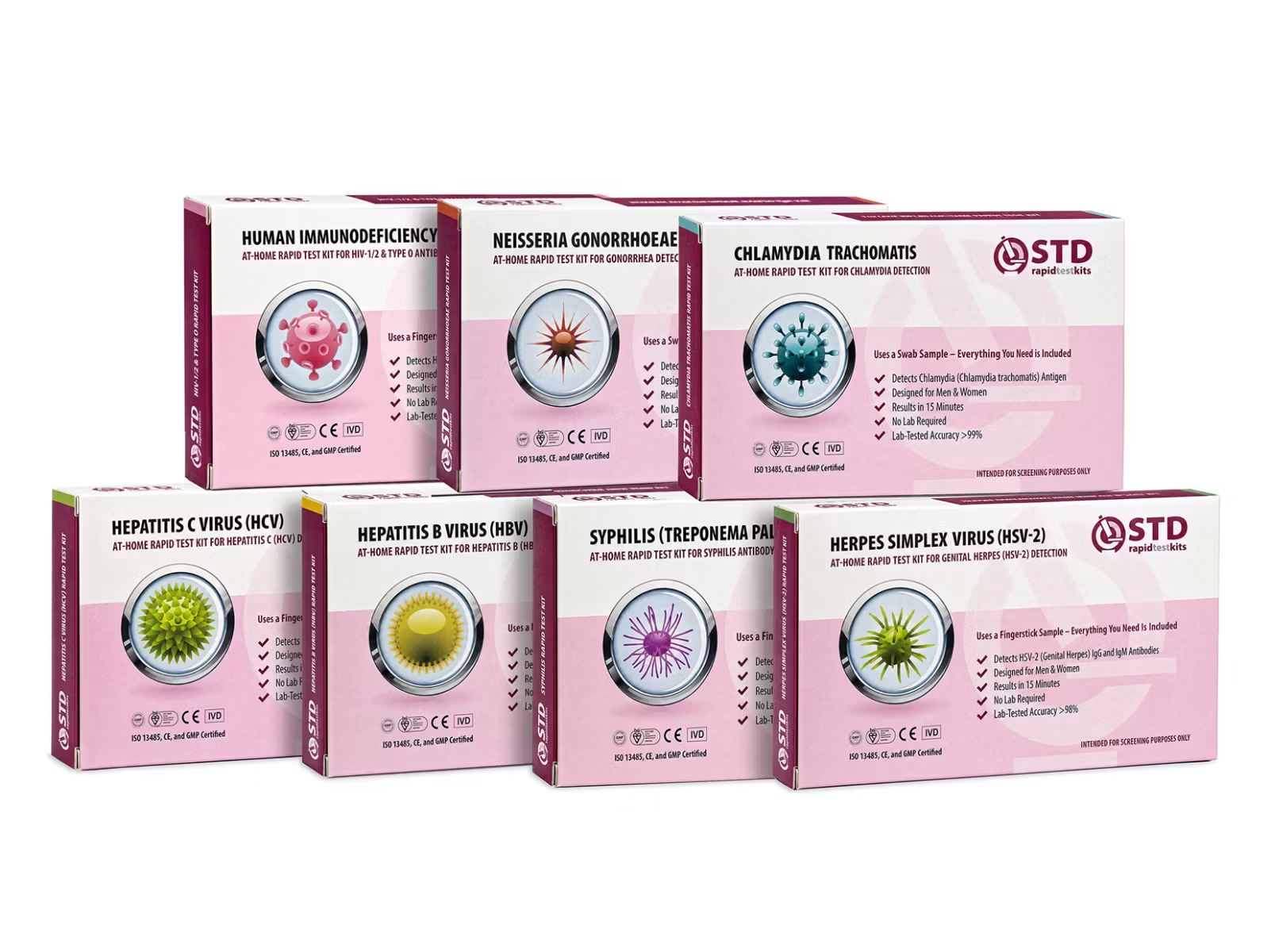
- Yes for chlamydia, gonorrhea, syphilis, and trichomoniasis (women) using lateral-flow rapid kits. The chlamydia and gonorrhea kits use a self-collected genital swab, the syphilis test uses a fingerstick blood drop, and the trichomoniasis kit uses a vaginal self-swab and is currently validated for women only. Rapid tests are useful screening tools, and a positive result is worth confirming with a lab NAAT when possible. A negative rapid test inside the window period should be repeated after the recommended interval.
- If I do need urgent care for the burning, what should I tell the clinician?
- Lead with the timeline: when burning started, whether it has worsened, and whether there are red flags such as fever, flank pain, blood in the urine, or visible sores. Mention any unprotected sexual contact in the last six weeks and the type of contact (vaginal, oral, anal), since this guides whether to add throat or rectal swabs. Bring a list of any over-the-counter or prescription products you have already tried. Ask specifically for a urine dipstick (for UTI), an STI swab panel covering chlamydia and gonorrhea, and syphilis serology if exposure was within the last three months.
- U.S. Centers for Disease Control and Prevention. Sexually transmitted infections hub, including symptom and surveillance information across STIs.
- U.S. Centers for Disease Control and Prevention. Chlamydia overview and fact sheet, including silent-infection pattern and onset within several weeks of exposure.
- U.S. Centers for Disease Control and Prevention. Gonorrhea overview and fact sheet, including symptom presentation in men and women.
- U.S. Centers for Disease Control and Prevention. Trichomoniasis fact sheet, including discharge presentation and the 2018 estimate of more than two million U.S. infections.
- U.S. Centers for Disease Control and Prevention. Genital herpes information, including localized burning and asymptomatic shedding.
- U.K. National Health Service. Sexually transmitted infections overview, including the note that some STIs can take up to seven weeks to show up on a test.
- Mayo Clinic. Urinary tract infection, symptoms and causes, including dysuria as the headline UTI symptom and lifetime UTI prevalence.
