
Published: August 2025 | Last updated: May 2026 | Editorial review and quality control: Martina N.
Vaginal discharge is one of the most common reasons people search for STI testing online, and one of the most misunderstood. Healthy bodies produce discharge every day. Most of it is normal. A smaller share signals an infection that needs treatment. Recognizing the difference between routine cycle variation and an early sign of infection is the hard part, particularly when the changes are subtle.
This guide walks through what healthy discharge looks like across the menstrual cycle, which color and texture changes are flagged by clinical guidelines as possibly infectious, and what tests can answer the question quickly. The goal is to replace guessing with a clear next step, whether that is reassurance or a same-week test.
Key Takeaways
- Healthy vaginal discharge changes in color, texture, and amount across the menstrual cycle and is not, on its own, a sign of infection.
- Yellow, green, or gray discharge paired with odor, itching, or burning can signal trichomoniasis, chlamydia, gonorrhea, or bacterial vaginosis, which only a test can distinguish.
When Vaginal Discharge Deserves Attention
Most people with a vagina notice some discharge daily. The American College of Obstetricians and Gynecologists describes vaginal secretions as a normal part of how the body keeps the vagina clean and balanced, with the volume and consistency shifting through the cycle. The pattern varies between people, and it can also shift over the course of one person's reproductive years.
The more useful question is whether discharge has changed from your personal baseline. Some changes track the menstrual cycle and need no follow-up. Others stand out: a new odor, an unfamiliar color, or texture that does not match anything you have noticed before.
One change in isolation is rarely diagnostic. A short cluster of changes, especially color plus odor or color plus itching, is the pattern that clinicians treat as suspicious. According to the U.S. Centers for Disease Control and Prevention, abnormal vaginal discharge is a leading reason adults present for STI evaluation, alongside genital irritation and pelvic pain.
- Color shifts from your usual baseline (clear, white, or pale yellow) toward green, gray, or rusty brown that is not menstrual blood
- A new odor that is fishy, sour, or metallic
- Texture turns frothy, foamy, or thick and clumpy in a way it has not been before
- Itching, burning, soreness, pelvic pain, or pain during urination or sex
- Bleeding between periods or after sex that does not match your usual cycle
What Healthy Discharge Looks Like Across the Cycle
Healthy discharge is not one fixed look. It moves with hormones, and it tracks roughly with the menstrual cycle. The UK National Health Service notes that secretions tend to be slippery and stretchy near ovulation, creamier in the second half of the cycle, and lighter at the start of the next bleed.
The chemistry stays in a narrow range when things are healthy. Vaginal pH sits between roughly 3.8 and 4.5 in adults of reproductive age, kept acidic by lactobacilli that crowd out potential pathogens. When that acid balance tips, conditions get easier for bacterial vaginosis, trichomoniasis, and yeast overgrowth to take hold.
Patterns most people recognize as their own normal:
| Cycle phase | Typical look | Texture |
|---|---|---|
| Days 1 to 5 (period) | Red to brown menstrual flow | Mixed with blood |
| Days 6 to 9 | Light, white, or absent | Tacky |
| Days 10 to 14 (around ovulation) | Clear | Stretchy, like raw egg white |
| Days 15 to 22 | White, cream | Lotion-like, thicker |
| Days 23 to 28 | Off-white to faint yellow | Tacky, sometimes scant |
Discharge Changes That Can Signal an STI
Several STIs commonly affect vaginal discharge. The patterns below are typical but not universal. Many infections cause no symptoms at all, which is why testing matters even when symptoms are mild or absent.
Trichomoniasis
Trichomoniasis is caused by a parasite, Trichomonas vaginalis. It is the most common curable STI worldwide by case count: roughly 156 million new infections annually, according to the World Health Organization. When trichomoniasis does cause symptoms, the classic discharge is yellow-green, sometimes frothy, with a strong odor and vulvar irritation. About 70% of people with the infection do not have any signs or symptoms, per the CDC trichomoniasis fact sheet, which is a major reason it is often missed and re-transmitted between partners.
Gonorrhea
Cervical gonorrhea can produce a thin, watery, yellowish discharge, sometimes with bleeding between periods or pain during urination. CDC fact sheets on gonorrhea note that most women with cervical infection have either no symptoms or symptoms mild enough to be mistaken for a urinary infection. Untreated gonorrhea raises the risk of pelvic inflammatory disease, a leading preventable cause of tubal-factor infertility.
Chlamydia
Chlamydial cervicitis often passes silently. When discharge changes appear, they are typically subtle: a slight increase in volume, a pale yellow tint, or post-coital spotting. Chlamydia is among the most commonly reported bacterial STIs in the United States, per the CDC's STI surveillance overview, and screening is recommended yearly for sexually active people under 25.
Genital herpes
Herpes does not usually cause heavy discharge. It causes painful sores or ulcers, sometimes with a watery secretion when sores burst. Any discharge change here usually comes alongside the visible lesions and the tingling or burning that often precedes them.
Bacterial vaginosis
Bacterial vaginosis (BV) is not classified as an STI, though sex with new or multiple partners increases risk. The signature is a thin, gray to off-white discharge with a fishy odor that often gets stronger after sex or during the period, due to the alkaline pH lift. BV needs antibiotic treatment because it does not clear reliably on its own and raises the risk of acquiring other STIs.
Yeast infection
Vaginal candidiasis (yeast) typically causes thick, white, cottage-cheese-like discharge with intense itching but little to no odor. It is not an STI, though some sexual activity can trigger it. Yeast and trichomoniasis are commonly confused on visual exam alone, which is one of the most well-documented misdiagnosis loops in primary care.

Why Discharge Gets Misdiagnosed
Discharge is a signal, not a diagnosis. Two infections with very different treatments can look almost identical on visual exam. CDC STI treatment guidelines highlight that trichomoniasis is frequently misdiagnosed as bacterial vaginosis or yeast when clinicians rely on appearance alone, because the discharge color and texture overlap.
The most common misdiagnosis loops:
- Trichomoniasis read as yeast. Both can present with itching and creamy discharge. Yeast cream will not treat trich, which needs an oral antibiotic such as metronidazole or tinidazole.
- BV treated with yeast cream. The fishy odor is the BV tell, but in a brief visit the symptoms can blur. Antifungal cream does not correct the bacterial overgrowth driving BV.
- Chlamydia or gonorrhea labeled as irritation. Mild symptoms get attributed to a new soap, a tight workout outfit, or recent shaving. Subtle yellowing and intermittent spotting are easy to dismiss without a swab.
These misdiagnoses delay treatment, allow continued transmission to partners, and increase the risk of complications. For chlamydia and gonorrhea, the most serious downstream consequence is pelvic inflammatory disease and the fertility damage that can follow. For trichomoniasis, untreated infection is associated with preterm birth in pregnancy and an increased risk of acquiring HIV.
The reliable way to distinguish these conditions is laboratory testing or a validated home test. A swab or rapid test gives a specific answer instead of a probability range, which is what correct treatment requires.
If you have not had a yeast infection diagnosed before, an over-the-counter antifungal can mask or delay treatment for trichomoniasis, BV, chlamydia, or gonorrhea. None of these will respond to yeast cream. If symptoms persist beyond a few days of self-care, or if you have had any sexual exposure since your last screen, test instead of guessing.
Non-STI Causes That Change Discharge
Plenty of discharge changes have nothing to do with sex. Recognizing the common non-infectious triggers can prevent a panicked test when the cause is benign.
Hormonal shifts
Pregnancy increases volume, often producing a milky white discharge called leukorrhea. Menopause reduces volume and can dry the surrounding tissue. Birth control pills and hormonal IUDs flatten cyclical changes. Stopping or switching hormonal birth control can reset the cycle in a way that takes a few months to settle.
Soap, douches, and laundry detergent
Fragranced washes, scented panty liners, harsh detergent, and douching all disrupt the vaginal microbiome and can trigger irritation, mild discharge changes, and odor. The vagina is self-cleaning. Plain water on the vulva is sufficient. Douching is associated with higher rates of BV and is recommended against by ACOG.
Antibiotics and yeast
Antibiotics kill protective lactobacilli alongside their target, opening the door to yeast overgrowth. The classic post-antibiotic yeast presentation is itching and thick, white, curd-like discharge appearing 3 to 10 days into a course.
Stress, illness, and sleep
Mid-term immune dips can shift the vaginal flora enough to change discharge for a week or two. The change is usually mild and self-resolves. Persistent changes deserve testing rather than waiting it out.
Sex itself
Semen is alkaline. After unprotected sex, vaginal pH rises briefly and can cause a temporary fishy smell that resolves within 24 to 48 hours. Lubricants, condoms, and spermicides can also trigger short-lived irritation in sensitive people that resolves within a couple of days.
- Post-sex pH lift: 24 to 48 hours
- New soap, detergent, or condom brand: a few days after stopping use
- Antibiotic-related yeast: appears 3 to 10 days into a course; resolves with antifungal treatment
- Hormonal birth control adjustment: a few weeks to a few months
- Stress or short illness: a week or two
If a change has lasted longer than the timeline above for the relevant trigger, treat it as a reason to test rather than wait.
When and How to Test
The question is rarely "should I test?" but "when, and with what test?" The answer depends on the symptoms, the type of exposure, and how recent it was.
If you have symptoms
Test as soon as the symptoms are new and persistent. For chlamydia, gonorrhea, and trichomoniasis, the relevant infection is usually detectable by the time symptoms appear. Confirming the cause directs treatment, treats the partners, and prevents the months of trial-and-error common with visual diagnosis alone.
If you have had a recent exposure with no symptoms
Window periods matter. CDC guidance indicates that chlamydia and gonorrhea are reliably detectable from about 1 to 2 weeks after exposure. Trichomoniasis is detectable within 5 to 28 days. Syphilis blood tests reliably turn positive 3 to 12 weeks after exposure. HIV antibody and antigen tests reach reliable detection 2 to 12 weeks after exposure depending on the assay.
What home rapid tests can and cannot do
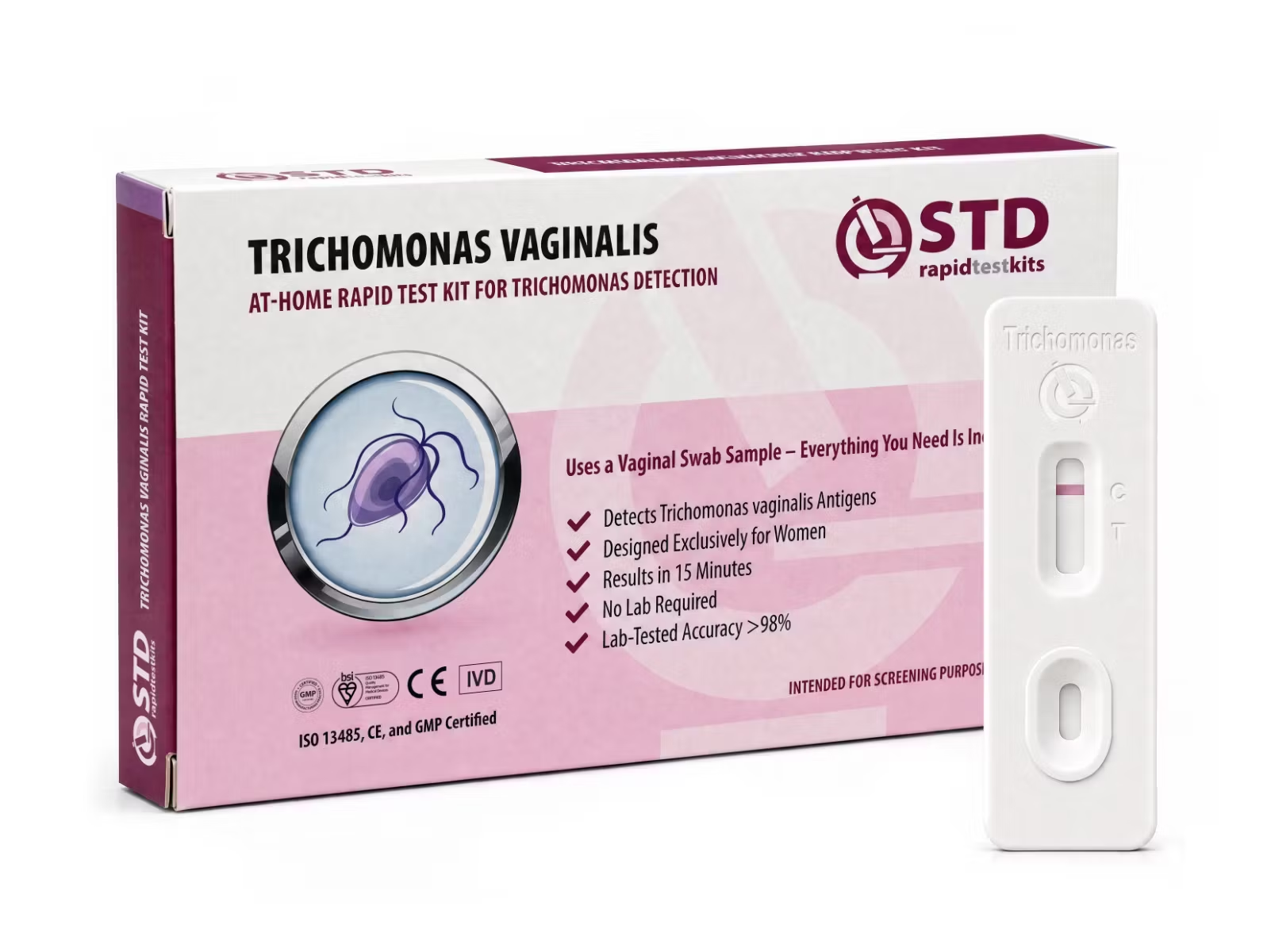
At-home rapid tests for chlamydia, gonorrhea, trichomoniasis, and HPV use a vaginal self-swab and a lateral-flow cassette to deliver a result in about 15 minutes. They are useful for screening at home, on a weekend, or when getting to a clinic is hard. They are not the same as laboratory NAAT or PCR testing, which has higher analytical sensitivity, especially in asymptomatic infections. A positive home result is worth confirming with lab testing or starting treatment under a clinician's guidance. A negative home result still leaves a small possibility of infection if the test was run inside the window period.
What to choose
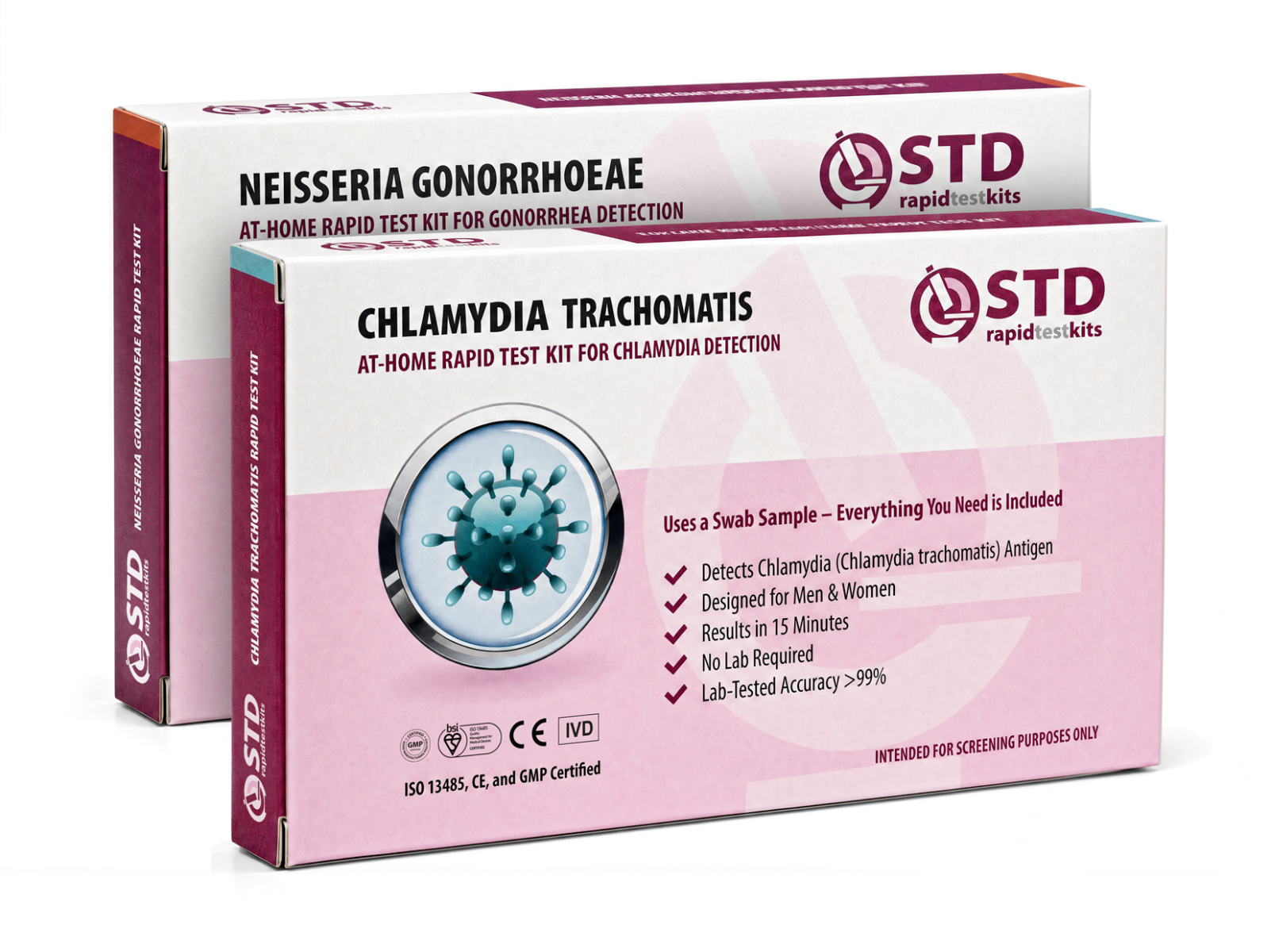
If discharge is the leading concern, a trichomoniasis test or a chlamydia and gonorrhea combo test covers the most common discharge-related infections. A broader 6-in-1 or 8-in-1 panel adds blood-based tests for HIV, syphilis, and hepatitis if there has been an unscreened exposure window in the past few months.
What to Do If Symptoms Persist or a Test Comes Back Positive
A positive home test is a strong signal that points toward infection but should be confirmed by a clinician, who can also prescribe treatment and advise on partner notification. Per CDC STI treatment guidelines, chlamydia is typically treated with a short oral antibiotic course and gonorrhea with an injection plus oral course. Trichomoniasis is treated with oral metronidazole or tinidazole. Bacterial vaginosis is treated with oral or vaginal metronidazole. Most discharge-related infections clear within a week of correct treatment.
Partner notification is part of effective treatment. Untreated partners reinfect the same day they reconnect, resetting the clock on healing. Many regions offer expedited partner therapy, where the clinician treating you can prescribe medication for partners without a separate appointment, or anonymous partner-notification services through the local health department.
If symptoms persist after treatment, return to a clinician for retesting. Antibiotic-resistant gonorrhea is a documented and growing concern, and treatment failure deserves a culture and susceptibility test rather than another empirical course of the same antibiotic.
If a home test is negative but symptoms continue, repeat testing at the end of the relevant window period or pursue laboratory NAAT, which has higher sensitivity than rapid lateral-flow tests, especially for asymptomatic and low-burden infections. Persistent symptoms with negative tests can also point to non-infectious causes such as lichen sclerosus, contact dermatitis, or atrophic vaginitis, which need a clinical exam to identify.

Quick Decision Guide: Test, Wait, or Reassure
Translating the patterns above into a quick action plan:
- Test now: discharge has changed for more than three days, with odor or itching, or with any recent sexual exposure that you have not yet screened.
- Test in 1 to 2 weeks: a recent unprotected exposure with no current symptoms; this clears the chlamydia and gonorrhea window.
- Test in 4 to 6 weeks: a recent unprotected exposure with no symptoms and you also want trichomoniasis covered.
- Reasonable to watch for 24 to 48 hours: a brief change after a single non-suspicious event (a new soap, a new condom brand, post-sex pH lift) that resolves on its own.
- See a clinician promptly: pelvic pain, fever, bleeding between periods, or persistent symptoms after treatment.
Most STIs have no symptoms or only mild symptoms that may not be recognized as an STI.
FAQs
- Is some vaginal discharge every day normal?
- Yes. Most adults of reproductive age have measurable discharge daily. The amount and texture change across the menstrual cycle and can also shift with hormonal birth control, pregnancy, and arousal. Discharge becomes a concern when it is new for you and persistent, especially if it is paired with odor, itching, or color change.
- What discharge colors are usually fine?
- Clear, white, and pale yellow when dried on underwear are typical for most people. Brown spotting at the start or end of a period is also normal. Green, gray, rusty brown unrelated to bleeding, and any color change paired with strong odor or itching are the colors that warrant a closer look.
- What does discharge from an STI typically look like?
- Trichomoniasis is the one most likely to combine frothy texture with a strong odor. Cervical gonorrhea tends to be thin, watery, and yellowish, often light enough to be missed. Chlamydia frequently causes no change at all, or only a slight increase in volume. Bacterial vaginosis, while not strictly an STI, produces a thin gray discharge with a fishy smell, especially after sex.
- Can I have an STI without any obvious symptoms?
- Yes, and this is common. About 70% of trichomoniasis cases and the majority of chlamydia and gonorrhea cases in women are asymptomatic, per CDC and WHO surveillance summaries. The lack of symptoms is one of the main reasons routine screening is recommended for sexually active people under 25 and others with new or multiple partners.
- Is frothy discharge always trichomoniasis?
- It is the classic presentation, but trichomoniasis can also look thin and yellow without froth, or cause no symptoms. Frothy texture is suggestive enough to test for trich. A swab or rapid test confirms the cause rather than ruling it in or out by appearance alone.
- Can over-the-counter yeast cream treat an STI?
- No. Antifungal creams treat candida (yeast). They do not treat trichomoniasis, bacterial vaginosis, chlamydia, or gonorrhea. Using them when the cause is one of these infections delays appropriate treatment and can briefly mask symptoms without curing the underlying problem.
- How is bacterial vaginosis different from an STI?
- BV is a disturbance of the normal vaginal bacterial flora rather than an infection from a sexual partner. It is more common in people with new or multiple partners, and the symptoms (gray discharge, fishy odor) overlap with trichomoniasis. The treatments are different, and the only reliable way to distinguish them is testing.
- How soon after exposure can a home rapid test detect an STI?
- Reliable detection windows: chlamydia and gonorrhea, about 1 to 2 weeks; trichomoniasis, 5 to 28 days; syphilis blood tests, 3 to 12 weeks; HIV antibody and antigen tests, 2 to 12 weeks depending on the assay. Testing too early in the window can miss an early infection. Re-test at the end of the window if there is any uncertainty.
- U.S. Centers for Disease Control and Prevention. Sexually transmitted infections overview: signs, symptoms, and surveillance summary.
- U.S. Centers for Disease Control and Prevention. Trichomoniasis fact sheet, including the share of asymptomatic cases.
- World Health Organization. Sexually transmitted infections (STIs) fact sheet, including global incidence figures and the prevalence of asymptomatic infection.
- UK National Health Service. Vaginal discharge: what is normal and what is not, including cycle-related variation.
- American College of Obstetricians and Gynecologists. Vulvovaginal health: discharge, douching, and vaginal hygiene guidance.
- U.S. Centers for Disease Control and Prevention. STI treatment guidelines, including trichomoniasis and gonorrhea management.
